
Mixed Koreans and Korean Language and Culture Learning
- Slides: 24
Mixed Koreans and Korean Language and Culture Learning Hye-Sook Wang (Brown University) Hye-Sook_Wang@brown. edu AATK 15 (6/25/2010) Washington University in St. Louis
Background of the Study Understanding our Learners : Survey Results (Wang 2008) - 23 schools participated - Head of the Korean program was individually contacted by the investigator - They submitted the survey via e-mail - Exclusively on student composition
Changing Profiles of Learners: Heritage vs. Non-heritage learners outnumber heritage learners in 1 st and 2 nd year class (73% vs. 27% & 52% vs. 48% respectively). More heritage learners in 3 rd year and beyond.
Changes in Perspective (between 2000 & 2008) o HLs considerably decreased (esp. at the lower levels) -> increase of NHLs -> HLs no longer dominate “Other Koreans” (half-Koreans, adopted Koreans) slightly increased Ethnic and cultural backgrounds of the non-heritage learners have become far more diversified (e. g. increase of Asian Americans) HLs are more like NHLs (Korean proficiency)
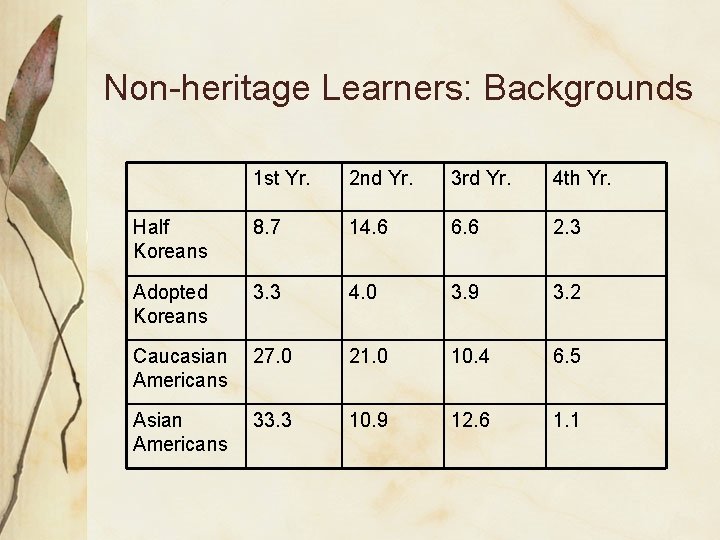
Non-heritage Learners: Backgrounds 1 st Yr. 2 nd Yr. 3 rd Yr. 4 th Yr. Half Koreans 8. 7 14. 6 6. 6 2. 3 Adopted Koreans 3. 3 4. 0 3. 9 3. 2 Caucasian Americans 27. 0 21. 0 10. 4 6. 5 Asian Americans 33. 3 10. 9 12. 6 1. 1
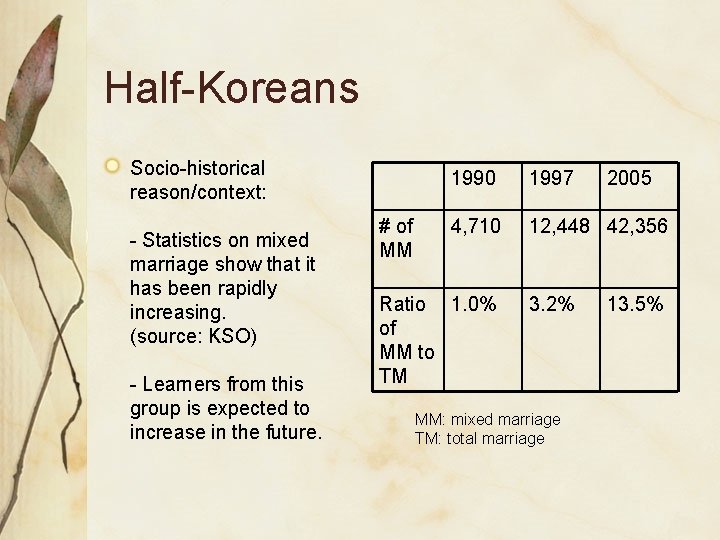
Half-Koreans Socio-historical reason/context: - Statistics on mixed marriage show that it has been rapidly increasing. (source: KSO) - Learners from this group is expected to increase in the future. # of MM 1990 1997 4, 710 12, 448 42, 356 Ratio 1. 0% of MM to TM 3. 2% MM: mixed marriage TM: total marriage 2005 13. 5%
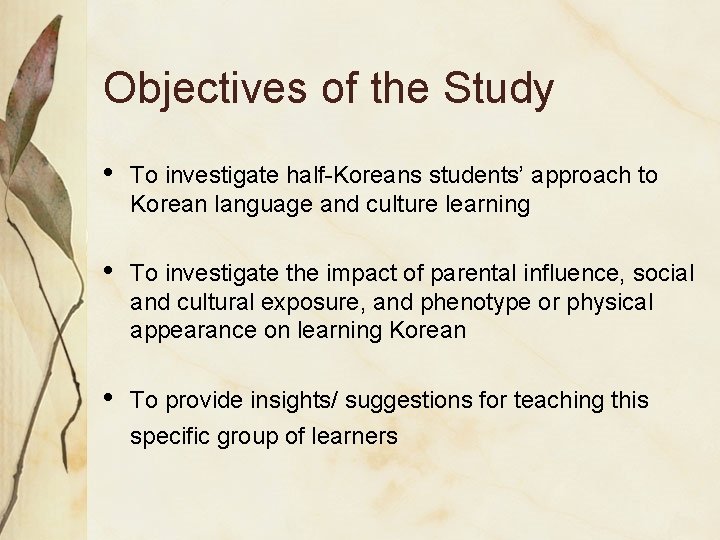
Objectives of the Study • To investigate half-Koreans students’ approach to Korean language and culture learning • To investigate the impact of parental influence, social and cultural exposure, and phenotype or physical appearance on learning Korean • To provide insights/ suggestions for teaching this specific group of learners
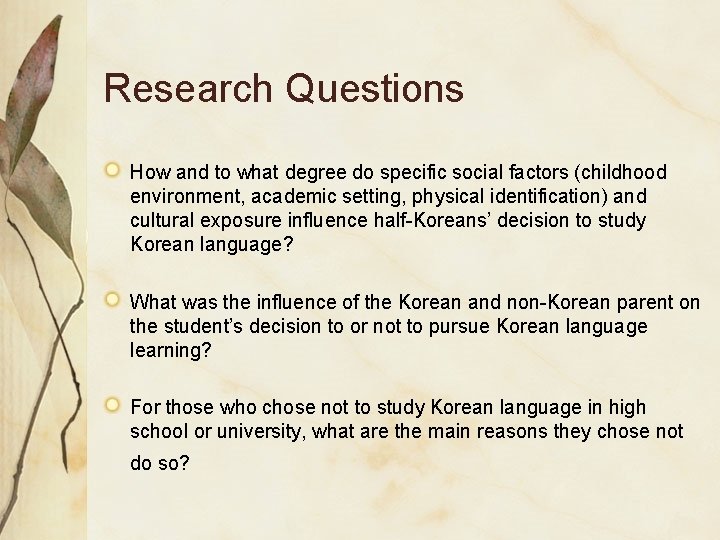
Research Questions How and to what degree do specific social factors (childhood environment, academic setting, physical identification) and cultural exposure influence half-Koreans’ decision to study Korean language? What was the influence of the Korean and non-Korean parent on the student’s decision to or not to pursue Korean language learning? For those who chose not to study Korean language in high school or university, what are the main reasons they chose not do so?
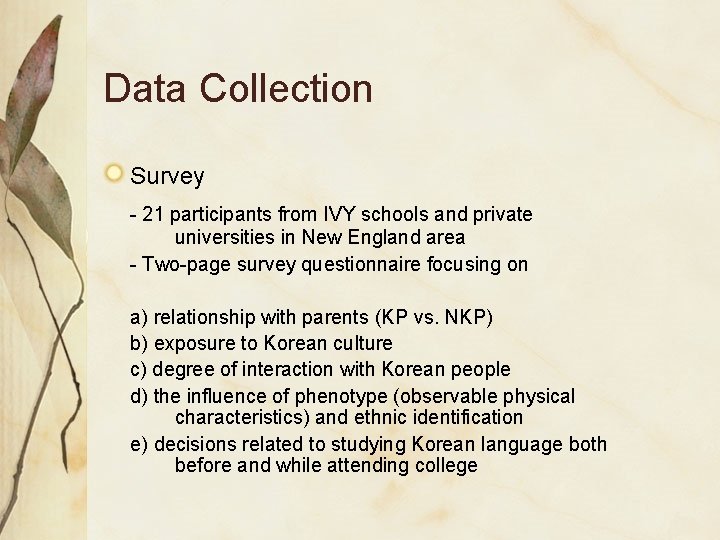
Data Collection Survey - 21 participants from IVY schools and private universities in New England area - Two-page survey questionnaire focusing on a) relationship with parents (KP vs. NKP) b) exposure to Korean culture c) degree of interaction with Korean people d) the influence of phenotype (observable physical characteristics) and ethnic identification e) decisions related to studying Korean language both before and while attending college
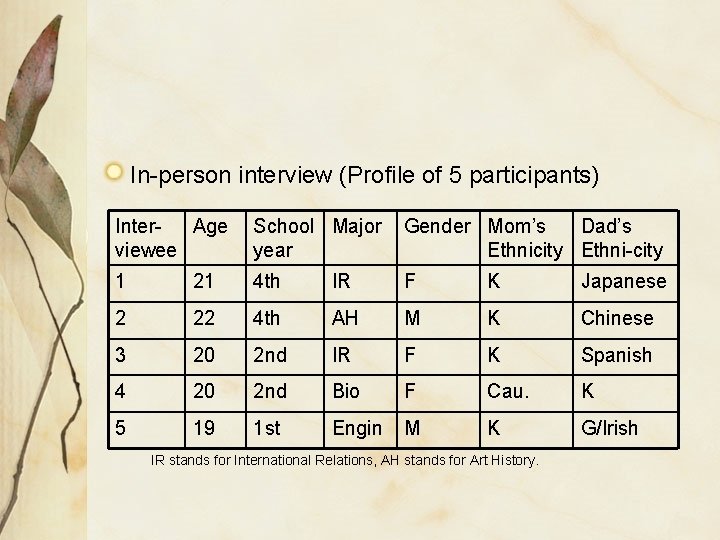
In-person interview (Profile of 5 participants) Inter. Age viewee School Major year Gender Mom’s Dad’s Ethnicity Ethni-city 1 21 4 th IR F K Japanese 2 22 4 th AH M K Chinese 3 20 2 nd IR F K Spanish 4 20 2 nd Bio F Cau. K 5 19 1 st Engin M K G/Irish IR stands for International Relations, AH stands for Art History.
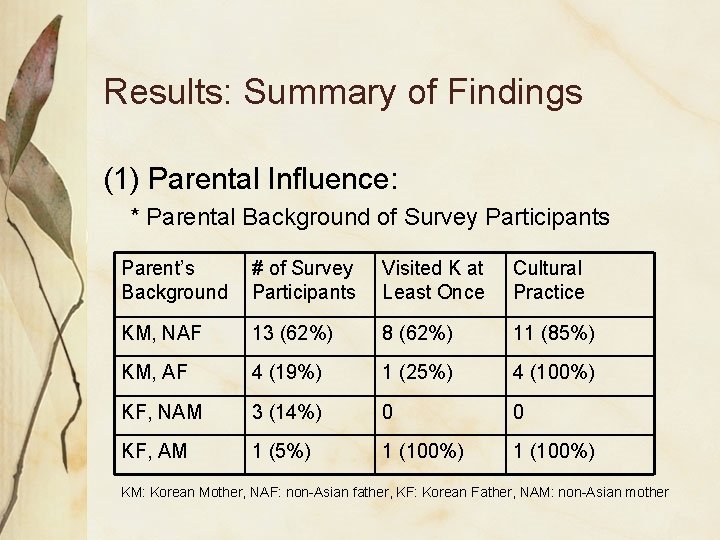
Results: Summary of Findings (1) Parental Influence: * Parental Background of Survey Participants Parent’s Background # of Survey Participants Visited K at Least Once Cultural Practice KM, NAF 13 (62%) 8 (62%) 11 (85%) KM, AF 4 (19%) 1 (25%) 4 (100%) KF, NAM 3 (14%) 0 0 KF, AM 1 (5%) 1 (100%) KM: Korean Mother, NAF: non-Asian father, KF: Korean Father, NAM: non-Asian mother
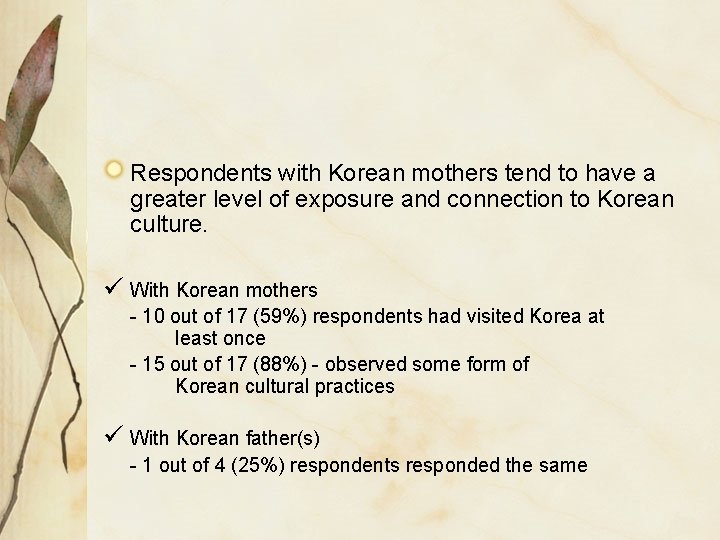
Respondents with Korean mothers tend to have a greater level of exposure and connection to Korean culture. ü With Korean mothers - 10 out of 17 (59%) respondents had visited Korea at least once - 15 out of 17 (88%) - observed some form of Korean cultural practices ü With Korean father(s) - 1 out of 4 (25%) respondents responded the same
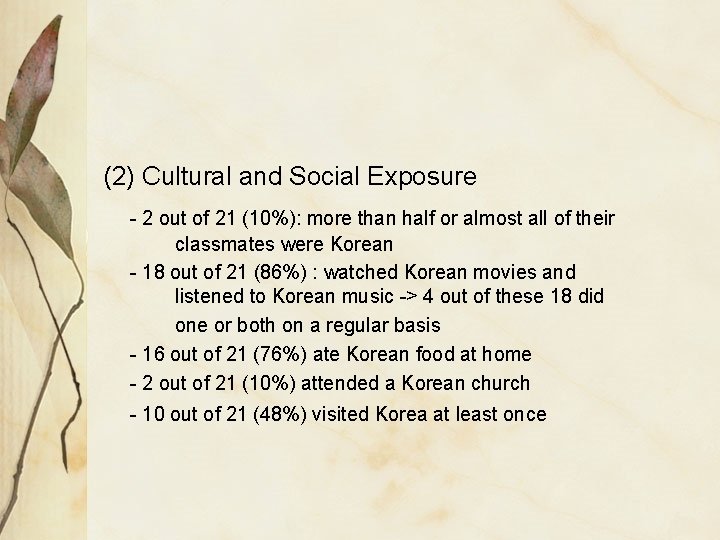
(2) Cultural and Social Exposure - 2 out of 21 (10%): more than half or almost all of their classmates were Korean - 18 out of 21 (86%) : watched Korean movies and listened to Korean music -> 4 out of these 18 did one or both on a regular basis - 16 out of 21 (76%) ate Korean food at home - 2 out of 21 (10%) attended a Korean church - 10 out of 21 (48%) visited Korea at least once
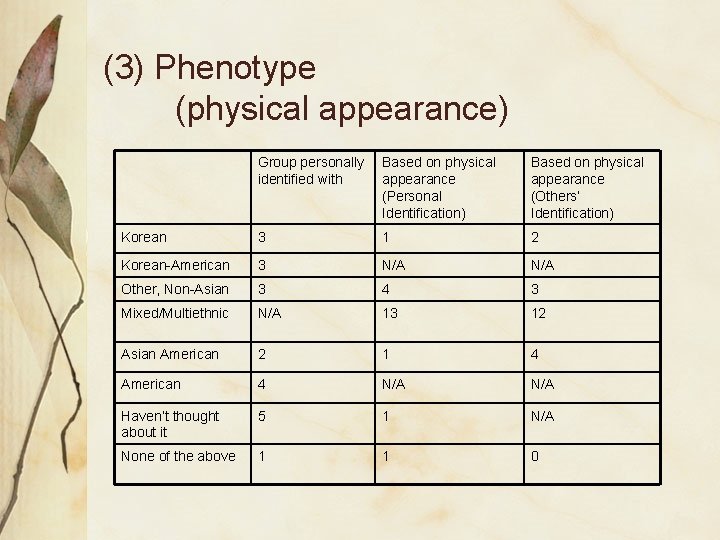
(3) Phenotype (physical appearance) Group personally identified with Based on physical appearance (Personal Identification) Based on physical appearance (Others’ Identification) Korean 3 1 2 Korean-American 3 N/A Other, Non-Asian 3 4 3 Mixed/Multiethnic N/A 13 12 Asian American 2 1 4 American 4 N/A Haven’t thought about it 5 1 N/A None of the above 1 1 0
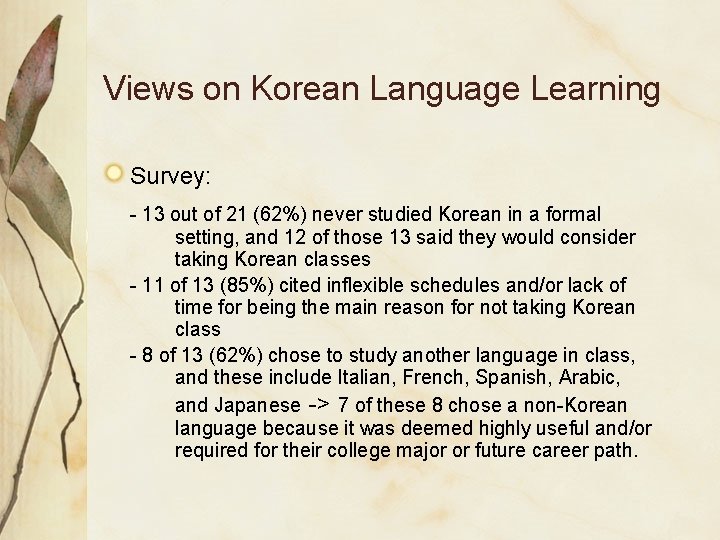
Views on Korean Language Learning Survey: - 13 out of 21 (62%) never studied Korean in a formal setting, and 12 of those 13 said they would consider taking Korean classes - 11 of 13 (85%) cited inflexible schedules and/or lack of time for being the main reason for not taking Korean class - 8 of 13 (62%) chose to study another language in class, and these include Italian, French, Spanish, Arabic, and Japanese -> 7 of these 8 chose a non-Korean language because it was deemed highly useful and/or required for their college major or future career path.
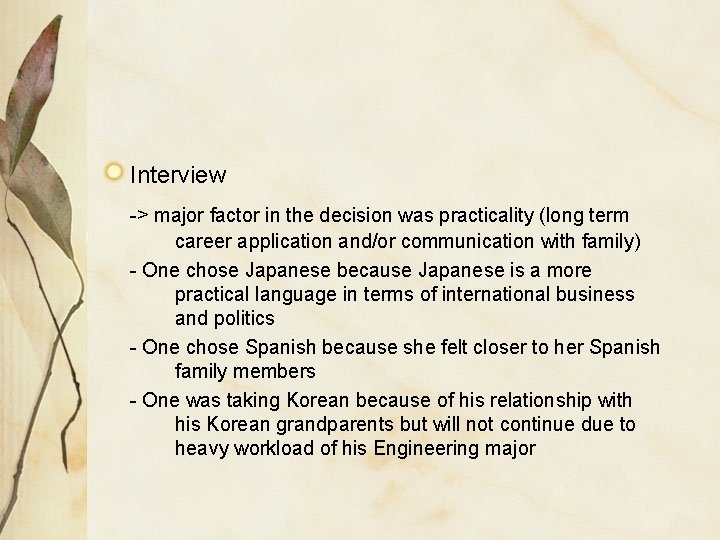
Interview -> major factor in the decision was practicality (long term career application and/or communication with family) - One chose Japanese because Japanese is a more practical language in terms of international business and politics - One chose Spanish because she felt closer to her Spanish family members - One was taking Korean because of his relationship with his Korean grandparents but will not continue due to heavy workload of his Engineering major
Implications Half-Koreans with a Korean mother are more likely to have exposure to Korean society, culture, and traditions and to be motivated to learn the language. The influence of social and cultural exposure to Korean people and traditions was difficult to gauge and hard to generalize. Participants varied in their views on phenotype - their identity varies by individual and social situation.
Participants decided whether or not to study Korean language based on its relative importance and immediate practical use. (practicality supercedes ethnic background) Large time commitment and heavy workload prevent the learners from taking the class. Half-Koreans seem to have a weak sense of racial identity and this seems to influence their decisions to pursue Korean language learning.
Limitations Difficulty of collecting data - hard to identify those who are not taking Korean classes - few volunteered for an interview - missing cell in the interview data (Asian M & KF)
Some Feedback from Half-Korean Students “Entering the class was a very personal decision for me. I wanted to learn more about my own culture, a culture that my mother never really exposed me to. Although I will be leaving the class with only a limited knowledge of the Korean language, this knowledge has helped me to move forward in finding my personal and cultural identity as well as to move forward in connecting with my mother, her personal identity, and her side of my family. ” (female, Korean mom & Caucasian dad)
“As the year progressed, the Korean class became more and more a part of my daily routine. I began to speak Korean in and out with some of my Korean friends, and it was a great feeling being able to read Korean. I really began to feel proud of my Korean culture. When people asked what I was taking, they are generally surprised to hear that I am taking Korean, because I do not look very Korean. It makes me proud to say that I am Korean, that my mother is Korean, and that I am now on the path to learning to speak Korean. I feel like I have a great start to becoming fluent in the language one day. It was a promise I made to my grandma when she passed away, and it is something that will hopefully bring me to Korea one day in the very near future. ” (Male, K mom & Caucasian dad)
Discussion Exchange/ share personal experiences and views
Suggestions Teaching half-Koreans - understand their unique background and challenges - increase exposure to Korean culture - take an individual approach üone-on-one meeting ücustomized homework
Thank You! For listening and participating