
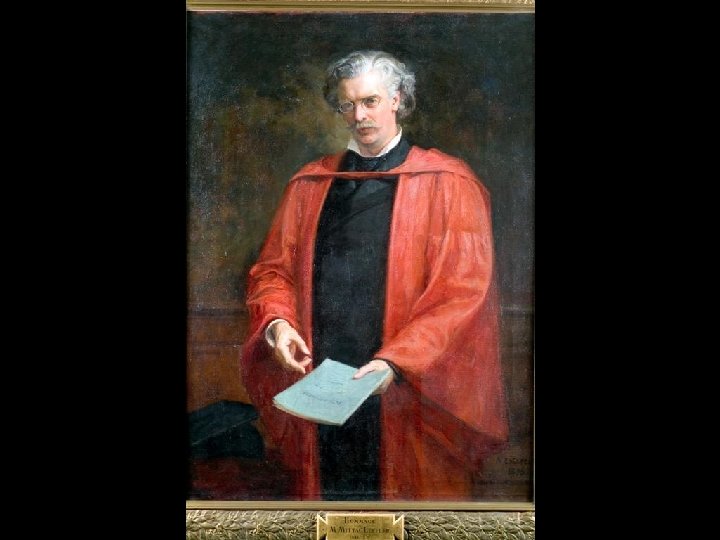
MittagLeffler and Acta Mathematica June BarrowGreen The Open
Mittag-Leffler and Acta Mathematica June Barrow-Green The Open University
Mittag-Leffler and Acta Mathematica “As founder and editor-in-chief of the international journal, Acta Mathematica, Mittag-Leffler was probably the best-known mathematician in Europe, if not in the world. ” The Times, 8 July 1927
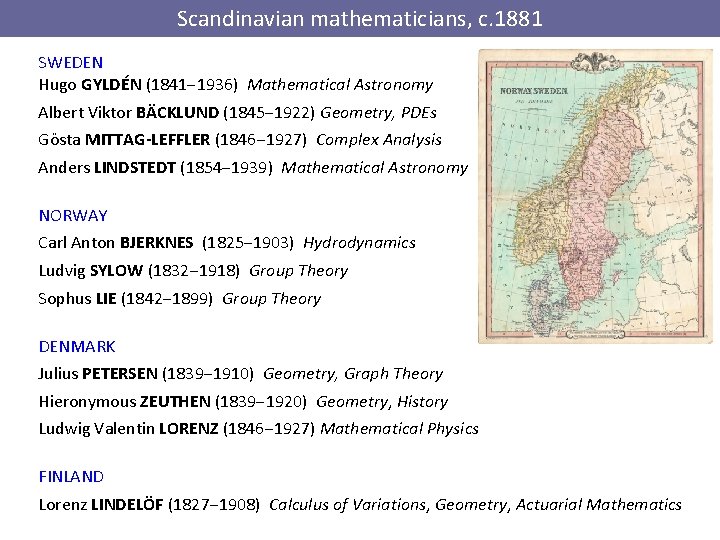
Scandinavian mathematicians, c. 1881 SWEDEN Hugo GYLDÉN (1841‒ 1936) Mathematical Astronomy Albert Viktor BÄCKLUND (1845‒ 1922) Geometry, PDEs Gösta MITTAG-LEFFLER (1846‒ 1927) Complex Analysis Anders LINDSTEDT (1854‒ 1939) Mathematical Astronomy NORWAY Carl Anton BJERKNES (1825‒ 1903) Hydrodynamics Ludvig SYLOW (1832‒ 1918) Group Theory Sophus LIE (1842‒ 1899) Group Theory DENMARK Julius PETERSEN (1839‒ 1910) Geometry, Graph Theory Hieronymous ZEUTHEN (1839‒ 1920) Geometry, History Ludwig Valentin LORENZ (1846‒ 1927) Mathematical Physics FINLAND Lorenz LINDELÖF (1827‒ 1908) Calculus of Variations, Geometry, Actuarial Mathematics
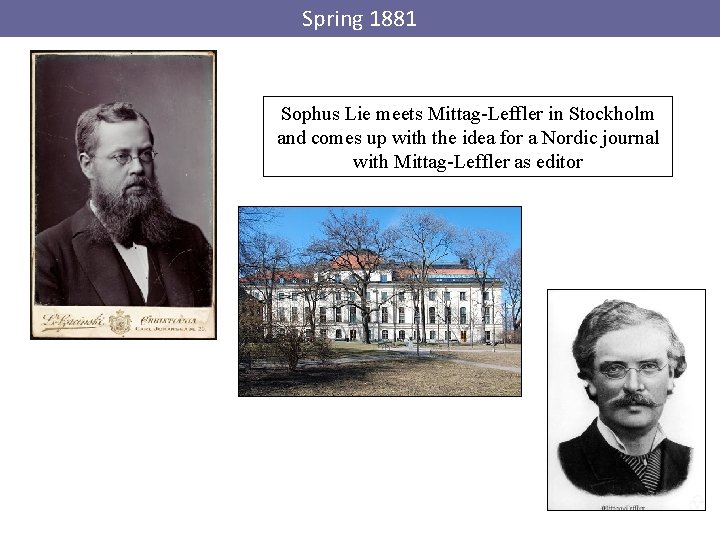
Spring 1881 Sophus Lie meets Mittag-Leffler in Stockholm and comes up with the idea for a Nordic journal with Mittag-Leffler as editor
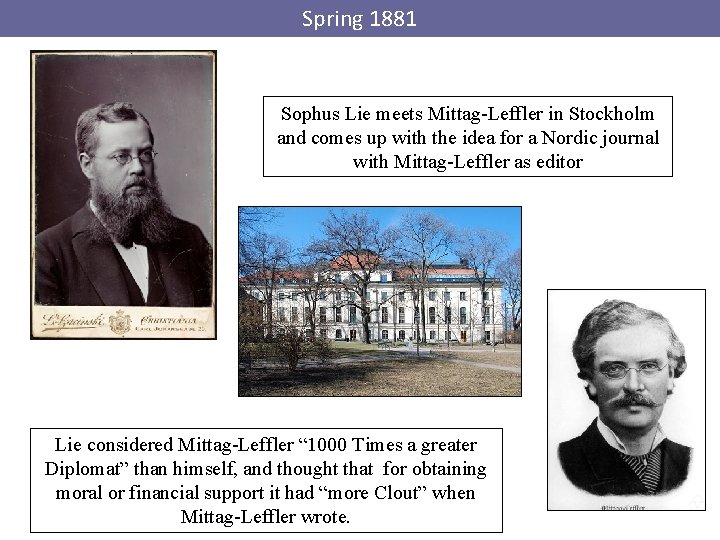
Spring 1881 Sophus Lie meets Mittag-Leffler in Stockholm and comes up with the idea for a Nordic journal with Mittag-Leffler as editor Lie considered Mittag-Leffler “ 1000 Times a greater Diplomat” than himself, and thought that for obtaining moral or financial support it had “more Clout” when Mittag-Leffler wrote.
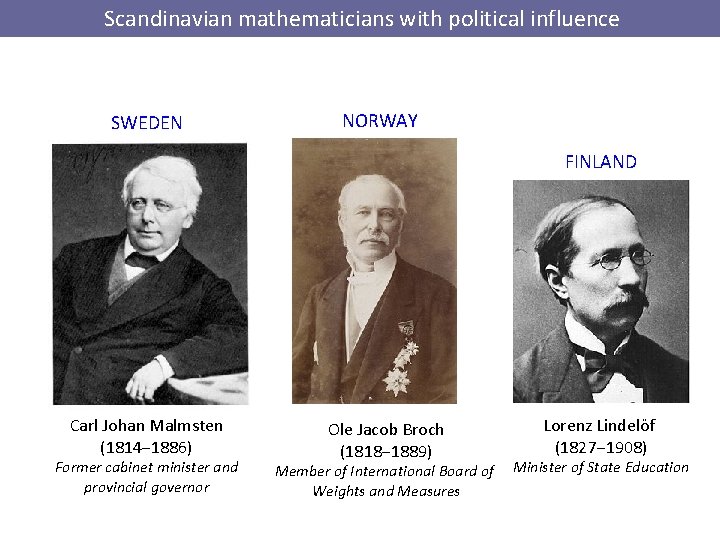
Scandinavian mathematicians with political influence SWEDEN NORWAY FINLAND Carl Johan Malmsten (1814‒ 1886) Former cabinet minister and provincial governor Ole Jacob Broch (1818‒ 1889) Member of International Board of Weights and Measures Lorenz Lindelöf (1827‒ 1908) Minister of State Education
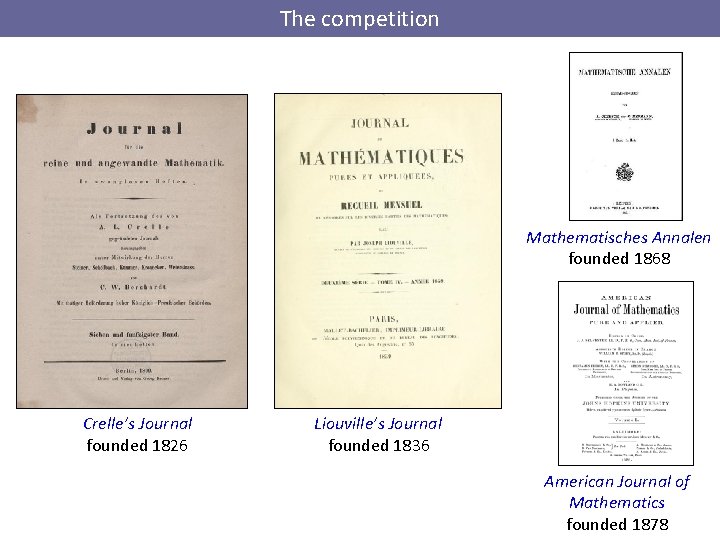
The competition Mathematisches Annalen founded 1868 Crelle’s Journal founded 1826 Liouville’s Journal founded 1836 American Journal of Mathematics founded 1878
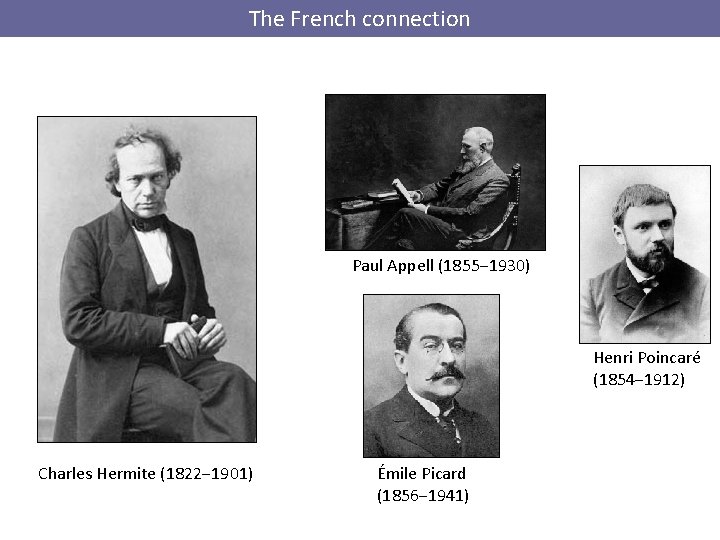
The French connection Paul Appell (1855‒ 1930) Henri Poincaré (1854‒ 1912) Charles Hermite (1822‒ 1901) Émile Picard (1856‒ 1941)
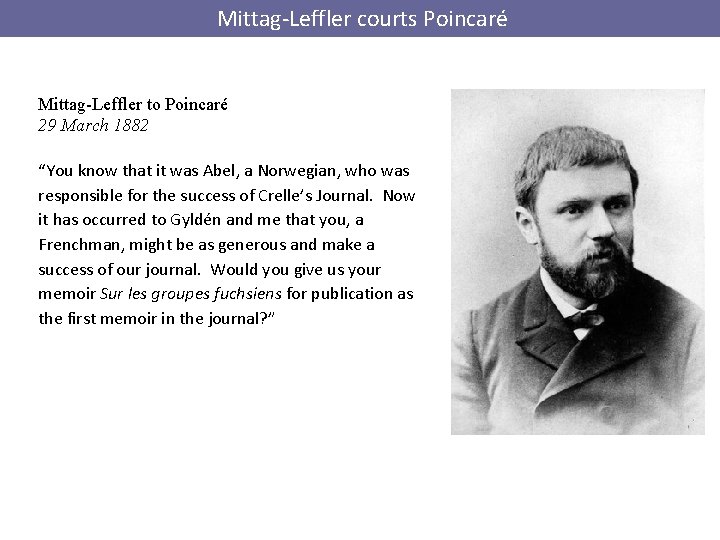
Mittag-Leffler courts Poincaré Mittag-Leffler to Poincaré 29 March 1882 “You know that it was Abel, a Norwegian, who was responsible for the success of Crelle’s Journal. Now it has occurred to Gyldén and me that you, a Frenchman, might be as generous and make a success of our journal. Would you give us your memoir Sur les groupes fuchsiens for publication as the first memoir in the journal? ”
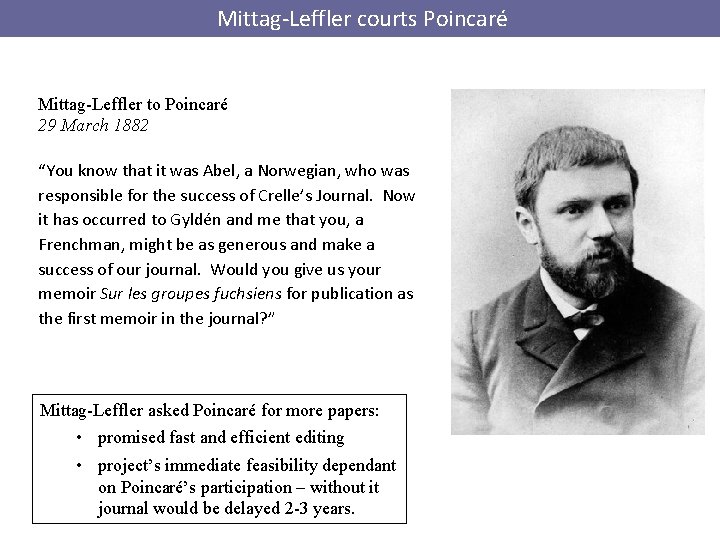
Mittag-Leffler courts Poincaré Mittag-Leffler to Poincaré 29 March 1882 “You know that it was Abel, a Norwegian, who was responsible for the success of Crelle’s Journal. Now it has occurred to Gyldén and me that you, a Frenchman, might be as generous and make a success of our journal. Would you give us your memoir Sur les groupes fuchsiens for publication as the first memoir in the journal? ” Mittag-Leffler asked Poincaré for more papers: • promised fast and efficient editing • project’s immediate feasibility dependant on Poincaré’s participation – without it journal would be delayed 2 -3 years.
Mittag-Leffler informs Malmsten Mittag-Leffler to Malmsten 1 April 1882 “According to my firm belief, we now find ourselves in a period quite similar to that of the discovery of elliptic functions. Then Abel made the success of Crelle’s German journal. In the same way Poincaré will make the success of our Swedish journal. ”
Poincaré has sent his memoir! Mittag-Leffler to Poincaré 10 April 1882 “I cannot thank you warmly enough for your kindness and your generosity. I was very touched by your good and kind letter, and delighted with the magnificent gift you have made to us of your memoir. After receiving your letter and your memoir, I left straightaway for Uppsala to communicate my happiness to M. Malmsten. ”
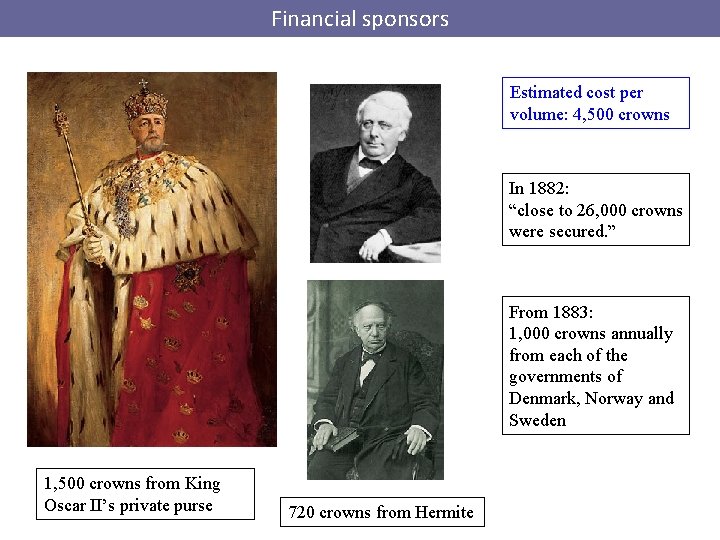
Financial sponsors Estimated cost per volume: 4, 500 crowns In 1882: “close to 26, 000 crowns were secured. ” From 1883: 1, 000 crowns annually from each of the governments of Denmark, Norway and Sweden 1, 500 crowns from King Oscar II’s private purse 720 crowns from Hermite
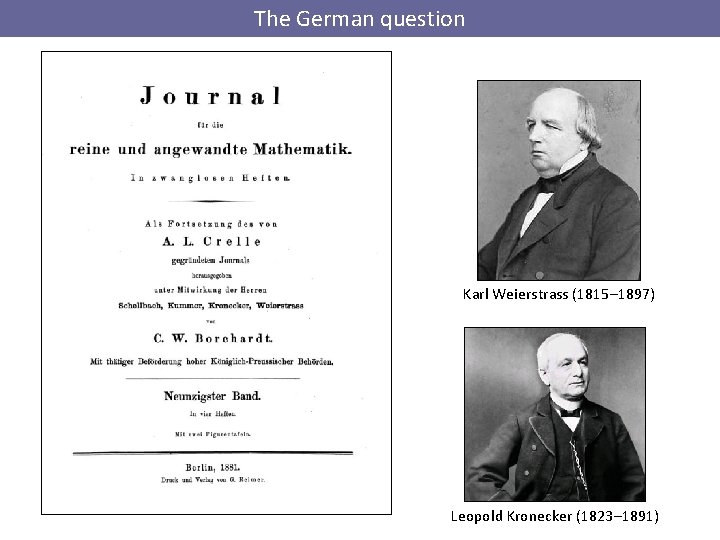
The German question Karl Weierstrass (1815‒ 1897) Leopold Kronecker (1823‒ 1891)
The journal begins to take shape. • Crelle’s Journal to be used as a model • Mittag-Leffler negotiates advantageous agreement with printers F & G Beijer in Stockholm • International distribution through Mayer & Müller in Berlin and Hermann in Paris • The title is under discussion • Poincaré suggests Disquisitionum Mathematicarum Compendium • Hermite suggests Horae Mathematicae • Appell suggests Selecta Mathematica • Focus of the journal to be mathematical analysis • Languages of publication to be French, German, or exceptionally English and Latin • Gustaf Eneström engaged as a proof-reader
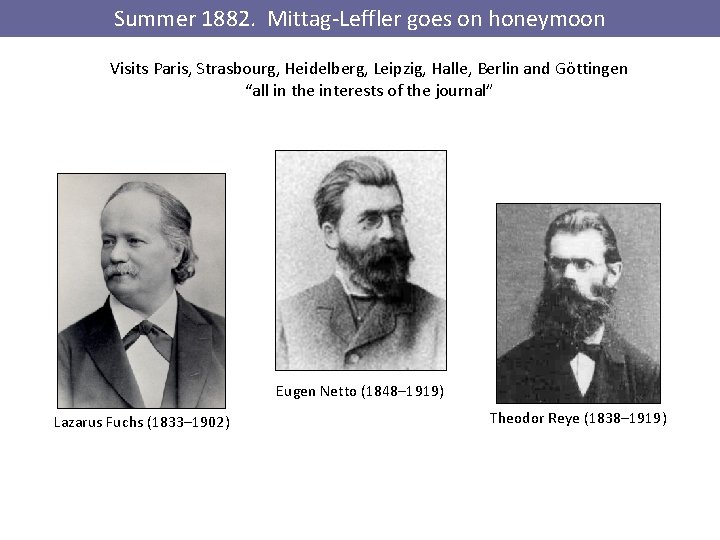
Summer 1882. Mittag-Leffler goes on honeymoon Visits Paris, Strasbourg, Heidelberg, Leipzig, Halle, Berlin and Göttingen “all in the interests of the journal” Eugen Netto (1848‒ 1919) Lazarus Fuchs (1833‒ 1902) Theodor Reye (1838‒ 1919)
Acta Mathematica is born • Title page and preface to be in French and German in parallel • Appendix surveying mathematical literature is added (produced by Eneström―later evolves into Bibliotheca Mathematica) • At the last minute, the proposed name Acta Mathematica Eruditorum gets changed to Acta Mathematica • 12 December 1882 Mittag-Leffler delivers first copy of Acta Mathematica to King Oscar
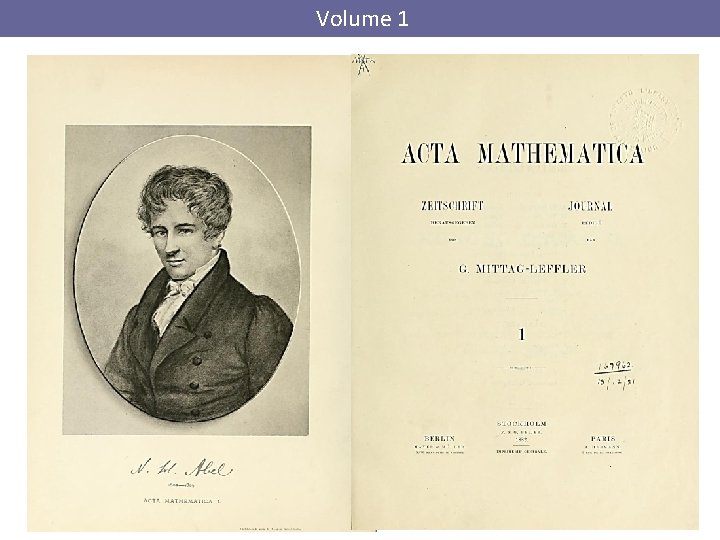
Volume 1
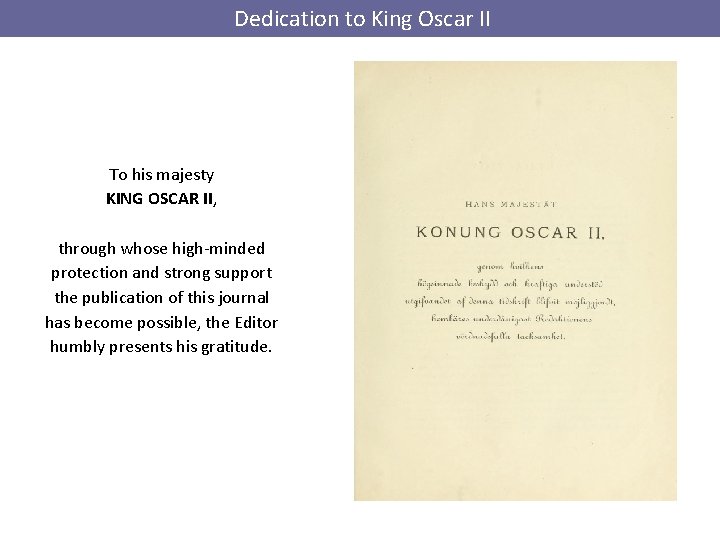
Dedication to King Oscar II To his majesty KING OSCAR II, through whose high-minded protection and strong support the publication of this journal has become possible, the Editor humbly presents his gratitude.
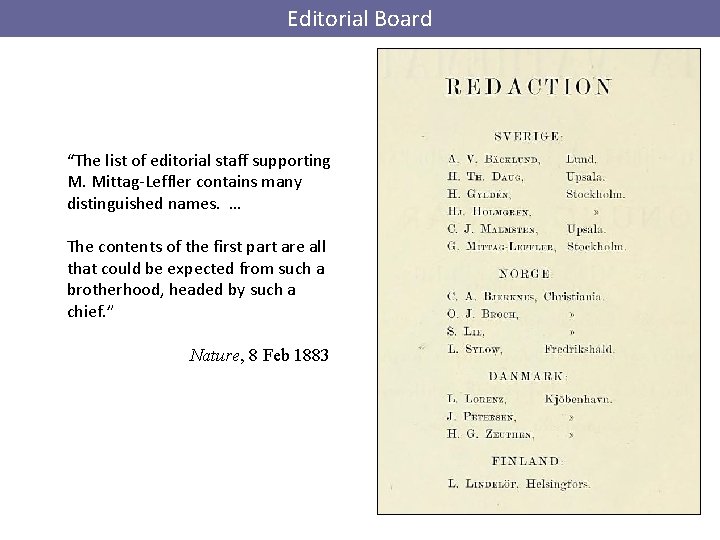
Editorial Board “The list of editorial staff supporting M. Mittag-Leffler contains many distinguished names. … The contents of the first part are all that could be expected from such a brotherhood, headed by such a chief. ” Nature, 8 Feb 1883
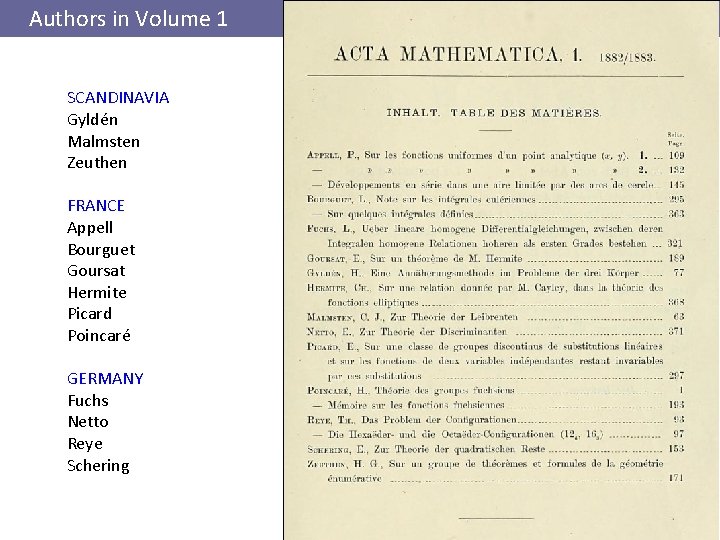
Authors in Volume 1 SCANDINAVIA Gyldén Malmsten Zeuthen FRANCE Appell Bourguet Goursat Hermite Picard Poincaré GERMANY Fuchs Netto Reye Schering
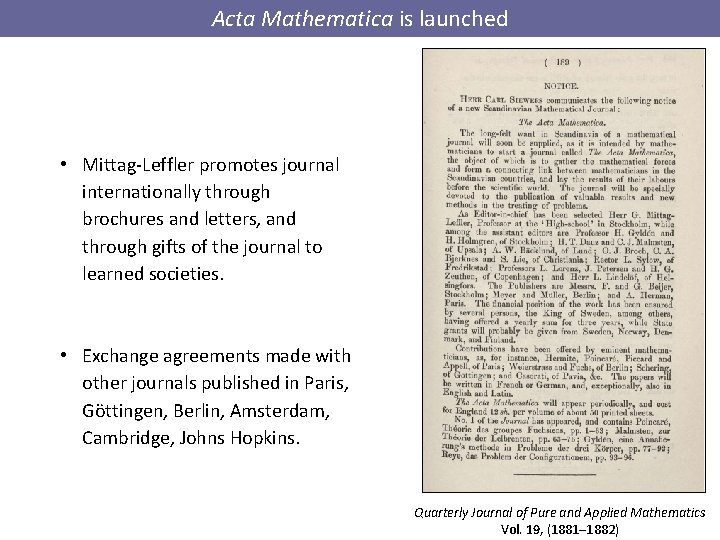
Acta Mathematica is launched • Mittag-Leffler promotes journal internationally through brochures and letters, and through gifts of the journal to learned societies. • Exchange agreements made with other journals published in Paris, Göttingen, Berlin, Amsterdam, Cambridge, Johns Hopkins. Quarterly Journal of Pure and Applied Mathematics Vol. 19, (1881‒ 1882)

A rapidly gained reputation The new Scandinavian journal, Acta Mathematica, has already gained such a reputation that the French government has decided to subscribe for 15 copies for the Facultés des Sciences. In his note to the Swedish Ambassador in Paris on the subject, M Jules Ferry pointed out that it is the first time his Government has supported a foreign publication, which he trusts will be an acknowledgement to the high international position the Acta Mathematica has gained and of the value it has become to French science. This journal is already supported by three Scandinavian governments. Nature, 12 June 1884 Acta Mathematica This journal, which has already won for itself the reputation of being one of the leading mathematical journals, not of the North merely, but of the world, sprang into life at the end of 1882. Nature, 9 December 1886
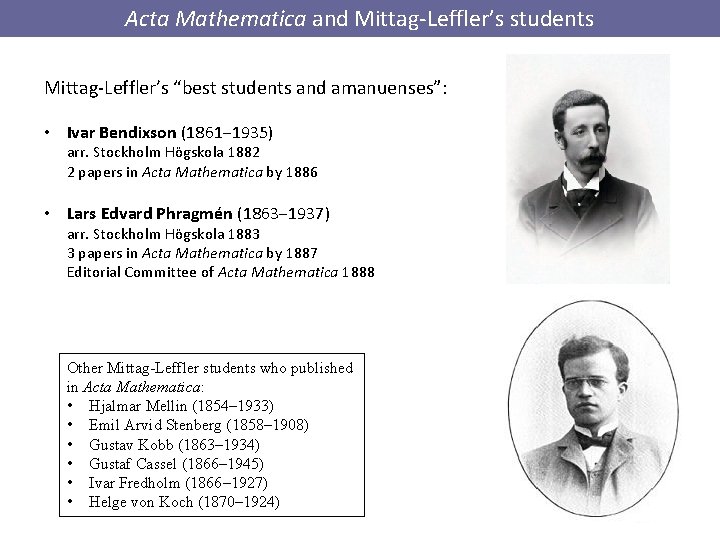
Acta Mathematica and Mittag-Leffler’s students Mittag-Leffler’s “best students and amanuenses”: • Ivar Bendixson (1861‒ 1935) arr. Stockholm Högskola 1882 2 papers in Acta Mathematica by 1886 • Lars Edvard Phragmén (1863‒ 1937) arr. Stockholm Högskola 1883 3 papers in Acta Mathematica by 1887 Editorial Committee of Acta Mathematica 1888 Other Mittag-Leffler students who published in Acta Mathematica: • Hjalmar Mellin (1854‒ 1933) • Emil Arvid Stenberg (1858‒ 1908) • Gustav Kobb (1863‒ 1934) • Gustaf Cassel (1866‒ 1945) • Ivar Fredholm (1866‒ 1927) • Helge von Koch (1870‒ 1924)
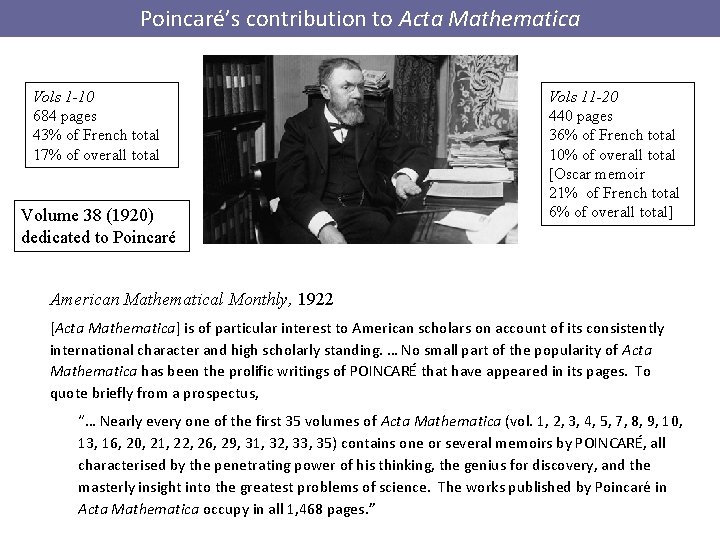
Poincaré’s contribution to Acta Mathematica Vols 1 -10 684 pages 43% of French total 17% of overall total Volume 38 (1920) dedicated to Poincaré Vols 11 -20 440 pages 36% of French total 10% of overall total [Oscar memoir 21% of French total 6% of overall total] American Mathematical Monthly, 1922 [Acta Mathematica] is of particular interest to American scholars on account of its consistently international character and high scholarly standing. … No small part of the popularity of Acta Mathematica has been the prolific writings of POINCARÉ that have appeared in its pages. To quote briefly from a prospectus, “… Nearly every one of the first 35 volumes of Acta Mathematica (vol. 1, 2, 3, 4, 5, 7, 8, 9, 10, 13, 16, 20, 21, 22, 26, 29, 31, 32, 33, 35) contains one or several memoirs by POINCARÉ, all characterised by the penetrating power of his thinking, the genius for discovery, and the masterly insight into the greatest problems of science. The works published by Poincaré in Acta Mathematica occupy in all 1, 468 pages. ”
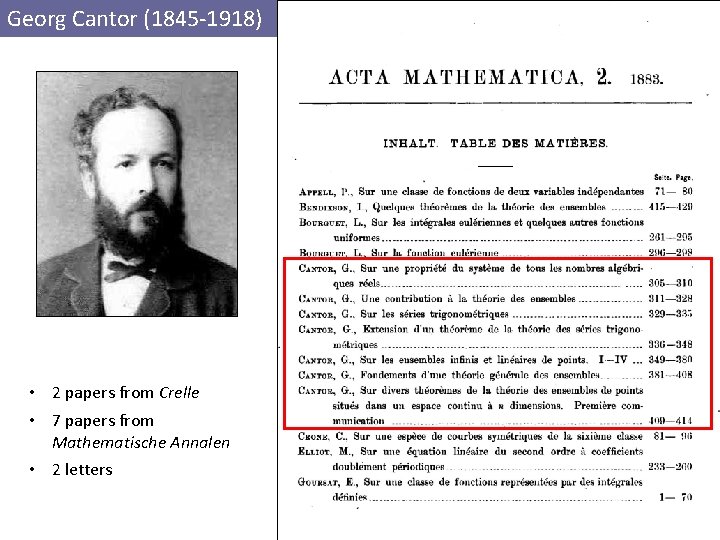
Georg Cantor (1845 -1918) • 2 papers from Crelle • 7 papers from Mathematische Annalen • 2 letters
Cantor’s papers in Acta Mathematica • Hermite arranged for one of his relatives to do the translations • Appell and Poincaré read and reviewed the translations • First four papers on foundations of set theory. They included: • proof of non-denumerability of the real numbers • proof of possibility of a one-to-one correspondence between the line and n-dimensional space • Remaining five papers were part of Cantor’s celebrated Grundlagen on transfinite numbers. Mittag-Leffler did not publish the Grundlagen in its entirety due to his unease about the philosophical aspects.
Revised French opinion Hermite to Mittag-Leffler 13 April 1883 “The impression that Cantor’s memoirs make on us is disastrous. Reading them seems, to all of us, to be an utter torture …” See: Hermite‒Mittag-Leffler correspondence now on the web at NUMDAM Cahiers du séminaire d'histoire des mathématiques 5
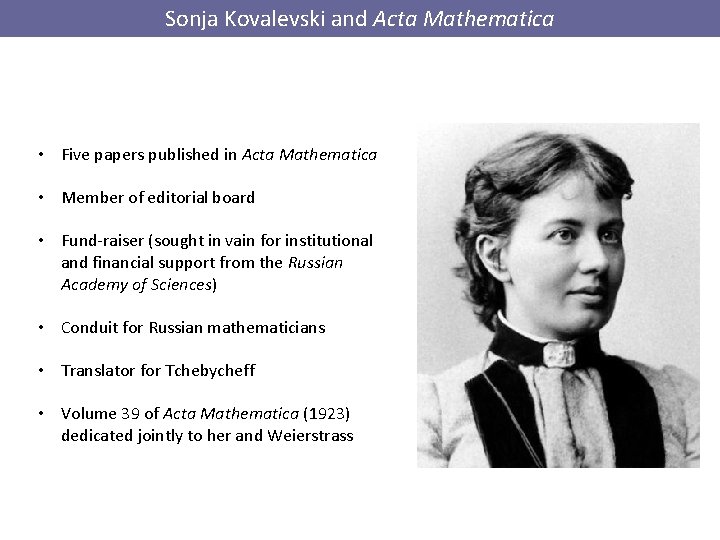
Sonja Kovalevski and Acta Mathematica • Five papers published in Acta Mathematica • Member of editorial board • Fund-raiser (sought in vain for institutional and financial support from the Russian Academy of Sciences) • Conduit for Russian mathematicians • Translator for Tchebycheff • Volume 39 of Acta Mathematica (1923) dedicated jointly to her and Weierstrass
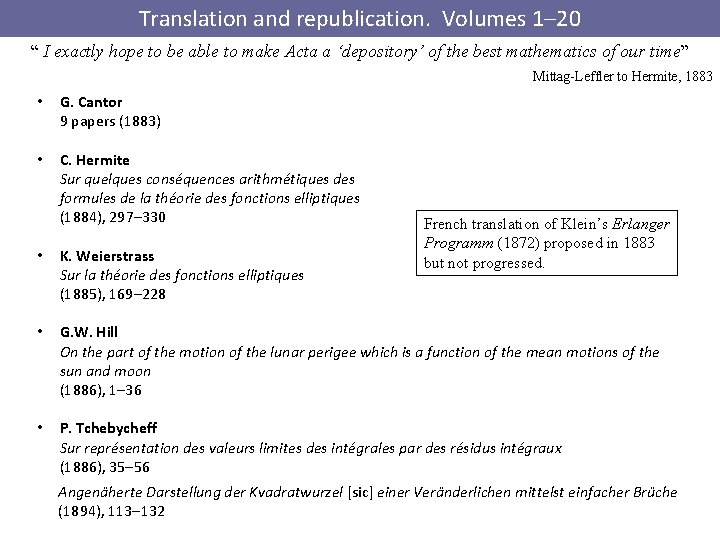
Translation and republication. Volumes 1‒ 20 “ I exactly hope to be able to make Acta a ‘depository’ of the best mathematics of our time” Mittag-Leffler to Hermite, 1883 • G. Cantor 9 papers (1883) • C. Hermite Sur quelques conséquences arithmétiques des formules de la théorie des fonctions elliptiques (1884), 297‒ 330 French translation of Klein’s Erlanger Programm (1872) proposed in 1883 but not progressed. • K. Weierstrass Sur la théorie des fonctions elliptiques (1885), 169‒ 228 • G. W. Hill On the part of the motion of the lunar perigee which is a function of the mean motions of the sun and moon (1886), 1‒ 36 • P. Tchebycheff Sur représentation des valeurs limites des intégrales par des résidus intégraux (1886), 35‒ 56 Angenäherte Darstellung der Kvadratwurzel [sic] einer Veränderlichen mittelst einfacher Brüche (1894), 113‒ 132
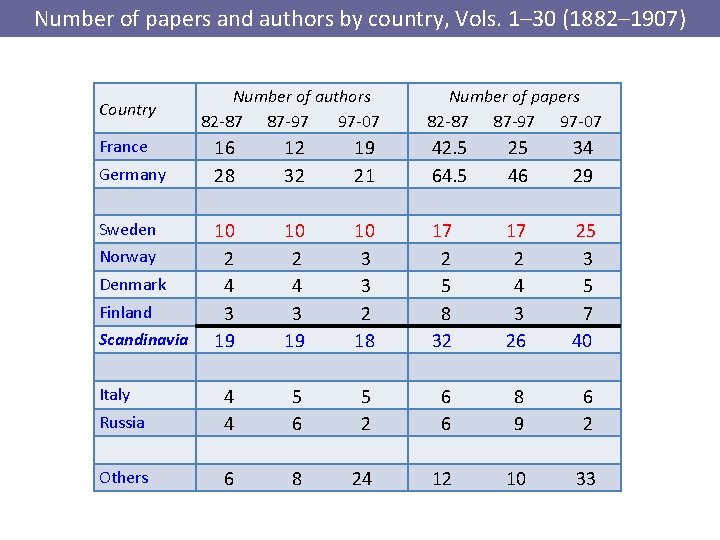
Number of papers and authors by country, Vols. 1‒ 30 (1882‒ 1907) Country France Germany Number of authors 82 -87 87 -97 97 -07 16 12 19 28 32 21 Number of papers 82 -87 87 -97 97 -07 42. 5 25 34 64. 5 46 29 Sweden 10 10 Norway 2 3 Denmark 4 3 Finland 3 2 Scandinavia 19 18 17 25 2 3 5 4 5 8 3 7 32 26 40 Italy Russia 4 5 4 6 2 6 8 6 6 9 2 6 8 24 12 10 33 Others
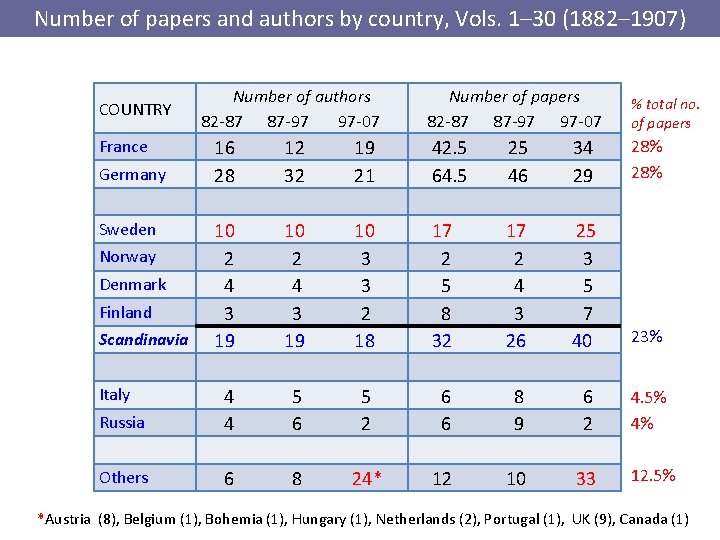
Number of papers and authors by country, Vols. 1‒ 30 (1882‒ 1907) COUNTRY France Germany Number of authors 82 -87 87 -97 97 -07 16 12 19 28 32 21 Number of papers 82 -87 87 -97 97 -07 % total no. of papers 42. 5 25 34 64. 5 46 29 28% 17 25 2 3 5 4 5 8 3 7 32 26 40 23% 4 5 4 6 2 6 8 6 6 9 2 4. 5% 4% 6 8 24* 12 10 33 12. 5% Sweden 10 10 Norway 2 3 Denmark 4 3 Finland 3 2 Scandinavia 19 18 Italy Russia Others *Austria (8), Belgium (1), Bohemia (1), Hungary (1), Netherlands (2), Portugal (1), UK (9), Canada (1)
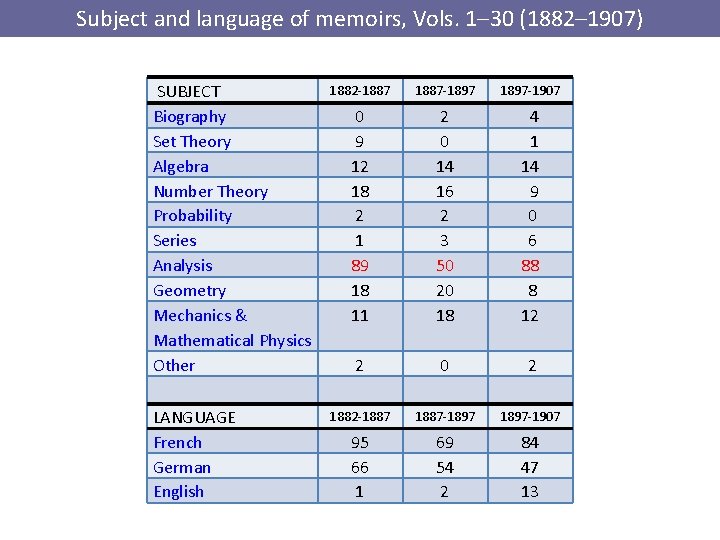
Subject and language of memoirs, Vols. 1‒ 30 (1882‒ 1907) SUBJECT Biography Set Theory Algebra Number Theory Probability Series Analysis Geometry Mechanics & Mathematical Physics Other 1882 -1887 1887 -1897 -1907 0 9 12 18 2 1 89 18 11 2 0 14 16 2 3 50 20 18 4 1 14 9 0 6 88 8 12 2 0 2 LANGUAGE French German English 1882 -1887 1887 -1897 -1907 95 66 1 69 54 2 84 47 13
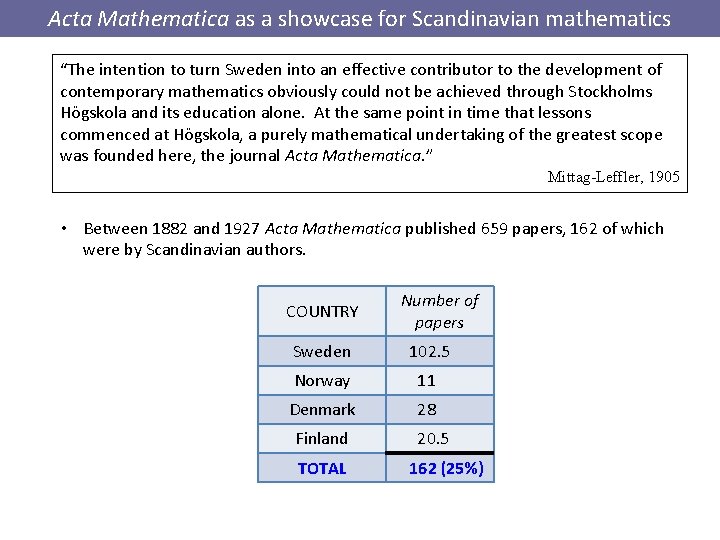
Acta Mathematica as a showcase for Scandinavian mathematics “The intention to turn Sweden into an effective contributor to the development of contemporary mathematics obviously could not be achieved through Stockholms Högskola and its education alone. At the same point in time that lessons commenced at Högskola, a purely mathematical undertaking of the greatest scope was founded here, the journal Acta Mathematica. ” Mittag-Leffler, 1905 • Between 1882 and 1927 Acta Mathematica published 659 papers, 162 of which were by Scandinavian authors. COUNTRY Number of papers Sweden 102. 5 Norway 11 Denmark 28 Finland TOTAL 20. 5 162 (25%)
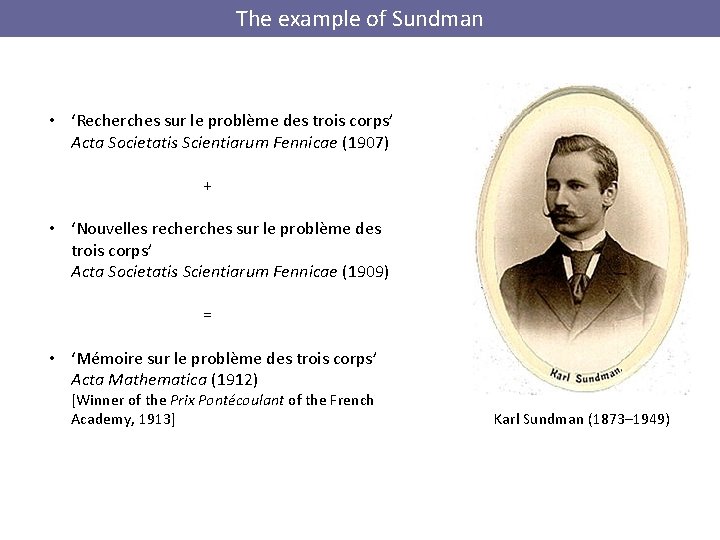
The example of Sundman • ‘Recherches sur le problème des trois corps’ Acta Societatis Scientiarum Fennicae (1907) + • ‘Nouvelles recherches sur le problème des trois corps’ Acta Societatis Scientiarum Fennicae (1909) = • ‘Mémoire sur le problème des trois corps’ Acta Mathematica (1912) [Winner of the Prix Pontécoulant of the French Academy, 1913] Karl Sundman (1873‒ 1949)
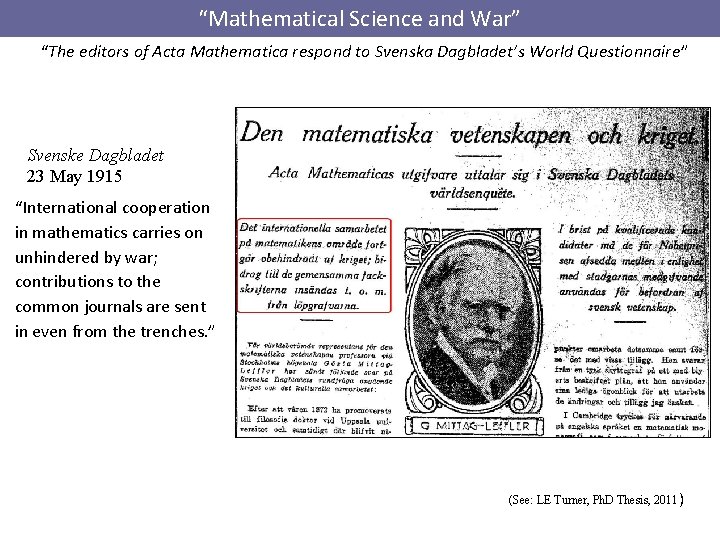
“Mathematical Science and War” “The editors of Acta Mathematica respond to Svenska Dagbladet’s World Questionnaire” Svenske Dagbladet 23 May 1915 “International cooperation in mathematics carries on unhindered by war; contributions to the common journals are sent in even from the trenches. ” (See: LE Turner, Ph. D Thesis, 2011)
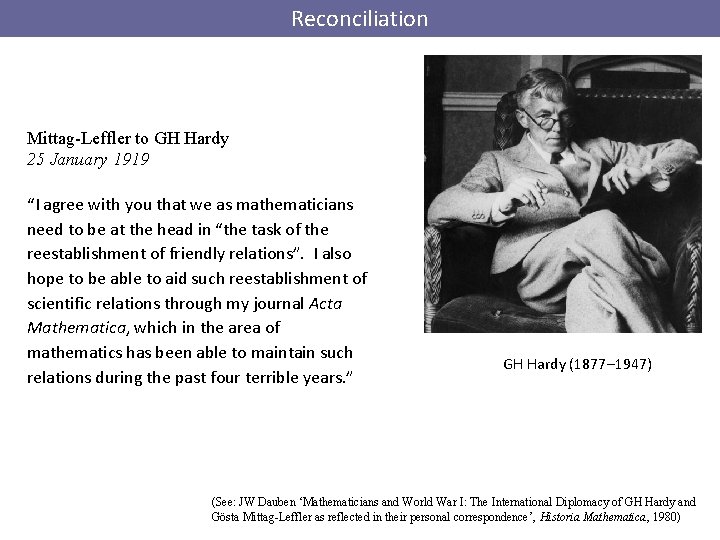
Reconciliation Mittag-Leffler to GH Hardy 25 January 1919 “I agree with you that we as mathematicians need to be at the head in “the task of the reestablishment of friendly relations”. I also hope to be able to aid such reestablishment of scientific relations through my journal Acta Mathematica, which in the area of mathematics has been able to maintain such relations during the past four terrible years. ” GH Hardy (1877‒ 1947) (See: JW Dauben ‘Mathematicians and World War I: The International Diplomacy of GH Hardy and Gösta Mittag-Leffler as reflected in their personal correspondence’, Historia Mathematica, 1980)
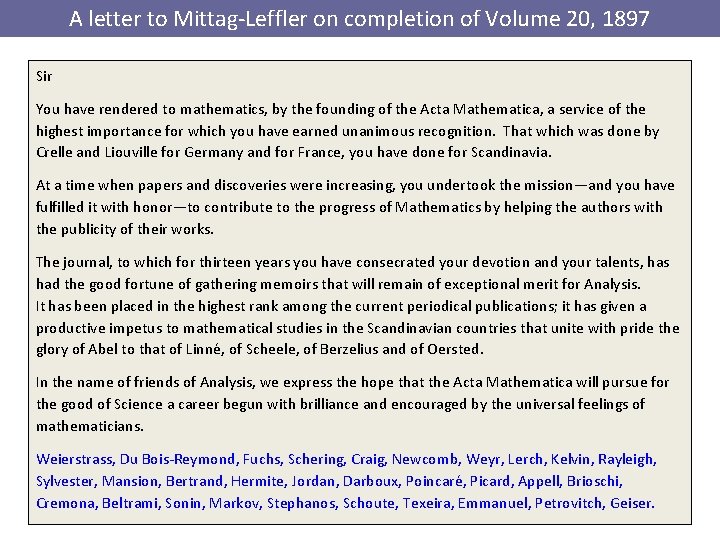
A letter to Mittag-Leffler on completion of Volume 20, 1897 Sir You have rendered to mathematics, by the founding of the Acta Mathematica, a service of the highest importance for which you have earned unanimous recognition. That which was done by Crelle and Liouville for Germany and for France, you have done for Scandinavia. At a time when papers and discoveries were increasing, you undertook the mission—and you have fulfilled it with honor—to contribute to the progress of Mathematics by helping the authors with the publicity of their works. The journal, to which for thirteen years you have consecrated your devotion and your talents, has had the good fortune of gathering memoirs that will remain of exceptional merit for Analysis. It has been placed in the highest rank among the current periodical publications; it has given a productive impetus to mathematical studies in the Scandinavian countries that unite with pride the glory of Abel to that of Linné, of Scheele, of Berzelius and of Oersted. In the name of friends of Analysis, we express the hope that the Acta Mathematica will pursue for the good of Science a career begun with brilliance and encouraged by the universal feelings of mathematicians. Weierstrass, Du Bois-Reymond, Fuchs, Schering, Craig, Newcomb, Weyr, Lerch, Kelvin, Rayleigh, Sylvester, Mansion, Bertrand, Hermite, Jordan, Darboux, Poincaré, Picard, Appell, Brioschi, Cremona, Beltrami, Sonin, Markov, Stephanos, Schoute, Texeira, Emmanuel, Petrovitch, Geiser.
Tributes to Mittag-Leffler as editor of Acta Mathematica “To the outside world Mittag-Leffler was, above everything, the editor of Acta Mathematica, the famous journal which he founded. Periodicals are the most important material facts in the mathematical world. The Acta took its place in the front rank of mathematical periodicals from the beginning, and its rank and standard have never declined. It has always been the most international of all mathematical journals. ” GH Hardy, 1928 “Mittag-Leffler had to create Acta Mathematica out of thin air, as it were. His success came like a bolt of lightning from the blue, and the way he achieved it reflected not only his imagination and daring but also his unusual talent for scientific diplomacy. ” David Rowe, 1992



Praise from Weierstrass to Mittag-Leffler 1885 “It gives me great pleasure to say that I have been pleased with the success of your undertaking. Perhaps it would be forgivable if I, as editor-in-chief of the oldest currently existing mathematical journal, have had a twinge of jealousy. From the beginning Acta has obtained so many old masters and young vigorous talents as authors, not only from Scandinavia but also from Germany, France and Italy. It is my pleasure and hope that Acta will continue as an international organ for the development of our science with the same success as it has had up to now and that it may remain the most cosmopolitan of them. ”
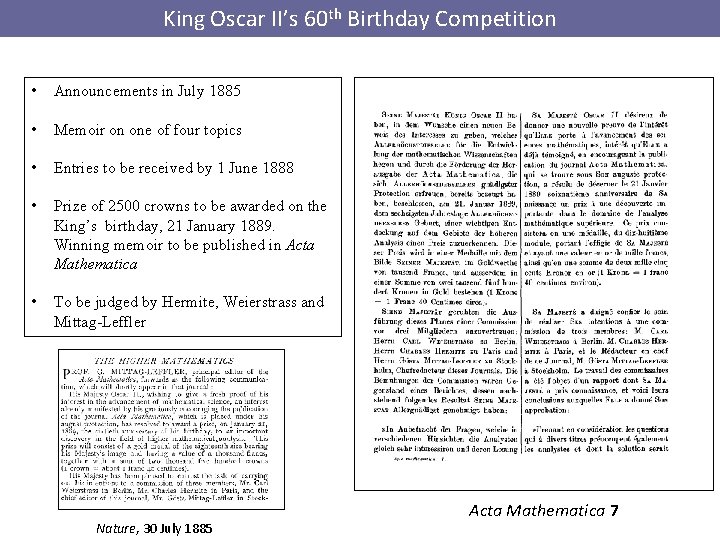
King Oscar II’s 60 th Birthday Competition • Announcements in July 1885 • Memoir on one of four topics • Entries to be received by 1 June 1888 • Prize of 2500 crowns to be awarded on the King’s birthday, 21 January 1889. Winning memoir to be published in Acta Mathematica • To be judged by Hermite, Weierstrass and Mittag-Leffler Nature, 30 July 1885 Acta Mathematica 7
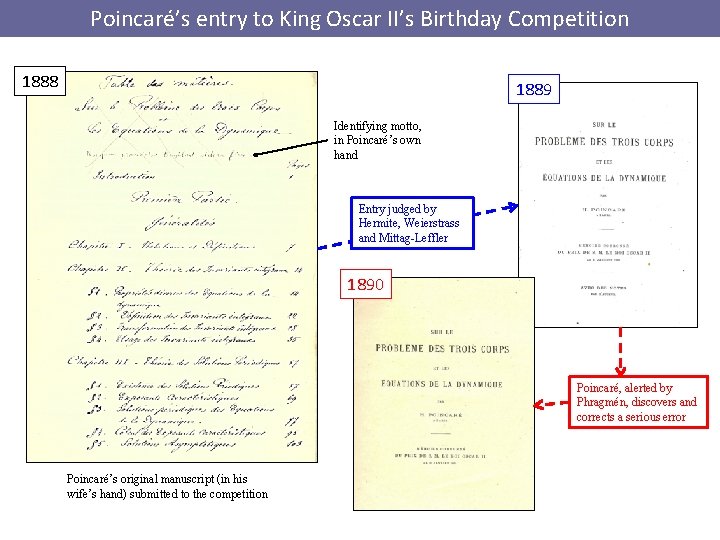
Poincaré’s entry to King Oscar II’s Birthday Competition 1888 1889 Identifying motto, in Poincaré’s own hand Entry judged by Hermite, Weierstrass and Mittag-Leffler 1890 Poincaré, alerted by Phragmén, discovers and corrects a serious error Poincaré’s original manuscript (in his wife’s hand) submitted to the competition
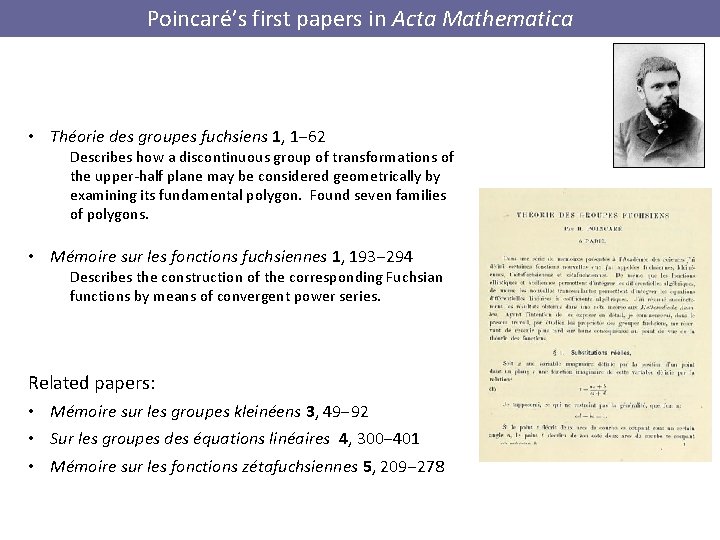
Poincaré’s first papers in Acta Mathematica • Théorie des groupes fuchsiens 1, 1‒ 62 Describes how a discontinuous group of transformations of the upper-half plane may be considered geometrically by examining its fundamental polygon. Found seven families of polygons. • Mémoire sur les fonctions fuchsiennes 1, 193‒ 294 Describes the construction of the corresponding Fuchsian functions by means of convergent power series. Related papers: • Mémoire sur les groupes kleinéens 3, 49‒ 92 • Sur les groupes des équations linéaires 4, 300‒ 401 • Mémoire sur les fonctions zétafuchsiennes 5, 209‒ 278
The beginning of the end of the relationship Mittag-Leffler to Cantor 9 March 1885 “I am convinced that the publication of your new work, before you have been able to explain new positive results, will greatly damage your reputation among mathematicians. I know well that basically this is all the same to you. But if once your theory is discredited in this way it will be a long time before it again commands the attention of the mathematical world. It may well be that you and your theory will never be given the justice you deserve in our lifetime. Then theory will be rediscovered in a hundred years or so by someone else, and then it will subsequently be found that you already had it all. Then, at least, you will be given justice. But in this way [i. e. , by publishing the article] you will exercise no significant influence, which you naturally desire, as does everyone who carries out scientific research. ”
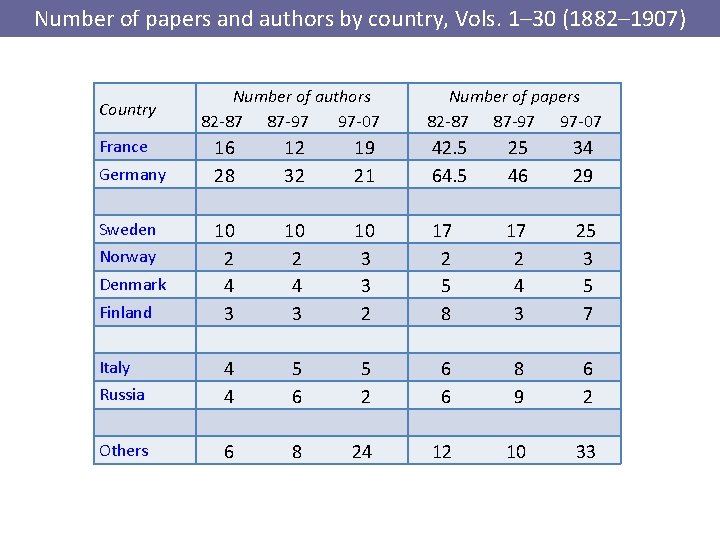
Number of papers and authors by country, Vols. 1‒ 30 (1882‒ 1907) Country France Germany Number of authors 82 -87 87 -97 97 -07 Number of papers 82 -87 87 -97 97 -07 16 12 19 28 32 21 42. 5 25 34 64. 5 46 29 10 10 2 3 4 3 3 2 17 25 2 3 5 4 5 8 3 7 4 5 4 6 2 6 8 6 6 9 2 6 8 24 12 10 33 Sweden Norway Denmark Finland Italy Russia Others
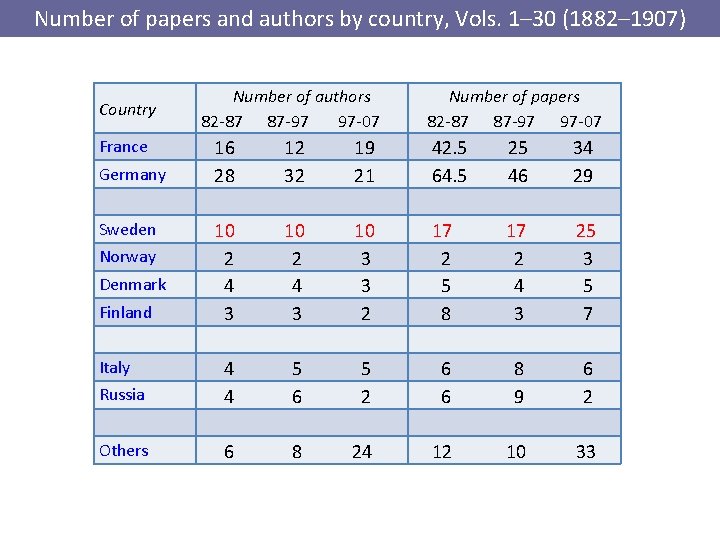
Number of papers and authors by country, Vols. 1‒ 30 (1882‒ 1907) Country France Germany Number of authors 82 -87 87 -97 97 -07 Number of papers 82 -87 87 -97 97 -07 16 12 19 28 32 21 42. 5 25 34 64. 5 46 29 10 10 2 3 4 3 3 2 17 25 2 3 5 4 5 8 3 7 4 5 4 6 2 6 8 6 6 9 2 6 8 24 12 10 33 Sweden Norway Denmark Finland Italy Russia Others
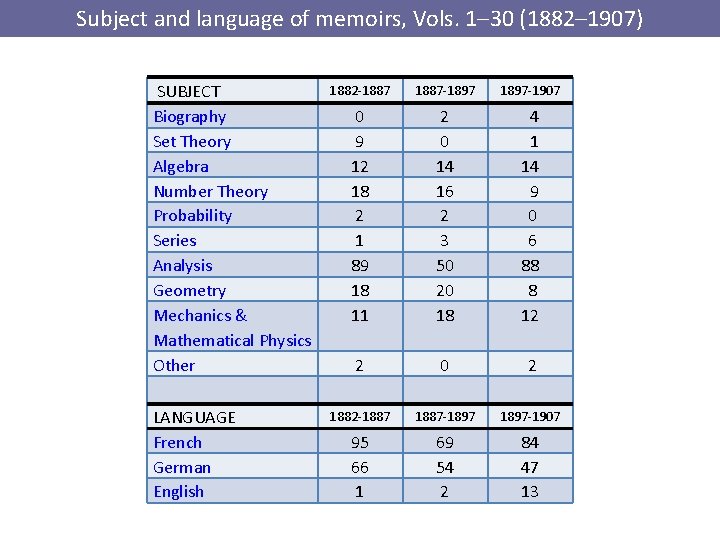
Subject and language of memoirs, Vols. 1‒ 30 (1882‒ 1907) SUBJECT Biography Set Theory Algebra Number Theory Probability Series Analysis Geometry Mechanics & Mathematical Physics Other 1882 -1887 1887 -1897 -1907 0 9 12 18 2 1 89 18 11 2 0 14 16 2 3 50 20 18 4 1 14 9 0 6 88 8 12 2 0 2 LANGUAGE French German English 1882 -1887 1887 -1897 -1907 95 66 1 69 54 2 84 47 13
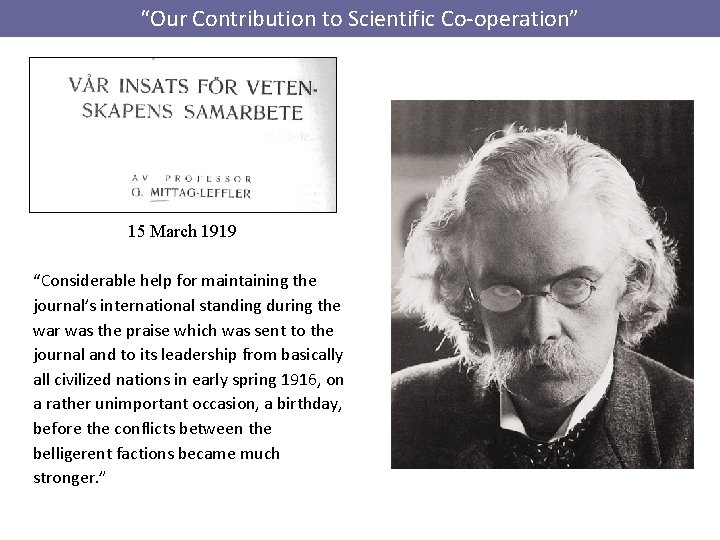
“Our Contribution to Scientific Co-operation” 15 March 1919 “Considerable help for maintaining the journal’s international standing during the war was the praise which was sent to the journal and to its leadership from basically all civilized nations in early spring 1916, on a rather unimportant occasion, a birthday, before the conflicts between the belligerent factions became much stronger. ”
- Slides: 52