
Mitsubishi M 16 C Instruction Set Architecture Lecture
Mitsubishi M 16 C Instruction Set Architecture Lecture 2 Embedded Systems 2 -1
Today Learn about Mitsubishi (Renesas) processor – Lecture covers ISA, derived from Assembler Language Programming Manual (M 16 C_Assembler. pdf MALPM Ch. 1, 2) • Registers: General Purpose, Control • Instruction Set • Addressing Modes • Memory Map Embedded Systems 2 -2
Reading for Next Week Software Manual (M 16 C_Software_Manual. pdf): pp. 1 -32 – Use chapter 3 as a reference. You are responsible for this material – not memorizing it, but instead being able to figure out what an instruction does, or finding an instruction to do something Data Sheet (M 16 C 62_Hardware_Manual_rev 1. 20. pdf) – pp. 1 -27 Embedded Systems 2 -3
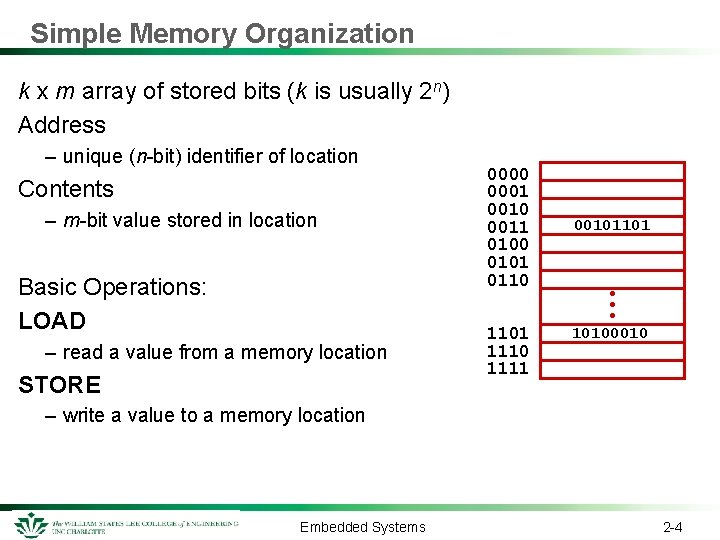
Simple Memory Organization k x m array of stored bits (k is usually 2 n) Address – unique (n-bit) identifier of location Contents – m-bit value stored in location Basic Operations: LOAD – read a value from a memory location STORE 0000 0001 0010 0011 0100 0101 0110 1101 1110 1111 00101101 • • • 10100010 – write a value to a memory location Embedded Systems 2 -4
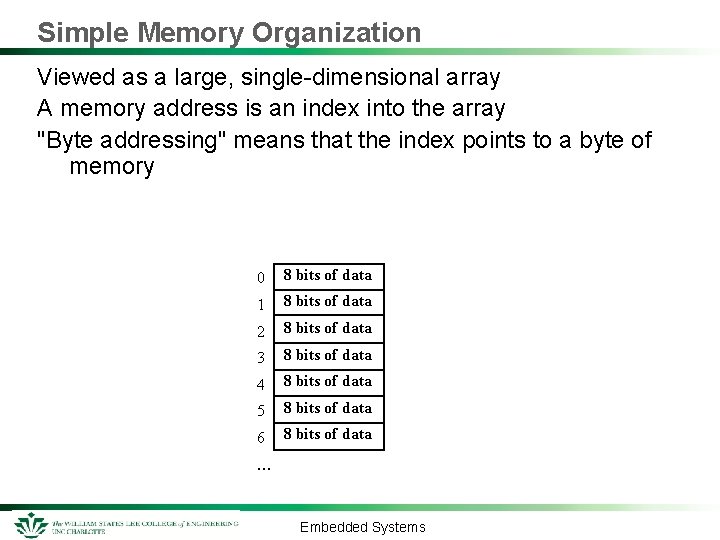
Simple Memory Organization Viewed as a large, single-dimensional array A memory address is an index into the array "Byte addressing" means that the index points to a byte of memory 0 8 bits of data 1 8 bits of data 2 8 bits of data 3 8 bits of data 4 8 bits of data 5 8 bits of data 6 8 bits of data . . . Embedded Systems

Memory Organization Bytes are nice, but most data items use larger "words" – For M 30626, a word is 16 bits or 2 bytes. 0 2 4 6 16 bits of data (registers also hold 16 bits of data) 216 bytes with byte addresses from 0, 1, 2 to 216 -1 215 words with byte addresses 0, 2, 4, . . . 216 -2. . . Embedded Systems

Endianness Big endian: most significant byte is stored at the lowest byte address u Ex: 68000, Power. PC, Sun SPARC 0 1 2 3 4 5 6 7 12 34 56 78 AB CD EF 01 m Little endian: least significant byte is stored at the lowest address u Ex: x 86, DEC VAX, Alpha BOTH store: word 12345678 is at location 0, word ABCDEF 01 is at location 4 0 1 2 3 4 5 6 7 78 56 34 12 01 EF CD AB Most of the time we will avoid this issue in class by only loading/storing words or loading/storing bytes m If two processors with different conventions use a local area network, a disk drive, etc. , YOU need to pay attention to endianness m Embedded Systems
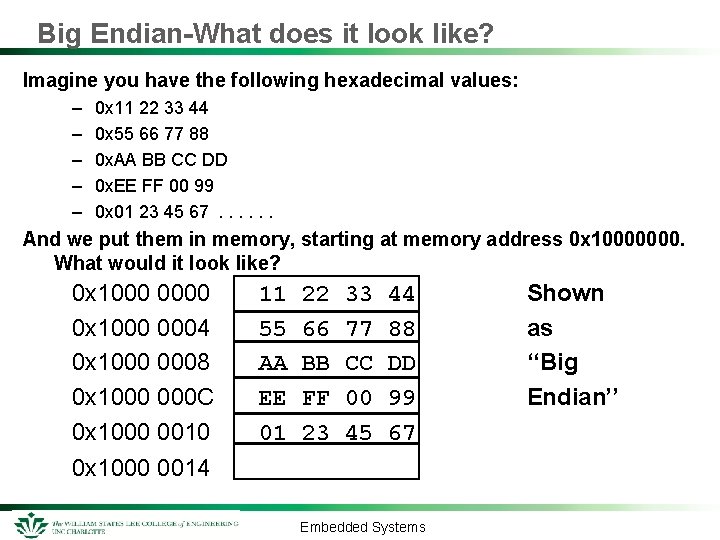
Big Endian-What does it look like? Imagine you have the following hexadecimal values: – – – 0 x 11 22 33 44 0 x 55 66 77 88 0 x. AA BB CC DD 0 x. EE FF 00 99 0 x 01 23 45 67. . . And we put them in memory, starting at memory address 0 x 10000000. What would it look like? 0 x 1000 0004 0 x 1000 0008 0 x 1000 000 C 0 x 1000 0010 11 55 AA EE 01 22 66 BB FF 23 33 77 CC 00 45 44 88 DD 99 67 0 x 1000 0014 Embedded Systems Shown as ‘‘Big Endian’’

Little Endian -What does it look like? Imagine you have the following hexadecimal values: – – – 0 x 11 22 33 44 0 x 55 66 77 88 0 x. AA BB CC DD 0 x. EE FF 00 99 0 x 01 23 45 67 And we put them in memory, starting at memory address 0 x 10000000. What would it look like? 0 x 1000 0004 0 x 1000 0008 0 x 1000 000 C 0 x 1000 0010 44 88 DD 99 67 33 77 CC 00 45 22 66 BB FF 23 11 55 AA EE 01 0 x 1000 0014 Embedded Systems Shown as ‘‘Little Endian’’
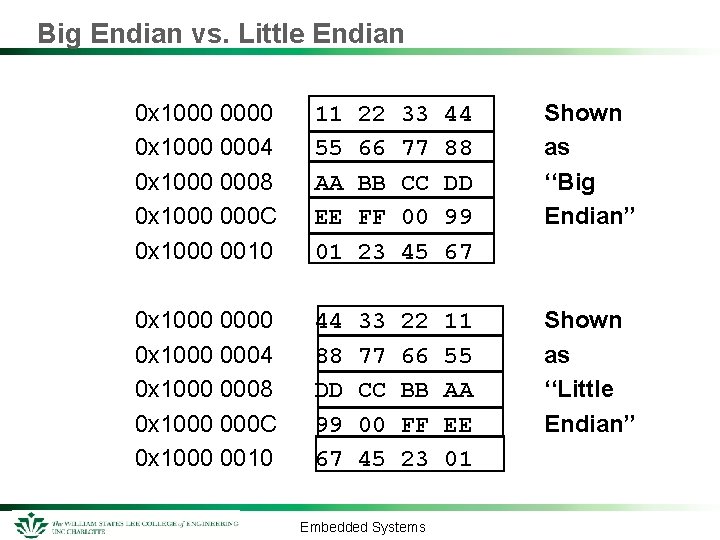
Big Endian vs. Little Endian 0 x 1000 0004 0 x 1000 0008 0 x 1000 000 C 0 x 1000 0010 11 55 AA EE 01 22 66 BB FF 23 33 77 CC 00 45 44 88 DD 99 67 Shown as ‘‘Big Endian’’ 0 x 1000 0004 0 x 1000 0008 0 x 1000 000 C 0 x 1000 0010 44 88 DD 99 67 33 77 CC 00 45 22 66 BB FF 23 11 55 AA EE 01 Shown as ‘‘Little Endian’’ Embedded Systems
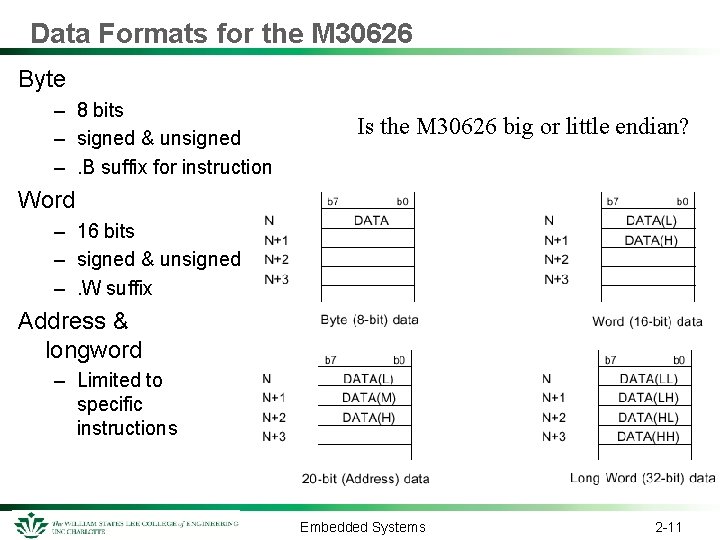
Data Formats for the M 30626 Byte – 8 bits – signed & unsigned –. B suffix for instruction Is the M 30626 big or little endian? Word – 16 bits – signed & unsigned –. W suffix Address & longword – Limited to specific instructions Embedded Systems 2 -11
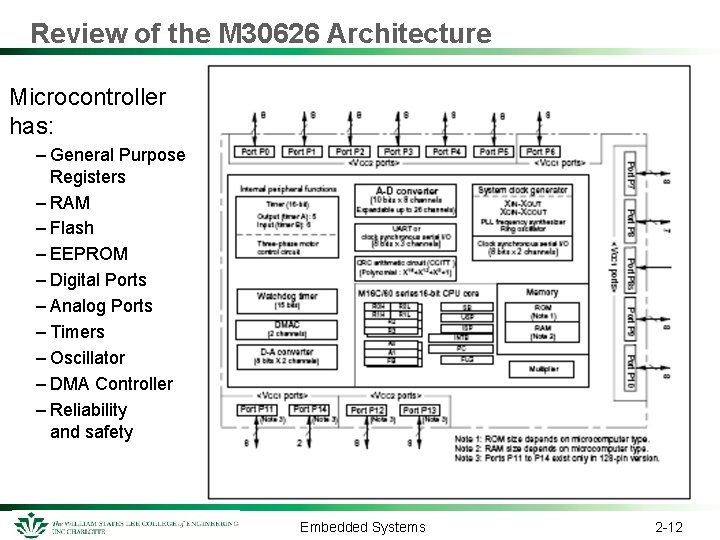
Review of the M 30626 Architecture Microcontroller has: – General Purpose Registers – RAM – Flash – EEPROM – Digital Ports – Analog Ports – Timers – Oscillator – DMA Controller – Reliability and safety Embedded Systems 2 -12
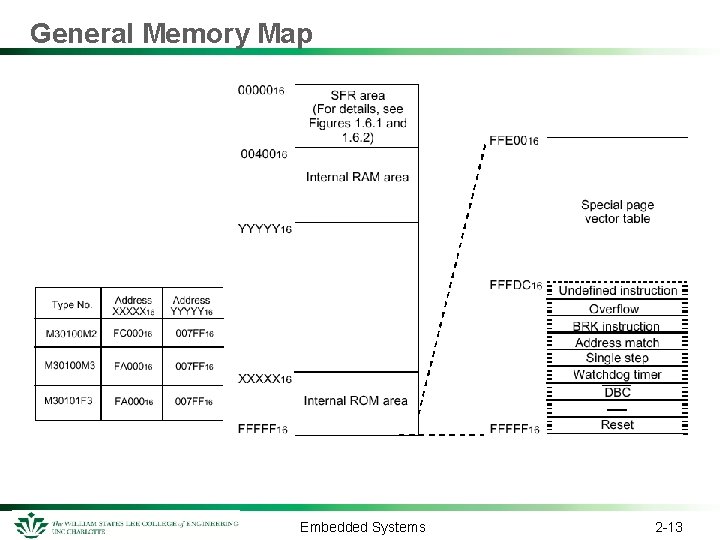
General Memory Map Embedded Systems 2 -13
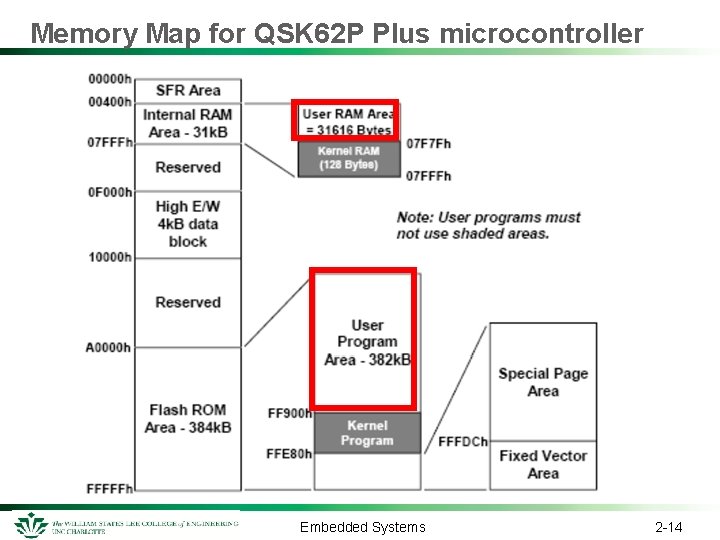
Memory Map for QSK 62 P Plus microcontroller Embedded Systems 2 -14
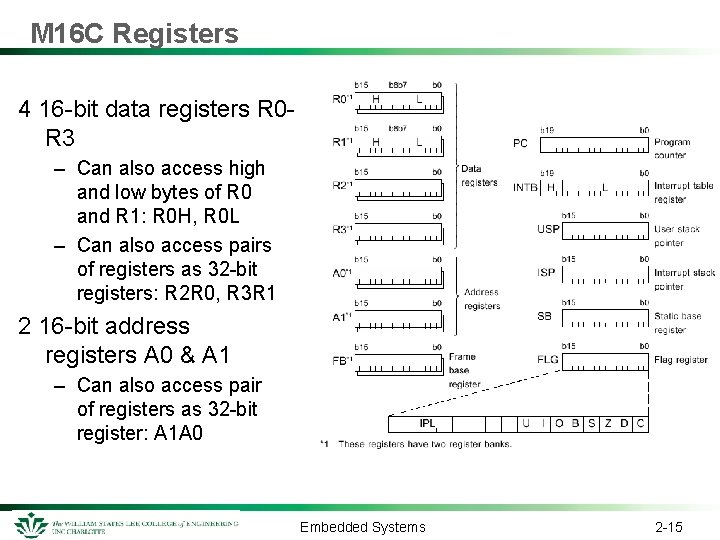
M 16 C Registers 4 16 -bit data registers R 0 R 3 – Can also access high and low bytes of R 0 and R 1: R 0 H, R 0 L – Can also access pairs of registers as 32 -bit registers: R 2 R 0, R 3 R 1 2 16 -bit address registers A 0 & A 1 – Can also access pair of registers as 32 -bit register: A 1 A 0 Embedded Systems 2 -15
Special Registers SP: Stack Pointer – for accessing call stack – USP: User code – ISP: Interrupt code FB: Frame Base – for accessing frame on call stack SB: Static Base INTB: Interrupt table pointer Embedded Systems 2 -16
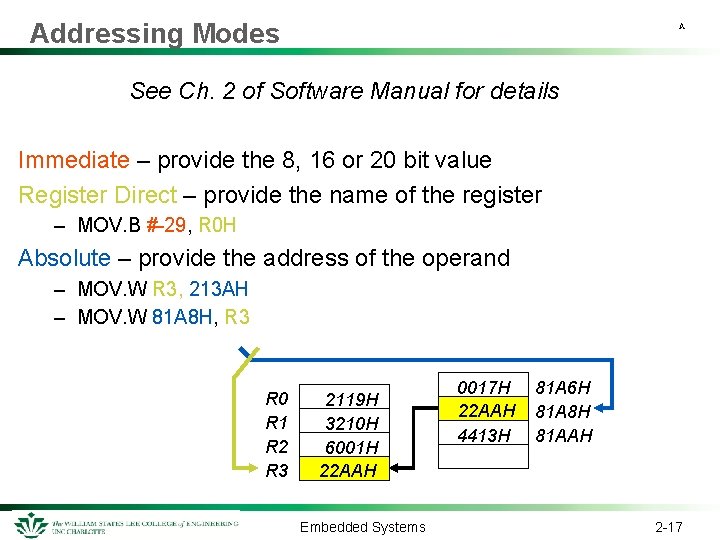
Addressing Modes A See Ch. 2 of Software Manual for details Immediate – provide the 8, 16 or 20 bit value Register Direct – provide the name of the register – MOV. B #-29, R 0 H Absolute – provide the address of the operand – MOV. W R 3, 213 AH – MOV. W 81 A 8 H, R 3 R 0 R 1 R 2 R 3 2119 H 3210 H 6001 H 22 AAH 0150 H Embedded Systems 0017 H 22 AAH 4413 H 81 A 6 H 81 A 8 H 81 AAH 2 -17
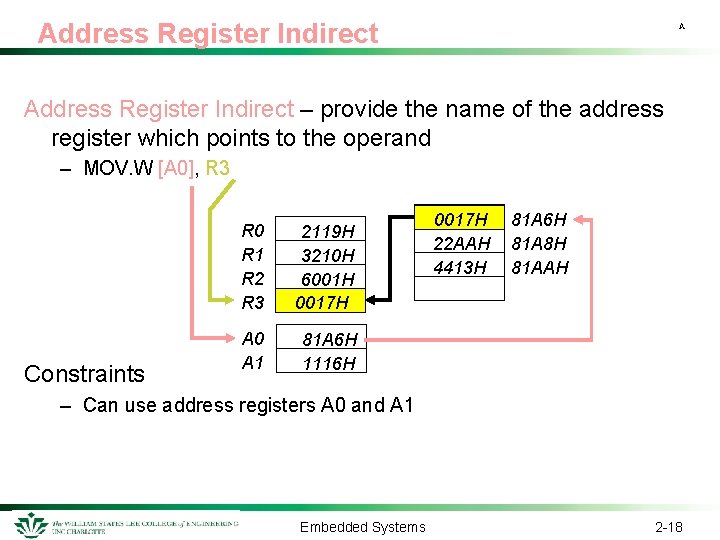
Address Register Indirect A Address Register Indirect – provide the name of the address register which points to the operand – MOV. W [A 0], R 3 Constraints R 0 R 1 R 2 R 3 2119 H 3210 H 6001 H 0017 H 0150 H A 0 A 1 81 A 6 H 1116 H 0017 H 22 AAH 4413 H 81 A 6 H 81 A 8 H 81 AAH – Can use address registers A 0 and A 1 Embedded Systems 2 -18
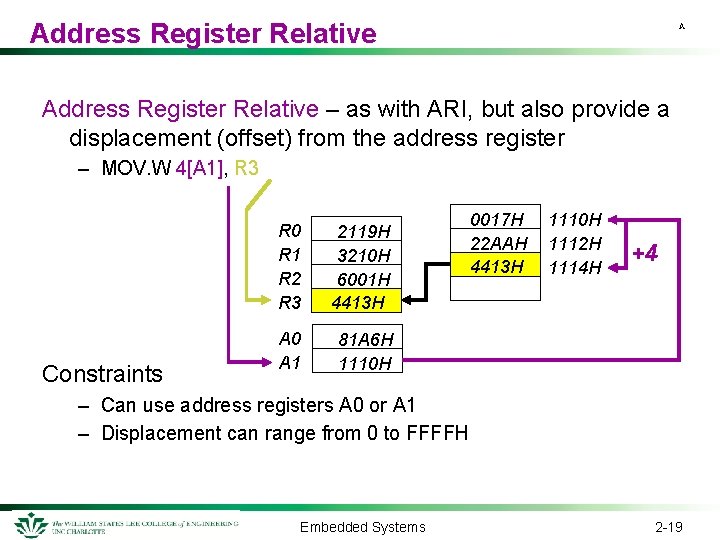
Address Register Relative A Address Register Relative – as with ARI, but also provide a displacement (offset) from the address register – MOV. W 4[A 1], R 3 Constraints R 0 R 1 R 2 R 3 2119 H 3210 H 6001 H 4413 H 0150 H A 0 A 1 81 A 6 H 1110 H 0017 H 22 AAH 4413 H 1110 H 1112 H 1114 H +4 – Can use address registers A 0 or A 1 – Displacement can range from 0 to FFFFH Embedded Systems 2 -19
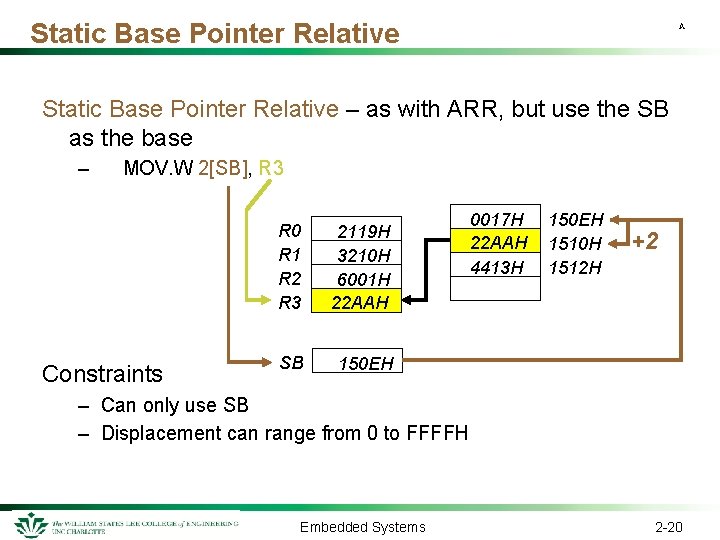
Static Base Pointer Relative A Static Base Pointer Relative – as with ARR, but use the SB as the base – MOV. W 2[SB], R 3 Constraints R 0 R 1 R 2 R 3 2119 H 3210 H 6001 H 22 AAH 0150 H SB 150 EH 0017 H 22 AAH 4413 H 150 EH 1510 H 1512 H +2 – Can only use SB – Displacement can range from 0 to FFFFH Embedded Systems 2 -20
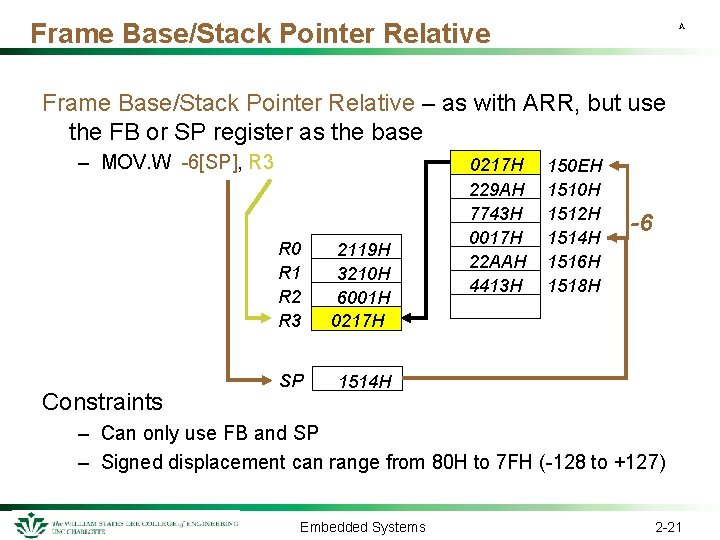
Frame Base/Stack Pointer Relative A Frame Base/Stack Pointer Relative – as with ARR, but use the FB or SP register as the base – MOV. W -6[SP], R 3 Constraints R 0 R 1 R 2 R 3 2119 H 3210 H 6001 H 0217 H 0150 H SP 1514 H 0217 H 229 AH 7743 H 0017 H 22 AAH 4413 H 150 EH 1510 H 1512 H 1514 H 1516 H 1518 H -6 – Can only use FB and SP – Signed displacement can range from 80 H to 7 FH (-128 to +127) Embedded Systems 2 -21
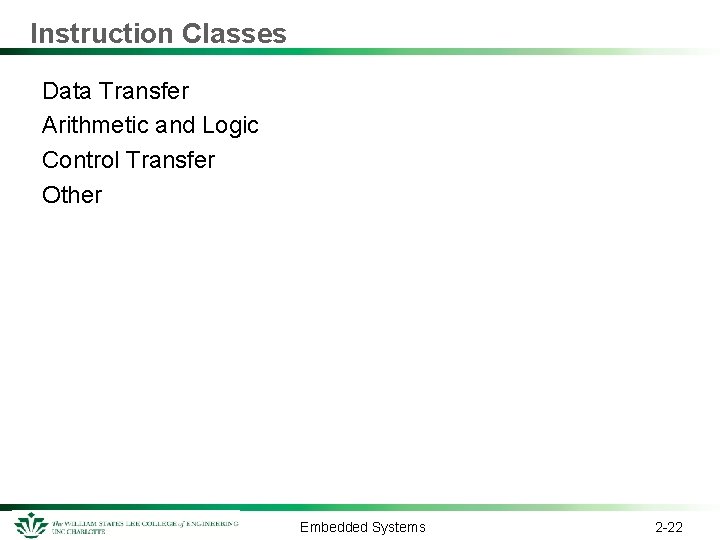
Instruction Classes Data Transfer Arithmetic and Logic Control Transfer Other Embedded Systems 2 -22
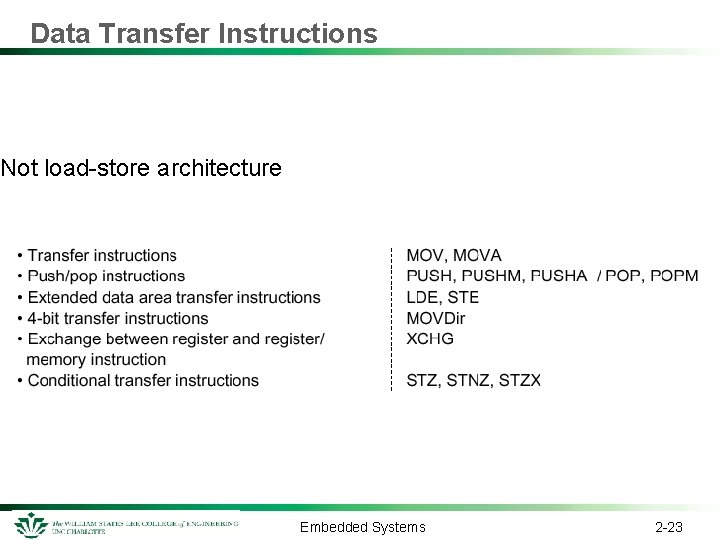
Data Transfer Instructions Not load-store architecture Embedded Systems 2 -23
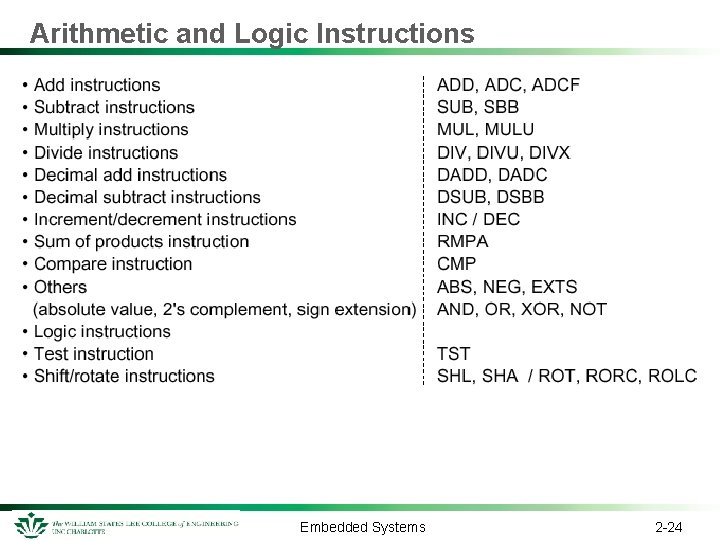
Arithmetic and Logic Instructions Embedded Systems 2 -24
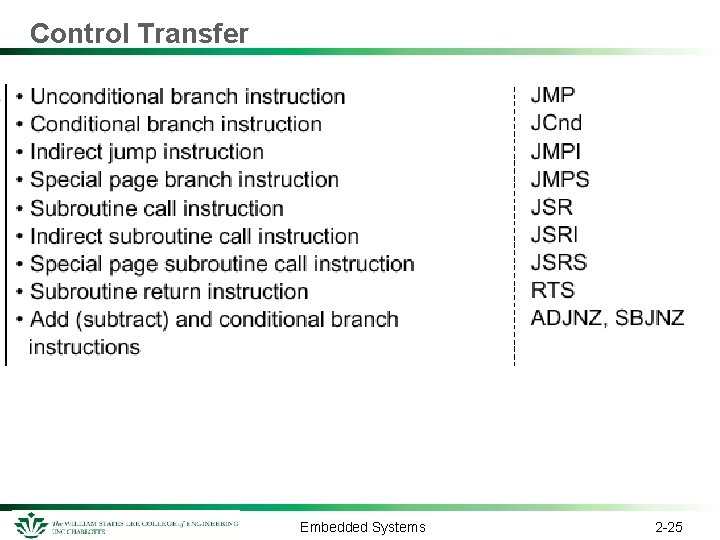
Control Transfer Embedded Systems 2 -25
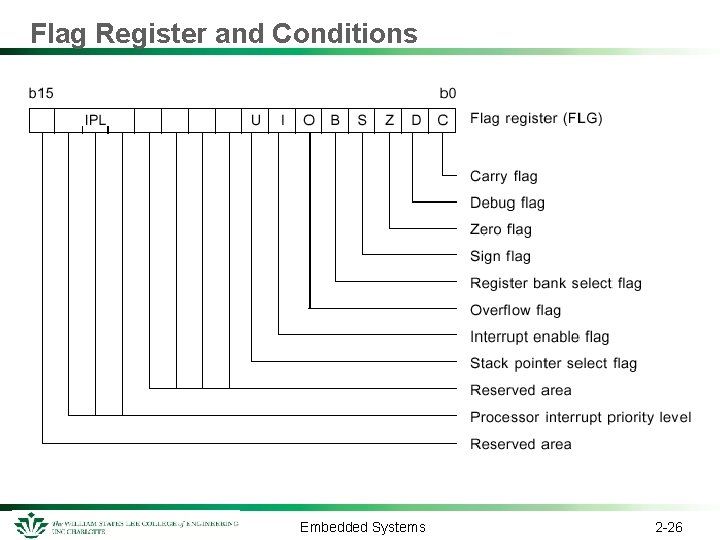
Flag Register and Conditions Embedded Systems 2 -26
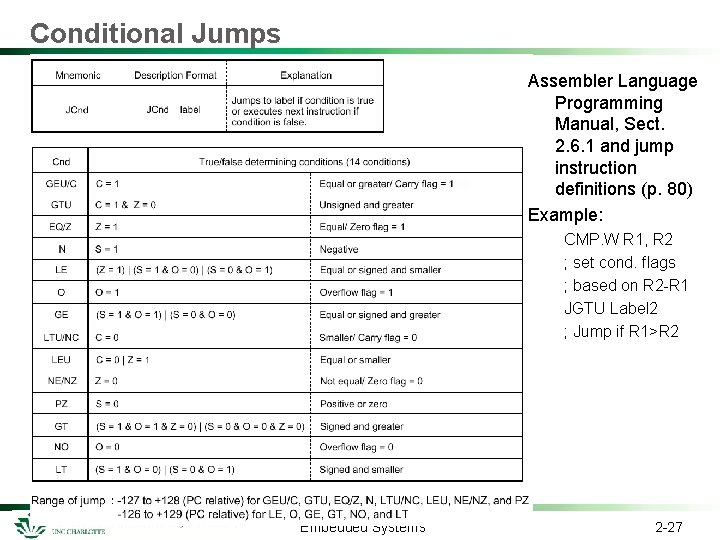
Conditional Jumps Assembler Language Programming Manual, Sect. 2. 6. 1 and jump instruction definitions (p. 80) Example: CMP. W R 1, R 2 ; set cond. flags ; based on R 2 -R 1 JGTU Label 2 ; Jump if R 1>R 2 Embedded Systems 2 -27
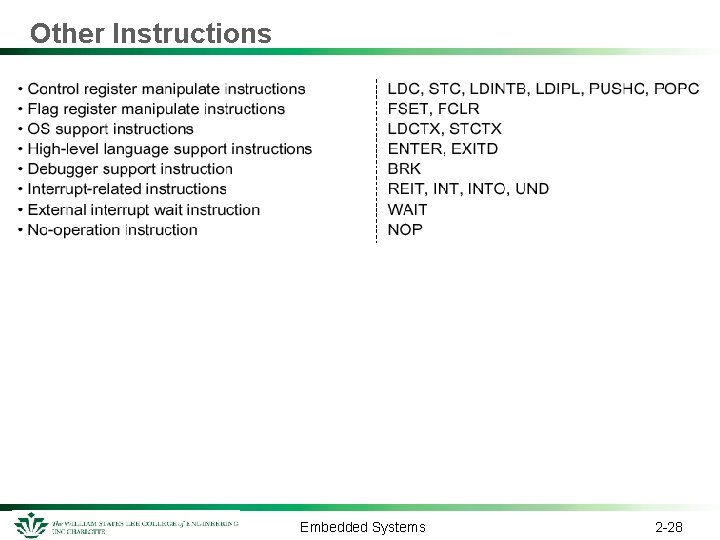
Other Instructions Embedded Systems 2 -28
- Slides: 28