
Mitosis Meiosis and Heredity Cell Growth and Division










- Slides: 24
Mitosis, Meiosis and Heredity: Cell Growth and Division Unit 7
What makes us get bigger? • Do our cells grow larger and larger or do they divide and multiply? ? ? • In most cases living things grow by producing more cells. • There’s no real cell size difference between baby and adult animals. Adults just have many more cells.
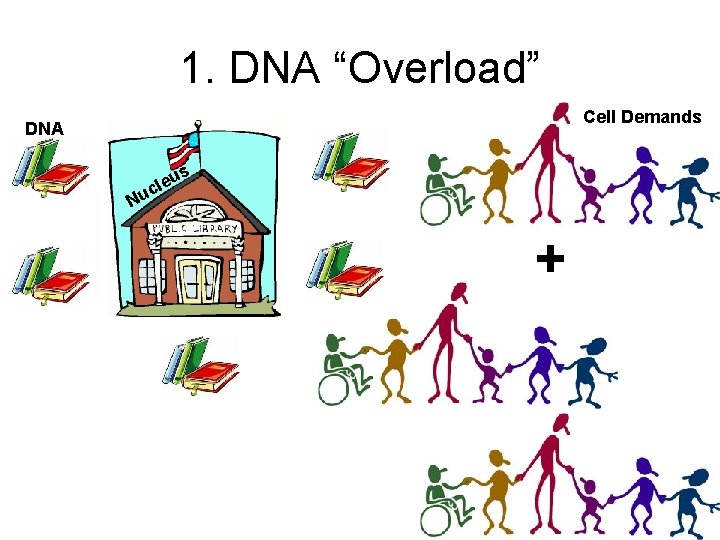
Limits to Cell Growth • There are two reasons cells divide rather than continue to grow: 1. The larger the cell becomes, the more demands the cell places on its DNA 2. Larger cells have more trouble moving things like nutrients and wastes across the cell’s membrane
1. DNA “Overload” Cell Demands DNA s u cle Nu +
Exchanging Materials TOWN LIMIT (Cell membrane)
2. Exchanging Materials • Remember: Nutrients enter and wastes exit through the cell’s membrane • The rate at which nutrients enter and wastes exit depends on the surface area of the cell • The rate at which these nutrients are used up and waste products are produced depends on the volume of the cell • So, we need to figure out the relationship between the cell’s surface area and volume to determine how they divide and grow
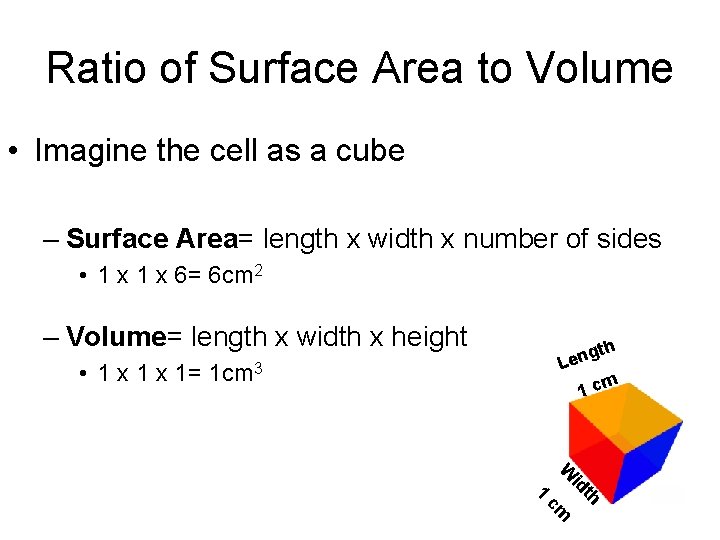
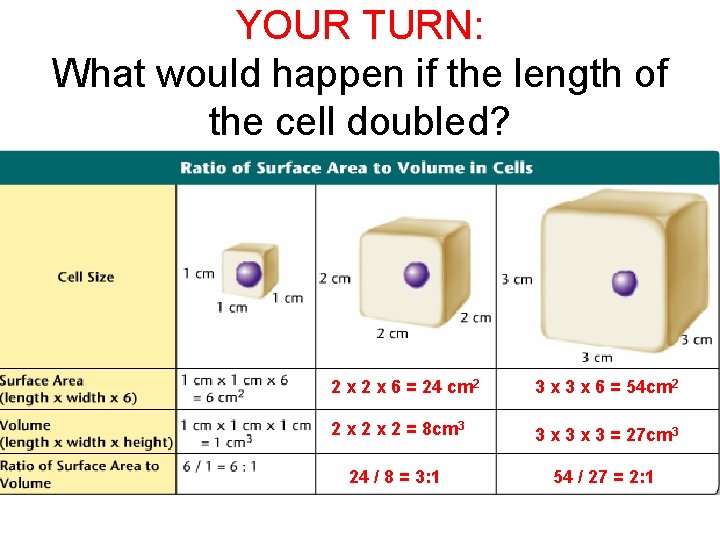
Ratio of Surface Area to Volume • Imagine the cell as a cube – Surface Area= length x width x number of sides • 1 x 6= 6 cm 2 – Volume= length x width x height gth n e L 1 cm • 1 x 1= 1 cm 3 cm h t id W 1
YOUR TURN: What would happen if the length of the cell doubled? 2 x 6 = 24 cm 2 3 x 6 = 54 cm 2 2 x 2 = 8 cm 3 3 x 3 = 27 cm 3 24 / 8 = 3: 1 54 / 27 = 2: 1
Division of the Cell • Cells divide before they get too large. • The process by which cells divide into two “daughter” cells is called cell division. This is like each new town getting it’s own “genetic library”!
Exact Replicas • Each daughter cell gets a complete copy of the parent cell’s genetic information • In order to copy this information exactly we need to know the role of chromosomes and the steps in the cell cycle
• Chromosomes carry the genetic information that is passed on from one generation to the next. They are made up of DNA. Chromosomes • The cells of every organism have a specific number of chromosomes – Humans have 46, carrots have 18 and fruit flies have 8 • Before cell division each chromosome is replicated. Because of this each chromosome consists of 2 genetically identical “sister” chromatids. 1 “sister” chromatid chromosome
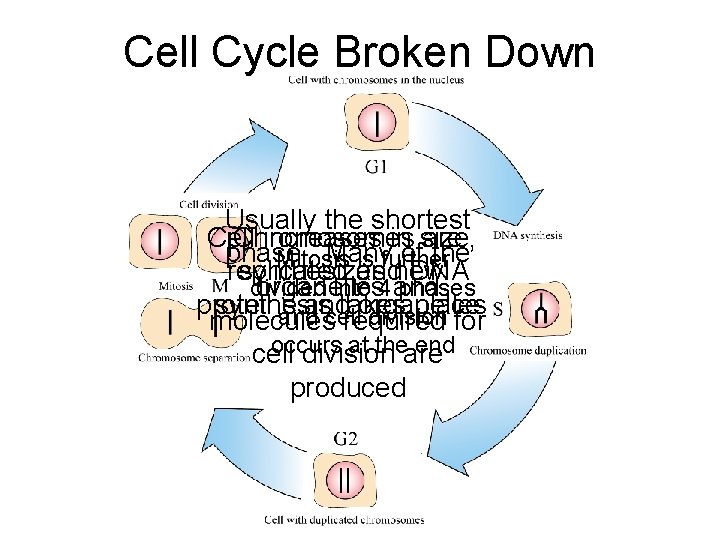
The Cell Cycle • During the cell cycle, a cell grows, prepares for division, and divides to form 2 daughter cells, each of which begins the cycle again. • There are 4 phases: 1. 2. 3. 4. G 1 phase S phase G 2 phase M phase Interphase
Cell Cycle Broken Down Usually the shortest Cell Chromosomes increases in size, are phase. Many of the Mitosis is further replicated synthesizes andnew DNA divided into 4 phases organelles and proteins synthesis and takes organelles place and cell division molecules required for occurs at theare end cell division produced
4 Phases of Mitosis 1. Prophase 2. Metaphase 3. Anaphase 4. Telophase
Prophase • Longest part of Mitosis -60% of the time) • Chromosomes become visible • Centrioles near the nuclear envelope move toward opposite poles • Condensed chromosomes become attached to spindle fibers at their centromeres • Nucleolus disappears and the nuclear envelope breaks down (50
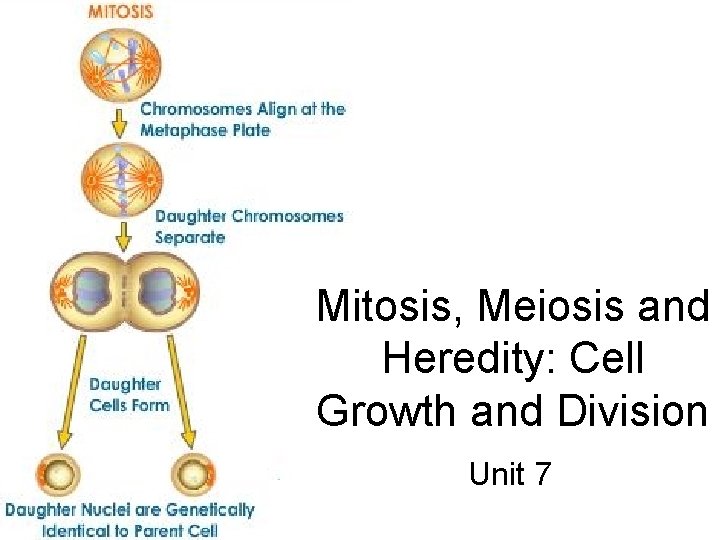
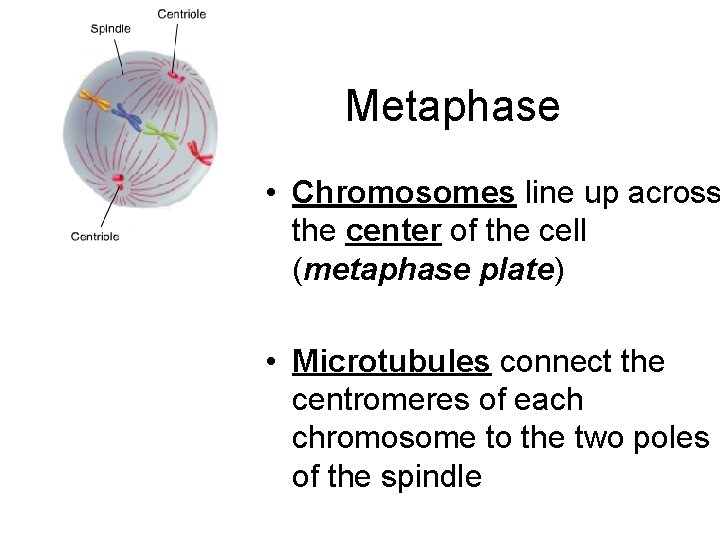
Metaphase • Chromosomes line up across the center of the cell (metaphase plate) • Microtubules connect the centromeres of each chromosome to the two poles of the spindle
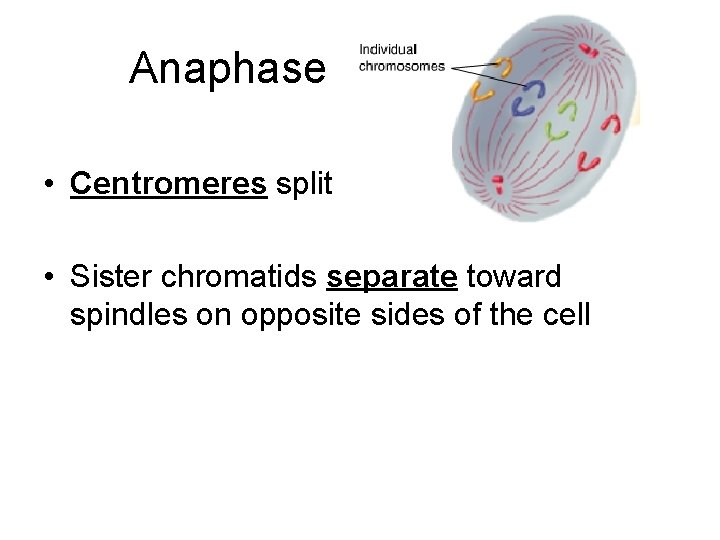
Anaphase • Centromeres split • Sister chromatids separate toward spindles on opposite sides of the cell
Telophase • Once distinct chromosomes begin to disperse into a tangle of dense material • Nuclear envelope re-forms around each cluster (2) of material • Spindle breaks apart • Nucleolus visible in each daughter nucleus • Mitosis is complete
What’s Next? • What we’ve got: – 2 nuclei with duplicate chromosomes in the cytoplasm of a single cell • Final task: – Divide the cytoplasm
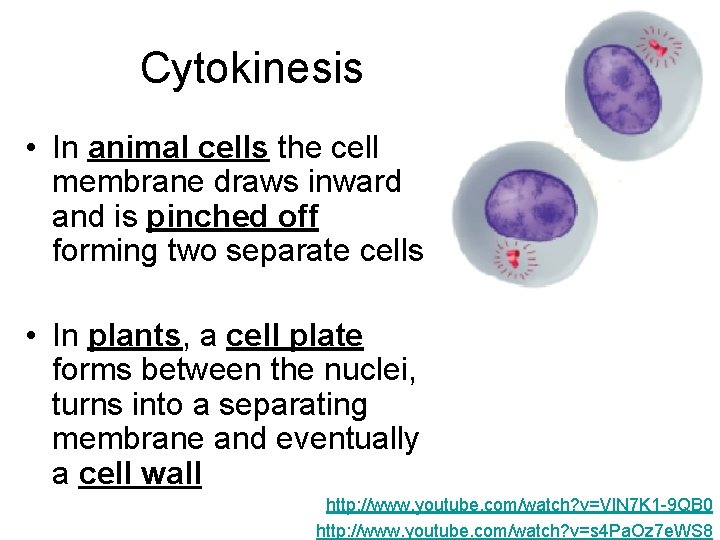
Cytokinesis • In animal cells the cell membrane draws inward and is pinched off forming two separate cells • In plants, a cell plate forms between the nuclei, turns into a separating membrane and eventually a cell wall http: //www. youtube. com/watch? v=Vl. N 7 K 1 -9 QB 0 http: //www. youtube. com/watch? v=s 4 Pa. Oz 7 e. WS 8
Controls on Cell Division • Scientists have observed what is “supposed to happen” in petri dishes. Cells should grow until the bottom is covered and then stop. They are also regulated by the surrounding cells.
So what actually does the regulating? • The amount of a protein called cyclin rises and falls in time with the cell cycle. – • Cyclins regulate the timing of the cell cycle in eukaryotic cells Other proteins have been linked to cell regulation as well 1. Internal Regulators – Ex: makes sure cell doesn’t enter Mitosis until chromosomes have been replicated 2. External Regulators – – Direct cell to speed up or slow down the cycle. Ex: Growth Factors are important during embryonic development and wound healing
What about uncontrolled cell growth? • Cancer is the result of cells not being able to control their growth. • Cancer cells DO NOT respond to the signals that regulate the growth of most cells • Uncontrolled cell growth causes tumors
What causes Cancer? • Smoking tobacco, radiation exposure, viral infections – These all have uncontrolled cell growth in common with one another • Many cancer cells have a defect in their p 53 gene which normally halts the cell cycle until all chromosomes have been replicated http: //www. youtube. com/watch? v=A 1 Fkdt-2 ve. M