
MITOSIS AND MEIOSIS Mitosis Nuclear envelope start to

- Slides: 5
MITOSIS AND MEIOSIS
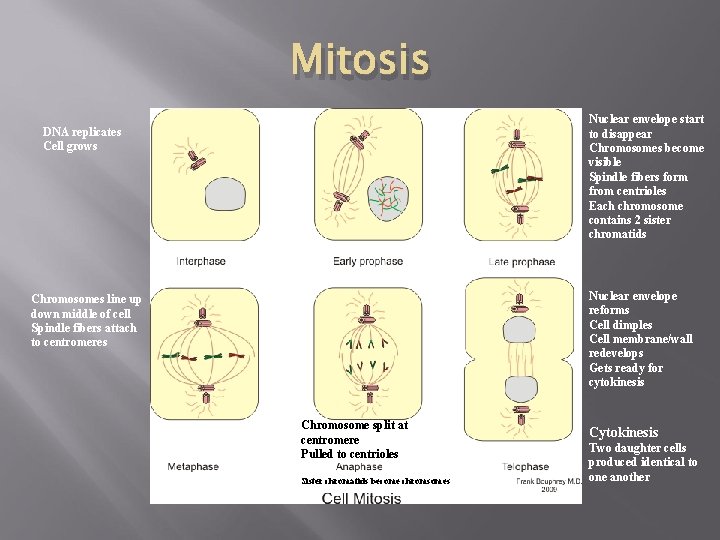
Mitosis Nuclear envelope start to disappear Chromosomes become visible Spindle fibers form from centrioles Each chromosome contains 2 sister chromatids DNA replicates Cell grows Nuclear envelope reforms Cell dimples Cell membrane/wall redevelops Gets ready for cytokinesis Chromosomes line up down middle of cell Spindle fibers attach to centromeres Chromosome split at centromere Pulled to centrioles Sister chromatids become chromsomes Cytokinesis Two daughter cells produced identical to one another
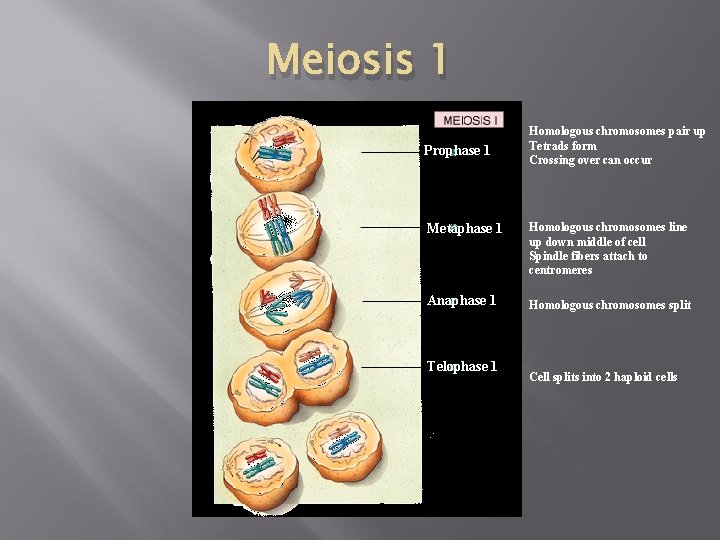
Meiosis 1 Prophase 1 Homologous chromosomes pair up Tetrads form Crossing over can occur Metaphase 1 Homologous chromosomes line up down middle of cell Spindle fibers attach to centromeres Anaphase 1 Homologous chromosomes split Telophase 1 Cell splits into 2 haploid cells
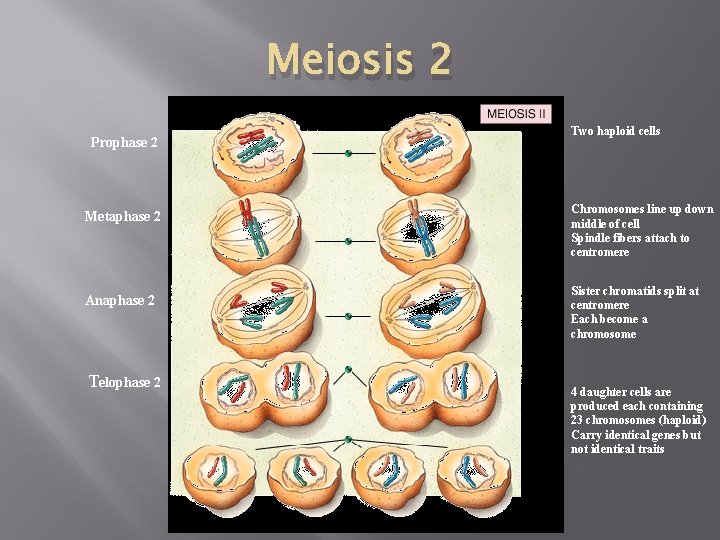
Meiosis 2 Prophase 2 Metaphase 2 Anaphase 2 Telophase 2 Two haploid cells Chromosomes line up down middle of cell Spindle fibers attach to centromere Sister chromatids split at centromere Each become a chromosome 4 daughter cells are produced each containing 23 chromosomes (haploid) Carry identical genes but not identical traits
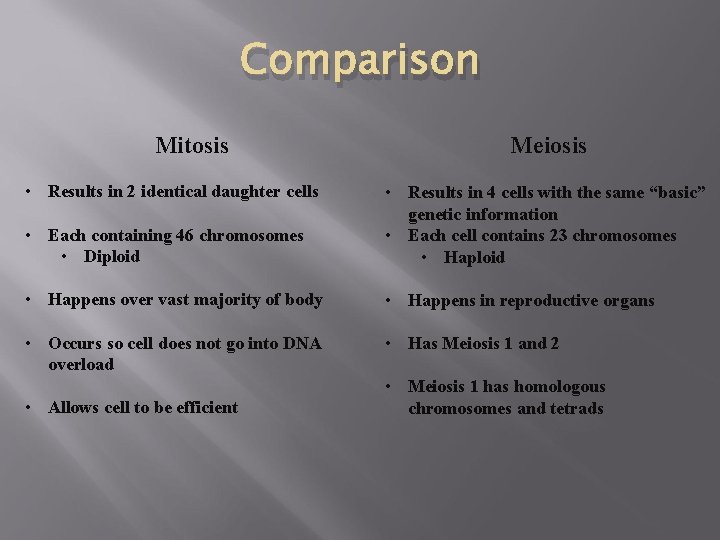
Comparison Mitosis • Results in 2 identical daughter cells Meiosis • Each containing 46 chromosomes • Diploid • Results in 4 cells with the same “basic” genetic information • Each cell contains 23 chromosomes • Haploid • Happens over vast majority of body • Happens in reproductive organs • Occurs so cell does not go into DNA overload • Has Meiosis 1 and 2 • Allows cell to be efficient • Meiosis 1 has homologous chromosomes and tetrads