
Mitosis and Cancer You will learn Reasons Cells
- Slides: 51
Mitosis and Cancer You will learn: -Reasons Cells Divide -Phases of the Cell Cycle -Abnormal Cell Growth
Some reasons why cells divide? • ________________ • ________
Limits to Cell Growth • There are two main reasons why cells divide
Reason #1 n The _______ a cell becomes, the ____________the cell places on its DNA • This is called “__________”
Understanding DNA Overload • In eukaryotic cells, DNA is found in the nucleus of the cell. When a cell is small, the information stored in the DNA is able to meet all the needs of the cell.
• As the cell increases in size, it needs to make more protein. As the cell get’s bigger, the cell’s DNA would no longer be able to ______________________________
Reason #2 • _______________ enter the cell through its cell membrane. Waste products must leave in the same way. • The rate at which this exchange takes place depends on the _______ of the cell, which is the total area of its cell membrane
• The rate at which food and oxygen is used up and waste products are produced depends on the ________________ • If a cell gets too large, it would be difficult to get sufficient amounts of _________________ in and waste products out
What is the Cell Cycle? • A period where the cell grows, _________and divides into two daughter cells.
Mitosis and Meiosis • Mitosis: -division of somatic (____) cells • Meiosis -division of gametes (_____ cells)
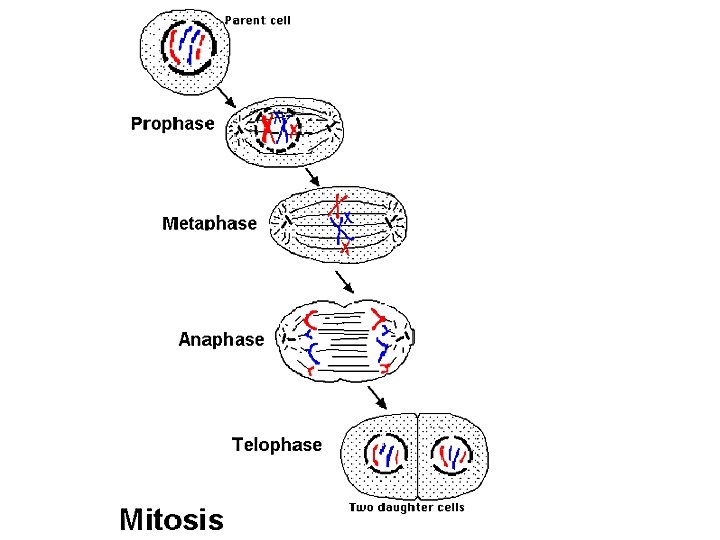
Mitosis • Prophase • Metaphase • Anaphase • Telophase
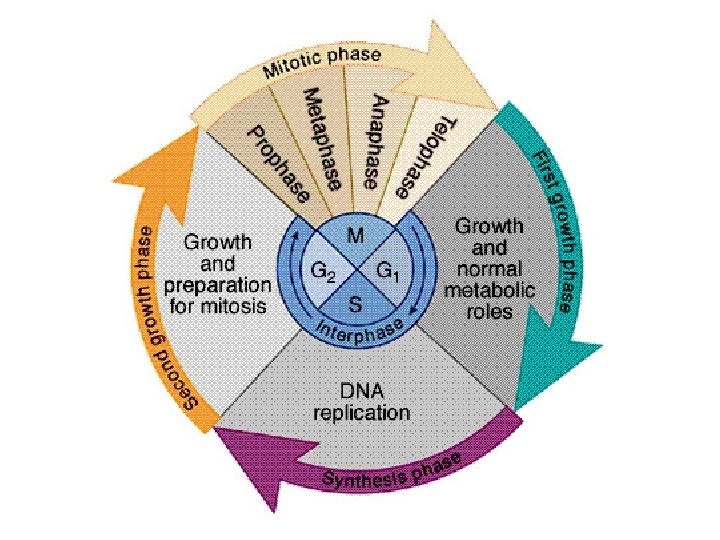
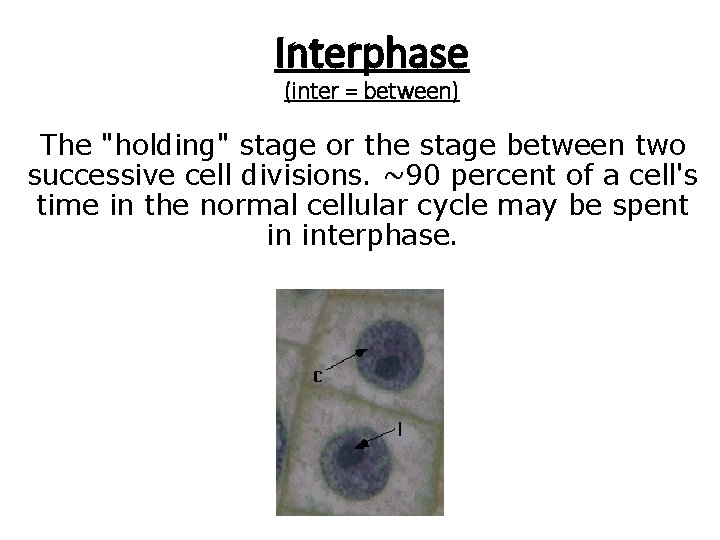
Interphase (inter = between) The "holding" stage or the stage between two successive cell divisions. ~90 percent of a cell's time in the normal cellular cycle may be spent in interphase.
Interphase (Longest Part of the Cell Cycle) • technically____________, but it is included in the cell cycle • Cell is in a ____________ • performing cell functions • _____________(copies) • organelles double in number, to prepare for division
Interphase • G 1 - (Growth 1) • S - (Synthesis) - _______ • G 2 - (Growth 2) - cell prepares for division
G 1 Phase (Cell Growth) • The cell does most of its growing • The cell __________ • New proteins & organelles are synthesized
S Phase (DNA Replication) • ___________ are replicated and the synthesis in DNA molecules take place • ____________ are also synthesized.
G 2 Phase (Prep. for Mitosis) • Shortest of the 3 phases • Many of the ________ and molecules required for cell division are _________.
M Phase (Mitosis) • The process of cell division begins.
MITOSIS n _______________ n number of chromosomes remains the _________
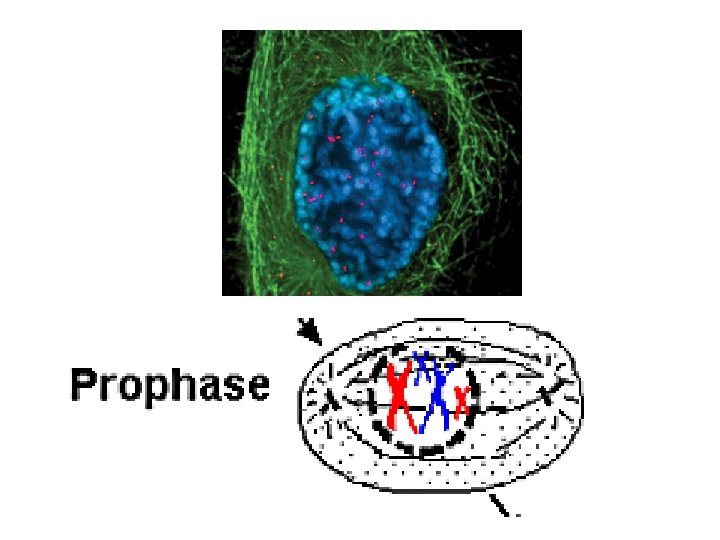
Prophase (pro=primary, first) • In prophase, the _________ condenses into discrete chromosomes. The nuclear envelope breaks down and spindles form at opposite "poles" of the cell.
Prophase Key Events n Chromatin coils to form _____ chromosomes n In animal cells, ________ begin to _________ to opposite poles n _______ forms
What is chromatin? • When a cell is "resting" i. e. not dividing, the chromosomes are organized into an entangled structure called chromatin
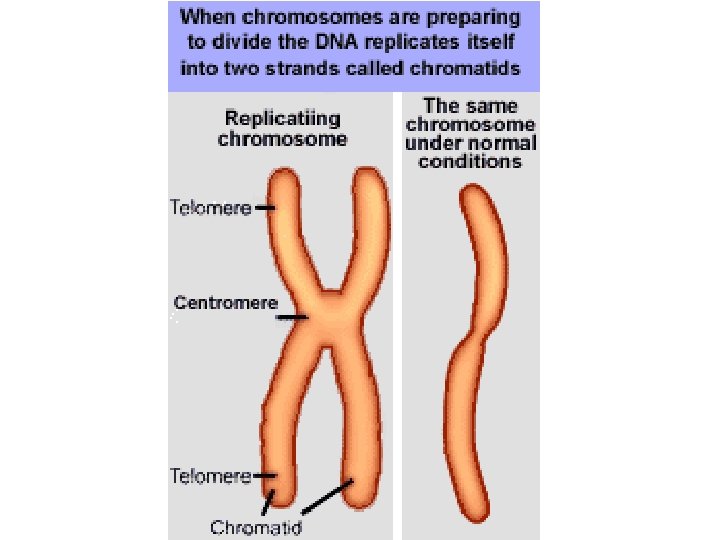
Prophase 1. 2. 3. 4. • Chromosome pair up! Chromosomes thicken and shorten -become visible -2 chromatids joined by a ______ Centrioles move to the opposite sides of the nucleus Nucleolus disappears _______________
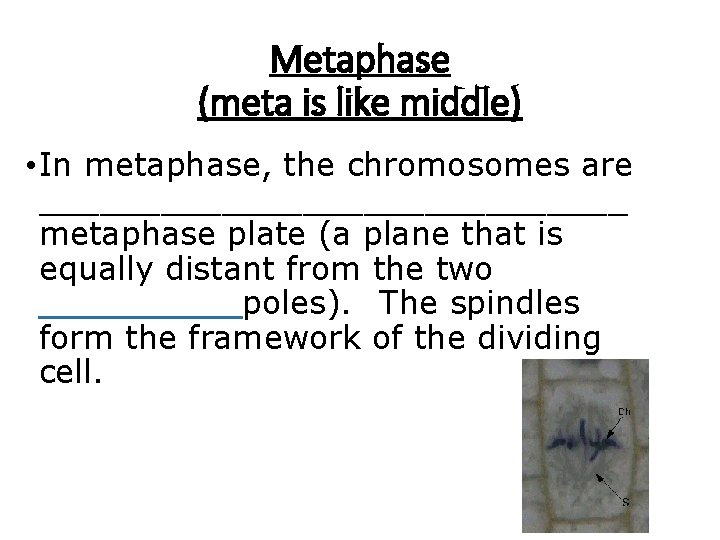
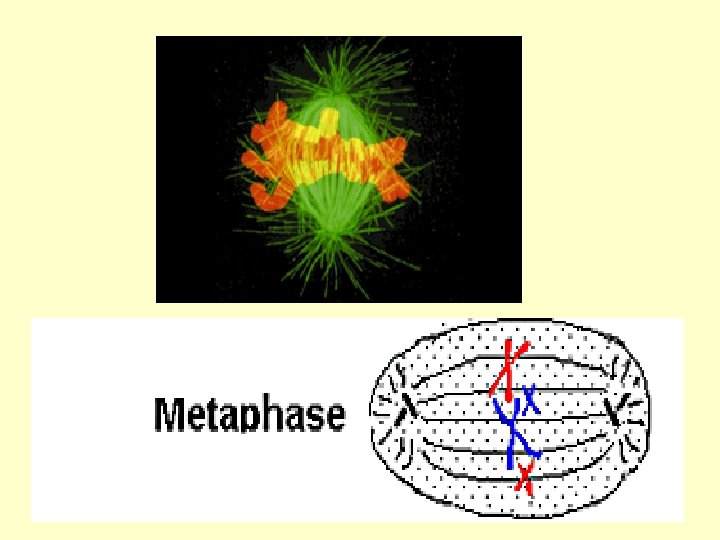
Metaphase (meta is like middle) • In metaphase, the chromosomes are _______________ metaphase plate (a plane that is equally distant from the two _____poles). The spindles form the framework of the dividing cell.
Metaphase • Chromosomes meet in the middle! 1. Chromosomes arrange at _______ of cell 2. Become attached to spindle fibres by _________
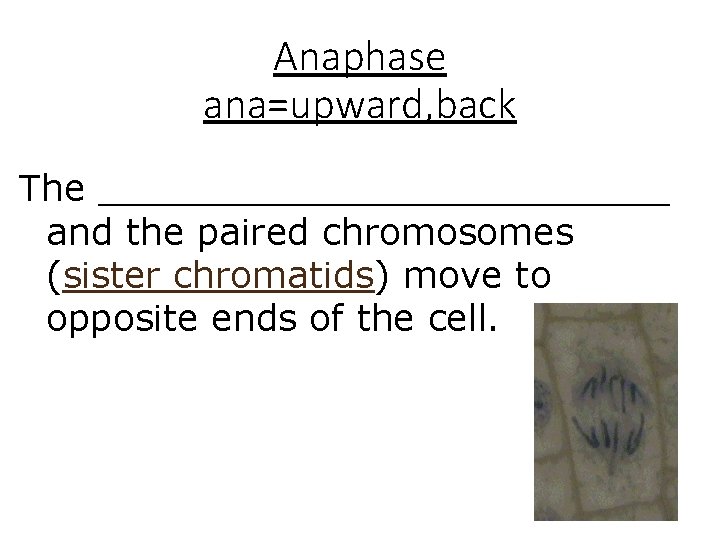
Anaphase ana=upward, back The _____________ and the paired chromosomes (sister chromatids) move to opposite ends of the cell.
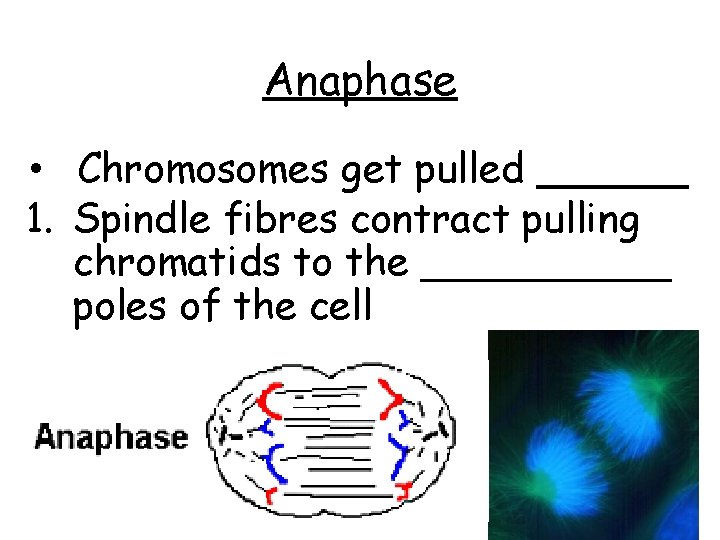
Anaphase • Chromosomes get pulled ______ 1. Spindle fibres contract pulling chromatids to the _____ poles of the cell
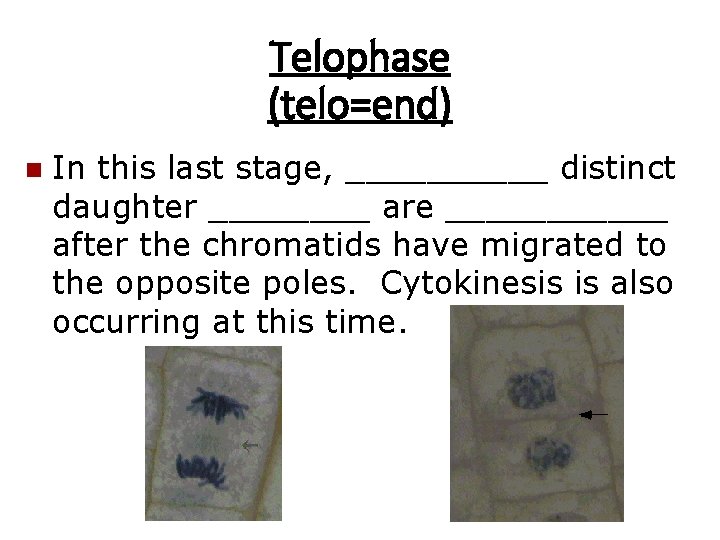
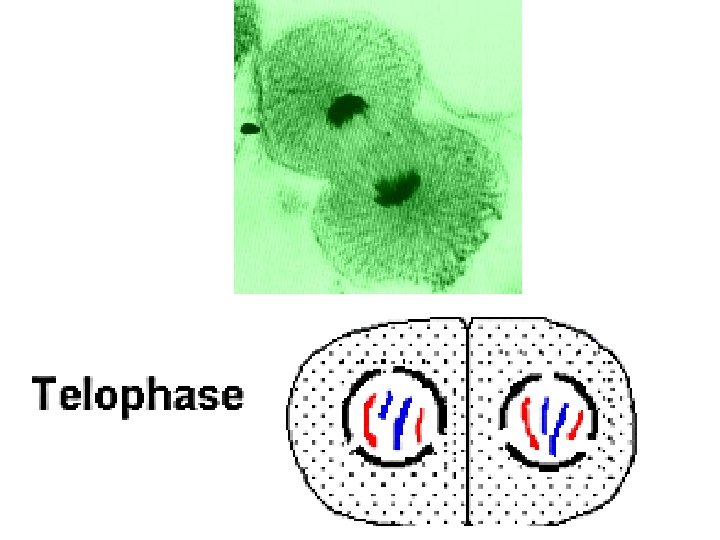
Telophase (telo=end) n In this last stage, _____ distinct daughter ____ are ______ after the chromatids have migrated to the opposite poles. Cytokinesis is also occurring at this time.
Telophase • Now there are ____ 1. Chromosomes uncoil 2. Spindle fibres disintegrate 3. Centrioles replicate 4. Nuclear membrane _______ 5. __________
Cytokinesis • Cyto =cell • Kinesis=movement • The cell’s cytoplasm divides at the end of telophase • Animals - _____________ • Plants – A new ___________ forms between the new cells.
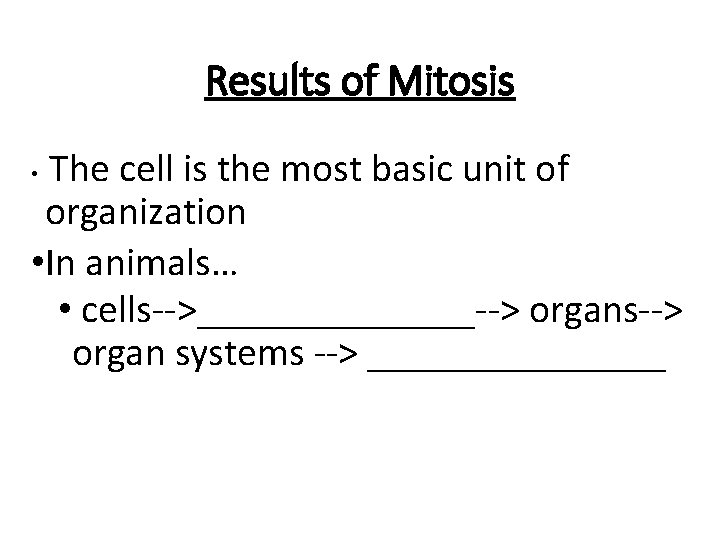
Results of Mitosis The cell is the most basic unit of organization • In animals… • cells-->_______--> organs--> organ systems --> ________ •
CANCER IS UNCONTROLLED MITOSIS!
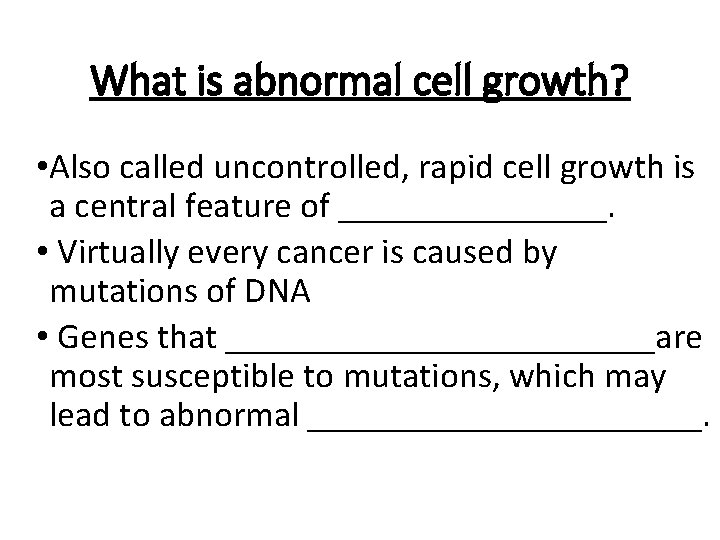
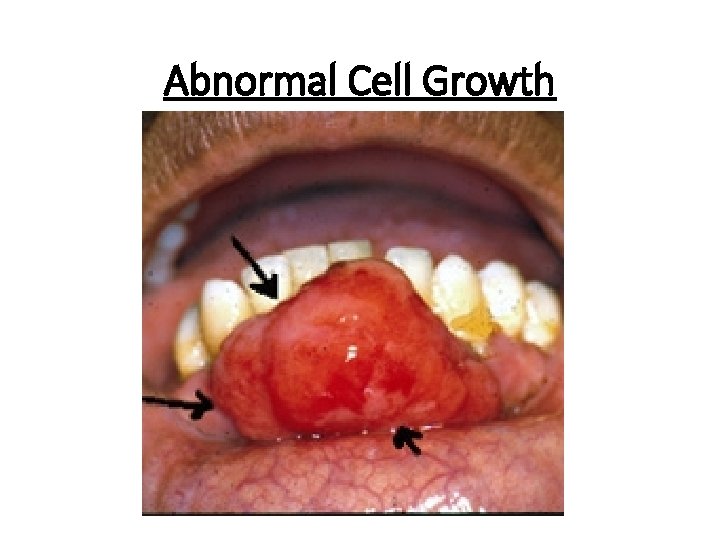
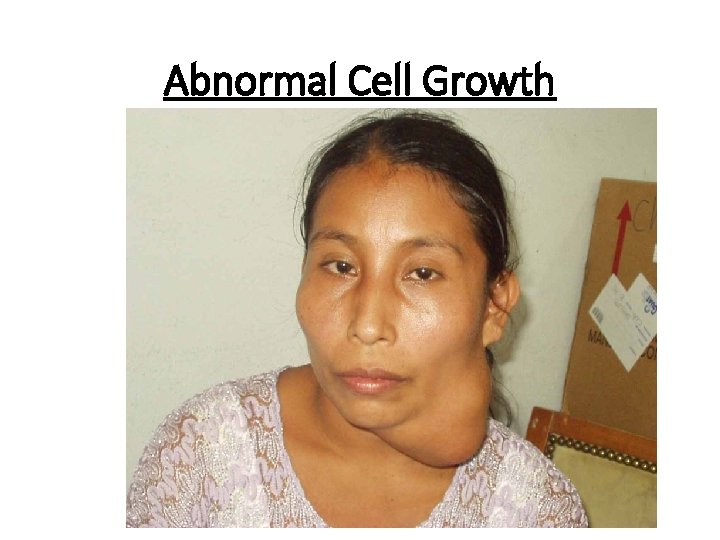
What is abnormal cell growth? • Also called uncontrolled, rapid cell growth is a central feature of ________. • Virtually every cancer is caused by mutations of DNA • Genes that ____________are most susceptible to mutations, which may lead to abnormal ___________.
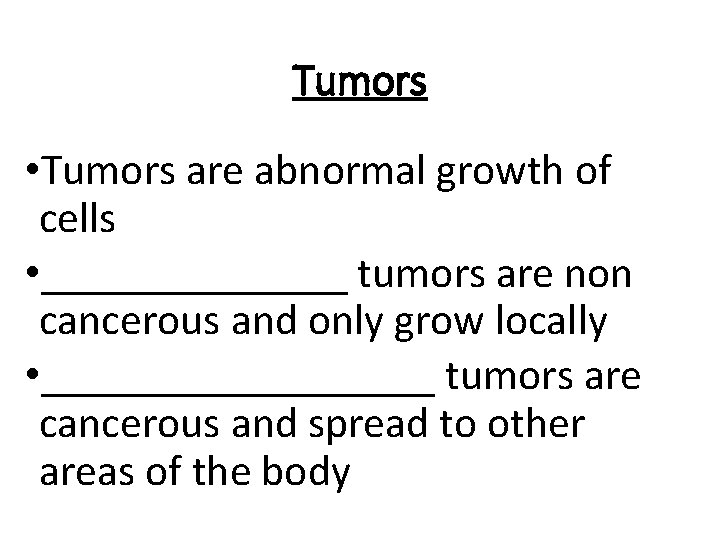
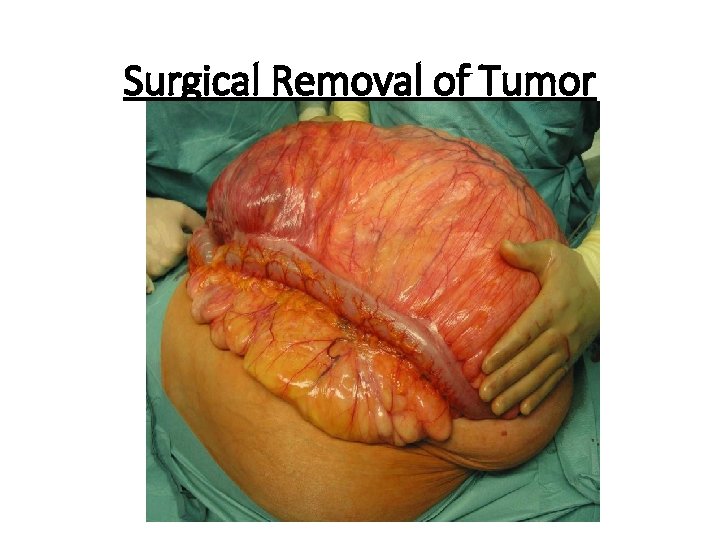
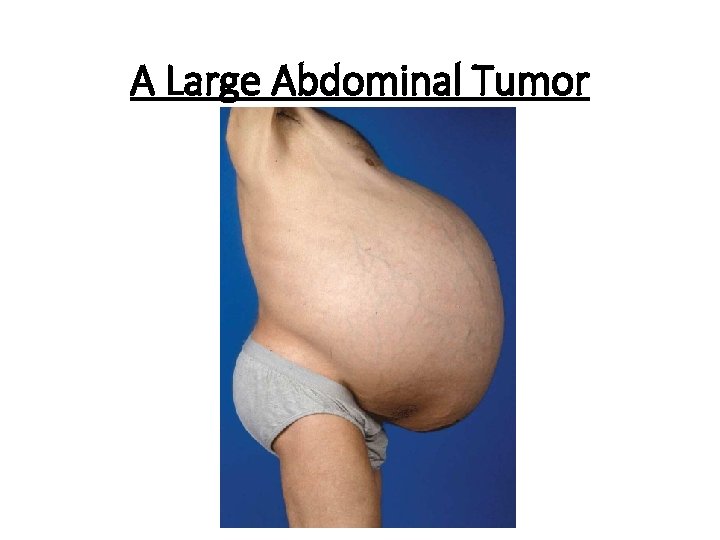
Tumors • Tumors are abnormal growth of cells • _______ tumors are non cancerous and only grow locally • _________ tumors are cancerous and spread to other areas of the body
Abnormal Cell Growth
Abnormal Cell Growth
Surgical Removal of Tumor
A Large Abdominal Tumor
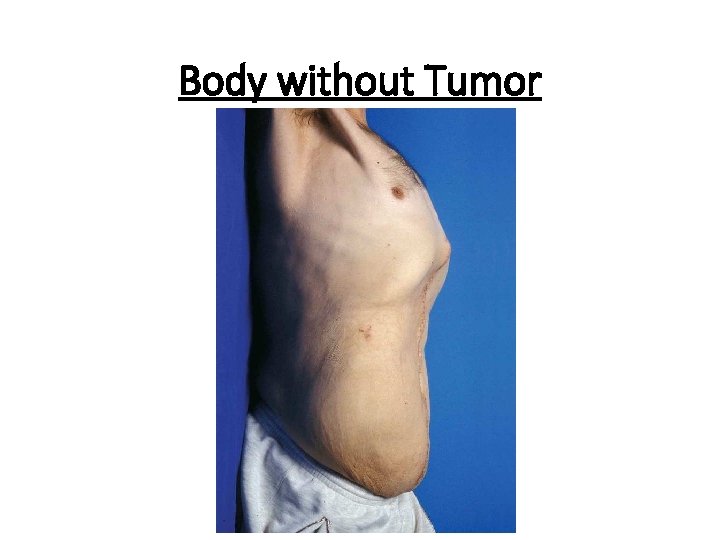
Body without Tumor
Cancer n Occasionally, cells ________ of the cell cycle n This results from: n failure to produce certain enzymes, n the overproduction of enzymes n Or the production of enzymes at the wrong time.
Cancer • Cancer is a malignant growth resulting from _____________________ • Malignant =dangerous to health; marked by uncontrolled growth
Cancer • _____ is the _____ leading cause of death in the U. S. • Lung, colon, breast, and prostate cancers are the most prevalent types
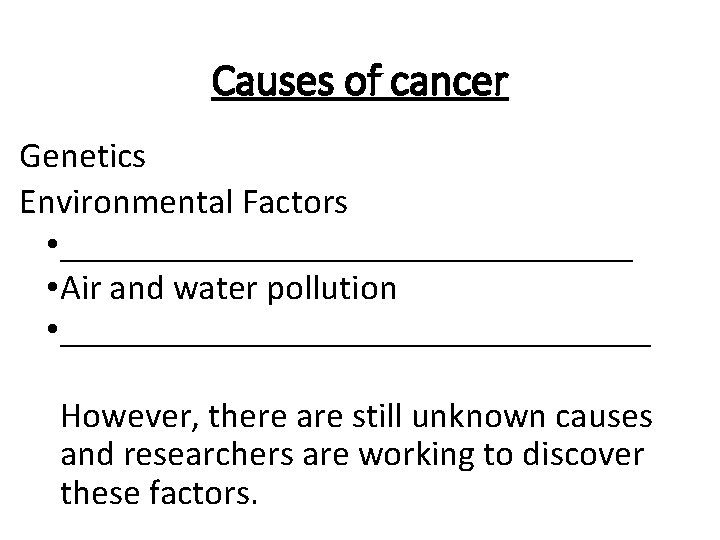
Causes of cancer Genetics Environmental Factors • ________________ • Air and water pollution • _________________ However, there are still unknown causes and researchers are working to discover these factors.
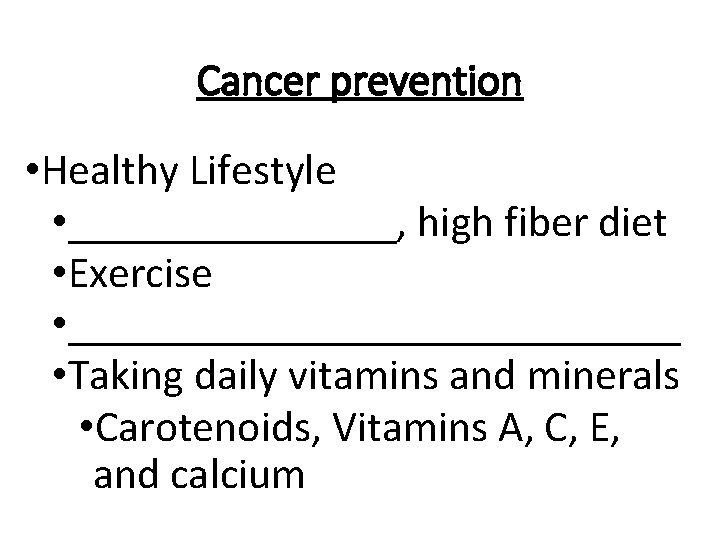
Cancer prevention • Healthy Lifestyle • ________, high fiber diet • Exercise • ______________ • Taking daily vitamins and minerals • Carotenoids, Vitamins A, C, E, and calcium
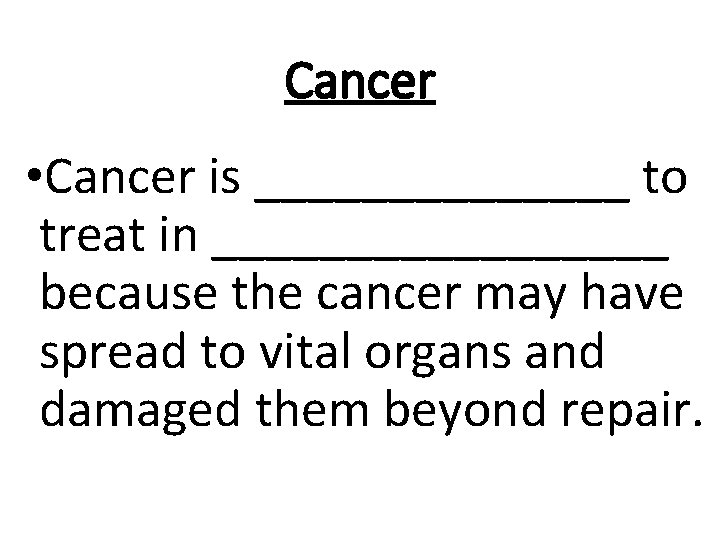
Cancer • Cancer is _______ to treat in _________ because the cancer may have spread to vital organs and damaged them beyond repair.