
Mitigation System THE NATIONAL CLIMATE CHANGE RESPONSE POLICY




- Slides: 22
Mitigation System THE NATIONAL CLIMATE CHANGE RESPONSE POLICY National Climate Change Response Policy 26 May 2015
Overview § Greenhouse Gas Inventory § MPA summary § Mitigation System § Supporting Projects
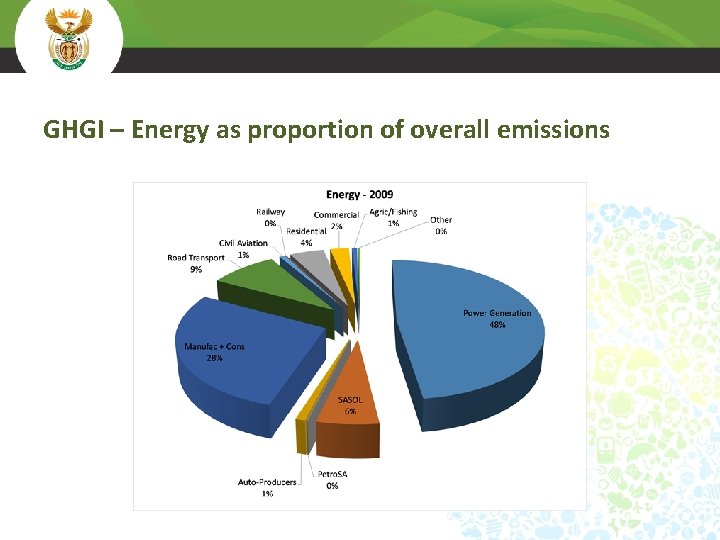
GHGI – Energy as proportion of overall emissions
South Africa’s Greenhouse Gas Mitigation Potential Analysis
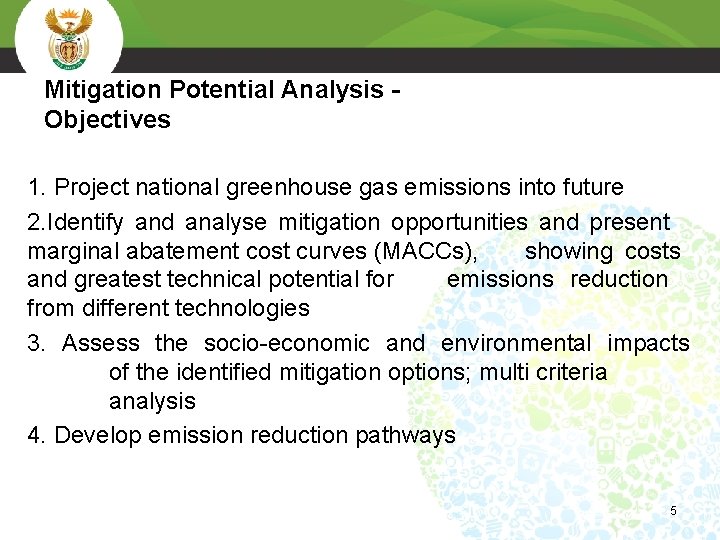
Mitigation Potential Analysis Objectives 1. Project national greenhouse gas emissions into future 2. Identify and analyse mitigation opportunities and present marginal abatement cost curves (MACCs), showing costs and greatest technical potential for emissions reduction from different technologies 3. Assess the socio-economic and environmental impacts of the identified mitigation options; multi criteria analysis 4. Develop emission reduction pathways 5
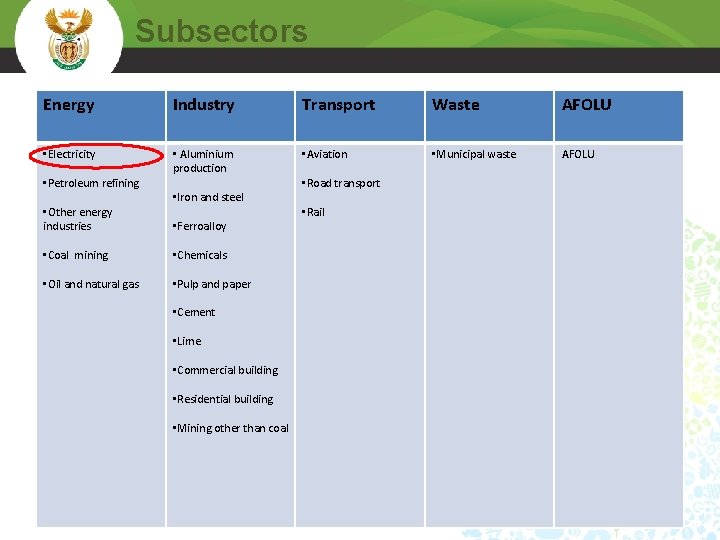
Subsectors Energy Industry Transport Waste AFOLU • Electricity • Aluminium production • Aviation • Municipal waste AFOLU • Petroleum refining • Other energy industries • Iron and steel • Ferroalloy • Coal mining • Chemicals • Oil and natural gas • Pulp and paper • Cement • Lime • Commercial building • Residential building • Mining other than coal • Road transport • Rail
MITIGATION POTENTIAL
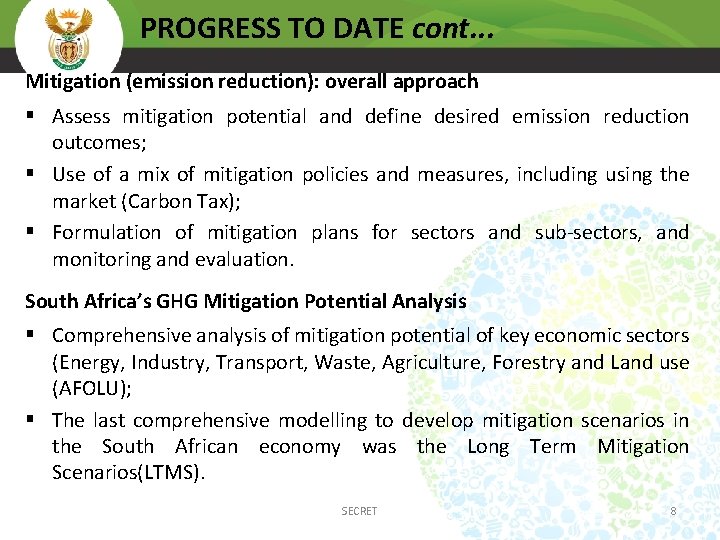
PROGRESS TO DATE cont. . . Mitigation (emission reduction): overall approach § Assess mitigation potential and define desired emission reduction outcomes; § Use of a mix of mitigation policies and measures, including using the market (Carbon Tax); § Formulation of mitigation plans for sectors and sub-sectors, and monitoring and evaluation. South Africa’s GHG Mitigation Potential Analysis § Comprehensive analysis of mitigation potential of key economic sectors (Energy, Industry, Transport, Waste, Agriculture, Forestry and Land use (AFOLU); § The last comprehensive modelling to develop mitigation scenarios in the South African economy was the Long Term Mitigation Scenarios(LTMS). SECRET 8
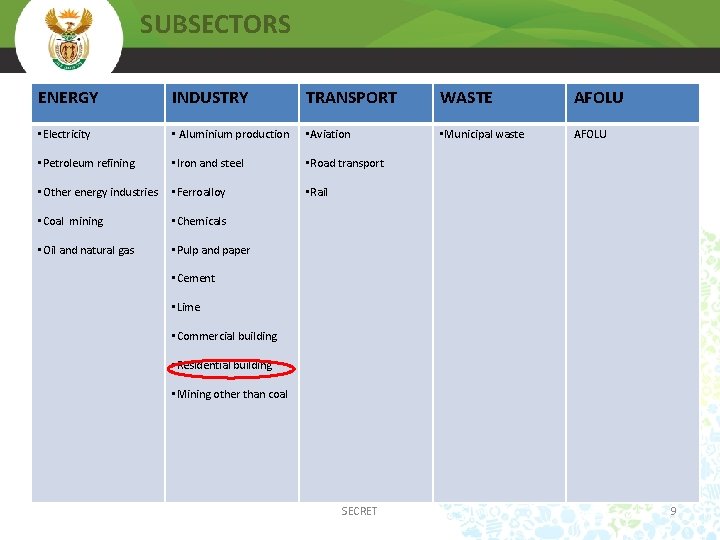
SUBSECTORS ENERGY INDUSTRY TRANSPORT WASTE AFOLU • Electricity • Aluminium production • Aviation • Municipal waste AFOLU • Petroleum refining • Iron and steel • Road transport • Other energy industries • Ferroalloy • Rail • Coal mining • Chemicals • Oil and natural gas • Pulp and paper • Cement • Lime • Commercial building • Residential building • Mining other than coal SECRET 9
SOUTH AFRICA'S GREENHOUSE GAS MITIGATION POTENTIAL ANALYSIS - OBJECTIVES • Project national greenhouse gas emissions into future; • Identify and analyse mitigation opportunities and present marginal abatement cost curves (MACCs), showing costs and greatest technical potential for emissions reduction from different technologies; • Assess the socio-economic and environmental impacts of the identified mitigation options; multi criteria analysis; • Develop emission reduction pathways ü Set of reduction trajectories over time, which is technologically achievable; ü Pathway merely identifies what is technically possible without providing a detailed description of how that outcome would be achieved. SECRET 10
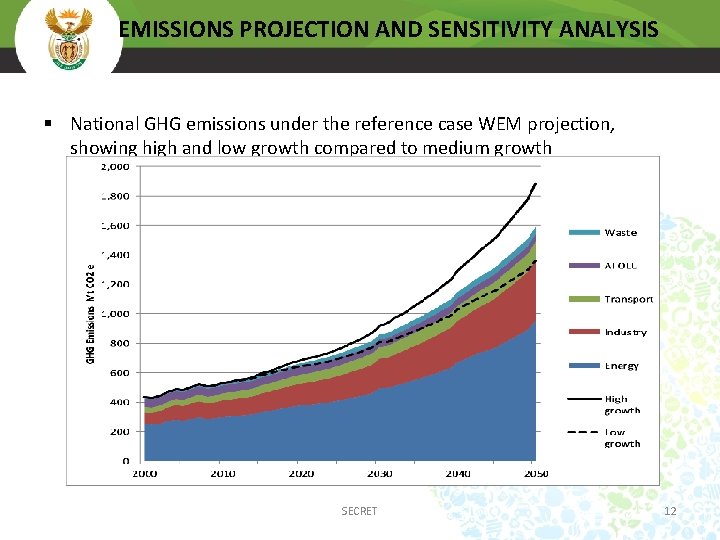
PROJECTING GHG EMISSIONS • “Bottom up” approach: models constructed for each subsector; • The projection uses historic emissions from the Draft Greenhouse Gas Inventory (GHGI) update (2010): ü Fuel activity data from GHGI; ü Electricity consumption data from Do. E Energy Balances; ü Emission sources which are not included in the current GHGI were not included in projections due to a lack of data; ü GDP growth assumptions tied to the National Development Plan (moderate growth to 2050 = 4. 2%); ü Sensitivity analysis based on low growth (3. 8%) & high growth (5. 4%). • Reference Case: 2000 – 2050: assumes no mitigation: ü “Without Measures” (WOM): 556 Mt. CO 2 e in 2010, reaching 906 Mt. CO 2 e by 2030, and 1, 695 Mt. CO 2 e by 2050; ü “With Existing Measures” (WEM) - impacts of existing policy (e. g. IRP 2010) and measures; 27 Mt. CO 2 e lower in 2010; 102 Mt. CO 2 e lower in 2050. SECRET 11
EMISSIONS PROJECTION AND SENSITIVITY ANALYSIS § National GHG emissions under the reference case WEM projection, showing high and low growth compared to medium growth SECRET 12
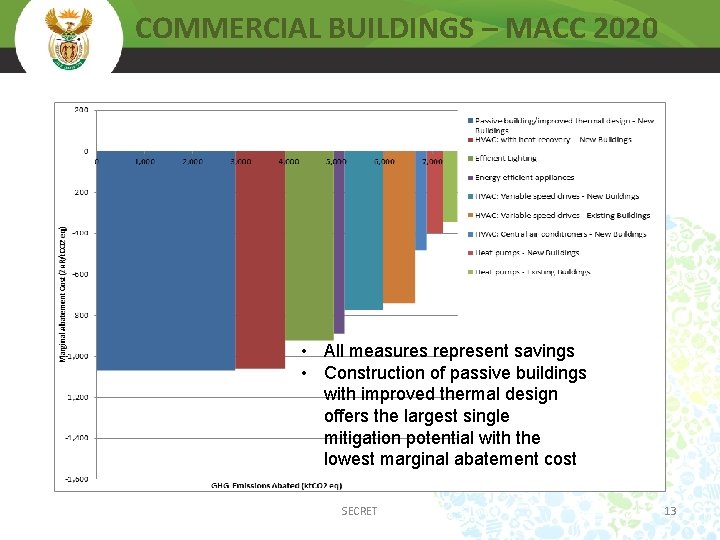
COMMERCIAL BUILDINGS – MACC 2020 • All measures represent savings • Construction of passive buildings with improved thermal design offers the largest single mitigation potential with the lowest marginal abatement cost SECRET 13
Power Sector
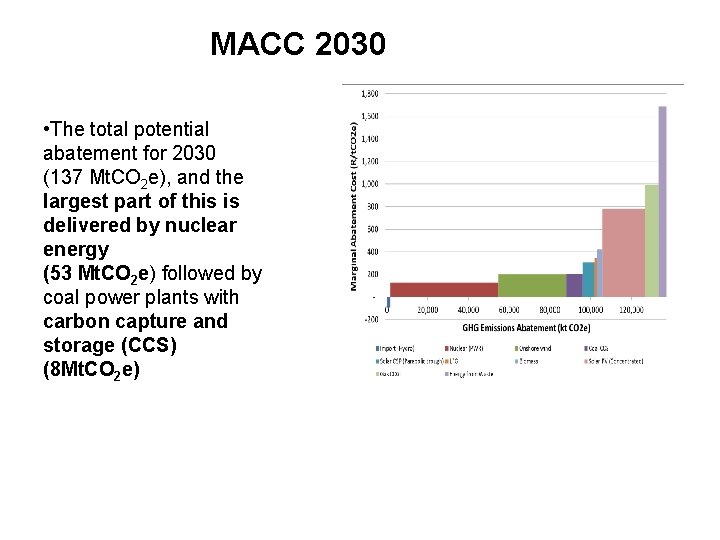
MACC 2030 • The total potential abatement for 2030 (137 Mt. CO 2 e), and the largest part of this is delivered by nuclear energy (53 Mt. CO 2 e) followed by coal power plants with carbon capture and storage (CCS) (8 Mt. CO 2 e)
NATIONAL
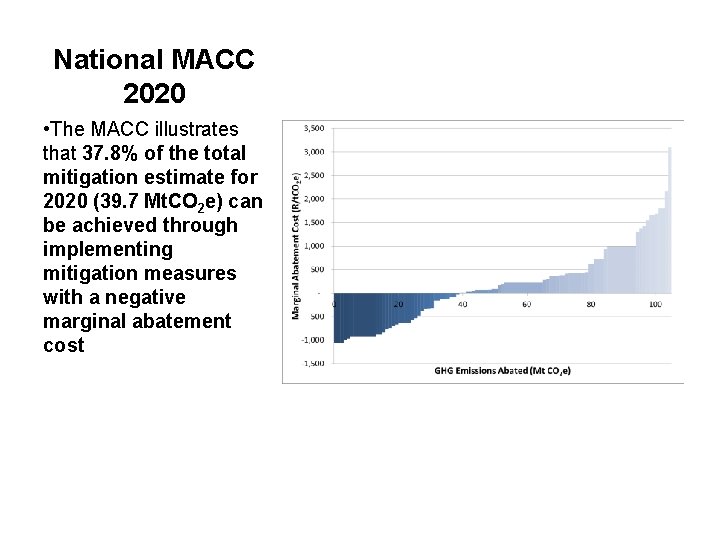
National MACC 2020 • The MACC illustrates that 37. 8% of the total mitigation estimate for 2020 (39. 7 Mt. CO 2 e) can be achieved through implementing mitigation measures with a negative marginal abatement cost
Towards a national mitigation system
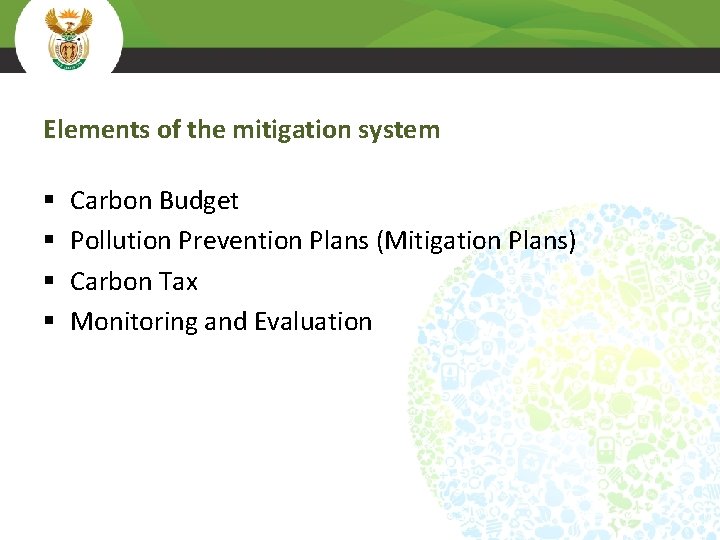
Elements of the mitigation system § § Carbon Budget Pollution Prevention Plans (Mitigation Plans) Carbon Tax Monitoring and Evaluation
Carbon Budgets § Means of regulating emission of greenhouse gases § Greenhouse gas emission allowance § Cbudget system: ü Budget for each company ü Reporting system ü Compliance process § Phased approach: ü First phase will run from 2016 to 2020 (5 years) ü Second phase – 2021 onwards (5 year periods)
Supporting Projects § Mitigation technology plan: assess opportunities and barriers for the development and large-scale deployment of the key mitigation technologies - DST leading § National Employment vulnerability assessment: assess impact on jobs, by sector – EDD leading § Socio-economic impact: assess impact of mitigation work