
Mitigation of Newtonian Noise Using Superconducting Gravity Gradiometer
- Slides: 13
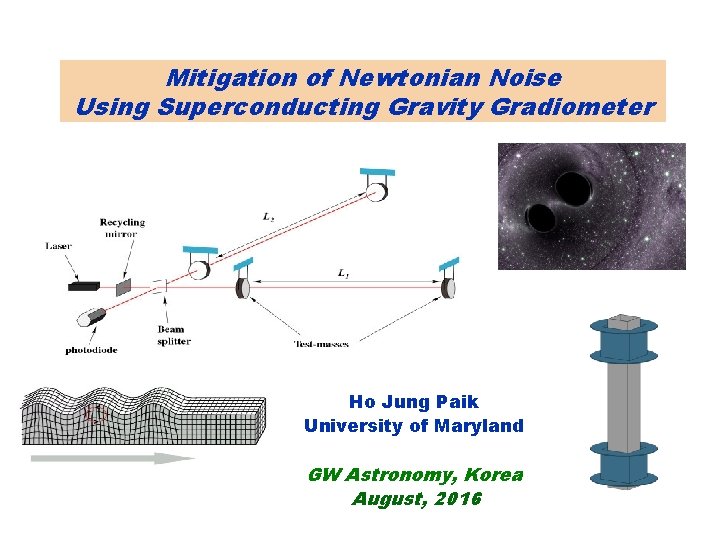
Mitigation of Newtonian Noise Using Superconducting Gravity Gradiometer Ho Jung Paik University of Maryland GW Astronomy, Korea August, 2016
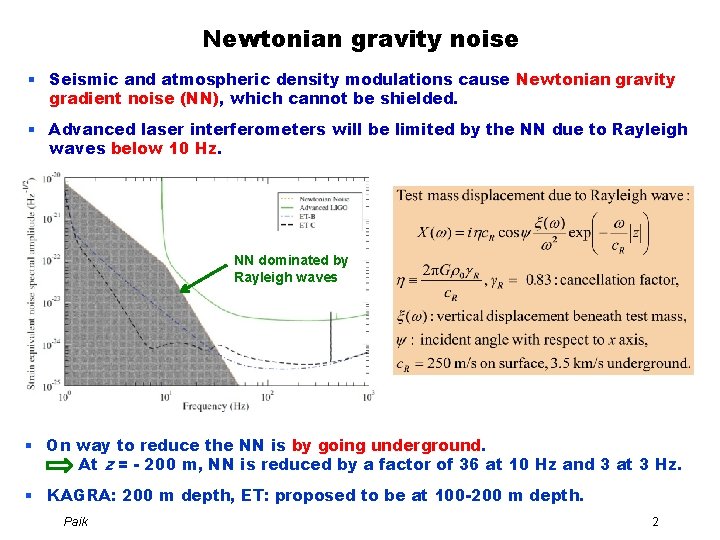
Newtonian gravity noise § Seismic and atmospheric density modulations cause Newtonian gravity gradient noise (NN), which cannot be shielded. § Advanced laser interferometers will be limited by the NN due to Rayleigh waves below 10 Hz. NN dominated by Rayleigh waves § On way to reduce the NN is by going underground. At z = - 200 m, NN is reduced by a factor of 36 at 10 Hz and 3 at 3 Hz. § KAGRA: 200 m depth, ET: proposed to be at 100 -200 m depth. Paik 2
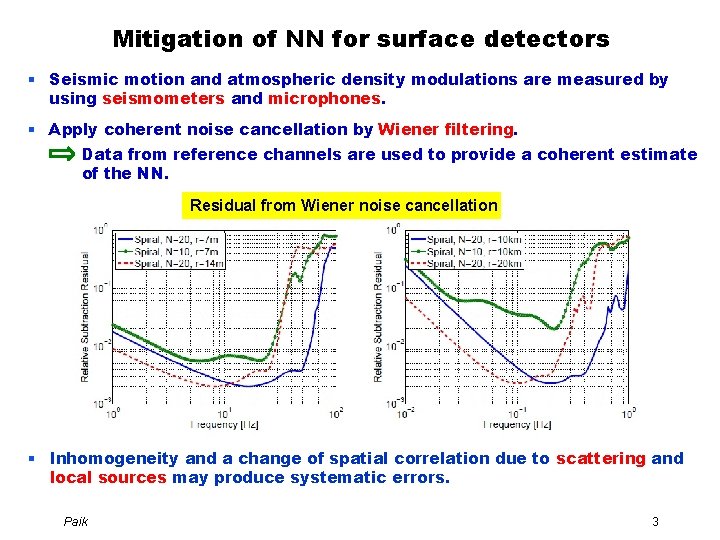
Mitigation of NN for surface detectors § Seismic motion and atmospheric density modulations are measured by using seismometers and microphones. § Apply coherent noise cancellation by Wiener filtering. Data from reference channels are used to provide a coherent estimate of the NN. Residual from Wiener noise cancellation § Inhomogeneity and a change of spatial correlation due to scattering and local sources may produce systematic errors. Paik 3
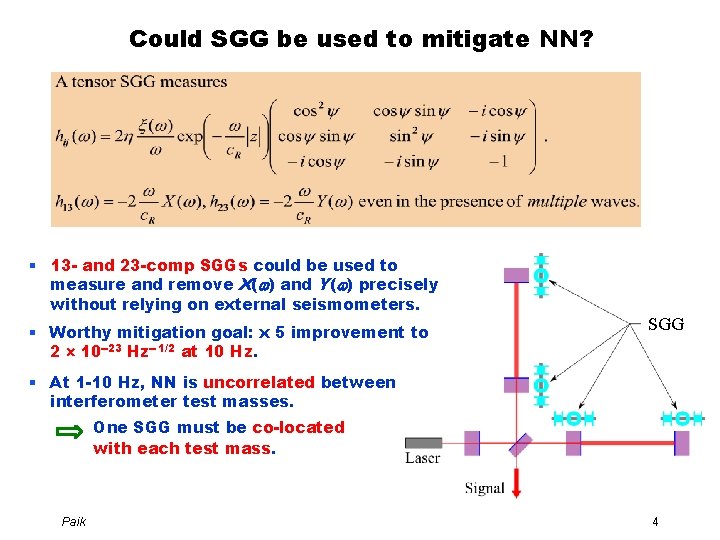
Could SGG be used to mitigate NN? § 13 - and 23 -comp SGGs could be used to measure and remove X( ) and Y( ) precisely without relying on external seismometers. § Worthy mitigation goal: x 5 improvement to 2 10 23 Hz 1/2 at 10 Hz. SGG § At 1 -10 Hz, NN is uncorrelated between interferometer test masses. One SGG must be co-located with each test mass. Paik 4
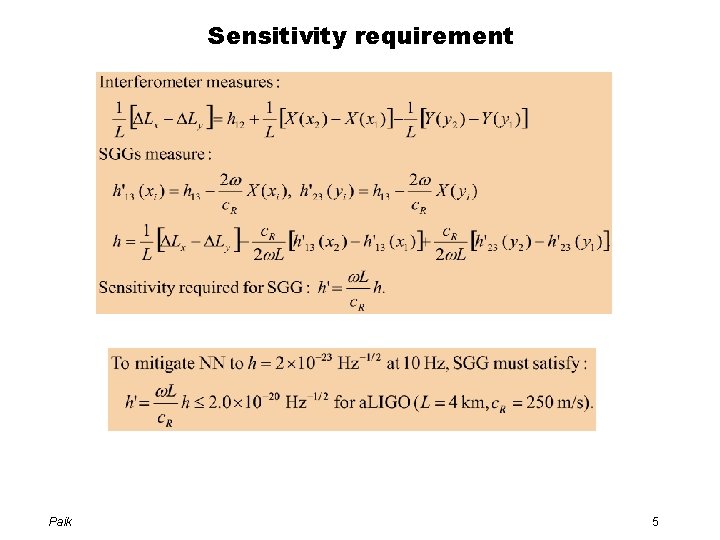
Sensitivity requirement Paik 5
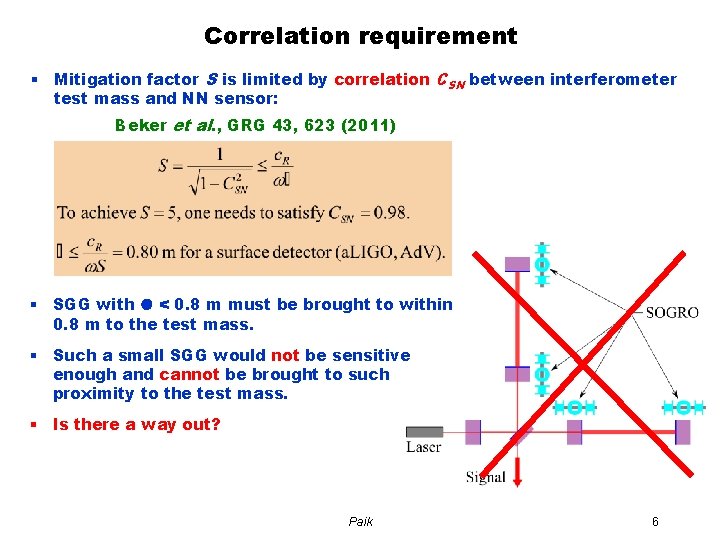
Correlation requirement § Mitigation factor S is limited by correlation CSN between interferometer test mass and NN sensor: Beker et al. , GRG 43, 623 (2011) § SGG with < 0. 8 m must be brought to within 0. 8 m to the test mass. § Such a small SGG would not be sensitive enough and cannot be brought to such proximity to the test mass. § Is there a way out? Paik 6
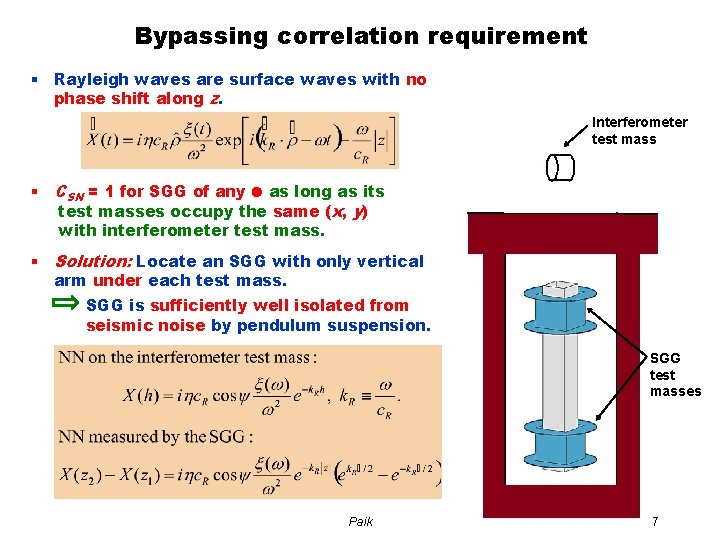
Bypassing correlation requirement § Rayleigh waves are surface waves with no phase shift along z. Interferometer test mass § CSN = 1 for SGG of any as long as its test masses occupy the same (x, y) with interferometer test mass. § Solution: Locate an SGG with only vertical arm under each test mass. SGG is sufficiently well isolated from seismic noise by pendulum suspension. SGG test masses Paik 7
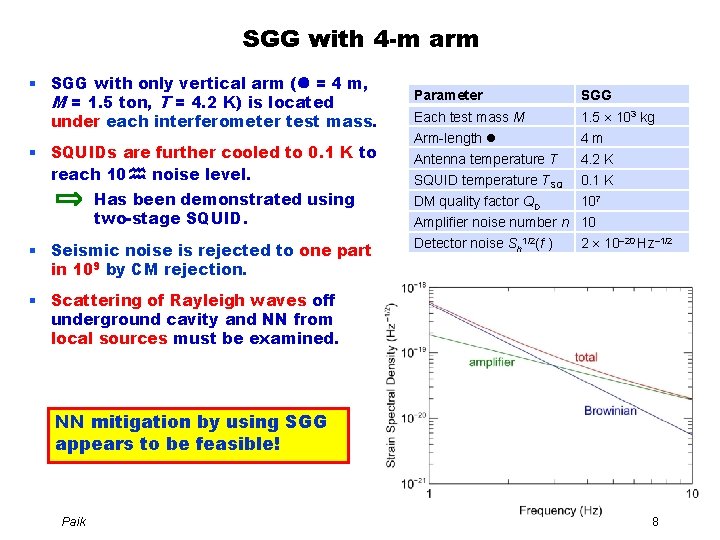
SGG with 4 -m arm § SGG with only vertical arm ( = 4 m, M = 1. 5 ton, T = 4. 2 K) is located under each interferometer test mass. Parameter SGG Each test mass M 1. 5 103 kg § SQUIDs are further cooled to 0. 1 K to reach 10 noise level. Arm-length 4 m Antenna temperature T 4. 2 K SQUID temperature TSQ 0. 1 K DM quality factor QD 107 Has been demonstrated using two-stage SQUID. § Seismic noise is rejected to one part in 109 by CM rejection. Amplifier noise number n 10 Detector noise Sh 1/2(f ) 2 10 20 Hz 1/2 § Scattering of Rayleigh waves off underground cavity and NN from local sources must be examined. NN mitigation by using SGG appears to be feasible! Paik 8
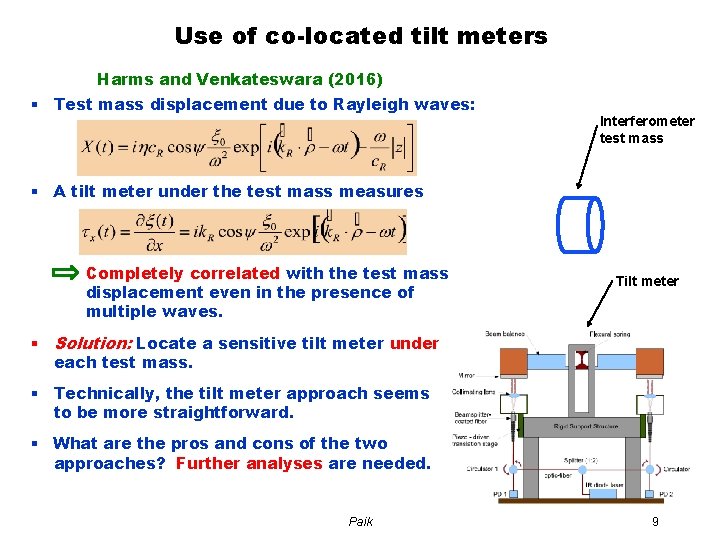
Use of co-located tilt meters Harms and Venkateswara (2016) § Test mass displacement due to Rayleigh waves: Interferometer test mass § A tilt meter under the test mass measures Completely correlated with the test mass displacement even in the presence of multiple waves. Tilt meter § Solution: Locate a sensitive tilt meter under each test mass. § Technically, the tilt meter approach seems to be more straightforward. § What are the pros and cons of the two approaches? Further analyses are needed. Paik 9
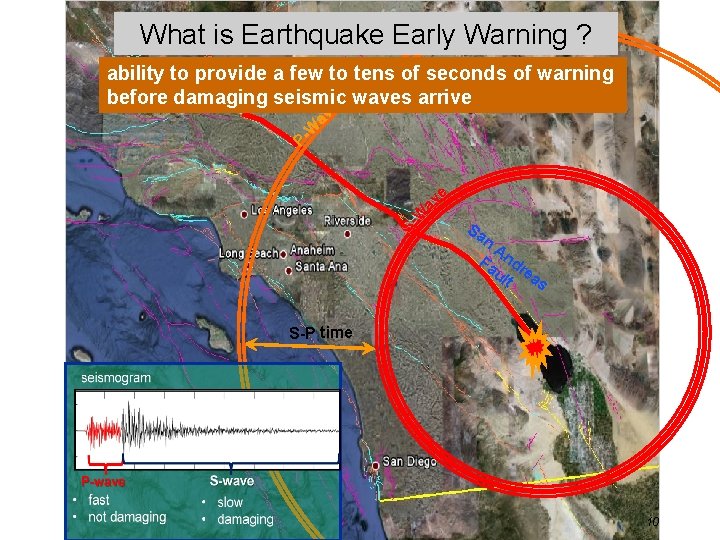
What is Earthquake Early Warning ? S -W av e P -W av e ability to provide a few to tens of seconds of warning before damaging seismic waves arrive Sa n A Fa ndr ul ea t s S-P time 10
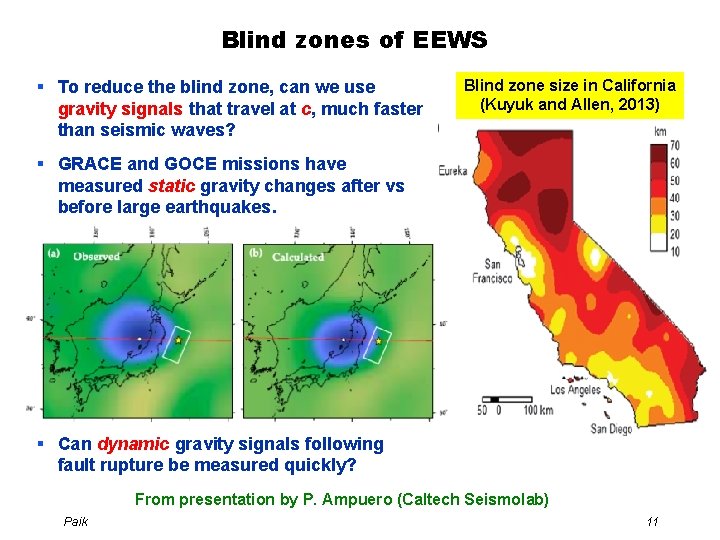
Blind zones of EEWS § To reduce the blind zone, can we use gravity signals that travel at c, much faster than seismic waves? Blind zone size in California (Kuyuk and Allen, 2013) § GRACE and GOCE missions have measured static gravity changes after vs before large earthquakes. § Can dynamic gravity signals following fault rupture be measured quickly? From presentation by P. Ampuero (Caltech Seismolab) Paik 11
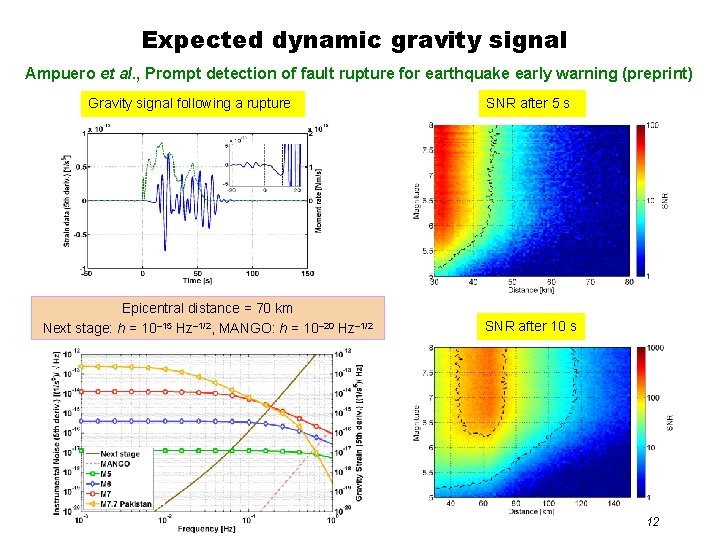
Expected dynamic gravity signal Ampuero et al. , Prompt detection of fault rupture for earthquake early warning (preprint) Gravity signal following a rupture Epicentral distance = 70 km Next stage: h = 10 15 Hz 1/2, MANGO: h = 10 20 Hz 1/2 Paik SNR after 5 s SNR after 10 s 12
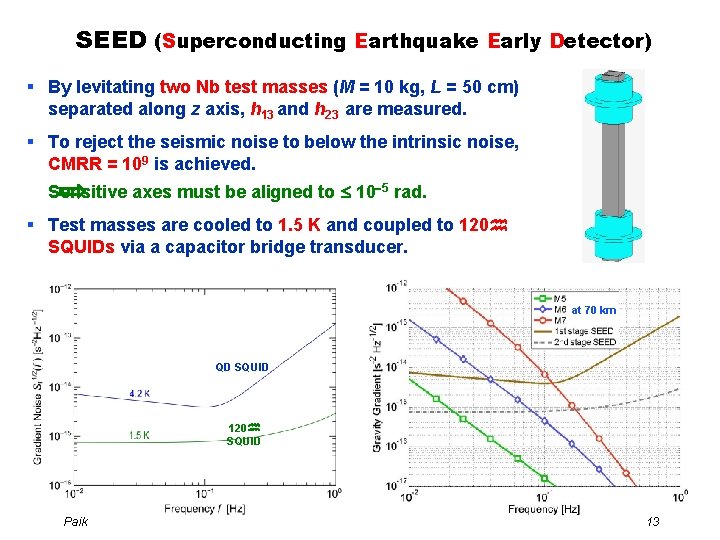
SEED (Superconducting Earthquake Early Detector) § By levitating two Nb test masses (M = 10 kg, L = 50 cm) separated along z axis, h 13 and h 23 are measured. § To reject the seismic noise to below the intrinsic noise, CMRR = 109 is achieved. Sensitive axes must be aligned to 10 5 rad. § Test masses are cooled to 1. 5 K and coupled to 120 SQUIDs via a capacitor bridge transducer. at 70 km QD SQUID 120 SQUID Paik 13