
Mitigating Environmental Emissions from the Power Sector Analysis
- Slides: 37
Mitigating Environmental Emissions from the Power Sector: Analysis of Technical and Policy Options in Selected Asian Countries Ram M. Shrestha S. C. Bhattacharya Asian Regional Research Programme in Energy, Environment and Climate (ARRPEEC) Asian Institute of Technology, Thailand COP 8, 01 November 2002, New Delhi, India 1
Overview of presentation ARRPEEC power sector project l Status of power sector l Least cost generation options under CO 2 emission targets l Identification of some CDM projects l Conclusions l AIT COP 8, 01 November 2002, New Delhi, India 2
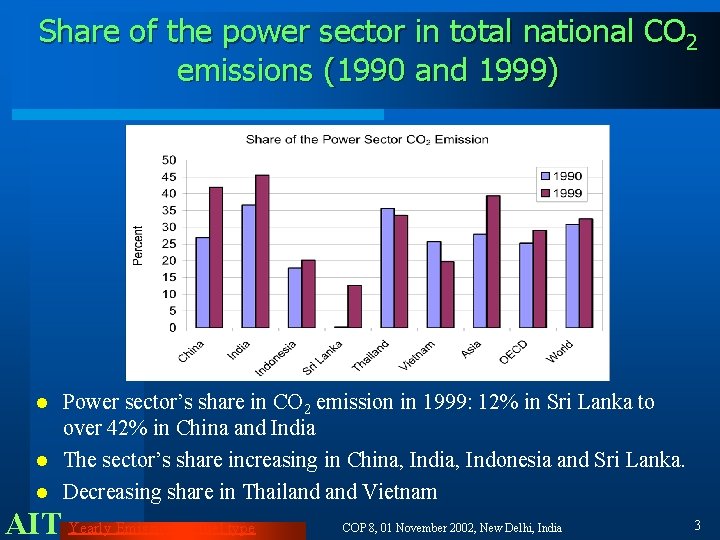
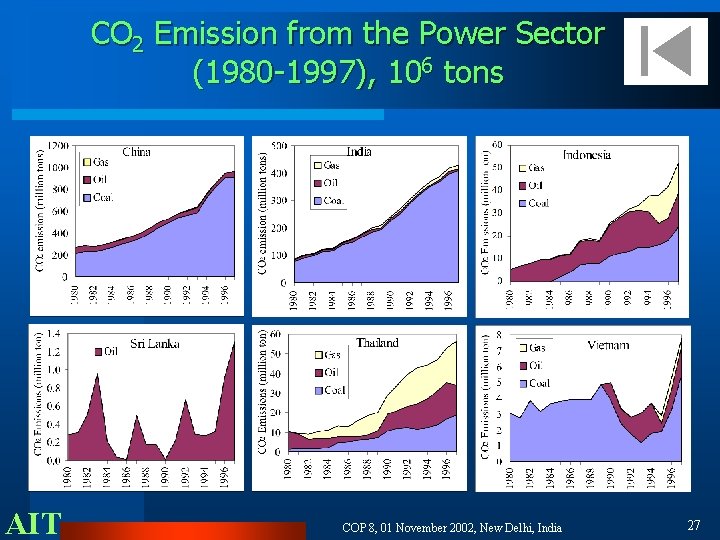
Share of the power sector in total national CO 2 emissions (1990 and 1999) l l l Power sector’s share in CO 2 emission in 1999: 12% in Sri Lanka to over 42% in China and India The sector’s share increasing in China, India, Indonesia and Sri Lanka. Decreasing share in Thailand Vietnam AIT Yearly Emission by fuel type COP 8, 01 November 2002, New Delhi, India 3
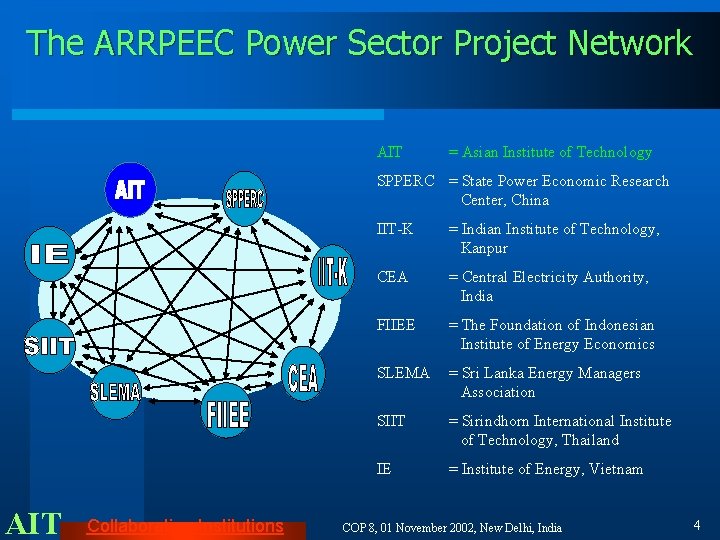
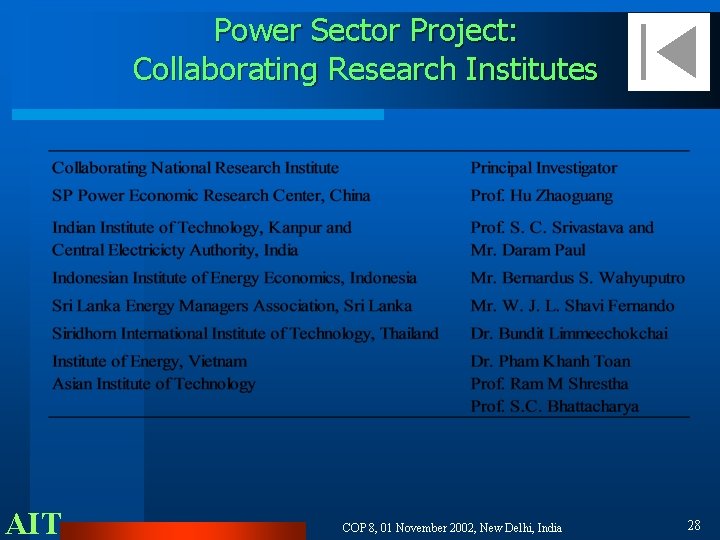
The ARRPEEC Power Sector Project Network AIT = Asian Institute of Technology SPPERC = State Power Economic Research Center, China AIT Collaborating Institutions IIT-K = Indian Institute of Technology, Kanpur CEA = Central Electricity Authority, India FIIEE = The Foundation of Indonesian Institute of Energy Economics SLEMA = Sri Lanka Energy Managers Association SIIT = Sirindhorn International Institute of Technology, Thailand IE = Institute of Energy, Vietnam COP 8, 01 November 2002, New Delhi, India 4
The ARRPEEC Power Sector Project: Specific Objectives l Determination of least cost supply-side options for GHG and other harmful emissions mitigation subject to CO 2 emission targets, l Identification of some CDM projects and assessment of their GHG and other harmful emissions mitigation potential l Assessment of environmental implications of Independent Power Producers (IPPs) and Distributed Power Generation (DPG) AIT COP 8, 01 November 2002, New Delhi, India 5
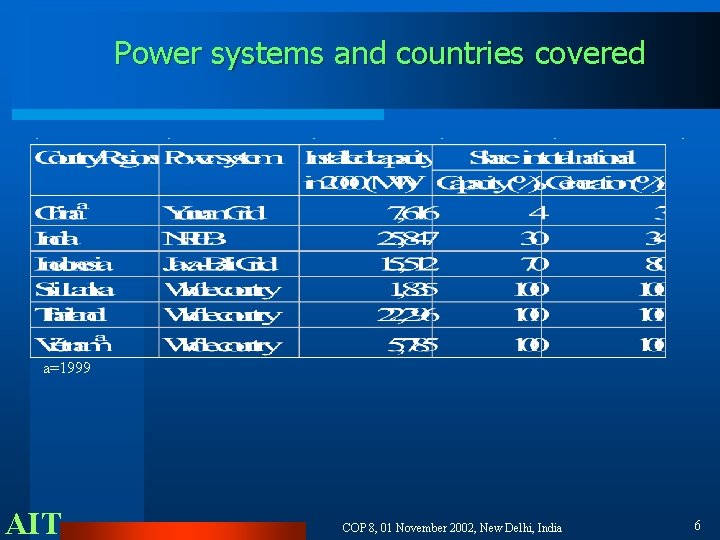
Power systems and countries covered a=1999 AIT COP 8, 01 November 2002, New Delhi, India 6
Research approach & planning horizon l Least cost power generation planning model l Planning horizon: 2003 to 2017 AIT COP 8, 01 November 2002, New Delhi, India 7
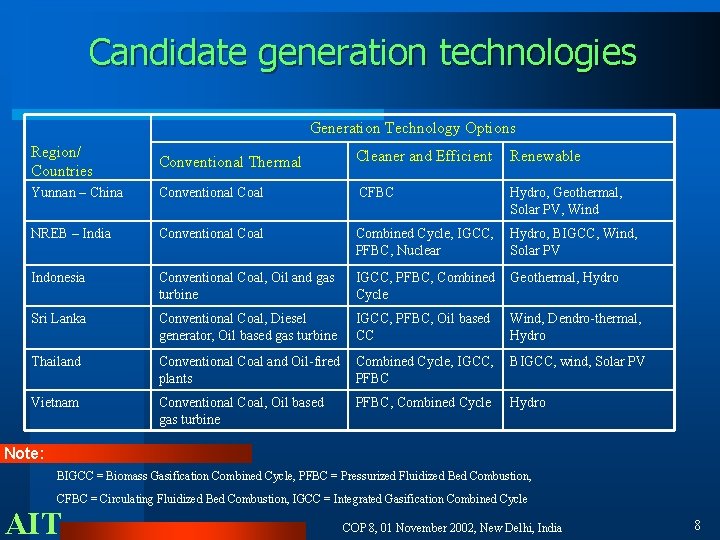
Candidate generation technologies Generation Technology Options Region/ Countries Conventional Thermal Cleaner and Efficient Renewable Yunnan – China Conventional Coal CFBC Hydro, Geothermal, Solar PV, Wind NREB – India Conventional Combined Cycle, IGCC, PFBC, Nuclear Hydro, BIGCC, Wind, Solar PV Indonesia Conventional Coal, Oil and gas turbine IGCC, PFBC, Combined Cycle Geothermal, Hydro Sri Lanka Conventional Coal, Diesel generator, Oil based gas turbine IGCC, PFBC, Oil based CC Wind, Dendro-thermal, Hydro Thailand Conventional Coal and Oil-fired plants Combined Cycle, IGCC, PFBC BIGCC, wind, Solar PV Vietnam Conventional Coal, Oil based gas turbine PFBC, Combined Cycle Hydro Note: BIGCC = Biomass Gasification Combined Cycle, PFBC = Pressurized Fluidized Bed Combustion, CFBC = Circulating Fluidized Bed Combustion, IGCC = Integrated Gasification Combined Cycle AIT COP 8, 01 November 2002, New Delhi, India 8
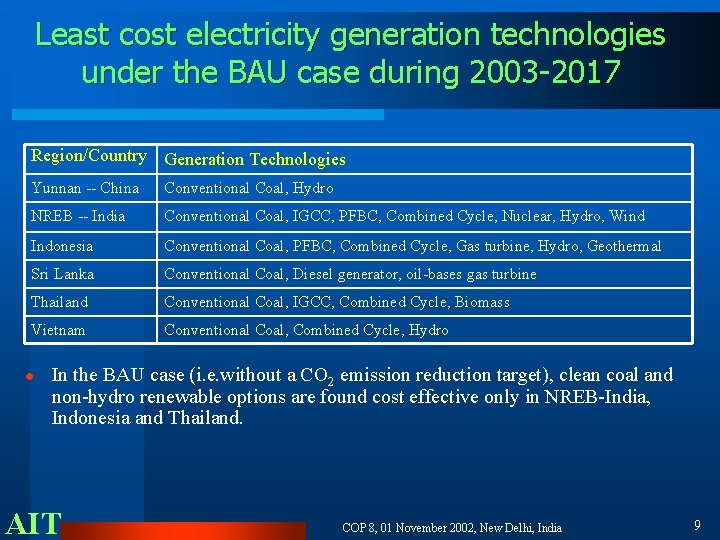
Least cost electricity generation technologies under the BAU case during 2003 -2017 Region/Country Generation Technologies Yunnan -- China Conventional Coal, Hydro NREB -- India Conventional Coal, IGCC, PFBC, Combined Cycle, Nuclear, Hydro, Wind Indonesia Conventional Coal, PFBC, Combined Cycle, Gas turbine, Hydro, Geothermal Sri Lanka Conventional Coal, Diesel generator, oil-bases gas turbine Thailand Conventional Coal, IGCC, Combined Cycle, Biomass Vietnam Conventional Coal, Combined Cycle, Hydro l In the BAU case (i. e. without a CO 2 emission reduction target), clean coal and non-hydro renewable options are found cost effective only in NREB-India, Indonesia and Thailand. AIT COP 8, 01 November 2002, New Delhi, India 9
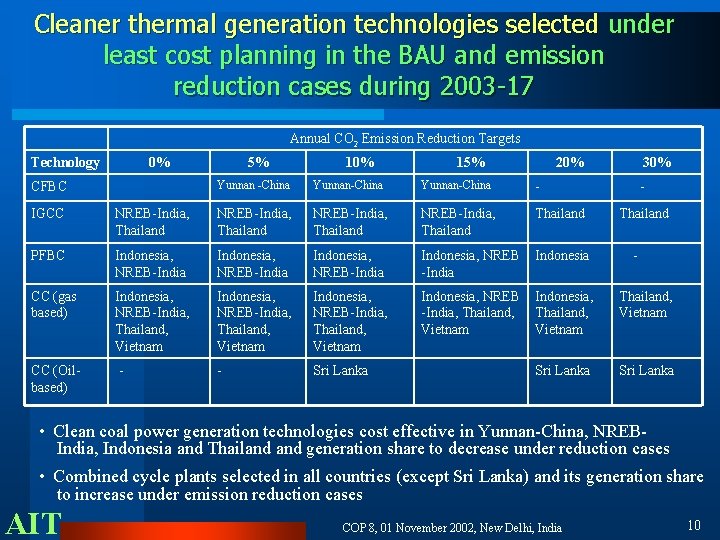
Cleaner thermal generation technologies selected under least cost planning in the BAU and emission reduction cases during 2003 -17 Annual CO 2 Emission Reduction Targets Technology 0% CFBC 5% 10% 15% 20% Yunnan -China Yunnan-China - 30% - IGCC NREB-India, Thailand Thailand PFBC Indonesia, NREB-India Indonesia, NREB -India Indonesia CC (gas based) Indonesia, NREB-India, Thailand, Vietnam Indonesia, NREB -India, Thailand, Vietnam Indonesia, Thailand, Vietnam CC (Oilbased) - - Sri Lanka - • Clean coal power generation technologies cost effective in Yunnan-China, NREBIndia, Indonesia and Thailand generation share to decrease under reduction cases • Combined cycle plants selected in all countries (except Sri Lanka) and its generation share to increase under emission reduction cases AIT COP 8, 01 November 2002, New Delhi, India 10
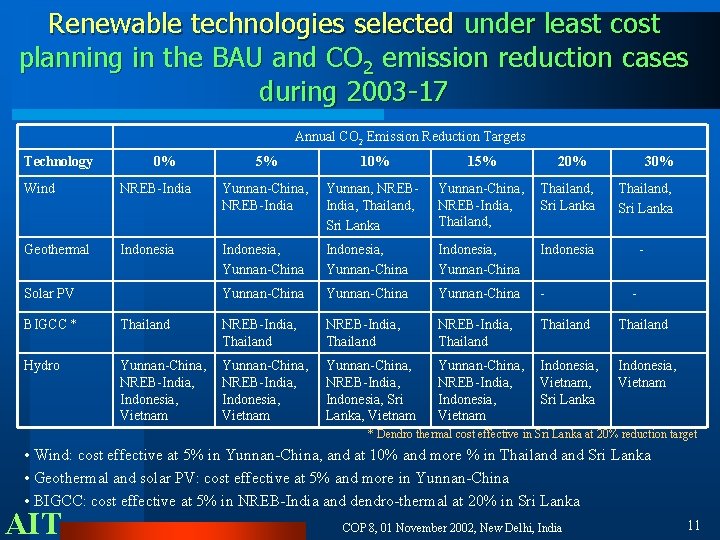
Renewable technologies selected under least cost planning in the BAU and CO 2 emission reduction cases during 2003 -17 Annual CO 2 Emission Reduction Targets Technology 0% 5% 10% 15% 20% 30% Wind NREB-India Yunnan-China, NREB-India Yunnan, NREBIndia, Thailand, Sri Lanka Yunnan-China, NREB-India, Thailand, Sri Lanka Geothermal Indonesia, Yunnan-China Indonesia - Yunnan-China - Solar PV - BIGCC * Thailand NREB-India, Thailand Hydro Yunnan-China, NREB-India, Indonesia, Vietnam Yunnan-China, NREB-India, Indonesia, Sri Lanka, Vietnam Yunnan-China, NREB-India, Indonesia, Vietnam, Sri Lanka Indonesia, Vietnam * Dendro thermal cost effective in Sri Lanka at 20% reduction target • Wind: cost effective at 5% in Yunnan-China, and at 10% and more % in Thailand Sri Lanka • Geothermal and solar PV: cost effective at 5% and more in Yunnan-China • BIGCC: cost effective at 5% in NREB-India and dendro-thermal at 20% in Sri Lanka AIT COP 8, 01 November 2002, New Delhi, India 11
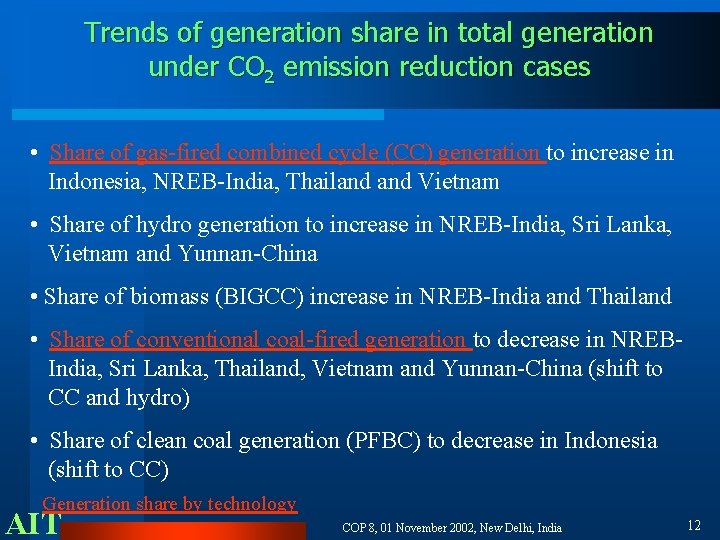
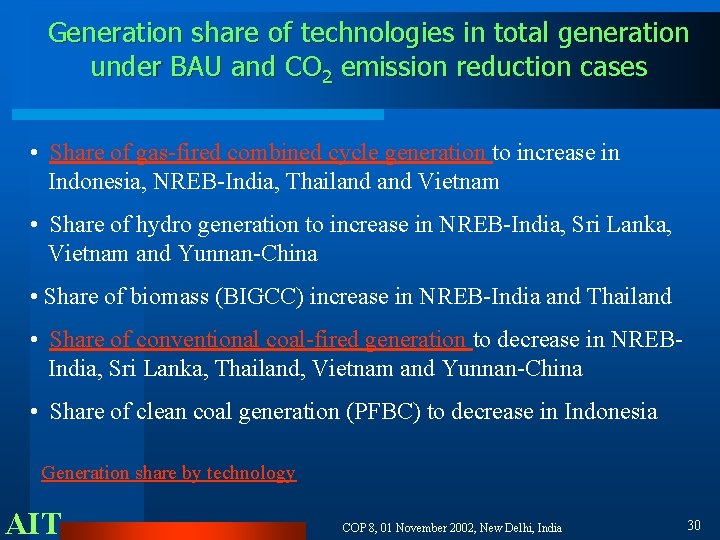
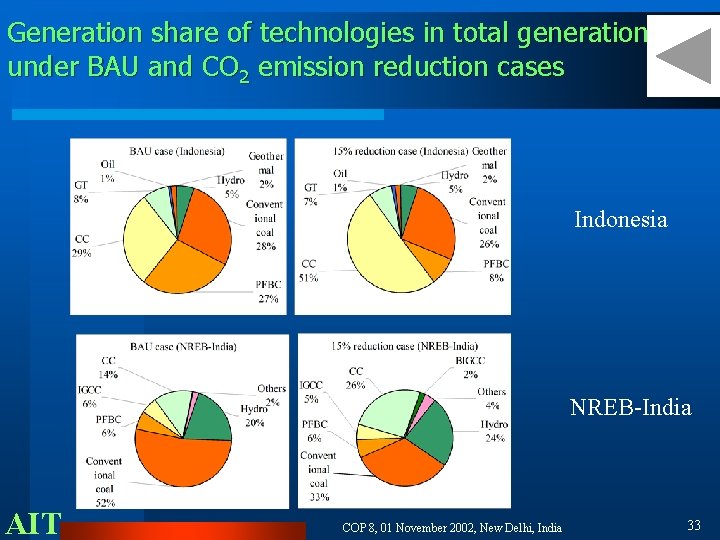
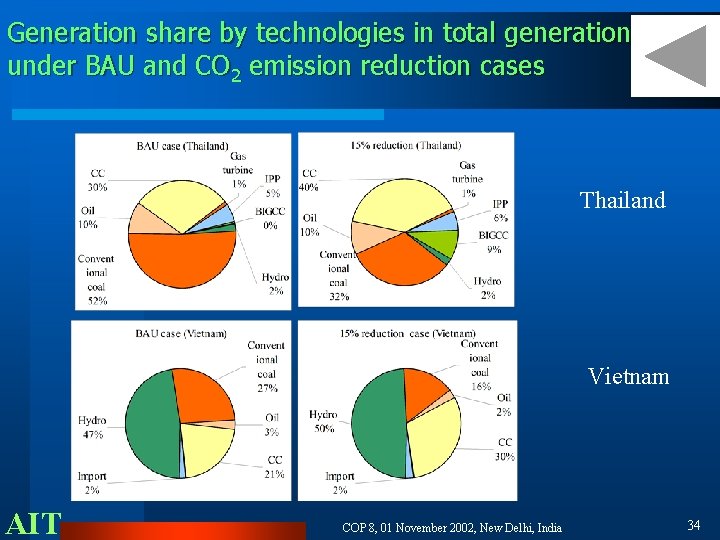
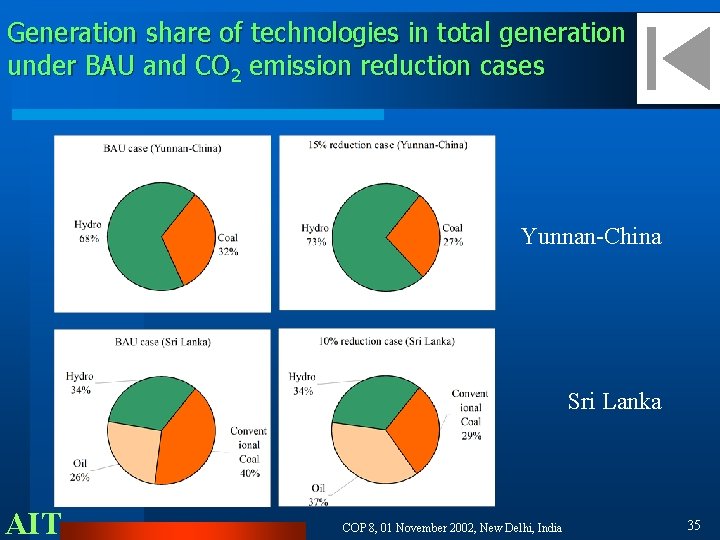
Trends of generation share in total generation under CO 2 emission reduction cases • Share of gas-fired combined cycle (CC) generation to increase in Indonesia, NREB-India, Thailand Vietnam • Share of hydro generation to increase in NREB-India, Sri Lanka, Vietnam and Yunnan-China • Share of biomass (BIGCC) increase in NREB-India and Thailand • Share of conventional coal-fired generation to decrease in NREBIndia, Sri Lanka, Thailand, Vietnam and Yunnan-China (shift to CC and hydro) • Share of clean coal generation (PFBC) to decrease in Indonesia (shift to CC) Generation share by technology AIT COP 8, 01 November 2002, New Delhi, India 12
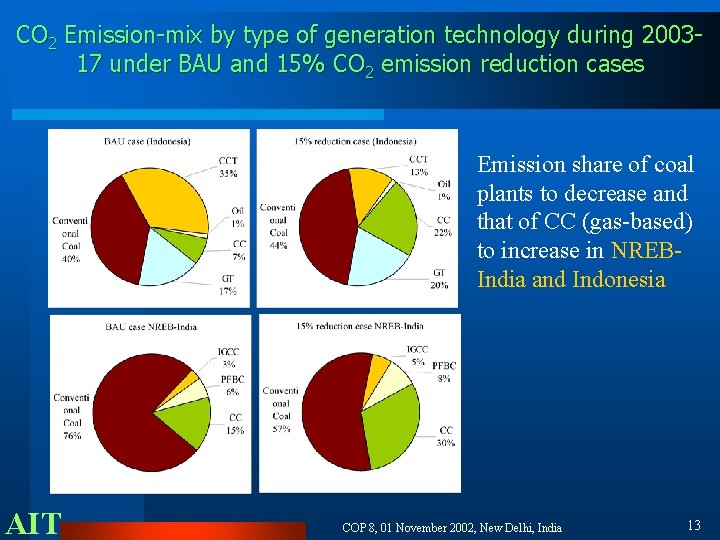
CO 2 Emission-mix by type of generation technology during 200317 under BAU and 15% CO 2 emission reduction cases Emission share of coal plants to decrease and that of CC (gas-based) to increase in NREBIndia and Indonesia AIT COP 8, 01 November 2002, New Delhi, India 13
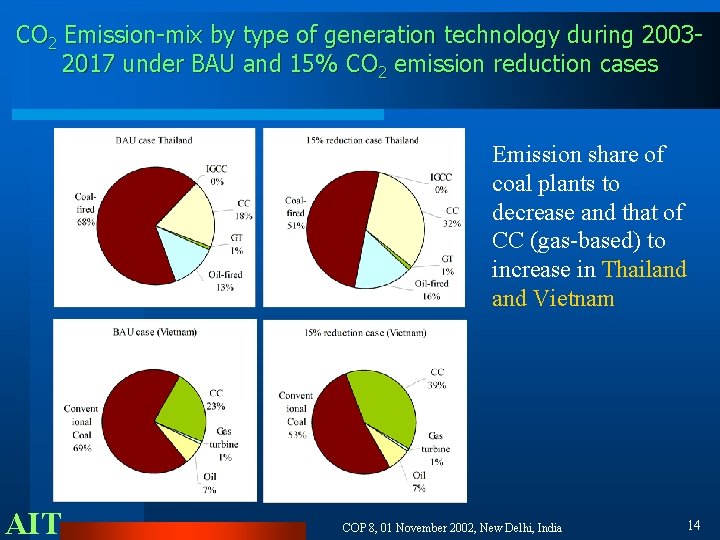
CO 2 Emission-mix by type of generation technology during 20032017 under BAU and 15% CO 2 emission reduction cases Emission share of coal plants to decrease and that of CC (gas-based) to increase in Thailand Vietnam AIT COP 8, 01 November 2002, New Delhi, India 14
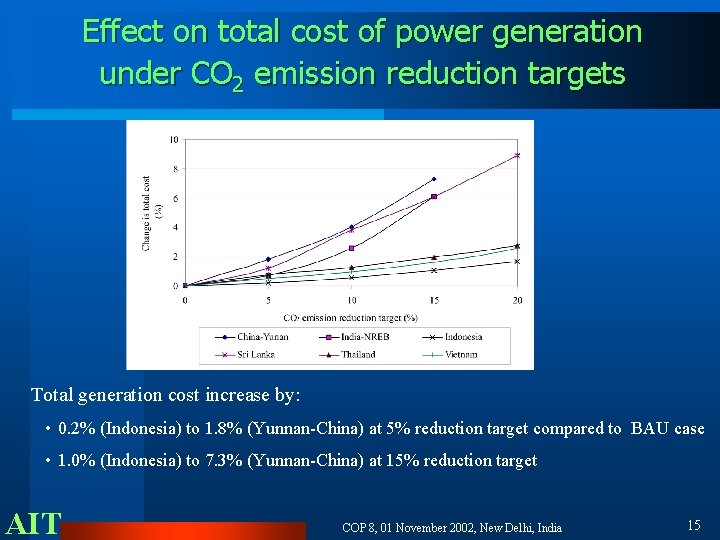
Effect on total cost of power generation under CO 2 emission reduction targets Total generation cost increase by: • 0. 2% (Indonesia) to 1. 8% (Yunnan-China) at 5% reduction target compared to BAU case • 1. 0% (Indonesia) to 7. 3% (Yunnan-China) at 15% reduction target AIT COP 8, 01 November 2002, New Delhi, India 15
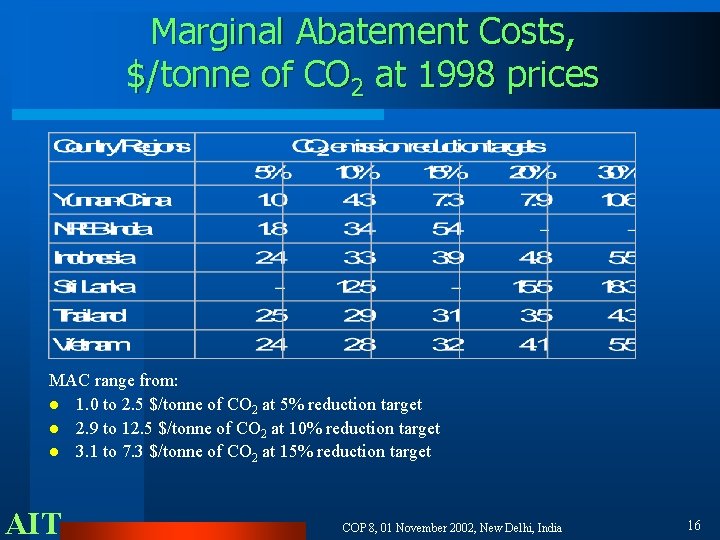
Marginal Abatement Costs, $/tonne of CO 2 at 1998 prices MAC range from: l 1. 0 to 2. 5 $/tonne of CO 2 at 5% reduction target l 2. 9 to 12. 5 $/tonne of CO 2 at 10% reduction target l 3. 1 to 7. 3 $/tonne of CO 2 at 15% reduction target AIT COP 8, 01 November 2002, New Delhi, India 16
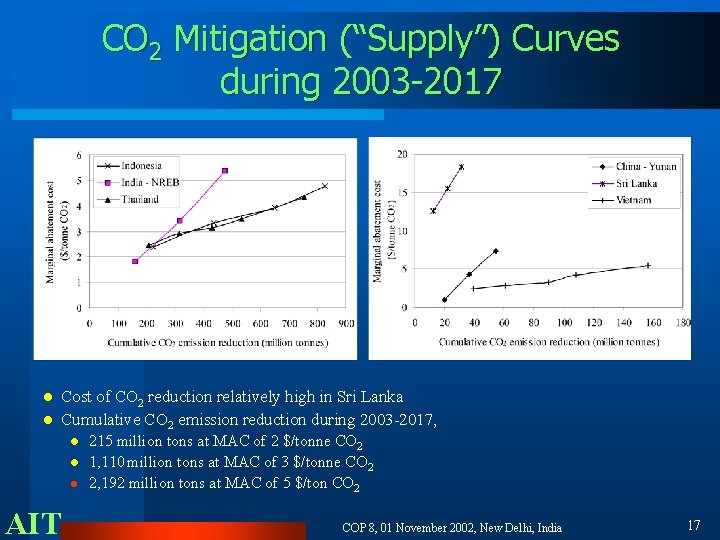
CO 2 Mitigation (“Supply”) Curves during 2003 -2017 l l Cost of CO 2 reduction relatively high in Sri Lanka Cumulative CO 2 emission reduction during 2003 -2017, l l l AIT 215 million tons at MAC of 2 $/tonne CO 2 1, 110 million tons at MAC of 3 $/tonne CO 2 2, 192 million tons at MAC of 5 $/ton CO 2 COP 8, 01 November 2002, New Delhi, India 17
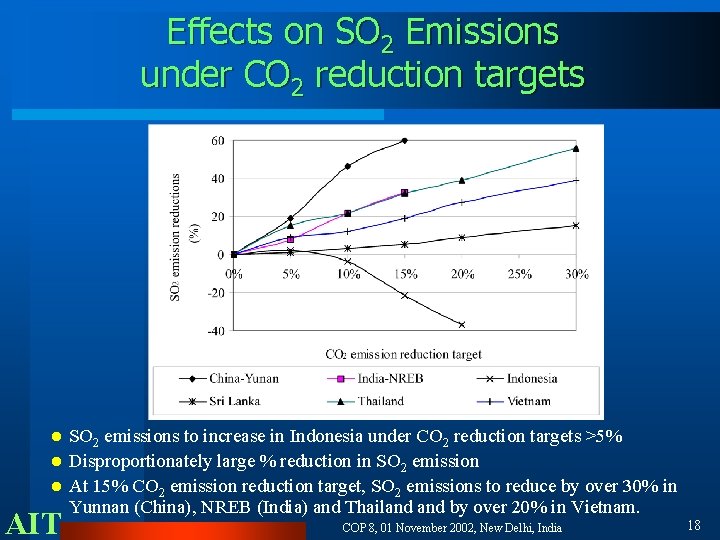
Effects on SO 2 Emissions under CO 2 reduction targets l l l AIT SO 2 emissions to increase in Indonesia under CO 2 reduction targets >5% Disproportionately large % reduction in SO 2 emission At 15% CO 2 emission reduction target, SO 2 emissions to reduce by over 30% in Yunnan (China), NREB (India) and Thailand by over 20% in Vietnam. COP 8, 01 November 2002, New Delhi, India 18
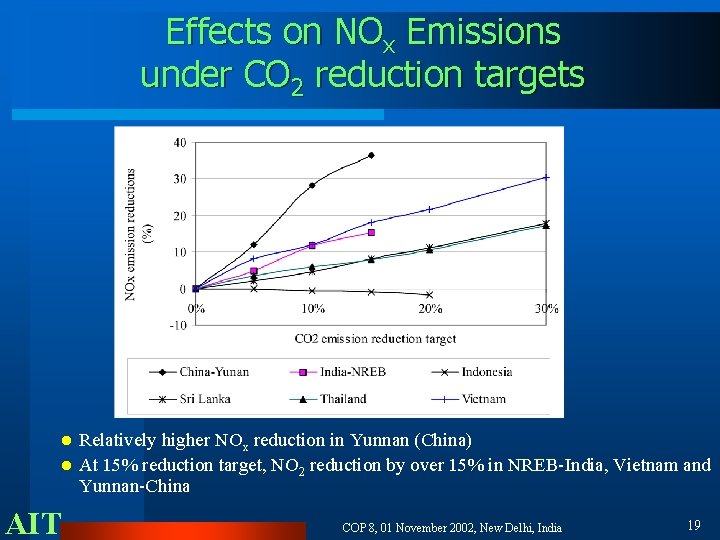
Effects on NOx Emissions under CO 2 reduction targets l l AIT Relatively higher NOx reduction in Yunnan (China) At 15% reduction target, NO 2 reduction by over 15% in NREB-India, Vietnam and Yunnan-China COP 8, 01 November 2002, New Delhi, India 19
Identification of CDM Projects in the Power Sector AIT COP 8, 01 November 2002, New Delhi, India 20
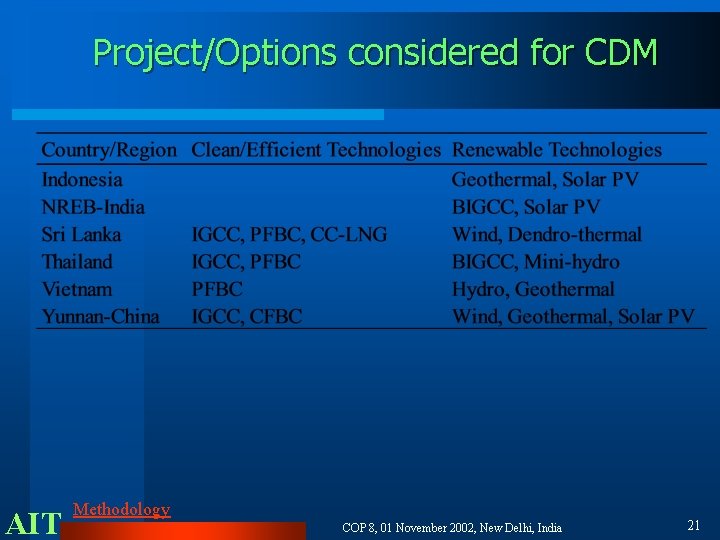
Project/Options considered for CDM AIT Methodology COP 8, 01 November 2002, New Delhi, India 21
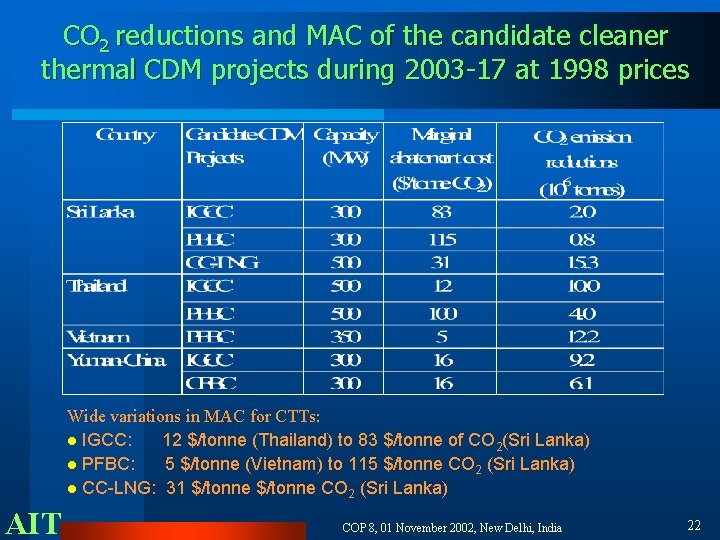
CO 2 reductions and MAC of the candidate cleaner thermal CDM projects during 2003 -17 at 1998 prices Wide variations in MAC for CTTs: l IGCC: 12 $/tonne (Thailand) to 83 $/tonne of CO 2(Sri Lanka) l PFBC: 5 $/tonne (Vietnam) to 115 $/tonne CO 2 (Sri Lanka) l CC-LNG: 31 $/tonne CO 2 (Sri Lanka) AIT COP 8, 01 November 2002, New Delhi, India 22
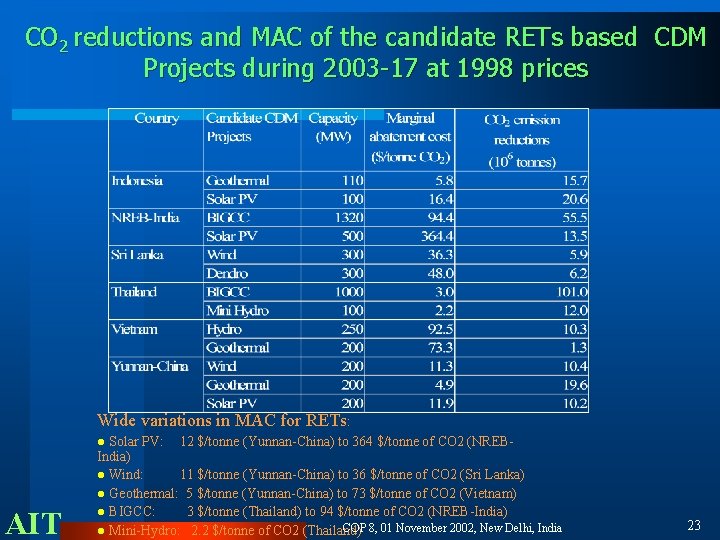
CO 2 reductions and MAC of the candidate RETs based CDM Projects during 2003 -17 at 1998 prices Wide variations in MAC for RETs: Solar PV: 12 $/tonne (Yunnan-China) to 364 $/tonne of CO 2 (NREBIndia) l Wind: 11 $/tonne (Yunnan-China) to 36 $/tonne of CO 2 (Sri Lanka) l Geothermal: 5 $/tonne (Yunnan-China) to 73 $/tonne of CO 2 (Vietnam) l BIGCC: 3 $/tonne (Thailand) to 94 $/tonne of CO 2 (NREB-India) COP 8, 01 November 2002, New Delhi, India l Mini-Hydro: 2. 2 $/tonne of CO 2 (Thailand) l AIT 23
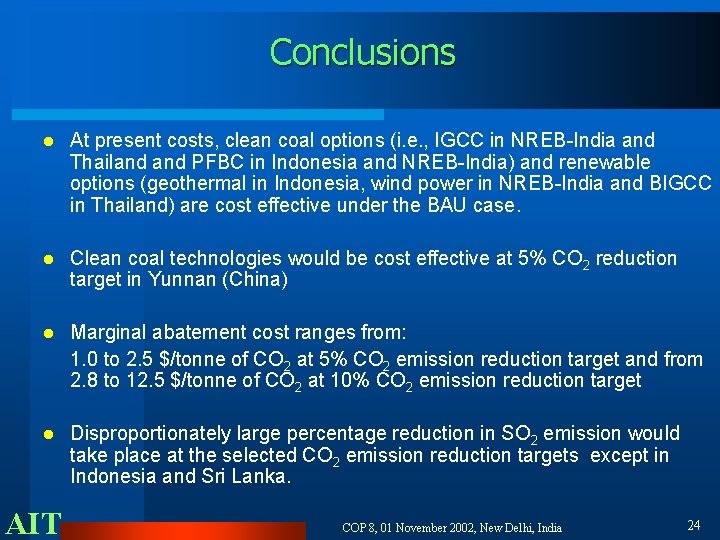
Conclusions l At present costs, clean coal options (i. e. , IGCC in NREB-India and Thailand PFBC in Indonesia and NREB-India) and renewable options (geothermal in Indonesia, wind power in NREB-India and BIGCC in Thailand) are cost effective under the BAU case. l Clean coal technologies would be cost effective at 5% CO 2 reduction target in Yunnan (China) l Marginal abatement cost ranges from: 1. 0 to 2. 5 $/tonne of CO 2 at 5% CO 2 emission reduction target and from 2. 8 to 12. 5 $/tonne of CO 2 at 10% CO 2 emission reduction target l Disproportionately large percentage reduction in SO 2 emission would take place at the selected CO 2 emission reduction targets except in Indonesia and Sri Lanka. AIT COP 8, 01 November 2002, New Delhi, India 24
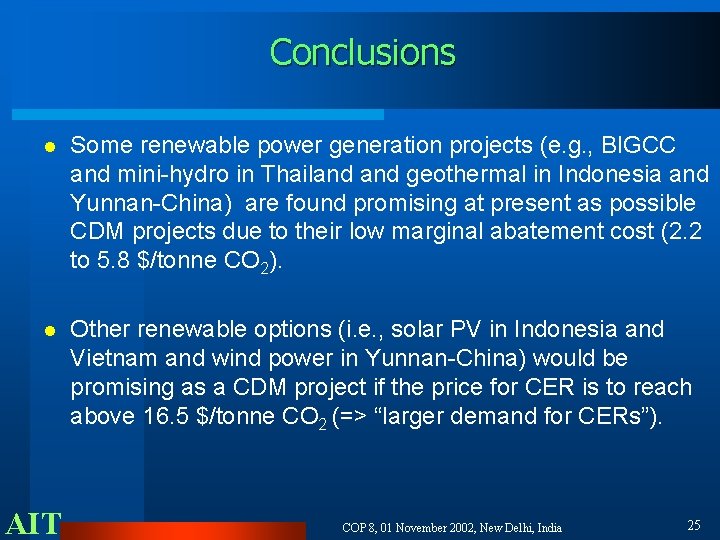
Conclusions l Some renewable power generation projects (e. g. , BIGCC and mini-hydro in Thailand geothermal in Indonesia and Yunnan-China) are found promising at present as possible CDM projects due to their low marginal abatement cost (2. 2 to 5. 8 $/tonne CO 2). l Other renewable options (i. e. , solar PV in Indonesia and Vietnam and wind power in Yunnan-China) would be promising as a CDM project if the price for CER is to reach above 16. 5 $/tonne CO 2 (=> “larger demand for CERs”). AIT COP 8, 01 November 2002, New Delhi, India 25
Thank You AIT COP 8, 01 November 2002, New Delhi, India 26
CO 2 Emission from the Power Sector (1980 -1997), 106 tons AIT COP 8, 01 November 2002, New Delhi, India 27
Power Sector Project: Collaborating Research Institutes AIT COP 8, 01 November 2002, New Delhi, India 28
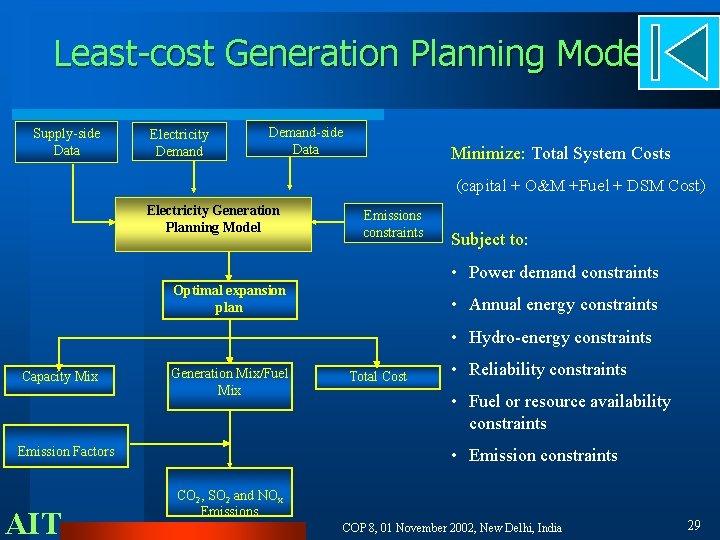
Least-cost Generation Planning Model Supply-side Data Electricity Demand-side Data Minimize: Total System Costs (capital + O&M +Fuel + DSM Cost) Electricity Generation Planning Model Emissions constraints Subject to: • Power demand constraints Optimal expansion plan • Annual energy constraints • Hydro-energy constraints Capacity Mix Generation Mix/Fuel Mix Emission Factors AIT Total Cost • Reliability constraints • Fuel or resource availability constraints • Emission constraints CO 2, SO 2 and NOx Emissions COP 8, 01 November 2002, New Delhi, India 29
Generation share of technologies in total generation under BAU and CO 2 emission reduction cases • Share of gas-fired combined cycle generation to increase in Indonesia, NREB-India, Thailand Vietnam • Share of hydro generation to increase in NREB-India, Sri Lanka, Vietnam and Yunnan-China • Share of biomass (BIGCC) increase in NREB-India and Thailand • Share of conventional coal-fired generation to decrease in NREBIndia, Sri Lanka, Thailand, Vietnam and Yunnan-China • Share of clean coal generation (PFBC) to decrease in Indonesia Generation share by technology AIT COP 8, 01 November 2002, New Delhi, India 30
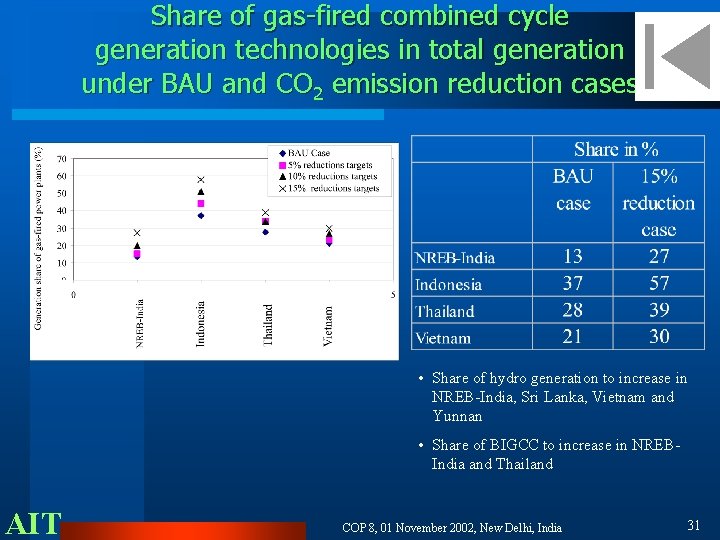
Share of gas-fired combined cycle generation technologies in total generation under BAU and CO 2 emission reduction cases • Share of hydro generation to increase in NREB-India, Sri Lanka, Vietnam and Yunnan • Share of BIGCC to increase in NREBIndia and Thailand AIT COP 8, 01 November 2002, New Delhi, India 31
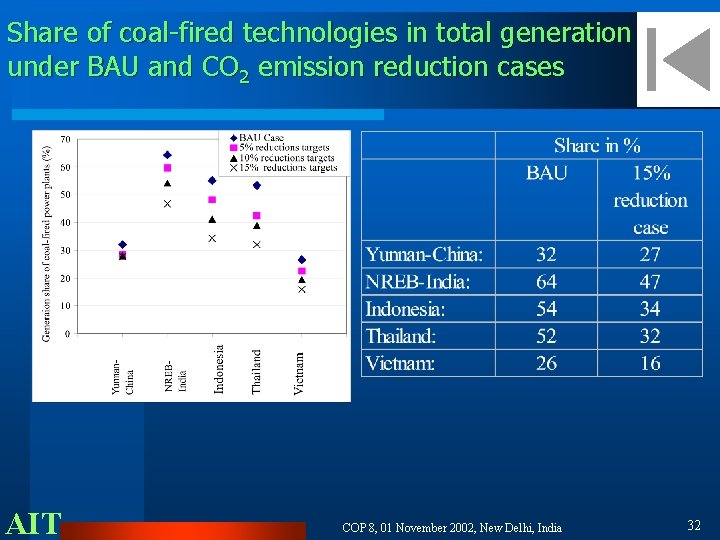
Share of coal-fired technologies in total generation under BAU and CO 2 emission reduction cases AIT COP 8, 01 November 2002, New Delhi, India 32
Generation share of technologies in total generation under BAU and CO 2 emission reduction cases Indonesia NREB-India AIT COP 8, 01 November 2002, New Delhi, India 33
Generation share by technologies in total generation under BAU and CO 2 emission reduction cases Thailand Vietnam AIT COP 8, 01 November 2002, New Delhi, India 34
Generation share of technologies in total generation under BAU and CO 2 emission reduction cases Yunnan-China Sri Lanka AIT COP 8, 01 November 2002, New Delhi, India 35
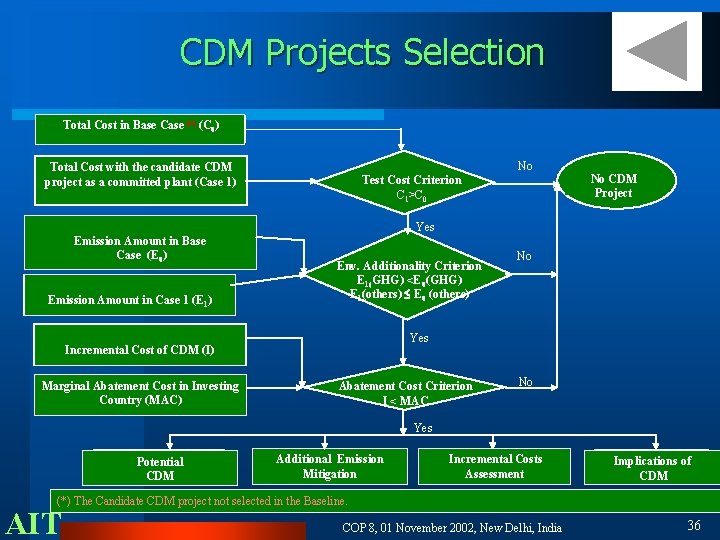
CDM Projects Selection Total Cost in Base Case (*) (C 0) No Total Cost with the candidate CDM project as a committed plant (Case 1) Test Cost Criterion C 1>C 0 No CDM Project Yes Emission Amount in Base Case (E 0) Emission Amount in Case 1 (E 1) Env. Additionality Criterion E 1(GHG) <E 0(GHG) E 1(others) E 0 (others) Yes Incremental Cost of CDM (I) Marginal Abatement Cost in Investing Country (MAC) No Abatement Cost Criterion I < MAC No Yes Potential CDM Additional Emission Mitigation Incremental Costs Assessment Implications of CDM (*) The Candidate CDM project not selected in the Baseline. AIT COP 8, 01 November 2002, New Delhi, India 36
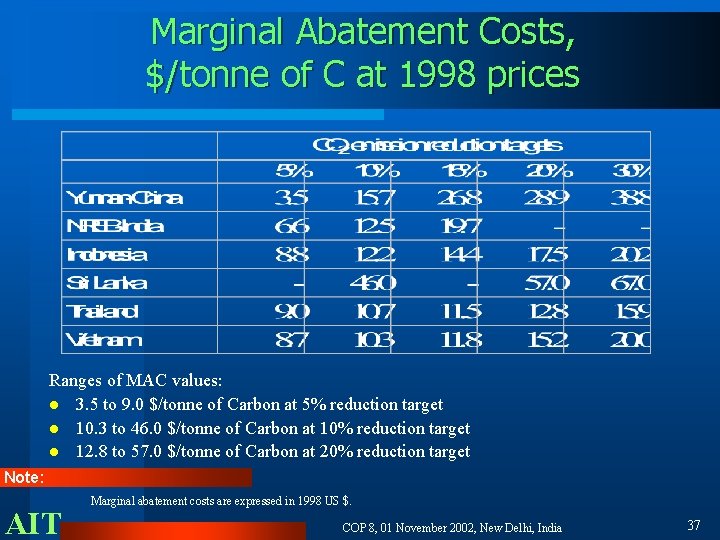
Marginal Abatement Costs, $/tonne of C at 1998 prices Ranges of MAC values: l 3. 5 to 9. 0 $/tonne of Carbon at 5% reduction target l 10. 3 to 46. 0 $/tonne of Carbon at 10% reduction target l 12. 8 to 57. 0 $/tonne of Carbon at 20% reduction target Note: AIT Marginal abatement costs are expressed in 1998 US $. COP 8, 01 November 2002, New Delhi, India 37