
MIT 6 035 Intermediate Formats Martin Rinard Laboratory
MIT 6. 035 Intermediate Formats Martin Rinard Laboratory for Computer Science Massachusetts Institute of Technology
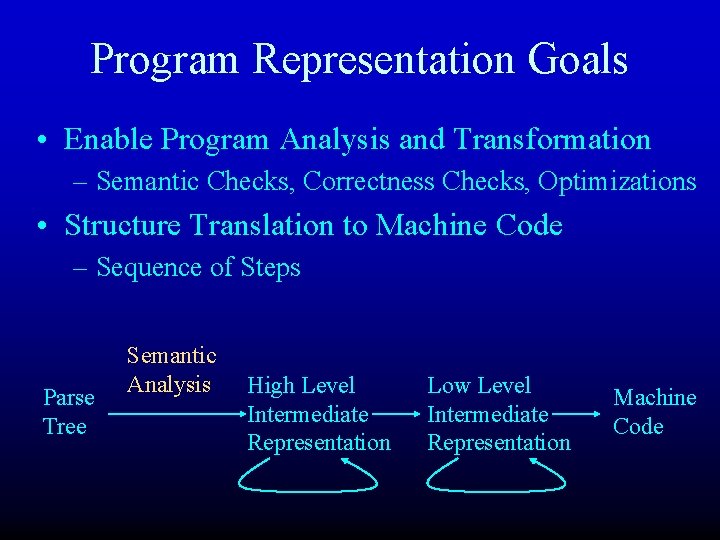
Program Representation Goals • Enable Program Analysis and Transformation – Semantic Checks, Correctness Checks, Optimizations • Structure Translation to Machine Code – Sequence of Steps Parse Tree Semantic Analysis High Level Intermediate Representation Low Level Intermediate Representation Machine Code
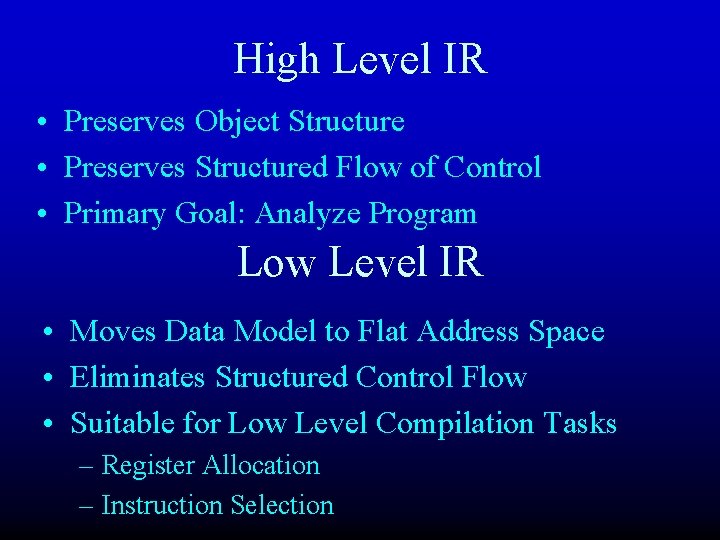
High Level IR • Preserves Object Structure • Preserves Structured Flow of Control • Primary Goal: Analyze Program Low Level IR • Moves Data Model to Flat Address Space • Eliminates Structured Control Flow • Suitable for Low Level Compilation Tasks – Register Allocation – Instruction Selection
Examples of Object Representation and Program Execution (This happens when program runs)
![Example Vector Class class vector { int v[]; void add(int x) { int i;](http://slidetodoc.com/presentation_image_h2/4b82036594c31669a840d289a548b59a/image-5.jpg "Example Vector Class class vector { int v[]; void add(int x) { int i;")
Example Vector Class class vector { int v[]; void add(int x) { int i; i = 0; while (i < v. length) { v[i] = v[i]+x; i = i+1; } } }
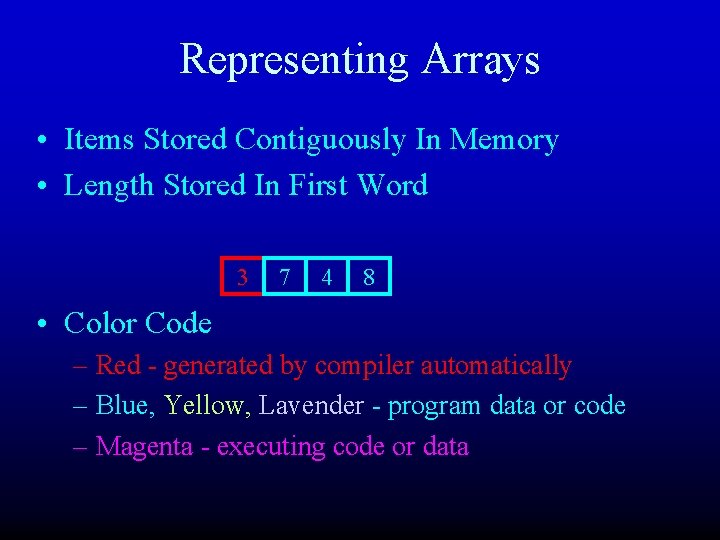
Representing Arrays • Items Stored Contiguously In Memory • Length Stored In First Word 3 7 4 8 • Color Code – Red - generated by compiler automatically – Blue, Yellow, Lavender - program data or code – Magenta - executing code or data
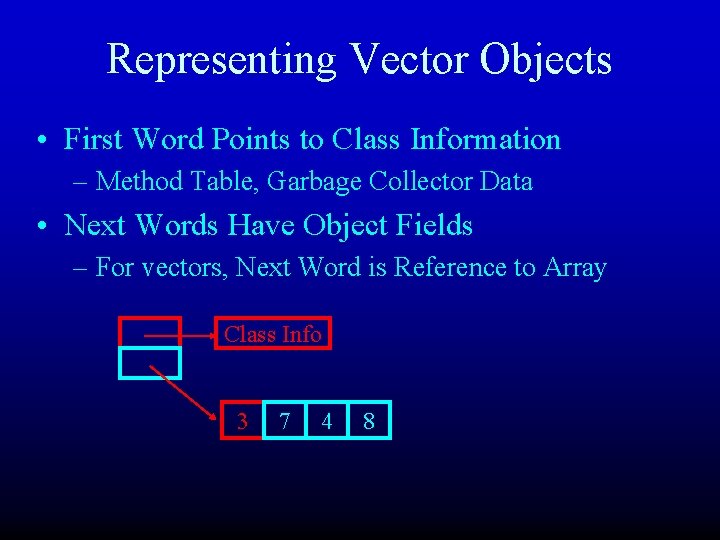
Representing Vector Objects • First Word Points to Class Information – Method Table, Garbage Collector Data • Next Words Have Object Fields – For vectors, Next Word is Reference to Array Class Info 3 7 4 8
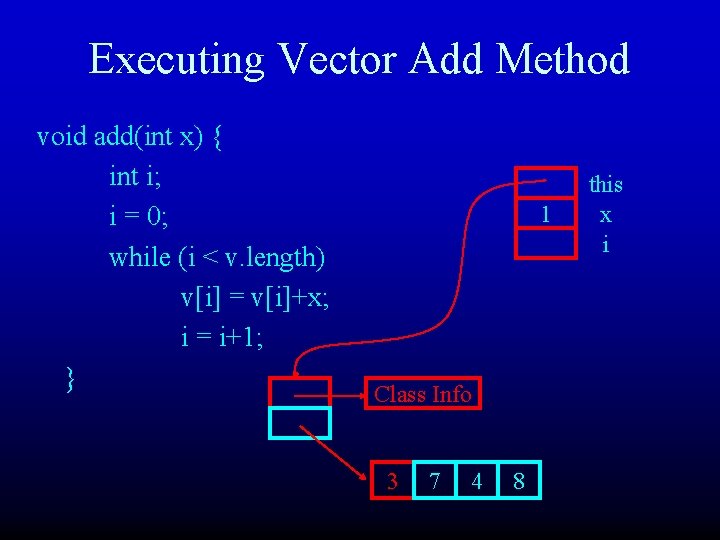
Executing Vector Add Method void add(int x) { int i; i = 0; while (i < v. length) v[i] = v[i]+x; i = i+1; } 1 Class Info 3 7 4 8 this x i
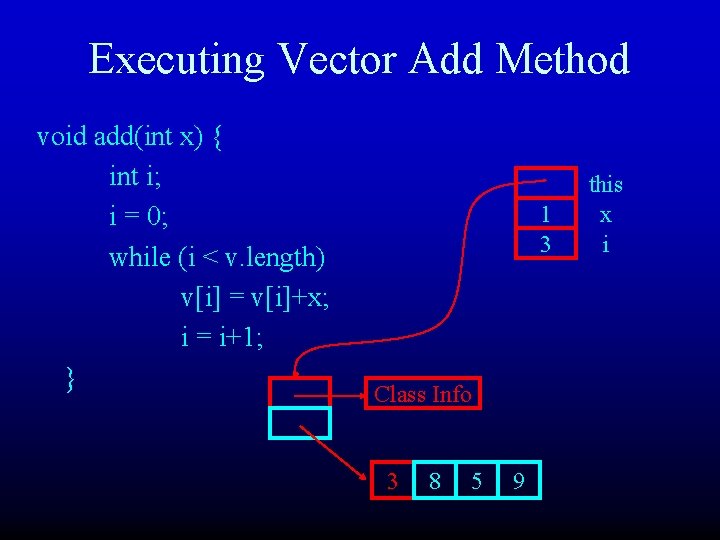
Executing Vector Add Method void add(int x) { int i; i = 0; while (i < v. length) v[i] = v[i]+x; i = i+1; } 1 3 Class Info 3 8 5 9 this x i
Compilation Tasks • Determine Format of Objects and Arrays • Determine Format of Call Stack • Generate Code to Read Values – this, parameters, locals, array elements, object fields • Generate Code to Evaluate Expressions • Generate Code to Write Values • Generate Code for Control Constructs
Further Complication - Inheritance Object Extension
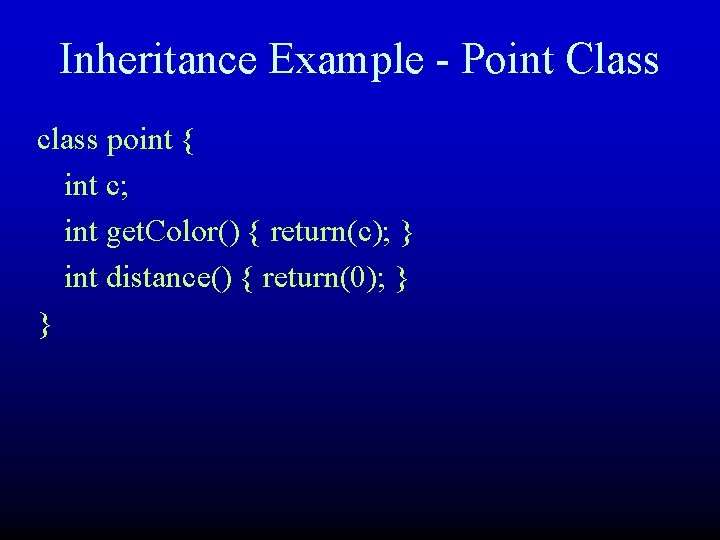
Inheritance Example - Point Class class point { int c; int get. Color() { return(c); } int distance() { return(0); } }
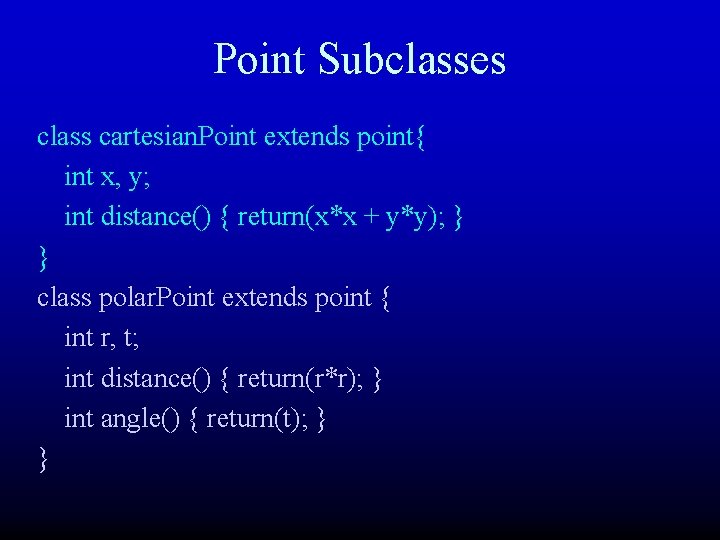
Point Subclasses class cartesian. Point extends point{ int x, y; int distance() { return(x*x + y*y); } } class polar. Point extends point { int r, t; int distance() { return(r*r); } int angle() { return(t); } }
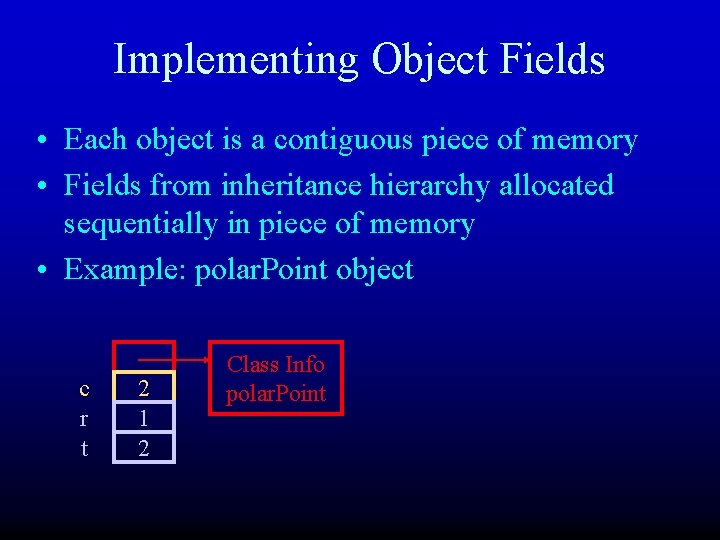
Implementing Object Fields • Each object is a contiguous piece of memory • Fields from inheritance hierarchy allocated sequentially in piece of memory • Example: polar. Point object c r t 2 1 2 Class Info polar. Point
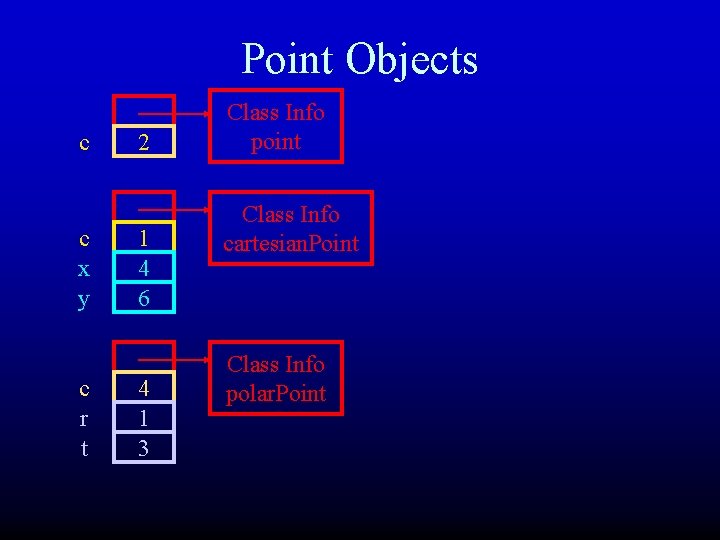
Point Objects c c x y c r t 2 1 4 6 4 1 3 Class Info point Class Info cartesian. Point Class Info polar. Point
Compilation Tasks • Determine Object Format in Memory – Fields from Parent Classes – Fields from Current Class • Generate Code for Methods – Field, Local Variable and Parameter Accesses – Method Invocations
Symbol Tables - Key Concept in Compilation • Compiler Uses Symbol Tables to Produce – Object Layout in Memory – Code to • Access Object Fields • Access Local Variables • Access Parameters • Invoke Methods
Symbol Tables During Translation From Parse Tree to IR • Symbol Tables Map Identifiers (strings) to Descriptors (information about identifiers) • Basic Operation: Lookup – Given A String, find Descriptor – Typical Implementation: Hash Table • Examples – Given a class name, find class descriptor – Given variable name, find descriptor • local descriptor, parameter descriptor, field descriptor
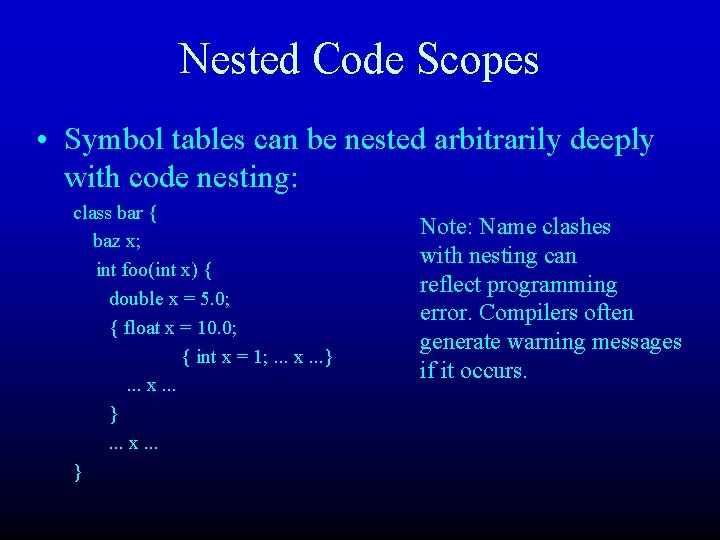
Hierarchy In Symbol Tables • Hierarchy Comes From – Nested Scopes - Local Scope Inside Field Scope – Inheritance - Child Class Inside Parent Class • Symbol Table Hierarchy Reflects These Hierarchies • Lookup Proceeds Up Hierarchy Until Descriptor is Found
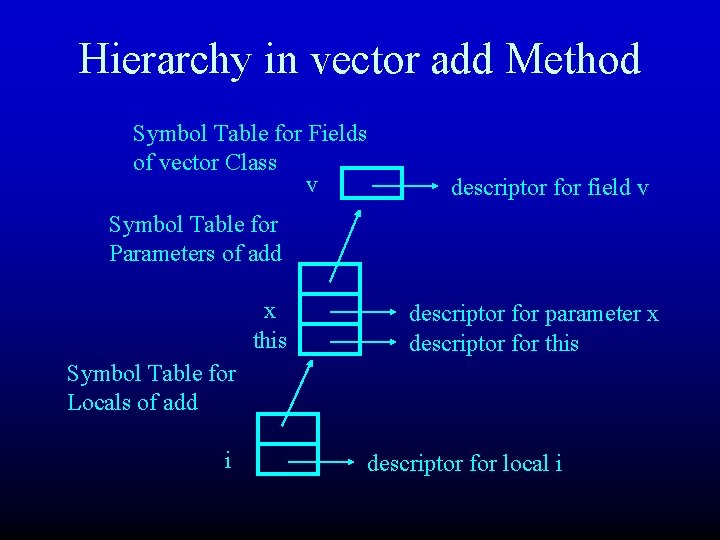
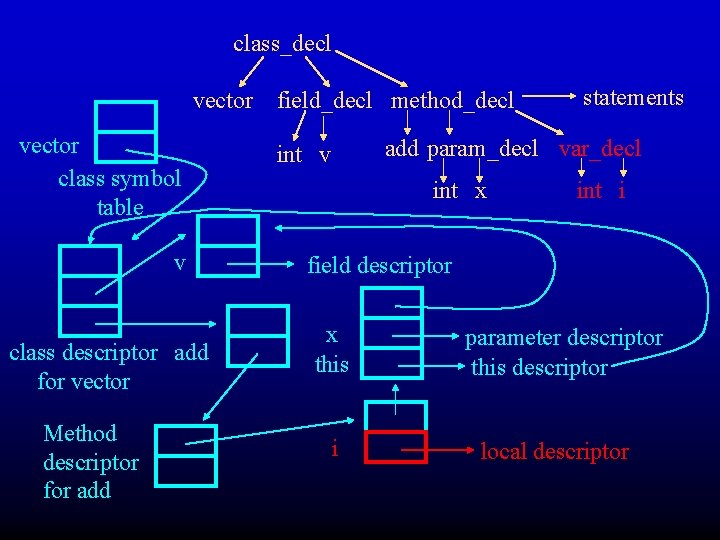
Hierarchy in vector add Method Symbol Table for Fields of vector Class v descriptor field v Symbol Table for Parameters of add x this descriptor for parameter x descriptor for this Symbol Table for Locals of add i descriptor for local i
![Lookup In vector Example • v[i] = v[i]+x; v x this i descriptor field](http://slidetodoc.com/presentation_image_h2/4b82036594c31669a840d289a548b59a/image-21.jpg "Lookup In vector Example • v[i] = v[i]+x; v x this i descriptor field")
Lookup In vector Example • v[i] = v[i]+x; v x this i descriptor field v descriptor for parameter x descriptor for this descriptor for local i
Descriptors • What do descriptors contain? • Information used for code generation and semantic analysis – local descriptors - name, type, stack offset – field descriptors - name, type, object offset – method descriptors • signature (type of return value, receiver, and parameters) • reference to local symbol table • reference to code for method
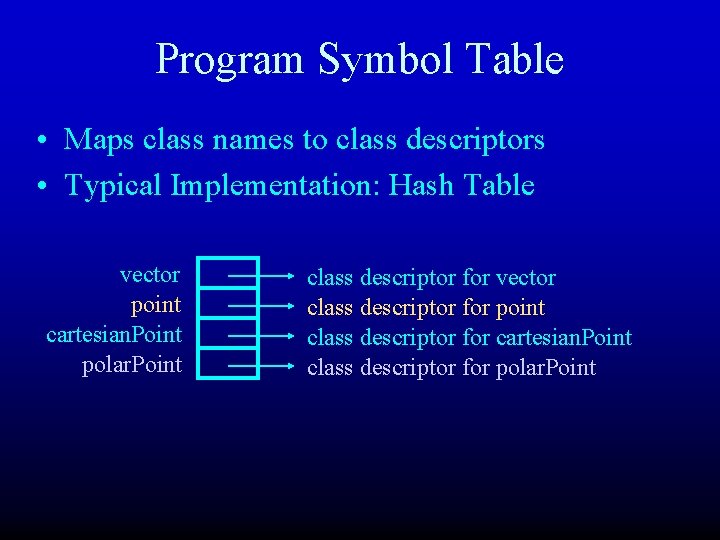
Program Symbol Table • Maps class names to class descriptors • Typical Implementation: Hash Table vector point cartesian. Point polar. Point class descriptor for vector class descriptor for point class descriptor for cartesian. Point class descriptor for polar. Point
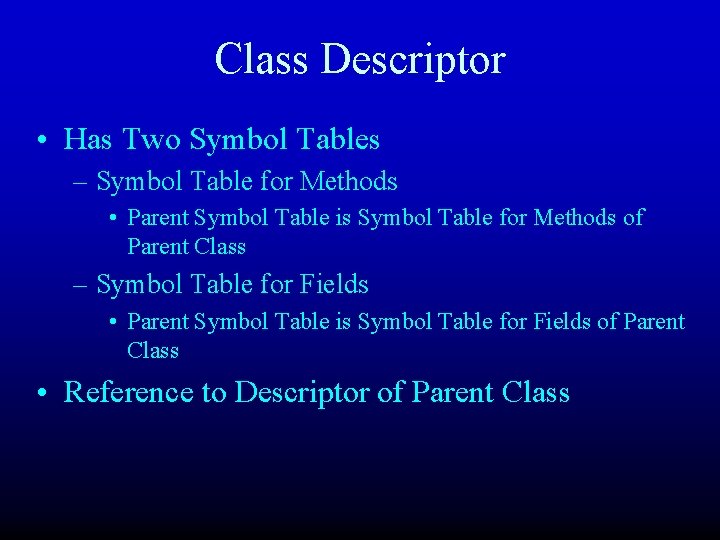
Class Descriptor • Has Two Symbol Tables – Symbol Table for Methods • Parent Symbol Table is Symbol Table for Methods of Parent Class – Symbol Table for Fields • Parent Symbol Table is Symbol Table for Fields of Parent Class • Reference to Descriptor of Parent Class
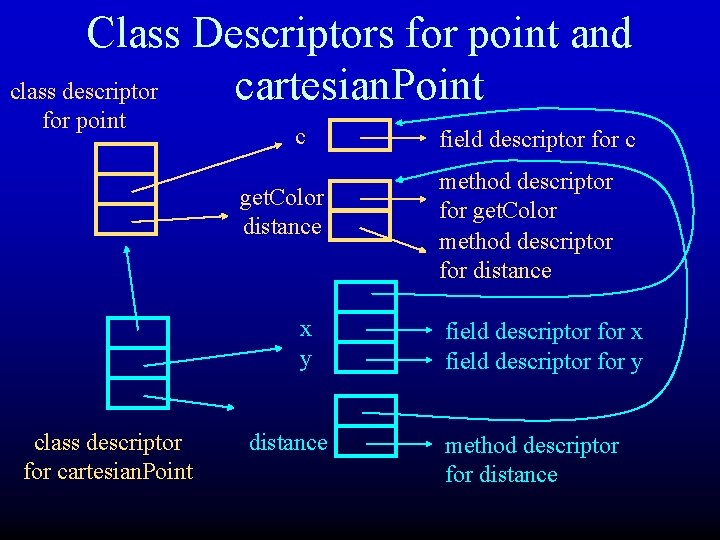
Class Descriptors for point and class descriptor cartesian. Point for point c get. Color distance x y class descriptor for cartesian. Point distance field descriptor for c method descriptor for get. Color method descriptor for distance field descriptor for x field descriptor for y method descriptor for distance
Field, Parameter and Local and Type Descriptors • Field, Parameter and Local Descriptors Refer to Type Descriptors – Base type descriptor: int, boolean – Array type descriptor, which contains reference to type descriptor for array elements – Class descriptor • Relatively Simple Type Descriptors • Base Type Descriptors and Array Descriptors Stored in Type Symbol Table
![Example Type Symbol Table int [] boolean [] vector int descriptor array descriptor boolean](http://slidetodoc.com/presentation_image_h2/4b82036594c31669a840d289a548b59a/image-27.jpg "Example Type Symbol Table int [] boolean [] vector int descriptor array descriptor boolean")
Example Type Symbol Table int [] boolean [] vector int descriptor array descriptor boolean descriptor array descriptor class descriptor for vector
Method Descriptors • Contain Reference to Code for Method • Contain Reference to Local Symbol Table for Local Variables of Method • Parent Symbol Table of Local Symbol Table is Parameter Symbol Table for Parameters of Method
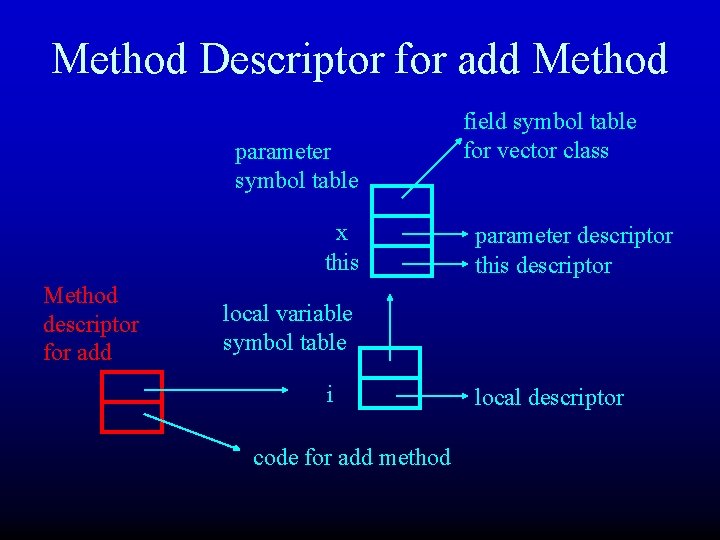
Method Descriptor for add Method parameter symbol table x this Method descriptor for add field symbol table for vector class parameter descriptor this descriptor local variable symbol table i code for add method local descriptor
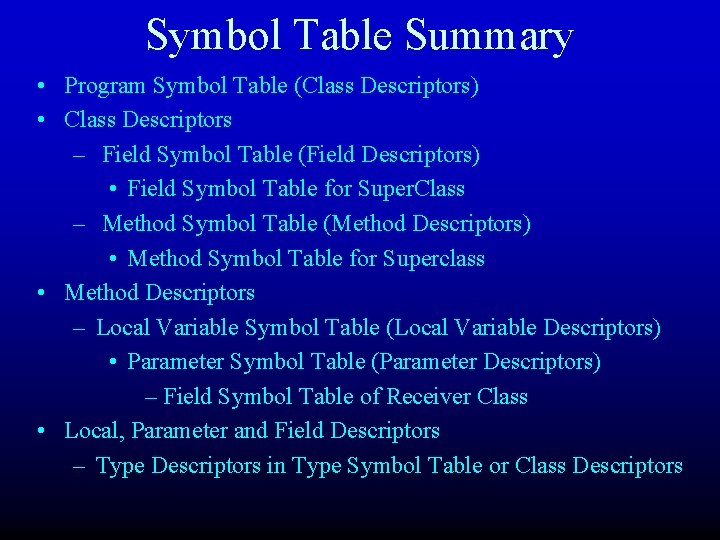
Symbol Table Summary • Program Symbol Table (Class Descriptors) • Class Descriptors – Field Symbol Table (Field Descriptors) • Field Symbol Table for Super. Class – Method Symbol Table (Method Descriptors) • Method Symbol Table for Superclass • Method Descriptors – Local Variable Symbol Table (Local Variable Descriptors) • Parameter Symbol Table (Parameter Descriptors) – Field Symbol Table of Receiver Class • Local, Parameter and Field Descriptors – Type Descriptors in Type Symbol Table or Class Descriptors
![v class descriptor for vector method descriptor for add type symbol table int []](http://slidetodoc.com/presentation_image_h2/4b82036594c31669a840d289a548b59a/image-31.jpg "v class descriptor for vector method descriptor for add type symbol table int []")
v class descriptor for vector method descriptor for add type symbol table int [] boolean [] vector [] add field symbol table field descriptor x this parameter symbol table method symbol table i parameter descriptor this descriptor local symbol table code for add method int descriptor array descriptor boolean descriptor array descriptor class_decl vector field_decl int v []
Translating from Abstract Syntax Trees to Symbol Tables
![Example Abstract Syntax Tree class vector { int v[]; void add(int x) { int](http://slidetodoc.com/presentation_image_h2/4b82036594c31669a840d289a548b59a/image-33.jpg "Example Abstract Syntax Tree class vector { int v[]; void add(int x) { int")
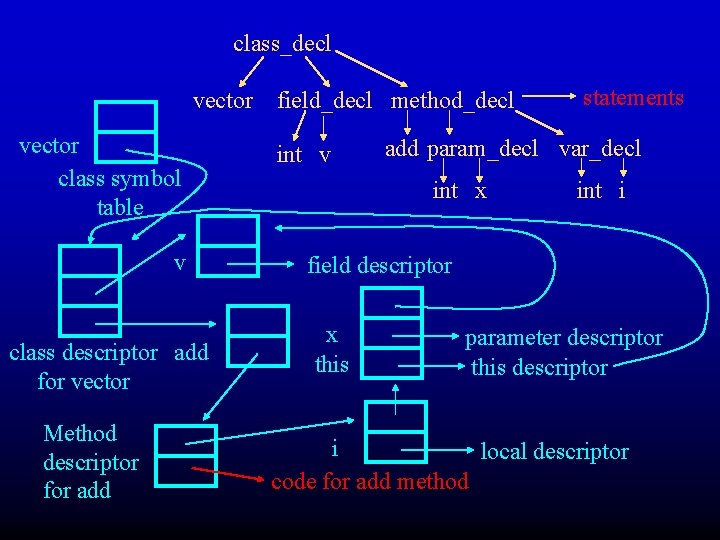
Example Abstract Syntax Tree class vector { int v[]; void add(int x) { int i; i = 0; while (i < v. length) { v[i] = v[i]+x; i = i+1; } } class_decl } vector field_decl method_decl int v statements add param_decl var_decl int x int i
class_decl vector class symbol table v class descriptor add for vector Method descriptor for add field_decl method_decl statements add param_decl var_decl int v int x int i field descriptor x this i parameter descriptor this descriptor local descriptor
Representing Code in High-Level Intermediate Representation
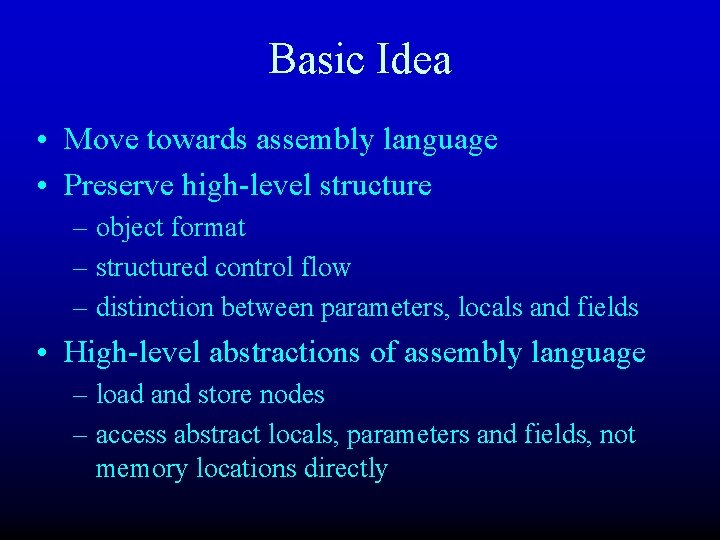
Basic Idea • Move towards assembly language • Preserve high-level structure – object format – structured control flow – distinction between parameters, locals and fields • High-level abstractions of assembly language – load and store nodes – access abstract locals, parameters and fields, not memory locations directly
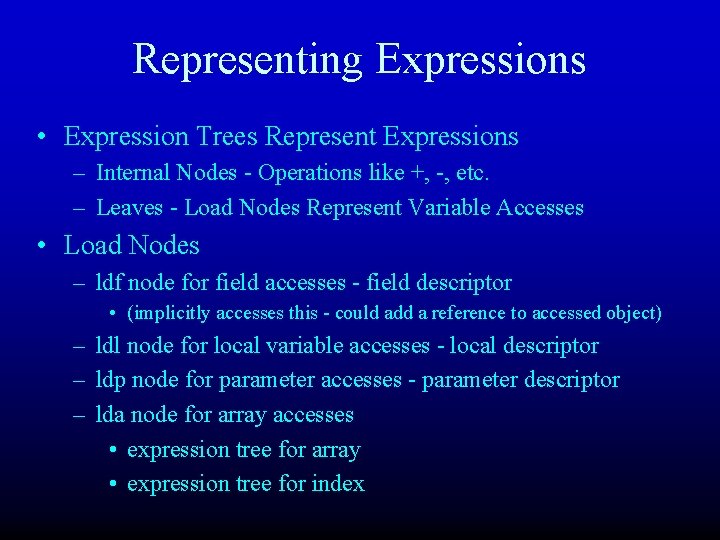
Representing Expressions • Expression Trees Represent Expressions – Internal Nodes - Operations like +, -, etc. – Leaves - Load Nodes Represent Variable Accesses • Load Nodes – ldf node for field accesses - field descriptor • (implicitly accesses this - could add a reference to accessed object) – ldl node for local variable accesses - local descriptor – ldp node for parameter accesses - parameter descriptor – lda node for array accesses • expression tree for array • expression tree for index
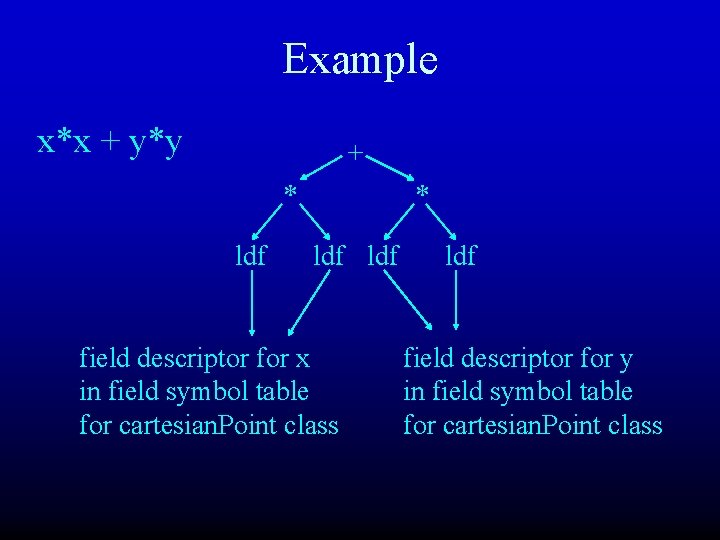
Example x*x + y*y + * ldf ldf field descriptor for x in field symbol table for cartesian. Point class ldf field descriptor for y in field symbol table for cartesian. Point class
![Example v[i]+x + lda ldf field descriptor for v in field symbol table for](http://slidetodoc.com/presentation_image_h2/4b82036594c31669a840d289a548b59a/image-39.jpg "Example v[i]+x + lda ldf field descriptor for v in field symbol table for")
Example v[i]+x + lda ldf field descriptor for v in field symbol table for vector class ldp ldl local descriptor for i in local symbol table of vector add parameter descriptor for x in parameter symbol table of vector add
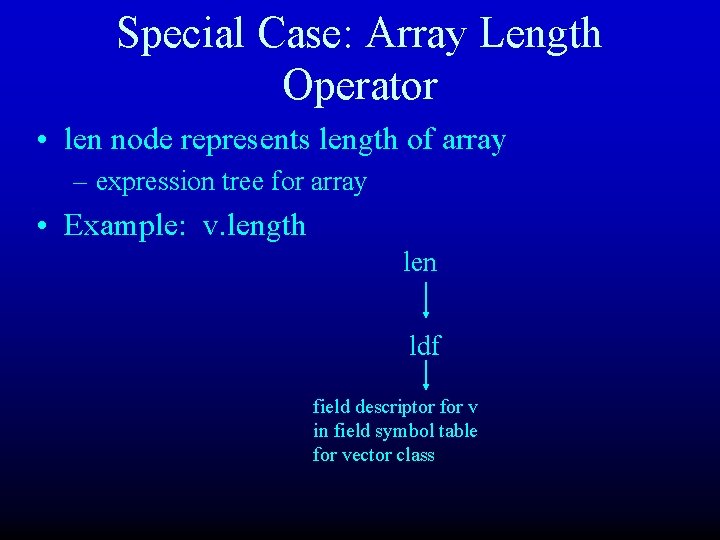
Special Case: Array Length Operator • len node represents length of array – expression tree for array • Example: v. length len ldf field descriptor for v in field symbol table for vector class
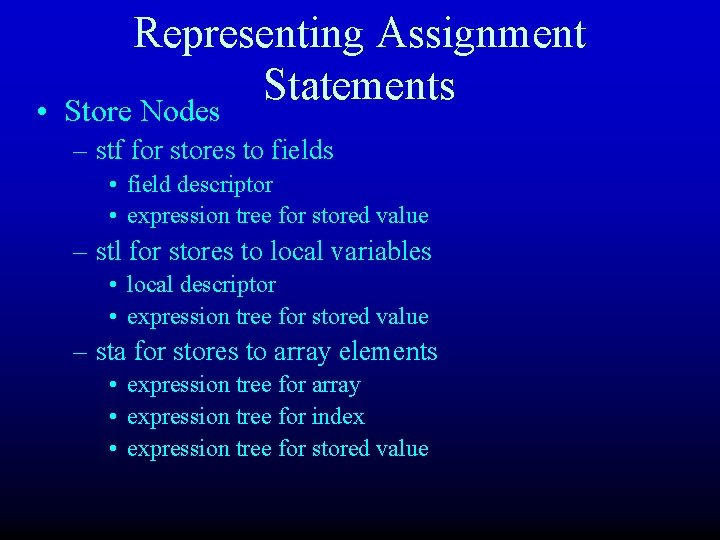
• Representing Assignment Statements Store Nodes – stf for stores to fields • field descriptor • expression tree for stored value – stl for stores to local variables • local descriptor • expression tree for stored value – sta for stores to array elements • expression tree for array • expression tree for index • expression tree for stored value
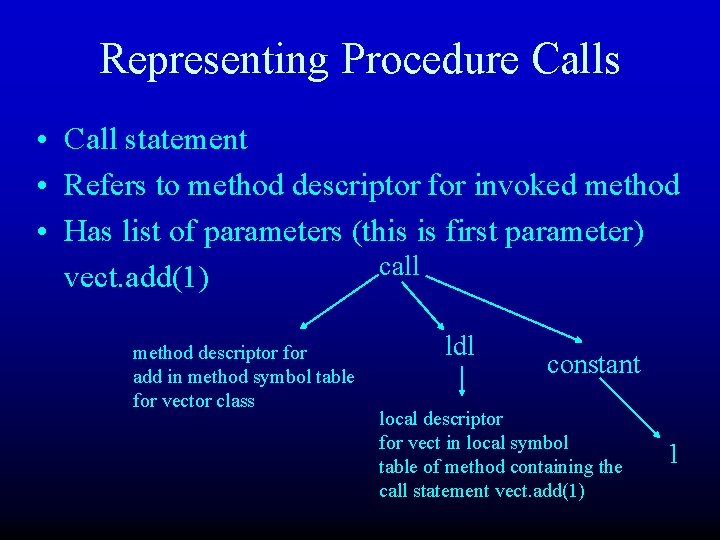
Representing Procedure Calls • Call statement • Refers to method descriptor for invoked method • Has list of parameters (this is first parameter) call vect. add(1) method descriptor for add in method symbol table for vector class ldl constant local descriptor for vect in local symbol table of method containing the call statement vect. add(1) 1
Representing Flow of Control • Statement Nodes – sequence node - first statement, next statement – if node • expression tree for condition • then statement node and else statement node – while node • expression tree for condition • statement node for loop body – return node • expression tree for return value
![Example while (i < v. length) v[i] = v[i]+x; while < ldl sta +](http://slidetodoc.com/presentation_image_h2/4b82036594c31669a840d289a548b59a/image-44.jpg "Example while (i < v. length) v[i] = v[i]+x; while < ldl sta +")
Example while (i < v. length) v[i] = v[i]+x; while < ldl sta + len ldf ldl lda ldp ldf ldl field descriptor for v local descriptor for i parameter descriptor for x
From Abstract Syntax Trees to Intermediate Representation
![while (i < v. length) v[i] = v[i]+x; while < ldl sta + len](http://slidetodoc.com/presentation_image_h2/4b82036594c31669a840d289a548b59a/image-46.jpg "while (i < v. length) v[i] = v[i]+x; while < ldl sta + len")
while (i < v. length) v[i] = v[i]+x; while < ldl sta + len ldf ldl lda ldp ldf ldl field descriptor for v local descriptor for i parameter descriptor for x
![Abbreviated Notation while (i < v. length) v[i] = v[i]+x; while < sta +](http://slidetodoc.com/presentation_image_h2/4b82036594c31669a840d289a548b59a/image-47.jpg "Abbreviated Notation while (i < v. length) v[i] = v[i]+x; while < sta +")
Abbreviated Notation while (i < v. length) v[i] = v[i]+x; while < sta + ldl i len ldf v ldl i lda ldp x ldf v ldl i
From Abstract Syntax Trees to IR • Recursively Traverse Abstract Syntax Tree • Build Up Representation Bottom-Up Manner – Look Up Variable Identifiers in Symbol Tables – Build Load Nodes to Access Variables – Build Expressions Out of Load Nodes and Operator Nodes – Build Store Nodes for Assignment Statements – Combine Store Nodes with Flow of Control Nodes
Summary High-Level Intermediate Representation • Goal: represent program in an intuitive way that supports future compilation tasks • Representing program data – Symbol tables – Hierarchical organization • Representing computation – Expression trees – Various types of load and store nodes – Structured flow of control • Traverse abstract syntax tree to build IR
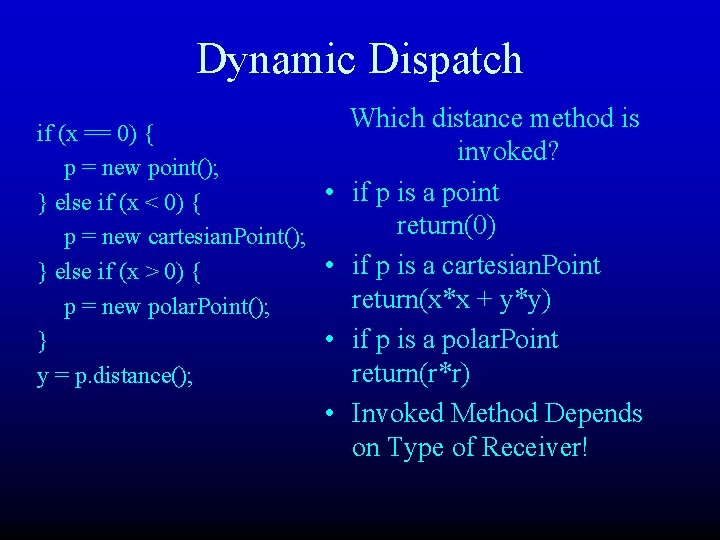
Dynamic Dispatch if (x == 0) { p = new point(); • } else if (x < 0) { p = new cartesian. Point(); • } else if (x > 0) { p = new polar. Point(); } • y = p. distance(); • Which distance method is invoked? if p is a point return(0) if p is a cartesian. Point return(x*x + y*y) if p is a polar. Point return(r*r) Invoked Method Depends on Type of Receiver!
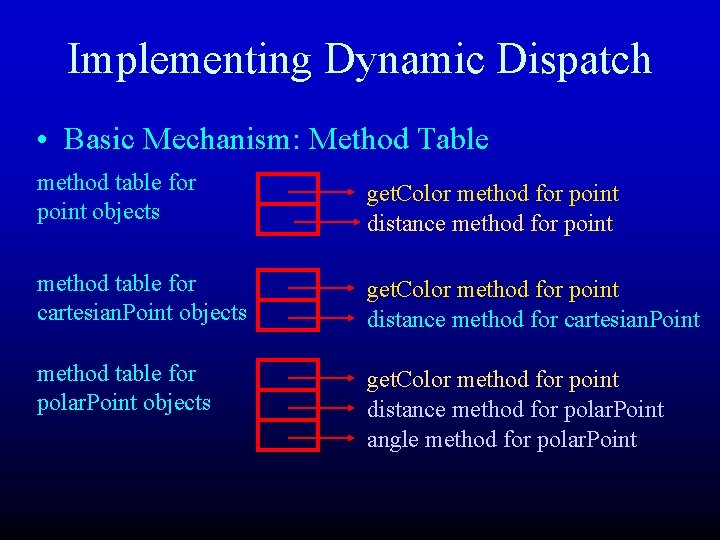
Implementing Dynamic Dispatch • Basic Mechanism: Method Table method table for point objects get. Color method for point distance method for point method table for cartesian. Point objects get. Color method for point distance method for cartesian. Point method table for polar. Point objects get. Color method for point distance method for polar. Point angle method for polar. Point
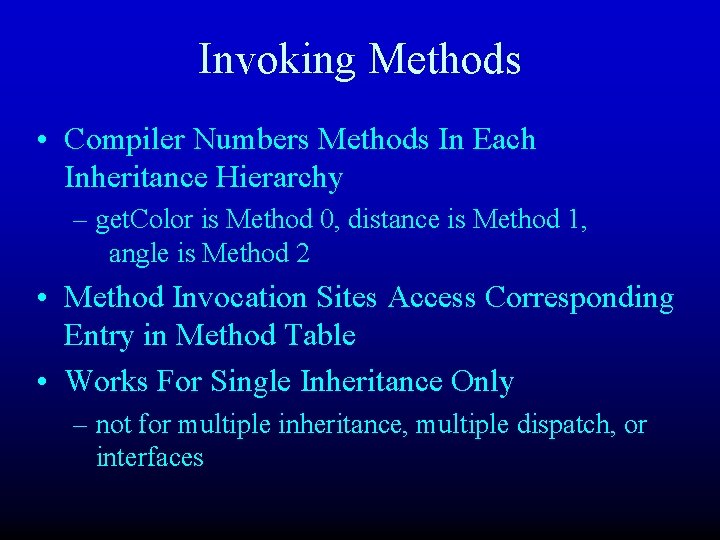
Invoking Methods • Compiler Numbers Methods In Each Inheritance Hierarchy – get. Color is Method 0, distance is Method 1, angle is Method 2 • Method Invocation Sites Access Corresponding Entry in Method Table • Works For Single Inheritance Only – not for multiple inheritance, multiple dispatch, or interfaces
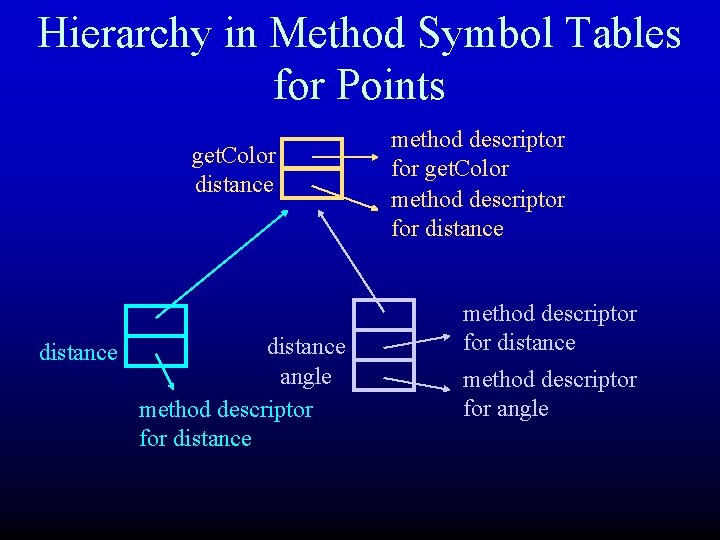
Hierarchy in Method Symbol Tables for Points get. Color distance angle method descriptor for distance method descriptor for get. Color method descriptor for distance method descriptor for angle
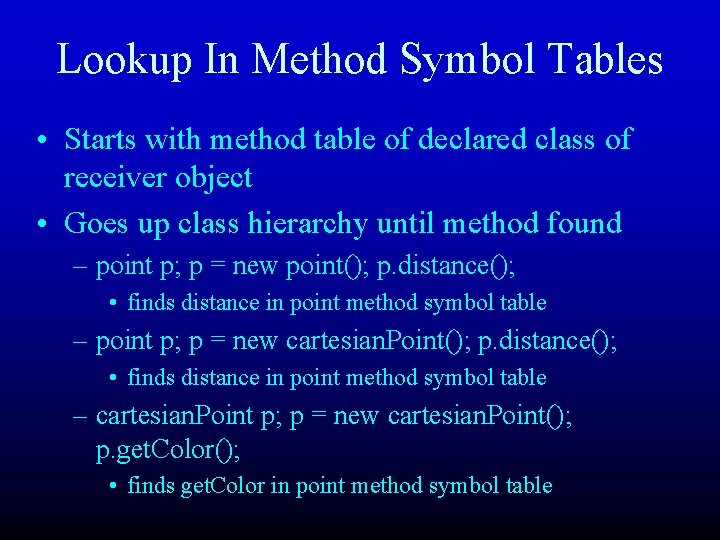
Lookup In Method Symbol Tables • Starts with method table of declared class of receiver object • Goes up class hierarchy until method found – point p; p = new point(); p. distance(); • finds distance in point method symbol table – point p; p = new cartesian. Point(); p. distance(); • finds distance in point method symbol table – cartesian. Point p; p = new cartesian. Point(); p. get. Color(); • finds get. Color in point method symbol table
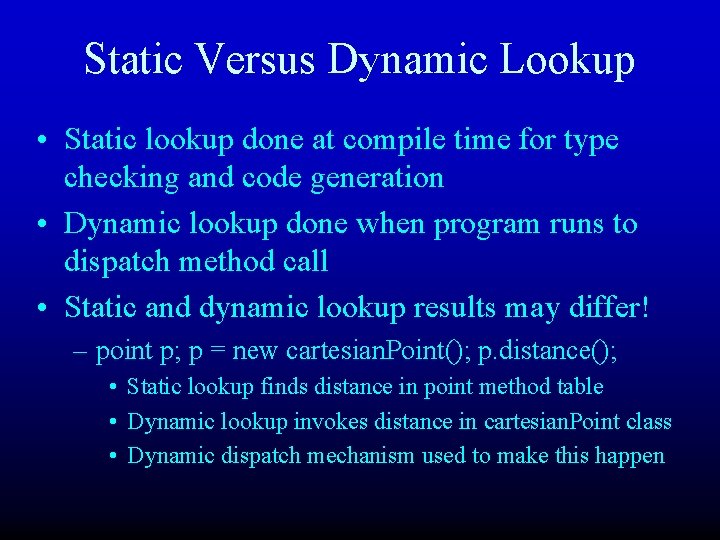
Static Versus Dynamic Lookup • Static lookup done at compile time for type checking and code generation • Dynamic lookup done when program runs to dispatch method call • Static and dynamic lookup results may differ! – point p; p = new cartesian. Point(); p. distance(); • Static lookup finds distance in point method table • Dynamic lookup invokes distance in cartesian. Point class • Dynamic dispatch mechanism used to make this happen
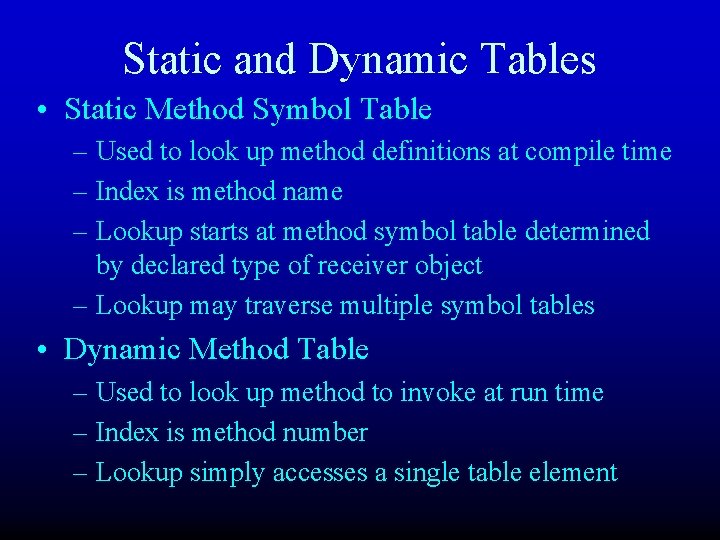
Static and Dynamic Tables • Static Method Symbol Table – Used to look up method definitions at compile time – Index is method name – Lookup starts at method symbol table determined by declared type of receiver object – Lookup may traverse multiple symbol tables • Dynamic Method Table – Used to look up method to invoke at run time – Index is method number – Lookup simply accesses a single table element
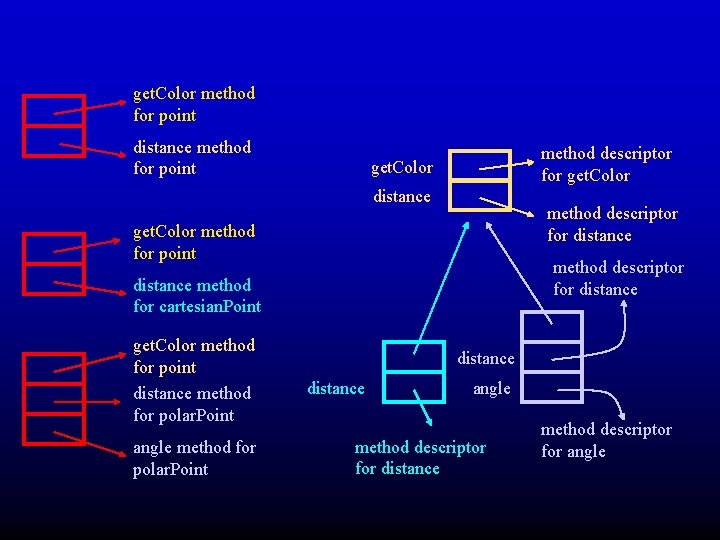
get. Color method for point distance method for point method descriptor for get. Color distance method descriptor for distance get. Color method for point method descriptor for distance method for cartesian. Point get. Color method for point distance method for polar. Point angle method for polar. Point distance angle method descriptor for distance method descriptor for angle
class_decl vector class symbol table v class descriptor add for vector Method descriptor for add field_decl method_decl int v statements add param_decl var_decl int x int i field descriptor x this parameter descriptor this descriptor i local descriptor code for add method
Eliminating Parse Tree Construction • Parser actions build symbol tables – Reduce actions build tables in bottom-up fashion – Actions correspond to activities that take place in top-down fashion in parse tree traversal • Eliminates intermediate construction of parse tree - improves performance • Also less code to write (but code may be harder to write than if just traverse parse tree)
![class vector { int v[]; void add(int x) { int i; . . .](http://slidetodoc.com/presentation_image_h2/4b82036594c31669a840d289a548b59a/image-60.jpg "class vector { int v[]; void add(int x) { int i; . . .")
class vector { int v[]; void add(int x) { int i; . . . }} field_decl method_decl class symbol table v class descriptor add for vector Method descriptor for add int v statements add param_decl var_decl int x int i field descriptor x this parameter descriptor this descriptor i local descriptor code for add method
Nested Scopes • So far, have seen several kinds of nesting – Method symbol tables nested inside class symbol tables – Local symbol tables nesting inside method symbol tables • Nesting disambiguates potential name clashes – Same name used for class field and local variable – Name refers to local variable inside method
Nested Code Scopes • Symbol tables can be nested arbitrarily deeply with code nesting: class bar { baz x; int foo(int x) { double x = 5. 0; { float x = 10. 0; { int x = 1; . . . x. . . } Note: Name clashes with nesting can reflect programming error. Compilers often generate warning messages if it occurs.
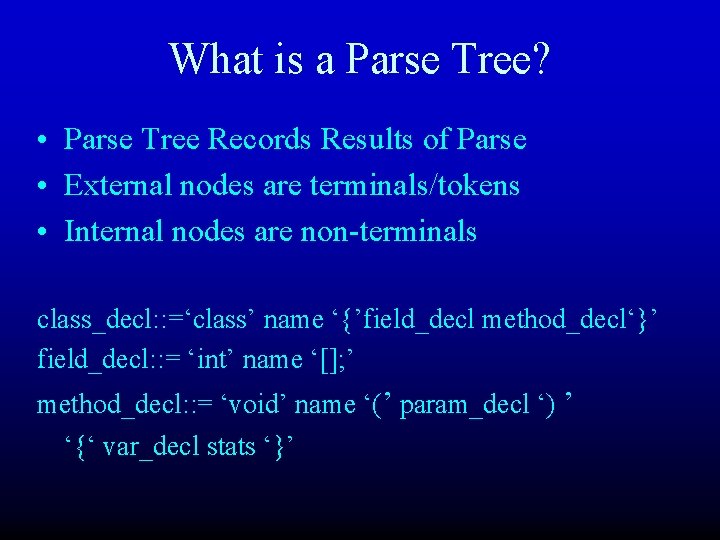
What is a Parse Tree? • Parse Tree Records Results of Parse • External nodes are terminals/tokens • Internal nodes are non-terminals class_decl: : =‘class’ name ‘{’field_decl method_decl‘}’ field_decl: : = ‘int’ name ‘[]; ’ method_decl: : = ‘void’ name ‘(’ param_decl ‘) ’ ‘{‘ var_decl stats ‘}’
Abstract Versus Concrete Trees • Remember grammar hacks – left factoring, ambiguity elimination, precedence of binary operators • Hacks lead to a tree that may not reflect cleanest interpretation of program • May be more convenient to work with abstract syntax tree (roughly, parse tree from grammar before hacks)
Building IR Alternatives • Build concrete parse tree in parser, translate to abstract syntax tree, translate to IR • Build abstract syntax tree in parser, translate to IR • Roll IR construction into parsing
From. Abstract Syntax Trees to Symbol Tables • Recursively Traverse Tree • Build Up Symbol Tables As Traversal Visits Nodes
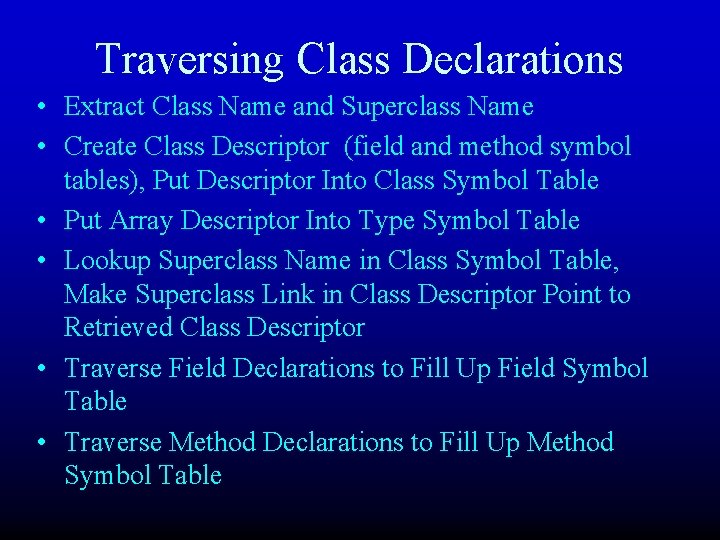
Traversing Class Declarations • Extract Class Name and Superclass Name • Create Class Descriptor (field and method symbol tables), Put Descriptor Into Class Symbol Table • Put Array Descriptor Into Type Symbol Table • Lookup Superclass Name in Class Symbol Table, Make Superclass Link in Class Descriptor Point to Retrieved Class Descriptor • Traverse Field Declarations to Fill Up Field Symbol Table • Traverse Method Declarations to Fill Up Method Symbol Table
- Slides: 67