
MIT 3 022 Microstructural Evolution in Materials Ice

- Slides: 17
MIT 3. 022 Microstructural Evolution in Materials Ice Cream 17: The Science of Ice Cream Juejun (JJ) Hu hujuejun@mit. edu
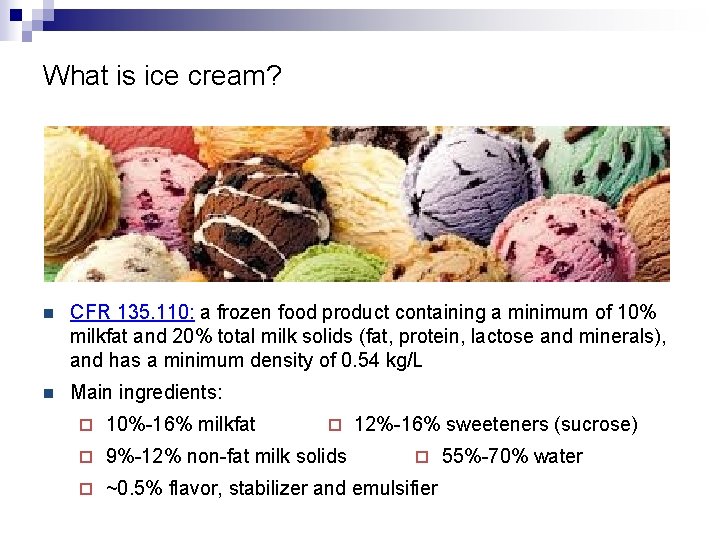
What is ice cream? n CFR 135. 110: a frozen food product containing a minimum of 10% milkfat and 20% total milk solids (fat, protein, lactose and minerals), and has a minimum density of 0. 54 kg/L n Main ingredients: ¨ 10%-16% milkfat ¨ 9%-12% non-fat milk solids ¨ ~0. 5% flavor, stabilizer and emulsifier ¨ 12%-16% sweeteners (sucrose) ¨ 55%-70% water
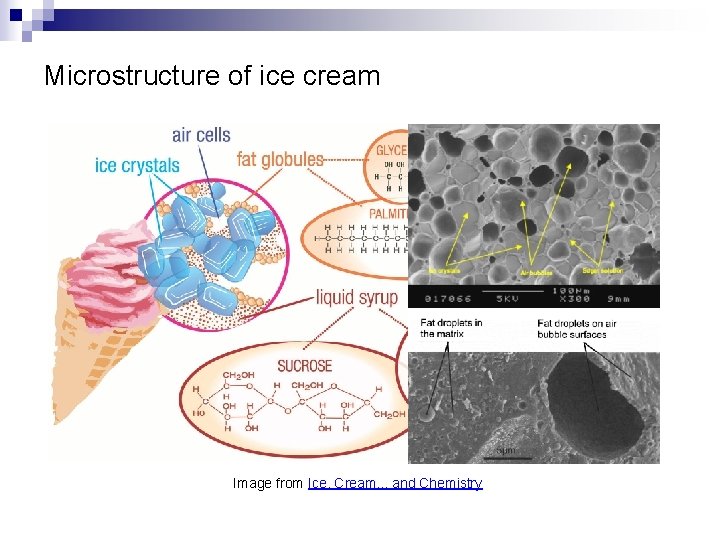
Microstructure of ice cream Image from Ice, Cream. . . and Chemistry
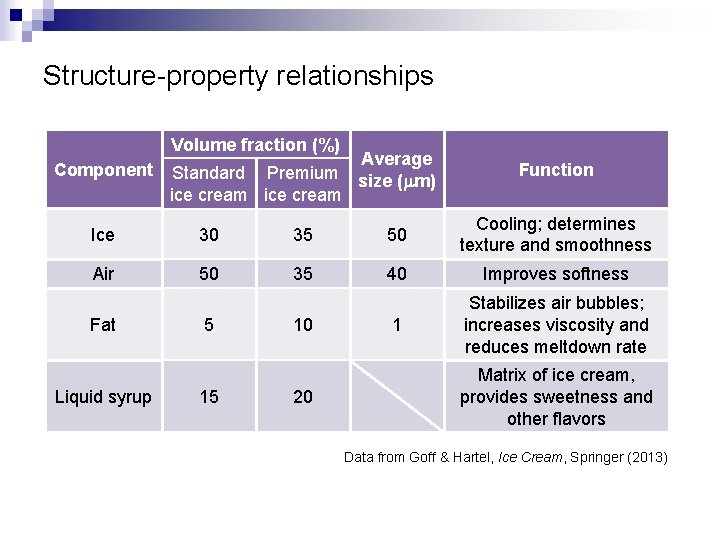
Structure-property relationships Volume fraction (%) Component Average Standard Premium size (mm) ice cream Function Ice 30 35 50 Cooling; determines texture and smoothness Air 50 35 40 Improves softness 1 Stabilizes air bubbles; increases viscosity and reduces meltdown rate Fat Liquid syrup 5 15 10 20 Matrix of ice cream, provides sweetness and other flavors Data from Goff & Hartel, Ice Cream, Springer (2013)
Thermodynamics of ice cream matrix n Freeze-concentration ¨ n Liquid The syrup is supersatured Glass transition ¨ Storage at -25 °C (close to Tg) prevents degradation Faceted growth of lactose crystals in ice cream matrix results in gritty mouthfeel -9. 5 °C Glass 100 mm Image from C. Clarke, The Science of Ice Cream, RSC (2005)
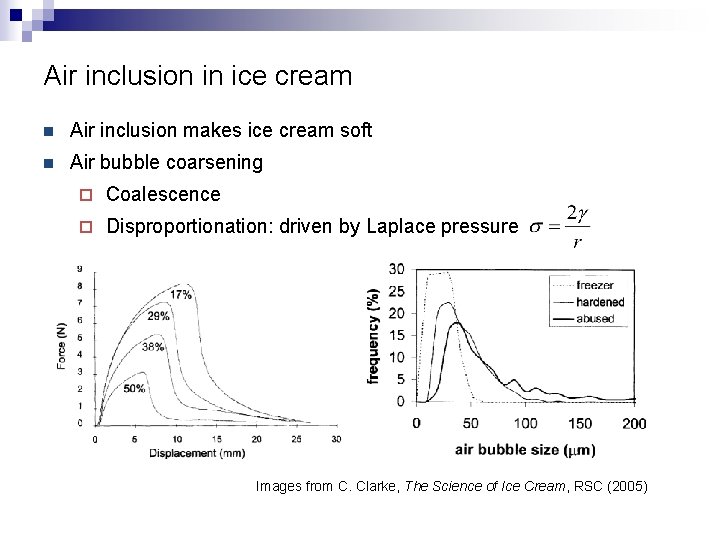
Air inclusion in ice cream n Air inclusion makes ice cream soft n Air bubble coarsening ¨ Coalescence ¨ Disproportionation: driven by Laplace pressure Images from C. Clarke, The Science of Ice Cream, RSC (2005)
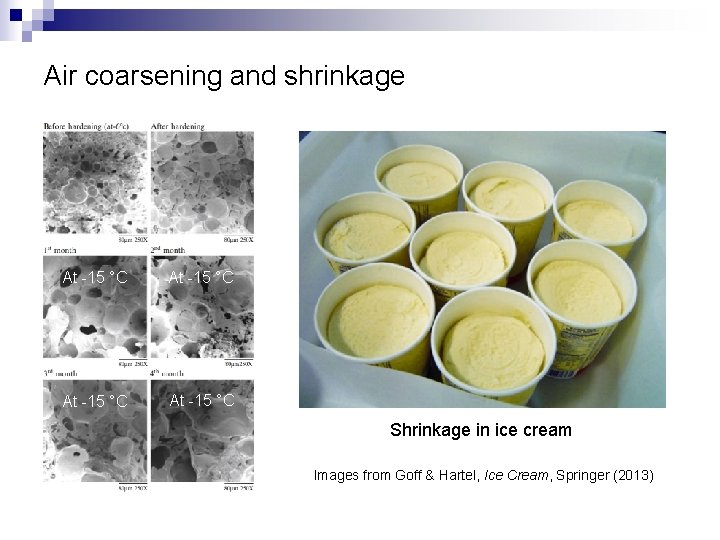
Air coarsening and shrinkage At -15 °C Shrinkage in ice cream Images from Goff & Hartel, Ice Cream, Springer (2013)
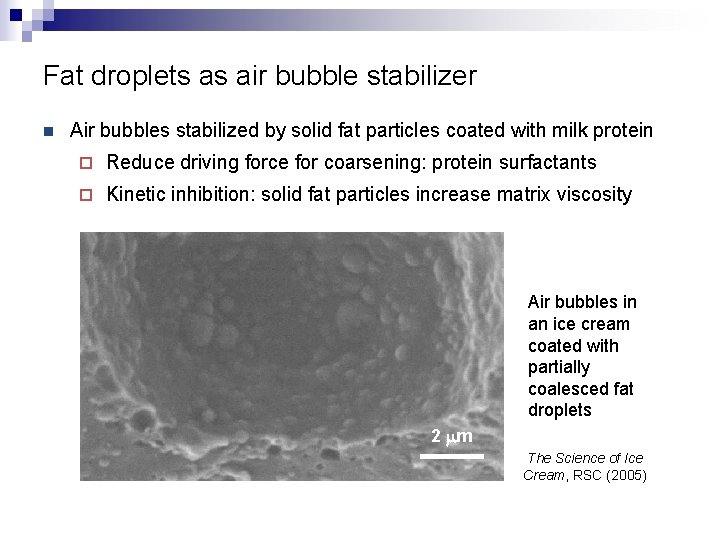
Fat droplets as air bubble stabilizer n Air bubbles stabilized by solid fat particles coated with milk protein ¨ Reduce driving force for coarsening: protein surfactants ¨ Kinetic inhibition: solid fat particles increase matrix viscosity Air bubbles in an ice cream coated with partially coalesced fat droplets 2 mm The Science of Ice Cream, RSC (2005)
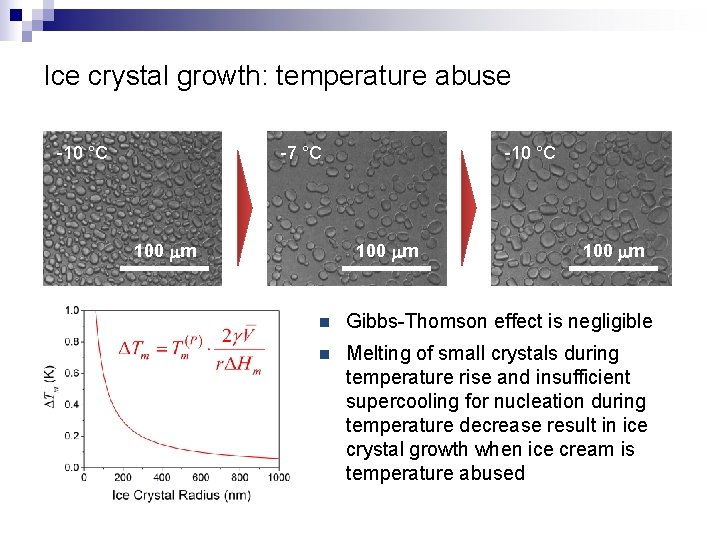
Ice crystal growth: temperature abuse -10 °C -7 °C 100 mm -10 °C 100 mm n Gibbs-Thomson effect is negligible n Melting of small crystals during temperature rise and insufficient supercooling for nucleation during temperature decrease result in ice crystal growth when ice cream is temperature abused
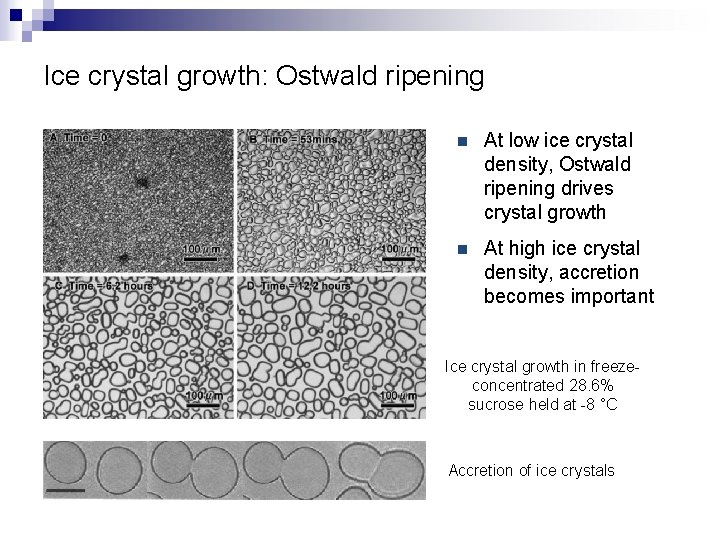
Ice crystal growth: Ostwald ripening n At low ice crystal density, Ostwald ripening drives crystal growth n At high ice crystal density, accretion becomes important Ice crystal growth in freezeconcentrated 28. 6% sucrose held at -8 °C Accretion of ice crystals
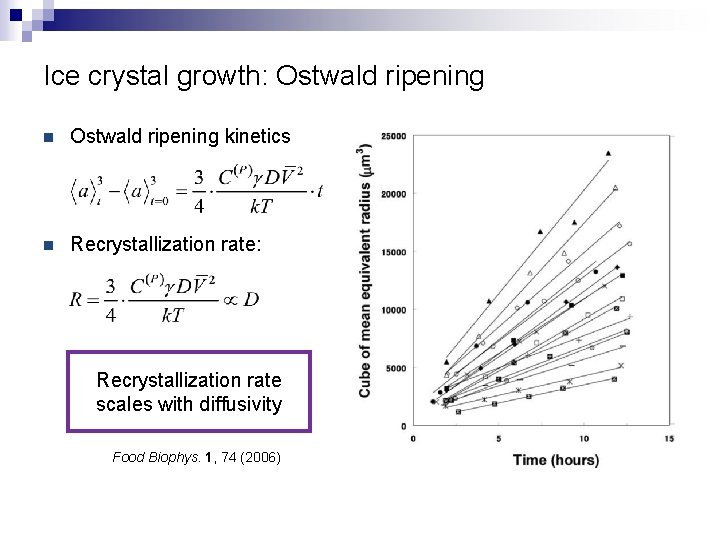
Ice crystal growth: Ostwald ripening n Ostwald ripening kinetics n Recrystallization rate: Recrystallization rate scales with diffusivity Food Biophys. 1, 74 (2006)
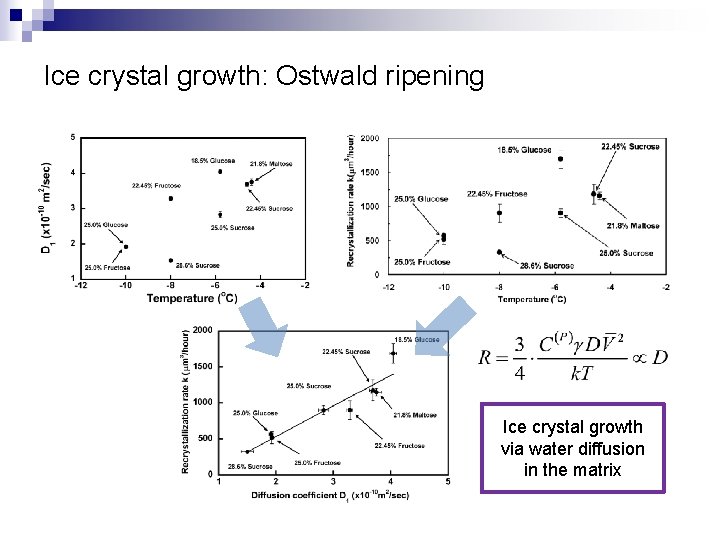
Ice crystal growth: Ostwald ripening Ice crystal growth via water diffusion in the matrix
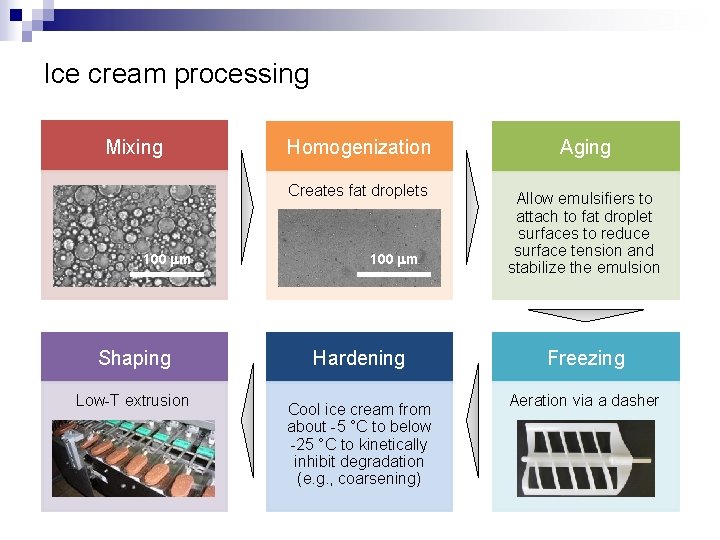
Ice cream processing Mixing Homogenization Creates fat droplets 100 mm Shaping Low-T extrusion 100 mm Hardening Cool ice cream from about -5 °C to below -25 °C to kinetically inhibit degradation (e. g. , coarsening) Aging Allow emulsifiers to attach to fat droplet surfaces to reduce surface tension and stabilize the emulsion Freezing Aeration via a dasher
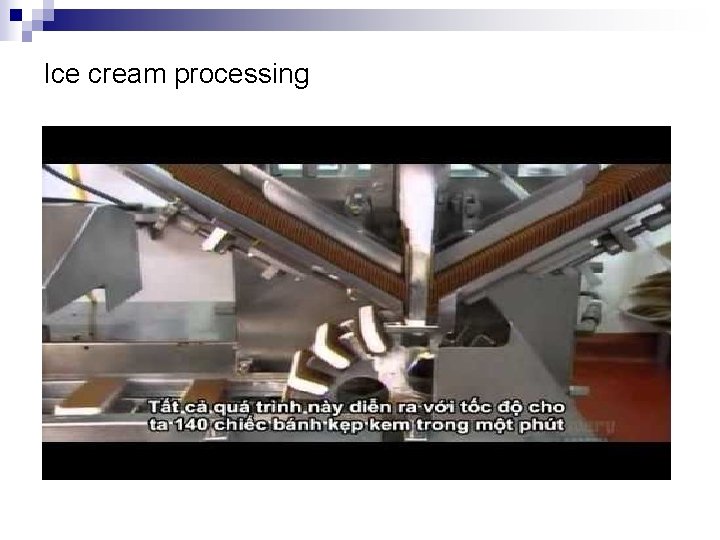
Ice cream processing
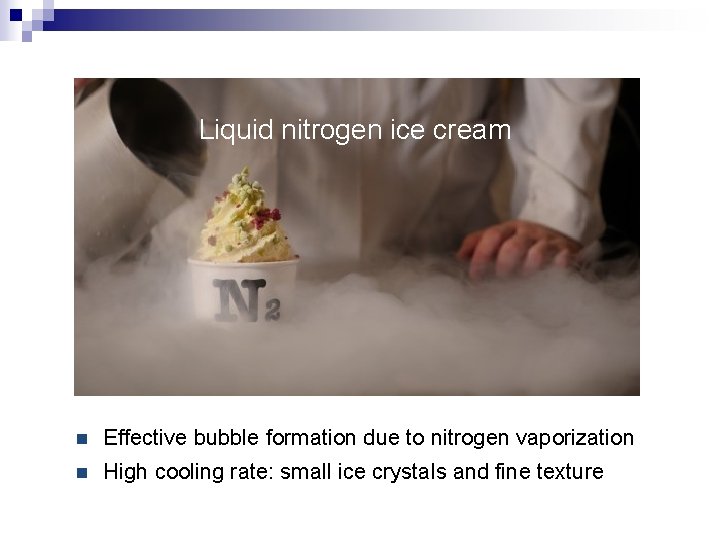
Liquid nitrogen ice cream n Effective bubble formation due to nitrogen vaporization n High cooling rate: small ice crystals and fine texture
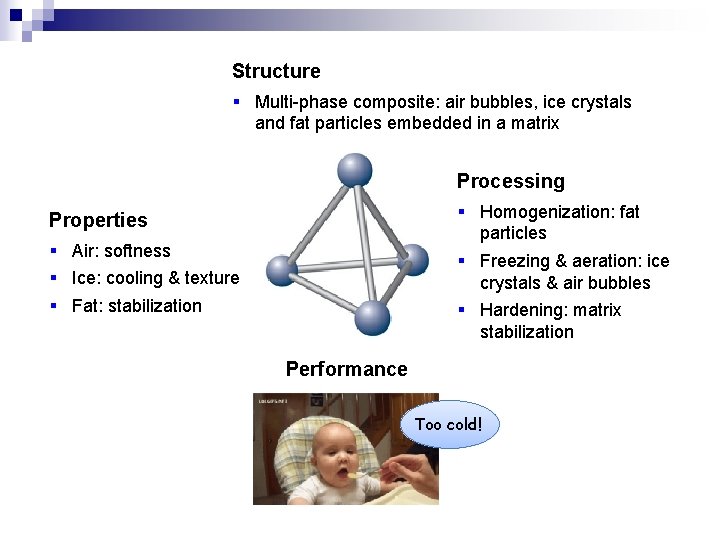
Structure § Multi-phase composite: air bubbles, ice crystals and fat particles embedded in a matrix Processing § Homogenization: fat particles § Freezing & aeration: ice crystals & air bubbles § Hardening: matrix stabilization Properties § Air: softness § Ice: cooling & texture § Fat: stabilization Performance Too cold!
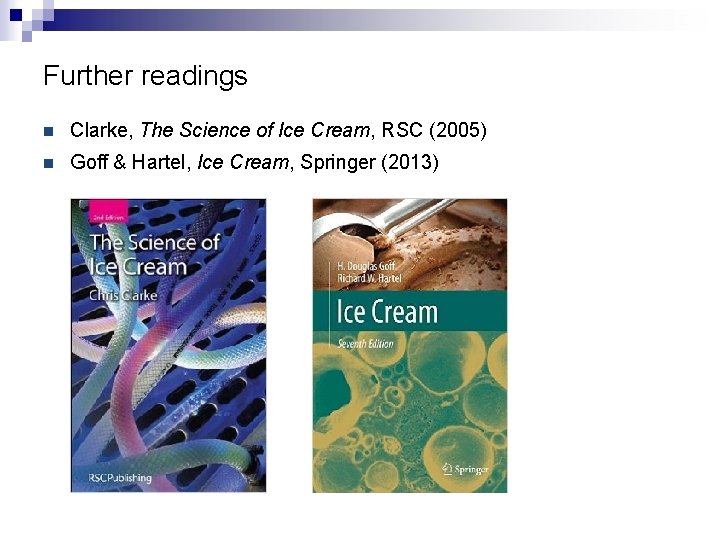
Further readings n Clarke, The Science of Ice Cream, RSC (2005) n Goff & Hartel, Ice Cream, Springer (2013)