
Mistakes to Avoid Distance Workouts and NonTraditional Structures



- Slides: 26
Mistakes to Avoid: Distance Workouts and Non-Traditional Structures Eric Heintz High Performance - Director eheintz@atlantatrackclub. org
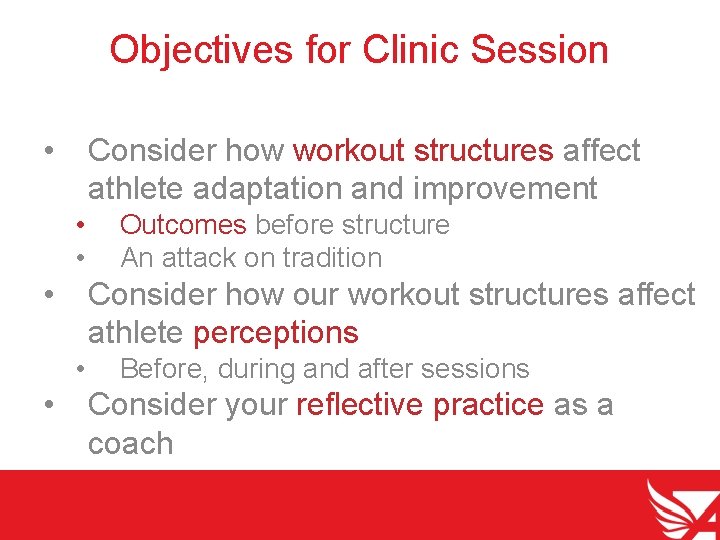
Objectives for Clinic Session • Consider how workout structures affect athlete adaptation and improvement • • • Consider how our workout structures affect athlete perceptions • • Outcomes before structure An attack on tradition Before, during and after sessions Consider your reflective practice as a coach
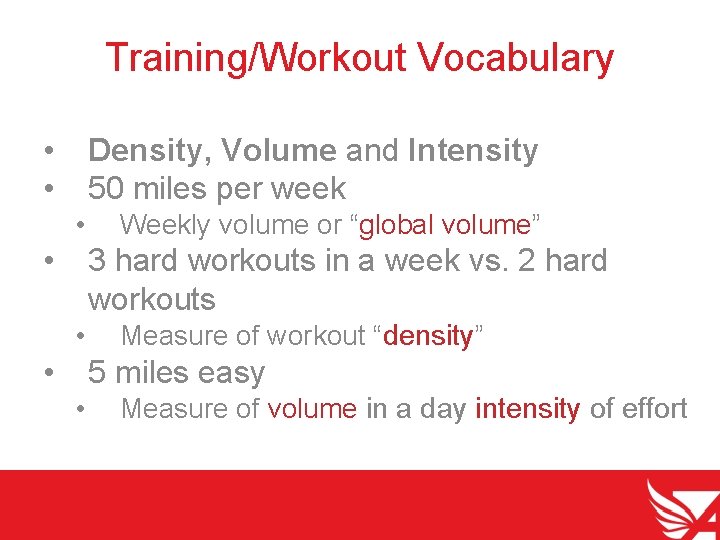
Training/Workout Vocabulary • • Density, Volume and Intensity 50 miles per week • • Weekly volume or “global volume” 3 hard workouts in a week vs. 2 hard workouts • • Measure of workout “density” 5 miles easy • Measure of volume in a day intensity of effort
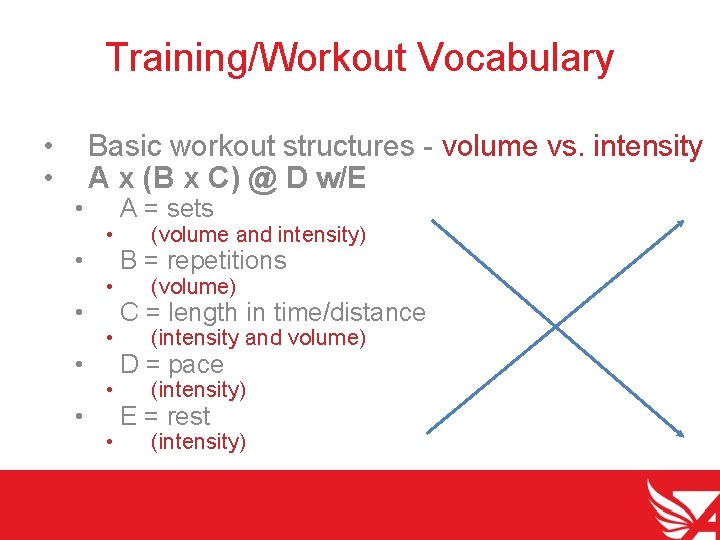
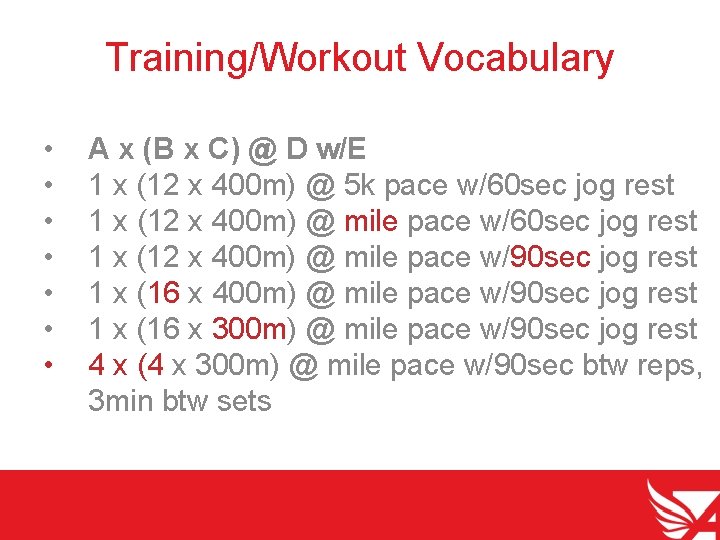
Training/Workout Vocabulary • • Basic workout structures - volume vs. intensity A x (B x C) @ D w/E • • • A = sets (volume and intensity) B = repetitions (volume) C = length in time/distance (intensity and volume) D = pace (intensity) E = rest (intensity)
Training/Workout Vocabulary • • A x (B x C) @ D w/E 1 x (12 x 400 m) @ 5 k pace w/60 sec jog rest 1 x (12 x 400 m) @ mile pace w/90 sec jog rest 1 x (16 x 300 m) @ mile pace w/90 sec jog rest 4 x (4 x 300 m) @ mile pace w/90 sec btw reps, 3 min btw sets
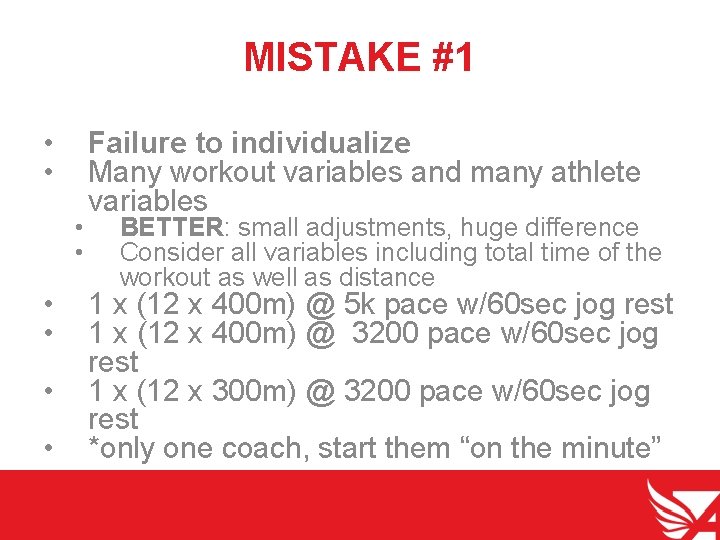
MISTAKE #1 • • Failure to individualize Many workout variables and many athlete variables BETTER: small adjustments, huge difference Consider all variables including total time of the workout as well as distance 1 x (12 x 400 m) @ 5 k pace w/60 sec jog rest 1 x (12 x 400 m) @ 3200 pace w/60 sec jog rest 1 x (12 x 300 m) @ 3200 pace w/60 sec jog rest *only one coach, start them “on the minute”
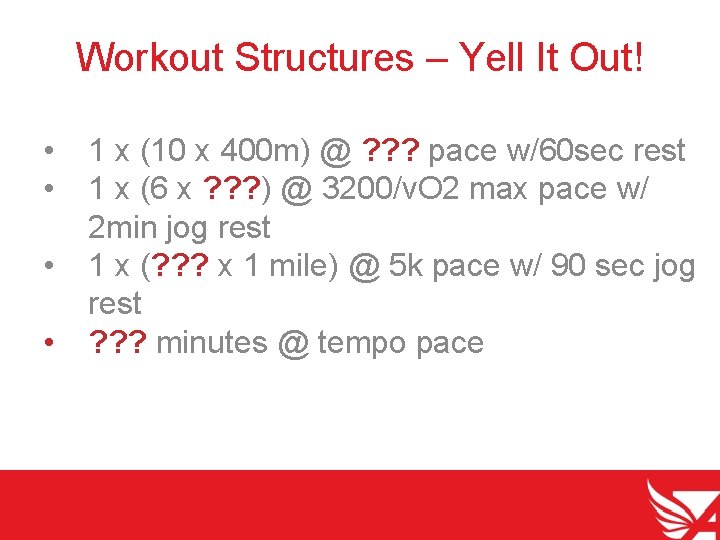
Workout Structures – Yell It Out! • • 1 x (10 x 400 m) @ ? ? ? pace w/60 sec rest 1 x (6 x ? ? ? ) @ 3200/v. O 2 max pace w/ 2 min jog rest 1 x (? ? ? x 1 mile) @ 5 k pace w/ 90 sec jog rest ? ? ? minutes @ tempo pace
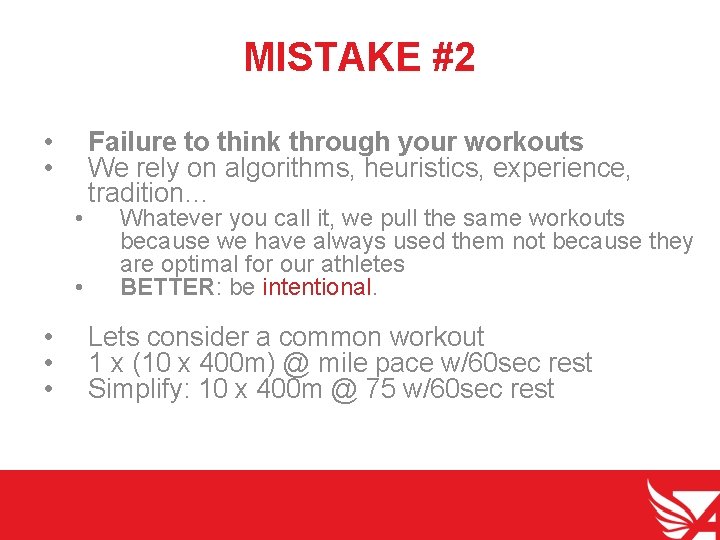
MISTAKE #2 • • Failure to think through your workouts We rely on algorithms, heuristics, experience, tradition… Whatever you call it, we pull the same workouts because we have always used them not because they are optimal for our athletes BETTER: be intentional. Lets consider a common workout 1 x (10 x 400 m) @ mile pace w/60 sec rest Simplify: 10 x 400 m @ 75 w/60 sec rest
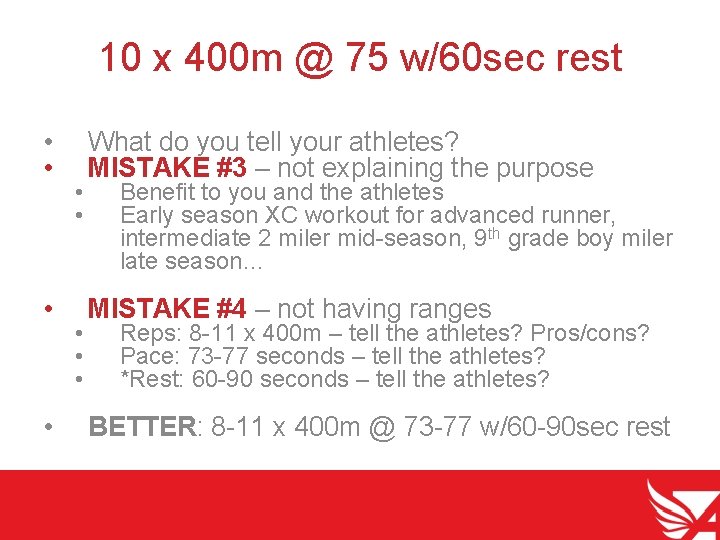
10 x 400 m @ 75 w/60 sec rest • • • What do you tell your athletes? MISTAKE #3 – not explaining the purpose Benefit to you and the athletes Early season XC workout for advanced runner, intermediate 2 miler mid-season, 9 th grade boy miler late season… MISTAKE #4 – not having ranges Reps: 8 -11 x 400 m – tell the athletes? Pros/cons? Pace: 73 -77 seconds – tell the athletes? *Rest: 60 -90 seconds – tell the athletes? BETTER: 8 -11 x 400 m @ 73 -77 w/60 -90 sec rest
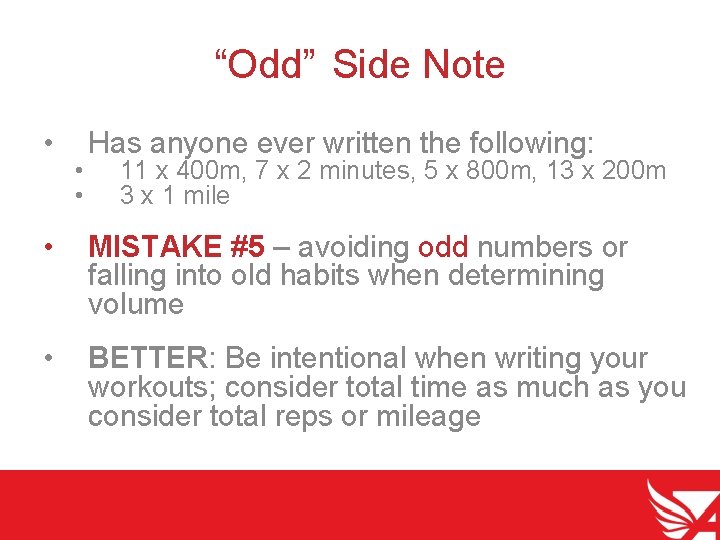
“Odd” Side Note • • • Has anyone ever written the following: 11 x 400 m, 7 x 2 minutes, 5 x 800 m, 13 x 200 m 3 x 1 mile • MISTAKE #5 – avoiding odd numbers or falling into old habits when determining volume • BETTER: Be intentional when writing your workouts; consider total time as much as you consider total reps or mileage
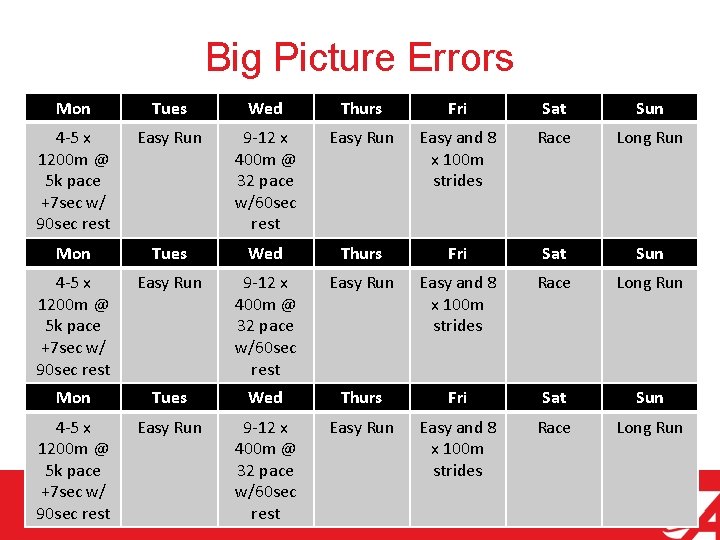
Big Picture Errors Mon Tues Wed Thurs Fri Sat Sun 4 -5 x 1200 m @ 5 k pace +7 sec w/ 90 sec rest Easy Run 9 -12 x 400 m @ 32 pace w/60 sec rest Easy Run Easy and 8 x 100 m strides Race Long Run
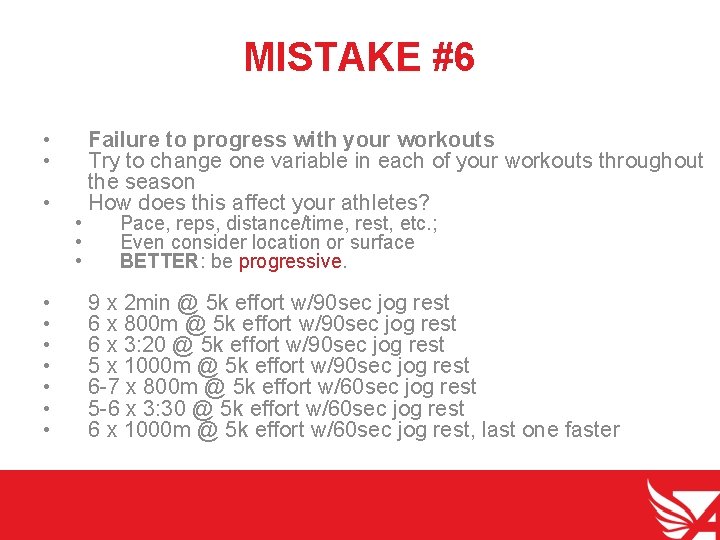
MISTAKE #6 • • • • Failure to progress with your workouts Try to change one variable in each of your workouts throughout the season How does this affect your athletes? Pace, reps, distance/time, rest, etc. ; Even consider location or surface BETTER: be progressive. 9 x 2 min @ 5 k effort w/90 sec jog rest 6 x 800 m @ 5 k effort w/90 sec jog rest 6 x 3: 20 @ 5 k effort w/90 sec jog rest 5 x 1000 m @ 5 k effort w/90 sec jog rest 6 -7 x 800 m @ 5 k effort w/60 sec jog rest 5 -6 x 3: 30 @ 5 k effort w/60 sec jog rest 6 x 1000 m @ 5 k effort w/60 sec jog rest, last one faster
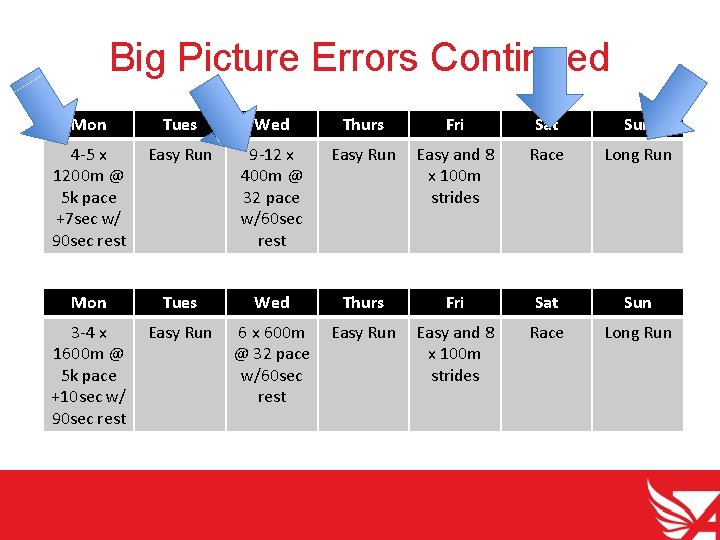
Big Picture Errors Continued Mon Tues Wed Thurs Fri Sat Sun 4 -5 x 1200 m @ 5 k pace +7 sec w/ 90 sec rest Easy Run 9 -12 x 400 m @ 32 pace w/60 sec rest Easy Run Easy and 8 x 100 m strides Race Long Run Mon Tues Wed Thurs Fri Sat Sun 3 -4 x 1600 m @ 5 k pace +10 sec w/ 90 sec rest Easy Run 6 x 600 m @ 32 pace w/60 sec rest Easy Run Easy and 8 x 100 m strides Race Long Run
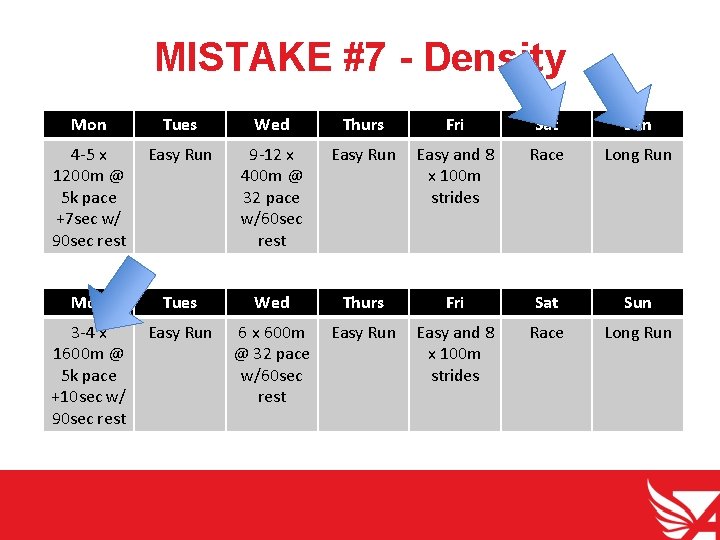
MISTAKE #7 - Density Mon Tues Wed Thurs Fri Sat Sun 4 -5 x 1200 m @ 5 k pace +7 sec w/ 90 sec rest Easy Run 9 -12 x 400 m @ 32 pace w/60 sec rest Easy Run Easy and 8 x 100 m strides Race Long Run Mon Tues Wed Thurs Fri Sat Sun 3 -4 x 1600 m @ 5 k pace +10 sec w/ 90 sec rest Easy Run 6 x 600 m @ 32 pace w/60 sec rest Easy Run Easy and 8 x 100 m strides Race Long Run
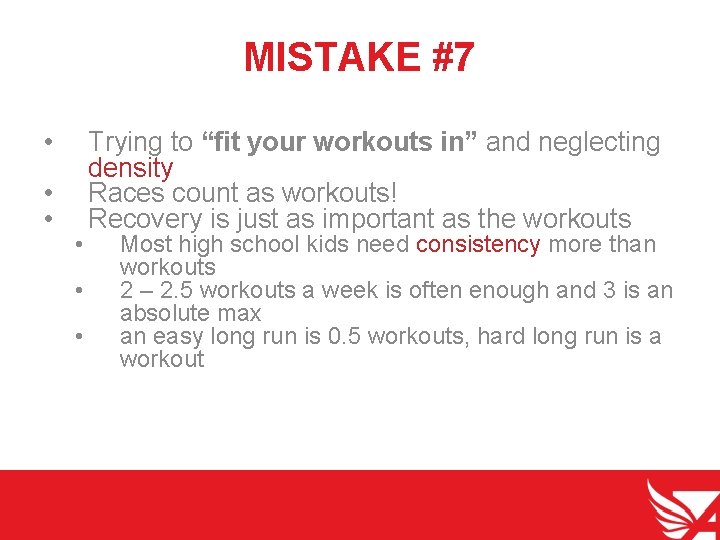
MISTAKE #7 • • • Trying to “fit your workouts in” and neglecting density Races count as workouts! Recovery is just as important as the workouts Most high school kids need consistency more than workouts 2 – 2. 5 workouts a week is often enough and 3 is an absolute max an easy long run is 0. 5 workouts, hard long run is a workout
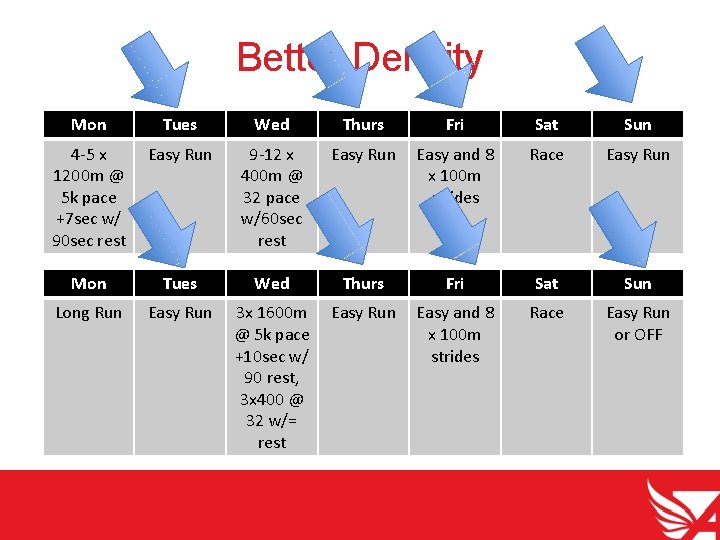
Better Density Mon Tues Wed Thurs Fri Sat Sun 4 -5 x 1200 m @ 5 k pace +7 sec w/ 90 sec rest Easy Run 9 -12 x 400 m @ 32 pace w/60 sec rest Easy Run Easy and 8 x 100 m strides Race Easy Run Mon Tues Wed Thurs Fri Sat Sun Long Run Easy Run 3 x 1600 m @ 5 k pace +10 sec w/ 90 rest, 3 x 400 @ 32 w/= rest Easy Run Easy and 8 x 100 m strides Race Easy Run or OFF
Go Shoe Shopping! • Mizuno Wave Rider • Smooth ride, cushion, support • 400+ miles of running • $109 • Mizuno Wave Rider • Smooth ride, cushion, support • 400+ miles of running • $129 Which do you buy?
MISTAKE #8 • • Training v. O 2 too often. *~3200 m pace Consider two workouts: 6 x 800 m @ 3200 pace w/90 sec rest 6 x 800 m @ 5 k pace w/90 sec rest How does an athlete feel after each workout? Paces slower and faster than 3200 m still elicit v. O 2 adaptations Why pay a greater cost for the same benefit? Increase in fatigue, form break down, injury risk, “risk of failure”, longer recovery period before next workout…
MISTAKE #8 continued • Training v. O 2 too often • • v. O 2 max is genetically-linked Why train something specifically that you can change very little or indirectly change at paces with other benefits or lower costs? Training at v. O 2 anecdotally leads to peaking “ 6 weeks from a PR”
v. O 2 TAKE AWAYS • Least amount of work for the most adaptation. • • “Most bang for your buck” Exceptions? • • • Specificity Mental challenge/find limits Canova’s “special block”
Writing A Good Workout • Goals • • Individualized Intentional Explained Ranges Progressive Appropriately spaced Right paces Consider athlete outcomes
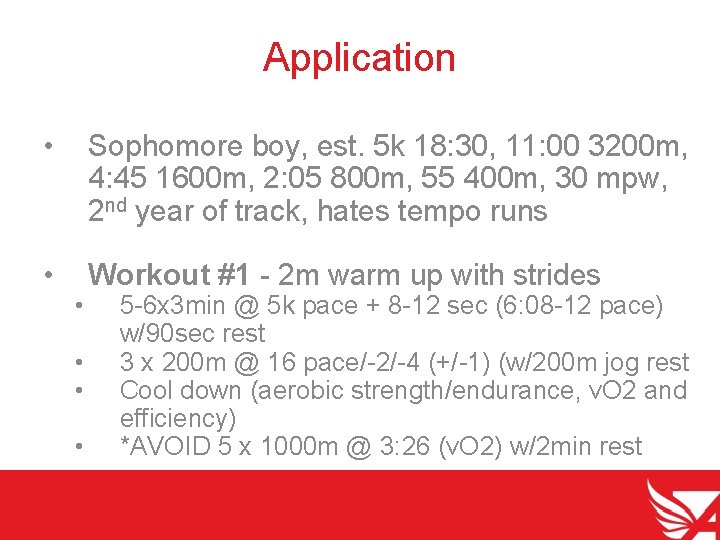
Application • Sophomore boy, est. 5 k 18: 30, 11: 00 3200 m, 4: 45 1600 m, 2: 05 800 m, 55 400 m, 30 mpw, 2 nd year of track, hates tempo runs • Workout #1 - 2 m warm up with strides • • 5 -6 x 3 min @ 5 k pace + 8 -12 sec (6: 08 -12 pace) w/90 sec rest 3 x 200 m @ 16 pace/-2/-4 (+/-1) (w/200 m jog rest Cool down (aerobic strength/endurance, v. O 2 and efficiency) *AVOID 5 x 1000 m @ 3: 26 (v. O 2) w/2 min rest
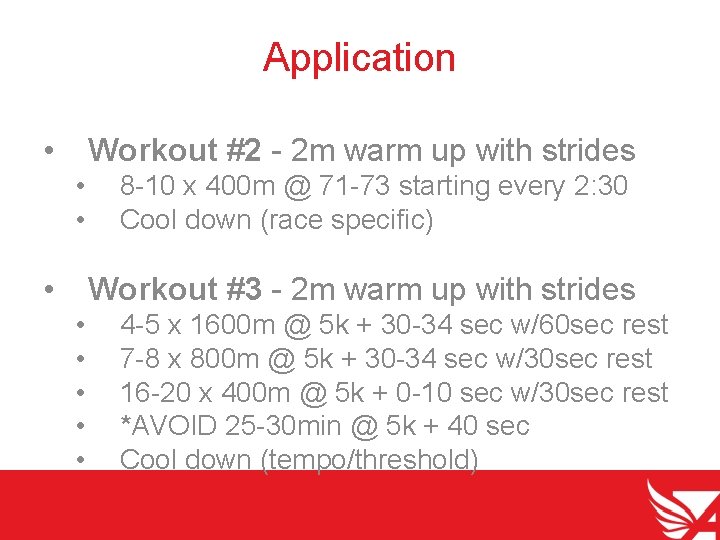
Application • Workout #2 - 2 m warm up with strides • • • 8 -10 x 400 m @ 71 -73 starting every 2: 30 Cool down (race specific) Workout #3 - 2 m warm up with strides • • • 4 -5 x 1600 m @ 5 k + 30 -34 sec w/60 sec rest 7 -8 x 800 m @ 5 k + 30 -34 sec w/30 sec rest 16 -20 x 400 m @ 5 k + 0 -10 sec w/30 sec rest *AVOID 25 -30 min @ 5 k + 40 sec Cool down (tempo/threshold)
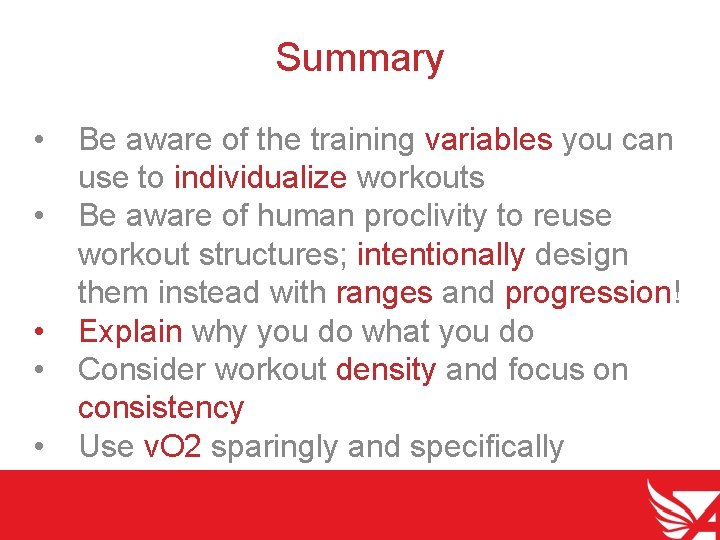
Summary • • • Be aware of the training variables you can use to individualize workouts Be aware of human proclivity to reuse workout structures; intentionally design them instead with ranges and progression! Explain why you do what you do Consider workout density and focus on consistency Use v. O 2 sparingly and specifically
Any Questions? Eric Heintz 770. 722. 1841 eheintz@atlantatrackclub. org