
Mississippi v Tennessee An Intriguing Case in Water

- Slides: 28
Mississippi v. Tennessee An Intriguing Case in Water Management Don Christy GMDA Annual Meeting June 1, 2018 Appreciation to Beau Melton for research support for this presentation
“Water, Everywhere…” All the water that will ever be, is right now. National Geographic, October 1993 When the well's dry, we know the worth of water. Benjamin Franklin (1706 -1790), Poor Richard's Almanac, 1746 Whisky is for drinkin’, water’s for fightin’ Mark Twain(? ) (1835 -1910)
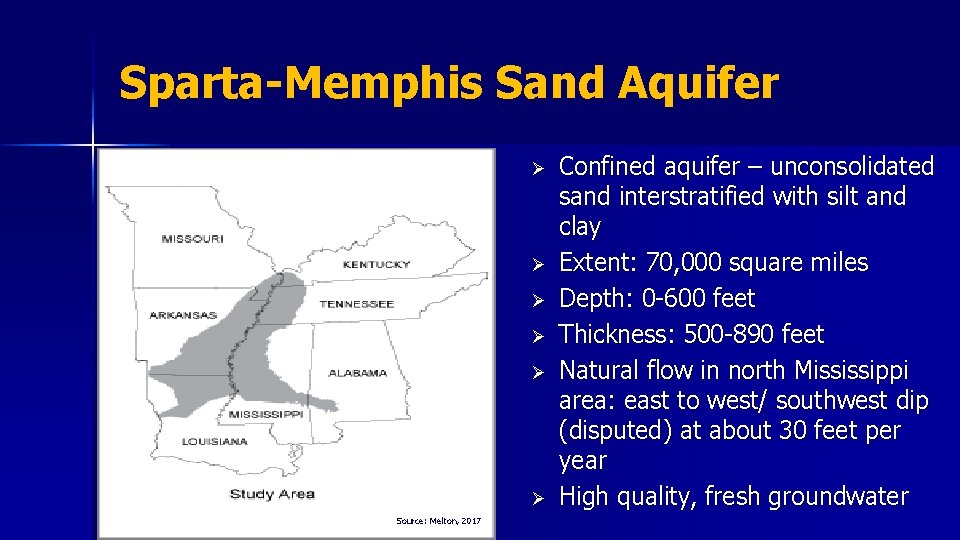
Sparta-Memphis Sand Aquifer Ø Ø Ø Source: Melton, 2017 Confined aquifer – unconsolidated sand interstratified with silt and clay Extent: 70, 000 square miles Depth: 0 -600 feet Thickness: 500 -890 feet Natural flow in north Mississippi area: east to west/ southwest dip (disputed) at about 30 feet per year High quality, fresh groundwater
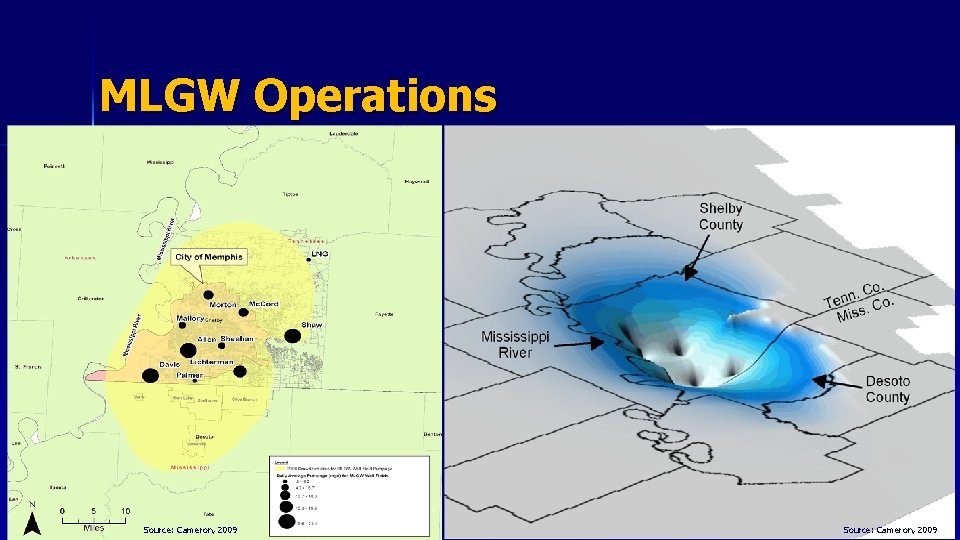
MLGW Operations Memphis - use of groundwater since 1886 Ø Memphis - largest city in the world relying solely on groundwater for water supply Ø MLGW is nation’s largest three-service municipal utility Ø 175 wells in 10 well fields Ø Pumping about 200 million gallons per day Ø MLGW is largest groundwater pumper in NW Mississippi Ø
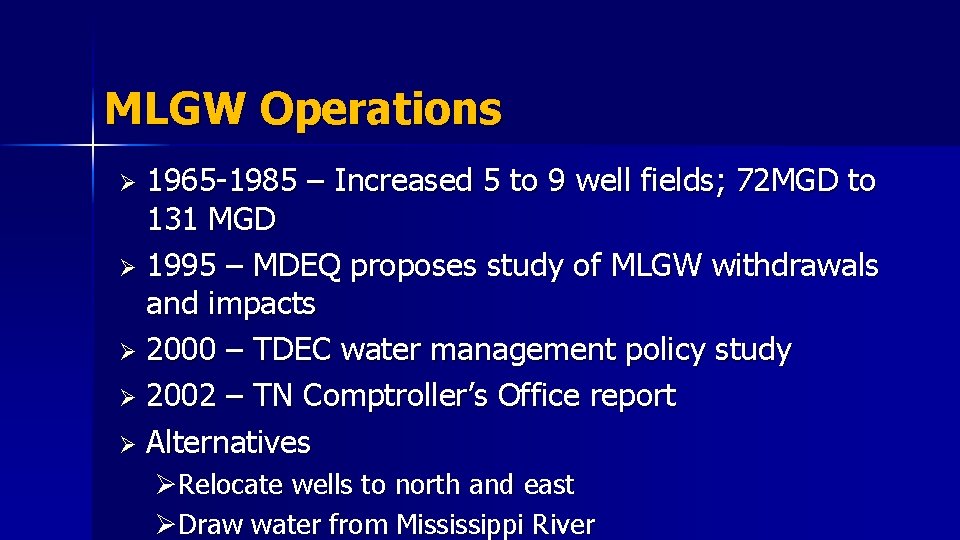
MLGW Operations 1965 -1985 – Increased 5 to 9 well fields; 72 MGD to 131 MGD Ø 1995 – MDEQ proposes study of MLGW withdrawals and impacts Ø 2000 – TDEC water management policy study Ø 2002 – TN Comptroller’s Office report Ø Alternatives Ø ØRelocate wells to north and east ØDraw water from Mississippi River
MLGW Operations Source: Cameron, 2009
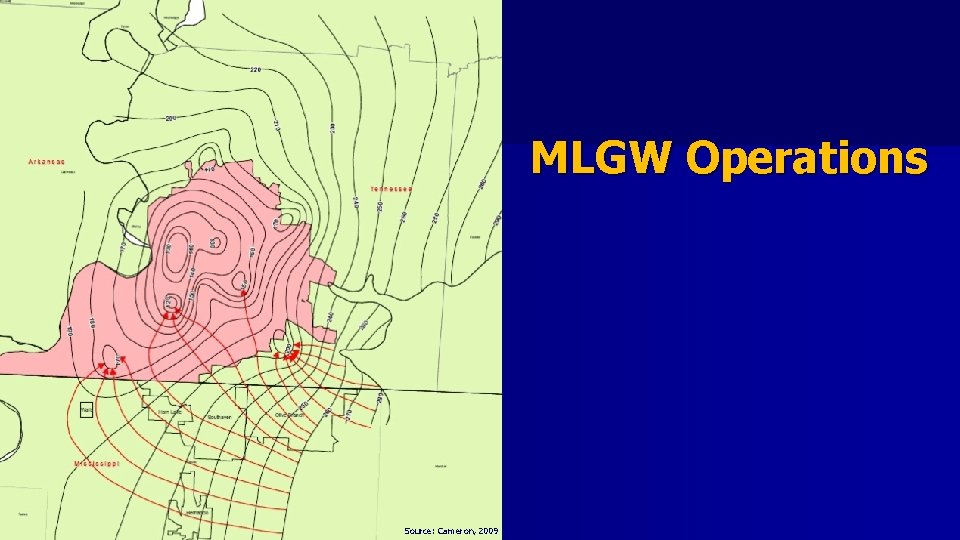
MLGW Operations Source: Cameron, 2009
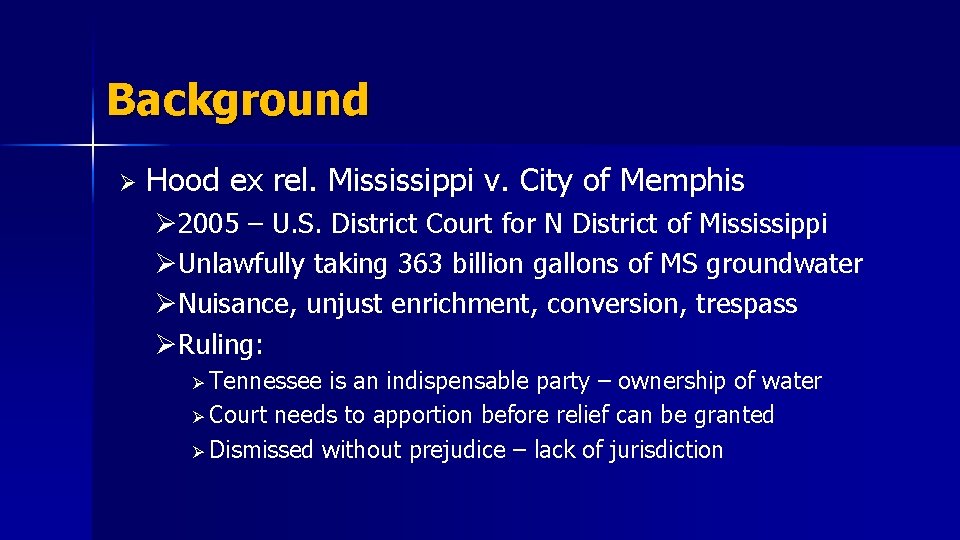
Background Ø Hood ex rel. Mississippi v. City of Memphis Ø 2005 – U. S. District Court for N District of Mississippi ØUnlawfully taking 363 billion gallons of MS groundwater ØNuisance, unjust enrichment, conversion, trespass ØRuling: Ø Tennessee is an indispensable party – ownership of water Ø Court needs to apportion before relief can be granted Ø Dismissed without prejudice – lack of jurisdiction
Background Ø Hood ex rel. Mississippi v. City of Memphis Ø 2009 – Fifth Circuit Court of Appeals ØNo lack of jurisdiction – no action between states (MS not seeking any relief from TN) ØMS owns water in aquifer ØRuling: Ø Affirmed District Court decision; no error of law Ø Aquifer is an interstate water source; rejected argument that MS owns a fixed quantity of resources Ø Interstate water source must be apportioned before suit for invasion
Background Ø Hood ex rel. Mississippi v. City of Memphis Ø 2012 – U. S. Supreme Court ØMississippi files petition for writ of certiorari and leave to file a bill of complain for original action ØRuling: Ø Court denies both motions Ø Equitable apportionment applicable to interstate water disputes
Mississippi Water Law - 1956 Ø Surface water appropriation law ØWater put to beneficial use ØWaste prohibited ØConservation exercised Groundwater not impacted Ø Board of Water Commissioners/State Water Engineer Ø Priority-based regulatory scheme/permit Ø Forfeiture for non-use Ø
Mississippi Water Law - 1985 Ø Substantial rewrite of MS water law ØWater resources to beneficial use ØConjunctive use encouraged ØSurface water and groundwater are basic resources of the state; belong to the people of the state and subject to regulation through police powers Ø No person may use water without a permit/some exceptions
Mississippi Water Law - 1985 Permit from Environmental Quality Permit Board Ø EQPB may delegated authority for review/ recommendation Ø Mining of groundwater prohibited Ø Max. permit term = 10 years/$10 fee Ø State water management plan required Ø Reporting Ø
Mississippi Law “All water, whether occurring on the surface of the ground or underneath the surface of the ground, is hereby declared to be among the basic resources of this state and therefore belong to the people of this state, and is subject to regulation…” MCA § 51 -3 -1 (2017)
Tennessee Law Ø Registration for water users of 10, 000+ gallons per day Ø “waters of the state are the property of the state and are held in public trust for the benefit of its citizens” TCA § 68 -221 -702/TCA § 69 -3 -1 (2017) Ø Definition of groundwater (TCA § 68 -221 -703 (2017))
Mississippi v. Tennessee Ø Leave to file a bill of complaint – June 2014 Ø Defendants’ opposition briefs – September 2014 Ø U. S. Solicitor General amicus brief (opposes) – May 2015 Ø Leave to file granted – June 2015 Ø Orig. No. 143 Ø Special Master – Eugene E. Siler, Jr. of London, KY
Mississippi’s Argument Ø Sovereign ownership and control over aquifer (groundwater in storage-trapped in geologic formation) – 20 -27 MGD pumped from storage ØActionable trespass – intentional intrusion/invasion ØConversion, taking and misappropriation of property belonging to Mississippi Aquifer is not subject to equitable apportionment Ø Tennessee regulates public water supply wells Ø
Mississippi’s Requests for Relief Declaratory judgement – sovereign right, title and exclusive interest in groundwater naturally located in state Ø Damages for value of groundwater taken - $615 M (extraction of 252 B gallons of groundwater from 1985 to date) Ø Defendants act to eliminate cone of depression Ø
Tennessee’s Response Groundwater is part of an interstate water source – state’s right of use through interstate compact or equitable apportionment Ø Groundwater would have moved from MS to TN (flow northwesterly) Ø MS claims barred by issue preclusion (2005 suit) Ø “Unnatural conditions” do not bar equitable apportionment Ø
Tennessee’s Requested Relief Ø Dismiss Mississippi’s claim with prejudice Ø Reject Mississippi’s requests for relief Ø Affirm Mississippi has no right to exclude or charge other states (or subdivisions) for groundwater in aquifer
Jurisdiction Ø Exclusive and original jurisdiction over controversies involving two states (U. S. Const. , Art. III, § 2, cl. 2) Ø Court can provide declaratory and injunctive relief and require payment of damages
Ownership Ø Aquifer analogous to land ØU. S. Const. , art. IV, § 3 – Equal footing doctrine Ø New states acquire equivalent rights to existing states Ø “Full jurisdiction over the lands within its borders, including the beds of streams and other waters” (Kansas v Colorado (1907)) Ø Aquifer is analogous to river or lake ØGroundwater is not subject to state ownership in the proprietary or possessory sense (Sporhase v Nebraska (1982)) Ø Sovereign ownership = legal fiction?
Equitable Apportionment Federal common law doctrine – “equality of right”/ “establish justice” Ø Analysis considers state laws and other relevant factors Ø State borders not dispositive – no exclusive control over interstate waters within the border Ø Not been applied to aquifers/applied to groundwater associated with surface waters Ø “Unnatural conditions” bar application of doctrine Ø
Settlement Ø 2010 – MS A. G. contacts TN A. G. ’s office regarding settlement negotiations – TN declined Ø Some negotiations between Mississippi, Tennessee and Arkansas officials
Memorandum of Decision on Motions Ø August 12, 2016 Ø Motions for judgment on the pleadings; motion to exclude certain materials Ø “it does not appear the complaint plausibly alleges that the aquifer/water within have an interstate character. ” Ø Mississippi disclaims request for equitable apportionment Ø Special masters to prepare records that err on the side of over-inclusiveness
Going Forward Ø Threshold issue – whether aquifer is an interstate resource Ø Evidentiary hearing on whether the aquifer and water constitute an interstate resource Ø Hearing scheduled for January 14, 2019 in Nashville, Tennessee
Possible Outcomes Ø Accept Mississippi’s position – it has sovereign ownership of the water in the aquifer; Tennessee is converting water (state ownership theory) Ø Apply equitable apportionment doctrine Ø Fashion a new doctrine for interstate groundwater aquifers based on common law interstate nuisance doctrine (benefits v. harms, reasonableness) Source: Hall and Regalia, 2016
Questions