
Mississippi Studies Chapter 1 Section 1 MISSISSIPPIS NATURAL




- Slides: 55
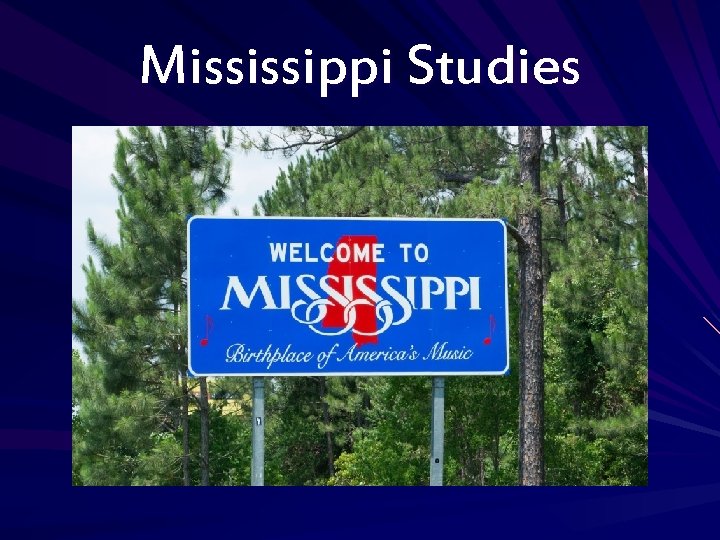
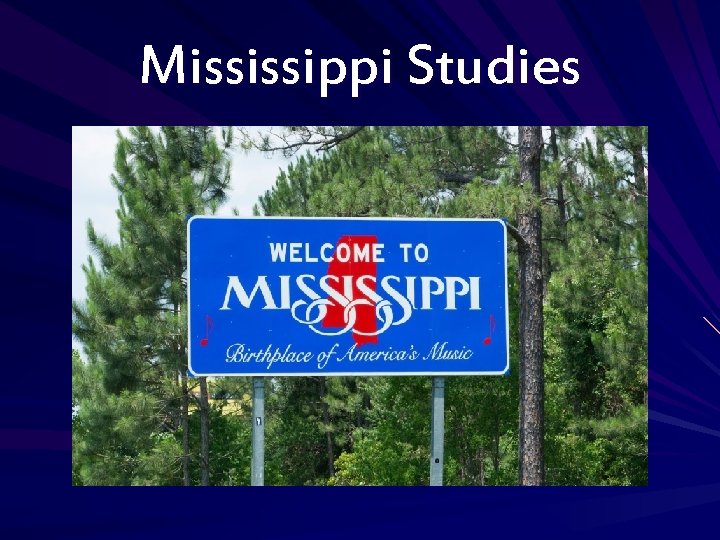
Mississippi Studies
Chapter 1 – Section 1 MISSISSIPPI’S NATURAL ENVIROMENT o Five Themes of Geography o Location
Chapter 1 – Section 1 MISSISSIPPI’S NATURAL ENVIROMENT o Five Themes of Geography
5 Themes of Geography include: o Location o Place o Human Environment Interaction o Movement o Regions
Location: focuses on where a place is in relation to other places or in terms of latitude and longitude
Every place on earth has a specific location.
Place: focuses on the physical and human or cultural characteristics of a particular location.
A place’s physical characteristics include: o Climate o Water Resources o Landforms o Soils o Energy and Mineral Resources o Vegetation o Animal Life
A place’s cultural characteristics include: o Languages o Religions o Technology o Political Systems of the Inhabitants
Human Environment Interaction is how humans interact with their environment.
Movement tells about how we interact with people outside of our immediate environment.
Regions allows geographers to define an area in terms of one or more characteristics.
Geographers divide the world into regions.
Natural regions are things like: o Landforms o Bodies of Water o Vegetation o Climate o Soil o Resources
Cultural regions are: o Language o Religion o Political Differences
Mississippi can be divided into four broad geographical regions: o the Delta o the Hills o the Piney Woods o the Gulf Coast
Chapter 1 – Section 1 MISSISSIPPI’S NATURAL ENVIROMENT o Location
Relative Location is where a place is compared to other places
Mississippi is located in the southeastern portion of the U. S.
Mississippi has four boundaries: o Tennessee to the north o Alabama to the east o Gulf of Mexico to the south o Mississippi River to the west
Absolute Location is: a precise place on the face of the earth. You can find this using a GPS.
Mississippi's absolute location is: 30 -34*N latitude 88 -91*W longitude
Latitude is: the distance north or south of the equator.
Longitude is: the distance east or west of the prime meridian.
Global Positioning System is: a satellite-based system used to determine the precise location of a place.
It’s Your Turn! 1. Give an example of a physical characteristic and a cultural characteristic of Lake Cormorant, MS. 2. What is the difference between absolute and relative location?
Mississippi Studies
Chapter 1 – Section 2 MISSISSIPPI’S NATURAL ENVIROMENT o Natural Environment o Water Resources
Mississippi’s Natural Environment includes elements such as: o Climate o Water o Landforms o Soil o Energy and Mineral Resources o Vegetation o Wildlife
Climate is: the long term average of weather conditions.
Mississippi has a humid subtropical climate.
Weather is: the day to day changes in the atmosphere.
The hottest temperature in Mississippi was 115*F in Holly Springs The coldest temperature in Mississippi was -19*F in Corinth
Mississippi’s average annual precipitation is 52 inches.
Most of the rainfall occurs in the winter. (15. 26 inches)
Mississippi’s Natural hazards include: o Thunderstorms o Tornados o Hail Storms o Hurricanes o High Winds
Tornadoes: o Generally occur in the spring and early summer o Rotate counter clockwise o Rarely more than ¼ mile wide
Hurricanes o Arise in the tropical Atlantic ocean o Rotate counter clockwise o Cause major flooding
It’s Your Turn! 1. What are the 7 elements that make up our natural environment? 2. Earth’s life support system contains four sphere. Name them. 3. Name the most powerful hurricane ever to hit Mississippi.
Hydrologic Cycle o Evaporation o Condensation o Precipitation
Surface Water is: the water in lakes, ponds, rivers, the ocean. and
Groundwater is: below the earths surface where it accumulates in aquifers (rock formations).
Aquifers are: ground water that has accumulated in rock formations
The Mississippi river makes up most of the western border of Mississippi.
Drainage Basin is: The geographical area draining into river or reservoir. a
The state has nine major and two minor river systems
Mississippi’s Major Rivers: o o o o o TOMBIGBEE RIVER MISSISSIPPI RIVER SUNFLOWER RIVER HOMOCHITTO RIVER NOXUBEE RIVER PEARL RIVER ENID RIVER COLDWATER RIVER YAZOO RIVER
The Mississippi river begins it’s journey at Lake Itasca in Minnesota where you can actually walk across (it’s only 3 feet deep).
The Missouri, Arkansas, and Ohio rivers flow into the Mississippi river.
The Yazoo, Big Black, Bayou Pierre-Cole, and Homochitto rivers drain westward into the Mississippi river.
The Tombigbee, Pearl, Amite, Pascagoula, and the Biloxi rivers drain to the south.
Our rivers are important but in recent years more attention has been placed on the storage and protection of surface water.
Our state’s reservoirs assist in flood control for our state.
Arkabutla, Sardis, Enid, and Grenada lakes were all designed to assist in flood control for the delta.
Mississippi’s Reservoirs: o PICKWICK LAKE o ROSS BARNETT RESIVOIR o SARDIS LAKE o ARKABUTLA LAKE o ENID LAKE o GRENADA LAKE