
MISSION SWACHH SWASTH PUNJAB UNDER SWACHH BHARAT MISSION
MISSION SWACHH & SWASTH PUNJAB UNDER SWACHH BHARAT MISSION (GRAMIN) SUSTAINING ODF STATUS Department of Water Supply & Sanitation, Punjab
Choice and Ownership in Asset Creation Beneficiary constructed his/her own toilet – contractors and middlemen eliminated Beneficiary decided where , how and what type of toilet will be constructed - women of the household played an important role Freedom of choice for technology to be adopted - twin leach pit / septic tank with soak pit Concept of bath - cum- toilet promoted Robust quality construction monitoring protocol through 3 stage picture upload , on especially created mobile app was linked to incentive release - this eliminated any possibility of ghost toilets
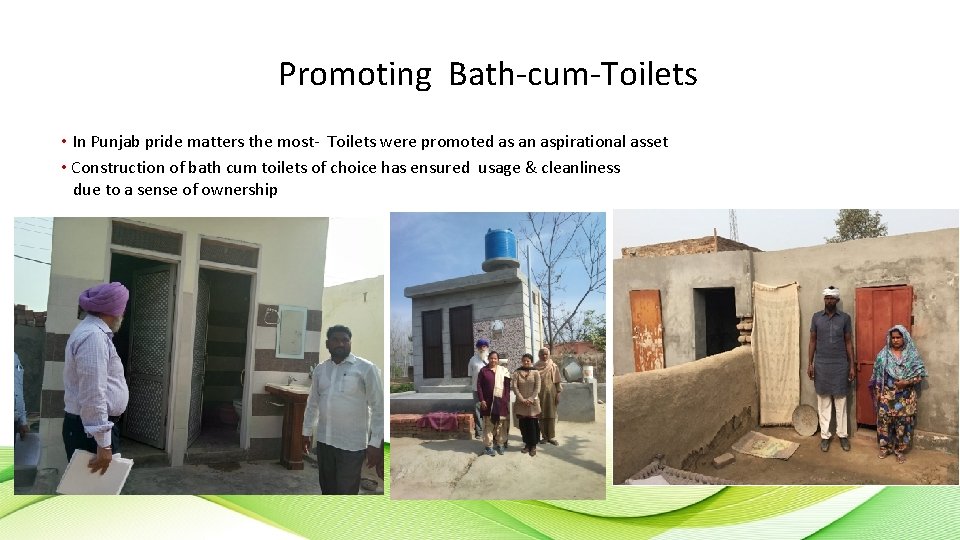
Promoting Bath-cum-Toilets • In Punjab pride matters the most- Toilets were promoted as an aspirational asset • Construction of bath cum toilets of choice has ensured usage & cleanliness due to a sense of ownership
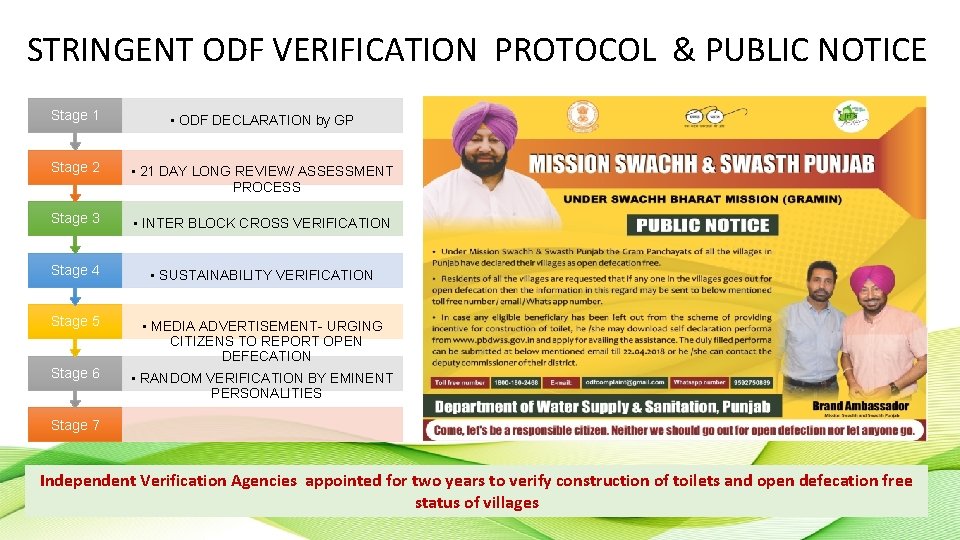
STRINGENT ODF VERIFICATION PROTOCOL & PUBLIC NOTICE Stage 1 • ODF DECLARATION by GP Stage 2 • 21 DAY LONG REVIEW/ ASSESSMENT PROCESS Stage 3 • INTER BLOCK CROSS VERIFICATION Stage 4 • SUSTAINABILITY VERIFICATION Stage 5 • MEDIA ADVERTISEMENT- URGING CITIZENS TO REPORT OPEN DEFECATION • RANDOM VERIFICATION BY EMINENT PERSONALITIES Stage 6 Stage 7 Independent Verification Agencies appointed for two years to verify construction of toilets and open defecation free status of villages
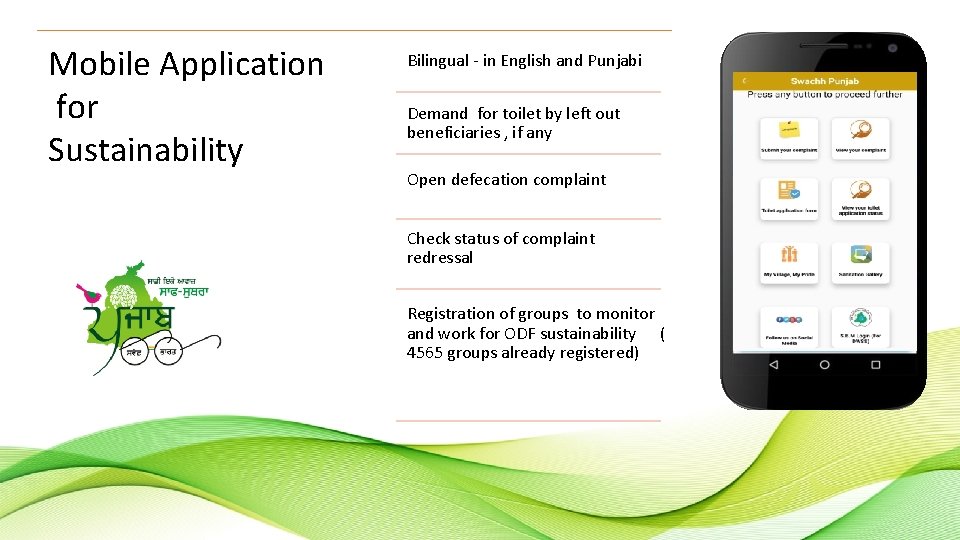
Mobile Application for Sustainability Bilingual - in English and Punjabi Demand for toilet by left out beneficiaries , if any Open defecation complaint Check status of complaint redressal Registration of groups to monitor and work for ODF sustainability ( 4565 groups already registered)
99% of Punjab villages are covered with piped water supply 50% of households have private water supply connections and the State is targeting 100% connections by 2019 Availability of Water for Sanitation State is focusing on higher service deliver parameters in water supply by providing 70 litre per capita per day (7768 villages already have 70 LPCD supply) Longer hours of water supply from minimum 10 hours to 24 x 7 (139 villages already have 24 x 7 water supply & 2370 villages have more than 10 hours of water supply ) 100% household connections ( 3760 villages already have 100% connections ) Community management of routine operation and maintenance of water supply schemes Ensuring availability of water has significantly contributed towards the sustenance of usage and cleanliness of toilets constructed by rural households
Institutional Arrangement to Sustain ODF Status Social and IEC staff deployed along with technical field functionaries for awareness generation and capacity building of community Job profile of technical staff from Junior Engineer to Chief Engineers reoriented towards service delivery Sections created in the department at field level to monitor and facilitate water and sanitation in the rural areas Each section looks after 20 -30 villages Each section headed by a Junior Engineer and supported by a team 9 field functionaries to support village water supply and sanitation committees in sustaining ODF status and ensuring regular water supply To inculcate the habit of hygiene from childhood and to imbibe the importance of safe water & sanitation, special chapters have been included in the curricular books of class III to class XII of the Punjab School Education Board
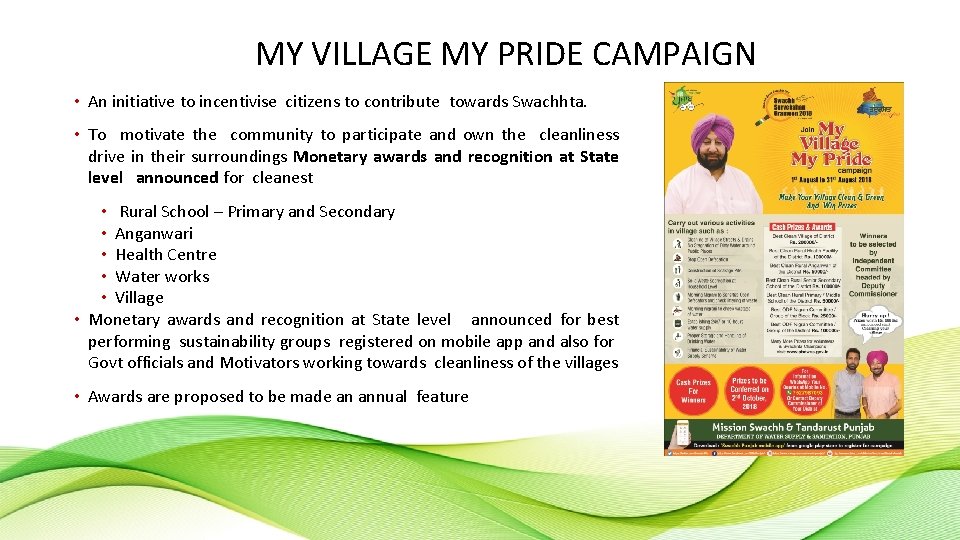
MY VILLAGE MY PRIDE CAMPAIGN • An initiative to incentivise citizens to contribute towards Swachhta. • To motivate the community to participate and own the cleanliness drive in their surroundings Monetary awards and recognition at State level announced for cleanest • Rural School – Primary and Secondary • Anganwari • Health Centre • Water works • Village • Monetary awards and recognition at State level announced for best performing sustainability groups registered on mobile app and also for Govt officials and Motivators working towards cleanliness of the villages • Awards are proposed to be made an annual feature
Way forwardnext stage challenges Notification of an Act or Rules for regulation of solid and liquid waste in rural areas Registration and regulation of operators handling faecal sludge and their capacity building Framing of guidelines mandating composting of faecal sludge and its proper end use Mandating construction of soak pits in all house holds with toilets constructed prior to SBM(G) from their own sources Renovation and remodelling of village ponds and reuse of treated waste water
THANK YOU
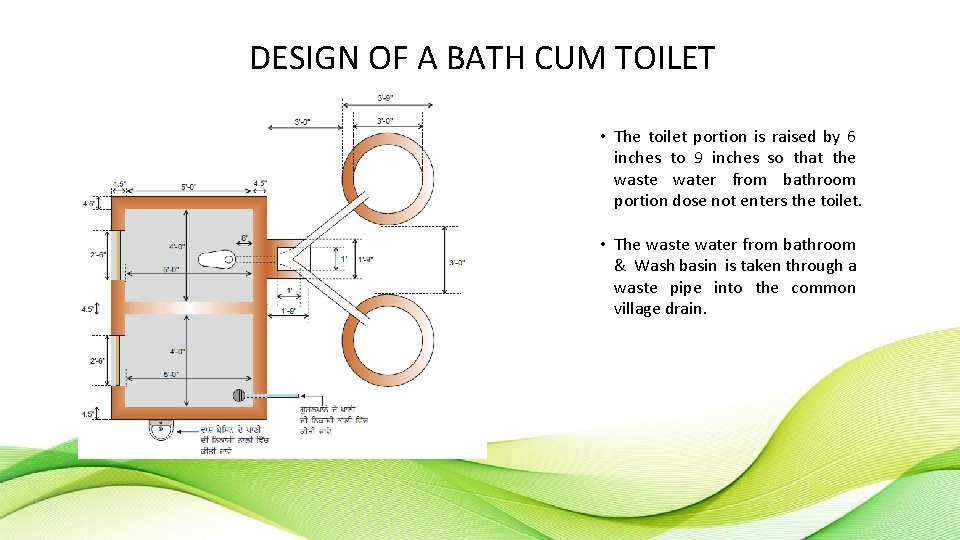
DESIGN OF A BATH CUM TOILET • The toilet portion is raised by 6 inches to 9 inches so that the waste water from bathroom portion dose not enters the toilet. • The waste water from bathroom & Wash basin is taken through a waste pipe into the common village drain.
- Slides: 11