
Mission Skills Assessment Assessing Character Traits in Middle


- Slides: 47
Mission Skills Assessment Assessing Character Traits in Middle School Students INDEX Mission Skills Assessment 1 Independent Schools Data Exchange www. indexgroups. org 617 -413 -8382
Mission Skills Assessment A Tool To Alter The Way Schools Think About Education MSA measures character strengths that have proven essential for success in school and in life. The assessment gives each school a more scientific way to measure its curriculum’s success at meeting the goals outlined in its mission. INDEX Mission Skills Assessment 2
Who We Are • INDEX Schools: Three national benchmarking and best practices groups of independent day schools: • Elementary (400+) – 30 PK/8 -9 schools – Initial Research Group • Mid-Sized (500 -1100) – 32 PK/K-12 schools • Large (750+) – 50 PK/K-12 schools • Center for Academic and Workforce Readiness and Success, Educational Testing Services (ETS). INDEX Mission Skills Assessment 3
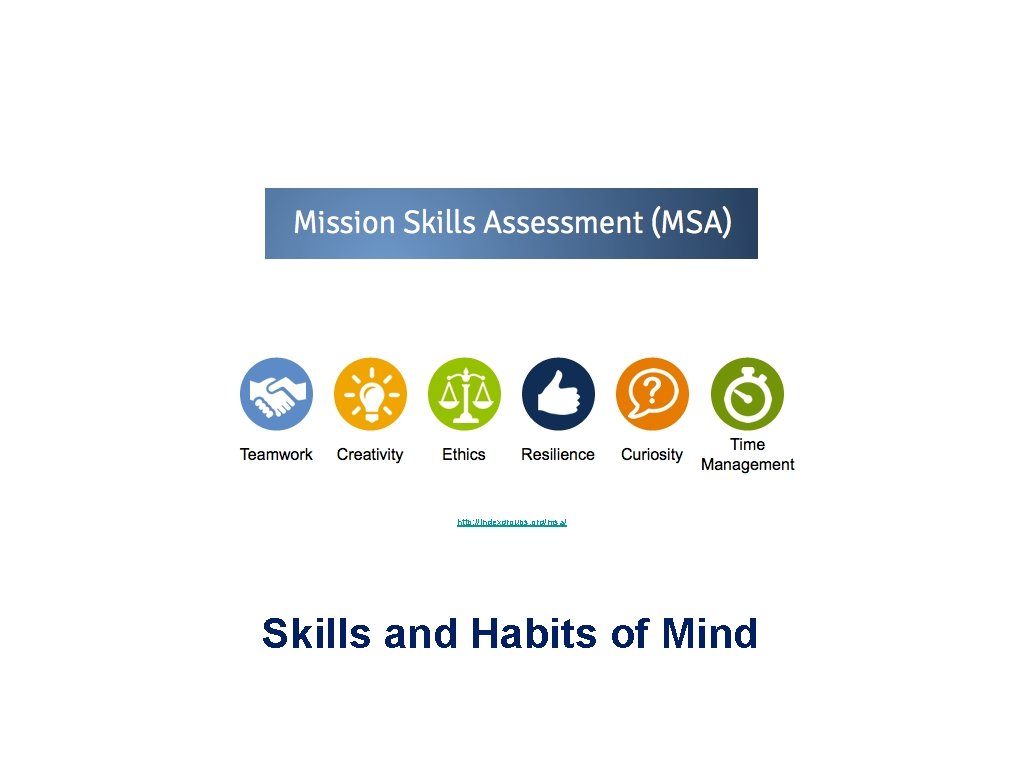
What is the Mission Skills Assessment? A longitudinal assessment measuring and benchmarking student achievement and improvement in core mission skills. • Teamwork • Creativity • Ethics • Resilience • Curiosity • Time Management INDEX Mission Skills Assessment 4
The Assessment • Web-based - approximately 60 minutes total. • Assess 6 th, 7 th, and 8 th graders once per year. • Three components: student self-assessment, situational judgment/performance-based questions, teacher-rater assessment • Correlate with outcome data (test scores, grades, absences, etc. ) • Institutional focus. No tracking of individual performance. INDEX Mission Skills Assessment 5
Noncognitive Skills Research INDEX Mission Skills Assessment 6
What are Noncognitive skills? • Not traditionally “tested” by standardized assessments • Not new but newly important; “ 21 st century skills” • Essential capacities necessary for success in school and in life • Often taught implicitly, but can be taught explicitly INDEX Mission Skills Assessment 7
Academic Success Noncognitive skills correlate positively with achievement on NAEP and PISA. Noncognitive factors predict college grades as strongly as cognitive variables do. ETS, (2008); Poropat, (2009) INDEX Mission Skills Assessment 8
Life Trajectory Early childhood interventions do not raise IQ, but improve noncognitive skills which affect education, employment, earnings, and crime. Heckman et al. (2010) INDEX Mission Skills Assessment 9
Life Satisfaction Noncognitive variables…have been demonstrated to predict happiness, health marital satisfaction and peer relationships. Diener & Lucas (1999); Bogg & Roberts (2004); Watson, Hubbard, & Wiese, (2000); Jensen-Campbell et al. (2002) INDEX Mission Skills Assessment 10
Demographics The benefits of higher noncognitive skills are demonstrable across IQ, socio-economic class, gender, and race. Tough, Paul. How Children Succeed: Grit, Curiosity and the Hidden Power of Character. (2012) INDEX Mission Skills Assessment 11
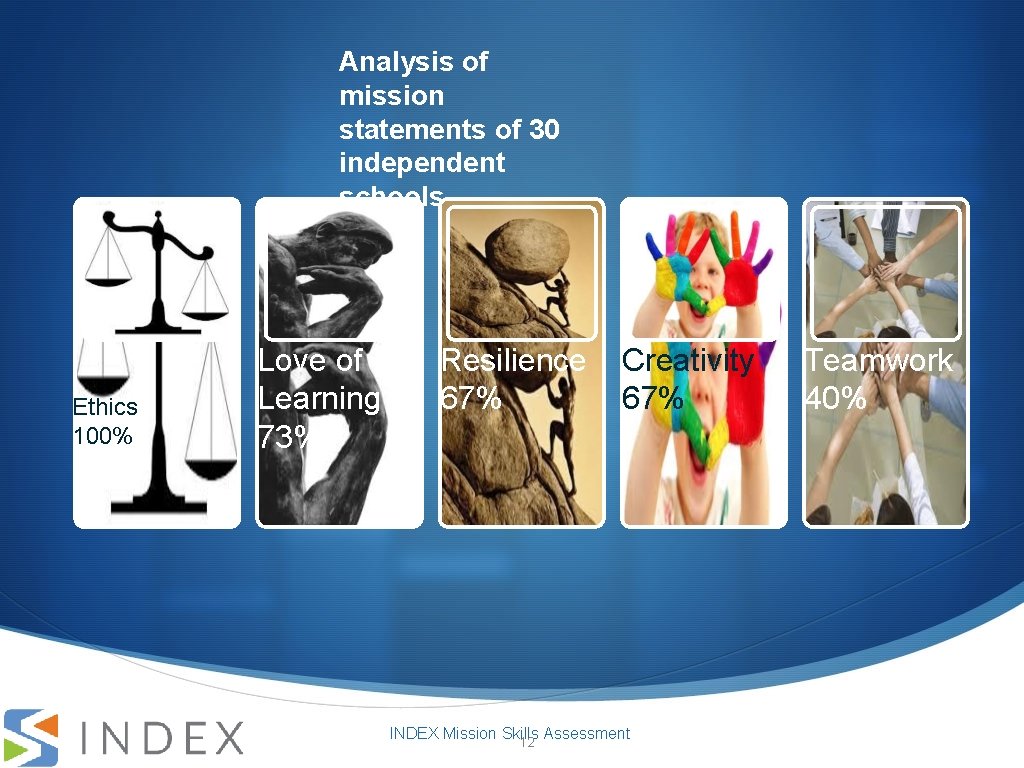
Analysis of mission statements of 30 independent schools Ethics 100% Love of Learning 73% Resilience 67% Creativity 67% INDEX Mission Skills Assessment 12 Teamwork 40%
Analysis of University Mission Statements (Oswald et. al. , 2004) Intellectual Interpersonal Intrapersonal Knowledge and mastery of general principles Appreciation for diversity Social responsibility and citizenship Continuous learning, intellectual interest and curiosity Leadership Physical and psychological health Artistic and cultural appreciation Interpersonal skills Career orientation Adaptability and life skills Perseverance Ethics and integrity INDEX Mission Skills Assessment 13
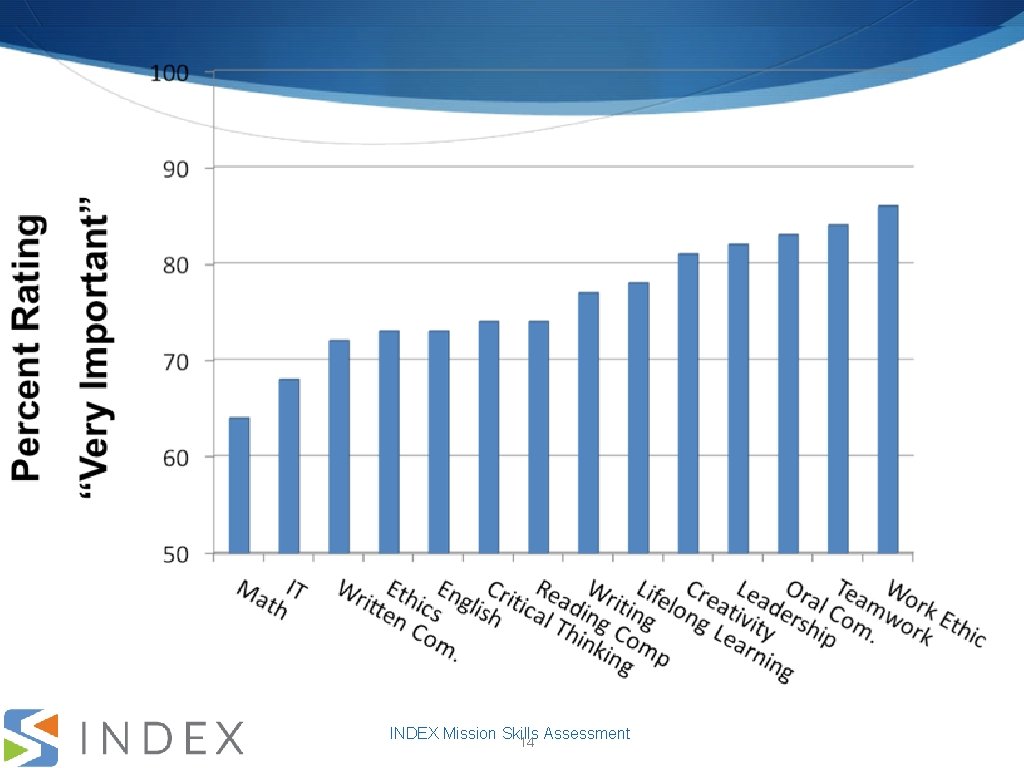
The Conference Board, Corporate Voices for Working Families, Partnership for 21 st Century Working Skills, and the Society for Human Resource Management. INDEX Mission Skills Assessment 14
The Character Imperative 1) Research shows that these skills lead to positive educational and life outcomes; 2) Colleges, universities, and employers are seeking these skills in students and workers; and 3) We must demonstrate the value we add. INDEX Mission Skills Assessment 15
Constructs in MSA INDEX Mission Skills Assessment 16
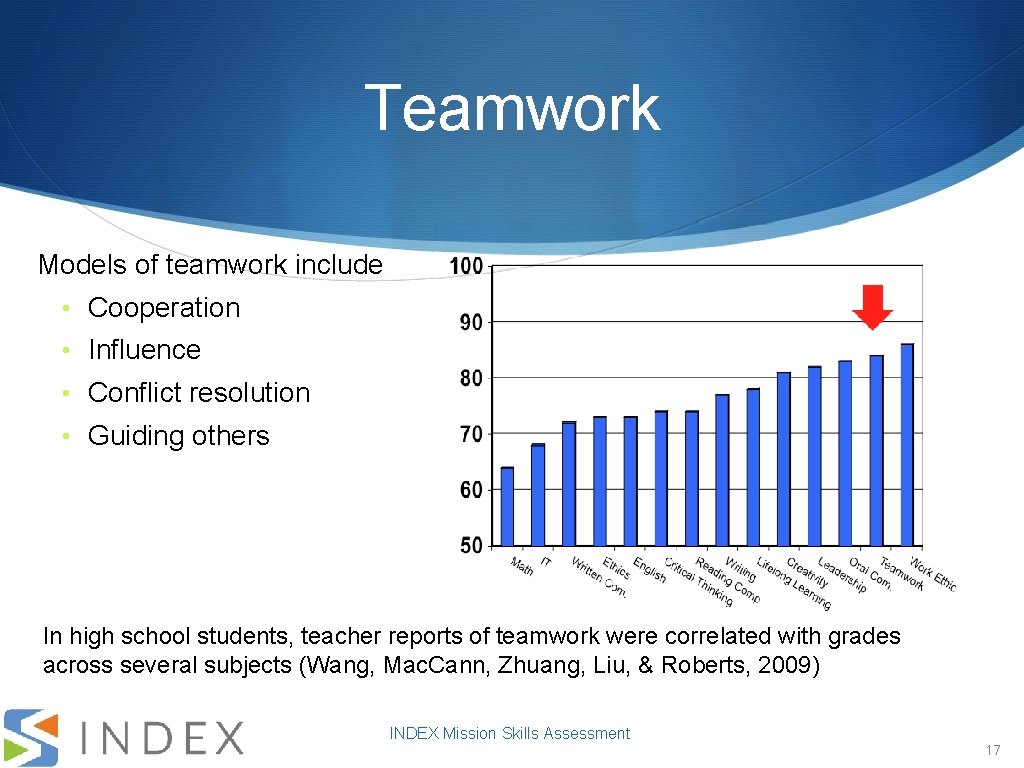
Teamwork Models of teamwork include • Cooperation • Influence • Conflict resolution • Guiding others In high school students, teacher reports of teamwork were correlated with grades across several subjects (Wang, Mac. Cann, Zhuang, Liu, & Roberts, 2009) INDEX Mission Skills Assessment 17
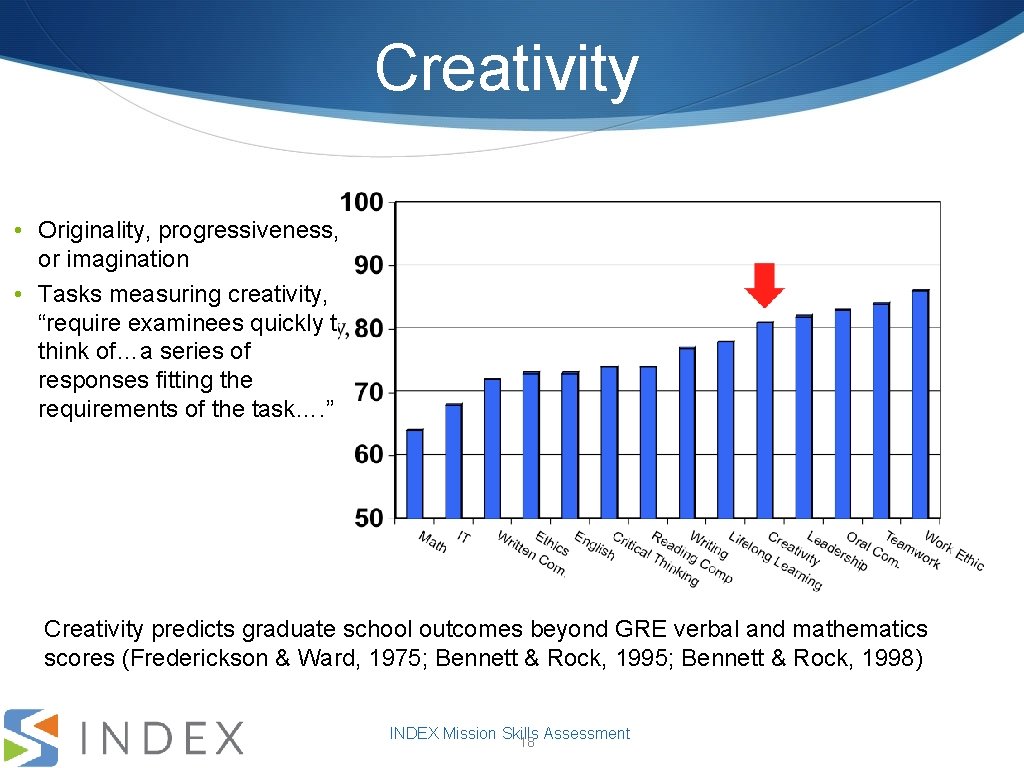
Creativity • Originality, progressiveness, or imagination • Tasks measuring creativity, “require examinees quickly to think of…a series of responses fitting the requirements of the task…. ” Creativity predicts graduate school outcomes beyond GRE verbal and mathematics scores (Frederickson & Ward, 1975; Bennett & Rock, 1998) INDEX Mission Skills Assessment 18
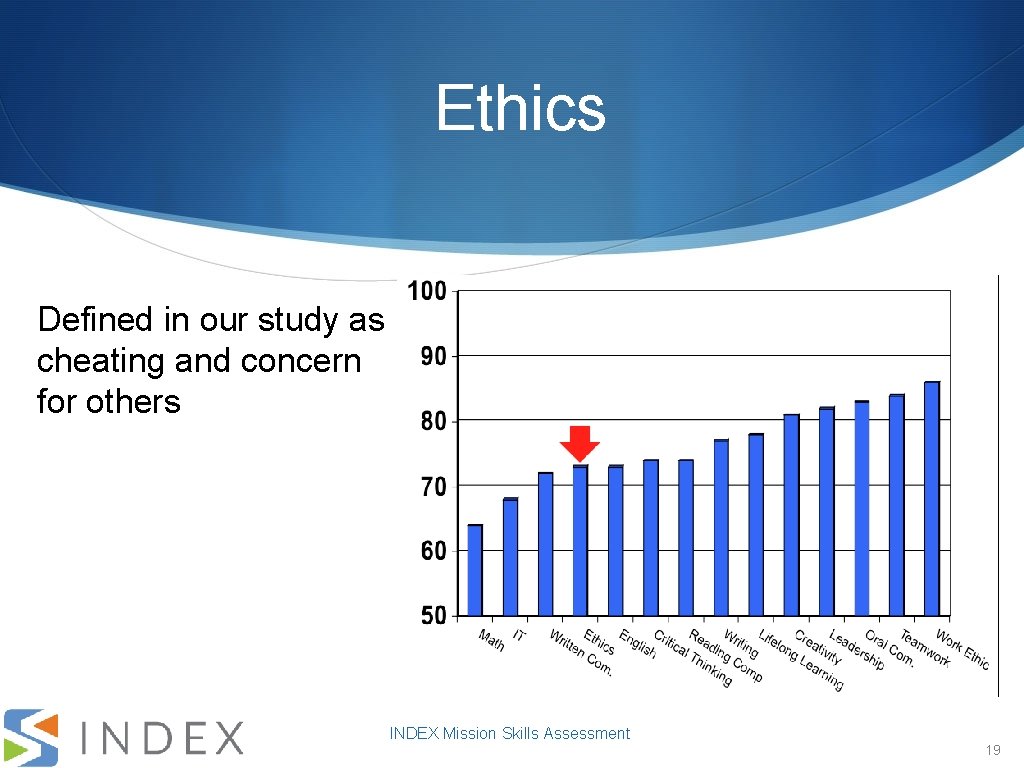
Ethics Defined in our study as cheating and concern for others INDEX Mission Skills Assessment 19
Resilience • A level of adaptability that allows individuals to survive and thrive in adverse conditions • Dent and Cameron (2003) • One way we measure resilience in the MSA is to measure core self-evaluation – or how capable, worthy, and effective a person feels. INDEX Mission Skills Assessment 20
Item Types INDEX Mission Skills Assessment 21
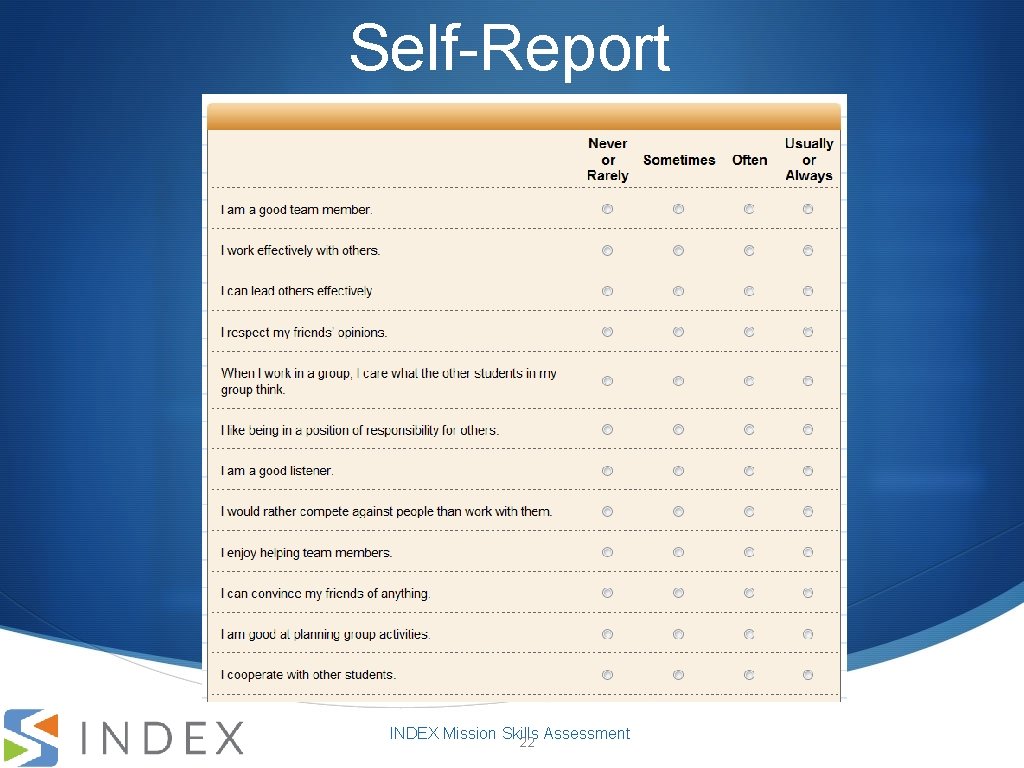
Self-Report INDEX Mission Skills Assessment 22
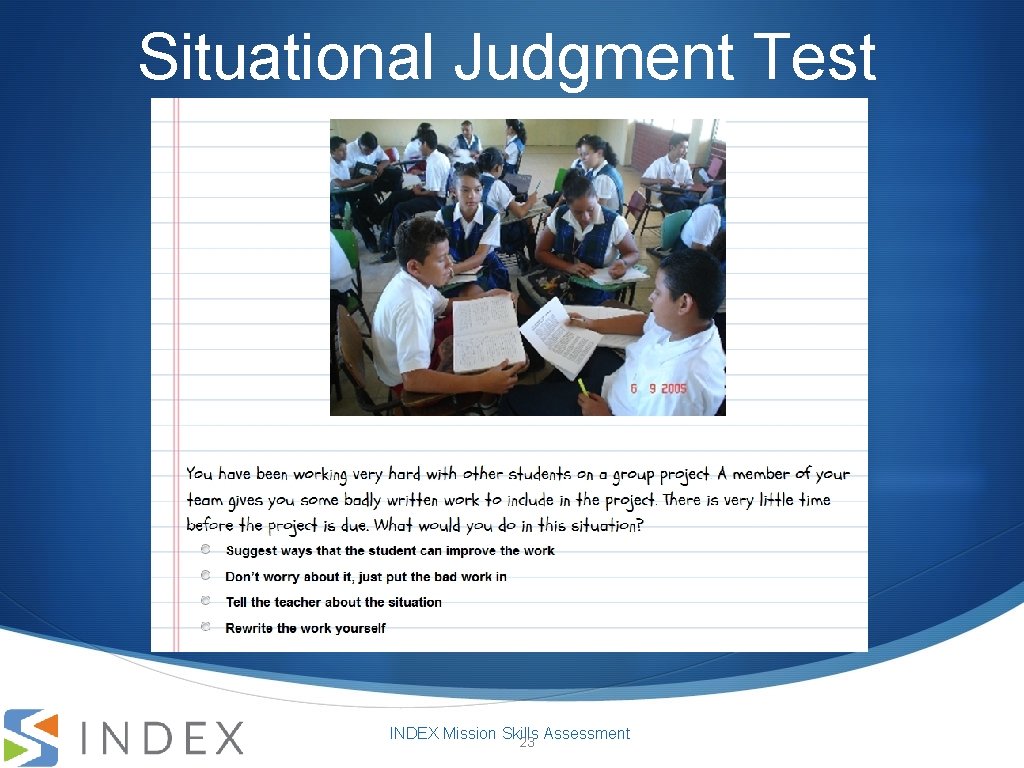
Situational Judgment Test INDEX Mission Skills Assessment 23
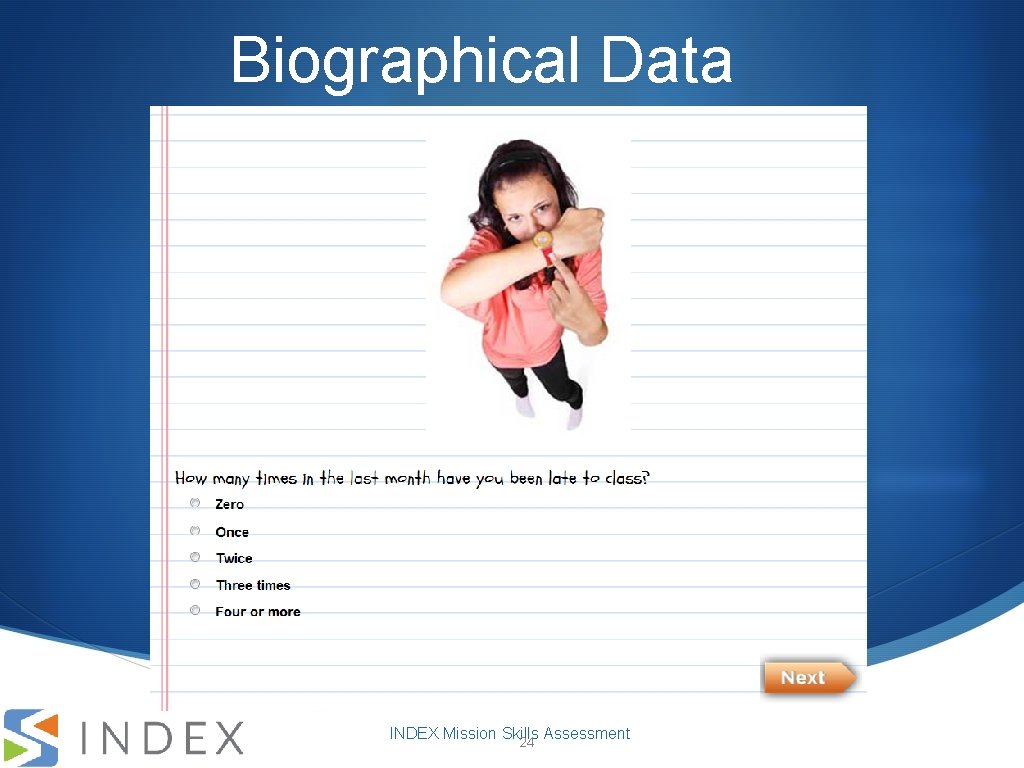
Biographical Data INDEX Mission Skills Assessment 24
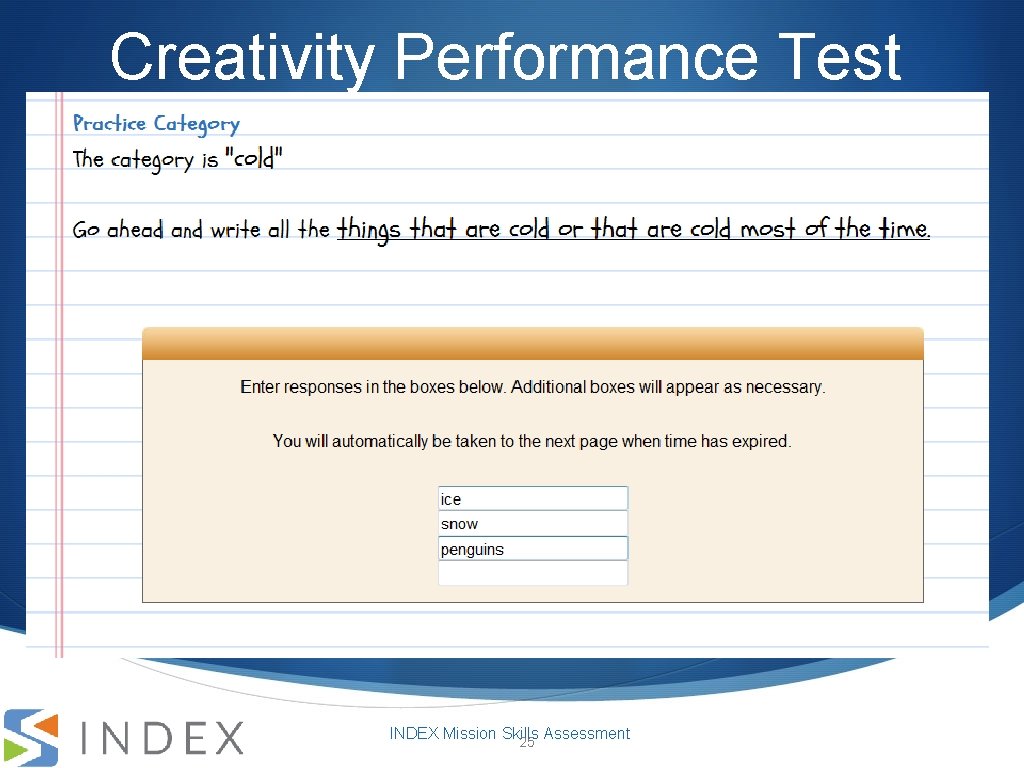
Creativity Performance Test INDEX Mission Skills Assessment 25
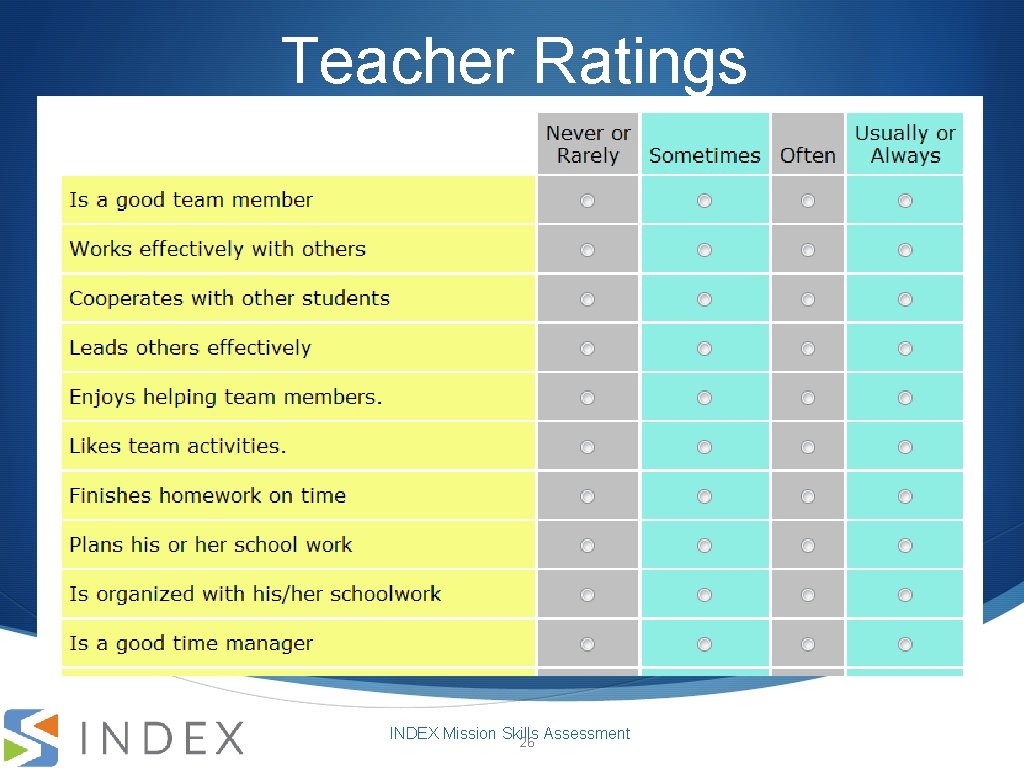
Teacher Ratings INDEX Mission Skills Assessment 26
Next Steps • Continual refinement of MSA assessment • Assessing underserved populations with MSA – Horizons Student Enrichment Programs (NCCS, Rumson CDS) • Expanding to all INDEX schools – 69 schools, 17, 000 students fall 2013 • Gathering interest from additional schools, districts, organizations INDEX Mission Skills Assessment 27
Instruction How can we teach these skills better and how will we know we are succeeding? • Deliberate, explicit and implicit instruction and interventions • Grade-level goals • Articulated, spiraled, integrated noncognitive curriculum • Updated analyzed curriculum maps INDEX Mission Skills Assessment 28
Opportunities • Shared vision, vocabulary, and resources • Participation in regional and national teacher networks, character summits • Shape report cards and parent conferences • Ongoing education–school leaders, faculty, students, parents INDEX Mission Skills Assessment 29
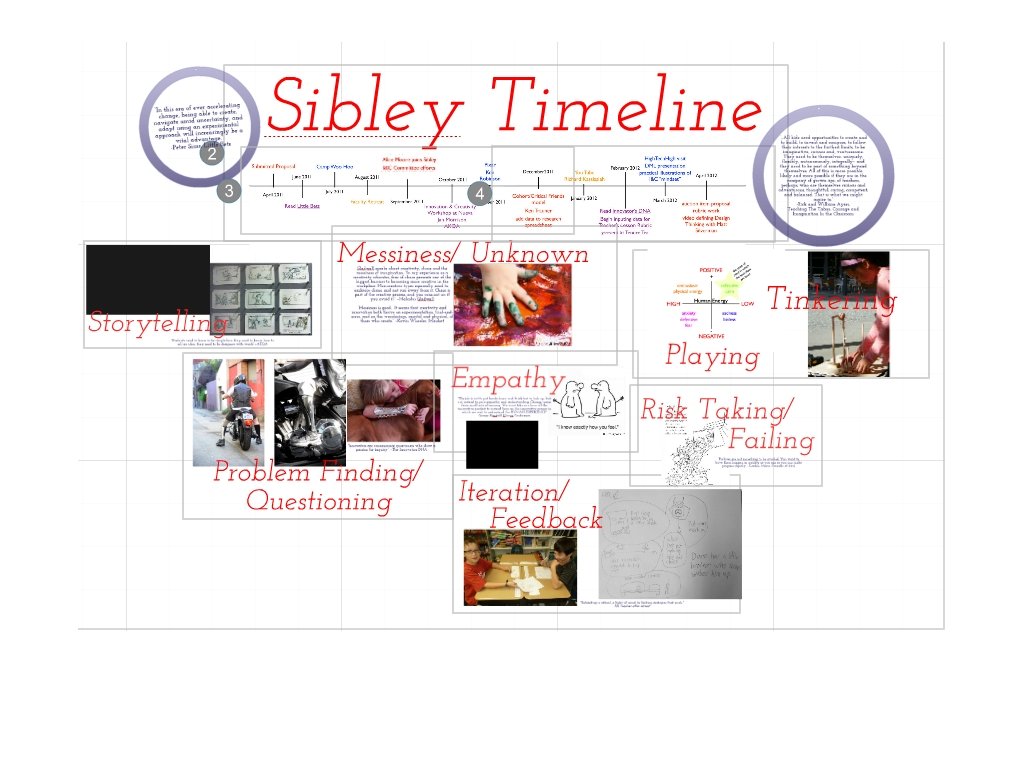
http: //bit. ly/16 xde 9 m Teacher Research and Development Team 18 Months
http: //bit. ly/12 n. Nu. HW http: //bit. ly/10 S 1 m. Aq http: //bit. ly/1481 p. X 5 http: //bit. ly/1 ab. Jq. Um
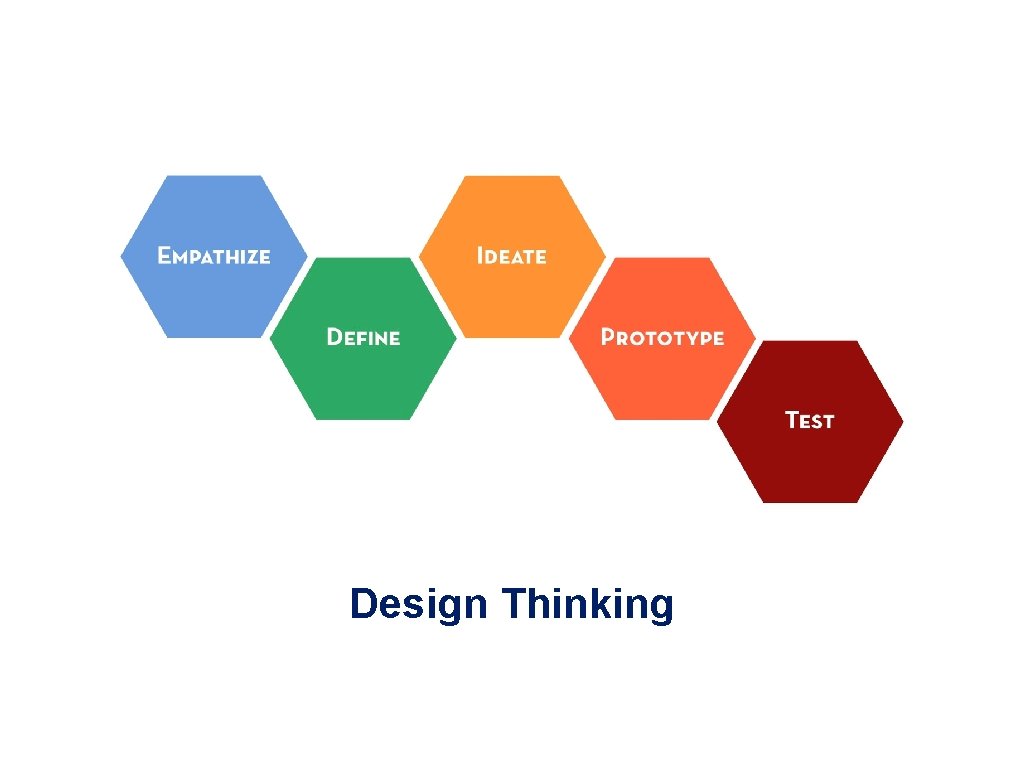
Design Thinking
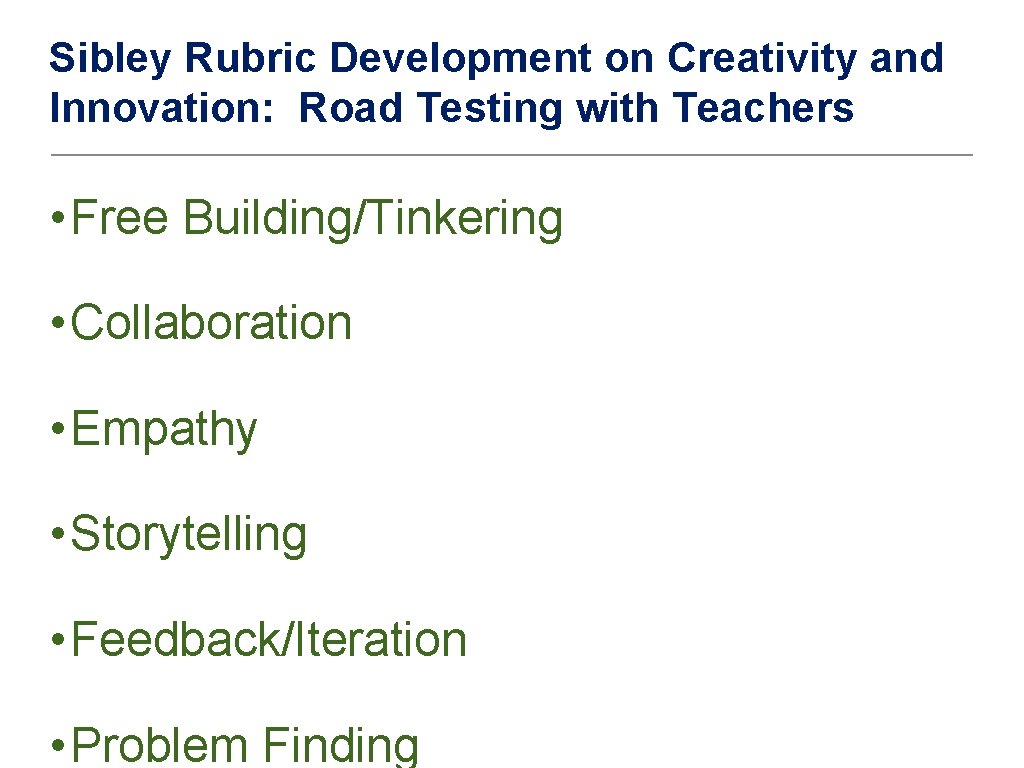
Sibley Rubric Development on Creativity and Innovation: Road Testing with Teachers • Free Building/Tinkering • Collaboration • Empathy • Storytelling • Feedback/Iteration • Problem Finding
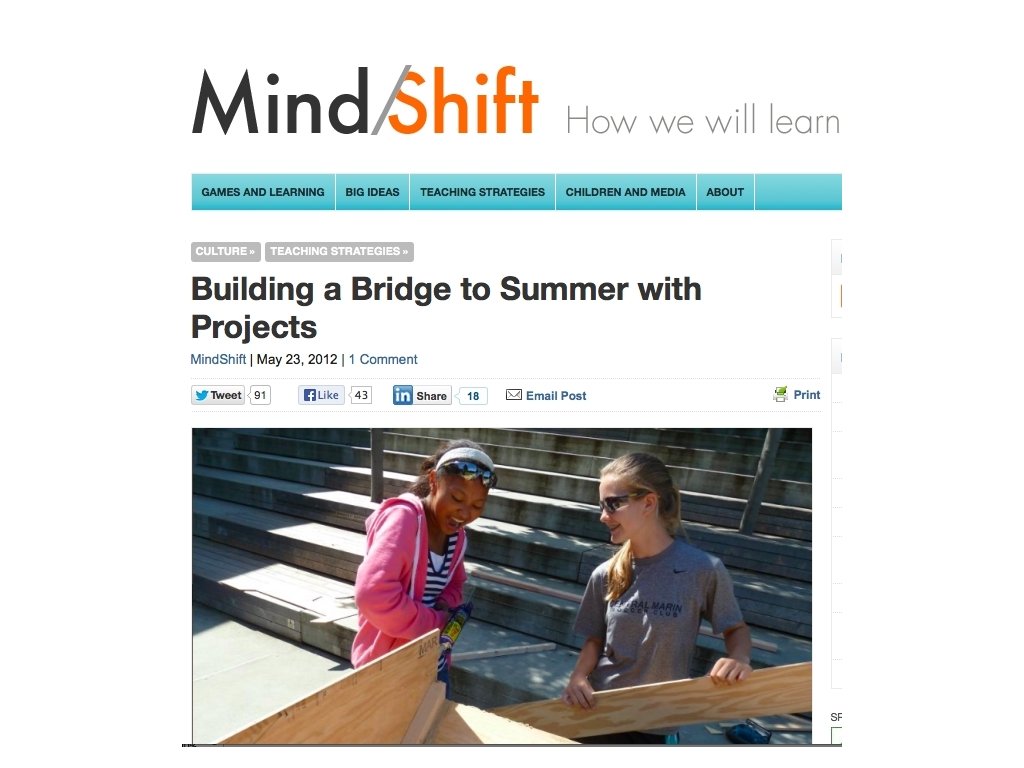
http: //bit. ly/w. FIem 5 http: //bit. ly/11 FIza 0 http: //bit. ly/1 ab. Nmo 4 Outside the Classroom: The Bridge to Parent Engagement
MCDS Explores
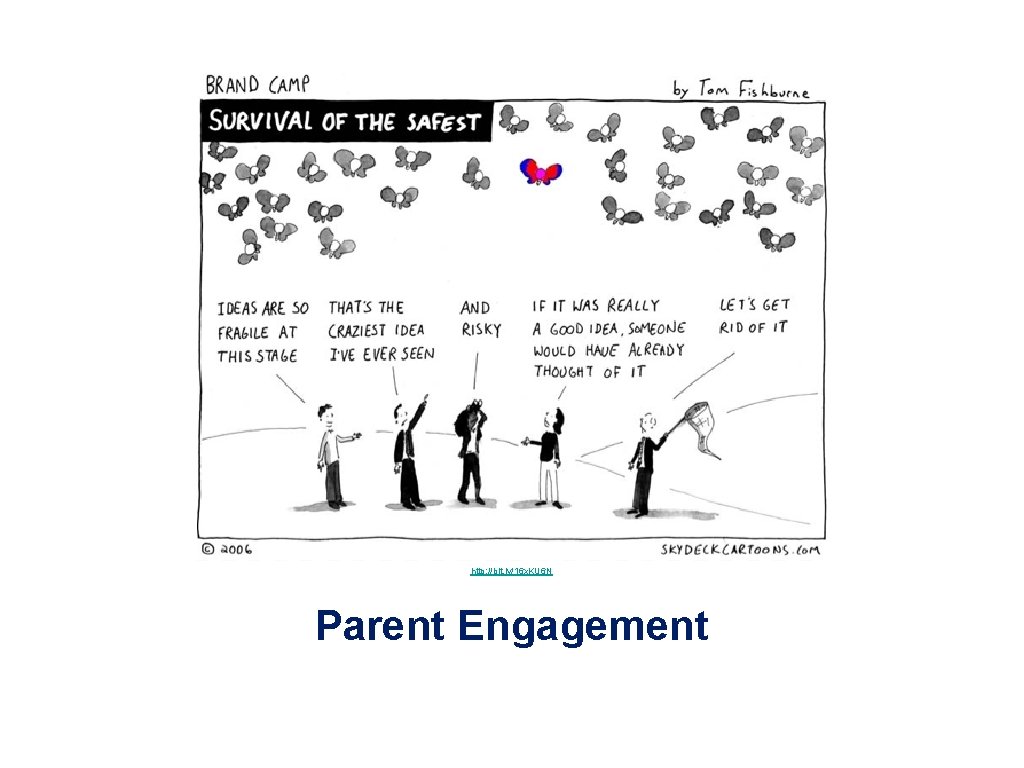
http: //bit. ly/16 x. KU 6 N Parent Engagement
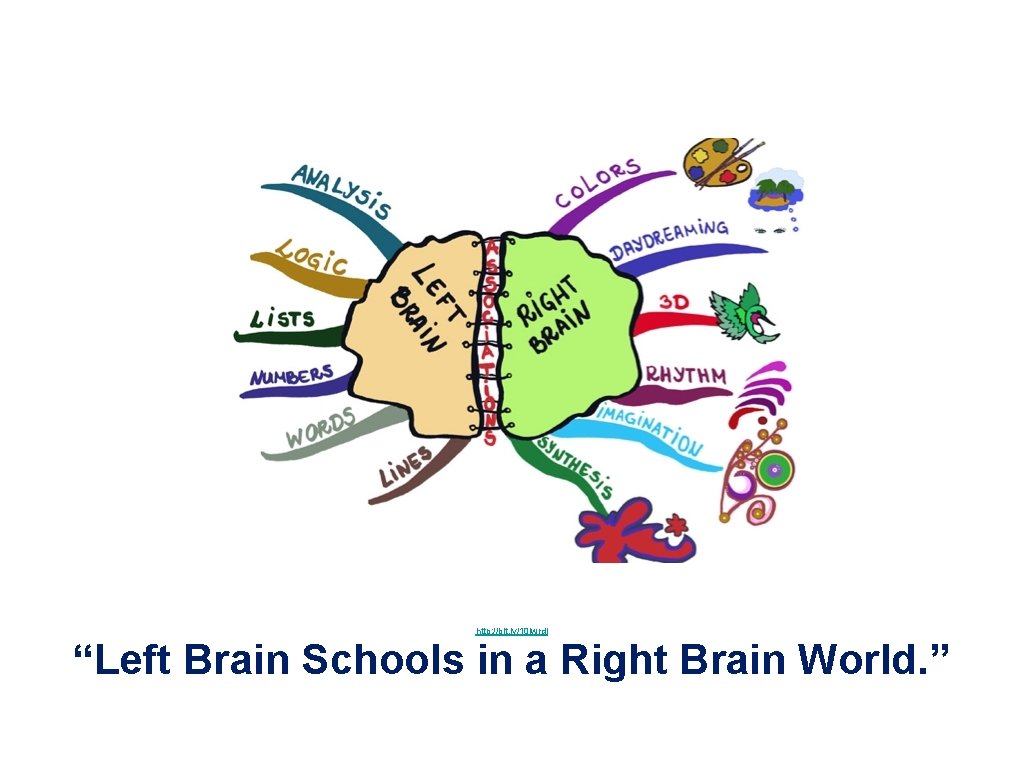
http: //bit. ly/10 lwrdj “Left Brain Schools in a Right Brain World. ”
Goals • Inventory - what’s working? • Research - what are the best practices? • Input from Experts in the Field - what do you do? • Blueprint - where do we go? • Isidor Rabi: Did you ask a good question today? http: //bit. ly/137 e. L 9 h
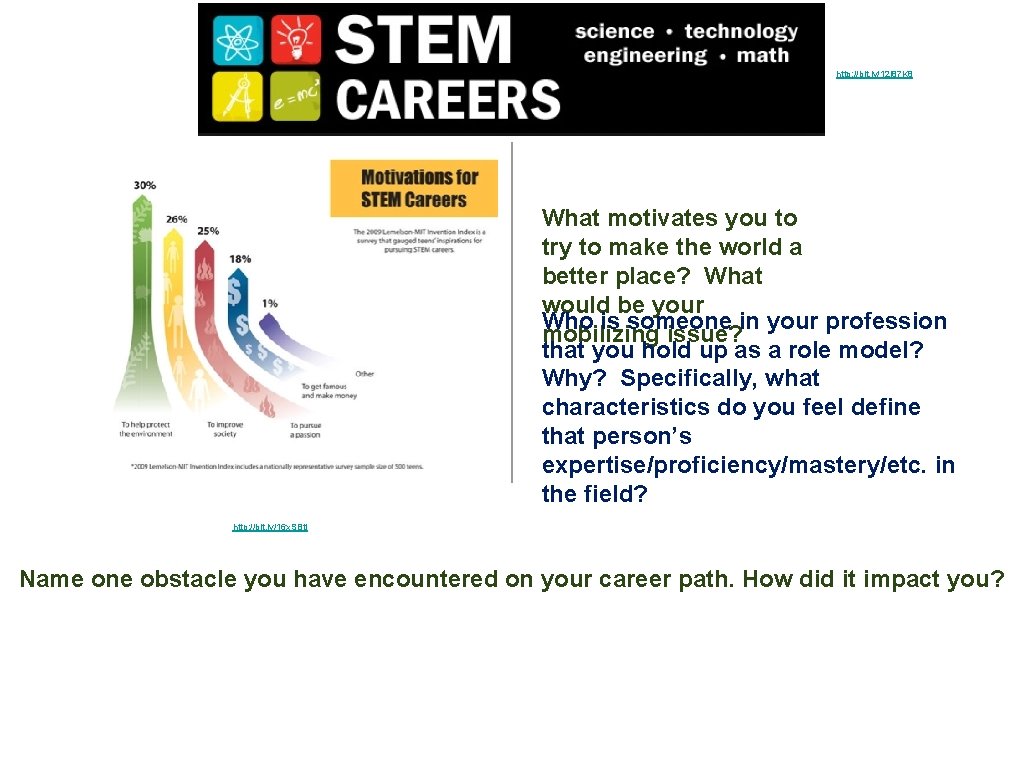
http: //bit. ly/12 i 87 K 8 What motivates you to try to make the world a better place? What would be your Who is someone in your profession mobilizing issue? that you hold up as a role model? Why? Specifically, what characteristics do you feel define that person’s expertise/proficiency/mastery/etc. in the field? http: //bit. ly/16 x. SBt. I Name one obstacle you have encountered on your career path. How did it impact you?
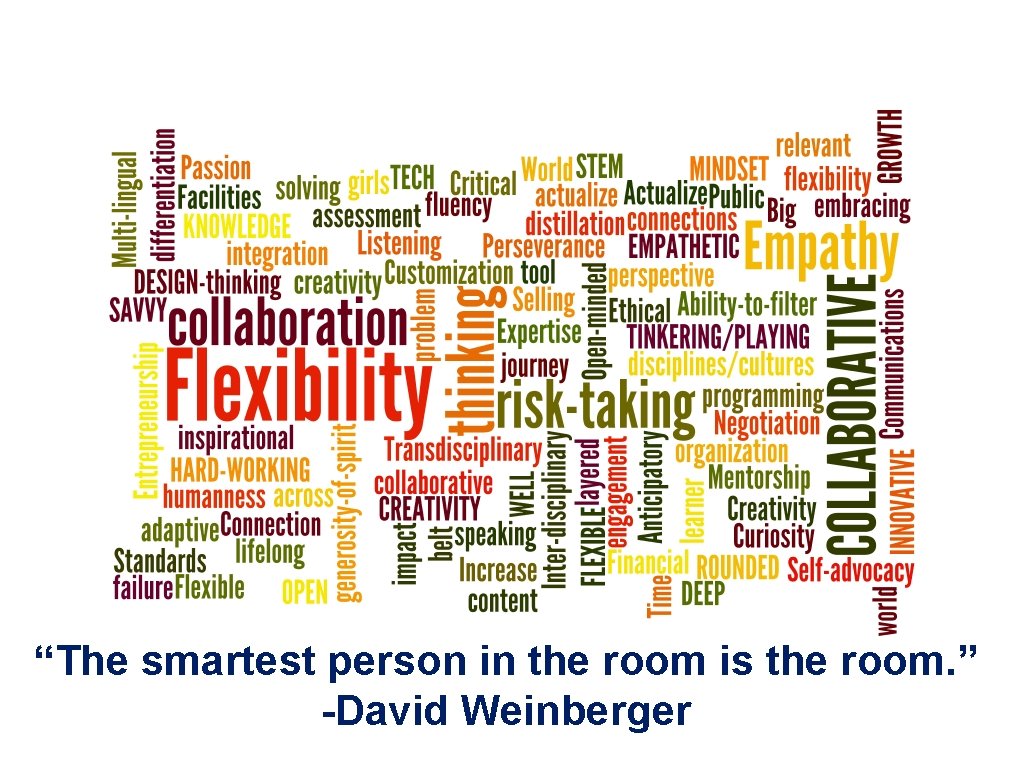
“The smartest person in the room is the room. ” -David Weinberger
Wonder Lab: MCDS and Laurel Dell Partnerships
http: //indexgroups. org/msa/ Skills and Habits of Mind
http: //f-l-o-a-t. com/ Capstone
http: //bit. ly/18 er. KHf Science Curriculum Review Process
Teacher Training and Curriculum Development Coaching