
Misrepresentation of Model Performance by RMSE From Mathematical
Misrepresentation of Model Performance by RMSE: From Mathematical Proof to Case Demonstration Fanglin Yang Environmental Modeling Center National Centers for Environmental Prediction Camp Springs, Maryland, USA GCWMB Bi-weekly Briefing, November 4, 2010
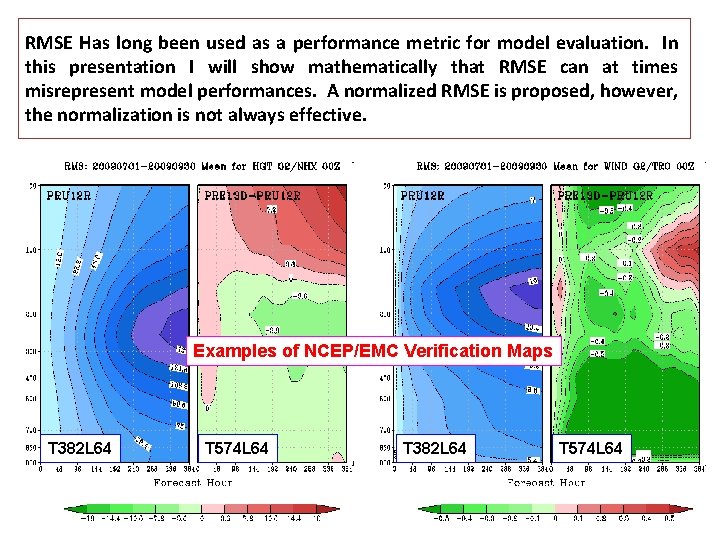
RMSE Has long been used as a performance metric for model evaluation. In this presentation I will show mathematically that RMSE can at times misrepresent model performances. A normalized RMSE is proposed, however, the normalization is not always effective. Examples of NCEP/EMC Verification Maps T 382 L 64 T 574 L 64
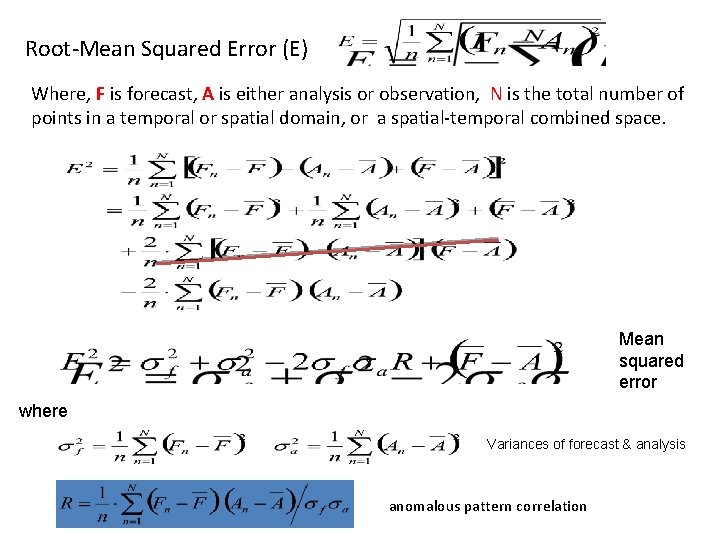
Root-Mean Squared Error (E) Where, F is forecast, A is either analysis or observation, N is the total number of points in a temporal or spatial domain, or a spatial-temporal combined space. Mean squared error where Variances of forecast & analysis anomalous pattern correlation
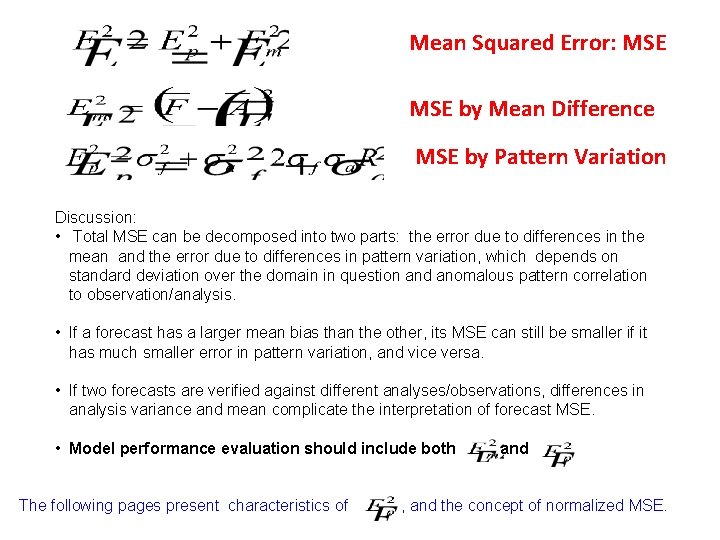
Mean Squared Error: MSE by Mean Difference MSE by Pattern Variation Discussion: • Total MSE can be decomposed into two parts: the error due to differences in the mean and the error due to differences in pattern variation, which depends on standard deviation over the domain in question and anomalous pattern correlation to observation/analysis. • If a forecast has a larger mean bias than the other, its MSE can still be smaller if it has much smaller error in pattern variation, and vice versa. • If two forecasts are verified against different analyses/observations, differences in analysis variance and mean complicate the interpretation of forecast MSE. • Model performance evaluation should include both The following pages present characteristics of and , and the concept of normalized MSE.

A: Given the same mean difference, will a forecast with smaller variance always give smaller MSE? The answer is no. Case 1) R =1, perfect pattern correlation One can see that if a forecast having either too large or too small a variance away from the analysis variance , its error of pattern variation increases. If R=1, does not award smooth forecasts that have smaller variances. It is not biased. 5
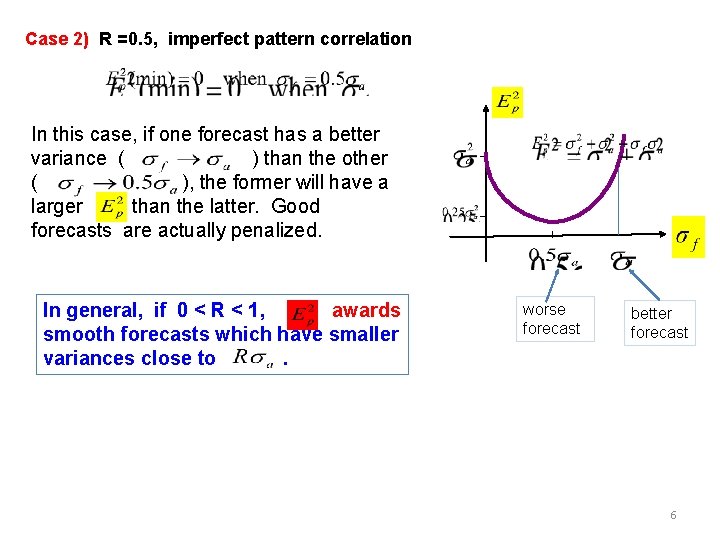
Case 2) R =0. 5, imperfect pattern correlation In this case, if one forecast has a better variance ( ) than the other ( ), the former will have a larger than the latter. Good forecasts are actually penalized. In general, if 0 < R < 1, awards smooth forecasts which have smaller variances close to. worse forecast better forecast 6
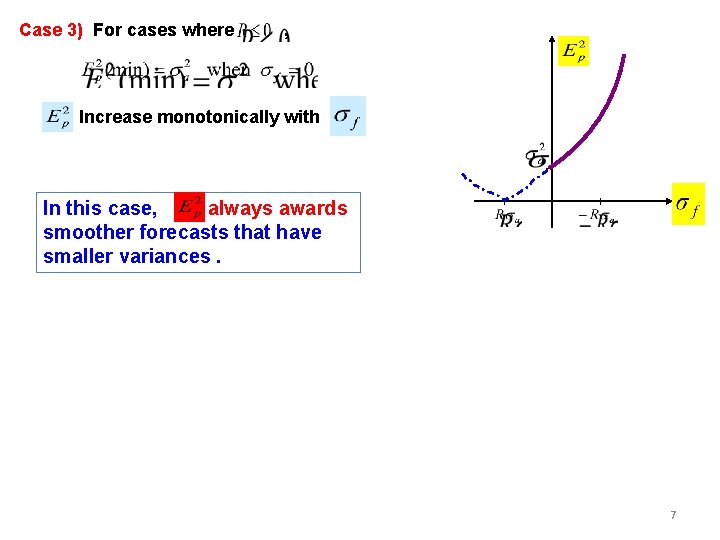
Case 3) For cases where , Increase monotonically with In this case, always awards smoother forecasts that have smaller variances. 7
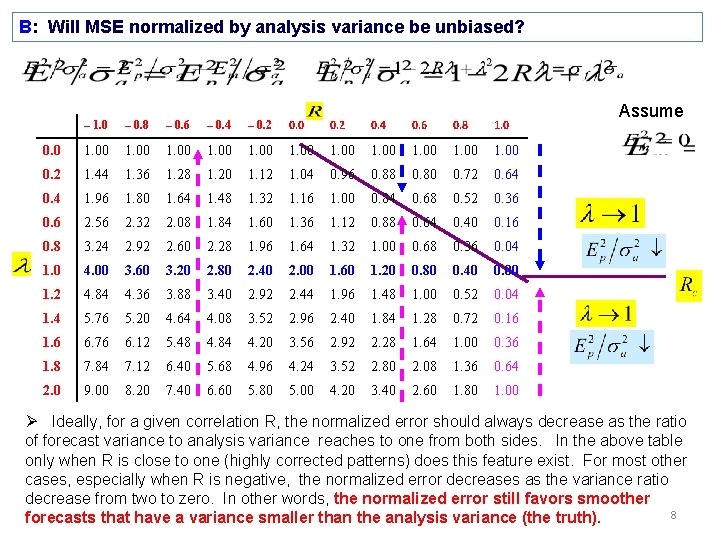
B: Will MSE normalized by analysis variance be unbiased? – 1. 0 – 0. 8 – 0. 6 – 0. 4 – 0. 2 0. 0 0. 2 0. 4 0. 6 0. 8 1. 0 0. 0 1. 00 1. 00 0. 2 1. 44 1. 36 1. 28 1. 20 1. 12 1. 04 0. 96 0. 88 0. 80 0. 72 0. 64 0. 4 1. 96 1. 80 1. 64 1. 48 1. 32 1. 16 1. 00 0. 84 0. 68 0. 52 0. 36 0. 6 2. 56 2. 32 2. 08 1. 84 1. 60 1. 36 1. 12 0. 88 0. 64 0. 40 0. 16 0. 8 3. 24 2. 92 2. 60 2. 28 1. 96 1. 64 1. 32 1. 00 0. 68 0. 36 0. 04 1. 0 4. 00 3. 60 3. 20 2. 80 2. 40 2. 00 1. 60 1. 20 0. 80 0. 40 0. 00 1. 2 4. 84 4. 36 3. 88 3. 40 2. 92 2. 44 1. 96 1. 48 1. 00 0. 52 0. 04 1. 4 5. 76 5. 20 4. 64 4. 08 3. 52 2. 96 2. 40 1. 84 1. 28 0. 72 0. 16 1. 6 6. 76 6. 12 5. 48 4. 84 4. 20 3. 56 2. 92 2. 28 1. 64 1. 00 0. 36 1. 8 7. 84 7. 12 6. 40 5. 68 4. 96 4. 24 3. 52 2. 80 2. 08 1. 36 0. 64 2. 0 9. 00 8. 20 7. 40 6. 60 5. 80 5. 00 4. 20 3. 40 2. 60 1. 80 1. 00 Assume Ø Ideally, for a given correlation R, the normalized error should always decrease as the ratio of forecast variance to analysis variance reaches to one from both sides. In the above table only when R is close to one (highly corrected patterns) does this feature exist. For most other cases, especially when R is negative, the normalized error decreases as the variance ratio decrease from two to zero. In other words, the normalized error still favors smoother 8 forecasts that have a variance smaller than the analysis variance (the truth).
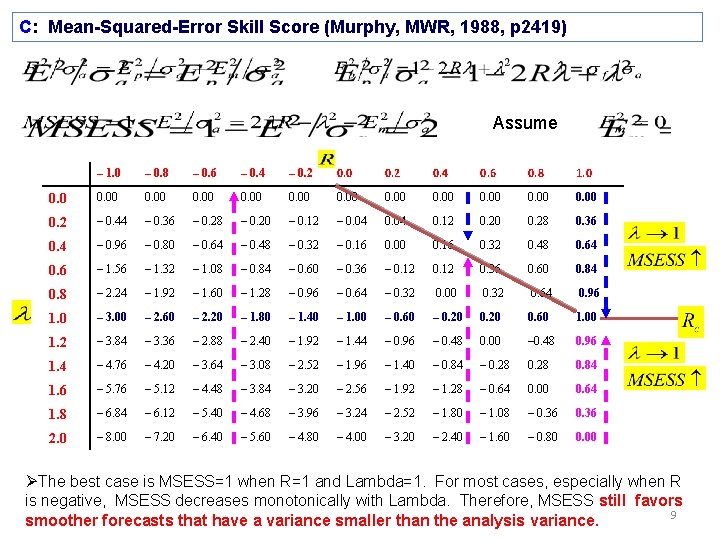
C: Mean-Squared-Error Skill Score (Murphy, MWR, 1988, p 2419) Assume – 1. 0 – 0. 8 – 0. 6 – 0. 4 – 0. 2 0. 0 0. 2 0. 4 0. 6 0. 8 1. 0 0. 00 0. 2 – 0. 44 – 0. 36 – 0. 28 – 0. 20 – 0. 12 – 0. 04 0. 12 0. 20 0. 28 0. 36 0. 4 – 0. 96 – 0. 80 – 0. 64 – 0. 48 – 0. 32 – 0. 16 0. 00 0. 16 0. 32 0. 48 0. 64 0. 6 – 1. 56 – 1. 32 – 1. 08 – 0. 84 – 0. 60 – 0. 36 – 0. 12 0. 36 0. 60 0. 84 0. 8 – 2. 24 – 1. 92 – 1. 60 – 1. 28 – 0. 96 – 0. 64 – 0. 32 0. 00 0. 32 0. 64 0. 96 1. 0 – 3. 00 – 2. 60 – 2. 20 – 1. 80 – 1. 40 – 1. 00 – 0. 60 – 0. 20 0. 60 1. 00 1. 2 – 3. 84 – 3. 36 – 2. 88 – 2. 40 – 1. 92 – 1. 44 – 0. 96 – 0. 48 0. 00 – 0. 48 0. 96 1. 4 – 4. 76 – 4. 20 – 3. 64 – 3. 08 – 2. 52 – 1. 96 – 1. 40 – 0. 84 – 0. 28 0. 84 1. 6 – 5. 76 – 5. 12 – 4. 48 – 3. 84 – 3. 20 – 2. 56 – 1. 92 – 1. 28 – 0. 64 0. 00 0. 64 1. 8 – 6. 84 – 6. 12 – 5. 40 – 4. 68 – 3. 96 – 3. 24 – 2. 52 – 1. 80 – 1. 08 – 0. 36 2. 0 – 8. 00 – 7. 20 – 6. 40 – 5. 60 – 4. 80 – 4. 00 – 3. 20 – 2. 40 – 1. 60 – 0. 80 0. 00 ØThe best case is MSESS=1 when R=1 and Lambda=1. For most cases, especially when R is negative, MSESS decreases monotonically with Lambda. Therefore, MSESS still favors 9 smoother forecasts that have a variance smaller than the analysis variance.
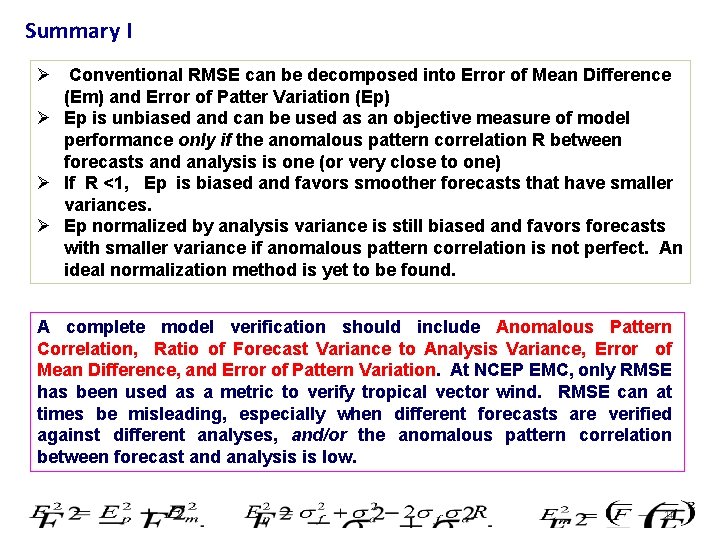
Summary I Ø Conventional RMSE can be decomposed into Error of Mean Difference (Em) and Error of Patter Variation (Ep) Ø Ep is unbiased and can be used as an objective measure of model performance only if the anomalous pattern correlation R between forecasts and analysis is one (or very close to one) Ø If R <1, Ep is biased and favors smoother forecasts that have smaller variances. Ø Ep normalized by analysis variance is still biased and favors forecasts with smaller variance if anomalous pattern correlation is not perfect. An ideal normalization method is yet to be found. A complete model verification should include Anomalous Pattern Correlation, Ratio of Forecast Variance to Analysis Variance, Error of Mean Difference, and Error of Pattern Variation. At NCEP EMC, only RMSE has been used as a metric to verify tropical vector wind. RMSE can at times be misleading, especially when different forecasts are verified against different analyses, and/or the anomalous pattern correlation between forecast and analysis is low. 10
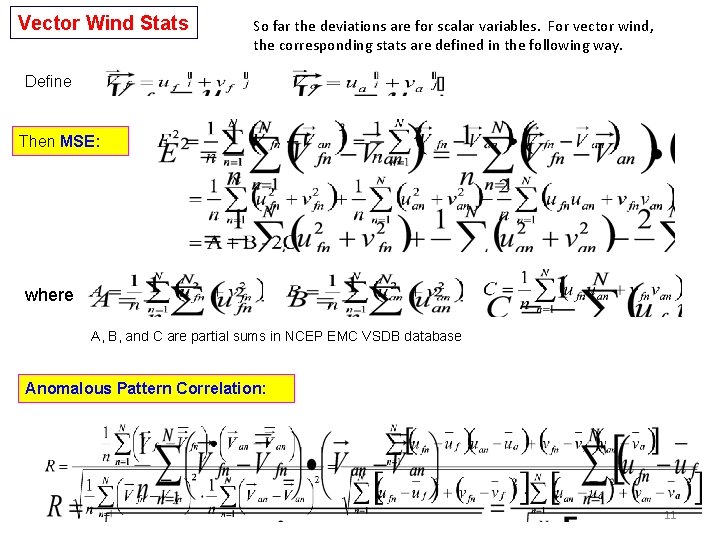
Vector Wind Stats So far the deviations are for scalar variables. For vector wind, the corresponding stats are defined in the following way. Define Then MSE: where A, B, and C are partial sums in NCEP EMC VSDB database Anomalous Pattern Correlation: 11
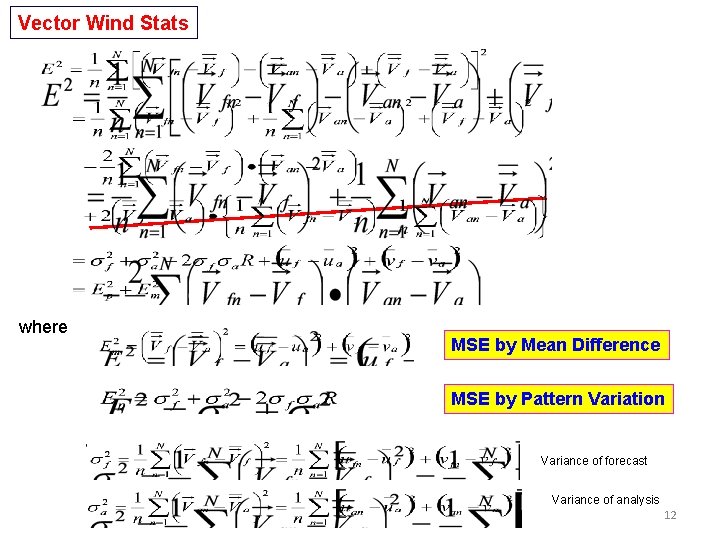
Vector Wind Stats where MSE by Mean Difference MSE by Pattern Variation Variance of forecast Variance of analysis 12
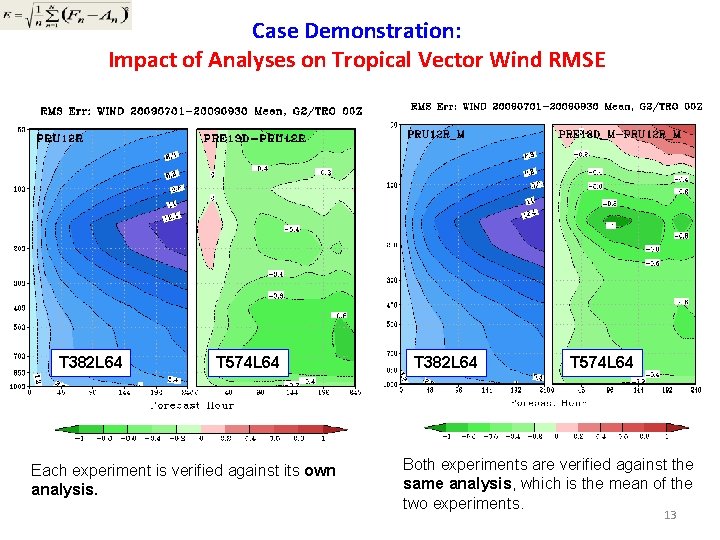
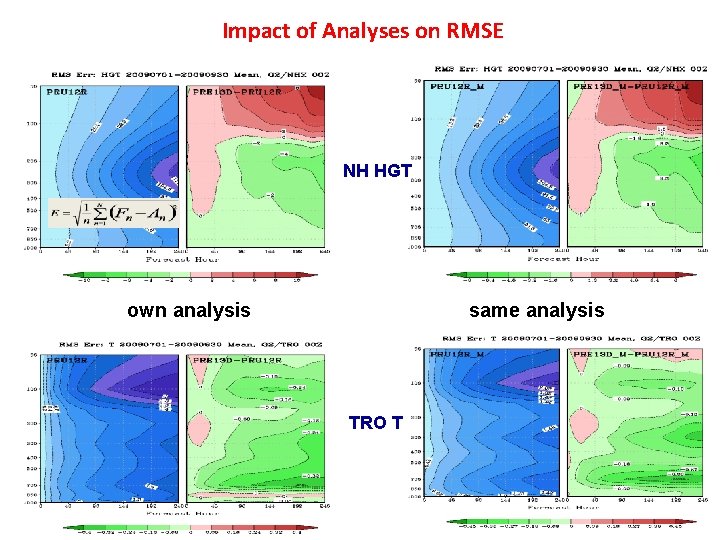
Case Demonstration: Impact of Analyses on Tropical Vector Wind RMSE T 382 L 64 T 574 L 64 Each experiment is verified against its own analysis. T 382 L 64 T 574 L 64 Both experiments are verified against the same analysis, which is the mean of the two experiments. 13
Impact of Analyses on RMSE NH HGT own analysis same analysis TRO T 14
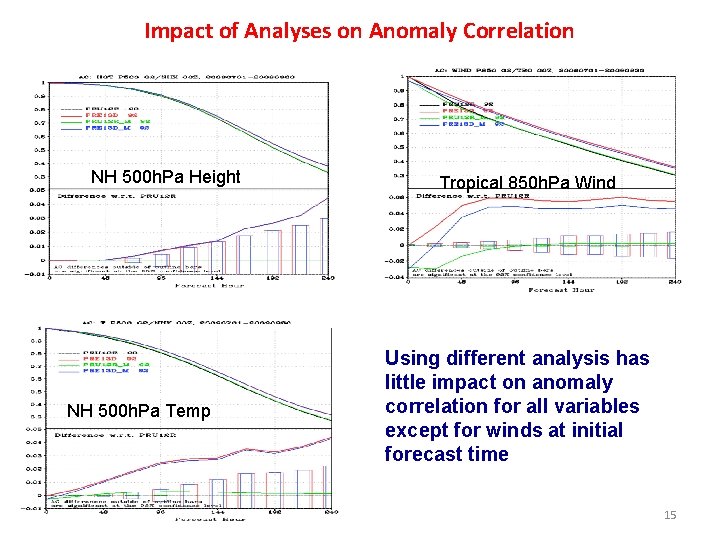
Impact of Analyses on Anomaly Correlation NH 500 h. Pa Height NH 500 h. Pa Temp Tropical 850 h. Pa Wind Using different analysis has little impact on anomaly correlation for all variables except for winds at initial forecast time 15
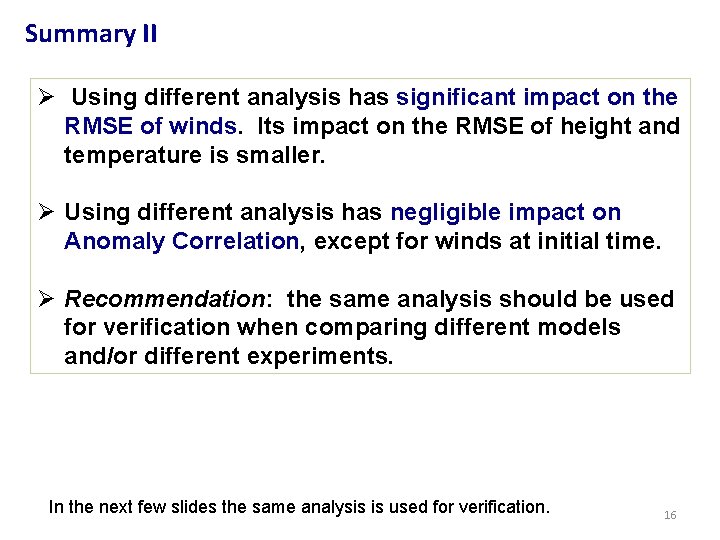
Summary II Ø Using different analysis has significant impact on the RMSE of winds. Its impact on the RMSE of height and temperature is smaller. Ø Using different analysis has negligible impact on Anomaly Correlation, except for winds at initial time. Ø Recommendation: the same analysis should be used for verification when comparing different models and/or different experiments. In the next few slides the same analysis is used for verification. 16
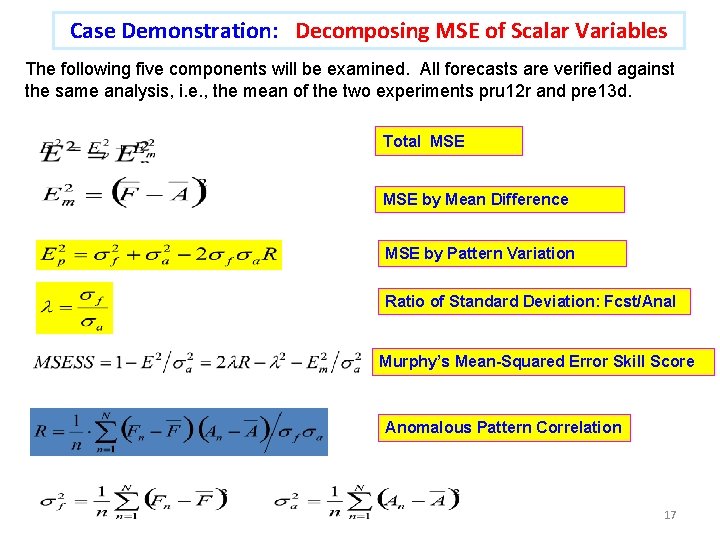
Case Demonstration: Decomposing MSE of Scalar Variables The following five components will be examined. All forecasts are verified against the same analysis, i. e. , the mean of the two experiments pru 12 r and pre 13 d. Total MSE by Mean Difference MSE by Pattern Variation Ratio of Standard Deviation: Fcst/Anal Murphy’s Mean-Squared Error Skill Score Anomalous Pattern Correlation 17
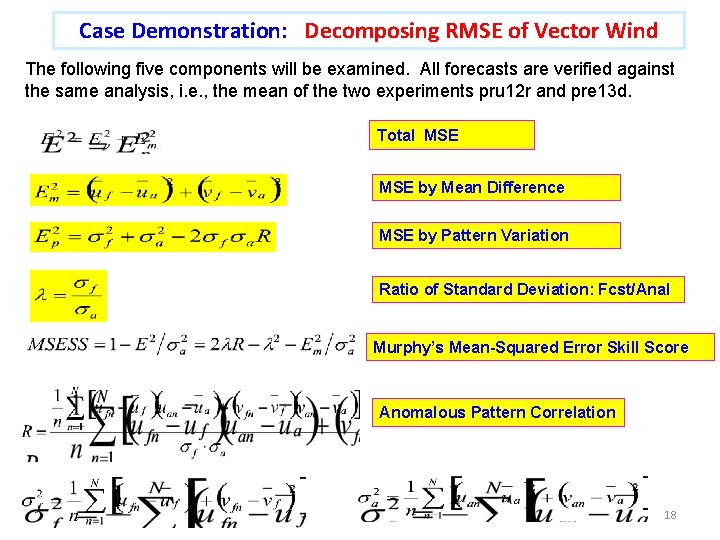
Case Demonstration: Decomposing RMSE of Vector Wind The following five components will be examined. All forecasts are verified against the same analysis, i. e. , the mean of the two experiments pru 12 r and pre 13 d. Total MSE by Mean Difference MSE by Pattern Variation Ratio of Standard Deviation: Fcst/Anal Murphy’s Mean-Squared Error Skill Score Anomalous Pattern Correlation 18
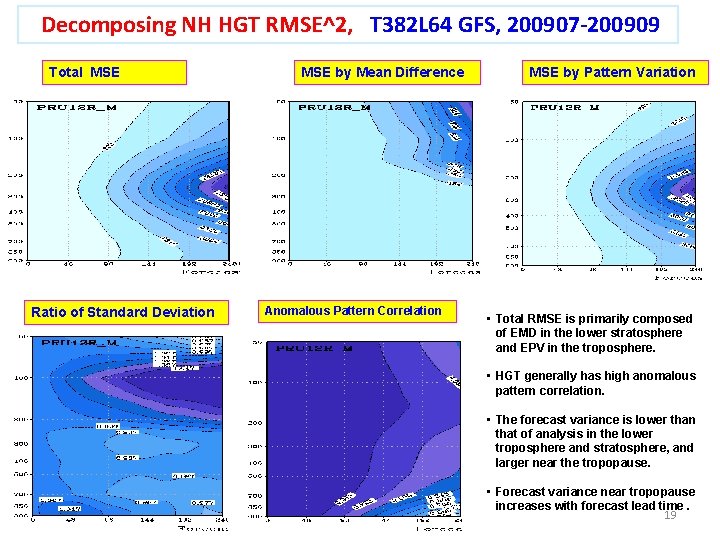
Decomposing NH HGT RMSE^2, T 382 L 64 GFS, 200907 -200909 Total MSE Ratio of Standard Deviation MSE by Mean Difference Anomalous Pattern Correlation MSE by Pattern Variation • Total RMSE is primarily composed of EMD in the lower stratosphere and EPV in the troposphere. • HGT generally has high anomalous pattern correlation. • The forecast variance is lower than that of analysis in the lower troposphere and stratosphere, and larger near the tropopause. • Forecast variance near tropopause increases with forecast lead time. 19
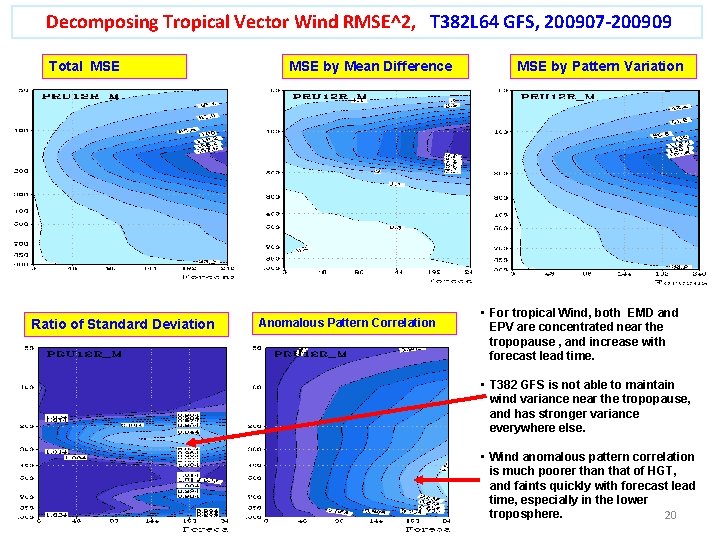
Decomposing Tropical Vector Wind RMSE^2, T 382 L 64 GFS, 200907 -200909 Total MSE Ratio of Standard Deviation MSE by Mean Difference Anomalous Pattern Correlation MSE by Pattern Variation • For tropical Wind, both EMD and EPV are concentrated near the tropopause , and increase with forecast lead time. • T 382 GFS is not able to maintain wind variance near the tropopause, and has stronger variance everywhere else. • Wind anomalous pattern correlation is much poorer than that of HGT, and faints quickly with forecast lead time, especially in the lower troposphere. 20
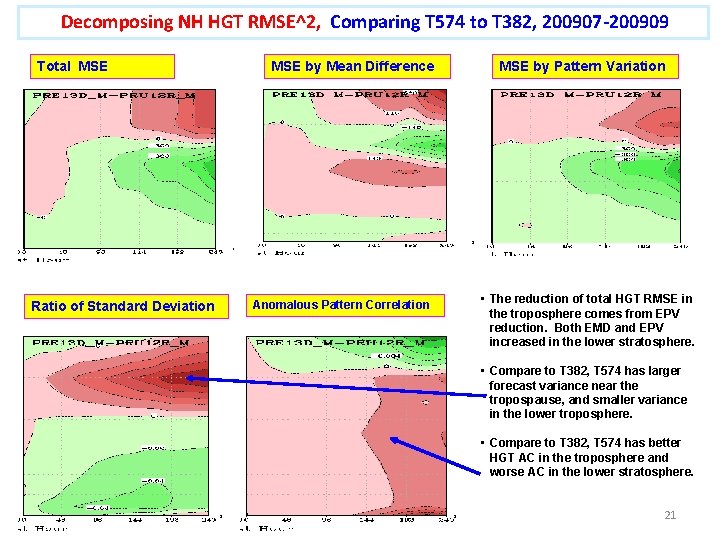
Decomposing NH HGT RMSE^2, Comparing T 574 to T 382, 200907 -200909 Total MSE Ratio of Standard Deviation MSE by Mean Difference Anomalous Pattern Correlation MSE by Pattern Variation • The reduction of total HGT RMSE in the troposphere comes from EPV reduction. Both EMD and EPV increased in the lower stratosphere. • Compare to T 382, T 574 has larger forecast variance near the tropospause, and smaller variance in the lower troposphere. • Compare to T 382, T 574 has better HGT AC in the troposphere and worse AC in the lower stratosphere. 21
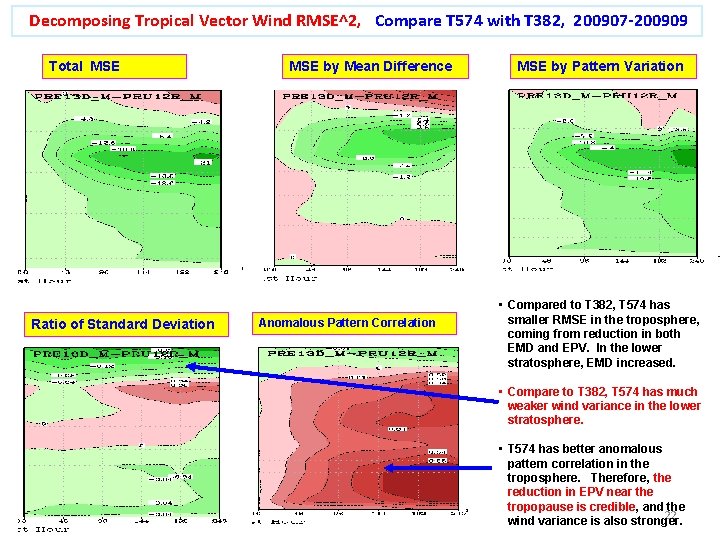
Decomposing Tropical Vector Wind RMSE^2, Compare T 574 with T 382, 200907 -200909 Total MSE Ratio of Standard Deviation MSE by Mean Difference Anomalous Pattern Correlation MSE by Pattern Variation • Compared to T 382, T 574 has smaller RMSE in the troposphere, coming from reduction in both EMD and EPV. In the lower stratosphere, EMD increased. • Compare to T 382, T 574 has much weaker wind variance in the lower stratosphere. • T 574 has better anomalous pattern correlation in the troposphere. Therefore, the reduction in EPV near the tropopause is credible, and the 22 wind variance is also stronger.
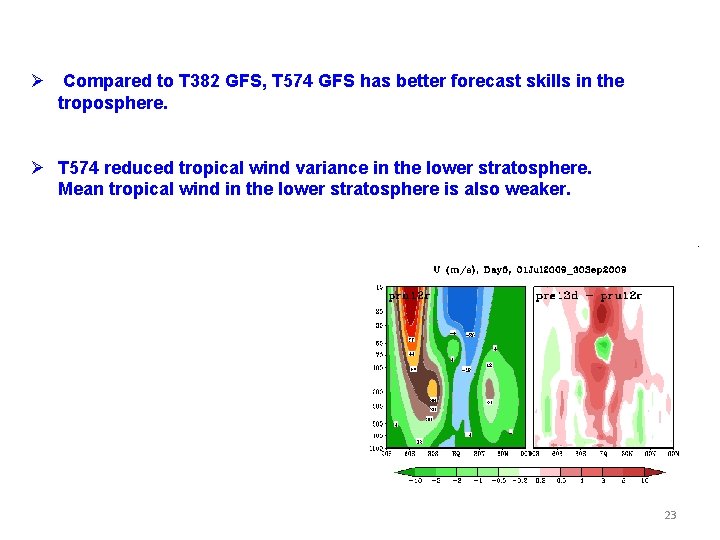
Ø Compared to T 382 GFS, T 574 GFS has better forecast skills in the troposphere. Ø T 574 reduced tropical wind variance in the lower stratosphere. Mean tropical wind in the lower stratosphere is also weaker. 23
Summary Ø RMSE/MSE can be at times misleading. Its fairness as a performance metric depends on the goodness of mean difference, standard deviation, and pattern correlation. Ø If pattern correlation is low, RMSE tends to award forecasts with smoother fields. The implication is that RMSE should not be used for extended NWP forecasts and seasonal forecasts either. Ø The same analysis should be used for verification when comparing different models and/or different experiments. The impact of analysis is on anomaly correlation than on RMSE, and less on height than on winds. Ø At NCEP/EMC, RMSE has been almost exclusively used to measure the performance of tropical wind. A more comprehensive verification should at least include MSE, MSE by Mean Difference, Anomalous Pattern Correlation, and Ratio of Forecast Variance to Analysis Variance. Ø MSE should be used instead of RMSE or standard deviation, the summation of the latter is hard to interpret in math terms. 24
- Slides: 24