
MISMO Future State of the Standards Initiative Briefing
MISMO Future State of the Standards Initiative Briefing March 28, 2017 Panelists: Steve Acker, Owner, Closergeist Geran Combs, Senior Manager, Actualize Consulting Tammy Pegg Kienlen, Senior Consultant, Newbold Advisors Mick Smothers, Principal Architect, Capco
Goals for the Future State Providing work products that align well with industry needs and encourage adoption of the standards Formalize the process for capturing and ensuring traceability of business influence in the standards: • Business knowledge, workflows, and terminology are captured and presented in forms that are easily understood by non-technical individuals and adaptable to multiple technologies • Business needs drive prioritization of work activities • Enable business analysis and technical work to occur independently and at different paces Providing a clear separation of concerns between business products and technical ones, such as XML schema Creating a technical process that allows for the production of the MISMO standards in formats in addition to XML schema. 2
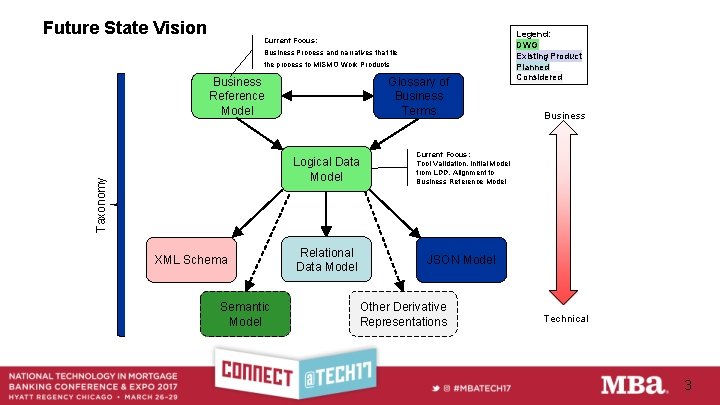
Future State Vision Current Focus: Business Process and narratives that tie the process to MISMO Work Products Taxonomy Business Reference Model XML Schema Semantic Model Glossary of Business Terms Logical Data Model Current Focus: Tool Validation, Initial Model from LDD, Alignment to Business Reference Model Relational Data Model JSON Model Other Derivative Representations Legend: DWG Existing Product Planned Considered Business Technical 3

Business Glossary
Business Glossary What will it look like? • Description and definition of “things” such as data, allowable values, events, actors, synonyms, etc. • Available in an A-Z format, like a dictionary • Will also have a taxonomy that classifies the “things” allowing for more specific, focused views • Will inform the Logical Data Model Content will be derived from many sources including: • Existing MISMO Logical Data Dictionary (LDD) • Business Reference Model • MBA Glossary of Mortgage Terms 5
Business Glossary Guiding principles: • The Business Glossary must add value to the business • The Business Glossary must be rendered in such a way as to be simple and easy for a business person to navigate and consume content • Taxonomies must be kept as simple as possible 6
MISMO Taxonomy What is the MISMO taxonomy? • A method of organizing and classifying “things” in the Business Glossary that are similar such as residential lending and finance business terms, their definitions and relationships • The MISMO Taxonomy will enable powerful search capabilities in the Business Glossary similar to the way the card catalog in a library allows readers to search in multiple ways. • Show me all of the model components related to HMDA or URLA • Show me all of the “things” related to Title 7
What’s next? • Target timeline: Ø Issue a Call for Participation by end of Q 1 2017 Ø Complete 1 st release of Business Glossary by Fall 2017 8
Business Reference Model
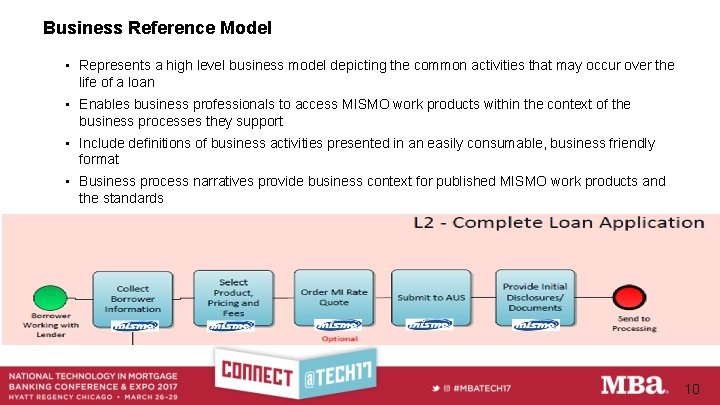
Business Reference Model • Represents a high level business model depicting the common activities that may occur over the life of a loan • Enables business professionals to access MISMO work products within the context of the business processes they support • Include definitions of business activities presented in an easily consumable, business friendly format • Business process narratives provide business context for published MISMO work products and the standards 10
Background and Mission Became a Development Workgroup (DWG) December 2016 Based on industry feedback • Complexity of the standards • Business people perceive MISMO as “a tech thing” Business Reference Model Mission • Develop a high level business model depicting the common activities that may occur over the life of a loan • Enable business professionals to access MISMO work products within the context of the business processes they support • Include definitions of business activities presented in an easily consumable, business friendly format Enough detail to include published MISMO work products • www. mismo. org Implementation Guides, Doc Mappings, etc. • Industry sites for MISMO-based specs (e. g. GSEs, CFPB) Initial focus on content (not on the “Tool”) 11
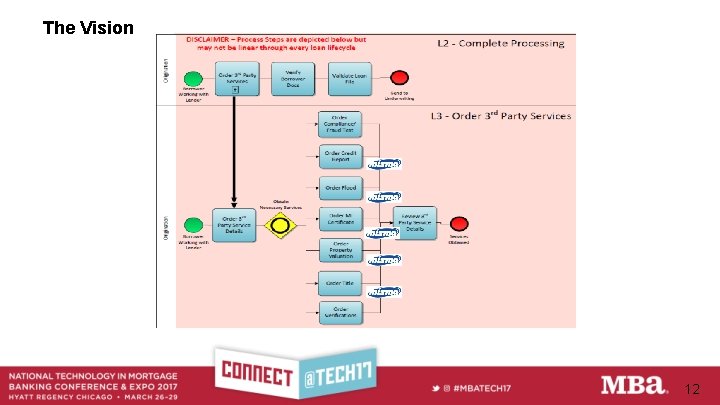
The Vision 12
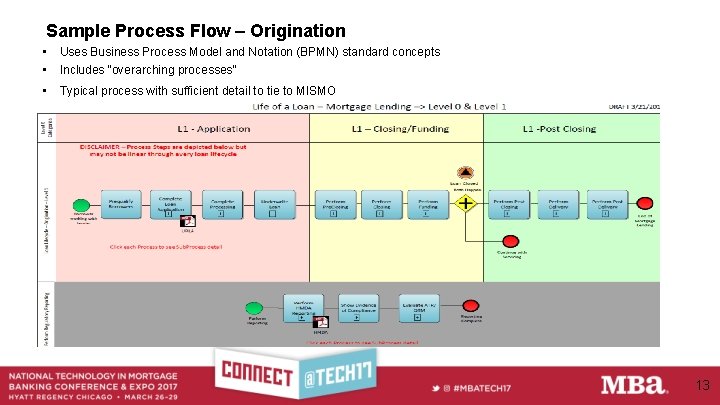
Sample Process Flow – Origination • • Uses Business Process Model and Notation (BPMN) standard concepts Includes “overarching processes” • Typical process with sufficient detail to tie to MISMO 13
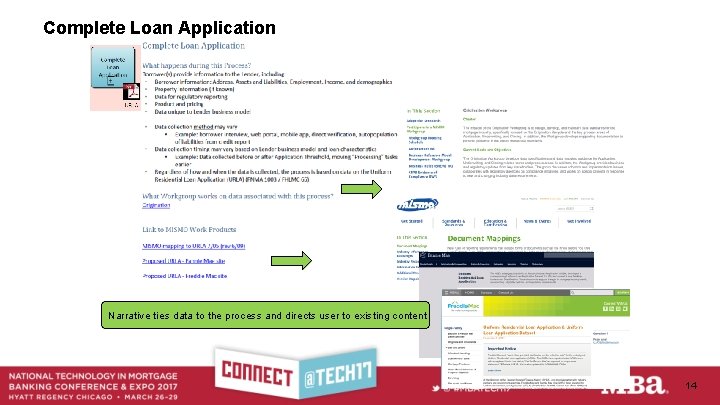
Complete Loan Application Narrative ties data to the process and directs user to existing content 14
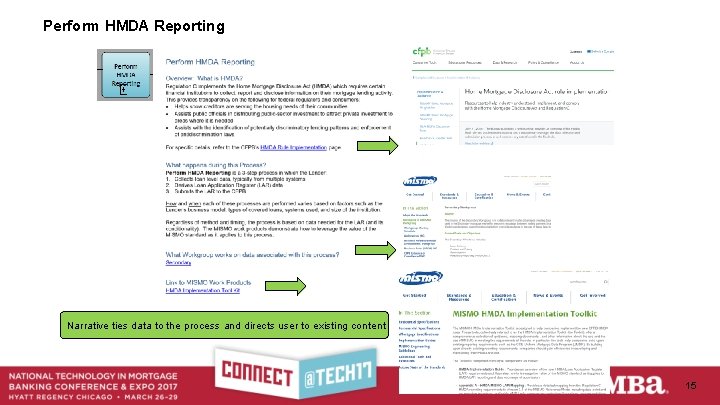
Perform HMDA Reporting Narrative ties data to the process and directs user to existing content 15
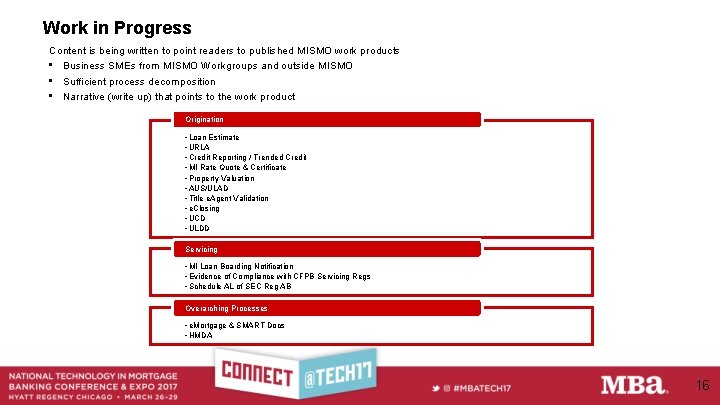
Work in Progress Content is being written to point readers to published MISMO work products • Business SMEs from MISMO Workgroups and outside MISMO • Sufficient process decomposition • Narrative (write up) that points to the work product Origination • Loan Estimate • URLA • Credit Reporting / Trended Credit • MI Rate Quote & Certificate • Property Valuation • AUS/ULAD • Title e. Agent Validation • e. Closing • UCD • ULDD Servicing • MI Loan Boarding Notification • Evidence of Compliance with CFPB Servicing Regs • Schedule AL of SEC Reg AB Overarching Processes • e. Mortgage & SMART Docs • HMDA 16
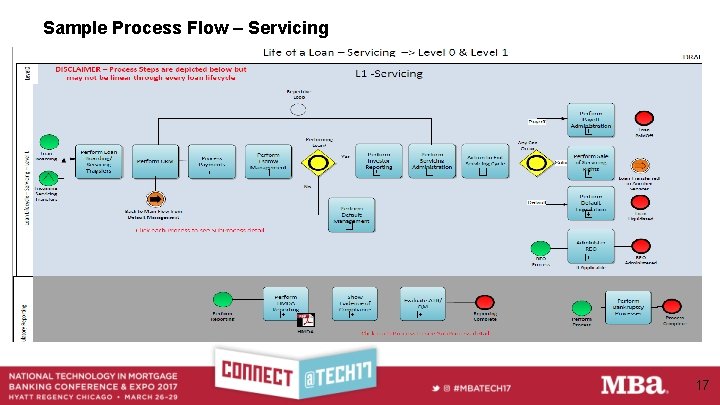
Sample Process Flow – Servicing 17
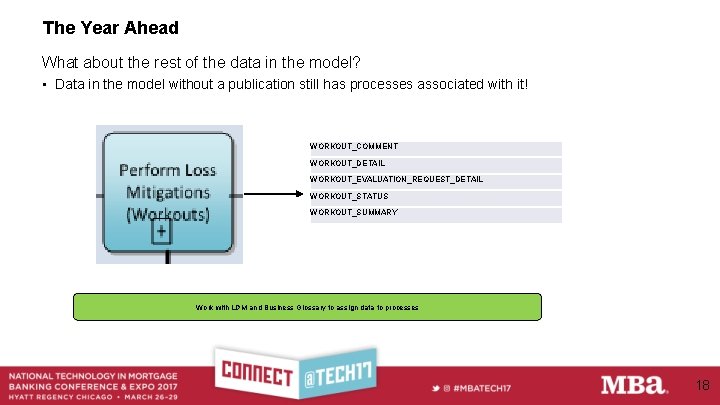
The Year Ahead What about the rest of the data in the model? • Data in the model without a publication still has processes associated with it! WORKOUT_COMMENT WORKOUT_DETAIL WORKOUT_EVALUATION_REQUEST_DETAIL WORKOUT_STATUS WORKOUT_SUMMARY Work with LDM and Business Glossary to assign data to processes 18
The Year Ahead TBD and will evolve! • Implementation of the “Tool” (Publish) • Work with Logical Data Model and Business Glossary DWGs • Release Process (Prioritization, Review, Approval, Iterations) • • Additional views into the process? Content for non-MISMO processes? Drilldown of additional processes? Point to “Work in Progress”? Business SME participation is critical to our success. Join us! 19
Logical Data Model
Logical Data Model The Logical Data Model (LDM) introduces the concept of a technical blueprint, which provides the following benefits: • Separates the design of the MISMO Reference model from any one implementation (i. e. XML Schema) • Simplifies the visual representation of “things” and how they are related • Allows for small snapshots into area of the model that are relevant for a particular business scenario • Allows MISMO to “design once” and “produce many”: easier production of alternative future work products, such as JSON or a relational database schema The LDM design is documented using the widely adopted Uniform Modeling Language (UML) 21
Future State Vision – Logical Data Model UML is a standard modeling methodology • It has been in existence for over 15 years • It is widely used worldwide The three essential UML pieces for the MISMO • Classes (used to represent “things”, or containers) • Attributes (represent discrete pieces of information, or data points) • Associations (represent how things are related to each other) 22
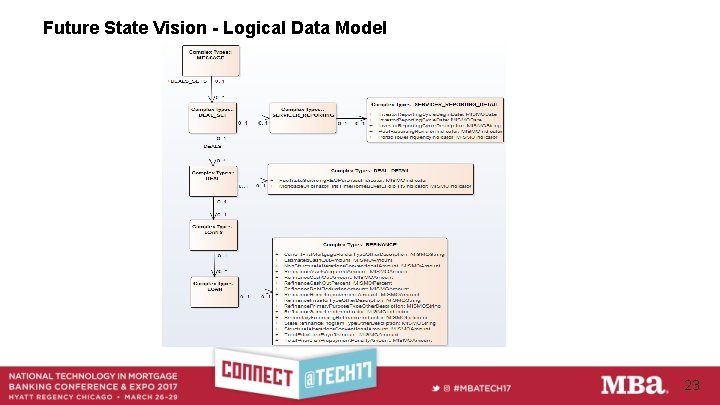
Future State Vision - Logical Data Model 23
Questions? 24
Contact Info Steve Acker Owner, Closergeist steve@closergeist. com Geran Combs Senior Manager, Actualize Consulting gcombs@actualizeconsulting. com Tammy Pegg Kienlen Senior Consultant, Newbold Advisors tkienlen@newboldadvisors. com Mick Smothers Principal Architect, Capco Mick. Smothers@capco. com
- Slides: 25