
Misconceptions and Fallacies Concerning Probability Assessments Law of
Misconceptions and Fallacies Concerning Probability Assessments
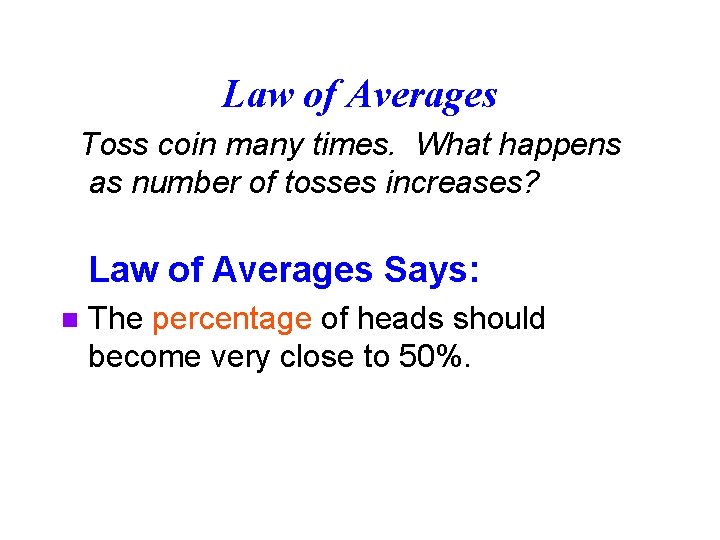
Law of Averages Toss coin many times. What happens as number of tosses increases? Law of Averages Says: n The percentage of heads should become very close to 50%.
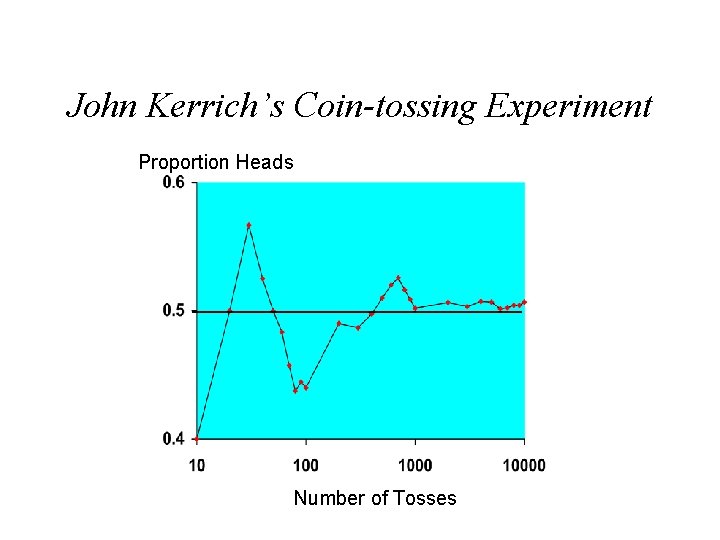
John Kerrich’s Coin-tossing Experiment Proportion Heads Number of Tosses
Law of Averages IN GENERAL Law of Averages says: Averages and proportions vary less from the “expected” as sample size increases
Two Misconceptions
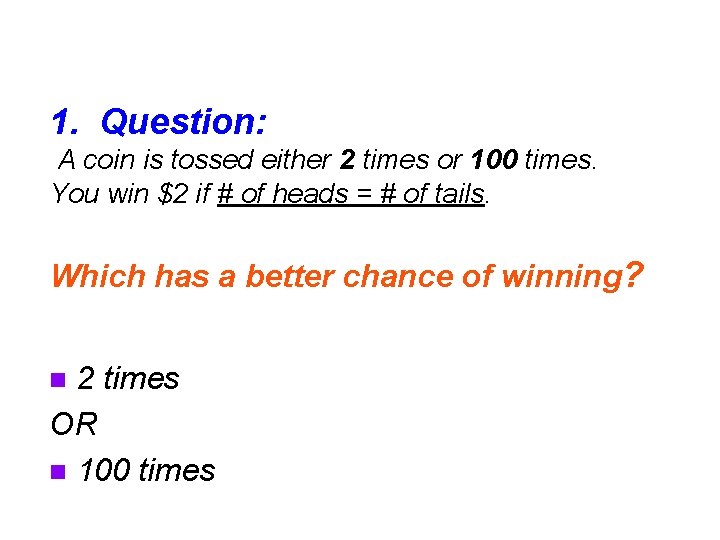
1. Question: A coin is tossed either 2 times or 100 times. You win $2 if # of heads = # of tails. Which has a better chance of winning? 2 times OR n 100 times n
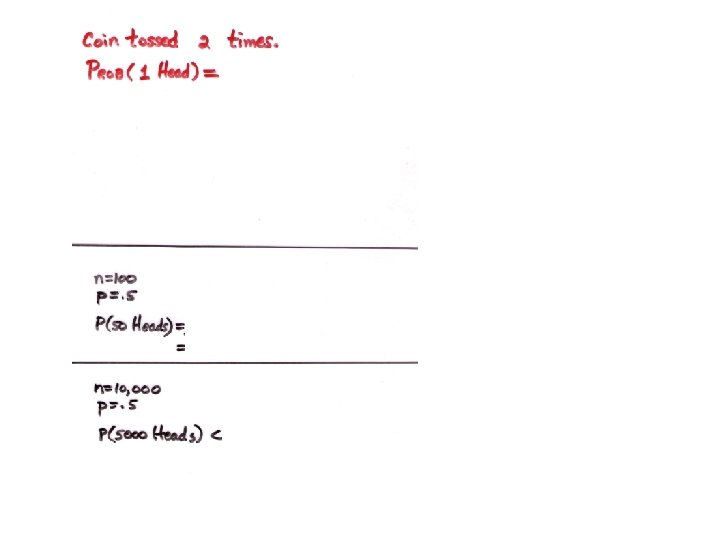
In fact: As # of tosses increases, the chance of “exactly 50% Heads” decreases
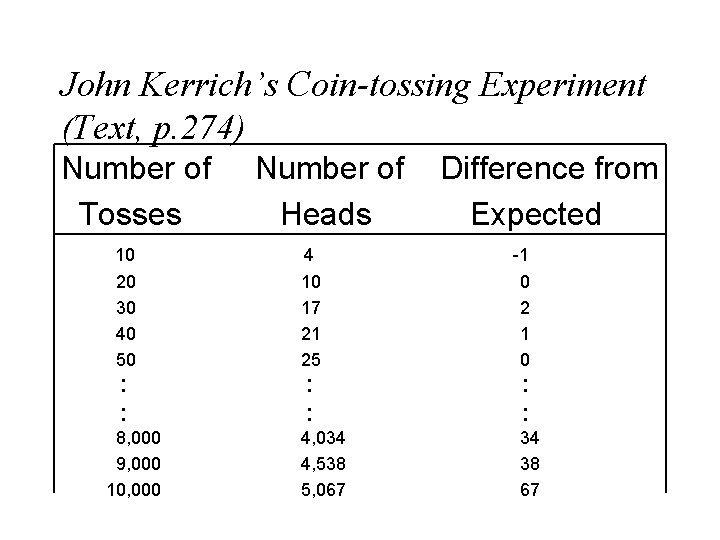
John Kerrich’s Coin-tossing Experiment (Text, p. 274) Number of Tosses Number of Heads Difference from Expected 10 4 -1 20 30 40 50 10 17 21 25 0 2 1 0 4, 034 4, 538 5, 067 34 38 67 : : 8, 000 9, 000 10, 000 : :
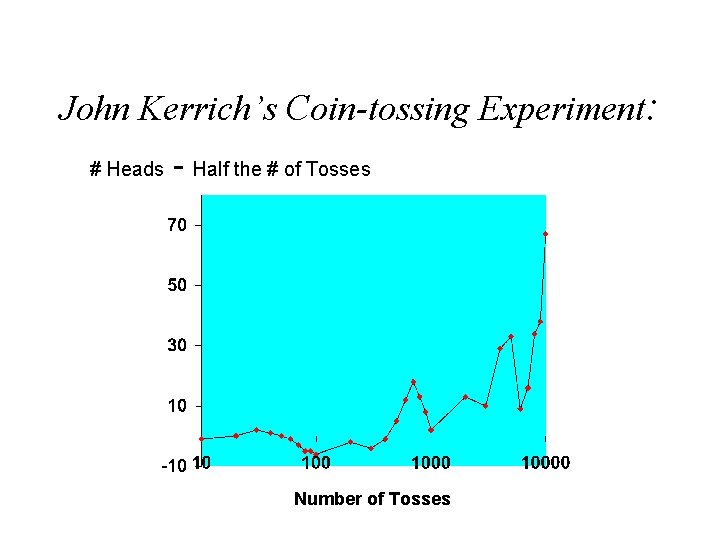
John Kerrich’s Coin-tossing Experiment: # Heads - Half the # of Tosses Number of Tosses
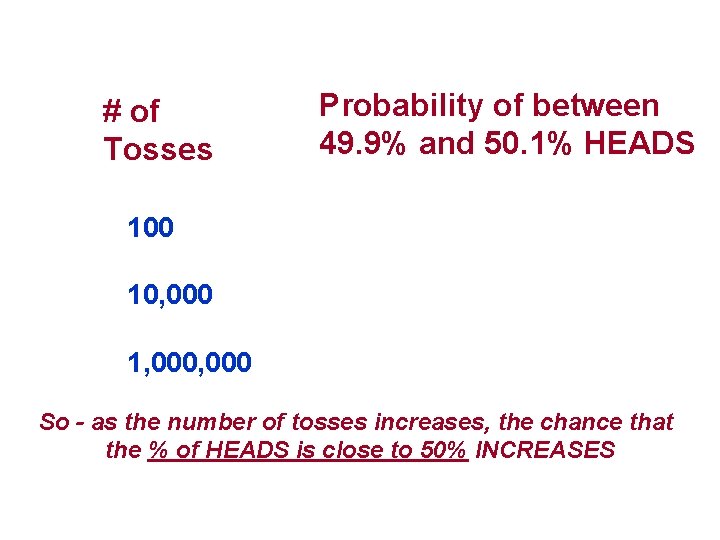
# of Tosses Probability of between 49. 9% and 50. 1% HEADS 100 . 08 10, 000 . 17 1, 000 . 95 So - as the number of tosses increases, the chance that the % of HEADS is close to 50% INCREASES
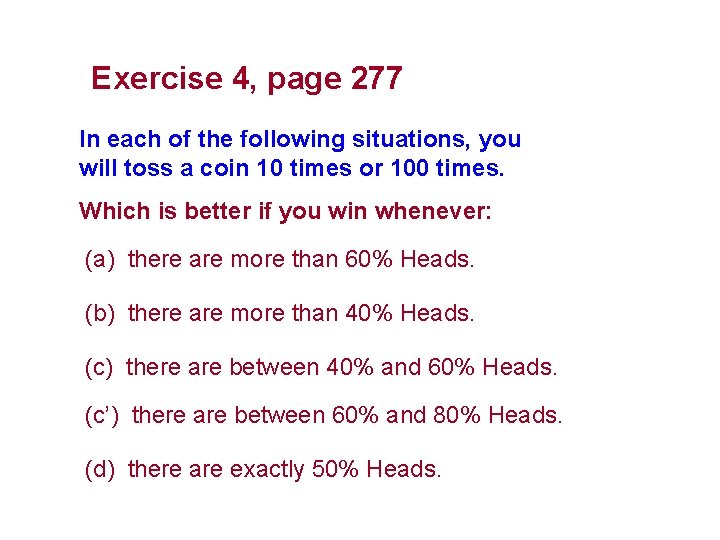
Exercise 4, page 277 In each of the following situations, you will toss a coin 10 times or 100 times. Which is better if you win whenever: (a) there are more than 60% Heads. (b) there are more than 40% Heads. (c) there are between 40% and 60% Heads. (c’) there are between 60% and 80% Heads. (d) there are exactly 50% Heads.
2. How Does the Law of Averages Work? n By “compensation” or “adjustment” ? NO! Kerrich example: - 130 instances of “HHHH” - next toss: 69 H’s! 61 T’s (no adjustment) – gambler’s fallacy
2. How Does the Law of Averages Work? Actually, the Law of Averages works by swamping. – isolated discrepancies become unimportant as number of tosses increases
Distortion of Subjective Probabilities 1. The Availability Heuristic -- probability assessment is based on instances that you can remember Example: deaths by homicide or from a stroke -- Which happen more often? (strokes cause about 11 times as many deaths as homicides)
2. Representative Heuristic -- assignment of higher probabilities than are realistic based on how one imagines things will happen Example: Bank Teller Linda is 31 yrs old, single, and outspoken. As a student she was involved with issues of discrimination and social justice, and she also participated in the anti-nuclear demonstrations. Which is more likely? (a) Linda is a bank teller (b) Linda is a bank teller who is active in the feminist movement.
Conjunction Fallacy -- when chance of 2 or more events both occurring is given a higher chance than the individual events.
3. Anchoring – risk perception can be distorted by providing an “anchor” or reference point Example: chance of nuclear war Questionnaire: (a) Do you think the chance of a nuclear war is higher or lower than 1% (b) Do you think the chance of a nuclear war is higher or lower than 90% Problem: conservatism in probability revision
4. Forgotten Base Rates – ignoring information concerning likelihood of an event Example: Physicians and Rare Diseases Situation: -- a patient may have a rare disease -- diagnostic test is positive -- what is chance the patient has the disease? Doctors often over-estimate the chance that the patient has the disease - in one such study the doctors’ estimates were 10 times too high
5. Overconfidence/Optimism – psychologists have found that people tend to have subjective probabilities about themselves that are unrealistically optimistic Example: “It’ll never happen to me” -- leads to foolish risk taking
6. Gambler’s Fallacy -- “I’m due”
- Slides: 21