
Misconceptions Adult learning Theory JOANNA FONTAINE EDU 643
- Slides: 11
Misconceptions: Adult learning Theory JOANNA FONTAINE – EDU 643 – DR. MICHELE HERRERA
Andragogy: Teaching the Adult Learner The term andragogy is used when referring to teaching adults, “According to Malcolm Knowles (1987), andragogy "is now widely used around the world as an alternative to pedagogy" (p. 169) when referring to teaching adults, ” (Mohring P. 1990 p 93). When teaching adult learners educators need to be conscious of the fact that the knowledge the adult learners are receiving is being applied to their everyday lives.
“ “An adult accumulates a growing reservoir of experience, which is a rich resource for learning, ” (MERRIAM, CAFFARELLA &BAUMGARTNER, 2007, P. 84). The adult learner is excited to be able to apply what they are learning to their everyday world and have the motivation to succeed. ”
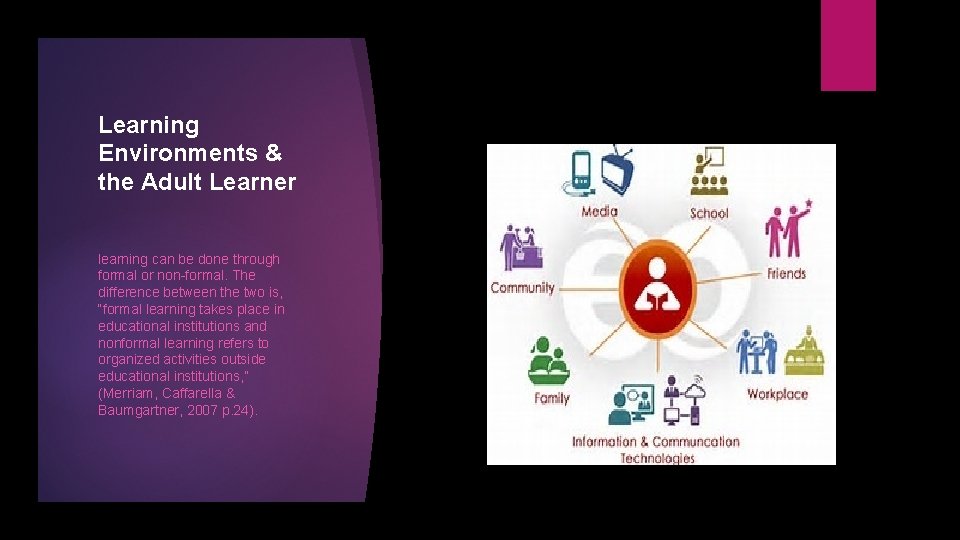
Learning Environments & the Adult Learner learning can be done through formal or non-formal. The difference between the two is, “formal learning takes place in educational institutions and nonformal learning refers to organized activities outside educational institutions, ” (Merriam, Caffarella & Baumgartner, 2007 p. 24).
Formal & Informal Learning Formal Some of the main characteristics of a formal education are, “corresponds to a systematic, organized education model, structured and administered according to a given set of laws and norms, presenting a rather rigid curriculum as regards objectives, content and methodology. Formal education has a well-defined set of features, ” structured content, extrinsic motivation, and strict assessments, ” (Hung, D. d. , Lee, S. s. , & Lim, K. k. (2012)para. 2). Informal learning is defined as, “the spontaneous, unstructured learning that goes on daily in the home and neighborhood, behind the school and in the playing field, in the workplace, marketplace, library and museum, and through the various mass media, ”( Merriam, Caffarella & Baumgartner, 2007 p. 35).
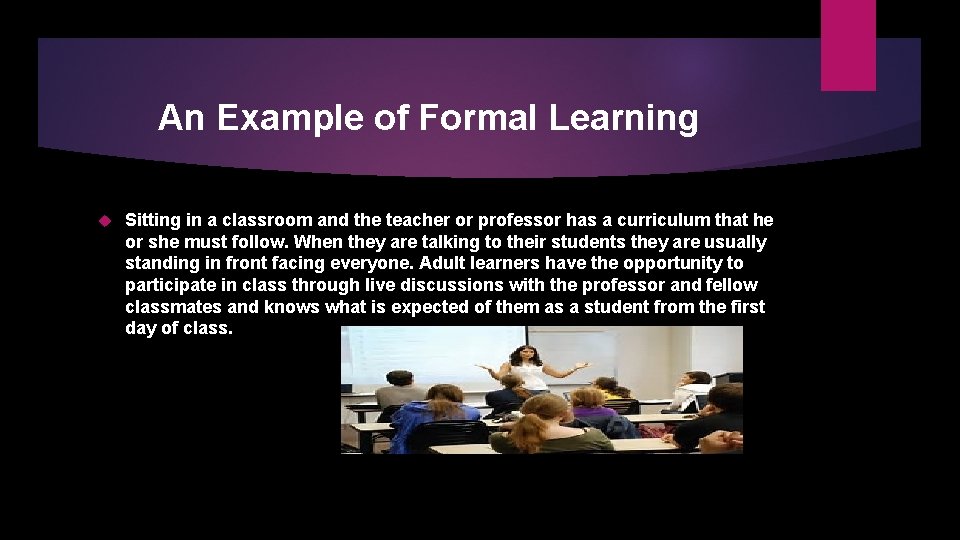
An Example of Formal Learning Sitting in a classroom and the teacher or professor has a curriculum that he or she must follow. When they are talking to their students they are usually standing in front facing everyone. Adult learners have the opportunity to participate in class through live discussions with the professor and fellow classmates and knows what is expected of them as a student from the first day of class.
Informal Learning An example of an informal learning environment would be an adult learner’s visit to a Broadway play. In this setting students are sitting in rows of seats that face a stage in which actors and actresses are performing a play. There is usually some sort of dialogue as well as music or singing that is done as well.
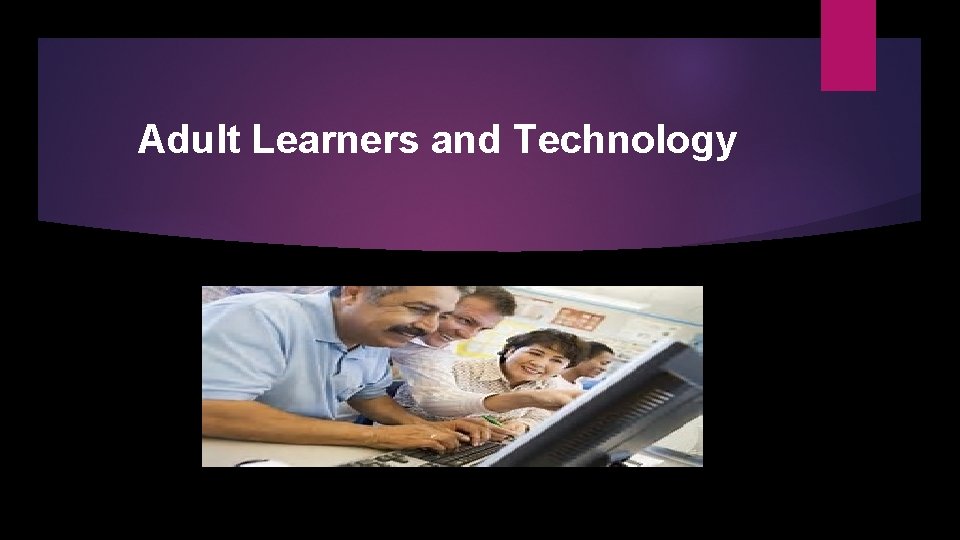
Adult Learners and Technology
Traditional Student VS Adult Student Some of the fear might come from some adults not having the exposure to different types of technology which plays a role in the gap between generations as well as a technological gap between a traditional college students versus an adult learner. Adult learners are capable of having the same experiences but they will do what needs to be done for their own learning. Younger students or “traditional students” have had exposure to technologies such as, “mobile phones and computers to do text messaging, talk to peers, listen to music, play games and watch other media, with the three most popular online activities being visiting social networking sites (eg, My. Space and Facebook), playing computer games and watching videos on websites, ” (Lai, K. , & Hong, K. 2015 p 725 -738).
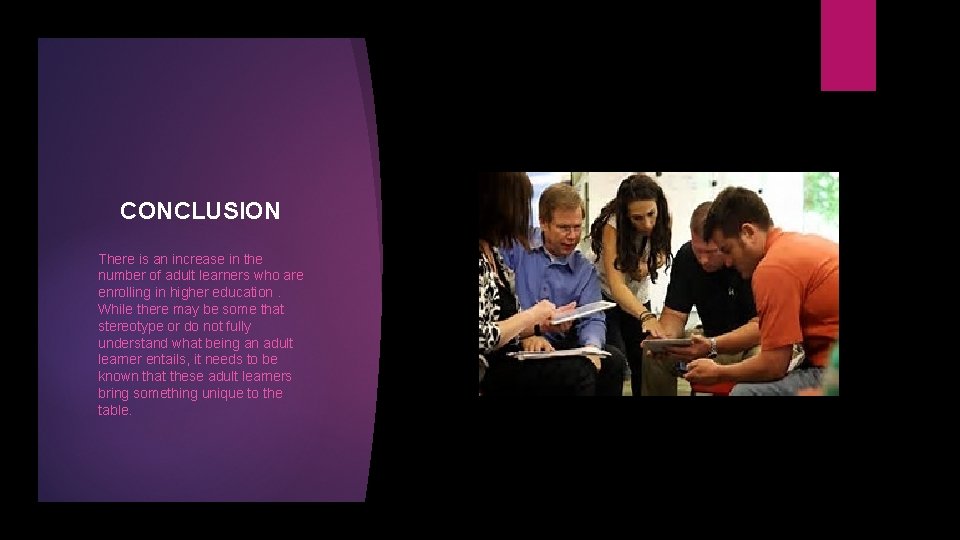
CONCLUSION There is an increase in the number of adult learners who are enrolling in higher education. While there may be some that stereotype or do not fully understand what being an adult learner entails, it needs to be known that these adult learners bring something unique to the table.
References Mohring P. Andragogy and Pedagogy: A Comment on Their Erroneous Usage. Human Resource Development Quarterly [serial online]. Spring 1990; 1(1): 93 -96. Available from: Business Source Complete, Ipswich, MA. Accessed March 1, 2017. Hung, D. d. , Lee, S. s. , & Lim, K. k. (2012). Authenticity in learning for the twenty-first century: bridging the formal and the informal. Educational Technology Research & Development, 60(6), 1071 -1091. doi: 10. 1007/s 11423 -012 -9272 -3 Yu-Chun, K. , Chen, J. S. , & Yu-Tung, K. (2015). Interaction among Online Adult Learners through the Use of Technologies. Journal Of Technologies In Education, 11(1), 1 -10. Merriam, S. B. , Caffarella, R. S. & Baumgartner, L. (2007). Learning in Adulthood: a Comprehensive Guide. San Francisco: Jossey-Bass. Rodriquez, F. G. , & Nash, S. S. (2004). Technology and the Adult Degree Program: The Human Element. New For Adult & Continuing Education, (103), 73 -79. doi: 10. 1002/ace. 150 Lai, K. , & Hong, K. (2015). Technology use and learning characteristics of students in higher education: Do generational differences exist? . British Journal Of Educational Technology, 46(4), 725 -738. doi: 10. 1111/bjet. 12161 Directions