
MIS UNIT IV SYSTEM DEVELOPMENT LIFE CYCLE SDLC


- Slides: 12
MIS UNIT - IV SYSTEM DEVELOPMENT LIFE CYCLE (SDLC) comp/honours/comp applications 1
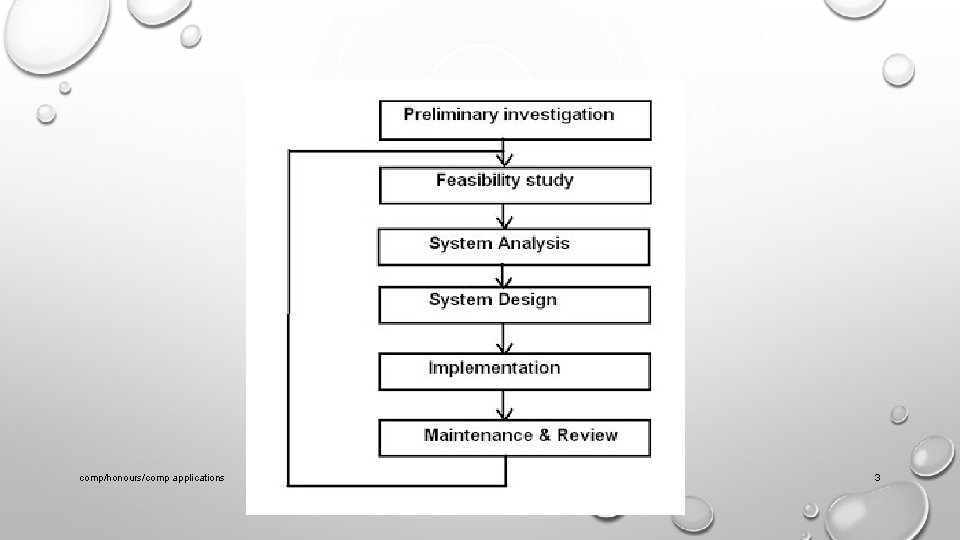
Software development lifecycle (SDLC) is a framework that defines the steps involved in the development of software. It covers the detailed plan for building, deploying and maintaining the software. SDLC defines the complete cycle of development i. e. all the tasks involved in gathering a requirement for the maintenance of a Product. There are following activities involves in SDLC: · Preliminary Investigation (Problem Identification) · Feasibility study · System analysis · System designing · Implementation & Evaluation · Maintenance comp/honours/comp applications 2
comp/honours/comp applications 3
Phase : 1 Preliminary Investigation OR Problem Identification: One of most difficult task of the system analyst is identifying the real problem of the existing system. It defines the user requirements or what the user expects from the new system. This also includes the rough idea of the resource requirements as well as estimated time for completion and number of persons expected to be involve in each phase. Problem identification helps in : i. Defining a problem ii. Setting proper system goal iii. Determining the boundaries of the project by considering the limitations of available resources comp/honours/comp applications 4
Phase 2 Feasibility study: It determines the possibility of either improving the existing system or developing the complete new system. It helps to obtain an overview of the problem and to get rough assessment of whether physical solution exist. The purpose of feasibility study is to determine whether the requested system successfully realizable. There are four aspects of feasibility study : i. Technical feasibility ii. Economical feasibility iii. Operational feasibility iv. Behavioural feasibility comp/honours/comp applications 5
i. Technical feasibility: It involves the required and existing computer system, hardware, software & to what extent it can support the proposed application. It answers following questions : • Whether the system can be carried out with existing equipments • Whether the existing software is enough • If a new technology is required how best it can be implemented ii. Economic feasibility: It involves post benefit analysis to determine the benefit and savings that are expected from new system and compared with costs. It benefits out weight cost then decision is made to design and implement new system. iii. Operational feasibility: It concerns with human, organizational and political aspects. It covers technical performance as well as acceptance within the organization. It determines the general attitude and job skills of existing personals and whether any restructuring of jobs will be acceptable to the current user. iv. Behavioral feasibility: It includes how strong the reaction of staff will be towards the development of new system that involves computer’s use in their daily work. So resistant to change is identified. comp/honours/comp applications 6
Phase 3 3. System analysis: This step involves collection, recording, verification and analysis of how the operations are being carried out presently. System analysis is carried put with the objective of developing an effective computer based procedure which will create benefits far in excess of those available from other means. System analysis is the activity which is used to sort out the area prospective for computerization and then determining the data volume and information requirements for each selected application. There are two approaches to conduct the information analysis: Decision Analysis approach: a) Identify objectives and /or current decisions or processes. b) Identify of formulate a decision making process. c) Identify the data required for the decision model of the process model. d) Specify the accuracy, any availability of limits for the data needed. Data Analysis approach: a) Collect all data, reports, files etc. Currently in use. b) By fact finding method, identify additional data that is not being currently collected. c) By interviews and analysis, seek to eliminate data for which no need can be perceived. comp/honours/comp applications 7 Continue….
Phase 3 System Study Report The output from this step or phase is a formal report called a Feasibility Report of System Study Report. This report may contain: a) The objectives for the system. b) A commentary on how the present system achieves of fails to achieve those objectives. c) Present operating costs and conditions. d) Interfaces with other system e) A schedule of the hardware, software and other requirements for the proposed system. f) A first estimate of system development time. g) Expect benefits which will accrue from the use of a new system. h) A cost-benefit projection. i) Conclusion and recommendations. comp/honours/comp applications 8
Phase : 4 System designing: In this process the primary object is to identify user requirements and to build a system that satisfies these requirements. Design of the system is mainly the logical design that can be sketch on a paper or on a computer. It includes physical design elements, describes the data to be inputted. The process involved in manipulation of data & output design represents: i. File structure, storage devices etc ii. Database is also designed in this phase iii. Changes to be made in the organizational structure of the firm are outlines iv. Input, Output, files, forms and procedures are planned v. Finally standards for testing, documentation, system control are designed. comp/honours/comp applications 9
Phase 5 5. Implementation & Evaluation: This is the final phase of development. It consists of installing hardware, programs, collecting data and organizing people to interact with and run the system. In this phase user actually starts using the system therefore it also involves training of users and provides friendly documentation. Evaluation is the process of verifying the capability of a system after it put into operation to see whether it meets the objective or not. It includes response time, overall reliability and limitations user behavior. comp/honours/comp applications 10
Phase 7 Maintenance: It is process of incorporating changes in the implemented existing system. i. Enhancement: Adding new functions or additional capability of the system. ii. Adaptation: Customizing the software to run in a new environment. iii. Correction: Correcting the bugs in the existing software. comp/honours/comp applications 11
Thank you comp/honours/comp applications 12