
MIS on Trees Christoph Lenzen and Roger Wattenhofer


- Slides: 13
MIS on Trees Christoph Lenzen and Roger Wattenhofer Christoph Lenzen, PODC 2011
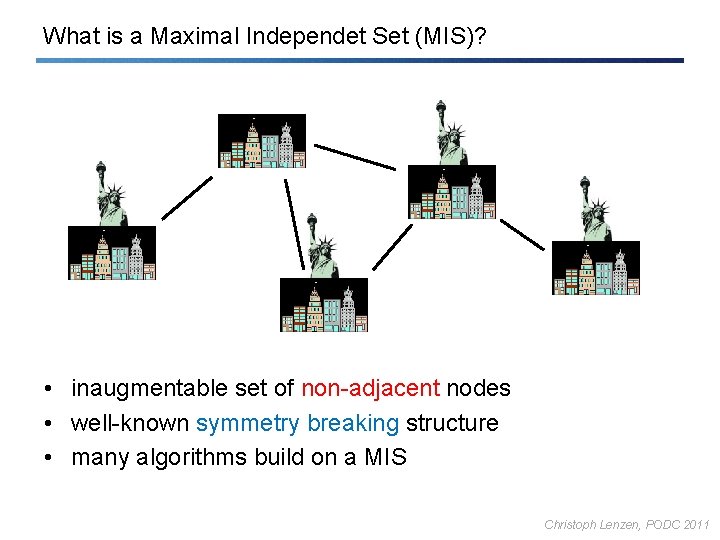
What is a Maximal Independet Set (MIS)? • inaugmentable set of non-adjacent nodes • well-known symmetry breaking structure • many algorithms build on a MIS Christoph Lenzen, PODC 2011
What is a Tree? Let’s assume we all know. . . Christoph Lenzen, PODC 2011
Talk Outline good talk convincing motivation impressive results sketch key ideas my talk Well, let’s skip that. . . We do it in O((ln n ln ln n)1/2) rounds! give details coherent conclusions make up for the bad talk Christoph Lenzen, PODC 2011
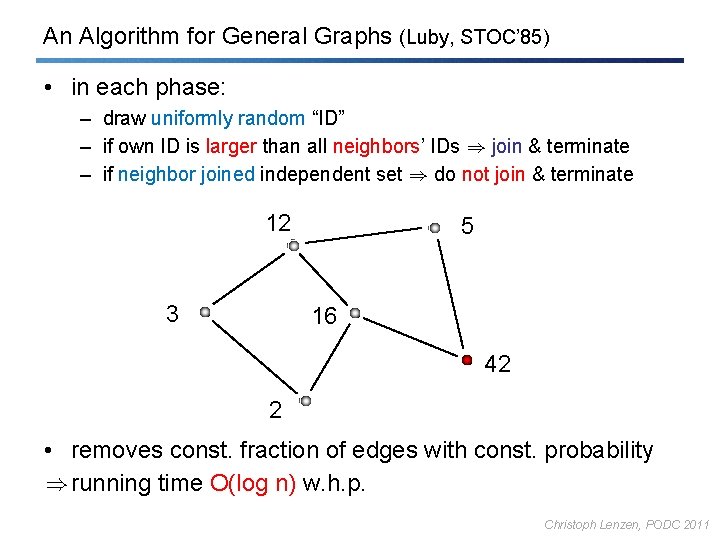
An Algorithm for General Graphs (Luby, STOC’ 85) • in each phase: – draw uniformly random “ID” – if own ID is larger than all neighbors’ IDs ) join & terminate – if neighbor joined independent set ) do not join & terminate 12 3 5 16 42 2 • removes const. fraction of edges with const. probability ) running time O(log n) w. h. p. Christoph Lenzen, PODC 2011
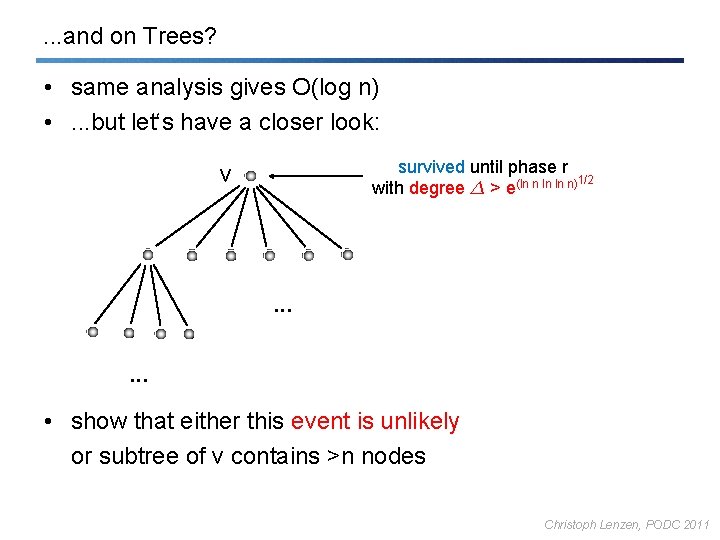
. . . and on Trees? • same analysis gives O(log n) • . . . but let‘s have a closer look: survived until phase r 1/2 with degree ¢ > e(ln n ln ln n) v . . . • show that either this event is unlikely or subtree of v contains >n nodes Christoph Lenzen, PODC 2011
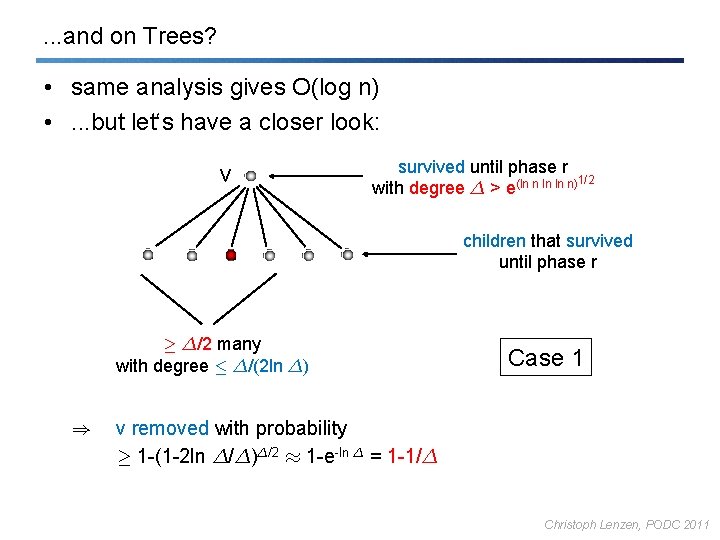
. . . and on Trees? • same analysis gives O(log n) • . . . but let‘s have a closer look: v survived until phase r 1/2 with degree ¢ > e(ln n ln ln n) children that survived until phase r ¸ ¢/2 many with degree · ¢/(2 ln ¢) ) Case 1 v removed with probability ¸ 1 -(1 -2 ln ¢/¢)¢/2 ¼ 1 -e-ln ¢ = 1 -1/¢ Christoph Lenzen, PODC 2011
. . . and on Trees? • same analysis gives O(log n) • . . . but let‘s have a closer look: v survived until phase r 1/2 with degree ¢ > e(ln n ln ln n) children that survived until phase r ¸ ¢/2 many with degree ¸ ¢/(2 ln ¢) ) also true in phase r-1 Case 2 each of them removed in phase r-1 with prob. ¸ 1 -2 ln ¢/¢ or has ¢/(4 ln ¢) high-degree children in phase r-1 Christoph Lenzen, PODC 2011
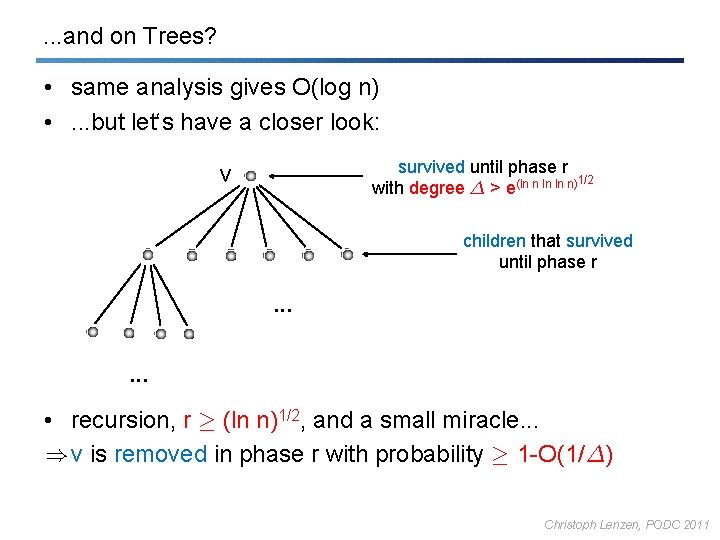
. . . and on Trees? • same analysis gives O(log n) • . . . but let‘s have a closer look: survived until phase r 1/2 with degree ¢ > e(ln n ln ln n) v children that survived until phase r . . . • recursion, r ¸ (ln n)1/2, and a small miracle. . . ) v is removed in phase r with probability ¸ 1 -O(1/¢) Christoph Lenzen, PODC 2011
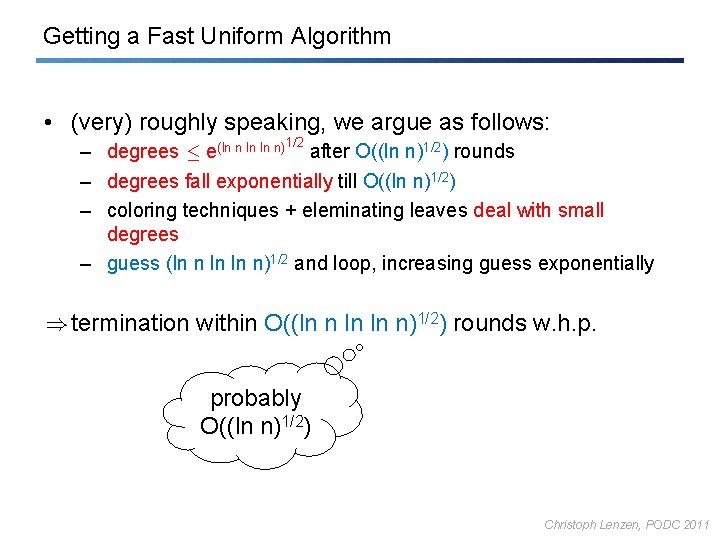
Getting a Fast Uniform Algorithm • (very) roughly speaking, we argue as follows: 1/2 – degrees · e(ln n ln ln n) after O((ln n)1/2) rounds – degrees fall exponentially till O((ln n)1/2) – coloring techniques + eleminating leaves deal with small degrees – guess (ln n ln ln n)1/2 and loop, increasing guess exponentially ) termination within O((ln n ln ln n)1/2) rounds w. h. p. probably O((ln n)1/2) Christoph Lenzen, PODC 2011
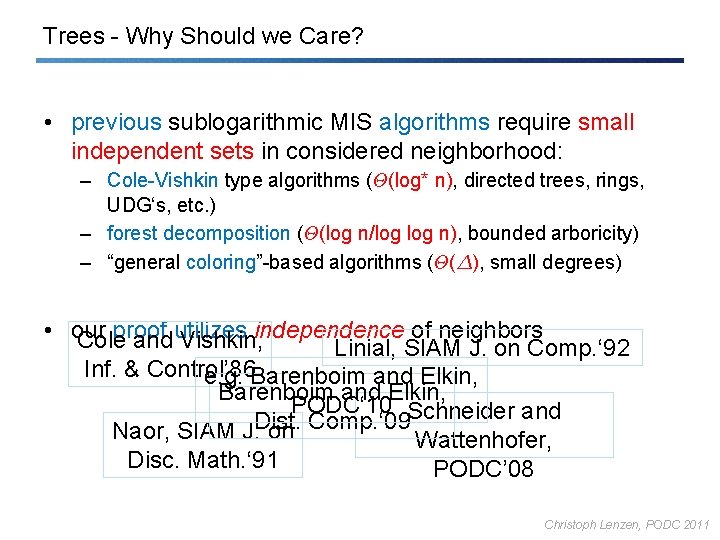
Trees - Why Should we Care? • previous sublogarithmic MIS algorithms require small independent sets in considered neighborhood: – Cole-Vishkin type algorithms (£(log* n), directed trees, rings, UDG‘s, etc. ) – forest decomposition (£(log n/log n), bounded arboricity) – “general coloring”-based algorithms (£(¢), small degrees) • our proof of neighbors Cole and utilizes Vishkin, independence Linial, SIAM J. on Comp. ‘ 92 Inf. & Control’ 86 e. g. Barenboim and Elkin, PODC‘ 10 Schneider and Naor, SIAM J. Dist. on Comp. ‘ 09 Wattenhofer, Disc. Math. ‘ 91 PODC’ 08 Christoph Lenzen, PODC 2011
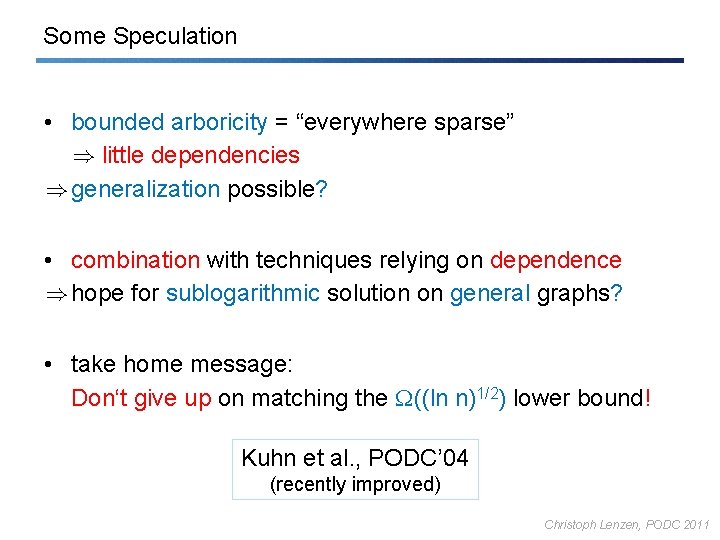
Some Speculation • bounded arboricity = “everywhere sparse” ) little dependencies ) generalization possible? • combination with techniques relying on dependence ) hope for sublogarithmic solution on general graphs? • take home message: Don‘t give up on matching the ((ln n)1/2) lower bound! Kuhn et al. , PODC’ 04 (recently improved) Christoph Lenzen, PODC 2011
Thank you! Christoph Lenzen, PODC 2011