
Mirrors Reflection Light always travels in a straight
- Slides: 16
Mirrors
Reflection � Light always travels in a straight line � However, when light hits another substance, it will change direction � Is a material is opaque (not transparent or translucent; impenetrable to light; not allowing light to pass through. ), the light will not pass through it but bounce off � The change in the direction of light is called reflection
Texture of the Surface � The manner in which the light reflects depends on the surface’s smoothness � Light that hits a rough surface is reflected in many directions. This is called diffuse reflection � Light reflected off a smooth surface is called specular reflection
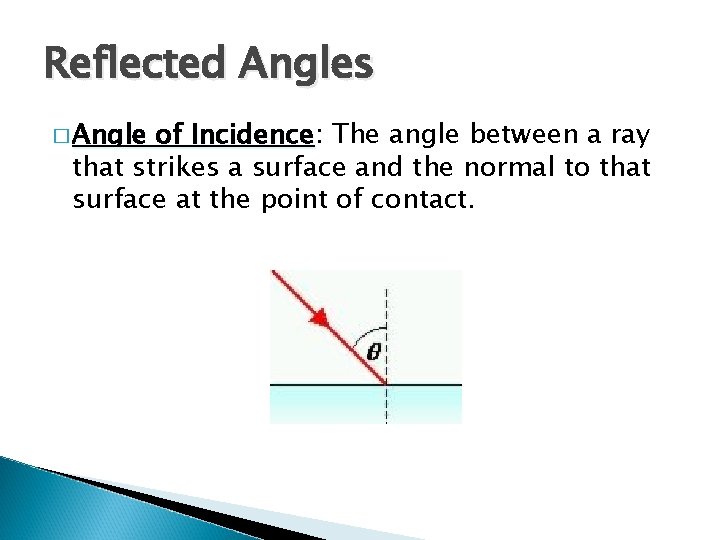
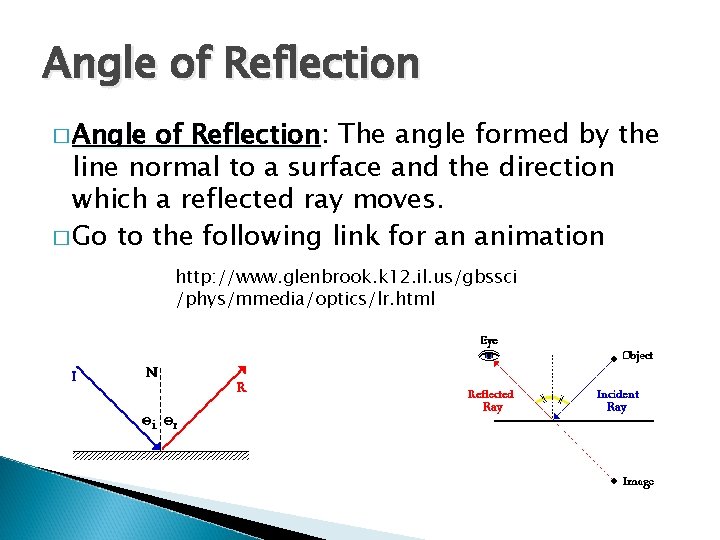
Reflected Angles � Angle of Incidence: Incidence The angle between a ray that strikes a surface and the normal to that surface at the point of contact.
Angle of Reflection � Angle of Reflection: Reflection The angle formed by the line normal to a surface and the direction which a reflected ray moves. � Go to the following link for an animation http: //www. glenbrook. k 12. il. us/gbssci /phys/mmedia/optics/lr. html
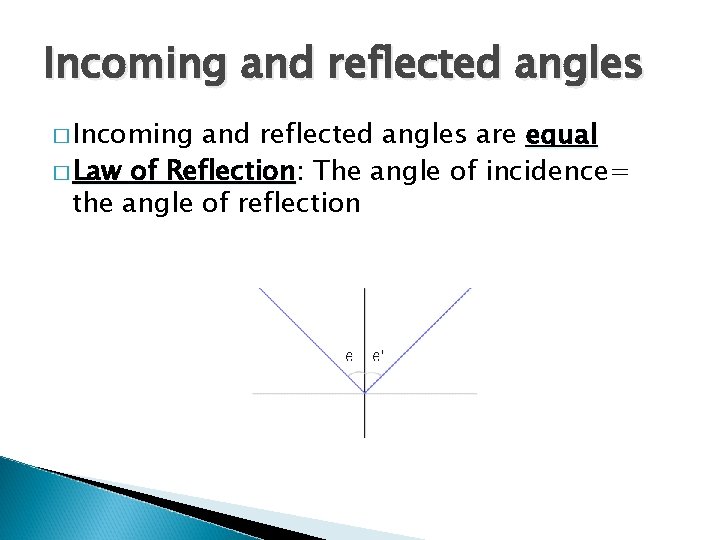
Incoming and reflected angles � Incoming and reflected angles are equal � Law of Reflection: Reflection The angle of incidence= the angle of reflection
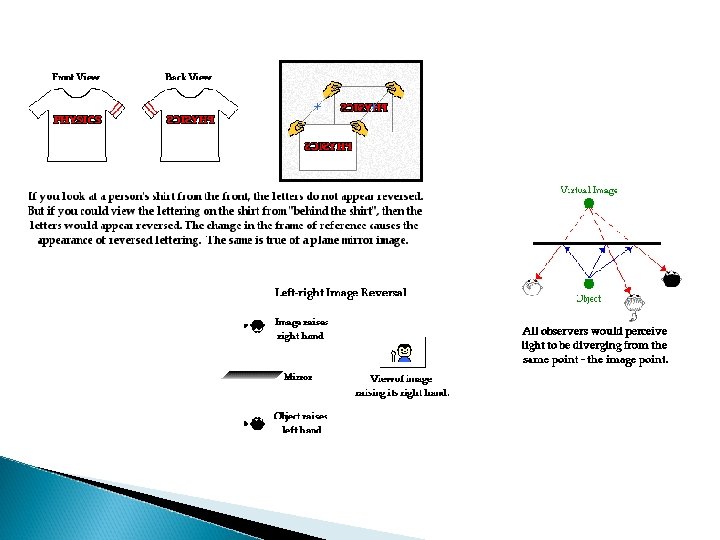
Reflection Rules The image is said to be a virtual image � Left right reversal: reversal if you raise your left hand, you will notice that the image raises what would seem to be it's right hand. � Image is upright instead of inverted- there is no top-bottom vertical reversal. If you stand on your feet in front of a plane mirror, the image does not stand on its head. � For plane mirrors, the object distance (often represented by the symbol do) is equal to the image distance (often represented by the symbol di). � the dimensions of the image are the same as the dimensions of the object If a 1. 6 -meter tall person stands in front of a mirror, he/she will see an image which is 1. 6 -meters tall. �
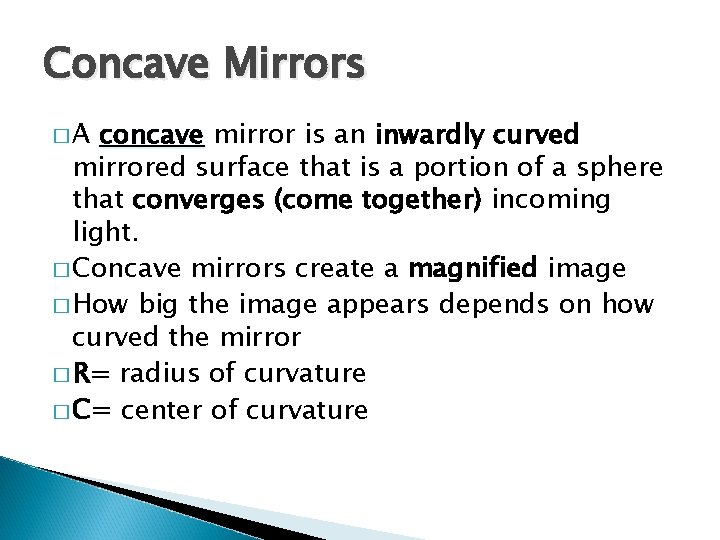
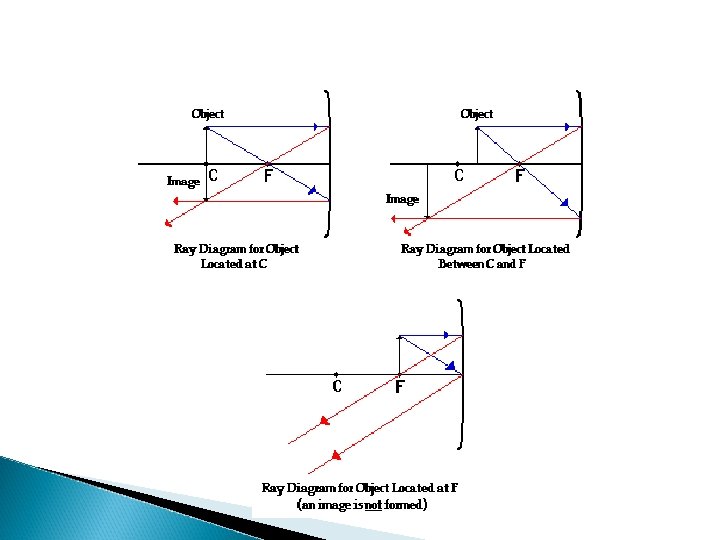
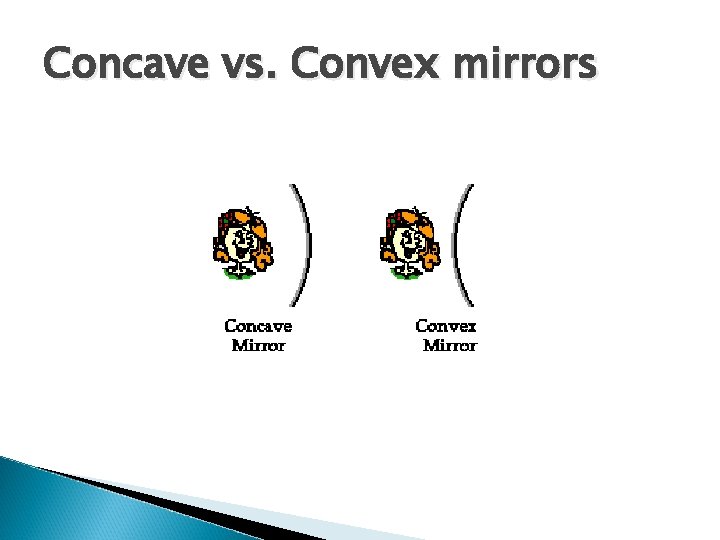
Concave Mirrors �A concave mirror is an inwardly curved mirrored surface that is a portion of a sphere that converges (come together) incoming light. � Concave mirrors create a magnified image � How big the image appears depends on how curved the mirror � R= radius of curvature � C= center of curvature
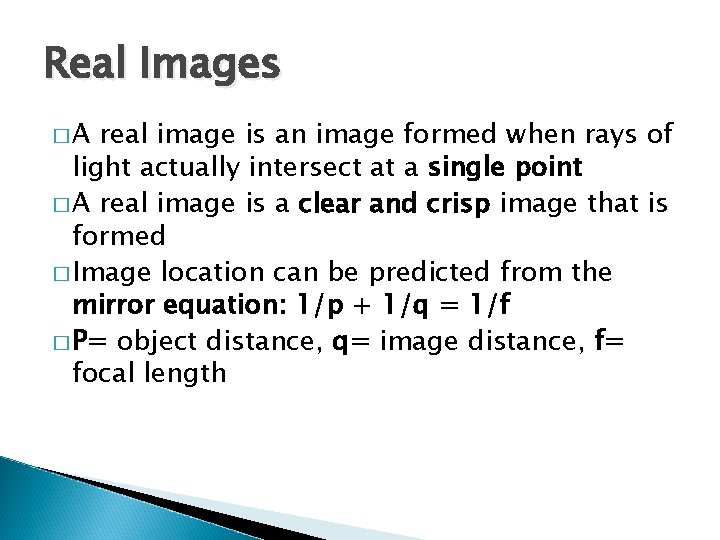
Real Images �A real image is an image formed when rays of light actually intersect at a single point � A real image is a clear and crisp image that is formed � Image location can be predicted from the mirror equation: 1/p + 1/q = 1/f � P= object distance, q= image distance, f= focal length
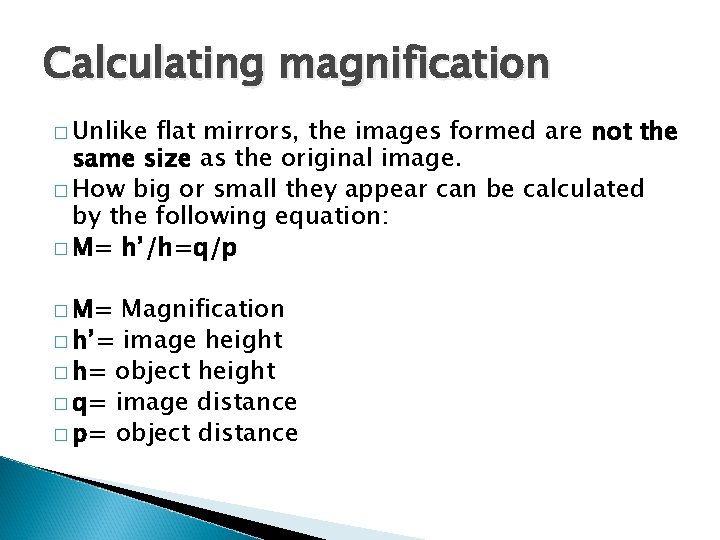
Calculating magnification � Unlike flat mirrors, the images formed are not the same size as the original image. � How big or small they appear can be calculated by the following equation: � M= h’/h=q/p � M= Magnification � h’= image height � h= object height � q= image distance � p= object distance
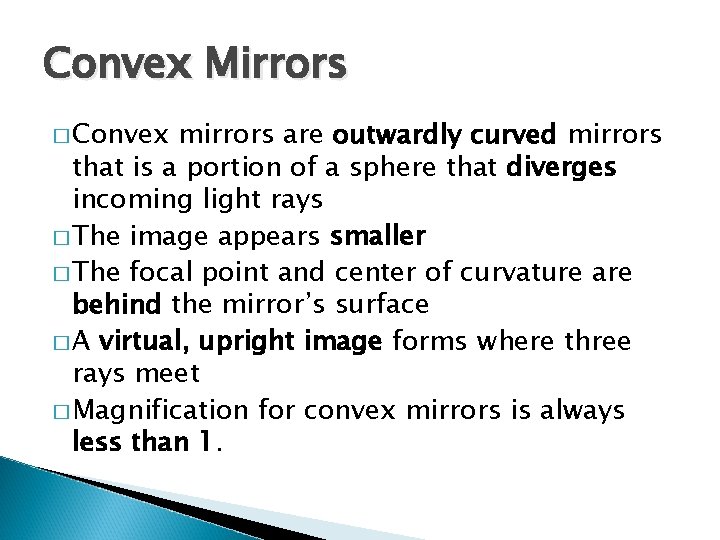
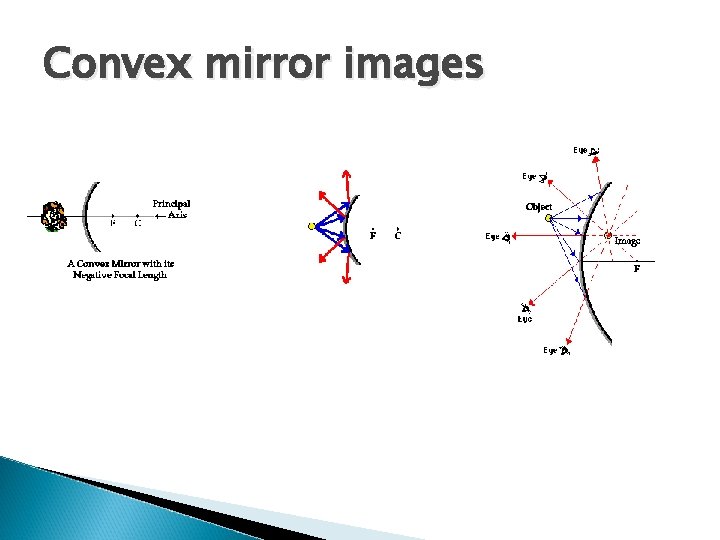
Convex Mirrors � Convex mirrors are outwardly curved mirrors that is a portion of a sphere that diverges incoming light rays � The image appears smaller � The focal point and center of curvature are behind the mirror’s surface � A virtual, upright image forms where three rays meet � Magnification for convex mirrors is always less than 1.
Concave vs. Convex mirrors
Convex mirror images
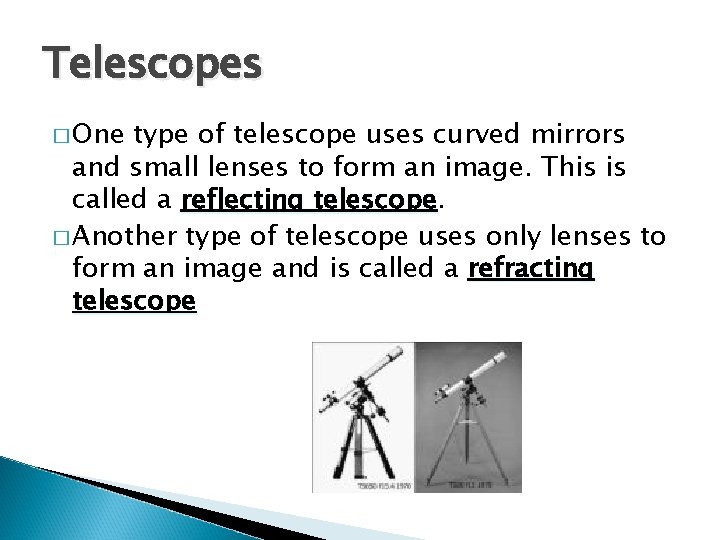
Telescopes � One type of telescope uses curved mirrors and small lenses to form an image. This is called a reflecting telescope � Another type of telescope uses only lenses to form an image and is called a refracting telescope