
Mirrors Practice Problems If you can do these
Mirrors - Practice Problems If you can do these, You will do well! Holt Physics
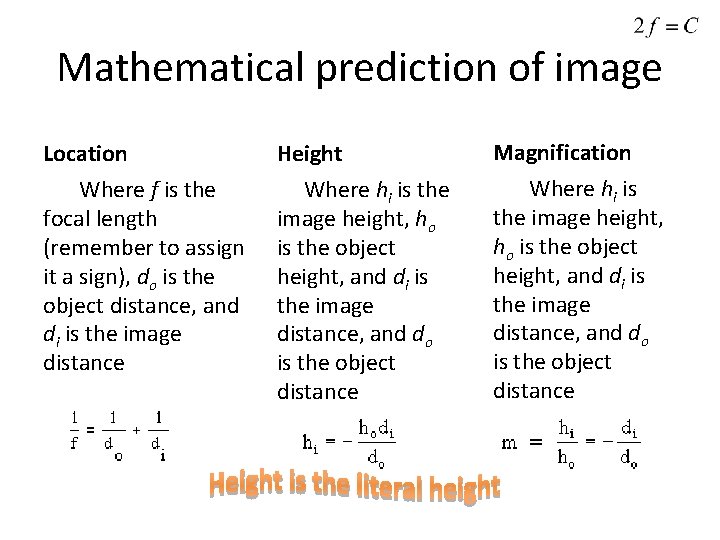
Mathematical prediction of image Location Height Magnification Where f is the focal length (remember to assign it a sign), do is the object distance, and di is the image distance Where hi is the image height, ho is the object height, and di is the image distance, and do is the object distance
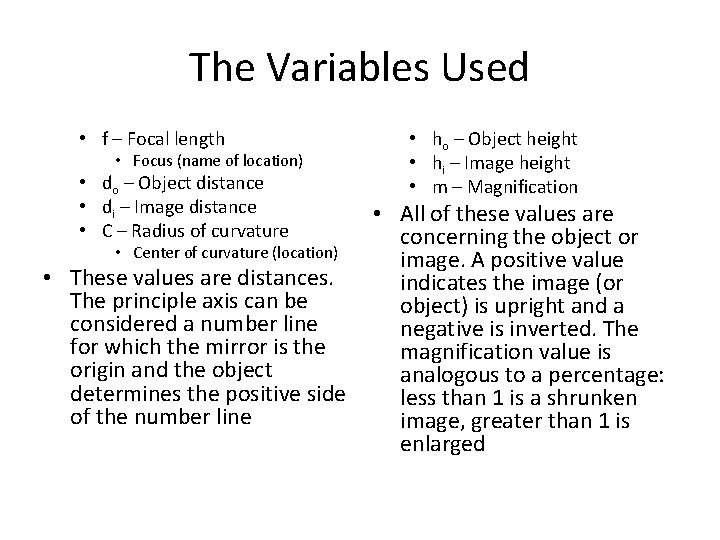
The Variables Used • f – Focal length • Focus (name of location) • do – Object distance • di – Image distance • C – Radius of curvature • Center of curvature (location) • These values are distances. The principle axis can be considered a number line for which the mirror is the origin and the object determines the positive side of the number line • ho – Object height • hi – Image height • m – Magnification • All of these values are concerning the object or image. A positive value indicates the image (or object) is upright and a negative is inverted. The magnification value is analogous to a percentage: less than 1 is a shrunken image, greater than 1 is enlarged
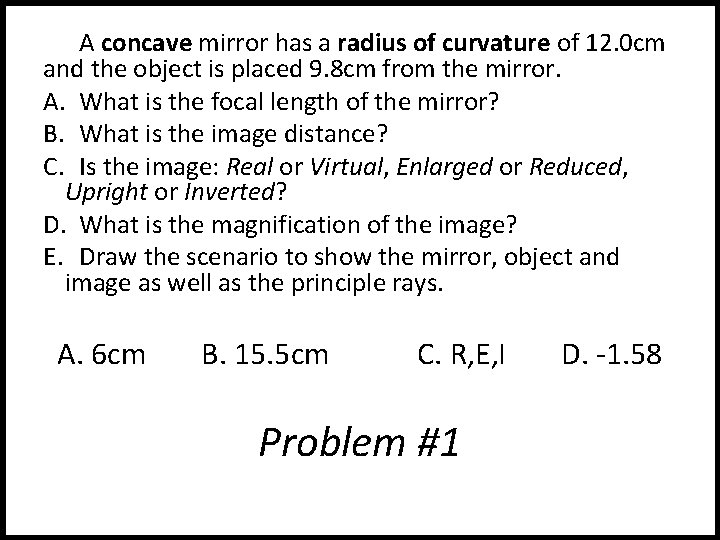
A concave mirror has a radius of curvature of 12. 0 cm and the object is placed 9. 8 cm from the mirror. A. What is the focal length of the mirror? B. What is the image distance? C. Is the image: Real or Virtual, Enlarged or Reduced, Upright or Inverted? D. What is the magnification of the image? E. Draw the scenario to show the mirror, object and image as well as the principle rays. A. 6 cm B. 15. 5 cm C. R, E, I Problem #1 D. -1. 58

A convex mirror has a focal length of 9. 0 cm and the object is placed 2 cm from the mirror. A. What is the radius of curvature of the mirror? B. What is the image distance? C. Is the image: Real or Virtual, Enlarged or Reduced, Upright or Inverted? D. What is the magnification of the image? E. Draw the scenario to show the mirror, object and image as well as the principle rays. A. -18 cm B. -1. 64 cm C. V, R, U Problem #2 D. 0. 82
- Slides: 5