
Mirror Equations Lesson 4 Objective Quantitatively determine the
Mirror Equations Lesson 4
Objective ¡ Quantitatively determine the relationship between the focal length and distance an object and its image are from the mirror.
Mirror or Lens Equations ¡ Equations that are used to indicate the location of an image or to find the image distance, di.

Eg) Concave mirror object image Mirror Equation:
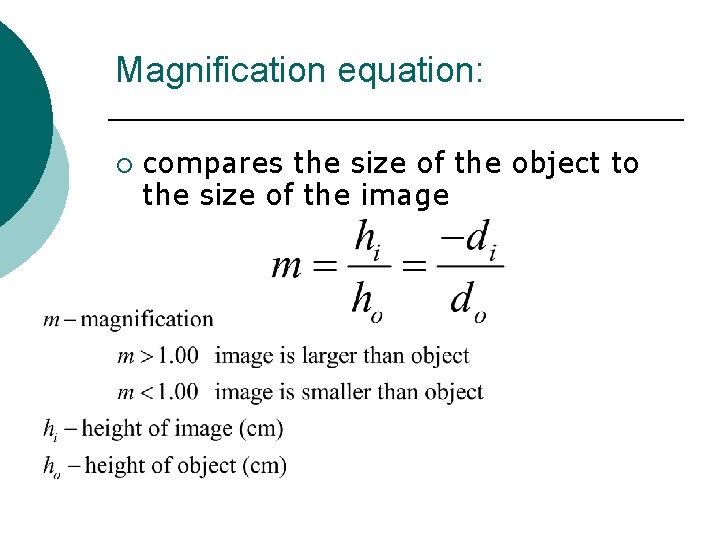
Magnification equation: ¡ compares the size of the object to the size of the image
Rules For Mirrors The object distance, do, is always positive ¡ If the image distance, di, is positive, then the image is real ¡ If the image distance, di, is negative, then the image is virtual ¡
Rules for Mirrors Upright objects or images have positive values for ho and hi ¡ Inverted objects or images have negative values for ho and hi ¡ Converging (Concave) mirrors have positive focal lengths while Diverging mirrors have negative focal lengths ¡
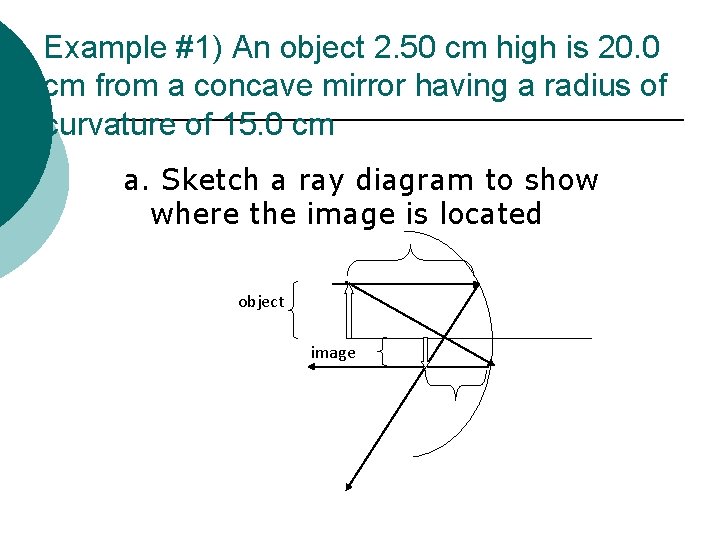
Example #1) An object 2. 50 cm high is 20. 0 cm from a concave mirror having a radius of curvature of 15. 0 cm a. Sketch a ray diagram to show where the image is located object image
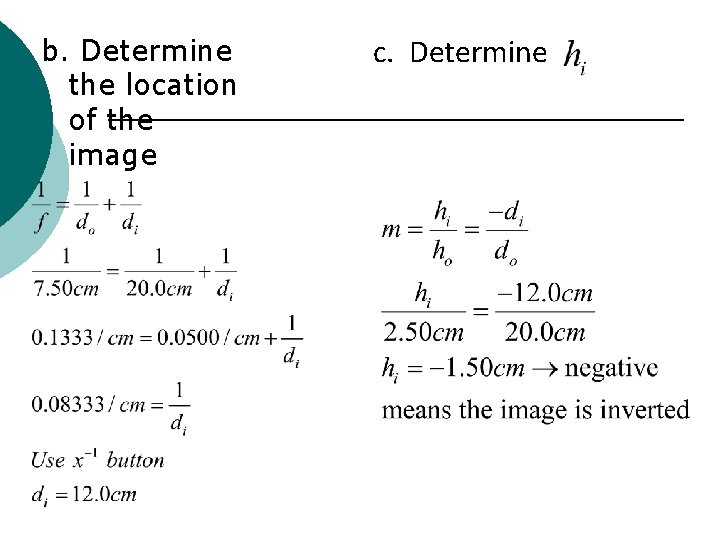
b. Determine the location of the image c. Determine
Convex Mirror A convex mirror reflects light from its outer surface and produces a virtual image ¡ Aka: Diverging mirror ¡
Example #2 An object is placed 30 cm from a diverging mirror, whose focal length is 10 cm. ¡ Determine: ¡ the image distance. ¡ if the image is real or virtual. ¡ if the image is erect or inverted. ¡ the image magnification. ¡
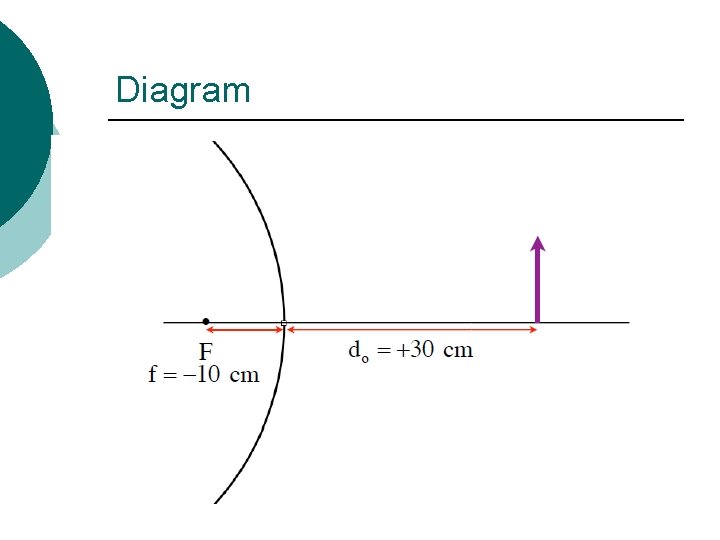
Diagram
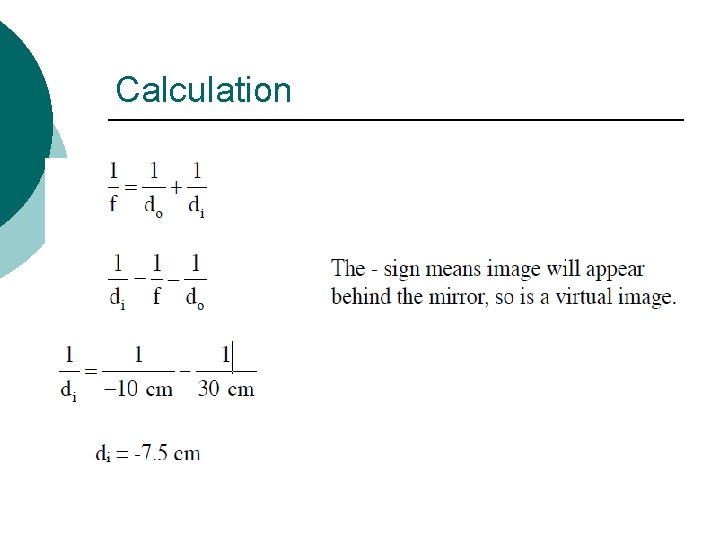
Calculation
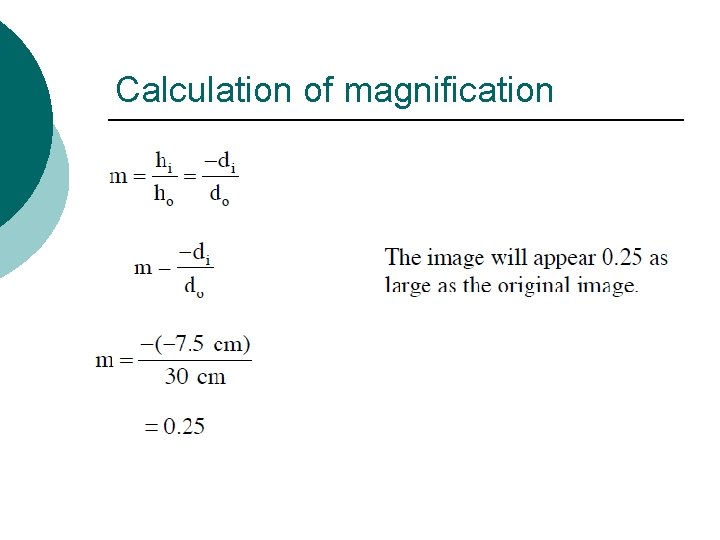
Calculation of magnification
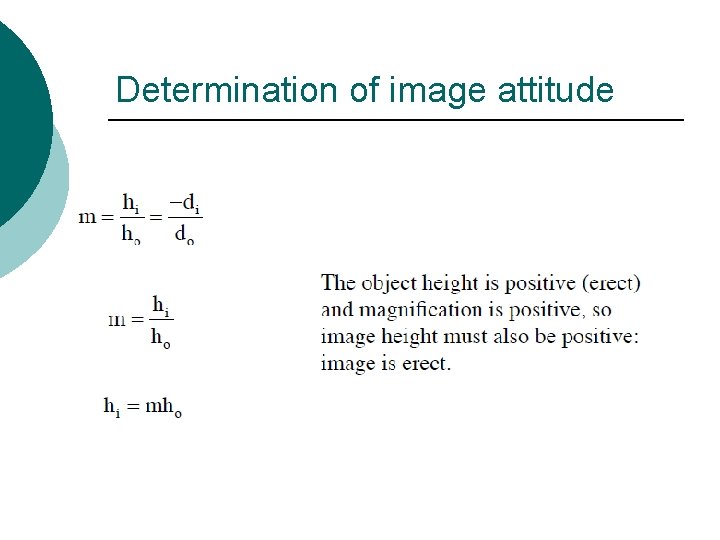
Determination of image attitude
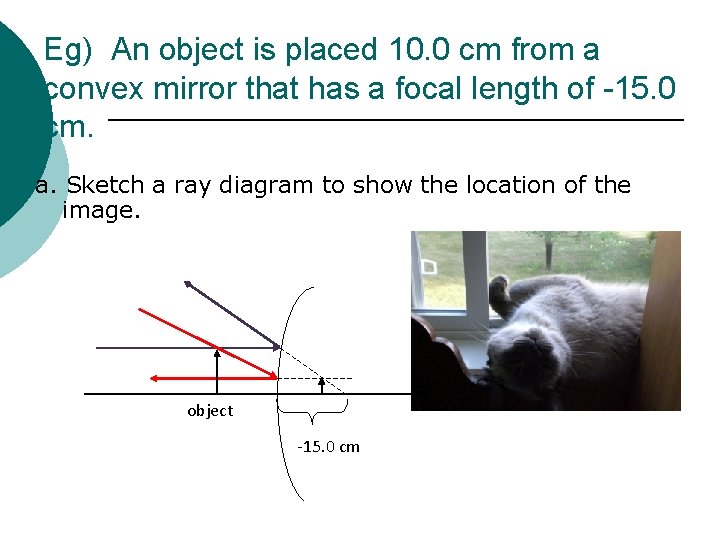
Eg) An object is placed 10. 0 cm from a convex mirror that has a focal length of -15. 0 cm. a. Sketch a ray diagram to show the location of the image. object -15. 0 cm
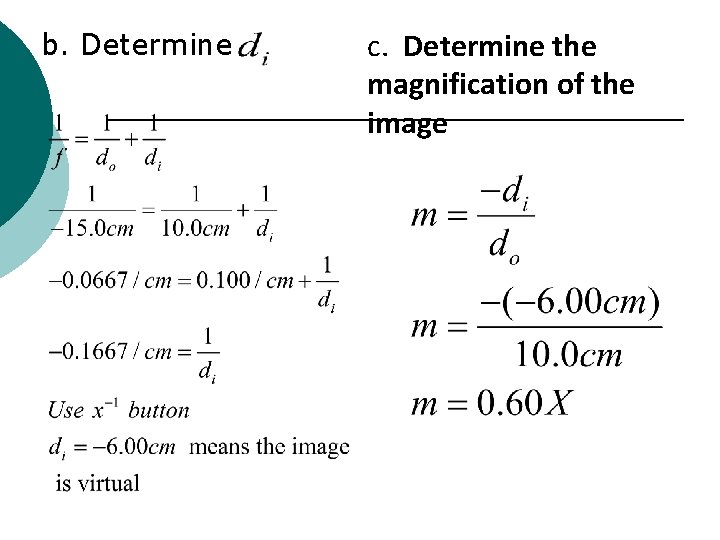
b. Determine c. Determine the magnification of the image
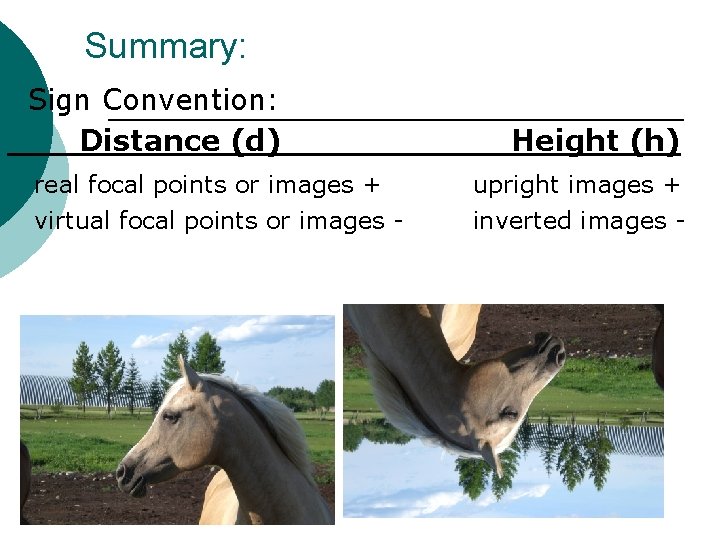
Summary: Sign Convention: Distance (d) real focal points or images + virtual focal points or images - Height (h) upright images + inverted images -
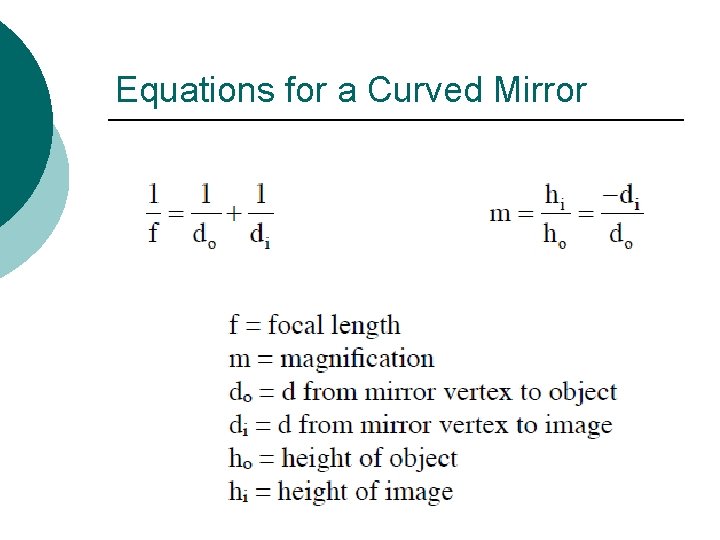
Equations for a Curved Mirror
- Slides: 19