
Mirror Equation Ray diagrams are useful for determining
- Slides: 10
Mirror Equation • Ray diagrams are useful for determining the general location and size of the image formed by a mirror. • However, the mirror equation and magnification equation give a more accurate mathematical description of the image
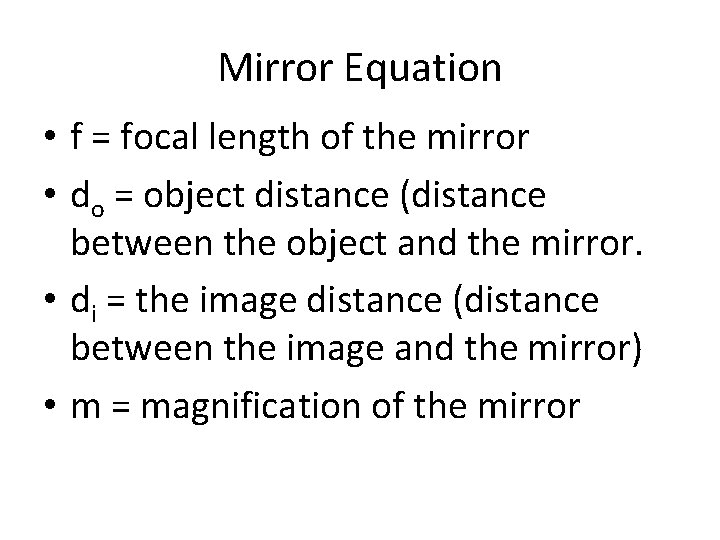
Mirror Equation • f = focal length of the mirror • do = object distance (distance between the object and the mirror. • di = the image distance (distance between the image and the mirror) • m = magnification of the mirror
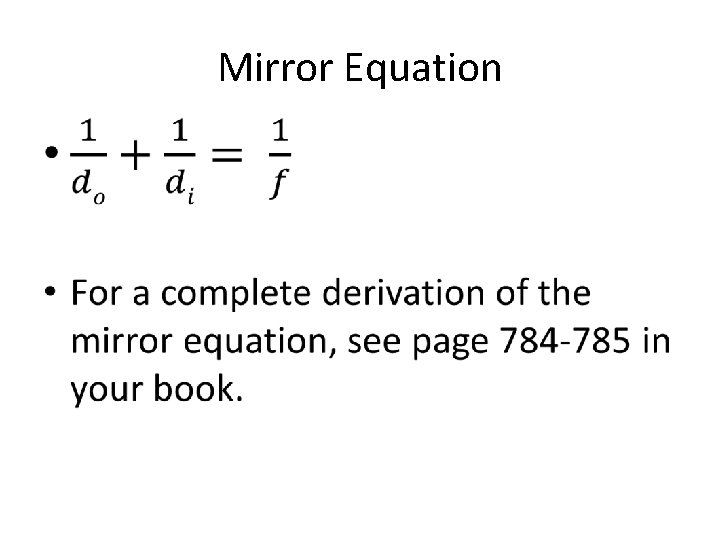
Mirror Equation •
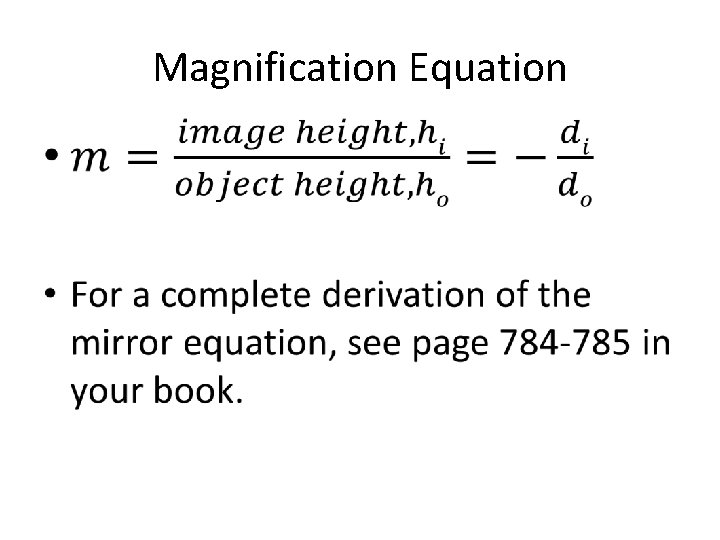
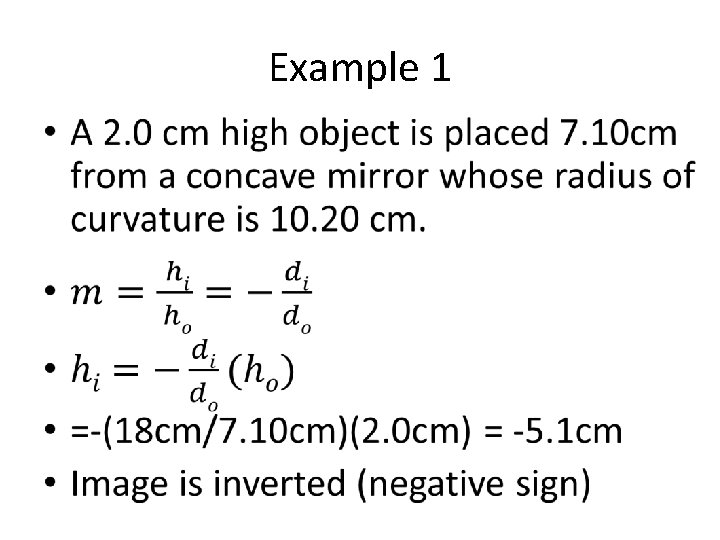
Magnification Equation •
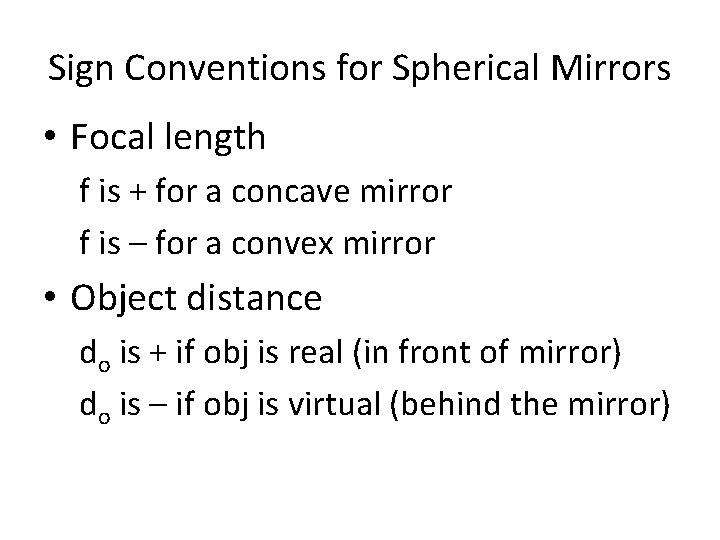
Sign Conventions for Spherical Mirrors • Focal length f is + for a concave mirror f is – for a convex mirror • Object distance do is + if obj is real (in front of mirror) do is – if obj is virtual (behind the mirror)
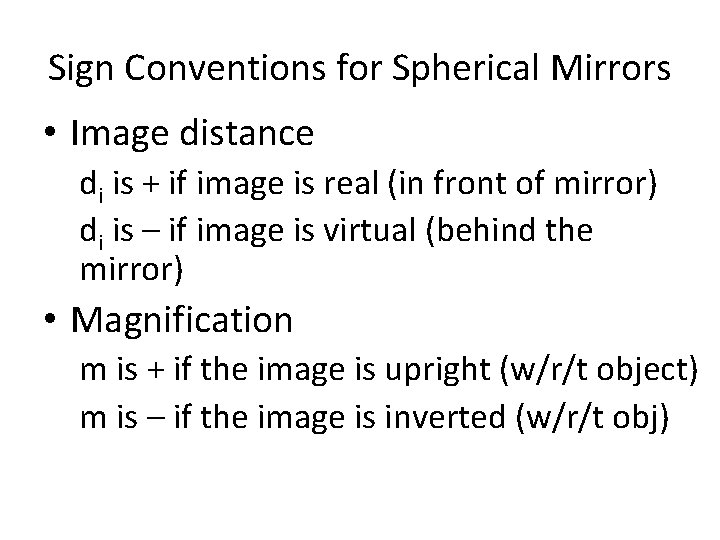
Sign Conventions for Spherical Mirrors • Image distance di is + if image is real (in front of mirror) di is – if image is virtual (behind the mirror) • Magnification m is + if the image is upright (w/r/t object) m is – if the image is inverted (w/r/t obj)
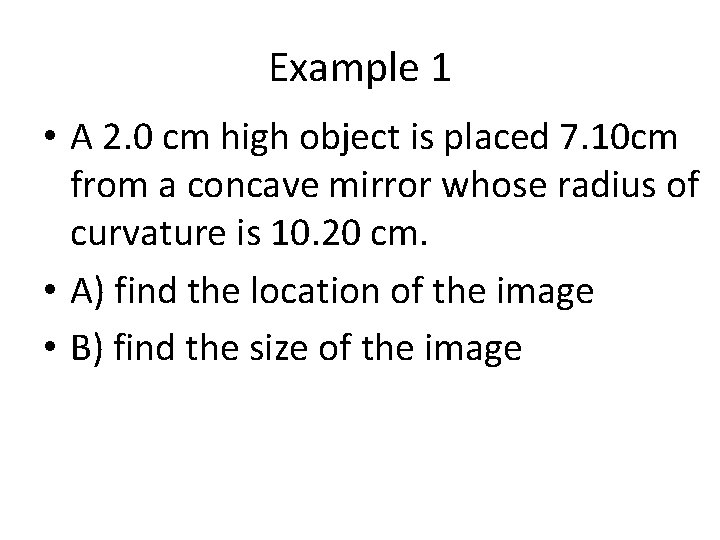
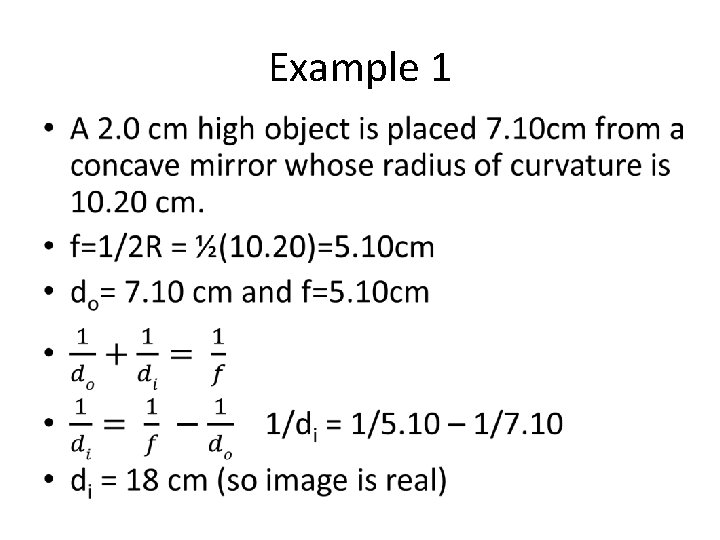
Example 1 • A 2. 0 cm high object is placed 7. 10 cm from a concave mirror whose radius of curvature is 10. 20 cm. • A) find the location of the image • B) find the size of the image
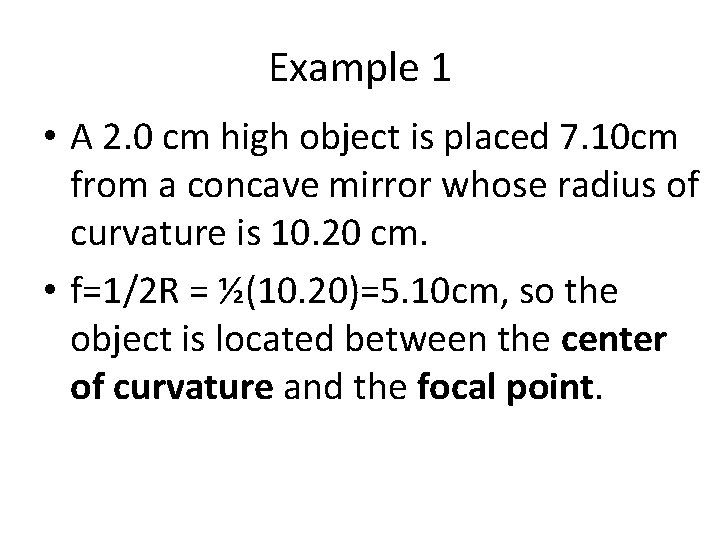
Example 1 • A 2. 0 cm high object is placed 7. 10 cm from a concave mirror whose radius of curvature is 10. 20 cm. • f=1/2 R = ½(10. 20)=5. 10 cm, so the object is located between the center of curvature and the focal point.
Example 1 •
Example 1 •