
Mirizzi Syndrome An Uncommon Gallstone Complication Dr Ma



- Slides: 36
Mirizzi Syndrome An Uncommon Gallstone Complication Dr. Ma Ka Wing Queen Elizabeth Hospital
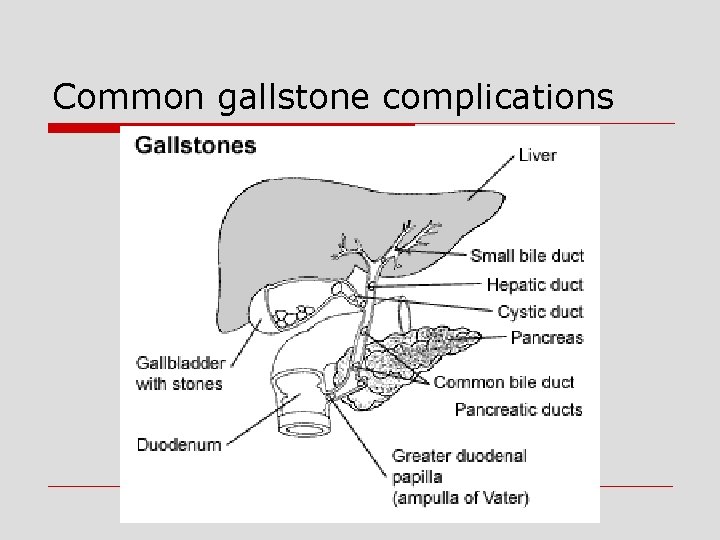
Common gallstone complications
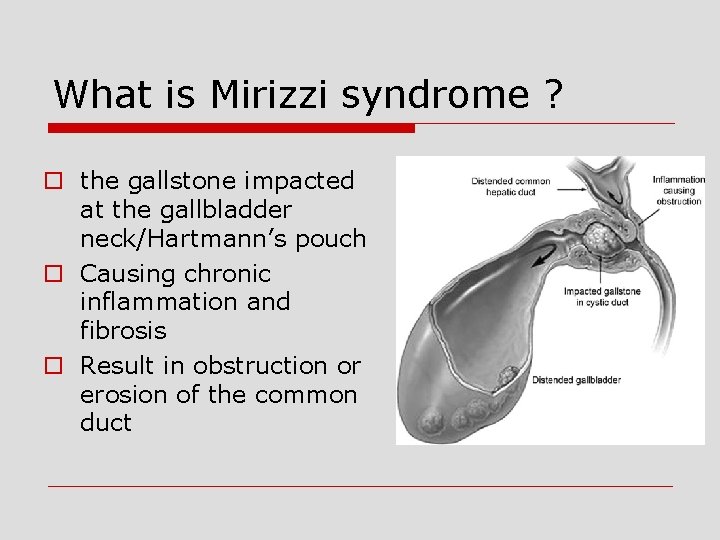
What is Mirizzi syndrome ? o the gallstone impacted at the gallbladder neck/Hartmann’s pouch o Causing chronic inflammation and fibrosis o Result in obstruction or erosion of the common duct
How uncommon is it? o Variable, from 0. 3% to 3% of patients having cholecystectomy o More common in South America
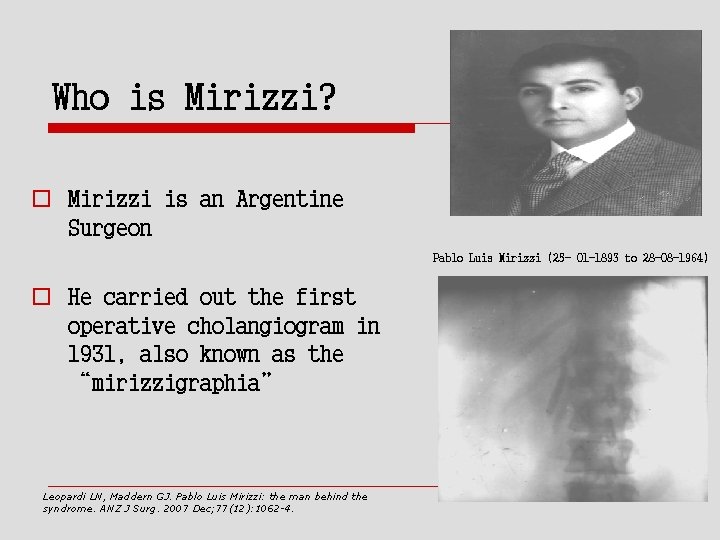
Who is Mirizzi? o Mirizzi is an Argentine Surgeon Pablo Luis Mirizzi (25 - 01 -1893 to 28 -08 -1964) o He carried out the first operative cholangiogram in 1931, also known as the “mirizzigraphia” Leopardi LN, Maddern GJ. Pablo Luis Mirizzi: the man behind the syndrome. ANZ J Surg. 2007 Dec; 77(12): 1062 -4.
Is there a classification for the disease? o Yes, many n Acute vs chronic n Cystic duct variant vs no variant n Obstruction due to stone vs obstruction due to inflammation Morelli A, Narducci F, Ciccone R. Can Mirizzi syndrome be classified into acute and chronic form? An endoscopic retrograde cholangiography (ERC) study. Endoscopy 1978; 10: 109– 12. Starling JR, Matallana RH. Benign mechanical obstruction of the common hepatic duct (Mirizzi syndrome). Surgery 1980; 88: 737– 40. Nagakawa T, Ohta T, Kayahara M, Ueno K, Konishi I, Sanada H. A new classification of Mirizzi syndrome from diagnostic and therapeutic viewpoints. Hepatogastroenterology 1997; 44: 63– 7.
How is it classified? o Mc. Sherry and Csendes classifications are most commonly used
Mc. Sherry Classification o Mirizzi syndrome classified into two types based on the ERCP features n Type I: CHD compression without fistula n Type II: presence of cholecystocholedochal fistula Mc. Sherry CK, Ferstenberg H, Virship M. The Mirizzi syndrome: suggested classification and surgical therapy. Surg. Gastroenterol. 1982; 1: 219– 25.
Csendes Classification o Mirizzi syndrome classified into four types n type I: extrinsic compression of common duct due to an impacted stone at gallbladder neck or cystic duct n Type II: cholecystobiliary (either cholecystohepatic or cholecystocholedochal) fistula with the defect less than 1/3 of the duct circumference n Type III: fistula formation, wall defect up to 2/3 n Type IV: fistula formation, complete destruction of the duct wall Csendes A, Diaz JC, Burdiles P, Maluenda F, Nava O. Mirizzi syndrome and cholecystobiliary fistula: a unifying classification. Br. J. Surg. 1989; 76: 1139– 43.
How to diagnose o Diagnosis of Mirizzi syndrome is difficult o biochemical profile not specific n elevated bilirubin n Elevated white cell count n Deranged liver function o Further investigations are needed
Imaging o USG n As an baseline for jaundice patient n Should see o A large gallstone o contracted or indiscernible gallbladder o Dilated upper CBD +/- IHDs n These findings are not specific for Mirizzi syndrome
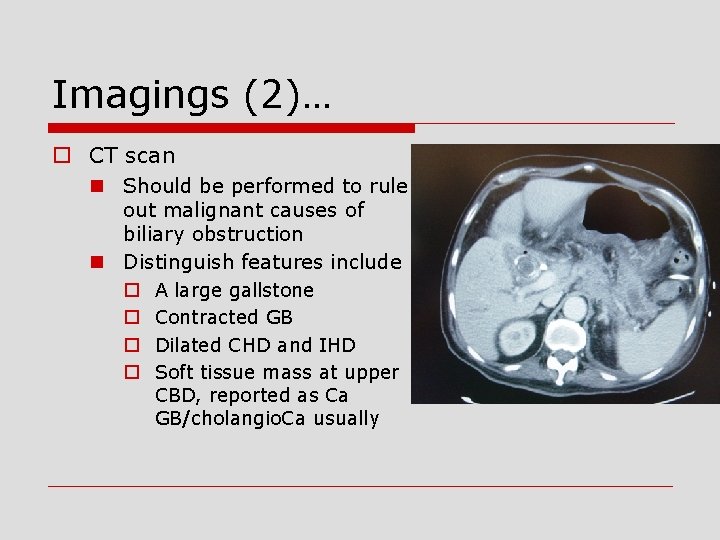
Imagings (2)… o CT scan n Should be performed to rule out malignant causes of biliary obstruction n Distinguish features include o A large gallstone o Contracted GB o Dilated CHD and IHD o Soft tissue mass at upper CBD, reported as Ca GB/cholangio. Ca usually
ERCP o Remains the most important investigation o serves both diagnostic and therapeutic purposes. .
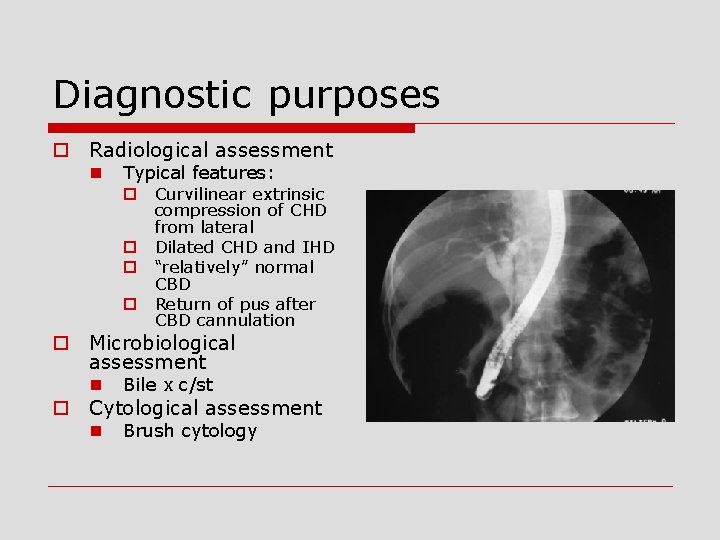
Diagnostic purposes o Radiological assessment n Typical features: o Curvilinear extrinsic compression of CHD from lateral o Dilated CHD and IHD o “relatively” normal CBD o Return of pus after CBD cannulation o Microbiological assessment n Bile x c/st n Brush cytology o Cytological assessment
Therapeutic purpose o Insertion of biliary stent to relieve biliary obstruction o Bring down bilirubin before operation o Remove the stone with special instruments
Despite of these… o Pre-operative diagnostic rate remains low o The quoted rate in the literatures were 862. 5% o actually not very important not recognizing it before OT but it is disastrous if not recognized intra-op o Fail to recognize this condition may lead to significant morbidity and mortality Baer HU, Matthews JB, Schweizer WP, Gertsch P, Blumgart LH. Management of the mirizzi syndrome and the surgical implication of the cholecystocholedochal fistula. Br. J. Surg. 1990; 77: 743 -5 Lai EC, Lau WY. Mirizzi syndrome: history, present and future development. ANZ J Surg. 2006 Apr; 76(4): 251 -7.
Management options o Surgical n Open surgery n Laparoscopic surgery o Non-surgical n Endoscopic n Interventional radiology o Percutaneous transhepatic stone removal n Extracorporeal shock-wave lithotripsy n Oral dissolution therapy
Open surgery o Remains the gold standard of treatment with good short term and long term result. Lai EC, Lau WY. Mirizzi syndrome: history, p future development. ANZ J Surg. 2006 Apr; 7
How do we do it? o o o Kocher’s incision Frozen section should be sent if malignancy is suspected Mobilize the gallbladder using the fundus first approach Transect gallbladder at around Hartmann’s pouch region (partial cholecystectomy) Remove the stone, if there is a gush of bile, this suggest presence of cholecystobiliary fistula Then you have to decide whether to. . n Repair or reconstruct according to extent of destruction n ECBD or not depends on suspicion of residual stone in common duct n T-tube or not depends on likelihood of biliary stricture and bile leaks from repair site
Methods of reconstruction
Controversies in management o Treatment approach n Which repair method is the best? Direct repair or HJ for all the case o Placement of t-tube n When and where to insert t-tube? n Proximal, distal or right into the fistula? o No randomized control trial to answer these questions
Laparoscopic surgery o Technically feasible but more risky o Most series involved small case number and the successful cases were limited to mild disease (type I or II) o Higher complication rate, re-operation rate and conversion rate (near 100% conversion for type II disease) Antoniou SA, Antoniou GA, Makridis C. Laparoscopic treatment of Mirizzi syndrome: a systematic review. Surg Endosc. 2010 Jan; 24 (1): 33 -9. Epub 2009 May 23.
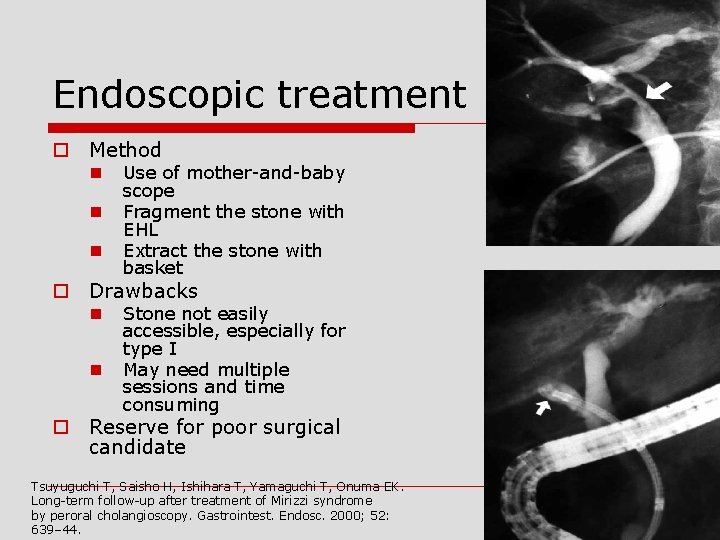
Endoscopic treatment o Method n n n Use of mother-and-baby scope Fragment the stone with EHL Extract the stone with basket o Drawbacks n n Stone not easily accessible, especially for type I May need multiple sessions and time consuming o Reserve for poor surgical candidate Tsuyuguchi T, Saisho H, Ishihara T, Yamaguchi T, Onuma EK. Long-term follow-up after treatment of Mirizzi syndrome by peroral cholangioscopy. Gastrointest. Endosc. 2000; 52: 639– 44.
Other treatment options o Percutaneous transhepatic stone removal n Reserved for patient with high operative risk o Oral dissolution therapy n May not work for large stone and obstructed cystic duct n Cholesterol stones are not as common as compared to the western patients
To conclude o Mirizzi syndrome is uncommon but important o ERCP and CT are the two important investigations o treatment should be individualized o open surgery with adequate treatment often provide satisfactory outcome
o Thank you
0. 3% to 3%, why so variable? o depends on accessibility of medical services, i. e. USG, lap chole… o Lifestyle o BMI….
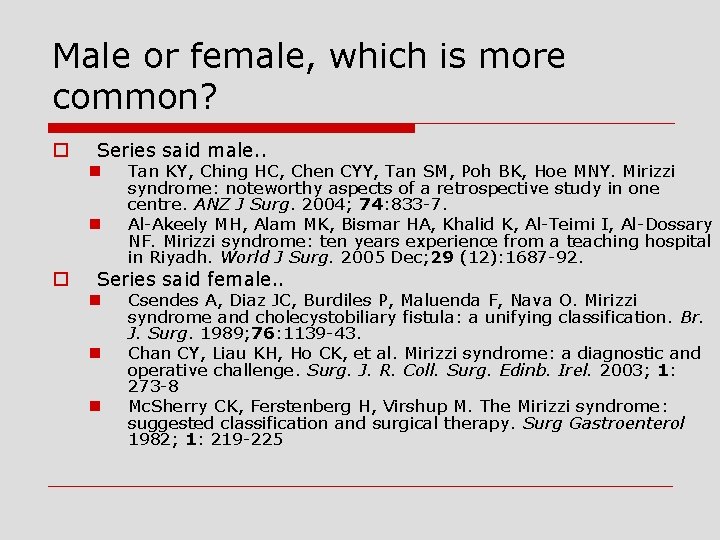
Male or female, which is more common? o Series said male. . n n o Tan KY, Ching HC, Chen CYY, Tan SM, Poh BK, Hoe MNY. Mirizzi syndrome: noteworthy aspects of a retrospective study in one centre. ANZ J Surg. 2004; 74: 833 -7. Al-Akeely MH, Alam MK, Bismar HA, Khalid K, Al-Teimi I, Al-Dossary NF. Mirizzi syndrome: ten years experience from a teaching hospital in Riyadh. World J Surg. 2005 Dec; 29 (12): 1687 -92. Series said female. . n n n Csendes A, Diaz JC, Burdiles P, Maluenda F, Nava O. Mirizzi syndrome and cholecystobiliary fistula: a unifying classification. Br. J. Surg. 1989; 76: 1139 -43. Chan CY, Liau KH, Ho CK, et al. Mirizzi syndrome: a diagnostic and operative challenge. Surg. J. R. Coll. Surg. Edinb. Irel. 2003; 1: 273 -8 Mc. Sherry CK, Ferstenberg H, Virshup M. The Mirizzi syndrome: suggested classification and surgical therapy. Surg Gastroenterol 1982; 1: 219 -225
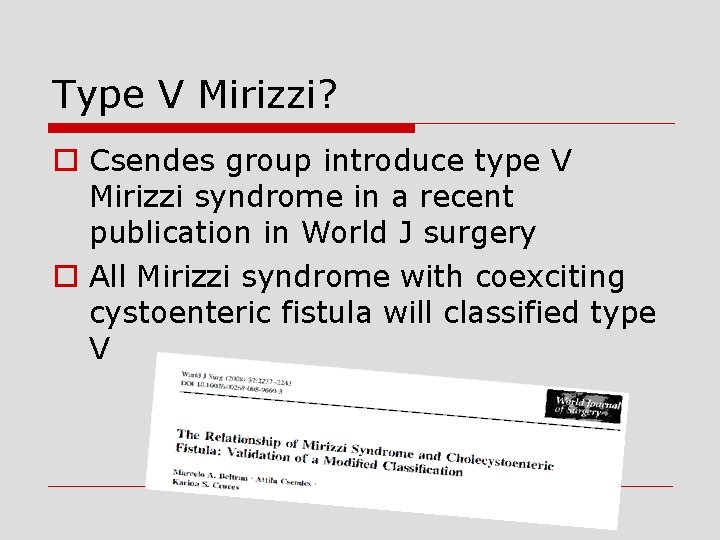
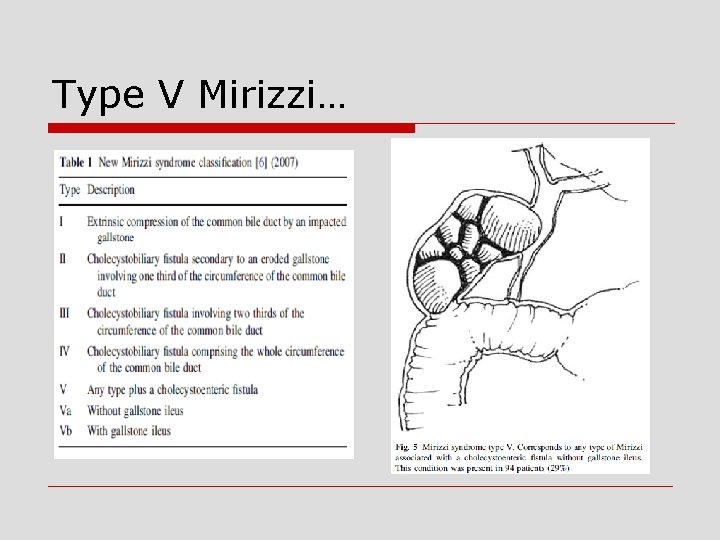
Type V Mirizzi? o Csendes group introduce type V Mirizzi syndrome in a recent publication in World J surgery o All Mirizzi syndrome with coexciting cystoenteric fistula will classified type V
Type V Mirizzi…
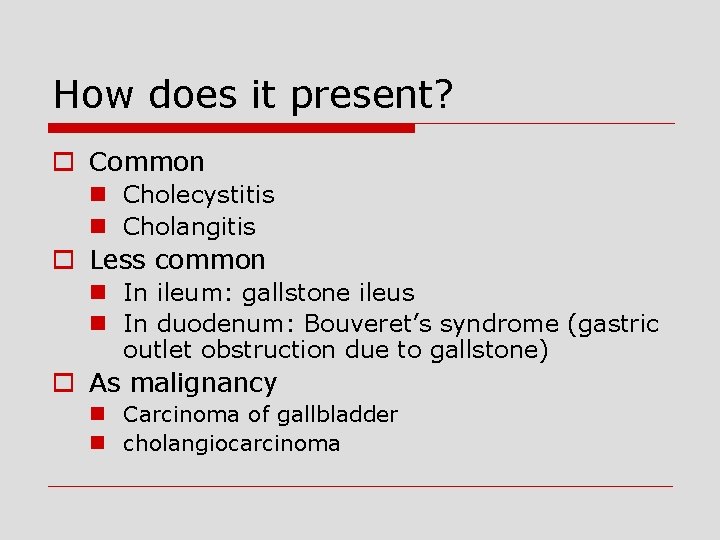
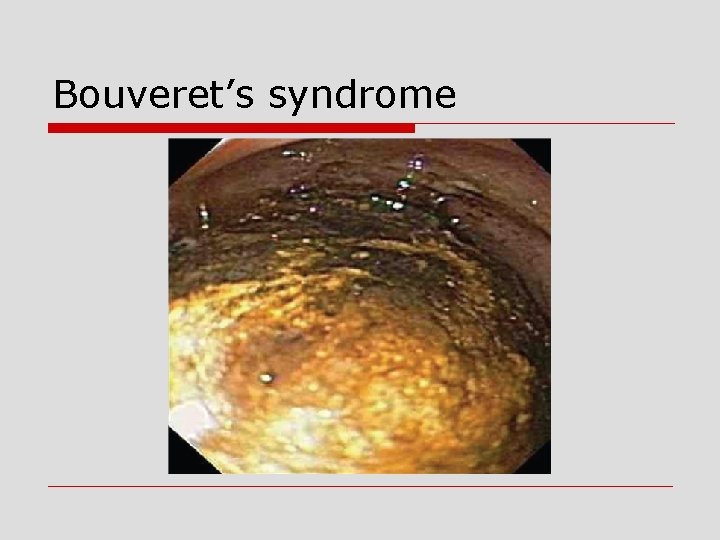
How does it present? o Common n Cholecystitis n Cholangitis o Less common n In ileum: gallstone ileus n In duodenum: Bouveret’s syndrome (gastric outlet obstruction due to gallstone) o As malignancy n Carcinoma of gallbladder n cholangiocarcinoma
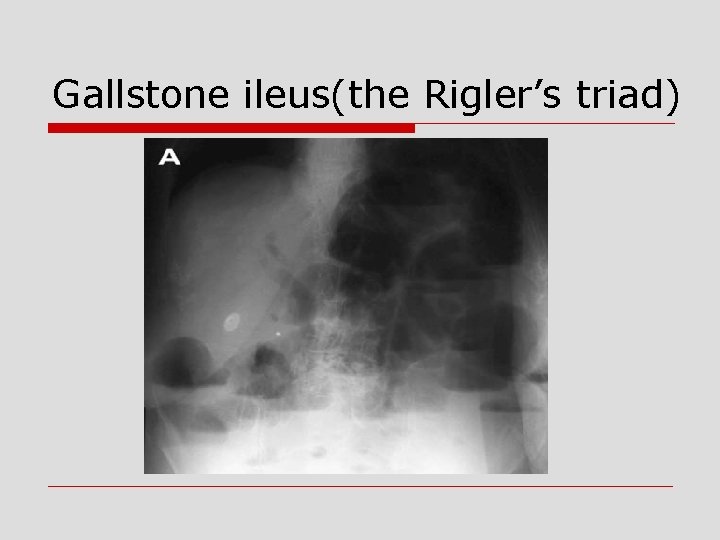
Gallstone ileus(the Rigler’s triad)
Bouveret’s syndrome
Bouveret’s syndrome