
MIRACLES IN THE BIBLE 1 What is a
MIRACLES IN THE BIBLE 1
What is a miracle? In the Bible, there are many accounts of things that might be considered to be miracles. They can be found on both the Old Testament and the New Testament. The stories of miracles of Jesus, such as turning water into wine and walking on water, are most familiar, but the Bible includes stories of miracles carried out by others as well. The Oxford English Dictionary defines a miracle as 'A surprising and welcome event that is not explicable by natural or scientific laws and is therefore considered to be the work of a divine agency'. According to this definition, what are three key elements which an event must have if it is to be called a miracle? 2
What is a miracle? Theologians sometimes classify the miracles in the Bible into categories, such as: • Healing miracles • Miracles of provision (in which people receive things that they need) • Miracles over nature On the next slides there are summaries of how the Bible tells the stories of nine wellknown miracles. Which of them you think belong to each of the categories? (it’s OK if you think that some of them don’t match to any of the categories, or if you think that some of them match up to more than one) 3
What is a miracle? The burning bush – God speaks to Moses from a bush which is on fire but which is not being destroyed by the fire, and tells him to go and bring the Israelites out of slavery in Egypt. The parting of the Red Sea – God sends a strong east wind that blows all night and divides the waters of the Red Sea, allowing Moses and the Israelites to escape from the pursuing Egyptian army, which is then swept away when the waters return. Daniel in the lions’ den – Daniel was thrown into a den of lions on the orders of the king of Persia, but the lions did not harm him. Water into wine – when the wine at a wedding party runs out, Jesus turns six large stone jars of water into wine. 4
What is a miracle? Blind Bartimaeus – Jesus restores the sight of a blind beggar at the gates of the city of Jericho. The calming of the storm – the disciples are terrified by a storm while they are out in their fishing boat, but when Jesus ordered the storm to calm down, it did so. The feeding of the 5, 000 – when a great crowd of people were without food, Jesus took five loaves of bread and two fish and made it sufficient to feed them all, with plenty left over. The resurrection – on the third day after he died, visitors to his tomb find that it is empty, because he has been restored to life, never to die again. 5 The lame man – a lame man who sits and begs by the gate in Jerusalem is healed in the name of Jesus by the disciples Peter and John.
What is a miracle? In which of the nine stories about miracles: would the people who saw it have been most surprised by what happened? was the greatest benefit brought by the miracle? The burning bush The parting of the Red Sea Daniel in the lions’ den Water into wine Blind Bartimaeus The calming of the storm The feeding of the 5, 000 The resurrection was the timing of when the miracle happened important? 6 The lame man
Miracles in the Gospels In the Bible, there are four accounts of the life of Jesus, which are known as the Gospels. They are named after their authors: Matthew, Mark, Luke and John. All four Gospels recount stories in which miracles are carried out by Jesus. There is a range of things that Christians might draw out of the miracle stories to help them to better understand who Jesus was, for example: • That compassion is important, because Jesus is often shown performing miracles out of compassion for people who were suffering or unwell. • That Jesus refused to perform a miracle just to show powerful he was, and he never asked for anything in return. • That the miracles prove that Jesus’ teachings were true and that Jesus was who he claimed to be, the Son of God. 7
The Feeding of the 5, 000 All four Gospels attribute to Jesus the feeding of enormous crowds of people from food that would barely have been enough for him and the twelve disciples alone. The best known example is the feeding of the 5, 000. After Jesus heard about John, he crossed Lake Galilee to go to some place where he could be alone. But the crowds found out and followed him on foot from the towns. When Jesus got out of the boat, he saw the large crowd. He felt sorry for them and healed everyone who was sick. That evening the disciples came to Jesus and said, “This place is like a desert, and it is already late. Let the crowds leave, so they can go to the villages and buy some food. ” Jesus replied, “They don’t have to leave. Why don’t you give them something to eat? ” 8 John the Baptist was Jesus’ cousin, who was executed on the orders of the local ruler Herod.
The Feeding of the 5, 000 But they said, “We have only five small loaves of bread and two fish. ” Jesus asked his disciples to bring the food to him, and he told the crowd to sit down on the grass. Jesus took the five loaves and the two fish. He looked up toward heaven and blessed the food. Then he broke the bread and handed it to his disciples, and they gave it to the people. After everyone had eaten all they wanted, Jesus' disciples picked up twelve large baskets of leftovers. There were about five thousand men who ate, not counting the women and children. Matthew chapter 14 verses 13 -21 (CEV) 9 The people who were with Jesus that day might have been reminded of stories from the Old Testament, in which God provided food for the twelve tribes of the Israelites while they were in the desert.
The Feeding of the 5, 000 What parts of the story of the feeding of the 5, 000 could be described as being a miracle? What might this miracle show a Christian about who Jesus was and what he was like? Which parts of the passage might have reminded the people of the Old Testament stories in which God provided food for the Israelites while they were in the desert? 10
The Feeding of the 5, 000 Matthew’s story of Jesus focuses on some parts of his life more than on others. For example, he misses out all of Jesus’ childhood but wrote a lot about the last week of his life. In a similar way, some miracles he mentions only briefly, but for others he tells the whole story in detail. The story of the feeding of the 5, 000 is one of the miracles that he chose to write about in more depth. 11
The Feeding of the 5, 000 Choose one of the ideas below, or write down one of your own, and argue that it is the most important reason why Matthew included the story of the feeding of the 5, 000 in his Gospel. Try to use examples from what Matthew wrote to support your answer. • He wanted to prove to his readers that Jesus was the Son of God • He wanted to teach his readers a lesson about the importance of feeding the poor • He wanted to remind his readers, many of whom came from a Jewish background, of some stories in the Old Testament when God provided for the Israelites, and to associate Jesus with them • A reason of your own Are there any questions which you would like to ask about the feeding of the 5, 000? How would each of your questions help you to understand the story better? 12
Healing miracles Most of the miracles carried out by Jesus in the Gospels are healing miracles: Jesus heals people of blindness, skin diseases and paralysis, and even raises someone from the dead. Passages in the Gospels indicate that Jesus carried out a great number of healings. From there, Jesus went along Lake Galilee. Then he climbed a hill and sat down. Large crowds came and brought many people who were crippled or blind or lame or unable to talk. They placed them, and many others, in front of Jesus, and he healed them all. Everyone was amazed at what they saw and heard. People who had never spoken could now speak. The lame were healed, the crippled could walk, and the blind were able to see. Everyone was praising the God of Israel. Matthew chapter 15 verses 29 -31 (CEV) 13
Healing miracles Where does this passage say that Jesus carried out these healings? Which types of illness does it mention? What response does the healing get from the crowd? From there, Jesus went along Lake Galilee. Then he climbed a hill and sat down. Large crowds came and brought many people who were crippled or blind or lame or unable to talk. They placed them, and many others, in front of Jesus, and he healed them all. Everyone was amazed at what they saw and heard. People who had never spoken could now speak. The lame were healed, the crippled could walk, and the blind were able to see. Everyone was praising the God of Israel. Matthew chapter 15 verses 29 -31 (CEV) 14
Healing miracles Sometimes, the Gospels go into more detail about a specific person who was healed by Jesus. This example comes from Luke’s Gospel. When Jesus was coming close to Jericho, a blind man sat begging beside the road. The man heard the crowd walking by and asked what was happening. Some people told him that Jesus from Nazareth was passing by. So the blind man shouted, “Jesus, Son of David have pity on me!” The people who were going along with Jesus told the man to be quiet. But he shouted even louder, “Son of David, have pity on me!” Jesus stopped and told some people to bring the blind man over to him. When the blind man was getting near, Jesus asked, “What do you want me to do for you? ” “Lord, I want to see!” he answered. 15
Healing miracles Jesus replied, “Look and you will see! Your eyes are healed because of your faith. ” Right away the man could see, and he went with Jesus and started thanking God. When the crowds saw what happened, they praised God. Luke chapter 18 verses 35 -43 (CEV) In the time Jesus lived in, many types of illness or disability would mean that the sufferer was shunned and excluded by others. Where can this be seen in the Bible passage. How does the miracle change the attitude of the crowd? How do you think that the blind man’s life might have been different once he could see? What does Jesus say that the key factor was in why the man’s blindness was healed? 16
How might Christians today relate to the miracles in the Bible? The Gospels tell us that people in Jesus’ time were amazed by his miracles, and that in at least some cases, including that of the blind man healed at Jericho, people became followers of Jesus because they had experienced or witnessed a miracle. Amazement and greater faith in God are still responses to the Bible’s miracles among Christians today, who are likely to believe that Jesus performed the miracles described in the Bible. Christianity teaches that the greatest miracle of them all was the resurrection of Jesus by God himself, which is one of the most fundamental beliefs in Christianity teaches that God is constantly active in the world, and Christians sometimes use the word ‘providence’ to describe God’s ongoing care for the universe in general and humanity in particular. 17
How might Christians today relate to the miracles in the Bible? Many Christians believe that God still makes miraculous events happen as part of his providence, though most would probably also say that while miracles are possible, they can’t be expected and that having great faith does not mean that a miracle will necessarily happen. Believing that you have experienced or witnessed a miracle can be an extremely powerful religious experience which might prompt responses such as wonder, praise for God and a feeling of greater closeness to God. Christians can look at the stories of the miracles in the Bible in different ways. If they look at a miracle literally, believing the story as it is written, then they might understand it to show God’s power over sickness, wrongdoing, nature and death. They might also pick up metaphorical meanings from the miracles, and find that the stories give them insight into their own lives. 18
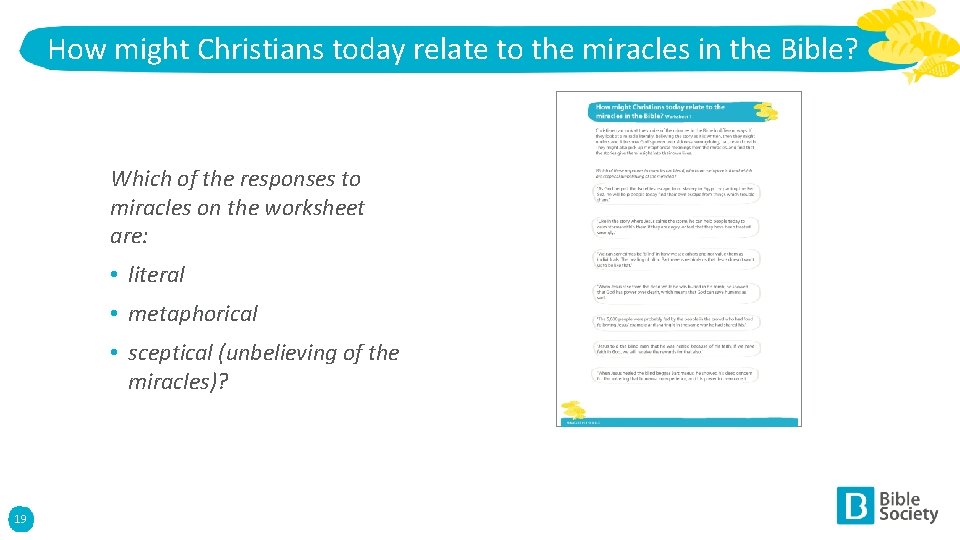
How might Christians today relate to the miracles in the Bible? Which of the responses to miracles on the worksheet are: • literal • metaphorical • sceptical (unbelieving of the miracles)? 19
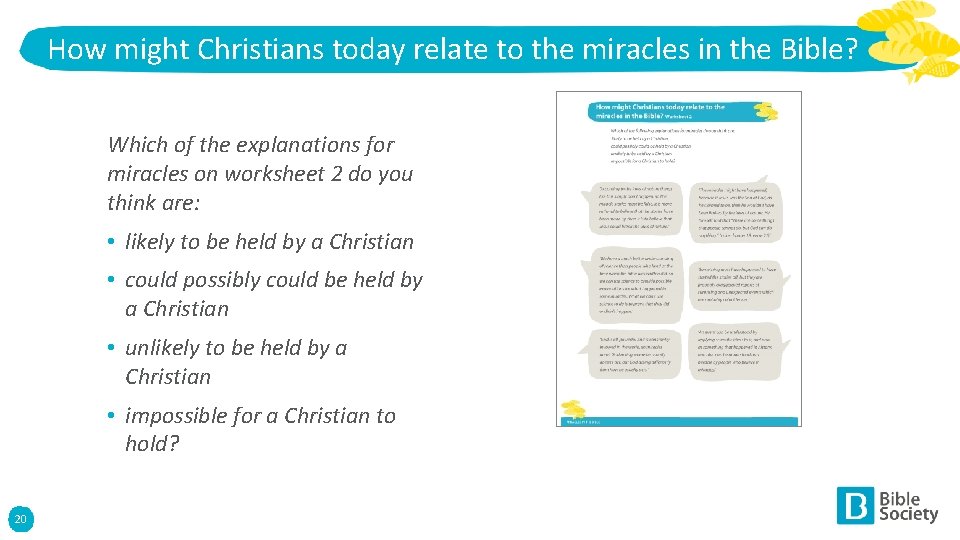
How might Christians today relate to the miracles in the Bible? Which of the explanations for miracles on worksheet 2 do you think are: • likely to be held by a Christian • could possibly could be held by a Christian • unlikely to be held by a Christian • impossible for a Christian to hold? 20
How might Christians today relate to the miracles in the Bible? Do you think that is it easier to accept some types of miracles than others? Try to use three categories of miracles on p. 1, healing miracles, miracles of provision (in which people receive things that they need) and miracles over nature, or examples from the Bible passages to help you to give your answer. 'Christianity teaches that when Jesus was resurrected, he proved that he had power over death and could bring salvation to humans. Therefore, the miracle of the resurrection should matter to Christians, but the other miracles are not important. ' How far do you agree? 21
How might Christians today relate to the miracles in the Bible? At the start of this resource, we used a definition of ‘miracle’ from a dictionary, which said that a miracle is 'A surprising and welcome event that is not explicable by natural or scientific laws and is therefore considered to be the work of a divine agency. ' Use this space to write three new definitions of the word ‘miracle • A definition as it might be given by a Christian • A definition as it might be given be someone who doesn’t believe in miracles. • What you think the best definition of ‘miracle’ is. 22
Contemporary English Version, Second Edition (CEV®) © 2006 American Bible Society. All rights reserved. Anglicisations © British and Foreign Bible Society 1997. The copyright for the derivative work of Anglicisation pertains only to the text within the Contemporary English Version (CEV) that British and Foreign Bible Society adapted for British literary usage, consistent with Section 103(b) of the United States Copyright Act, 17 U. S. C. § 103(b). Bible text from the Contemporary English Version 2 nd Edition (CEV®) is not to be reproduced in copies or otherwise by any means except as permitted in writing by American Bible Society, 101 North Independence Mall East, Floor 8, Philadelphia, PA 19106 -2155 (americanbible. org). 23
- Slides: 23