
MIRA Project Detector of Solar flare effects on
- Slides: 15
MIRA Project Detector of Solar flare effects on geomagnetism and ionosphere based on GNSS and ionosonde data J. J. Curto(1), J. M. Juan(2), D. Altadill(1), C. Timoté(2), E. Blanch(1), A. Segarra(1) Observatori de l’Ebre (CSIC – URL), Roquetes, Spain (2) Research Group of Astronomy and Geomatics (g. AGE) Universitat Politècnica de Catalunya (UPC), Barcelona, Spain 1 2019/11/18 ESWW 16, Session 3; Liège, Brussels
MIRA Project Outline • Detector of solar flare effects on geomagnetism based on GNSS data Ø Geomagnetic SFE Ø GNSS-SF detector as SFE tracker • Detector of solar flare effects on ionosphere based on ionosonde data Ø Solar flare effects on ionosonde (SNR) Ø First steps towards an indicator of energetic solar emissions that can produce Sudden Ionospheric Disturbances and radio fade-outs 2 2019/11/18 ESWW 16, Session 3; Liège, Brussels
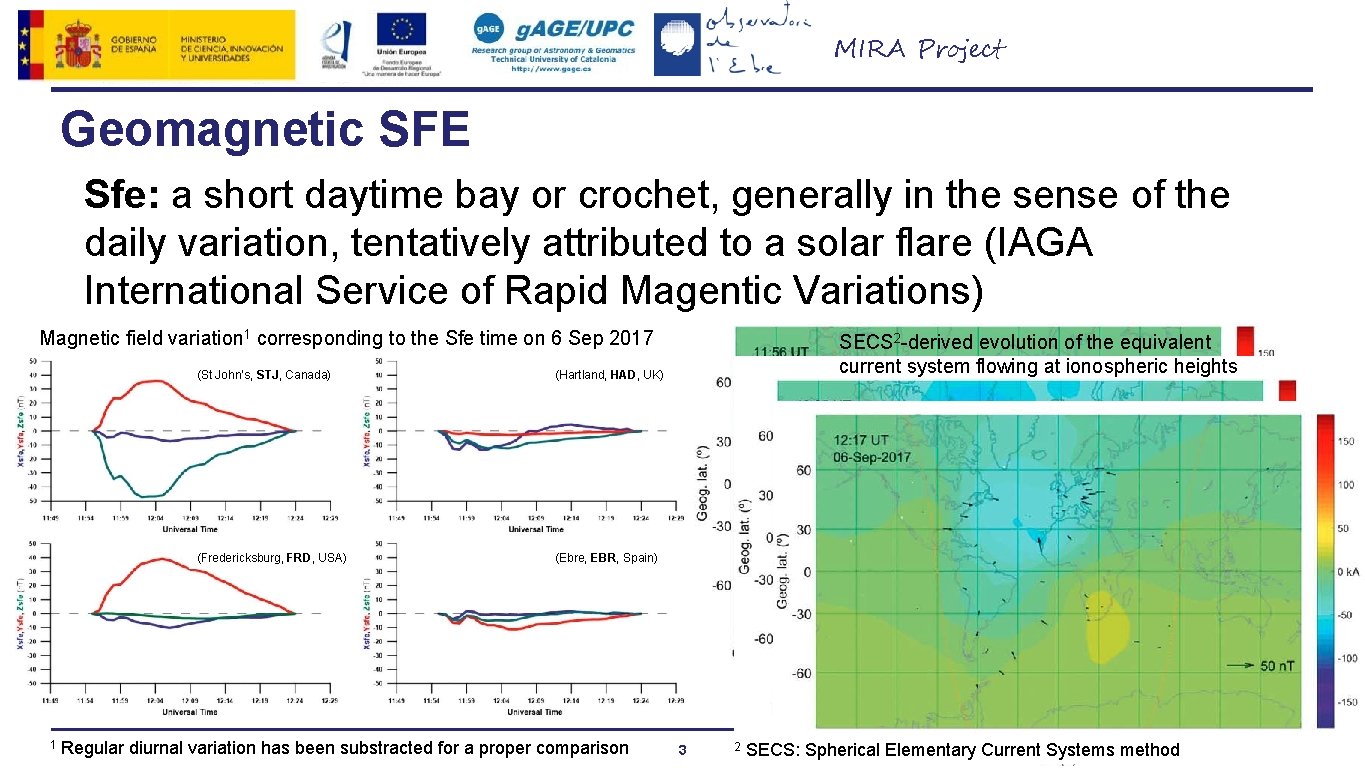
MIRA Project Geomagnetic SFE Sfe: a short daytime bay or crochet, generally in the sense of the daily variation, tentatively attributed to a solar flare (IAGA International Service of Rapid Magentic Variations) Magnetic field variation 1 corresponding to the Sfe time on 6 Sep 2017 1 (St John’s, STJ, Canada) (Hartland, HAD, UK) (Fredericksburg, FRD, USA) (Ebre, EBR, Spain) Regular diurnal variation has been substracted for a proper comparison SECS 2 -derived evolution of the equivalent current system flowing at ionospheric heights 3 2 2019/11/18 ESWW 16, method Session 3; Liège, Brussels SECS: Spherical Elementary Current Systems
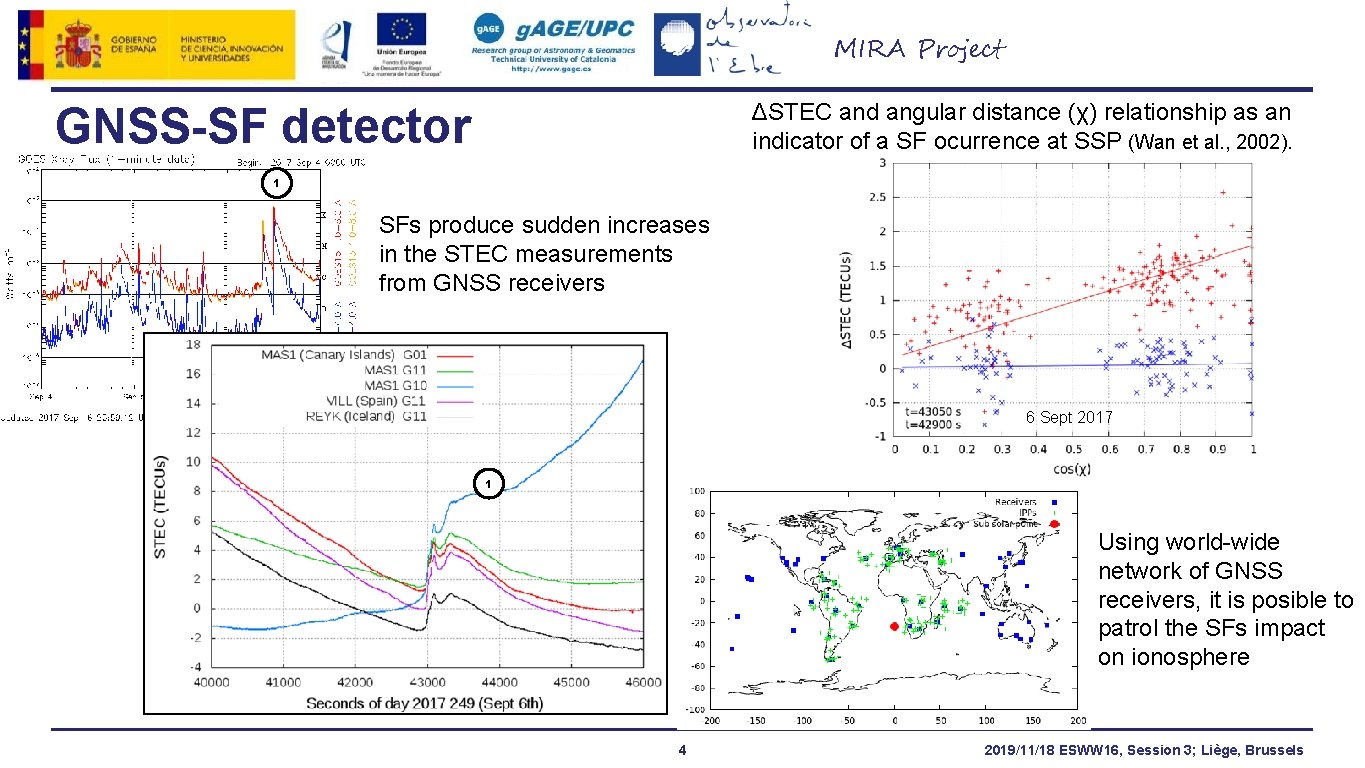
MIRA Project ΔSTEC and angular distance (χ) relationship as an indicator of a SF ocurrence at SSP (Wan et al. , 2002). GNSS-SF detector 1 SFs produce sudden increases in the STEC measurements from GNSS receivers 6 Sept 2017 1 Using world-wide network of GNSS receivers, it is posible to patrol the SFs impact on ionosphere 4 2019/11/18 ESWW 16, Session 3; Liège, Brussels
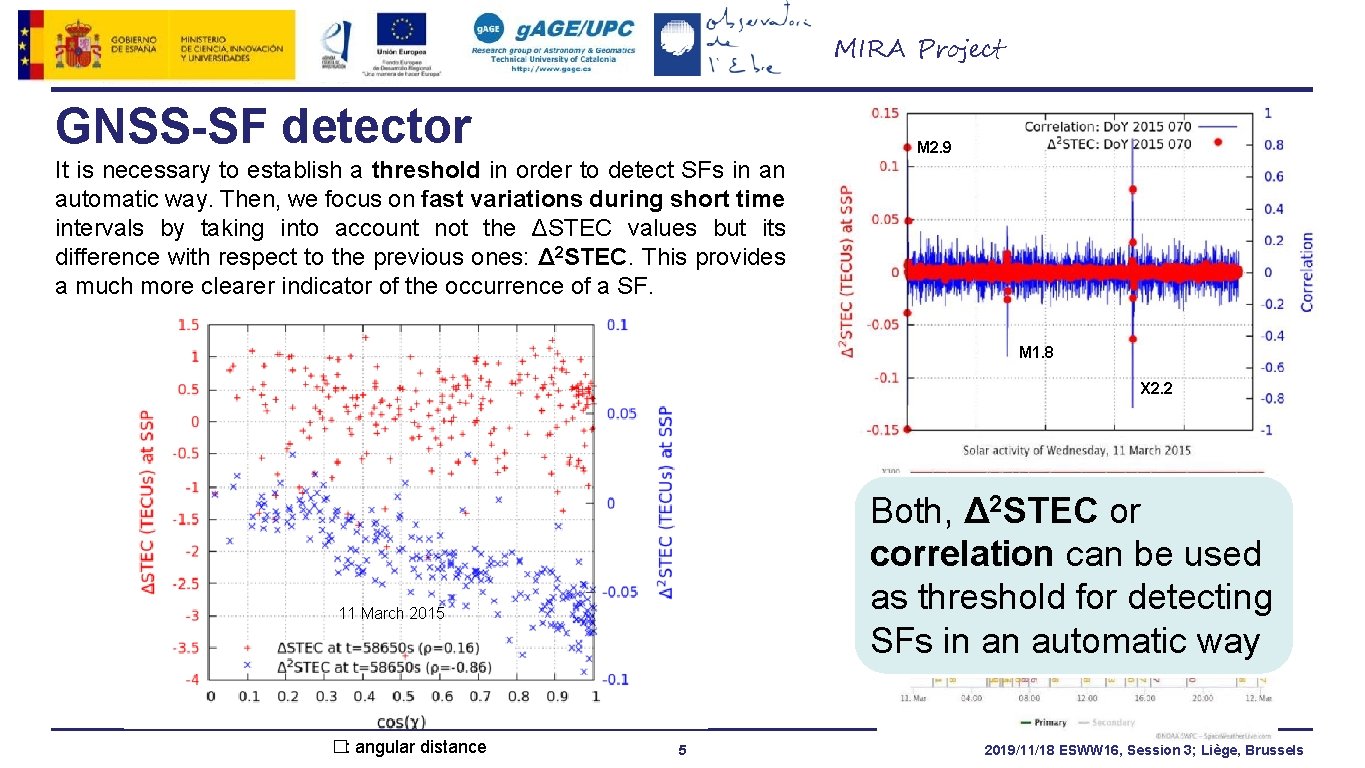
MIRA Project GNSS-SF detector M 2. 9 It is necessary to establish a threshold in order to detect SFs in an automatic way. Then, we focus on fast variations during short time intervals by taking into account not the ΔSTEC values but its difference with respect to the previous ones: Δ 2 STEC. This provides a much more clearer indicator of the occurrence of a SF. M 1. 8 X 2. 2 Both, Δ 2 STEC or correlation can be used as threshold for detecting SFs in an automatic way 11 March 2015 �: angular distance 5 2019/11/18 ESWW 16, Session 3; Liège, Brussels
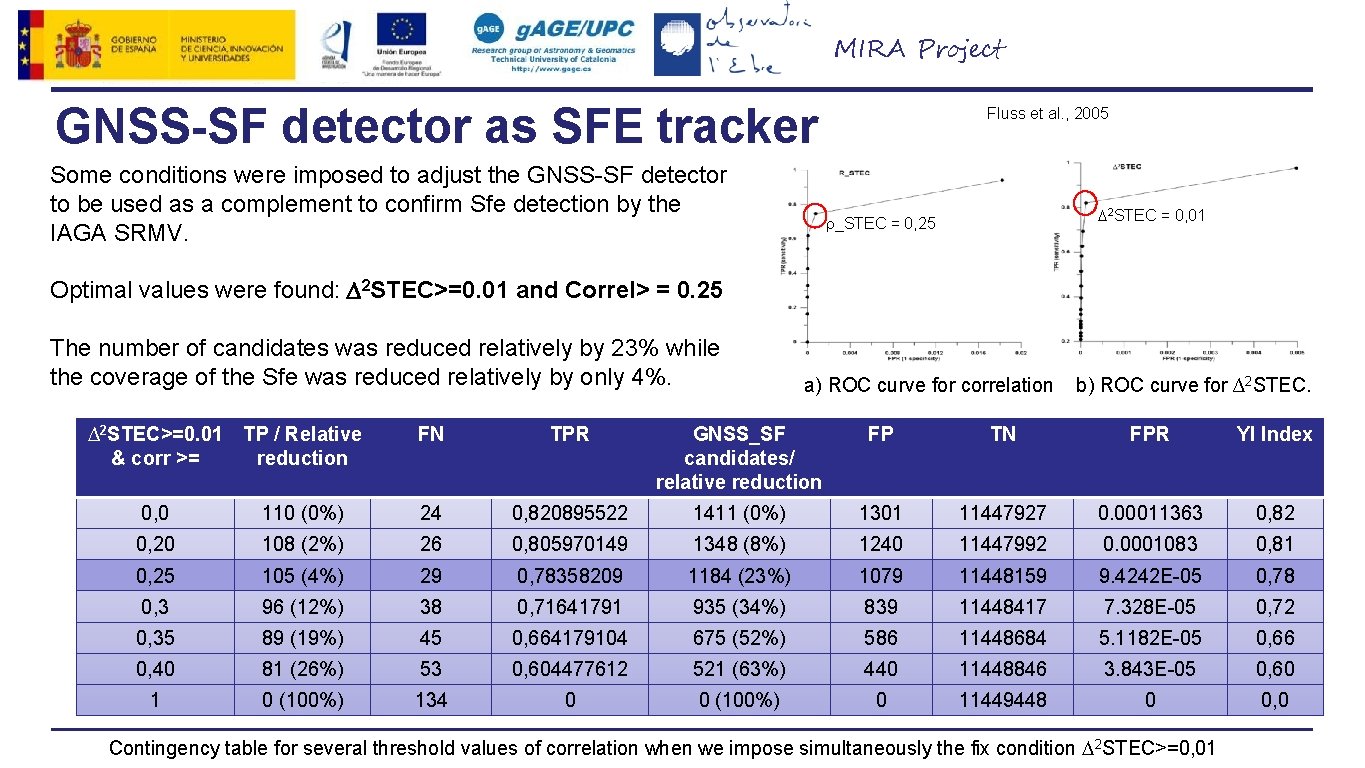
MIRA Project GNSS-SF detector as SFE tracker Some conditions were imposed to adjust the GNSS-SF detector to be used as a complement to confirm Sfe detection by the IAGA SRMV. Fluss et al. , 2005 D 2 STEC = 0, 01 _STEC = 0, 25 Optimal values were found: D 2 STEC>=0. 01 and Correl> = 0. 25 The number of candidates was reduced relatively by 23% while the coverage of the Sfe was reduced relatively by only 4%. a) ROC curve for correlation b) ROC curve for ∆2 STEC>=0. 01 & corr >= TP / Relative reduction FN TPR GNSS_SF candidates/ relative reduction FP TN FPR YI Index 0, 0 110 (0%) 24 0, 820895522 1411 (0%) 1301 11447927 0. 00011363 0, 82 0, 20 108 (2%) 26 0, 805970149 1348 (8%) 1240 11447992 0. 0001083 0, 81 0, 25 105 (4%) 29 0, 78358209 1184 (23%) 1079 11448159 9. 4242 E-05 0, 78 0, 3 96 (12%) 38 0, 71641791 935 (34%) 839 11448417 7. 328 E-05 0, 72 0, 35 89 (19%) 45 0, 664179104 675 (52%) 586 11448684 5. 1182 E-05 0, 66 0, 40 81 (26%) 53 0, 604477612 521 (63%) 440 11448846 3. 843 E-05 0, 60 1 0 (100%) 134 0 0 (100%) 0 11449448 0 0, 0 ESWW 16, Session 3; Liège, Brussels Contingency table for several threshold values of correlation when condition D 2 STEC>=0, 01 6 we impose simultaneously the fix 2019/11/18
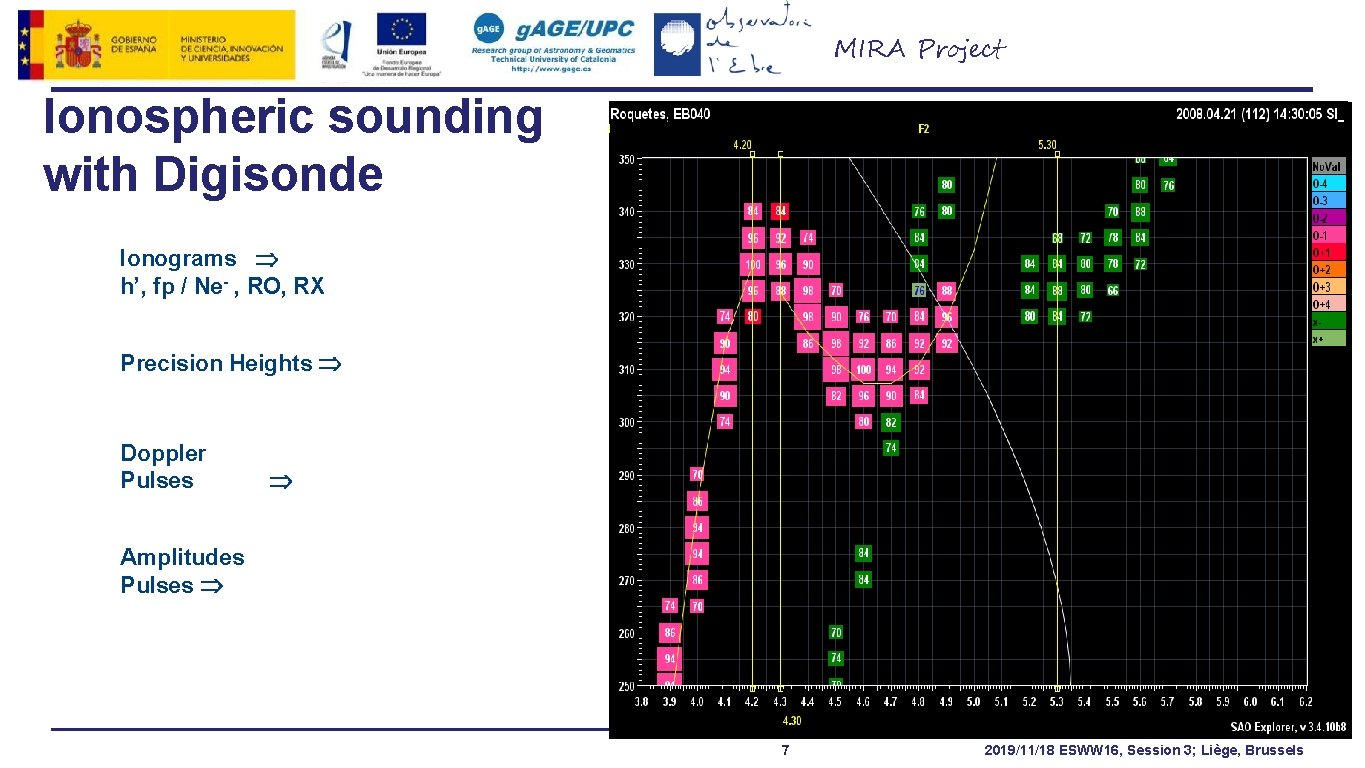
MIRA Project Ionospheric sounding with Digisonde Ionograms h’, fp / Ne- , RO, RX Precision Heights Doppler Pulses Amplitudes Pulses 7 2019/11/18 ESWW 16, Session 3; Liège, Brussels
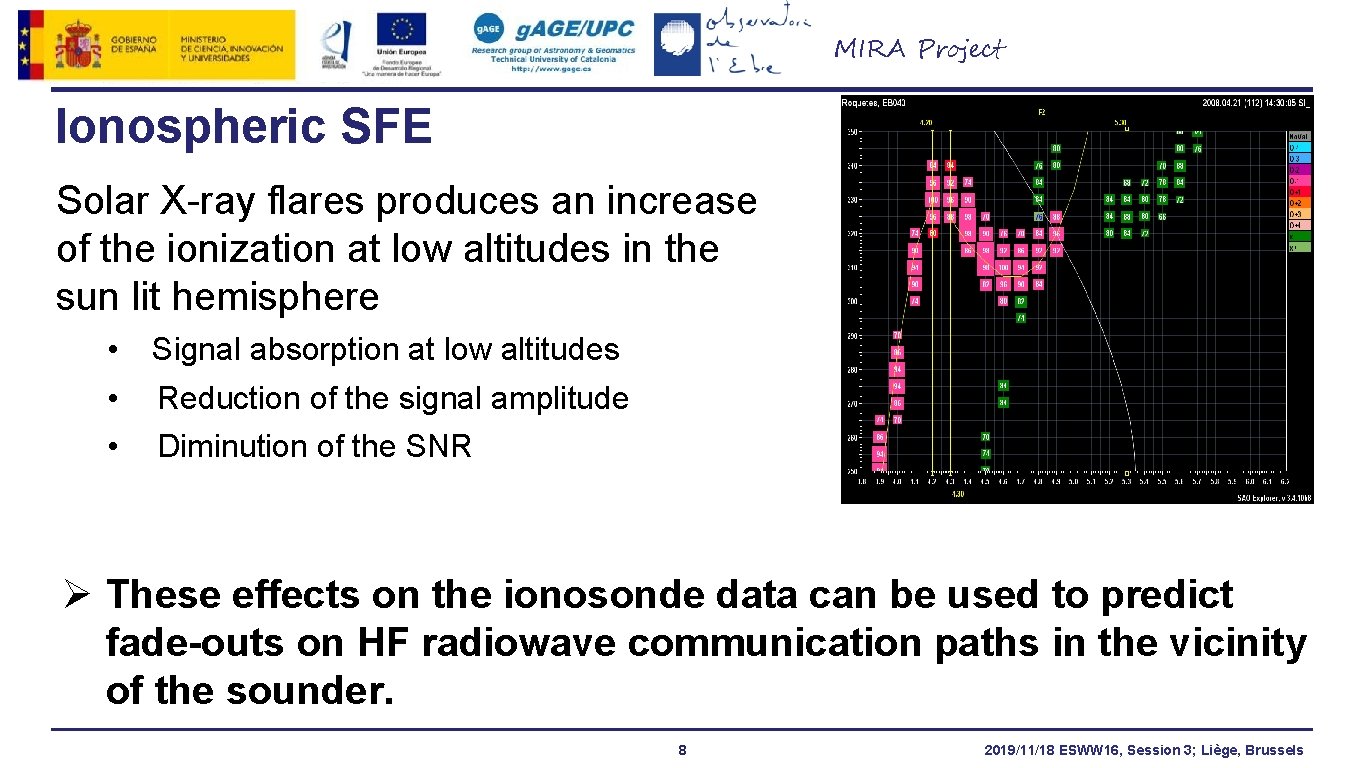
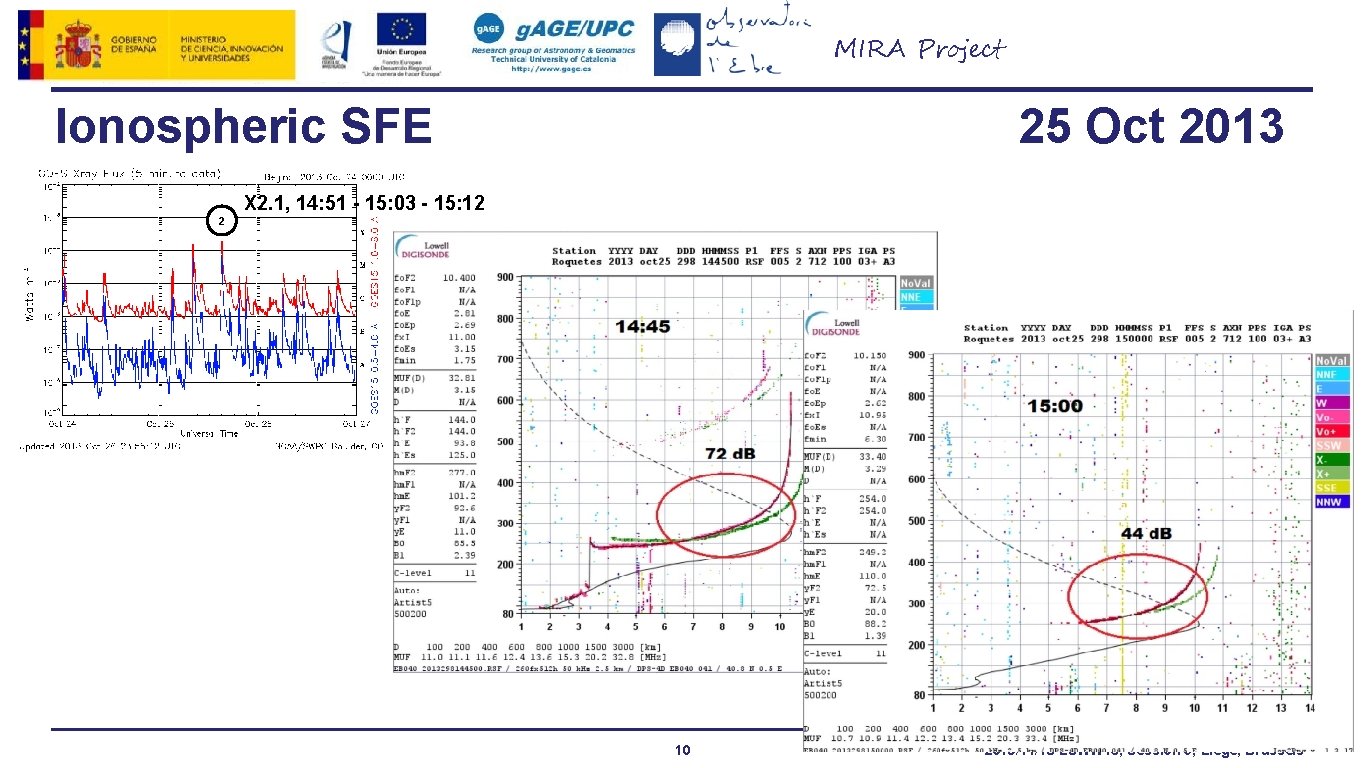
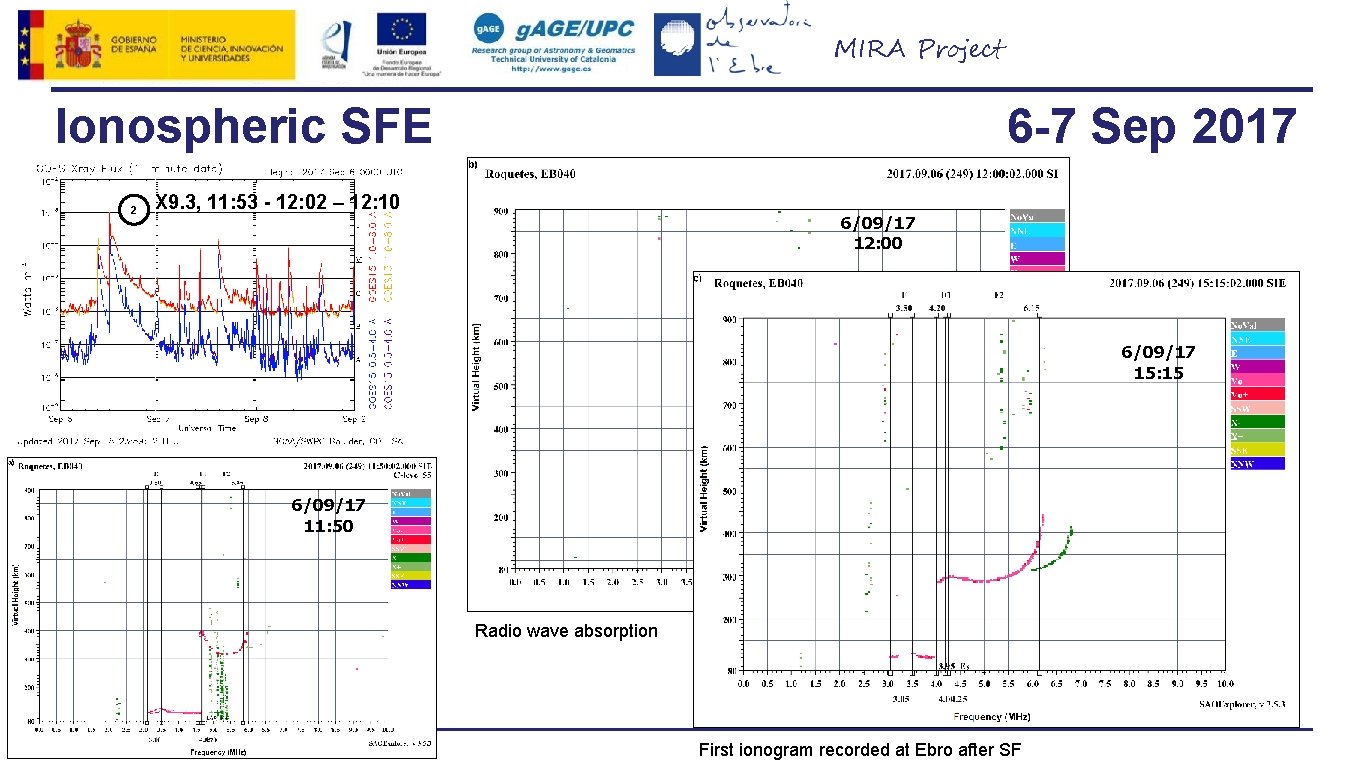
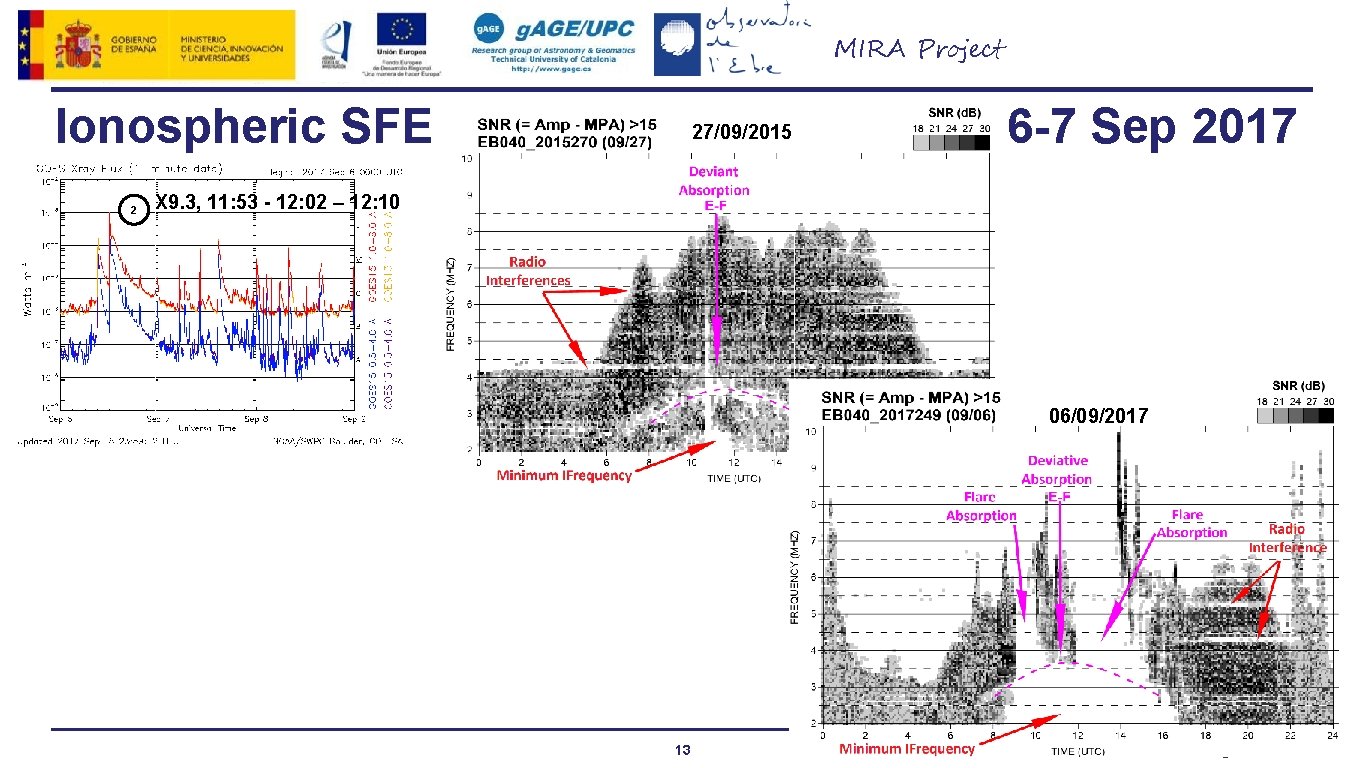
MIRA Project Ionospheric SFE Solar X-ray flares produces an increase of the ionization at low altitudes in the sun lit hemisphere • • • Signal absorption at low altitudes Reduction of the signal amplitude Diminution of the SNR Ø These effects on the ionosonde data can be used to predict fade-outs on HF radiowave communication paths in the vicinity of the sounder. 8 2019/11/18 ESWW 16, Session 3; Liège, Brussels
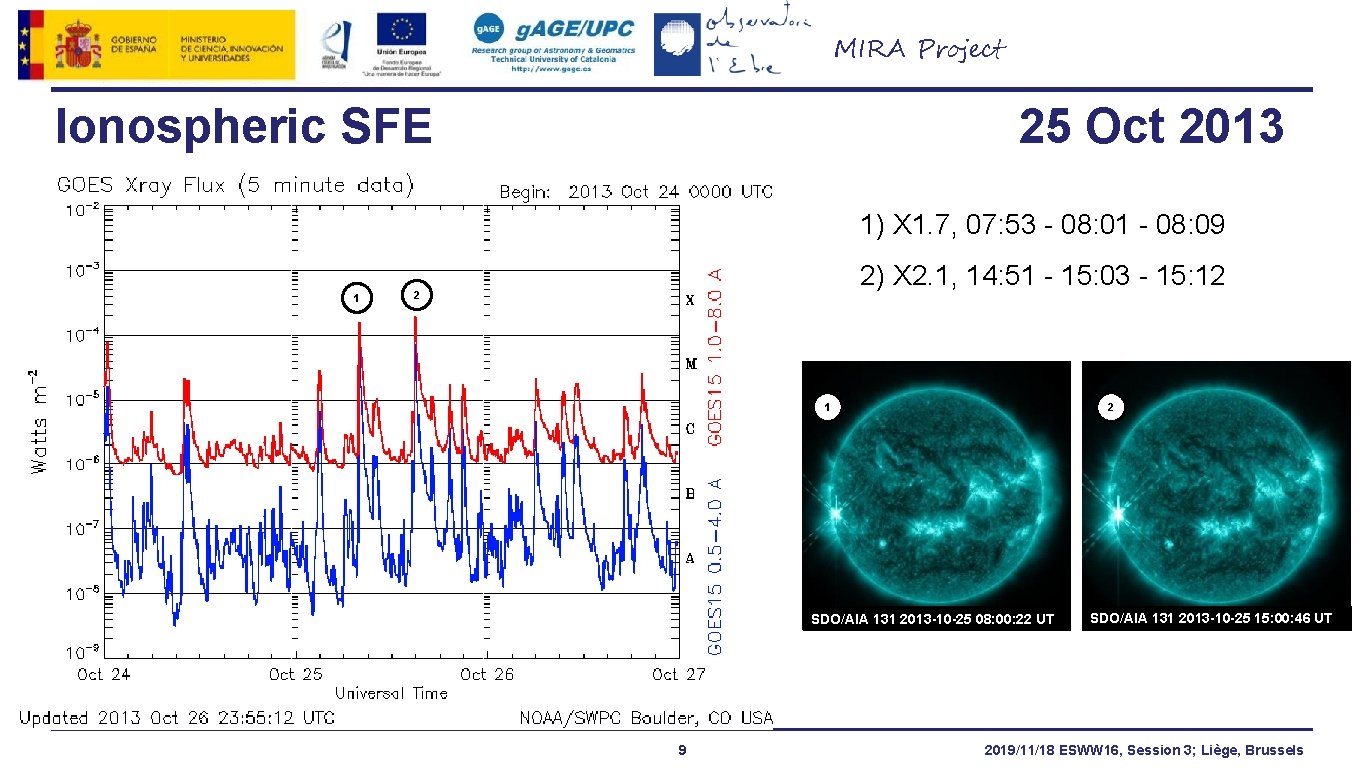
MIRA Project Ionospheric SFE 25 Oct 2013 1) X 1. 7, 07: 53 - 08: 01 - 08: 09 1 2) X 2. 1, 14: 51 - 15: 03 - 15: 12 2 1 2 SDO/AIA 131 2013 -10 -25 08: 00: 22 UT 9 SDO/AIA 131 2013 -10 -25 15: 00: 46 UT 2019/11/18 ESWW 16, Session 3; Liège, Brussels
MIRA Project Ionospheric SFE 25 Oct 2013 X 2. 1, 14: 51 - 15: 03 - 15: 12 2 10 2019/11/18 ESWW 16, Session 3; Liège, Brussels
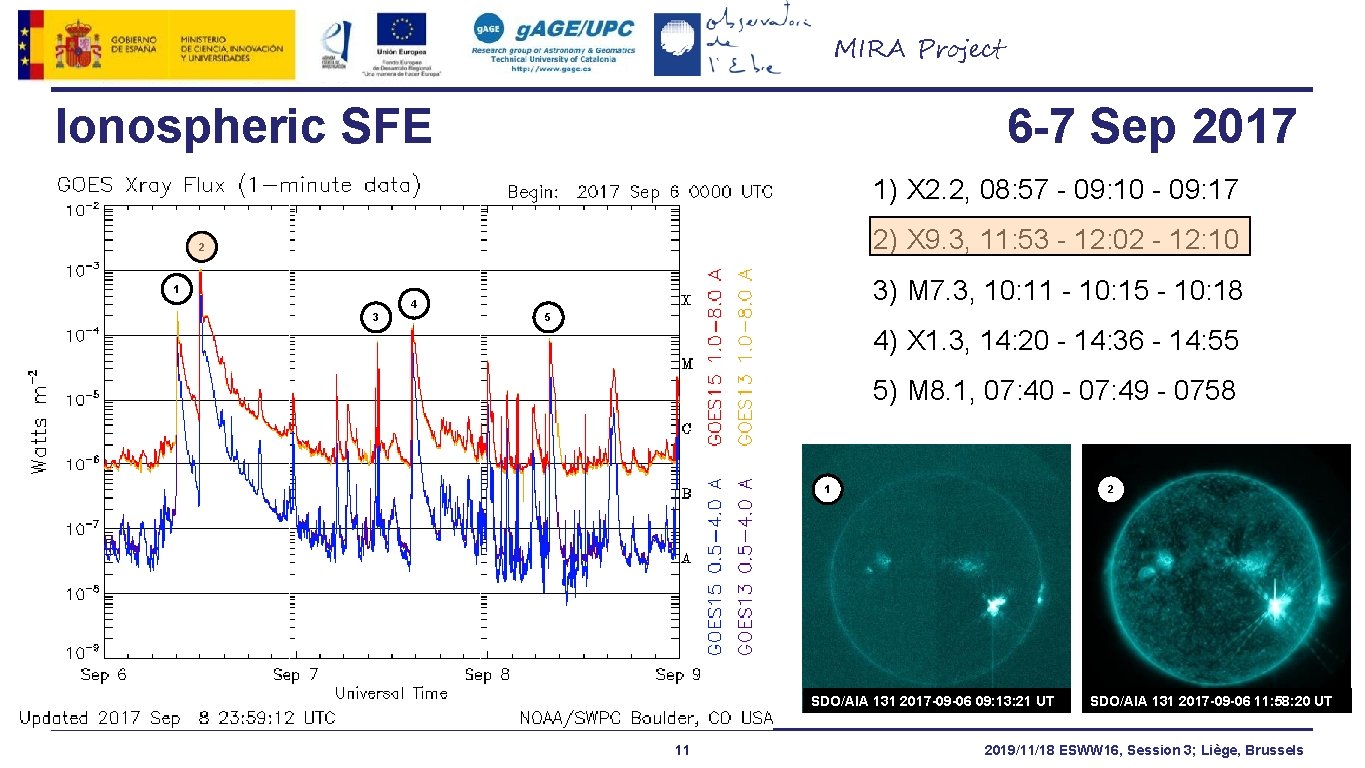
MIRA Project Ionospheric SFE 6 -7 Sep 2017 1) X 2. 2, 08: 57 - 09: 10 - 09: 17 2) X 9. 3, 11: 53 - 12: 02 - 12: 10 2 3) M 7. 3, 10: 11 - 10: 15 - 10: 18 1 4 3 5 4) X 1. 3, 14: 20 - 14: 36 - 14: 55 5) M 8. 1, 07: 40 - 07: 49 - 0758 1 2 SDO/AIA 131 2017 -09 -06 09: 13: 21 UT 11 SDO/AIA 131 2017 -09 -06 11: 58: 20 UT 2019/11/18 ESWW 16, Session 3; Liège, Brussels
MIRA Project Ionospheric SFE 2 6 -7 Sep 2017 X 9. 3, 11: 53 - 12: 02 – 12: 10 6/09/17 12: 00 6/09/17 15: 15 6/09/17 11: 50 Radio wave absorption 12 2019/11/18 ESWW 16, Session 3; Liège, Brussels First ionogram recorded at Ebro after SF
MIRA Project Ionospheric SFE 2 6 -7 Sep 2017 27/09/2015 X 9. 3, 11: 53 - 12: 02 – 12: 10 6/09/17 12: 00 06/09/2017 13 2019/11/18 ESWW 16, Session 3; Liège, Brussels
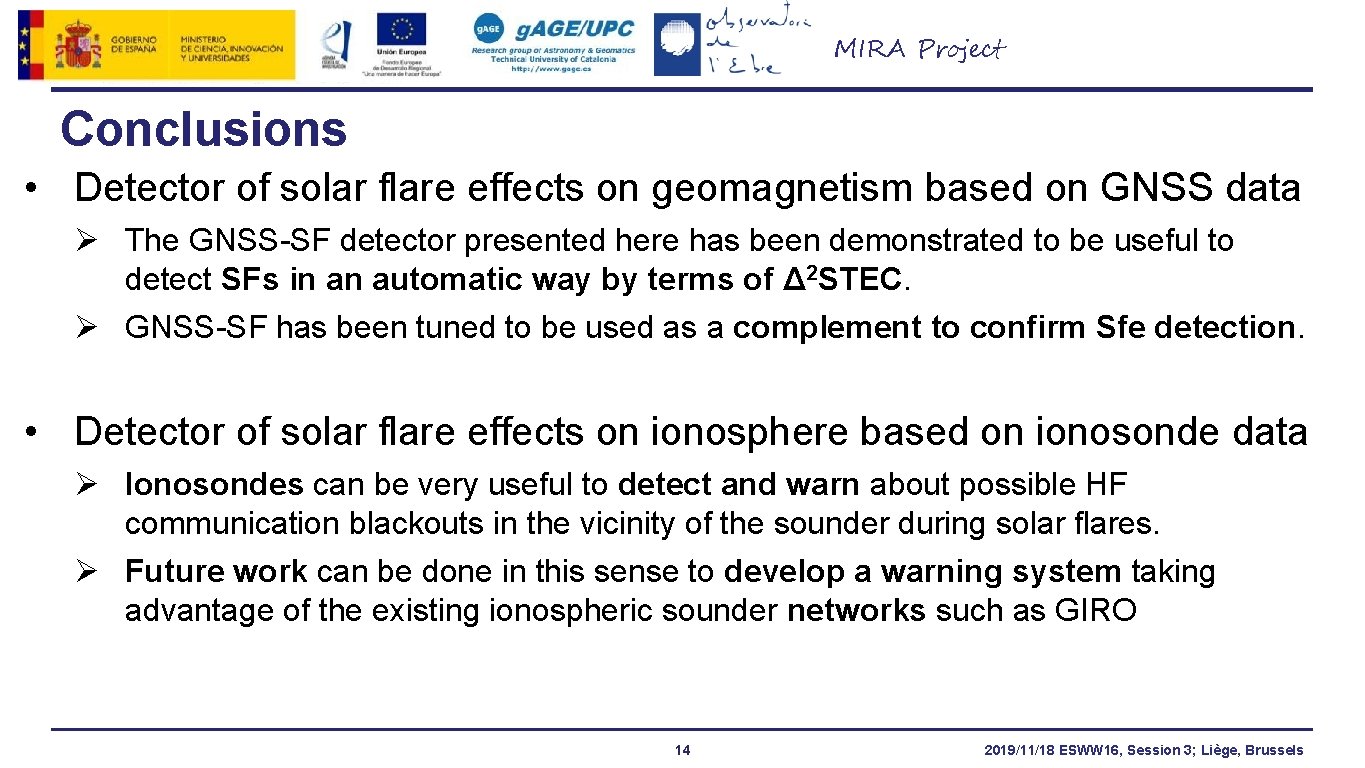
MIRA Project Conclusions • Detector of solar flare effects on geomagnetism based on GNSS data Ø The GNSS-SF detector presented here has been demonstrated to be useful to detect SFs in an automatic way by terms of Δ 2 STEC. Ø GNSS-SF has been tuned to be used as a complement to confirm Sfe detection. • Detector of solar flare effects on ionosphere based on ionosonde data Ø Ionosondes can be very useful to detect and warn about possible HF communication blackouts in the vicinity of the sounder during solar flares. Ø Future work can be done in this sense to develop a warning system taking advantage of the existing ionospheric sounder networks such as GIRO 14 2019/11/18 ESWW 16, Session 3; Liège, Brussels
MIRA Project References: - Curto, J. J. , Marsal, S. , Blanch, E. , & Altadill, D. (2018). Analysis of the solar flare effects of 6 September 2017 in the ionosphere and in the Earth’s magnetic field using spherical elementary current systems. Space Weather, 16. https: //doi. org/10. 1029/2018 SW 001927. - Curto, J. J. , Juan, J. M and Timoté, C. (2019). Confirming Geomagnetic Sfe by means of a Solar Flare Detector based on GNSS. Journal of Space Weather and Space Climate 10. 1051/swsc/2019040, 2019. THANK YOU for your ATENTION • Comments? • Questions? • Suggestions? 15 2019/11/18 ESWW 16, Session 3; Liège, Brussels