
MIPS Reporting Quality 2019 Reporting Guide for CRNAs

- Slides: 13
MIPS Reporting Quality 2019 Reporting Guide for CRNAs
MIPS Reporting Categories • • Quality Improvement Activities (IA) Promoting Interoperability (PI) Cost *Most CRNAs will report data for the Quality and IA categories. 08 FEB 2019 2
Quality Performance Category • Measures health care processes, outcomes and patient experiences • Reported by individual clinicians and groups • Consists of data collected for an entire calendar year (January 1 st to December 31 st), called the performance period. 08 FEB 2019 3
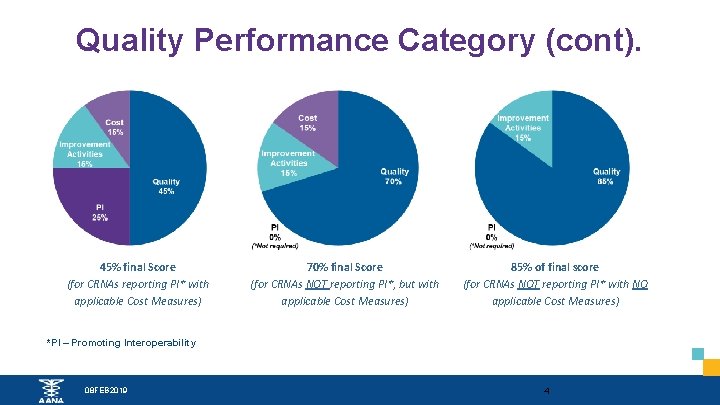
Quality Performance Category (cont). 45% final Score (for CRNAs reporting PI* with applicable Cost Measures) 70% final Score (for CRNAs NOT reporting PI*, but with applicable Cost Measures) 85% of final score (for CRNAs NOT reporting PI* with NO applicable Cost Measures) *PI – Promoting Interoperability 08 FEB 2019 4
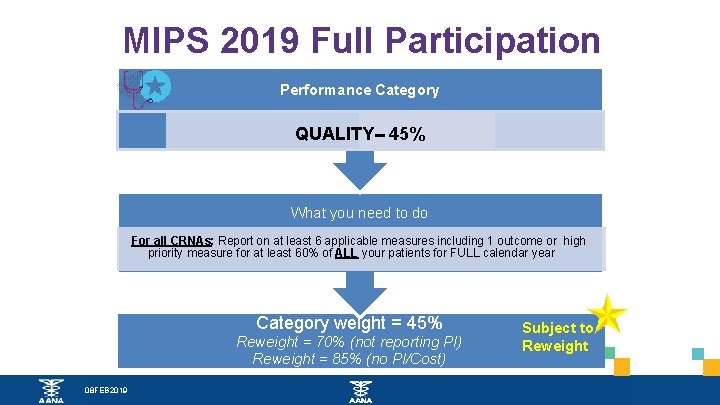
MIPS 2019 Full Participation Performance Category Requirements QUALITY-- 45% What you need to do For all CRNAs: Report on at least 6 applicable measures including 1 outcome or high priority measure for at least 60% of ALL your patients for FULL calendar year Category weight = 45% Reweight = 70% (not reporting PI) Reweight = 85% (no PI/Cost) 08 FEB 2019 Subject to Reweight
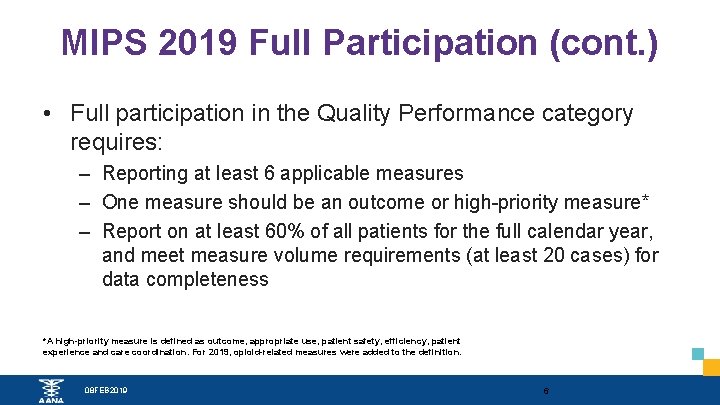
MIPS 2019 Full Participation (cont. ) • Full participation in the Quality Performance category requires: – Reporting at least 6 applicable measures – One measure should be an outcome or high-priority measure* – Report on at least 60% of all patients for the full calendar year, and meet measure volume requirements (at least 20 cases) for data completeness *A high-priority measure is defined as outcome, appropriate use, patient safety, efficiency, patient experience and care coordination. For 2019, opioid-related measures were added to the definition. 08 FEB 2019 6
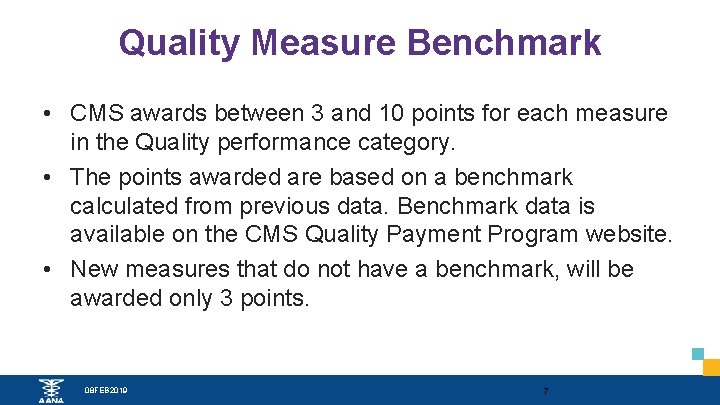
Quality Measure Benchmark • CMS awards between 3 and 10 points for each measure in the Quality performance category. • The points awarded are based on a benchmark calculated from previous data. Benchmark data is available on the CMS Quality Payment Program website. • New measures that do not have a benchmark, will be awarded only 3 points. 08 FEB 2019 7
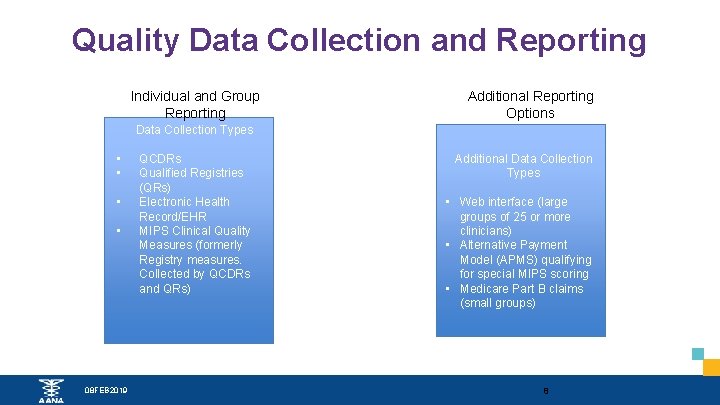
Quality Data Collection and Reporting Individual and Group Reporting Additional Reporting Options Data Collection Types • • 08 FEB 2019 QCDRs Qualified Registries (QRs) Electronic Health Record/EHR MIPS Clinical Quality Measures (formerly Registry measures. Collected by QCDRs and QRs) Additional Data Collection Types • Web interface (large groups of 25 or more clinicians) • Alternative Payment Model (APMS) qualifying for special MIPS scoring • Medicare Part B claims (small groups) 8
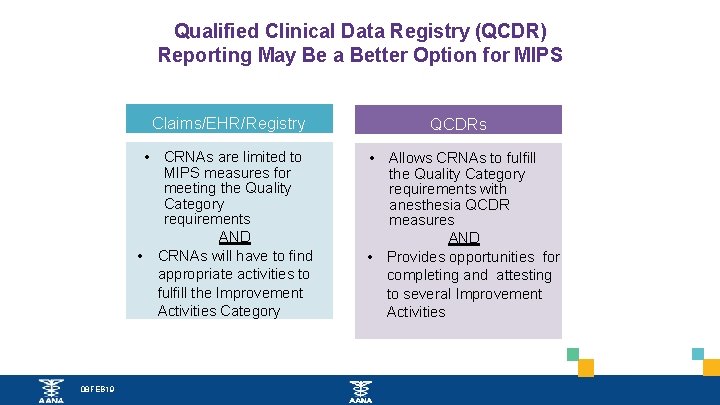
Qualified Clinical Data Registry (QCDR) Reporting May Be a Better Option for MIPS Claims/EHR/Registry • CRNAs are limited to MIPS measures for meeting the Quality Category requirements AND • CRNAs will have to find appropriate activities to fulfill the Improvement Activities Category 08 FEB 19 QCDRs • Allows CRNAs to fulfill the Quality Category requirements with anesthesia QCDR measures AND • Provides opportunities for completing and attesting to several Improvement Activities
Data Completeness and Bonus Points • The small practice bonus is 6 points for MIPS-eligible clinicians who submit data for at least one quality measure. The bonus will be added to the Quality performance category score in 2019. • Small practices can receive up to 3 points for reporting quality measures that do not meet data completeness requirements (reporting on least 60% of all patients). • Two bonus points can be awarded for reporting outcome and patient experience measures. • One point can be awarded for other high-priority measures that meet data completeness and case minimum requirements. 08 FEB 2019 10
Quality Performance Category (cont. ) • The Performance Threshold for 2019 is 30 points in order to avoid the 7% penalty. • Bonus points for exceptional performance can be earned for achieving 75 points. 08 FEB 2019 11
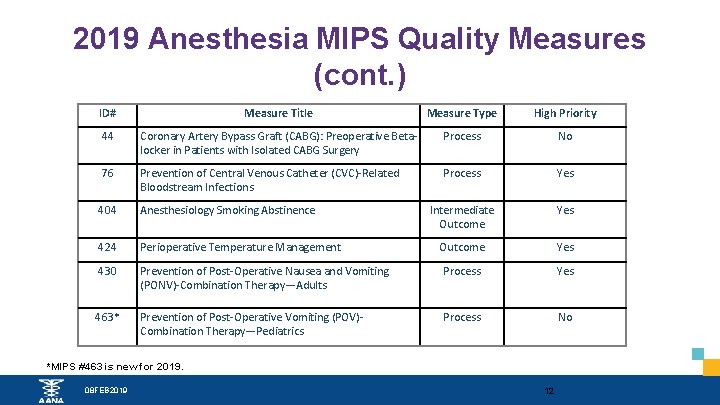
2019 Anesthesia MIPS Quality Measures (cont. ) ID# Measure Title Measure Type High Priority 44 Coronary Artery Bypass Graft (CABG): Preoperative Betalocker in Patients with Isolated CABG Surgery Process No 76 Prevention of Central Venous Catheter (CVC)-Related Bloodstream Infections Process Yes 404 Anesthesiology Smoking Abstinence Intermediate Outcome Yes 424 Perioperative Temperature Management Outcome Yes 430 Prevention of Post-Operative Nausea and Vomiting (PONV)-Combination Therapy—Adults Process Yes 463* Prevention of Post-Operative Vomiting (POV)Combination Therapy—Pediatrics Process No *MIPS #463 is new for 2019. 08 FEB 2019 12
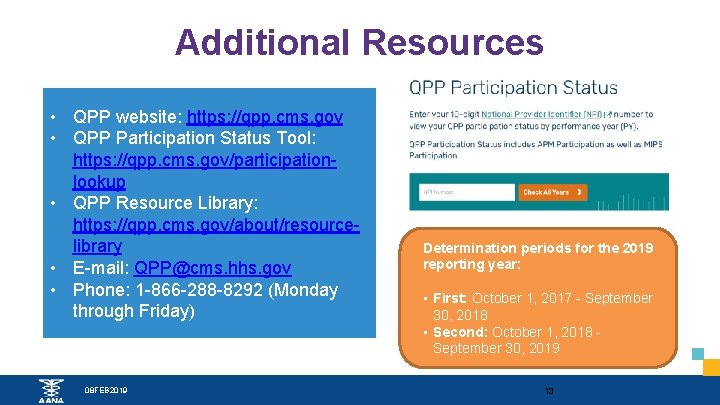
Additional Resources • QPP website: https: //qpp. cms. gov • QPP Participation Status Tool: https: //qpp. cms. gov/participationlookup • QPP Resource Library: https: //qpp. cms. gov/about/resourcelibrary • E-mail: QPP@cms. hhs. gov • Phone: 1 -866 -288 -8292 (Monday through Friday) 08 FEB 2019 Determination periods for the 2019 reporting year: • First: October 1, 2017 - September 30, 2018 • Second: October 1, 2018 September 30, 2019 13