
MIPS Functions Procedures and Functions We programmers use


- Slides: 22
MIPS Functions
Procedures and Functions • We programmers use procedures and functions to structure and organize programs – To make them easier to understand – To allow code to be reused 6/16/2021 week 04 -3. ppt 2
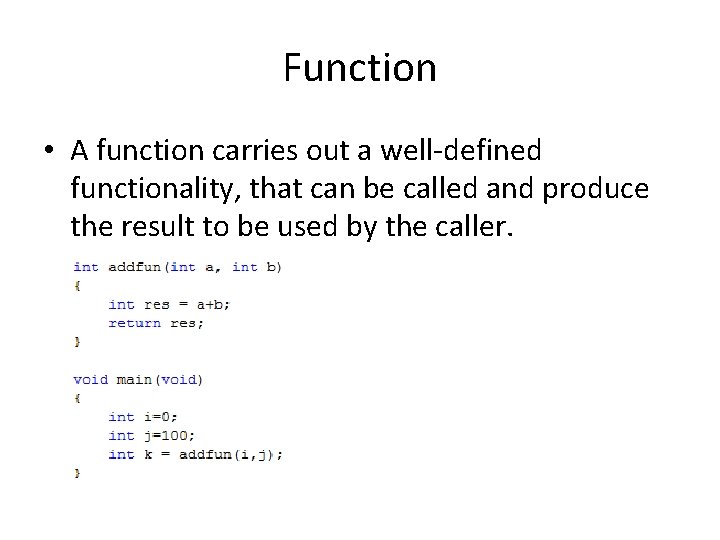
Function • A function carries out a well-defined functionality, that can be called and produce the result to be used by the caller.
Functions • A function is a consecutive piece of code stored in the memory. • To invoke (or call) a function, we must go to that piece of code. Then it does certain things, and get the result we need. • What do we know about going to a piece of code?
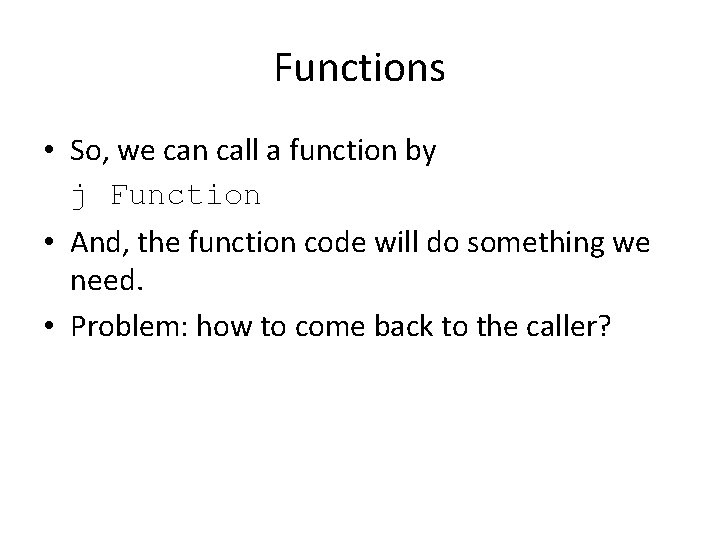
Functions • So, we can call a function by j Function • And, the function code will do something we need. • Problem: how to come back to the caller?
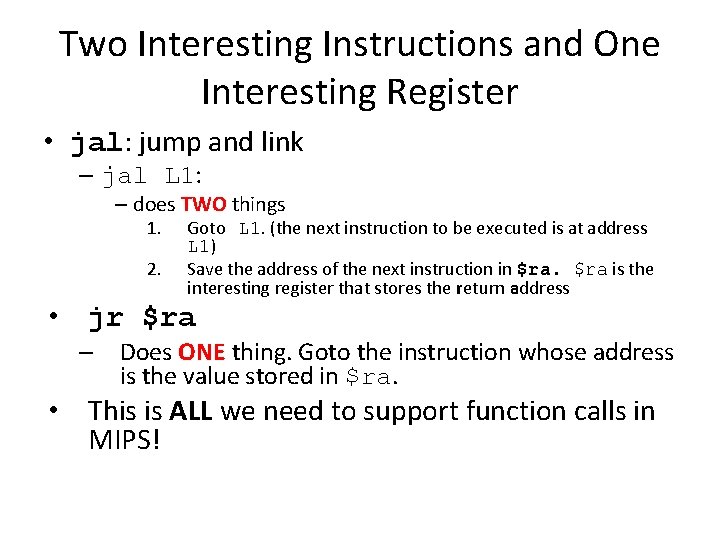
Two Interesting Instructions and One Interesting Register • jal: jump and link – jal L 1: – does TWO things 1. 2. Goto L 1. (the next instruction to be executed is at address L 1) Save the address of the next instruction in $ra is the interesting register that stores the return address • jr $ra – Does ONE thing. Goto the instruction whose address is the value stored in $ra. • This is ALL we need to support function calls in MIPS!
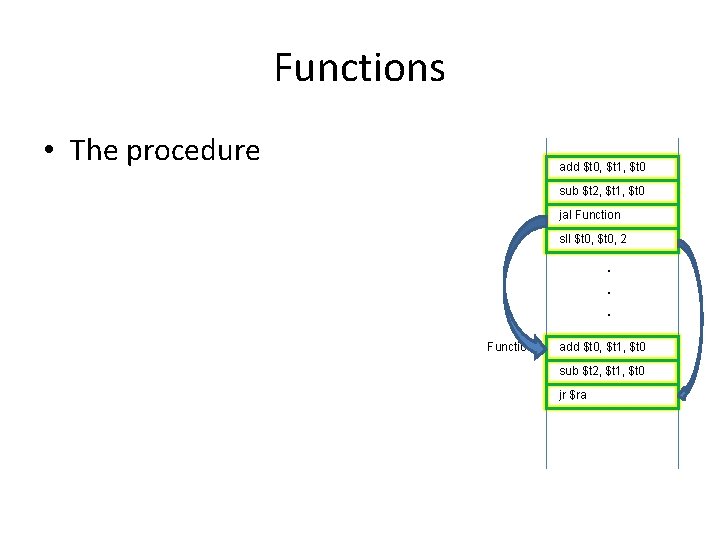
Functions • The procedure add $t 0, $t 1, a $t 0 sub $t 2, $t 1, a $t 0 jal Function a sll $t 0, a 2 . . . Function: add $t 0, $t 1, a $t 0 sub $t 2, $t 1, a $t 0 jr $ra a
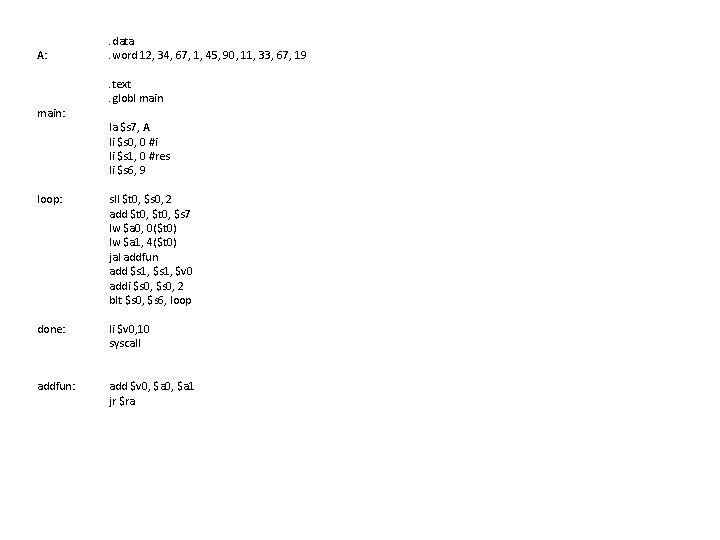
A simple function
A: main: . data. word 12, 34, 67, 1, 45, 90, 11, 33, 67, 19. text. globl main la $s 7, A li $s 0, 0 #i li $s 1, 0 #res li $s 6, 9 loop: sll $t 0, $s 0, 2 add $t 0, $s 7 lw $a 0, 0($t 0) lw $a 1, 4($t 0) jal addfun add $s 1, $v 0 addi $s 0, 2 blt $s 0, $s 6, loop done: li $v 0, 10 syscall addfun: add $v 0, $a 1 jr $ra
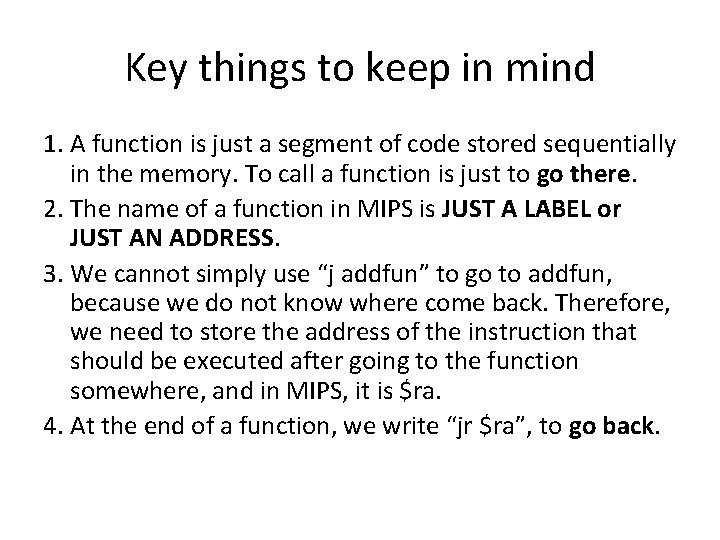
Key things to keep in mind 1. A function is just a segment of code stored sequentially in the memory. To call a function is just to go there. 2. The name of a function in MIPS is JUST A LABEL or JUST AN ADDRESS. 3. We cannot simply use “j addfun” to go to addfun, because we do not know where come back. Therefore, we need to store the address of the instruction that should be executed after going to the function somewhere, and in MIPS, it is $ra. 4. At the end of a function, we write “jr $ra”, to go back.
MIPS Calling Conventions • MIPS assembly follows the following convention in using registers – $a 0 - $a 3: four argument registers in which to pass parameters – $v 0 - $v 1: two value registers in which to return values – $ra: one return address register to return to the point of origin 6/16/2021 week 04 -3. ppt 11
MIPS Conventions • Quite often, our function needs to use some registers to do dome calculation. So we will modify the values of them. • We can use $t 0 -$t 9 freely inside a function, because the caller does not expect the values inside $t 0 -$t 9 to stay the same after the function call. • But, the caller do expect the values in $s 0 to $s 7 to be the same after a function call.
MIPS Conventions • So, just try to avoid using $s 0 and $s 7 inside a function whenever possible. • But what if do need it? Such occasions will arise…
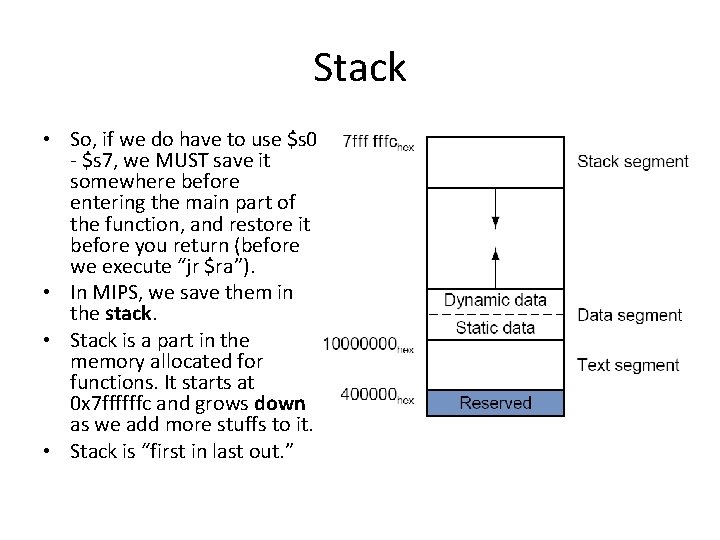
Stack • So, if we do have to use $s 0 - $s 7, we MUST save it somewhere before entering the main part of the function, and restore it before you return (before we execute “jr $ra”). • In MIPS, we save them in the stack. • Stack is a part in the memory allocated for functions. It starts at 0 x 7 ffffffc and grows down as we add more stuffs to it. • Stack is “first in last out. ”
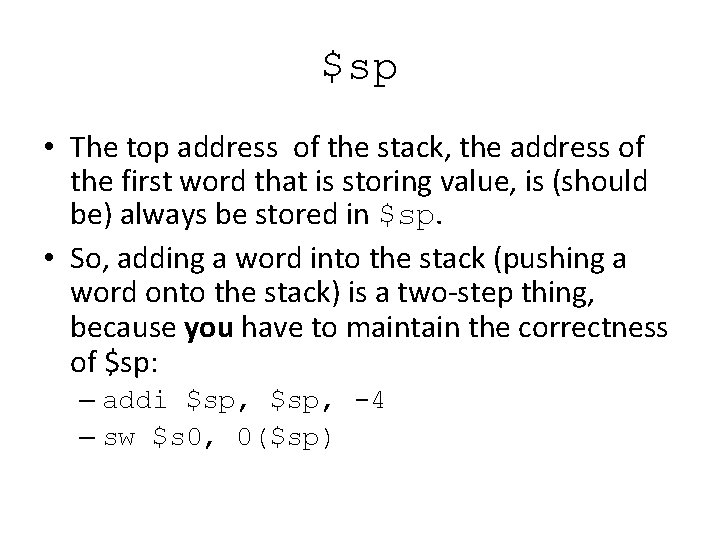
$sp • The top address of the stack, the address of the first word that is storing value, is (should be) always be stored in $sp. • So, adding a word into the stack (pushing a word onto the stack) is a two-step thing, because you have to maintain the correctness of $sp: – addi $sp, -4 – sw $s 0, 0($sp)
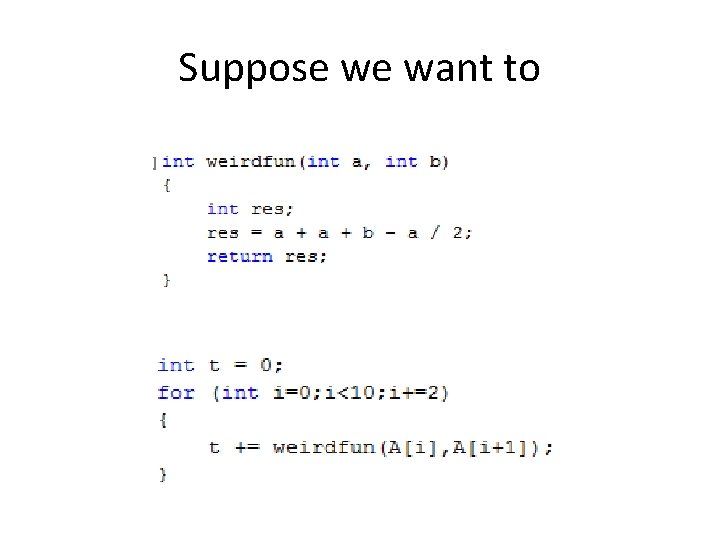
Suppose we want to
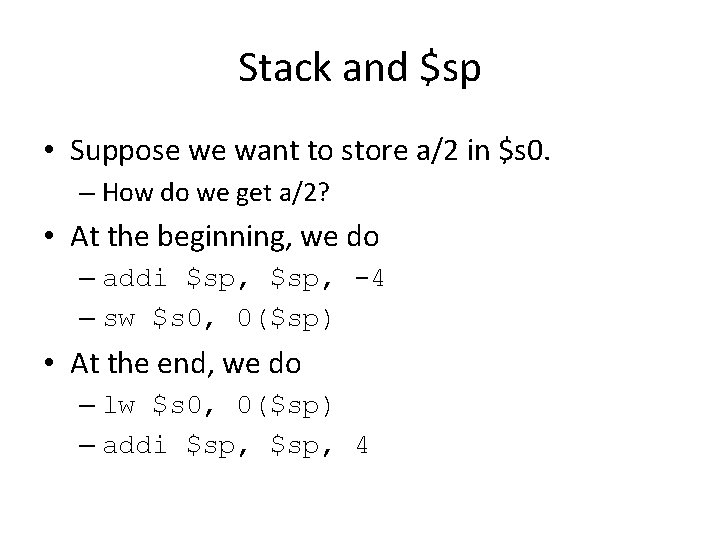
Stack and $sp • Suppose we want to store a/2 in $s 0. – How do we get a/2? • At the beginning, we do – addi $sp, -4 – sw $s 0, 0($sp) • At the end, we do – lw $s 0, 0($sp) – addi $sp, 4
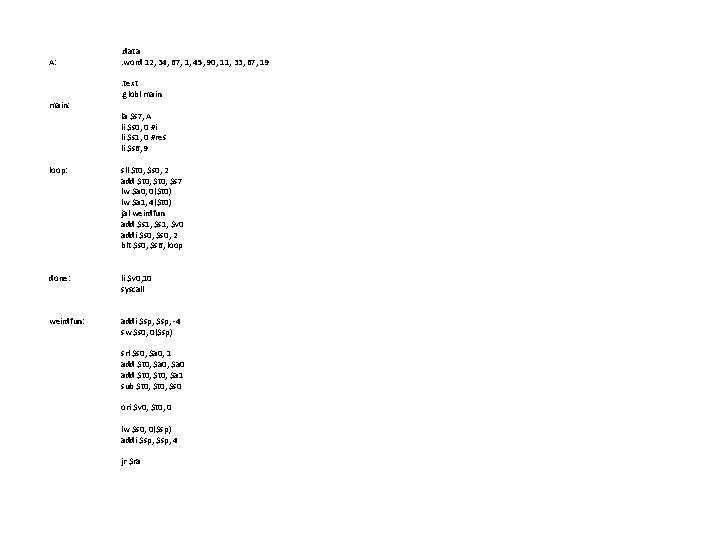
A: main: . data. word 12, 34, 67, 1, 45, 90, 11, 33, 67, 19. text. globl main la $s 7, A li $s 0, 0 #i li $s 1, 0 #res li $s 6, 9 loop: sll $t 0, $s 0, 2 add $t 0, $s 7 lw $a 0, 0($t 0) lw $a 1, 4($t 0) jal weirdfun add $s 1, $v 0 addi $s 0, 2 blt $s 0, $s 6, loop done: li $v 0, 10 syscall weirdfun: addi $sp, -4 sw $s 0, 0($sp) srl $s 0, $a 0, 1 add $t 0, $a 0 add $t 0, $a 1 sub $t 0, $s 0 ori $v 0, $t 0, 0 lw $s 0, 0($sp) addi $sp, 4 jr $ra
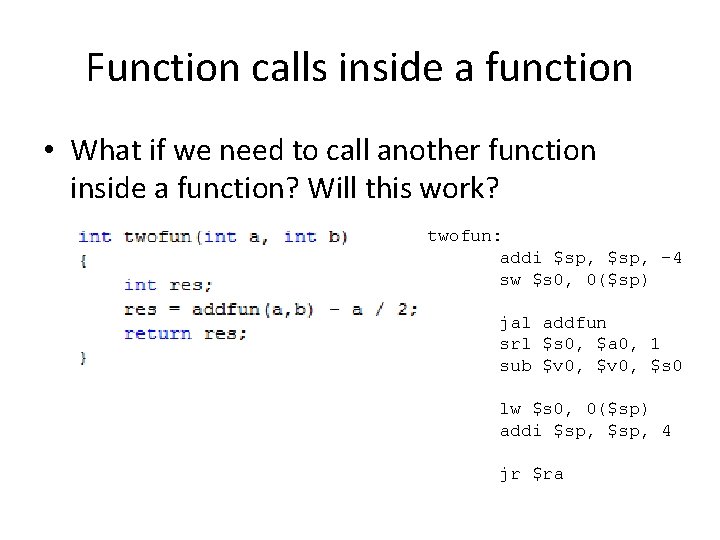
Function calls inside a function • What if we need to call another function inside a function? Will this work? twofun: addi $sp, -4 sw $s 0, 0($sp) jal addfun srl $s 0, $a 0, 1 sub $v 0, $s 0 lw $s 0, 0($sp) addi $sp, 4 jr $ra
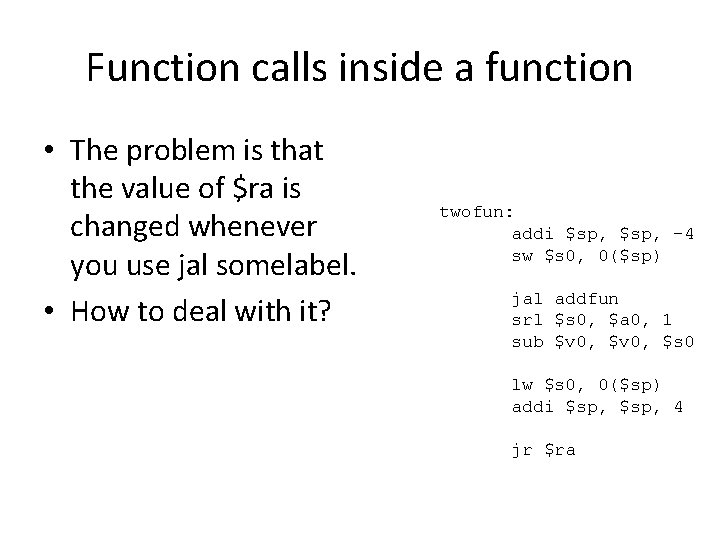
Function calls inside a function • The problem is that the value of $ra is changed whenever you use jal somelabel. • How to deal with it? twofun: addi $sp, -4 sw $s 0, 0($sp) jal addfun srl $s 0, $a 0, 1 sub $v 0, $s 0 lw $s 0, 0($sp) addi $sp, 4 jr $ra
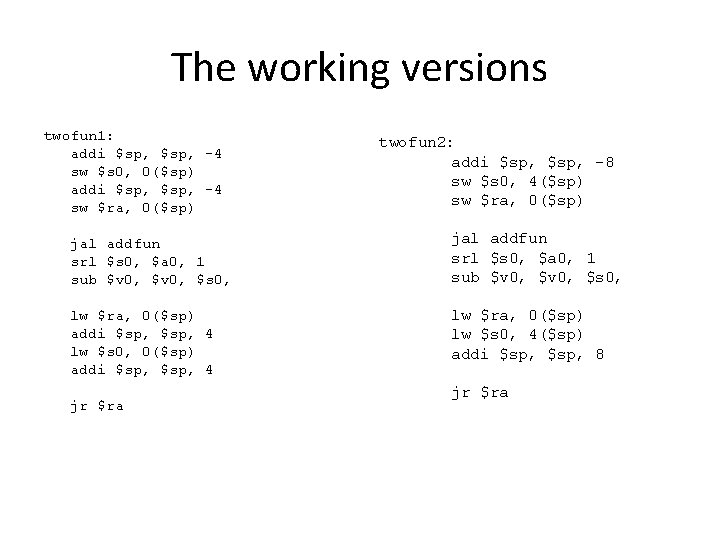
The working versions twofun 1: addi $sp, -4 sw $s 0, 0($sp) addi $sp, -4 sw $ra, 0($sp) twofun 2: addi $sp, -8 sw $s 0, 4($sp) sw $ra, 0($sp) jal addfun srl $s 0, $a 0, 1 sub $v 0, $s 0, lw $ra, 0($sp) addi $sp, 4 lw $s 0, 0($sp) addi $sp, 4 lw $ra, 0($sp) lw $s 0, 4($sp) addi $sp, 8 jr $ra
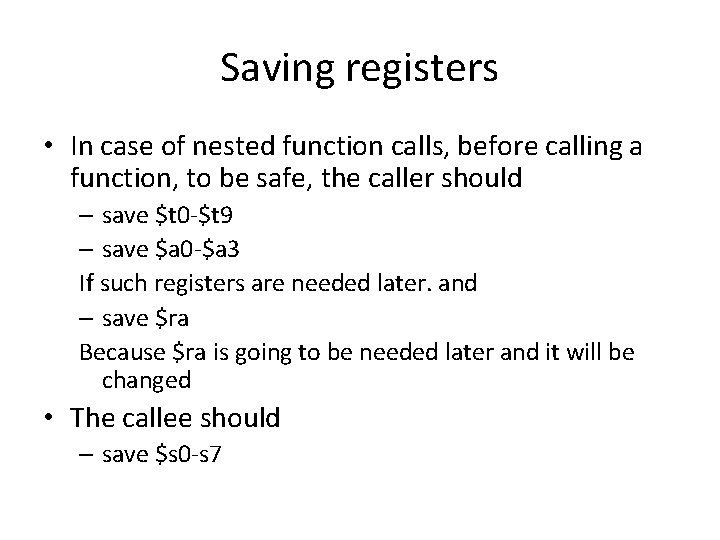
Saving registers • In case of nested function calls, before calling a function, to be safe, the caller should – save $t 0 -$t 9 – save $a 0 -$a 3 If such registers are needed later. and – save $ra Because $ra is going to be needed later and it will be changed • The callee should – save $s 0 -s 7