
Minute Taking Made Easy By Rhonda Scharf CSP
Minute Taking Made Easy By: Rhonda Scharf, CSP Presented by: Robin Cochran, CPS/CAP
Don’t Let the Thought of Doing Minutes Stress You Out!
What Are Minutes? Minutes are the official, written, permanent, formal record of what transpires during a meeting. Their purpose is to provide people with: 1) 2) 3) 4) A clear and objective summary of the meeting To update those unable to attend A reminder of future expected actions To provide a rationale and historical background
What Should Minutes Contain? a) b) c) d) e) f) g) h) i) Dates Times Locations Motions/decisions Attendees/absences Guests Group name Attachments The word MINUTES has to be shown What Should Minutes Not Contain? a) b) c) d) e) f) Welcome Lunch/break details Personal issues Actual conversations The recorders input (give input only if requested) Side conversations
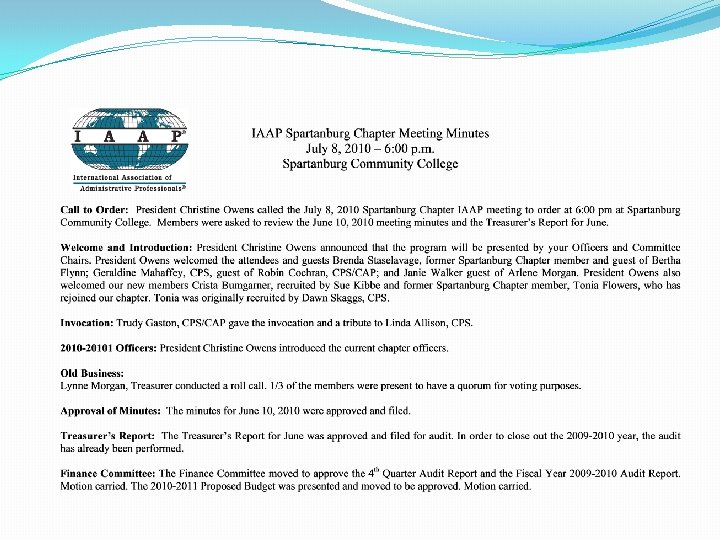
Types of Minutes FORMAL Formal minutes adhere to the strict use of Rules of Order. Large meetings are likely to be more formal than small meetings. The larger the meeting the more control is necessary to expedite the business at hand, to assure legality. Examples of Formal Meetings: 1) Annual Membership Meetings 2) Monthly Board Meetings 3) Corporate Meetings 4) State and Regional Conventions 5) National Conferences 6) Seminars 7) Federal and Local Government Meetings Definition of Robert’s Rules of Order Provides common rules and procedures for deliberation and debate in order to place the whole membership on the same footing and speaking the same language.
Types of Minutes (continued) Modified Formal As indicated, this type of meeting conducts its business with relaxed Rules of Order. Example of Modified Formal 1) Use of formal motions, but informal discussions
Types of Minutes (continued) Informal meetings use few or no Rules of Order to conduct business. Examples of Informal 1) Staff Meetings 2) Management Meetings 3) Committee Meetings 4) Social/Civic Club Meetings
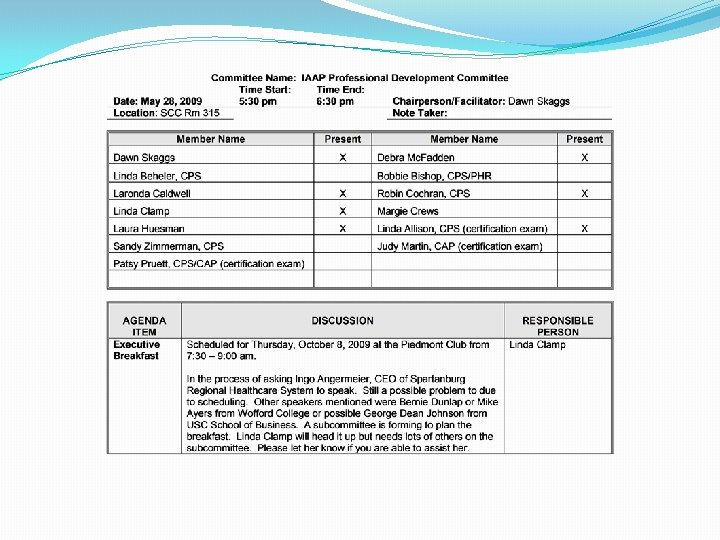
Roles of the Minute Taker 1) Sort out the comments/suggested actions and decisions expressed at the meeting and produce an accurate summary 2) Keep track of attendance/absence at the meeting 3) Store the minutes and all related materials 4) Request the chair to temporarily halt the meeting if the comments are flowing too quickly 5) Authenticate all the records and documents associated with the meeting by having the chair add his/her signature 6) Be familiar with the procedures used by the group A Minute Taker Must Be: 1) Highly Organized 2) Be a Good Listener 3) Be Focused
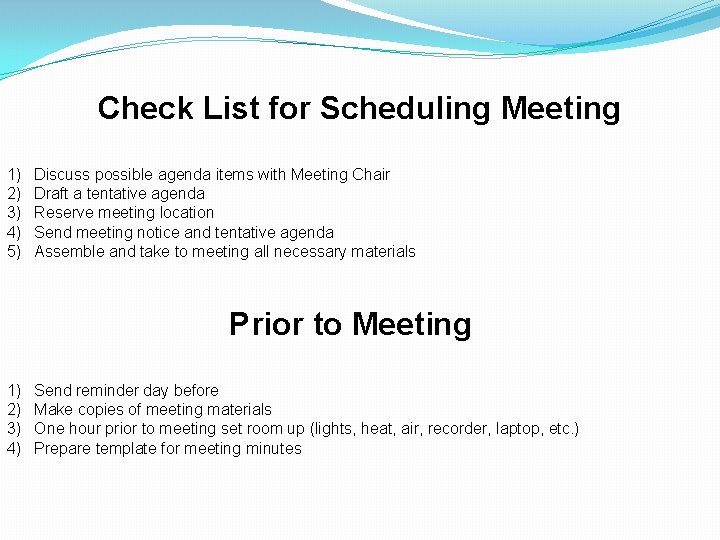
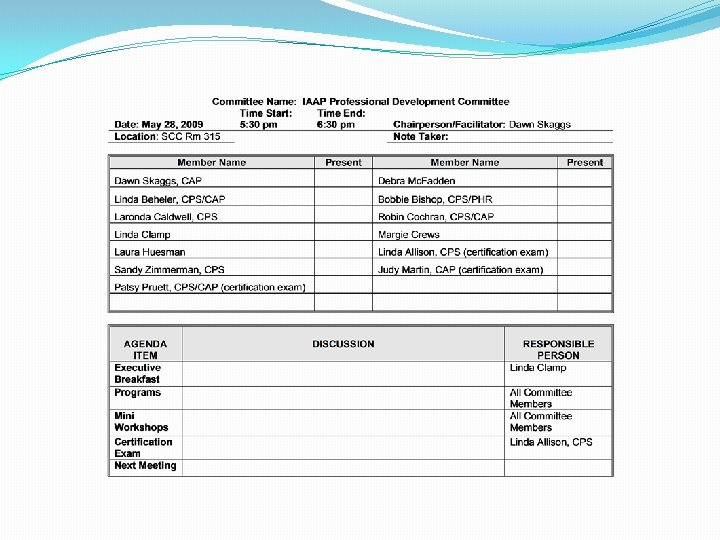
Check List for Scheduling Meeting 1) 2) 3) 4) 5) Discuss possible agenda items with Meeting Chair Draft a tentative agenda Reserve meeting location Send meeting notice and tentative agenda Assemble and take to meeting all necessary materials Prior to Meeting 1) 2) 3) 4) Send reminder day before Make copies of meeting materials One hour prior to meeting set room up (lights, heat, air, recorder, laptop, etc. ) Prepare template for meeting minutes
Listening Skills Active listening is a skill used to GET information before you GIVE your own ideas. In work situations active listening is critical. Most of us focus on our responsibilities and actions as speakers (senders), and forget our responsibilities as listeners (receivers). We often think of listening as a passive activity. It’s hard work and active listening is the skill that keeps communication moving forward. What Are Active Listening Responses? § Paraphrase § Reflect § Probe § Clarify § Summarize Remember: Watch the non-verbal communication!
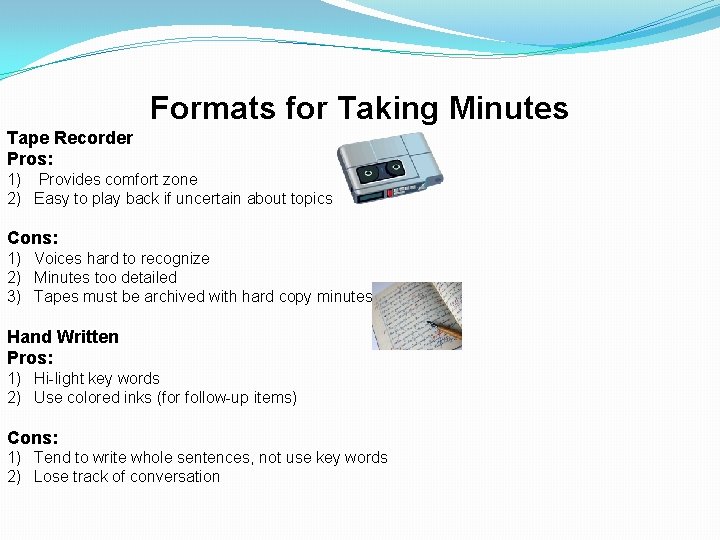
Formats for Taking Minutes Tape Recorder Pros: 1) Provides comfort zone 2) Easy to play back if uncertain about topics Cons: 1) Voices hard to recognize 2) Minutes too detailed 3) Tapes must be archived with hard copy minutes Hand Written Pros: 1) Hi-light key words 2) Use colored inks (for follow-up items) Cons: 1) Tend to write whole sentences, not use key words 2) Lose track of conversation
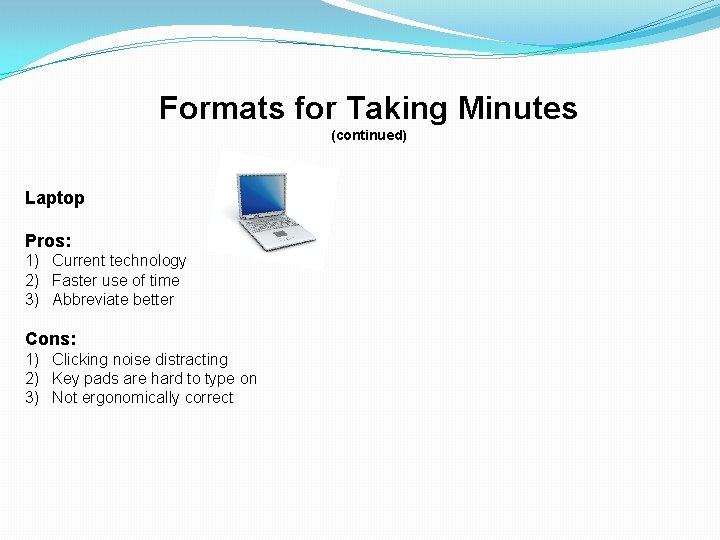
Formats for Taking Minutes (continued) Laptop Pros: 1) Current technology 2) Faster use of time 3) Abbreviate better Cons: 1) Clicking noise distracting 2) Key pads are hard to type on 3) Not ergonomically correct
Items to be Recorded 1) 2) 3) 4) 5) 6) Motions and resolutions verbatim Objective summary of what is being discussed Record a comment only once Never inject your own personal opinions Never give one person’s comments more weight than another’s Be consistent with reference to the attendees ( Ms. Jane Doe verses Jane Doe)
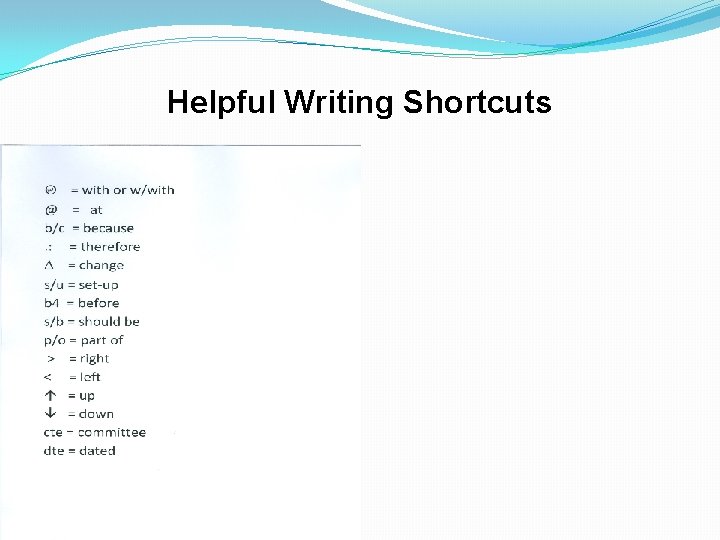
Helpful Writing Shortcuts
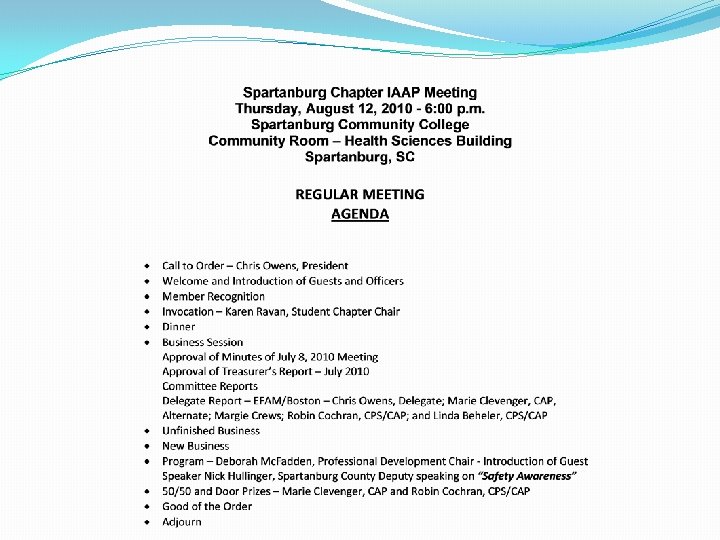
The Agenda Preparing the agenda is not part of the Minute-taking process but many recorders help the chair to write and circulate them. The purpose of the agenda is to familiarize all the participants with the topics that will be discussed at the meeting. There is no correct way to set up an agenda. There are many ways an agenda can be formatted. 1) The agenda for an informal meeting may be done as a simple numbered list of topics 2) The agenda formal meeting will typically call for a more structured list of topics The Layout of the Agenda 1) The heading of the agenda should be consistent with the heading on the minutes 2) The word “Agenda” can be at the top or bottom of the page 3) The agenda should be sent out before hand to allow the participants time to reflect on the meeting topics and to do research if needed 4) Agendas should be sent out at least 3 -days before the meeting (a week is preferable)
Organizing the Minutes Formal Minutes 1) Heading The heading should be 1 inch from the top of the page. Each heading line should be centered and be typed in either capitals or in upper/lower case letters. Use the same style for all of an organizations Minutes and Agendas. The location, time and date may be placed in the heading as well. In a formal meeting the Minutes should state if the meeting is a special or a regular meeting. 2) Attendance You must include the names of people attending the meeting and the people who are absent. The attendance record is necessary to show a quorum. . Guests must also be listed. Meeting chair must also be listed. 3) Minutes of previous meeting Minutes of the previous meeting should be approved at the beginning of the meeting (this is mostly done in formal meetings). The recorder stands to read the Minutes in a formal meeting. If minutes are corrected the changes occur in the margin near the correction or amendment. 4) Reports This refers to the reports received from any of the group’s members. Committee reports should be submitted in writing and dated. Copies of the report should be received in advance and attached to the agenda for members to review.
Organizing the Minutes (continued) 5) Finances are usually discussed under the treasurer’s report. 6) Correspondence Letters sent to the group are usually read by the recorder and then either filed or attached to the appendix of the Minutes. 7) Unfinished business This involves motions or issues raised at an earlier meeting and carried forward to the current meeting. Old business is always listed on the agenda. 8) New business This portion of the meeting is devoted solely to the introduction of new information. It may also include assigning tasks to members of the group and setting deadlines. 9) Adjournment The meeting is closed due to no further business or discussion. This is recorded in the minutes. 10) Signatures In the past, the phrase “respectfully submitted” was considered appropriate, now it is considered “old fashioned”, but still used by most organizations.
After the Meeting 1) Draft the minutes as soon after the meeting as possible 2) If time does not allow this, reread your notes to ensure they are detailed, so you can interpret later 3) Minutes need to be completed in a timely manner Minute Summary – Small Informal Meetings 1) Full minutes are not always required 2) Minute summaries are more useful for staff meetings where a multitude of topics are discussed 3) The summary simply records the meeting in an abbreviated format Retaining Minutes 1) Minutes should be maintained in hard copy form with signatures (minutes should be kept for 5 years) 2) If you record your minutes, the tapes should be kept and dated 3) If you use a laptop to record your minutes make sure you always have a back up disk 4) If there any questions or concerns about the minutes, the recorded and chair are the responsible parties
After the Meeting (continued) 5) After drafting the minutes, they should be distributed to the meeting attendees for review before finalizing and distribution 6) All finalized minutes should contain the signature of the recorder and meeting chair
Connecting Words Stage of Argument Initially At the onset Up to the present time So far Currently In sum Lastly Finally After all In Conclusion First Secondly Degree of Certainly Surely Indeed Perhaps Anyway Basically In any case Naturally Of course Probably Doubtlessly To a degree Example Indeed In fact In other words That is To illustrate For example For instance Summary To summarize In brief In short On the whole In essence Thus Briefly Consequence or Result As a rule Therefore As a result Hence Otherwise Apparently Fortunately So far this reason Consequently Accordingly
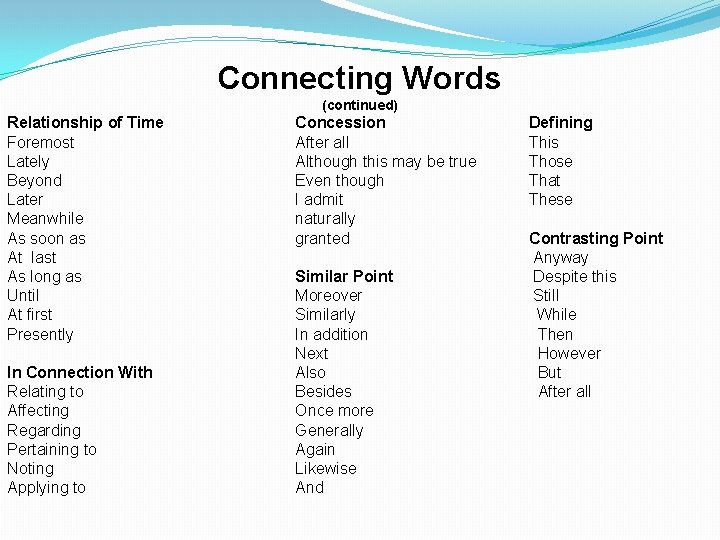
Connecting Words (continued) Relationship of Time Foremost Lately Beyond Later Meanwhile As soon as At last As long as Until At first Presently In Connection With Relating to Affecting Regarding Pertaining to Noting Applying to Concession After all Although this may be true Even though I admit naturally granted Similar Point Moreover Similarly In addition Next Also Besides Once more Generally Again Likewise And Defining This Those That These Contrasting Point Anyway Despite this Still While Then However But After all

Hope These Minute Taking Tips Have Brought A Smile to Your Face Have a Great day!!!!
- Slides: 26