
Minor Head Injury Case 1 One year old
- Slides: 10
Minor Head Injury
Case 1 • One year old child was playing in a swing and accidentally fell. Since the fall about 2 hours back she has vomited twice. • There is no history of seizures or LOC. There is history of bleeding from nose which stopped on its own in a couple of minutes. • The family is well known to you , & bring the older sibling also to you. • The only significant finding is a bruise over the occipital area. • What would be your plan of action ?
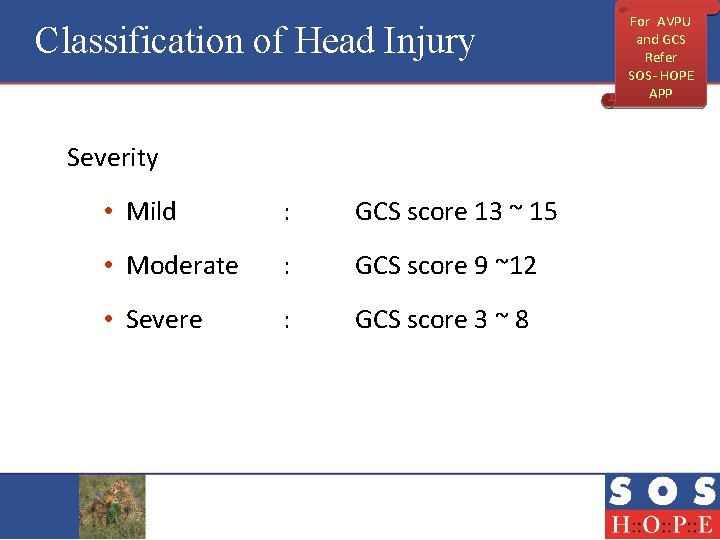
Classification of Head Injury Severity • Mild : GCS score 13 ~ 15 • Moderate : GCS score 9 ~12 • Severe : GCS score 3 ~ 8 For AVPU and GCS Refer SOS- HOPE APP
Importance of CT scan • Clinically important traumatic brain injury needs to be identified and scanned appropriately. • It is important to not subject patients to unnecessary scans as there is a small but definite increase in the incidence of leukemia & brain tumors in children subjected to radiation of CT ( 1 in 1500 )
Indications of CT scan in TBI • • • GCS < 14 Progressive headache Worsening level of consciousness, Definite Loss of Consciousness for more than few seconds, Focal or abnormal neurological findings, Seizure, Persistent Vomiting Penetrating skull injuries, Signs of a basal or depressed skull fracture,
Do not perform CT scan in… Low-risk patients should meet all of the following criteria • Normal mental status • No parietal, occipital or temporal scalp hematoma • No loss of consciousness >5 seconds • No evidence of skull fracture • Normal behavior according to the routine caregiver • No high-risk mechanism of injury
Historical features that may suggest an increased risk of brain injury Child younger than two years of age is not acting normally Seizure, confusion, or loss of consciousness ( > 5 seconds ) Severe or worsening headache Vomiting > 2 times after fall High-risk mechanism, such as a fall from greater than 3 to 5 feet , significant motor vehicle collision, penetrating injury, inflicted injury, or unwitnessed fall • Pre-existing conditions that place the child at risk for intracranial hemorrhage, such as arterio-venous malformation or a bleeding disorder • Concerns about non accidental trauma • • •
Physical findings that may suggest an increased risk of brain injury • Scalp abnormalities, such as hematoma> 3 cm in non frontal area , tenderness, or depression • In infants, bulging anterior fontanel • Abnormal mental status • Focal neurologic abnormality • Signs of basilar skull fracture
Disposition • Perform neuroimaging in all patients with high risk signs or symptoms • Observe for 4 -6 hours in all others. • Observation can be done at home by a compliant care giver or in the ER /Clinic • No role for X-ray of skull