
Minoan and Mycenaean Cultures Intro to Greek Architecture
- Slides: 52
Minoan and Mycenaean Cultures, Intro to Greek Architecture Submitted by WWW. ASSIGNMENTPOINT. COM www. assignmentpoint. com
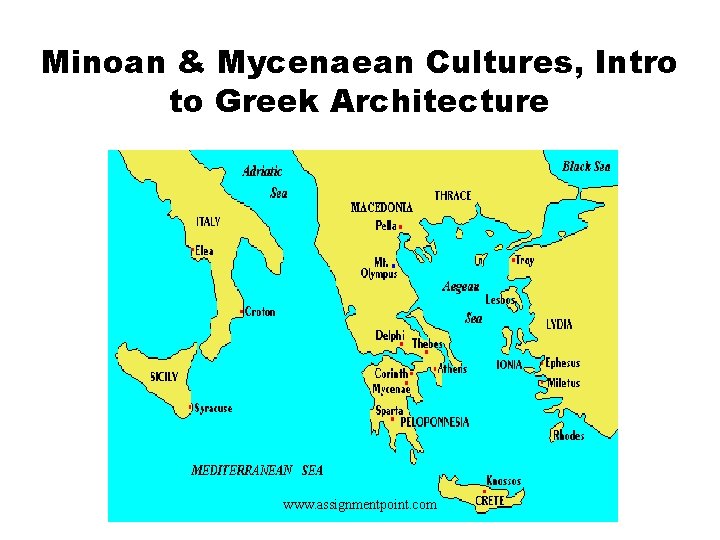
Minoan & Mycenaean Cultures, Intro to Greek Architecture www. assignmentpoint. com
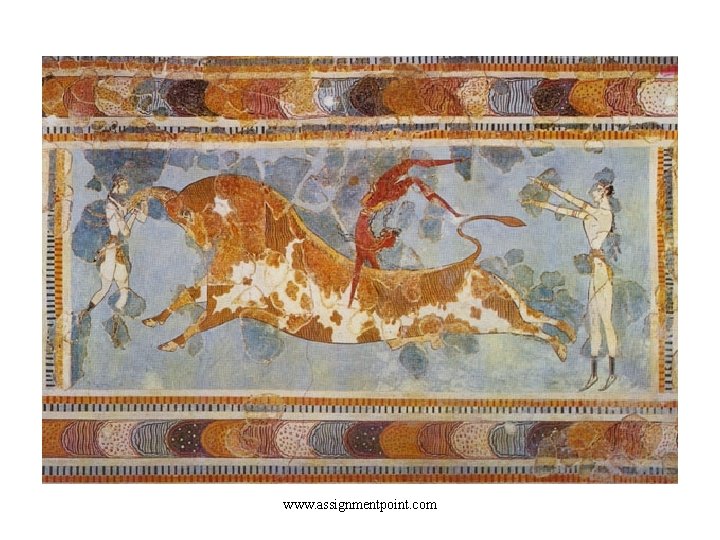
Crete • • About the time of the Middle Kingdom in Egypt, the seafaring peoples of the Aegean Sea (Eastern Mediterranean) had learned how to exploit natural resources such as timber, stone, metallic ores, and clay for pottery to produce distinctive artifacts. With these and other agricultural products they waged brisk trade with Egypt and other settlements in the Eastern Mediterranean, where they constructed small fortified settlements and villages on islands and the coastline. There was probably some contact with Mesopotamia also. Early Cretans worshipped nature deities associated with mountains, trees and animals, especially snakes. They also practiced bull-jumping, probably an off-shoot to the Sumerian practice of bull biting, similar to bull fighting in Spain. Lions associated with royalty in Egypt and Mesopotamia were appropriated by the Cretans, though they had no lions on the island. Egyptian artifacts from 18 th Dynasty have been retrieved from the harbor at Kairatos, Crete and 1300 pieces of Aegean pottery dating from 1370 – 1350 BCE were found in the rubbish heaps of Akhnaten and wall paintings during Hatshepsut’s reign depict envoys from Crete bearing characteristic pottery from the island. These early peoples are called Minoans, from Minos, an early king or the title, similar to Pharaoh. It was the later Greeks who created legends associated with King Minos of Crete. www. assignmentpoint. com
www. assignmentpoint. com
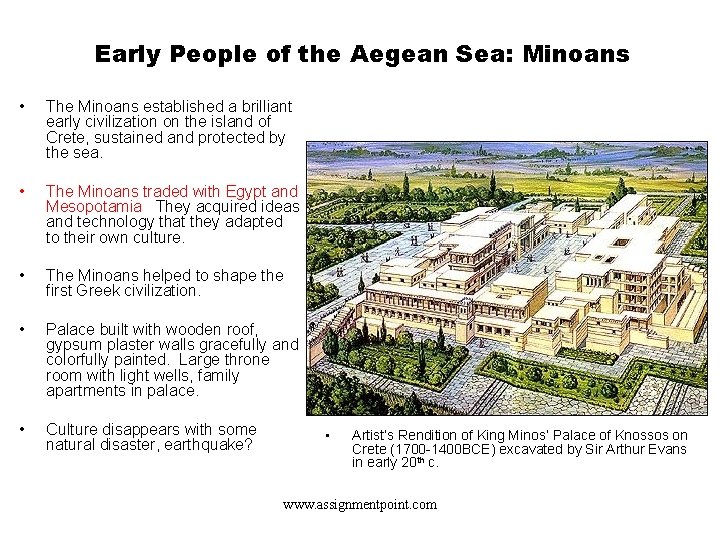
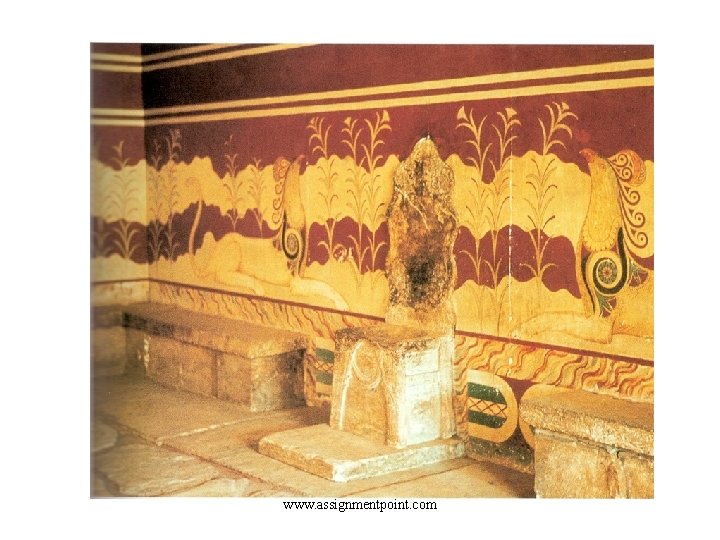
Early People of the Aegean Sea: Minoans • The Minoans established a brilliant early civilization on the island of Crete, sustained and protected by the sea. • The Minoans traded with Egypt and Mesopotamia. They acquired ideas and technology that they adapted to their own culture. • The Minoans helped to shape the first Greek civilization. • Palace built with wooden roof, gypsum plaster walls gracefully and colorfully painted. Large throne room with light wells, family apartments in palace. • Culture disappears with some natural disaster, earthquake? • Artist’s Rendition of King Minos’ Palace of Knossos on Crete (1700 -1400 BCE) excavated by Sir Arthur Evans in early 20 th c. www. assignmentpoint. com
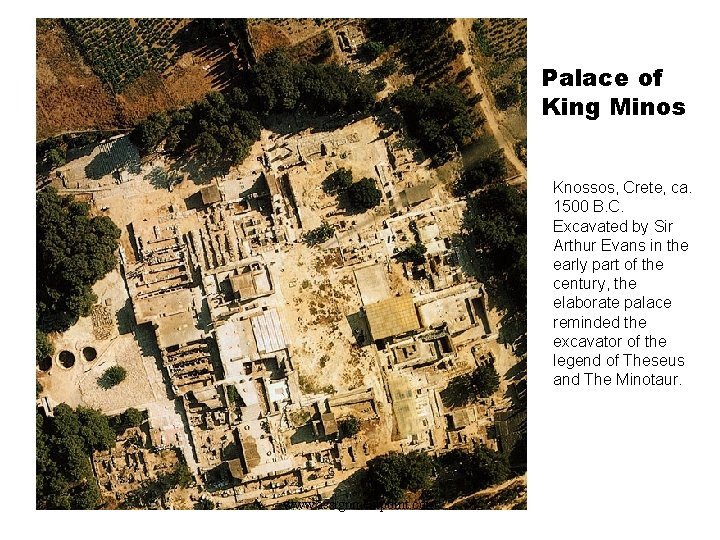
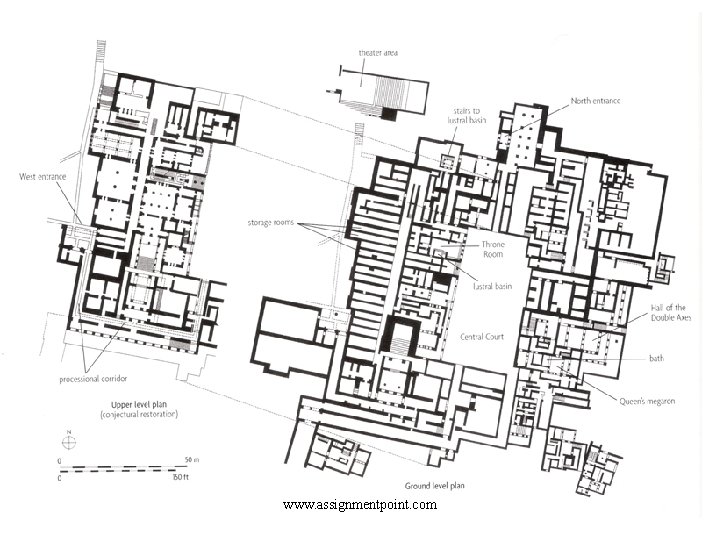
In Greek mythology, the labyrinth of Crete was derived from the elaborate floor plan of the Palace at Knossos. Daedalus the Athenian craftsman, was the architect and inventor who designed for King Minos of Crete the labyrinth in which was imprisoned the Minotaur, a man-eating monster that was half man and half bull. The labyrinth was so skillfully designed that no one could escape from the maze or the Minotaur. Daedalus revealed the secret of the labyrinth only to Ariadne, daughter of Minos, and she aided her lover, the Athenian hero Theseus, to slay the monster and escape. In anger at the escape, Minos imprisoned Daedalus and his son Icarus in the labyrinth. Although the prisoners could not find the exit, Daedalus made waxwings so that they could both fly out of the maze. Icarus, however, flew too near the sun; his wings melted, and he fell into the sea. Daedalus flew to Sicily, where he was welcomed by King Cocalus. Minos later pursued Daedalus but was killed by the daughters of Cocalus. www. assignmentpoint. com Palace of King Minos Knossos, Crete, ca. 1500 B. C. Excavated by Sir Arthur Evans in the early part of the century, the elaborate palace reminded the excavator of the legend of Theseus and The Minotaur.
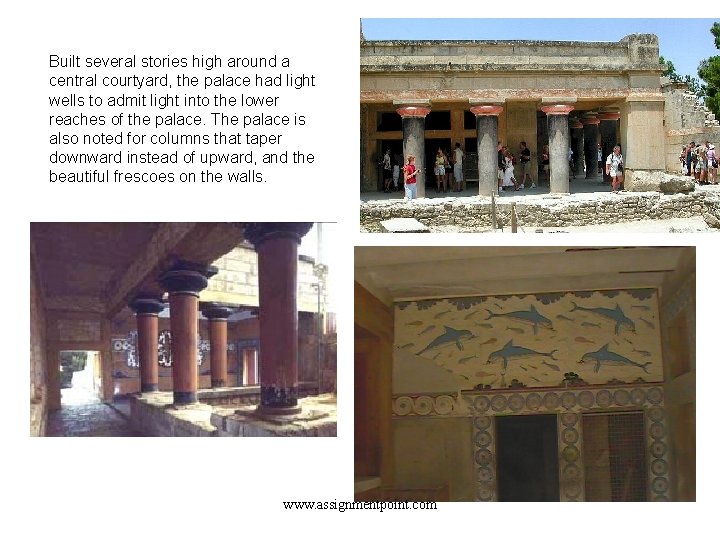
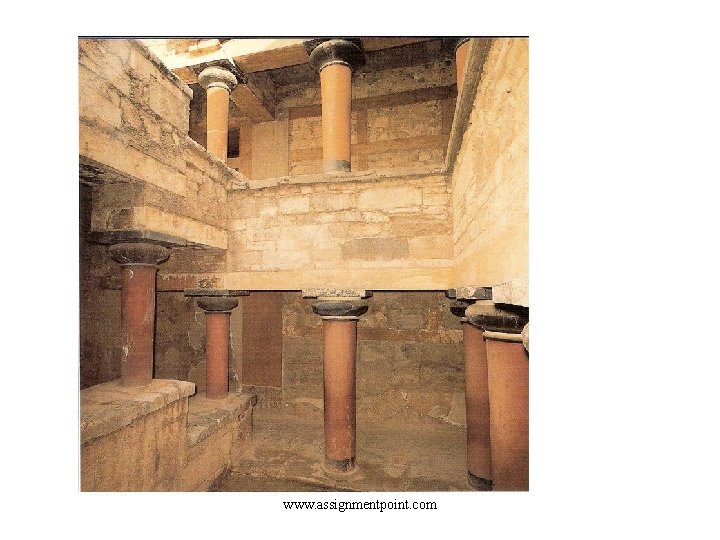
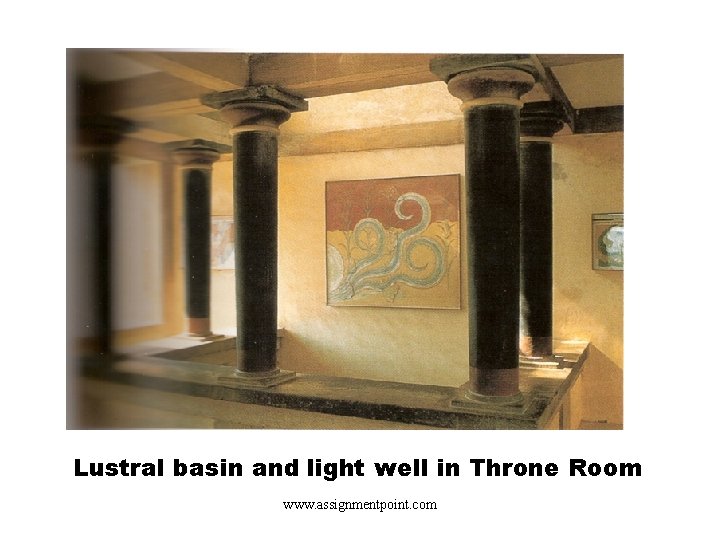
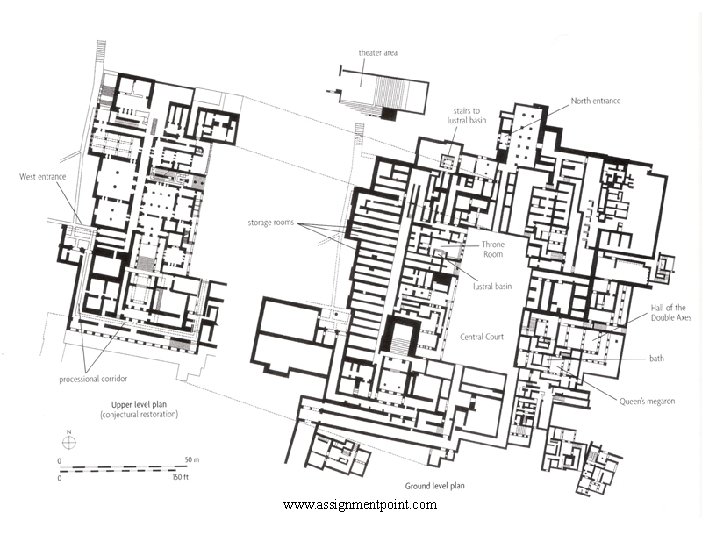
Built several stories high around a central courtyard, the palace had light wells to admit light into the lower reaches of the palace. The palace is also noted for columns that taper downward instead of upward, and the beautiful frescoes on the walls. www. assignmentpoint. com
www. assignmentpoint. com
www. assignmentpoint. com
Lustral basin and light well in Throne Room www. assignmentpoint. com
www. assignmentpoint. com
www. assignmentpoint. com
www. assignmentpoint. com
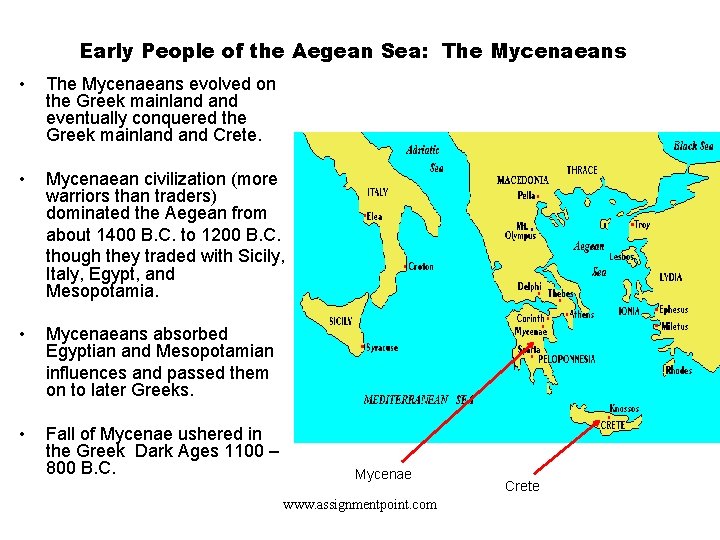
Early People of the Aegean Sea: The Mycenaeans • The Mycenaeans evolved on the Greek mainland eventually conquered the Greek mainland Crete. • Mycenaean civilization (more warriors than traders) dominated the Aegean from about 1400 B. C. to 1200 B. C. though they traded with Sicily, Italy, Egypt, and Mesopotamia. • Mycenaeans absorbed Egyptian and Mesopotamian influences and passed them on to later Greeks. • Fall of Mycenae ushered in the Greek Dark Ages 1100 – 800 B. C. Mycenae www. assignmentpoint. com Crete
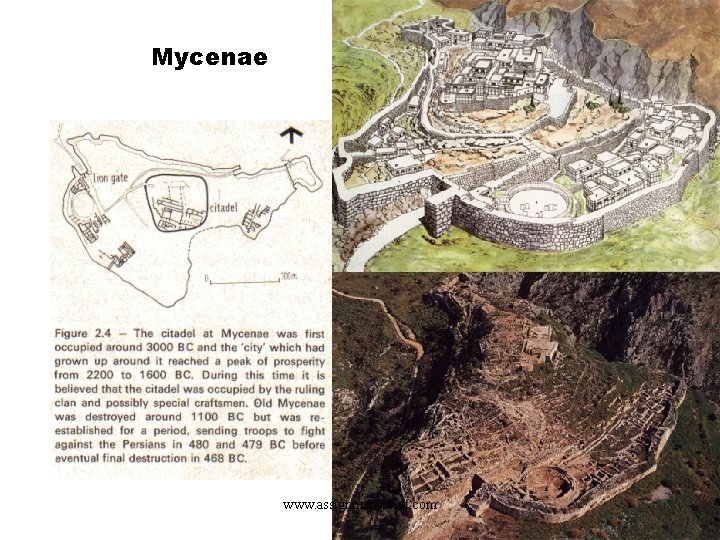
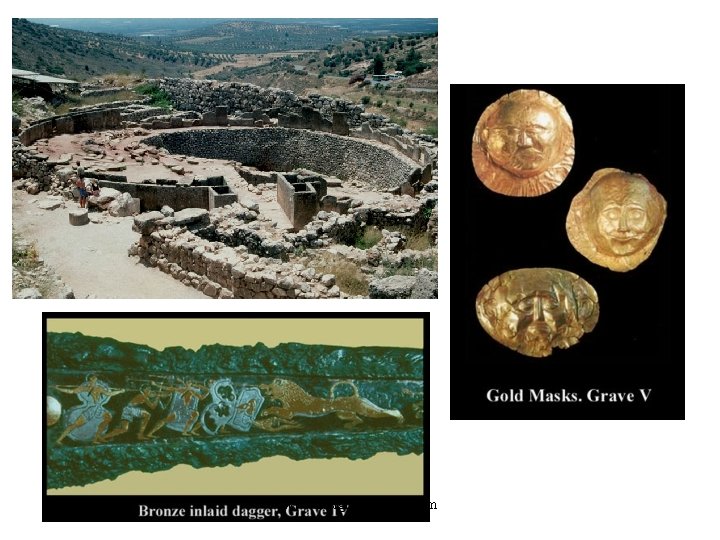
Mycenae www. assignmentpoint. com
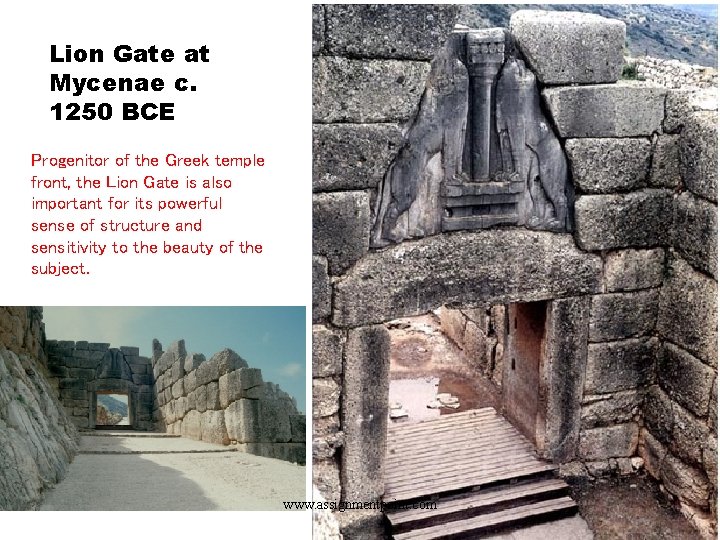
Lion Gate at Mycenae c. 1250 BCE Progenitor of the Greek temple front, the Lion Gate is also important for its powerful sense of structure and sensitivity to the beauty of the subject. www. assignmentpoint. com
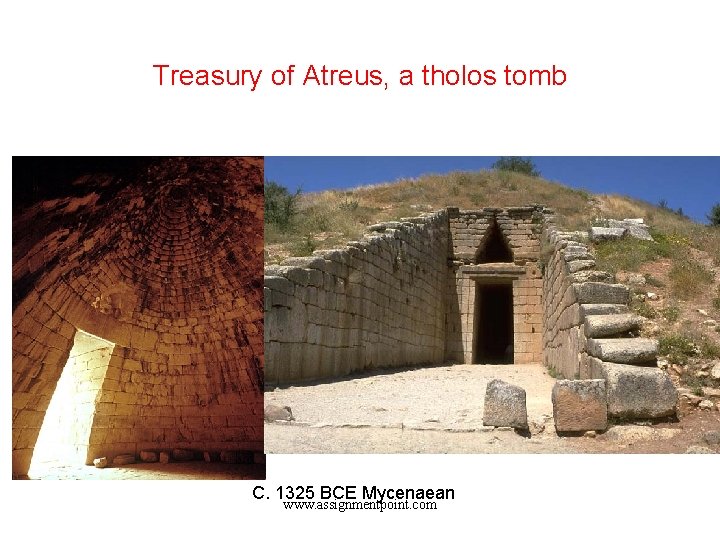
Treasury of Atreus, a tholos tomb C. 1325 BCE Mycenaean www. assignmentpoint. com
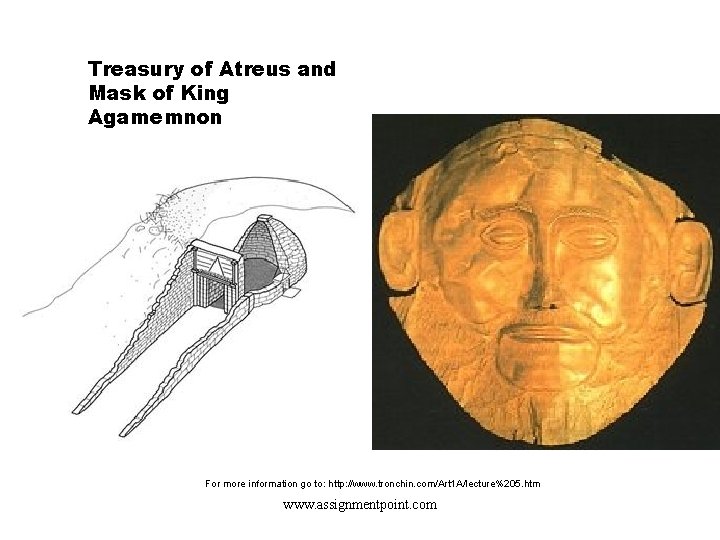
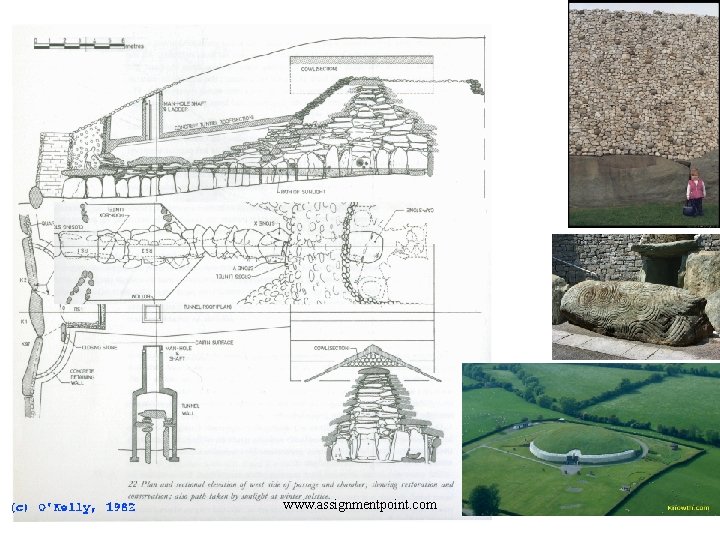
Treasury of Atreus and Mask of King Agamemnon For more information go to: http: //www. tronchin. com/Art 1 A/lecture%205. htm www. assignmentpoint. com
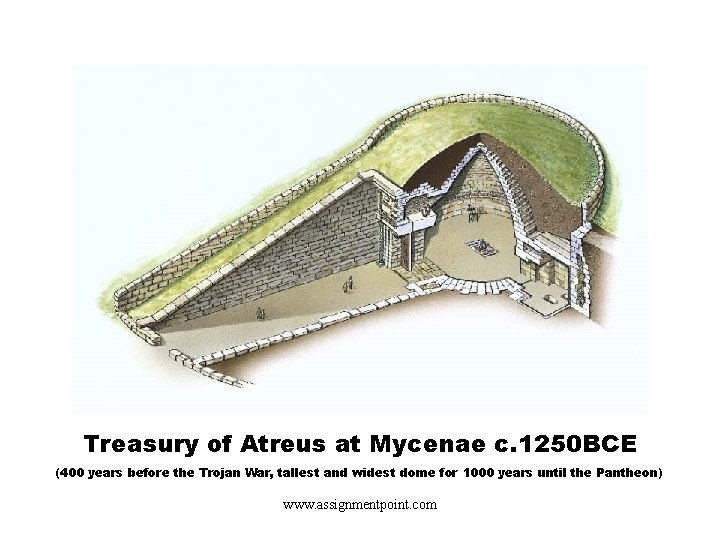
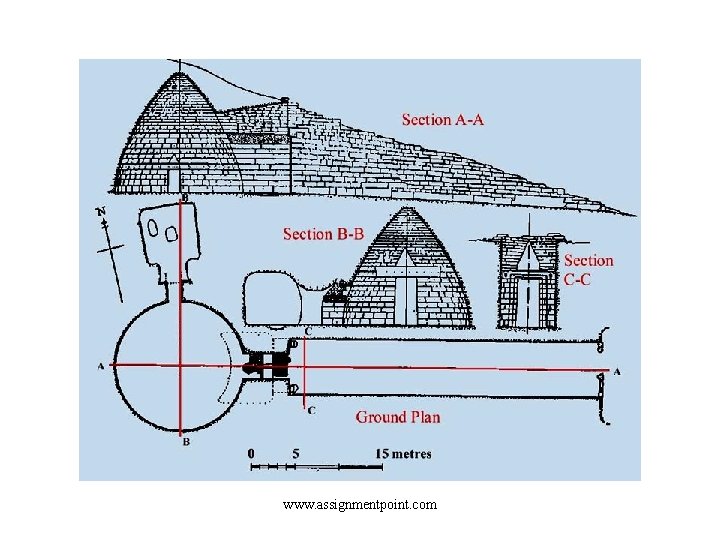
Treasury of Atreus at Mycenae c. 1250 BCE (400 years before the Trojan War, tallest and widest dome for 1000 years until the Pantheon) www. assignmentpoint. com
www. assignmentpoint. com
www. assignmentpoint. com
www. assignmentpoint. com
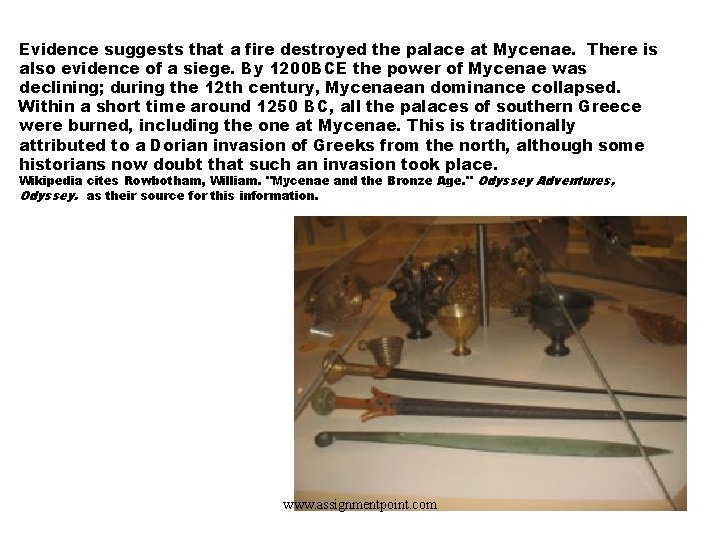
Evidence suggests that a fire destroyed the palace at Mycenae. There is also evidence of a siege. By 1200 BCE the power of Mycenae was declining; during the 12 th century, Mycenaean dominance collapsed. Within a short time around 1250 BC, all the palaces of southern Greece were burned, including the one at Mycenae. This is traditionally attributed to a Dorian invasion of Greeks from the north, although some historians now doubt that such an invasion took place. Wikipedia cites Rowbotham, William. "Mycenae and the Bronze Age. " Odyssey Adventures, Odyssey. as their source for this information. www. assignmentpoint. com
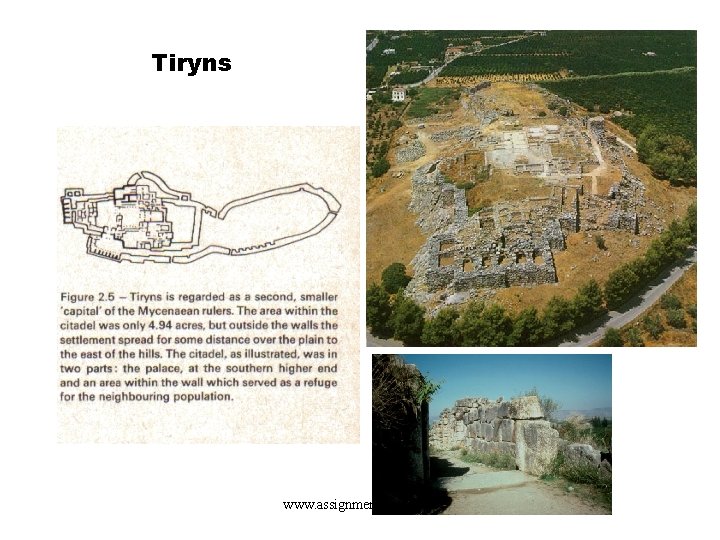
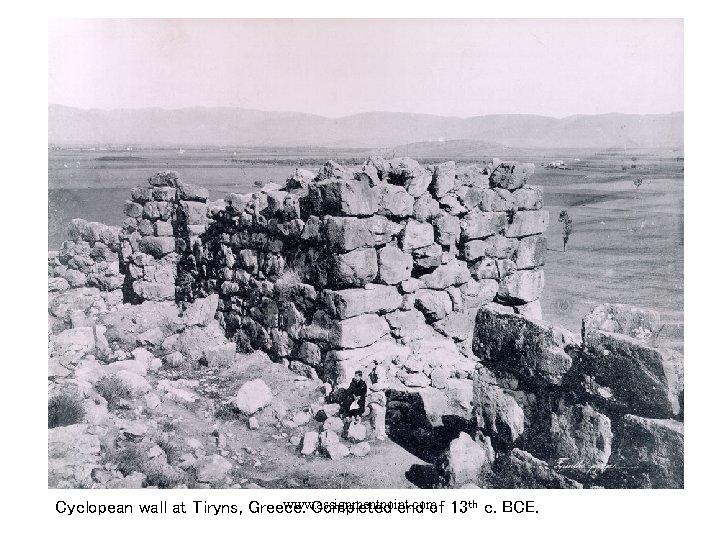
Tiryns www. assignmentpoint. com
www. assignmentpoint. com Cyclopean wall at Tiryns, Greece. Completed end of 13 th c. BCE.
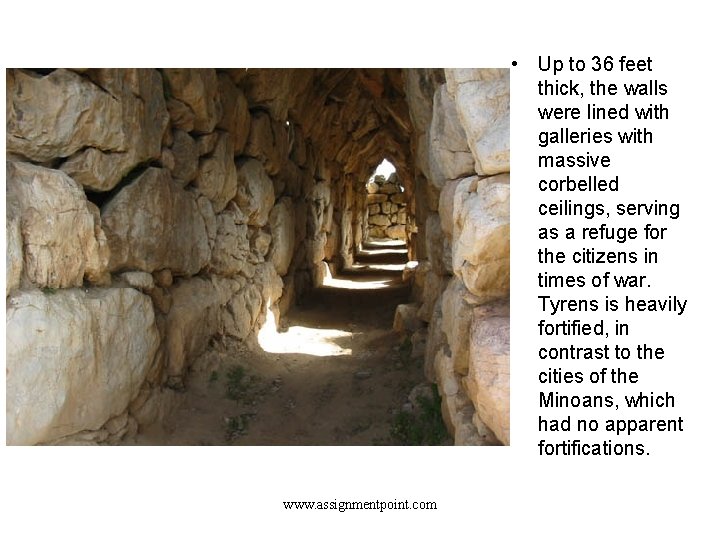
• Up to 36 feet thick, the walls were lined with galleries with massive corbelled ceilings, serving as a refuge for the citizens in times of war. Tyrens is heavily fortified, in contrast to the cities of the Minoans, which had no apparent fortifications. www. assignmentpoint. com
www. assignmentpoint. com
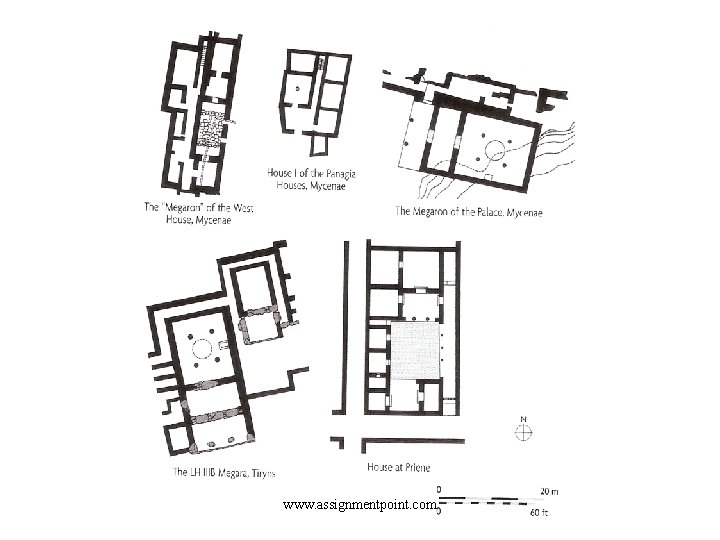
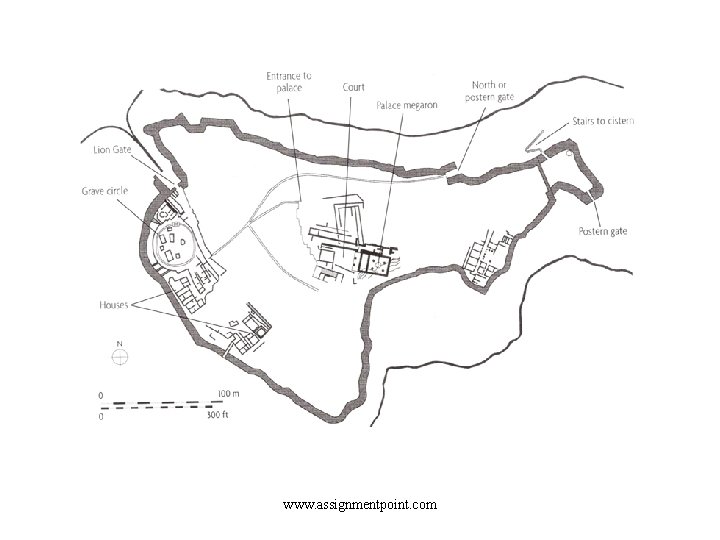
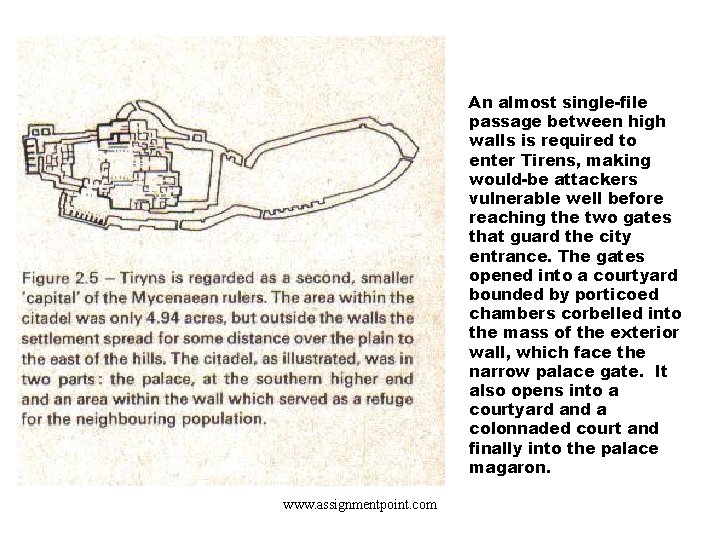
An almost single-file passage between high walls is required to enter Tirens, making would-be attackers vulnerable well before reaching the two gates that guard the city entrance. The gates opened into a courtyard bounded by porticoed chambers corbelled into the mass of the exterior wall, which face the narrow palace gate. It also opens into a courtyard and a colonnaded court and finally into the palace magaron. www. assignmentpoint. com
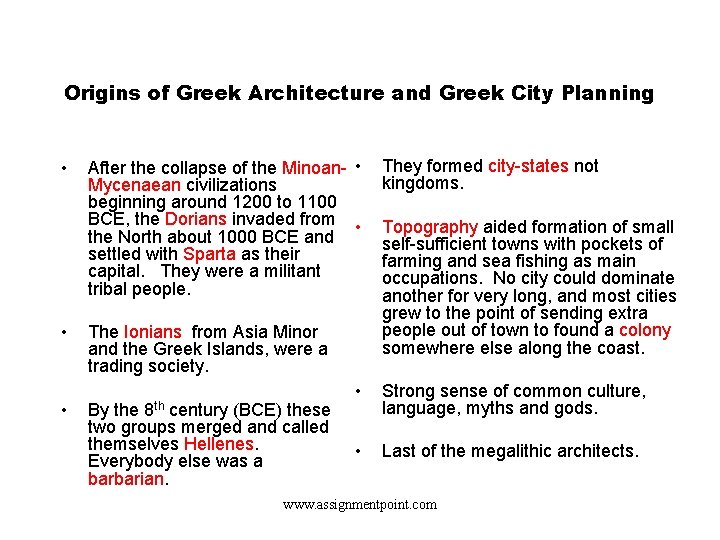
Origins of Greek Architecture and Greek City Planning • • • After the collapse of the Minoan- • Mycenaean civilizations beginning around 1200 to 1100 BCE, the Dorians invaded from • the North about 1000 BCE and settled with Sparta as their capital. They were a militant tribal people. The Ionians, from Asia Minor and the Greek Islands, were a trading society. 8 th By the century (BCE) these two groups merged and called themselves Hellenes. Everybody else was a barbarian. They formed city-states not kingdoms. Topography aided formation of small self-sufficient towns with pockets of farming and sea fishing as main occupations. No city could dominate another for very long, and most cities grew to the point of sending extra people out of town to found a colony somewhere else along the coast. • Strong sense of common culture, language, myths and gods. • Last of the megalithic architects. www. assignmentpoint. com
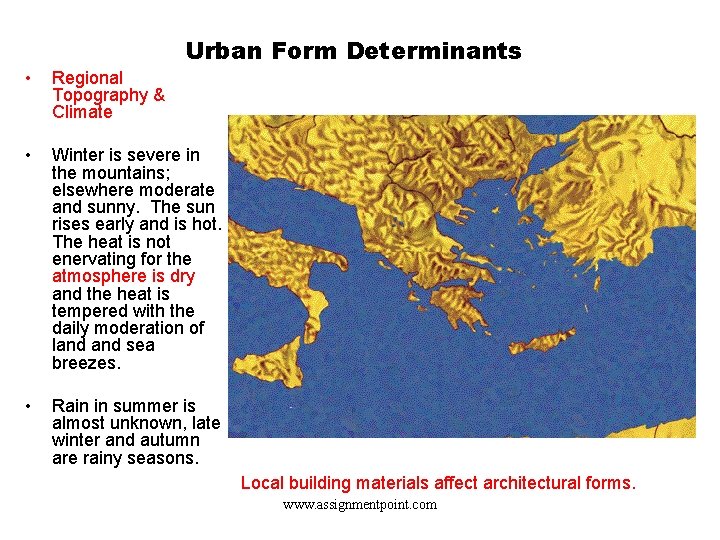
Urban Form Determinants • Regional Topography & Climate • Winter is severe in the mountains; elsewhere moderate and sunny. The sun rises early and is hot. The heat is not enervating for the atmosphere is dry, and the heat is tempered with the daily moderation of land sea breezes. • Rain in summer is almost unknown, late winter and autumn are rainy seasons. Local building materials affect architectural forms. www. assignmentpoint. com
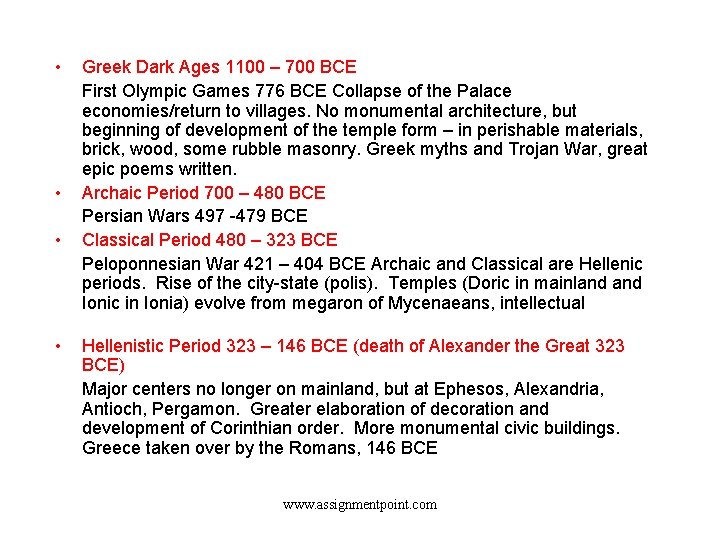
• • Chronology Greek Dark Ages 1100 – 700 BCE First Olympic Games 776 BCE Collapse of the Palace economies/return to villages. No monumental architecture, but beginning of development of the temple form – in perishable materials, brick, wood, some rubble masonry. Greek myths and Trojan War, great epic poems written. Archaic Period 700 – 480 BCE Persian Wars 497 -479 BCE Classical Period 480 – 323 BCE Peloponnesian War 421 – 404 BCE Archaic and Classical are Hellenic periods. Rise of the city-state (polis). Temples (Doric in mainland Ionic in Ionia) evolve from megaron of Mycenaeans, intellectual approach to architecture with emphasis on form. Hellenistic Period 323 – 146 BCE (death of Alexander the Great 323 BCE) Major centers no longer on mainland, but at Ephesos, Alexandria, Antioch, Pergamon. Greater elaboration of decoration and development of Corinthian order. More monumental civic buildings. Greece taken over by the Romans, 146 BCE www. assignmentpoint. com
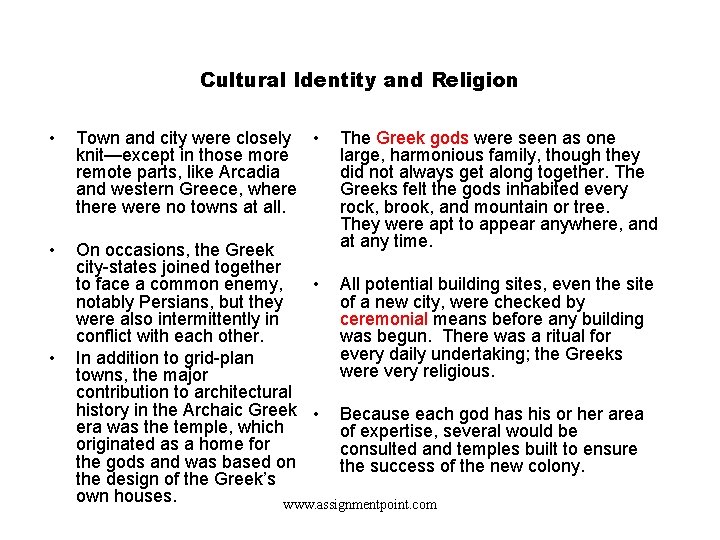
Cultural Identity and Religion • Town and city were closely • knit—except in those more remote parts, like Arcadia and western Greece, where there were no towns at all. • On occasions, the Greek city-states joined together to face a common enemy, • All potential building sites, even the site notably Persians, but they of a new city, were checked by were also intermittently in ceremonial means before any building conflict with each other. was begun. There was a ritual for every daily undertaking; the Greeks In addition to grid-plan were very religious. towns, the major contribution to architectural history in the Archaic Greek • Because each god has his or her area era was the temple, which of expertise, several would be originated as a home for consulted and temples built to ensure the gods and was based on the success of the new colony. the design of the Greek’s own houses. www. assignmentpoint. com • The Greek gods were seen as one large, harmonious family, though they did not always get along together. The Greeks felt the gods inhabited every rock, brook, and mountain or tree. They were apt to appear anywhere, and at any time.
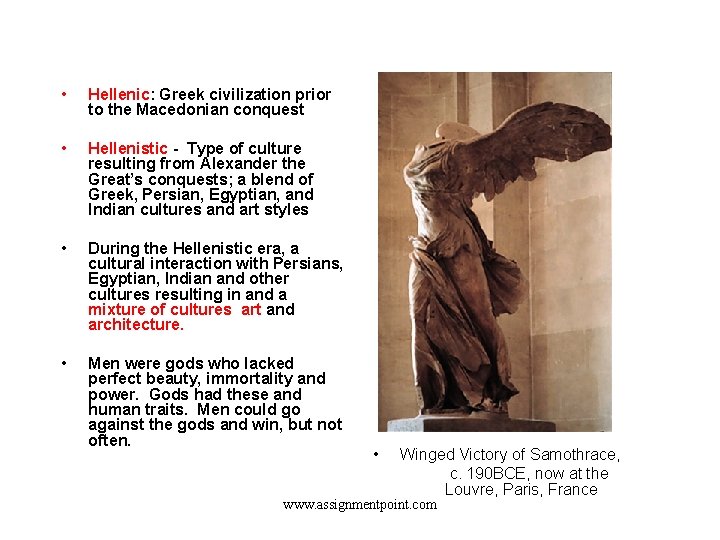
Hellenic and Hellenistic • Hellenic: Greek civilization prior to the Macedonian conquest • Hellenistic - Type of culture resulting from Alexander the Great’s conquests; a blend of Greek, Persian, Egyptian, and Indian cultures and art styles • During the Hellenistic era, a cultural interaction with Persians, Egyptian, Indian and other cultures resulting in and a mixture of cultures, art and architecture. • Men were gods who lacked perfect beauty, immortality and power. Gods had these and human traits. Men could go against the gods and win, but not often. • Winged Victory of Samothrace, c. 190 BCE, now at the Louvre, Paris, France www. assignmentpoint. com
Greek altars of Classical times were always under the open sky. Hera may have been the first to whom an enclosed roofed temple sanctuary was dedicated, at Samos about 800 BCE. (It was replaced later by the Heraion, one of the largest Greek temples anywhere. ) There were many temples built on this site so evidence is somewhat confusing and archaeological dates are confused. We know that the temple from the architect Rhoechus was destroyed between 570 - 60 BC. This was replaced by the Polycratean temple 540 -530 BC. In one of these temples we see a forest of 155 columns. There is also no evidence of tiles on this temple suggesting either the temple was never finished or that the temple was open to the sky. Samos excavations have revealed votive offerings, many of them late 8 th and 7 th century, which reveal that Hera at Samos was not merely a local Greek goddess of the Aegean: the museum there contains figures of gods and suppliants and other votive offerings from Armenia, Babylon, Persia, Assyria, Egypt, testimony to the reputation which this sanctuary of Hera enjoyed and to the large influx of pilgrims. This mighty goddess also possessed the earliest temple at Olympia and two of the great fifth and sixth century temples of Paestum. wikipedia www. assignmentpoint. com
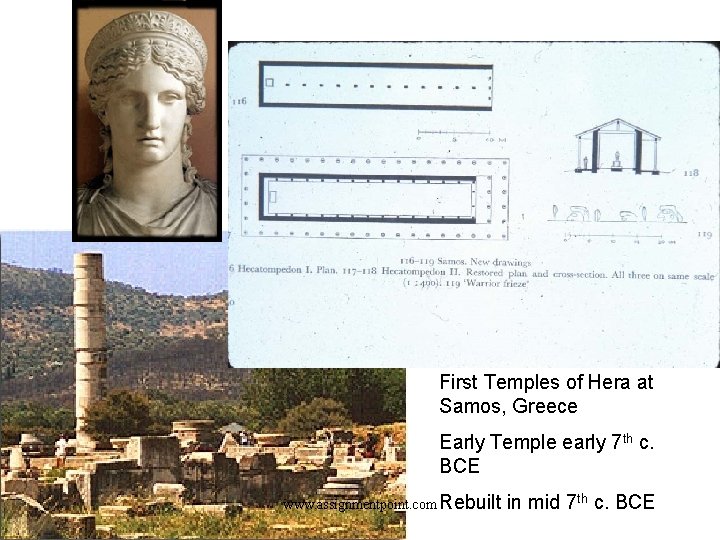
First Temples of Hera at Samos, Greece Early Temple early 7 th c. BCE www. assignmentpoint. com Rebuilt in mid 7 th c. BCE
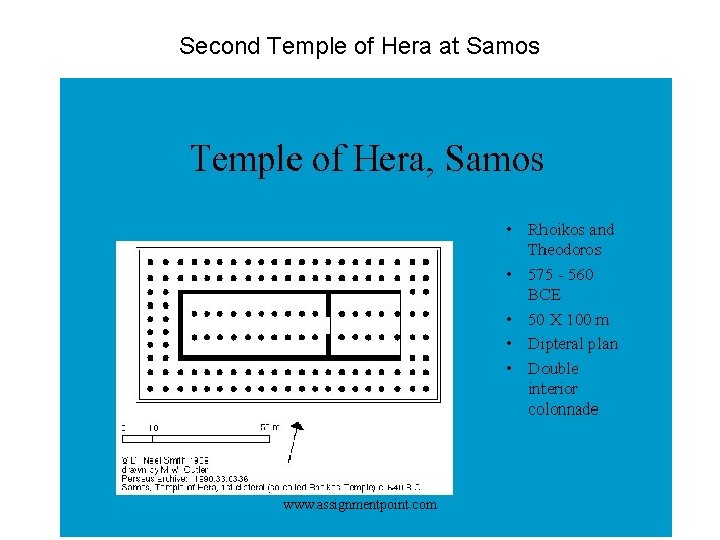
Second Temple of Hera at Samos www. assignmentpoint. com
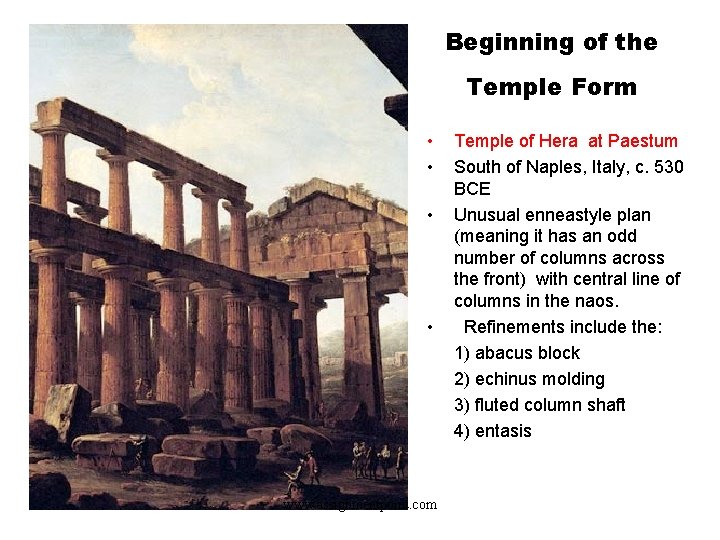
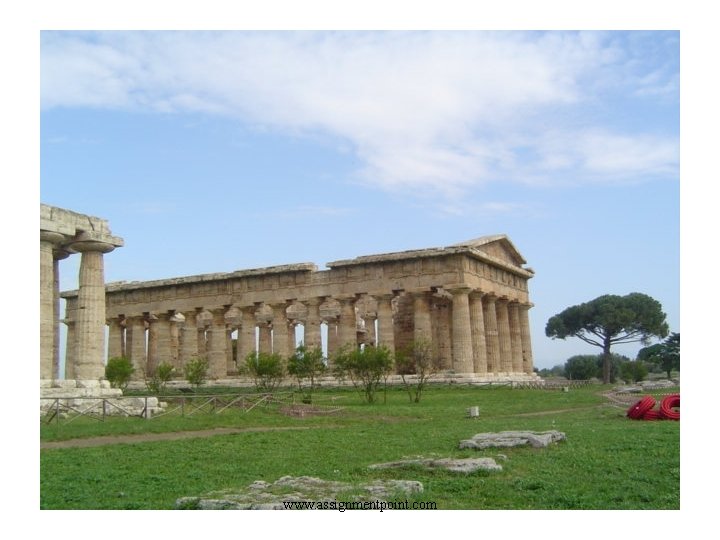
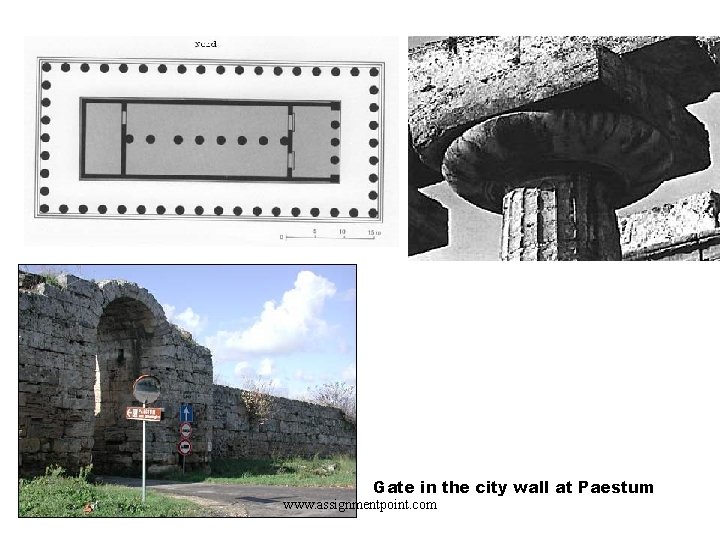
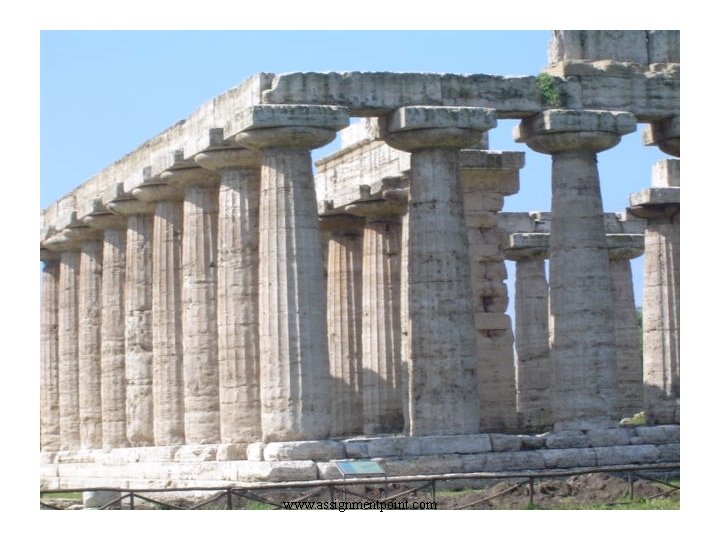
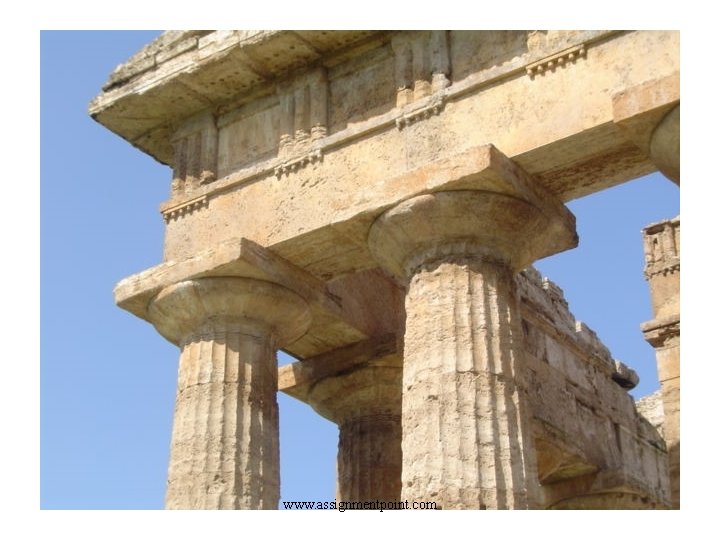
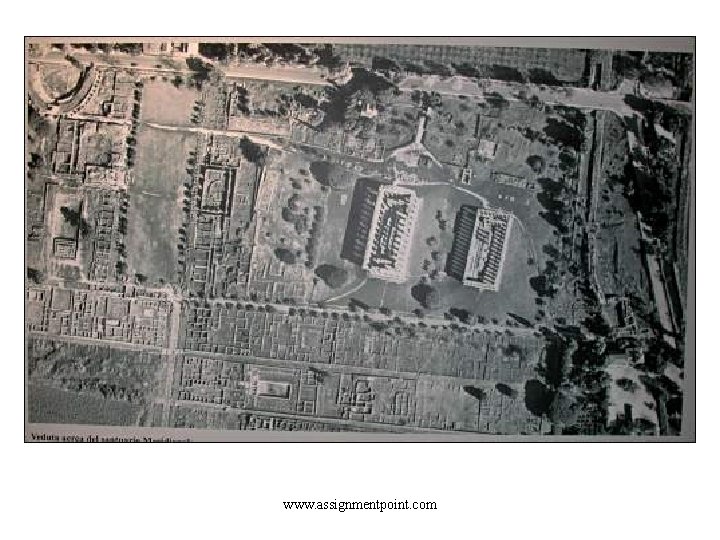
Beginning of the Temple Form • • www. assignmentpoint. com Temple of Hera at Paestum, South of Naples, Italy, c. 530 BCE Unusual enneastyle plan (meaning it has an odd number of columns across the front) with central line of columns in the naos. Refinements include the: 1) abacus block 2) echinus molding 3) fluted column shaft 4) entasis
www. assignmentpoint. com
Gate in the city wall at Paestum www. assignmentpoint. com
www. assignmentpoint. com
www. assignmentpoint. com
www. assignmentpoint. com
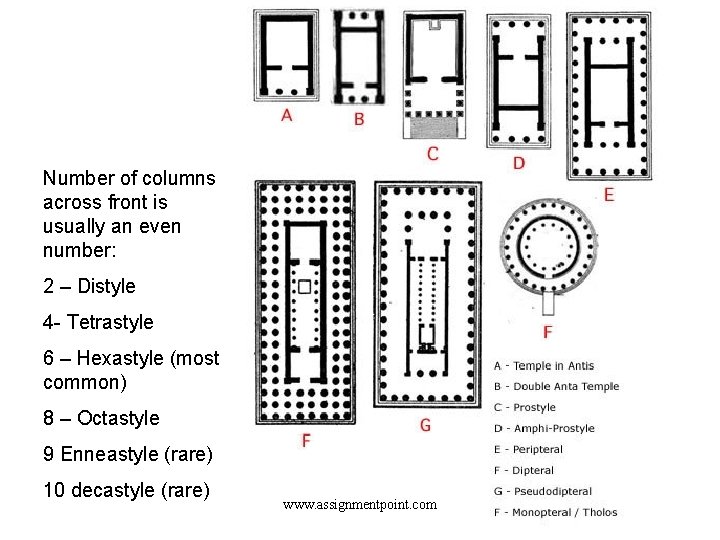
Greek Temple Styles Number of columns across front is usually an even number: 2 – Distyle 4 - Tetrastyle 6 – Hexastyle (most common) 8 – Octastyle 9 Enneastyle (rare) 10 decastyle (rare) www. assignmentpoint. com
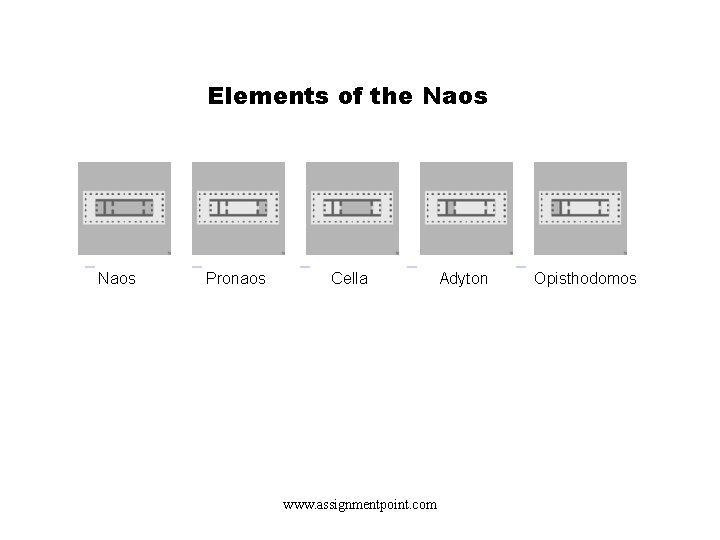
Elements of the Naos Pronaos Cella www. assignmentpoint. com Adyton Opisthodomos
Number of columns along the temple’s sides is calculated by this formula: Number across the front X 2 plus 1 So an octastyle has 8 X 2 = 16 + 1 = 17 columns along each side. Intercolumnation is the spacing between columns. Pycnostyle = 1 ½ diameter Systyle = 2 diameters Eustyle = 2 ¼ diameters Diastyle = 3 diameters Aracostyle = 3 ½ diameters The majority of Greek Temples were Hexastyle Peripteral, but the Parthenon was Octastyle Peripteral. www. assignmentpoint. com
• The first temples were mudbrick structures on stone foundations. • The columns and superstructure were wooden, door openings and antae were protected with wooden planks. The mudbrick walls were often reinforced by wooden posts, in a type of halftimbered technique. • Near the end of the 7 th c BCE, the dimensions of these simple structures were increased considerably. • Since it was not technically possible to roof broad spaces at that time, these temples remained very narrow, at 6 to 10 m width. • To stress the importance of the cult statue and the building holding it, the naos was equipped with a canopy, supported by columns. • As time went on mudbrick and wooden temples were replaced with stone as a building material. Many features of the wooden construction were carried over into the stone. www. assignmentpoint. com
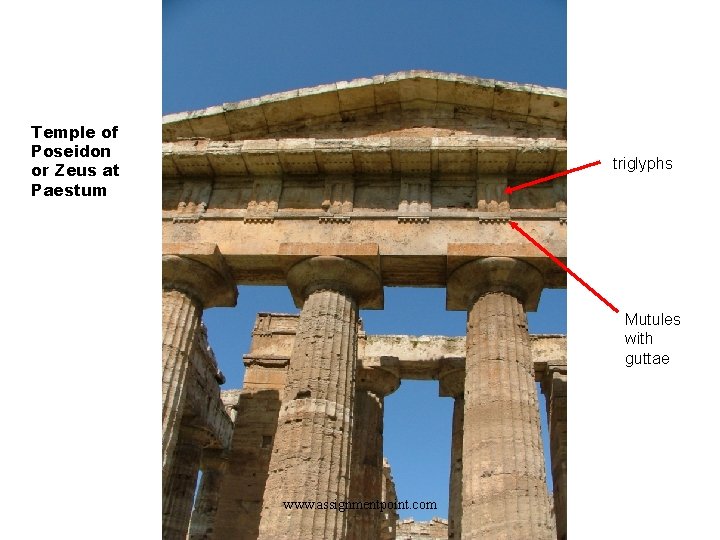
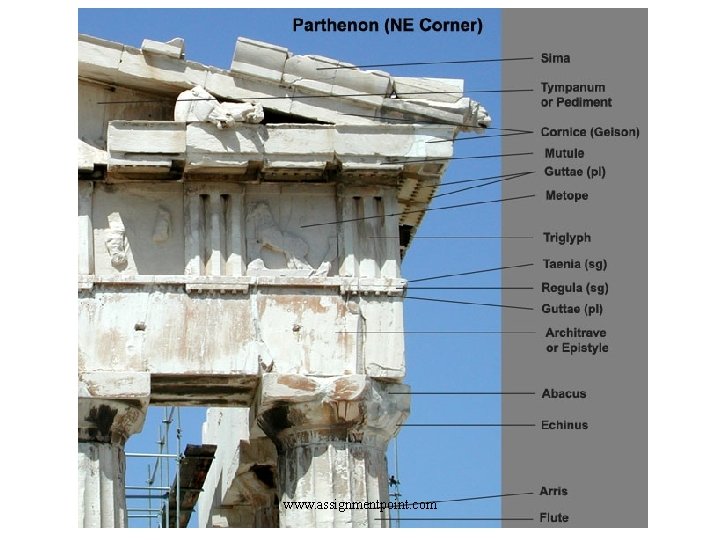
Temple of Poseidon, Paestum Temple of Poseidon or Zeus at Paestum triglyphs Mutules with guttae www. assignmentpoint. com
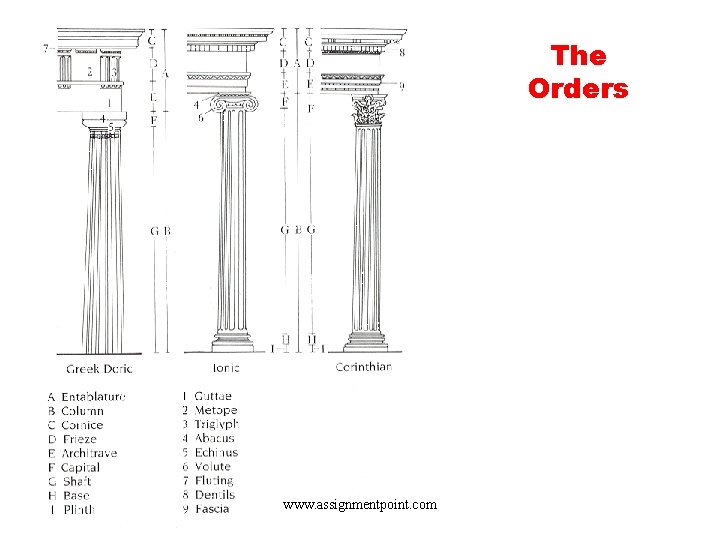
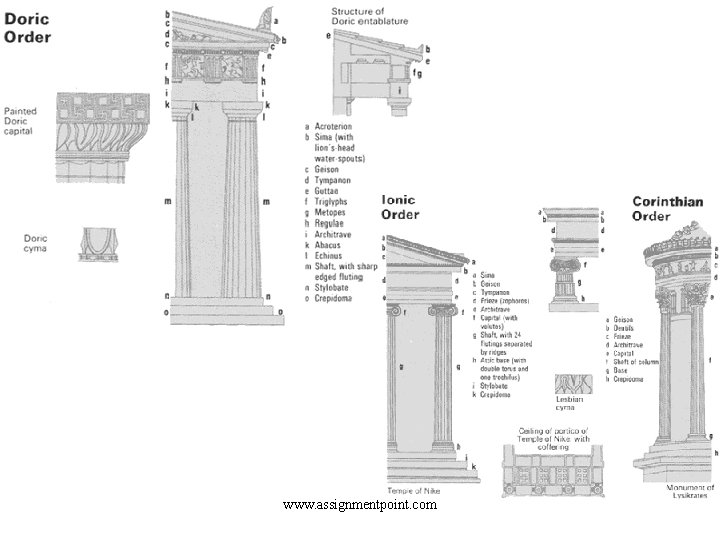
The Orders www. assignmentpoint. com
www. assignmentpoint. com
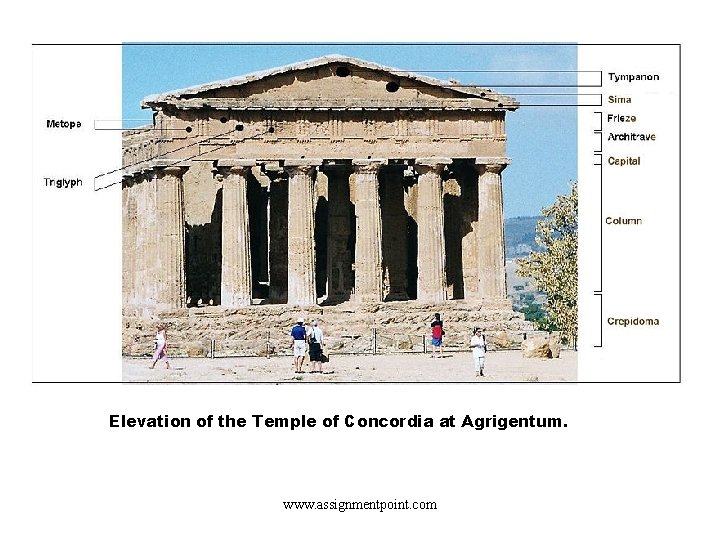
Elevation of the Temple of Concordia at Agrigentum. www. assignmentpoint. com
www. assignmentpoint. com
www. assignmentpoint. com