
Ministry of Education Secondary Engagement Programme September 2020

Ministry of Education Secondary Engagement Programme September 2020 Grade 9 Agricultural Science Week 2 Lesson # 2 Topic: Animal Nutrition Subtopic: Sources of Food 1
2 Sources of Food All animal feeds are derived from four sources: - Crops other than forage - By products of crops and animal processing - Natural or planted forage - The synthesis from non biological material

3 Classification of livestock feed Most feeds for livestock maybe classified into two major types: (1) Roughage -Roughage has a large amount of crude fibre -Roughage may be divided into two: Dry Roughage and Succulents -Succulents are sub divided in to (i) Green forages (ii) Root crops (2) Concentrates - Concentrates contains less crude fibre and relatively large quantity of major food constituents - Concentrates are divided into: Plant and Animal origin (3) Other feeds These include new type of feed that are manufactured

4 Rations A maintenance ration is the amount of food need to prevent increase or decrease in the live weight of the animal -It is just sufficient to maintain the supplies the energy and protein for all metabolic activities A production ration is any mixture of foods that is supplied in excess of maintenance of meat, milk, or egg production Flushing – Feeding production ration is used to increase the fertility rate of the female Steaming up – Feeding a production ration given during the late stages of pregnancy to increase the mammary tissues and blood supply. A balance diet is one that contains all the food nutrients in the right proportion for growth and production.

5 Pasture grasses Legumes The most common legumes grown in pastures in the Caribbean in the Kudzu. Other legumes are phasey bean, river tamarind , some species of pigeon peas and Alfalfa.
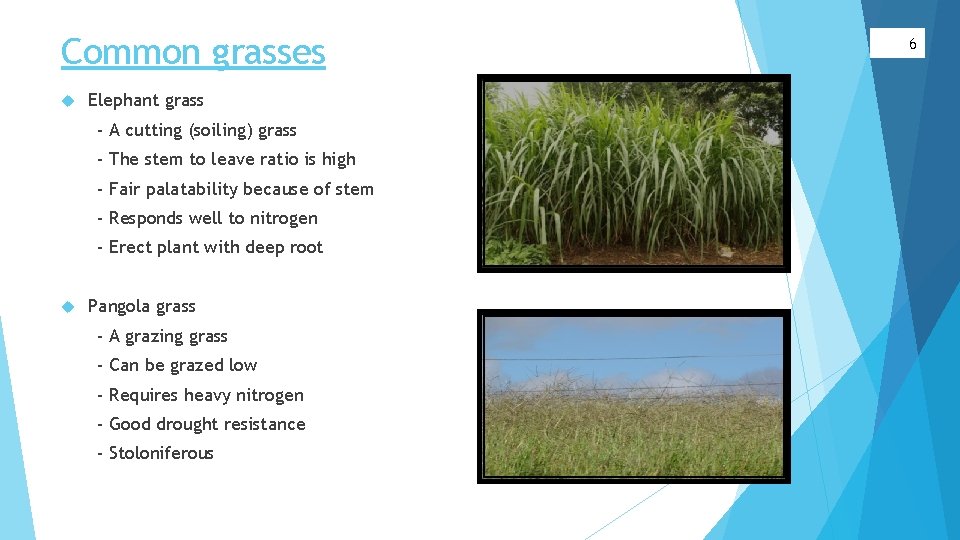
Common grasses Elephant grass - A cutting (soiling) grass - The stem to leave ratio is high - Fair palatability because of stem - Responds well to nitrogen - Erect plant with deep root Pangola grass - A grazing grass - Can be grazed low - Requires heavy nitrogen - Good drought resistance - Stoloniferous 6
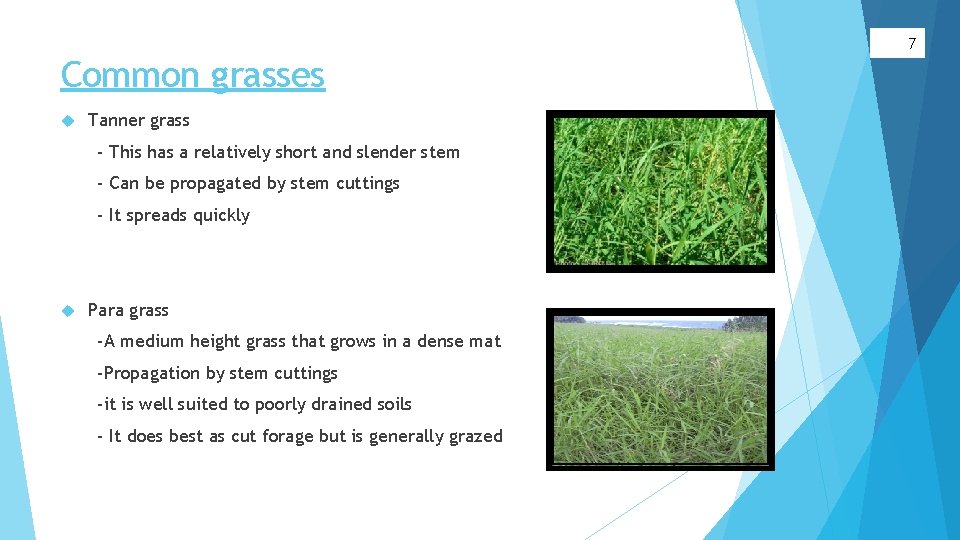
7 Common grasses Tanner grass - This has a relatively short and slender stem - Can be propagated by stem cuttings - It spreads quickly Para grass -A medium height grass that grows in a dense mat -Propagation by stem cuttings -it is well suited to poorly drained soils - It does best as cut forage but is generally grazed
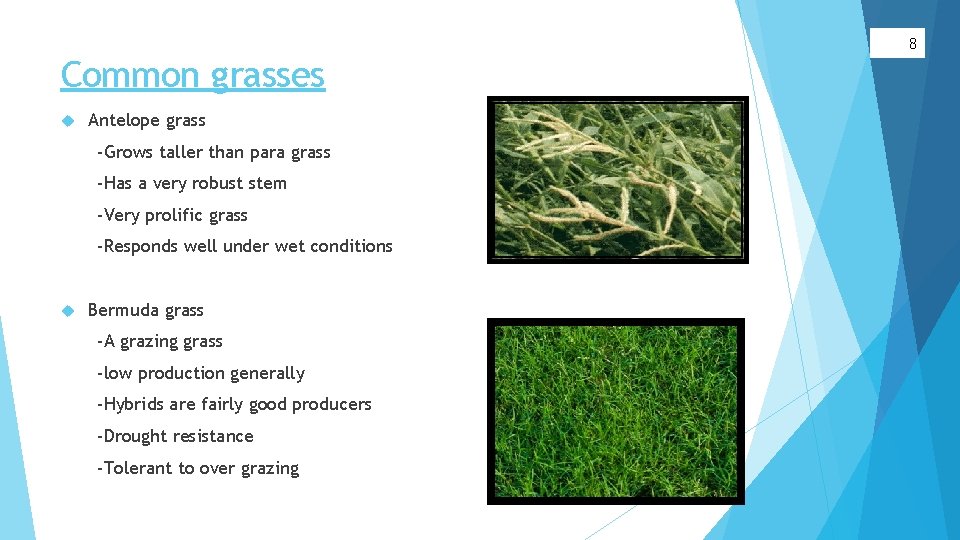
8 Common grasses Antelope grass -Grows taller than para grass -Has a very robust stem -Very prolific grass -Responds well under wet conditions Bermuda grass -A grazing grass -low production generally -Hybrids are fairly good producers -Drought resistance -Tolerant to over grazing
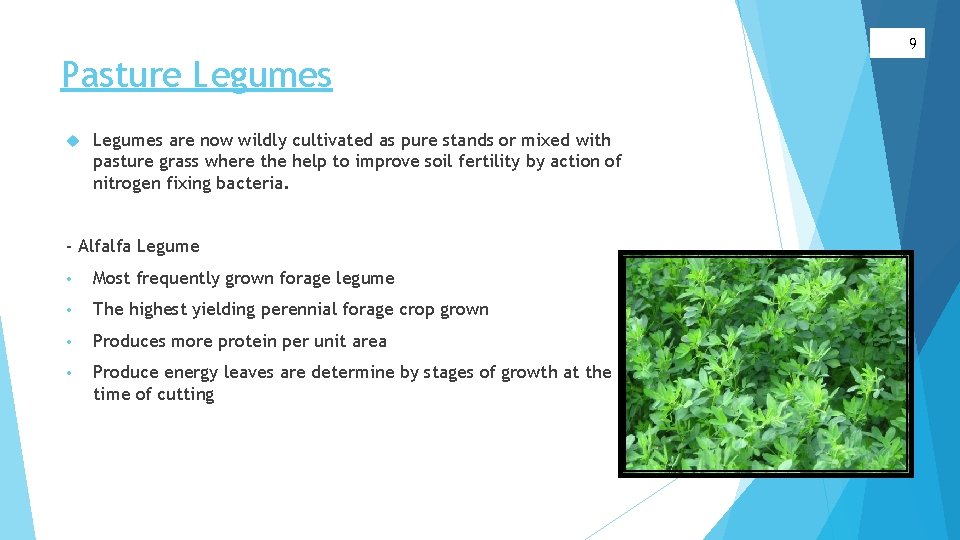
9 Pasture Legumes are now wildly cultivated as pure stands or mixed with pasture grass where the help to improve soil fertility by action of nitrogen fixing bacteria. - Alfalfa Legume • Most frequently grown forage legume • The highest yielding perennial forage crop grown • Produces more protein per unit area • Produce energy leaves are determine by stages of growth at the time of cutting
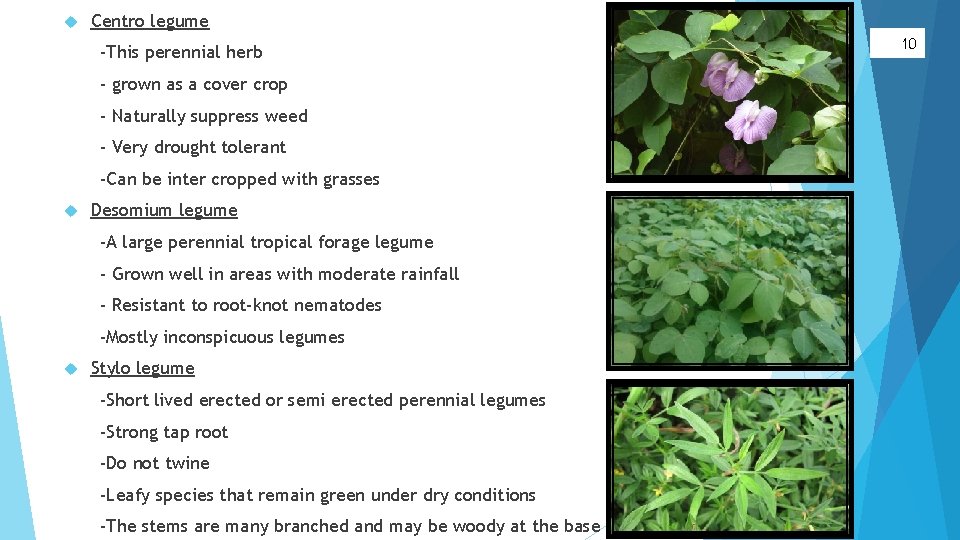
Centro legume -This perennial herb - grown as a cover crop - Naturally suppress weed - Very drought tolerant -Can be inter cropped with grasses Desomium legume -A large perennial tropical forage legume - Grown well in areas with moderate rainfall - Resistant to root-knot nematodes -Mostly inconspicuous legumes Stylo legume -Short lived erected or semi erected perennial legumes -Strong tap root -Do not twine -Leafy species that remain green under dry conditions -The stems are many branched and may be woody at the base 10
11 Exercises (1) Explain the meaning of each of the following terms: (a) Roughages (b) Succulents (c) Flushing (d) Balanced diet (2) State the difference between a maintenance ration and a production ration (3) Grass collection Steps: (i) Collect five samples of grasses from your yard or surroundings (ii) Place samples between sheet of old news papers, separately (iii) Place in a safe place for drying (iv) Check regularly (v) Place dried samples in an album with its name and characteristics.

12 References Sahadeo Ragoonanan (2011) ‘Agriculture for CSEC Revision course’ New Edition, Caribbean Educational Publisher Ltd, Trinidad, WI Fitzroy Weever et al (2014) Agricultural Science for Secondary Schools in Guyana, Book 3, Ministry on Education NCERD, Georgetown, Guyana Sahadeo Ragoonanan (1991) CXC Agriculture- A Revision Course, Caribbean Educational Publisher Ltd, Trinidad, WI
- Slides: 12