
Ministry of Education Indigenous Education in Ontario Indigenous
- Slides: 20
Ministry of Education Indigenous Education in Ontario Indigenous Education Office November 2020
Purpose The purpose of this presentation is to provide: Ø An overview of the Ministry of Education’s approach to Indigenous Education in Ontario. Ø Information about how Indigenous Education is implemented through collaboration between the Ministry and the school boards. “Education, delivered through residential schools, was the tool for assimilation. It was education that helped to perpetuate the situation we see today for Indigenous peoples in Canada. We […] believe that it will be education, again, that will be the tool that best addresses all of that, for education will create knowledge and from knowledge will come understanding. From understanding will come respect – both self-respect for Indigenous people and mutual respect for all. ” - The Honourable Justice Senator Murray Sinclair 2 Indigenous Education in Ontario
Indigenous Education: the Ministry of Education’s role
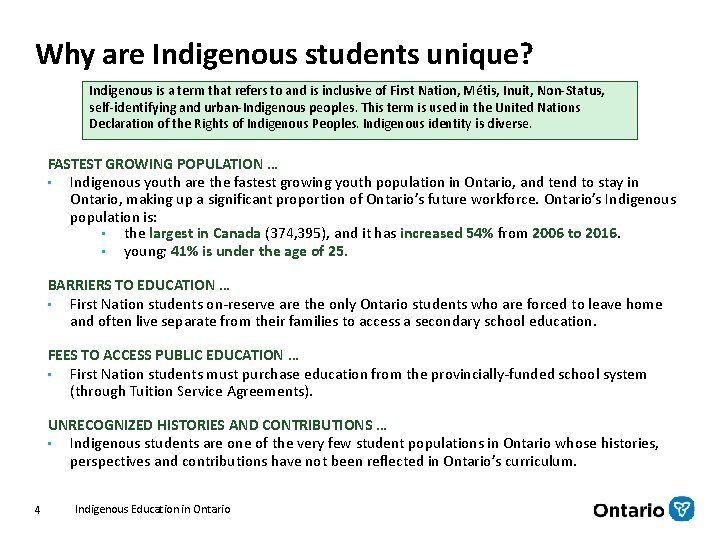
Why are Indigenous students unique? Indigenous is a term that refers to and is inclusive of First Nation, Métis, Inuit, Non-Status, self-identifying and urban-Indigenous peoples. This term is used in the United Nations Declaration of the Rights of Indigenous Peoples. Indigenous identity is diverse. FASTEST GROWING POPULATION … • Indigenous youth are the fastest growing youth population in Ontario, and tend to stay in Ontario, making up a significant proportion of Ontario’s future workforce. Ontario’s Indigenous population is: • the largest in Canada (374, 395), and it has increased 54% from 2006 to 2016. • young; 41% is under the age of 25. BARRIERS TO EDUCATION … • First Nation students on-reserve are the only Ontario students who are forced to leave home and often live separate from their families to access a secondary school education. FEES TO ACCESS PUBLIC EDUCATION … • First Nation students must purchase education from the provincially-funded school system (through Tuition Service Agreements). UNRECOGNIZED HISTORIES AND CONTRIBUTIONS … • Indigenous students are one of the very few student populations in Ontario whose histories, perspectives and contributions have not been reflected in Ontario’s curriculum. 4 Indigenous Education in Ontario
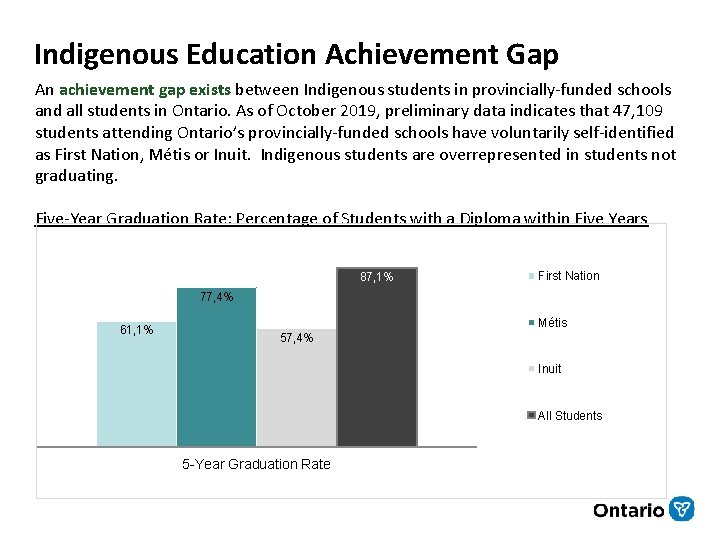
Indigenous Education Achievement Gap An achievement gap exists between Indigenous students in provincially-funded schools and all students in Ontario. As of October 2019, preliminary data indicates that 47, 109 students attending Ontario’s provincially-funded schools have voluntarily self-identified as First Nation, Métis or Inuit. Indigenous students are overrepresented in students not graduating. Five-Year Graduation Rate: Percentage of Students with a Diploma within Five Years 87, 1% First Nation 77, 4% 61, 1% Métis 57, 4% Inuit All Students 5 -Year Graduation Rate
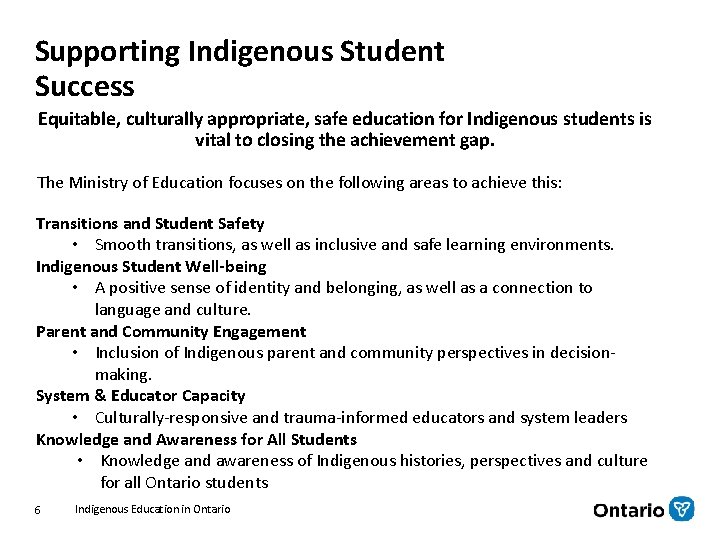
Supporting Indigenous Student Success Equitable, culturally appropriate, safe education for Indigenous students is vital to closing the achievement gap. The Ministry of Education focuses on the following areas to achieve this: Transitions and Student Safety • Smooth transitions, as well as inclusive and safe learning environments. Indigenous Student Well-being • A positive sense of identity and belonging, as well as a connection to language and culture. Parent and Community Engagement • Inclusion of Indigenous parent and community perspectives in decisionmaking. System & Educator Capacity • Culturally-responsive and trauma-informed educators and system leaders Knowledge and Awareness for All Students • Knowledge and awareness of Indigenous histories, perspectives and culture for all Ontario students 6 Indigenous Education in Ontario
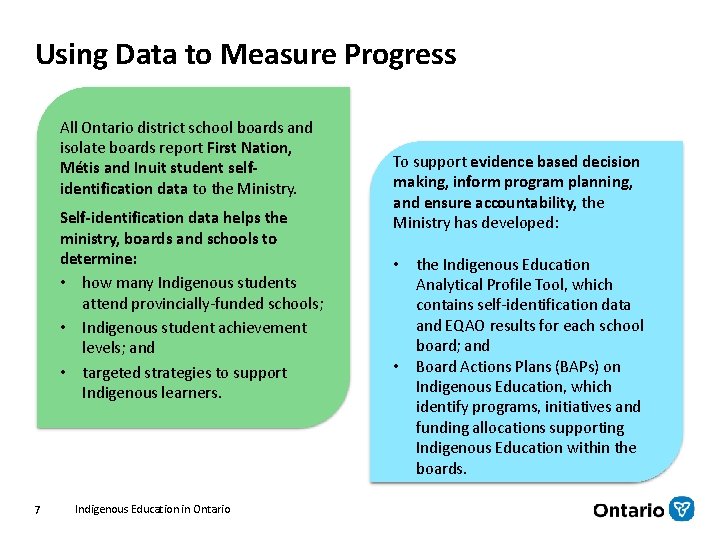
Using Data to Measure Progress All Ontario district school boards and isolate boards report First Nation, Métis and Inuit student selfidentification data to the Ministry. Self-identification data helps the ministry, boards and schools to determine: • how many Indigenous students attend provincially-funded schools; • Indigenous student achievement levels; and • targeted strategies to support Indigenous learners. 7 Indigenous Education in Ontario To support evidence based decision making, inform program planning, and ensure accountability, the Ministry has developed: • the Indigenous Education Analytical Profile Tool, which contains self-identification data and EQAO results for each school board; and • Board Actions Plans (BAPs) on Indigenous Education, which identify programs, initiatives and funding allocations supporting Indigenous Education within the boards.
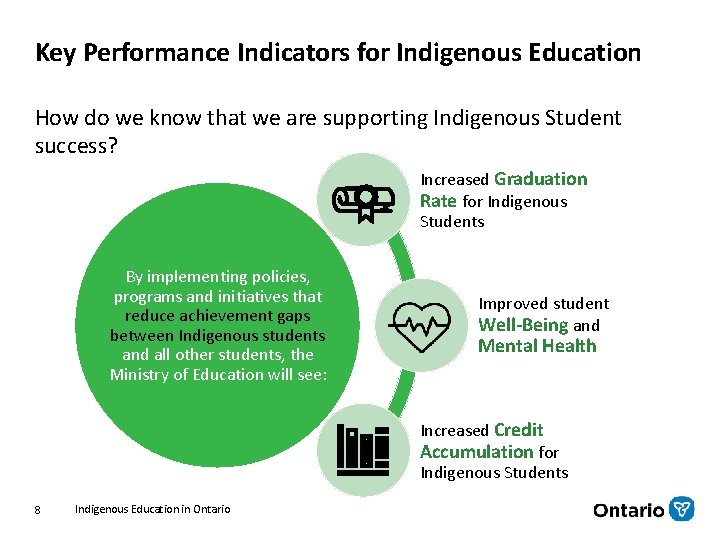
Key Performance Indicators for Indigenous Education How do we know that we are supporting Indigenous Student success? Increased Graduation Rate for Indigenous Students By implementing policies, programs and initiatives that reduce achievement gaps between Indigenous students and all other students, the Ministry of Education will see: Improved student Well-Being and Mental Health Increased Credit Accumulation for Indigenous Students 8 Indigenous Education in Ontario
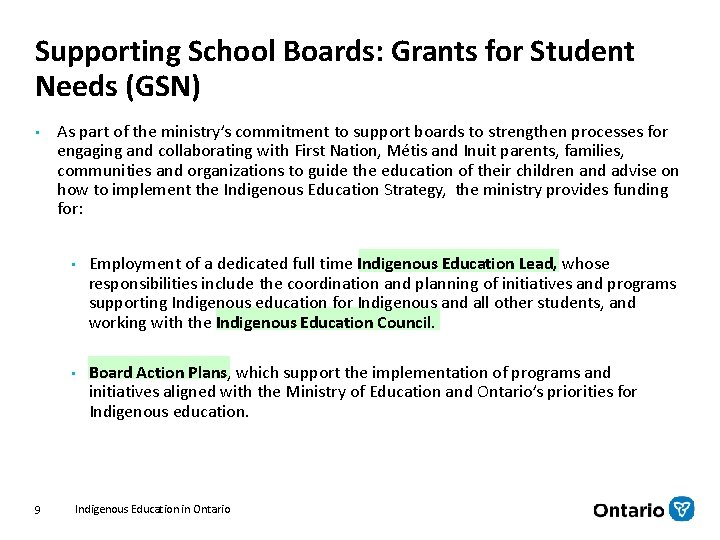
Supporting School Boards: Grants for Student Needs (GSN) • 9 As part of the ministry’s commitment to support boards to strengthen processes for engaging and collaborating with First Nation, Métis and Inuit parents, families, communities and organizations to guide the education of their children and advise on how to implement the Indigenous Education Strategy, the ministry provides funding for: • Employment of a dedicated full time Indigenous Education Lead, whose responsibilities include the coordination and planning of initiatives and programs supporting Indigenous education for Indigenous and all other students, and working with the Indigenous Education Council. • Board Action Plans, which support the implementation of programs and initiatives aligned with the Ministry of Education and Ontario’s priorities for Indigenous education. Indigenous Education in Ontario
Indigenous Education: School Boards
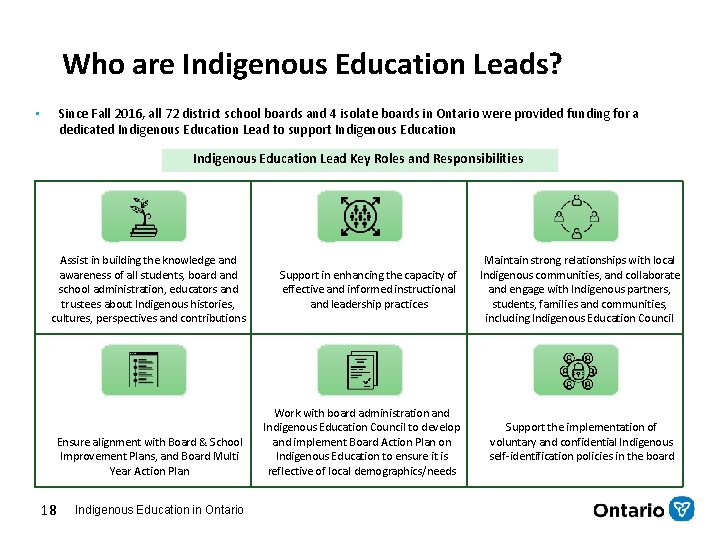
Who are Indigenous Education Leads? Since Fall 2016, all 72 district school boards and 4 isolate boards in Ontario were provided funding for a dedicated Indigenous Education Lead to support Indigenous Education • Indigenous Education Lead Key Roles and Responsibilities Assist in building the knowledge and awareness of all students, board and school administration, educators and trustees about Indigenous histories, cultures, perspectives and contributions Ensure alignment with Board & School Improvement Plans, and Board Multi Year Action Plan 18 Indigenous Education in Ontario Support in enhancing the capacity of effective and informed instructional and leadership practices Work with board administration and Indigenous Education Council to develop and implement Board Action Plan on Indigenous Education to ensure it is reflective of local demographics/needs Maintain strong relationships with local Indigenous communities, and collaborate and engage with Indigenous partners, students, families and communities, including Indigenous Education Council Support the implementation of voluntary and confidential Indigenous self-identification policies in the board
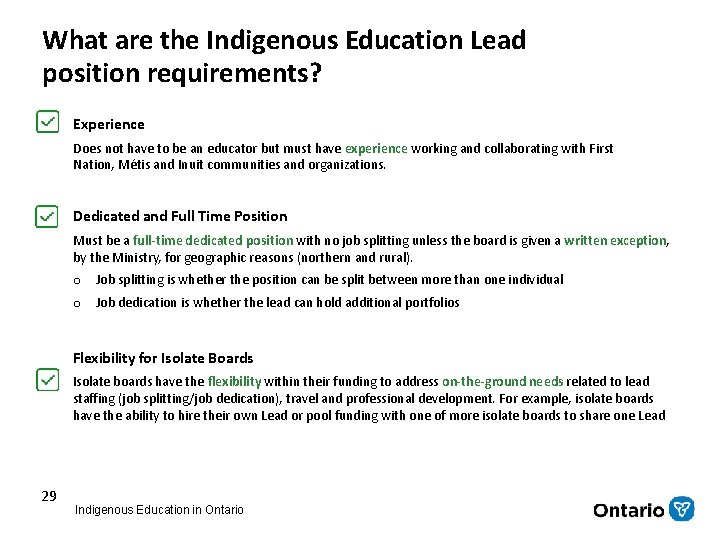
What are the Indigenous Education Lead position requirements? Experience Does not have to be an educator but must have experience working and collaborating with First Nation, Métis and Inuit communities and organizations. Dedicated and Full Time Position Must be a full-time dedicated position with no job splitting unless the board is given a written exception, by the Ministry, for geographic reasons (northern and rural). o Job splitting is whether the position can be split between more than one individual o Job dedication is whether the lead can hold additional portfolios Flexibility for Isolate Boards Isolate boards have the flexibility within their funding to address on-the-ground needs related to lead staffing (job splitting/job dedication), travel and professional development. For example, isolate boards have the ability to hire their own Lead or pool funding with one of more isolate boards to share one Lead 29 Indigenous Education in Ontario
Indigenous Education Councils • The Ontario FNMI Education Policy Framework, which is currently being refreshed, states that to foster supportive and engaged families and communities, school boards will strive to: • • • 13 Establish First Nation, Métis, and Inuit Education Advisory Councils that include representation from First Nations, community members, and local Indigenous service delivery organizations; Develop creative strategies to encourage more First Nation, Métis, and Inuit parents to participate more directly in the education of their children; Develop strategies to involve First Nation, Métis, and Inuit communities and service providers in ensuring that integrated and seamless services are provided to First Nation, Métis, and Inuit students with special education needs; Increase involvement of First Nation, Métis and Inuit parents, Elders, and other community members; Provide continuing education programs for First Nation, Métis, and Inuit parents; Develop creative strategies to engage more First Nation, Métis, and Inuit students in school activities and encourage them to participate more actively in school. Indigenous Education in Ontario
Board Action Plans on Indigenous Education What are Board Action Plans on Indigenous Education? • Developed annually by district school boards to identify and monitor the programs and initiatives supporting Indigenous Education within the board. • The planning and development of Board Action Plans help boards target resources and supports in order to improve engagement, learning, performance, and well-being of First Nation, Métis, and Inuit students. • includes a financial section where the funding allocations used to support development and implementation of the programs and initiatives must be included. 14 Indigenous Education in Ontario
Board Action Plans, cont. Who is responsible for completing the Board Action Plan on Indigenous Education? • Boards are expected to co-develop the Board Action Plan with their local Indigenous Education Council to ensure that local and community needs are reflected. • The Indigenous Education Lead is expected to complete the Board Action Plan, and obtain sign off by the Superintendent, Director of Education and representative(s) from the Indigenous Education Council, . The Lead supports the board in implementing the Board Action Plan on Indigenous Education. • 15 Indigenous Education in Ontario
Board Action Plans, cont. How are Board Action Plans on Indigenous Education funded? • • 16 Boards receive dedicated enveloped funding for their Board Action Plans through the Indigenous Education Grant within the Grant for Student Needs (GSN). Boards are required to use this funding exclusively to support the implementation of programs and initiatives included in the Board Action Plan, as per regulation 550 under the Education Act (https: //www. ontario. ca/laws/regulation/r 17550) Indigenous Education in Ontario
Supporting Equitable Outcomes for Indigenous Students
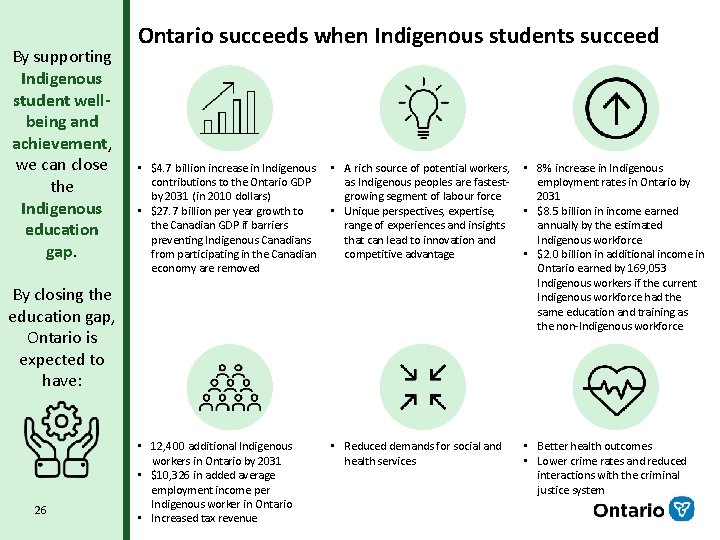
By supporting Indigenous student wellbeing and achievement, we can close the Indigenous education gap. Ontario succeeds when Indigenous students succeed • $4. 7 billion increase in Indigenous contributions to the Ontario GDP by 2031 (in 2010 dollars) • $27. 7 billion per year growth to the Canadian GDP if barriers preventing Indigenous Canadians from participating in the Canadian economy are removed • A rich source of potential workers, as Indigenous peoples are fastestgrowing segment of labour force • Unique perspectives, expertise, range of experiences and insights that can lead to innovation and competitive advantage • 8% increase in Indigenous employment rates in Ontario by 2031 • $8. 5 billion in income earned annually by the estimated Indigenous workforce • $2. 0 billion in additional income in Ontario earned by 169, 053 Indigenous workers if the current Indigenous workforce had the same education and training as the non-Indigenous workforce • 12, 400 additional Indigenous workers in Ontario by 2031 • $10, 326 in added average employment income per Indigenous worker in Ontario • Increased tax revenue • Reduced demands for social and health services • Better health outcomes • Lower crime rates and reduced interactions with the criminal justice system By closing the education gap, Ontario is expected to have: 26
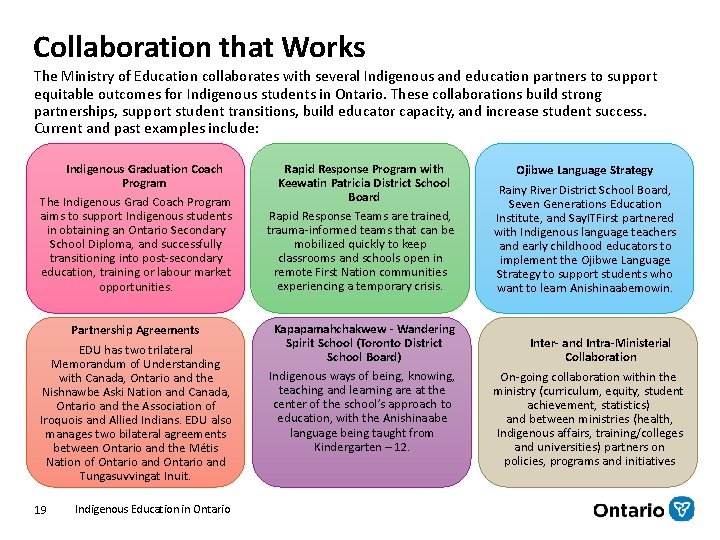
Collaboration that Works The Ministry of Education collaborates with several Indigenous and education partners to support equitable outcomes for Indigenous students in Ontario. These collaborations build strong partnerships, support student transitions, build educator capacity, and increase student success. Current and past examples include: Indigenous Graduation Coach Program The Indigenous Grad Coach Program aims to support Indigenous students in obtaining an Ontario Secondary School Diploma, and successfully transitioning into post-secondary education, training or labour market opportunities. Rapid Response Program with Keewatin Patricia District School Board Rapid Response Teams are trained, trauma-informed teams that can be mobilized quickly to keep classrooms and schools open in remote First Nation communities experiencing a temporary crisis. Partnership Agreements Kapapamahchakwew - Wandering Spirit School (Toronto District School Board) Indigenous ways of being, knowing, teaching and learning are at the center of the school’s approach to education, with the Anishinaabe language being taught from Kindergarten – 12. EDU has two trilateral Memorandum of Understanding with Canada, Ontario and the Nishnawbe Aski Nation and Canada, Ontario and the Association of Iroquois and Allied Indians. EDU also manages two bilateral agreements between Ontario and the Métis Nation of Ontario and Tungasuvvingat Inuit. 19 Indigenous Education in Ontario Ojibwe Language Strategy Rainy River District School Board, Seven Generations Education Institute, and Say. ITFirst partnered with Indigenous language teachers and early childhood educators to implement the Ojibwe Language Strategy to support students who want to learn Anishinaabemowin. Inter- and Intra-Ministerial Collaboration On-going collaboration within the ministry (curriculum, equity, student achievement, statistics) and between ministries (health, Indigenous affairs, training/colleges and universities) partners on policies, programs and initiatives
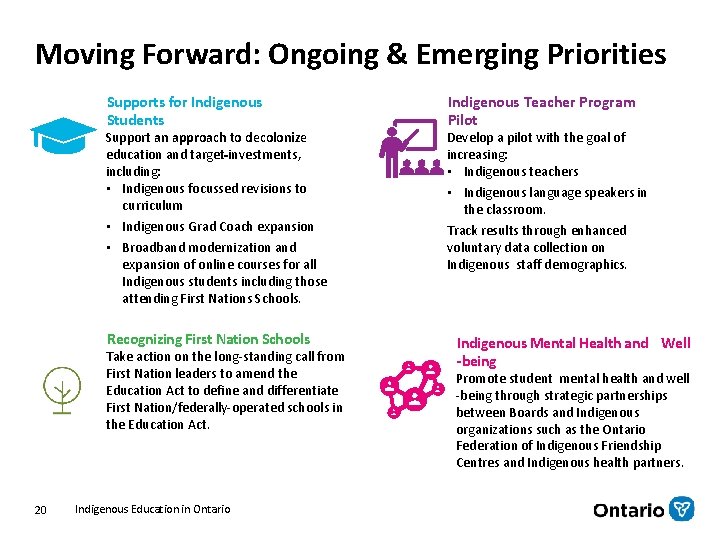
Moving Forward: Ongoing & Emerging Priorities Supports for Indigenous Students Support an approach to decolonize education and target investments, including: • Indigenous focussed revisions to curriculum • Indigenous Grad Coach expansion • Broadband modernization and expansion of online courses for all Indigenous students including those attending First Nations Schools. Recognizing First Nation Schools Take action on the long-standing call from First Nation leaders to amend the Education Act to define and differentiate First Nation/federally-operated schools in the Education Act. 20 Indigenous Education in Ontario Indigenous Teacher Program Pilot Develop a pilot with the goal of increasing: • Indigenous teachers • Indigenous language speakers in the classroom. Track results through enhanced voluntary data collection on Indigenous staff demographics. Indigenous Mental Health and Well -being Promote student mental health and well -being through strategic partnerships between Boards and Indigenous organizations such as the Ontario Federation of Indigenous Friendship Centres and Indigenous health partners.