
Ministry of Education ELT General Supervision Standards Competences
- Slides: 24
Ministry of Education ﻭﺯﺍﺭﺓ ﺍﻟﺘﺮﺑﻴﺔ ELT General Supervision ﺍﻟﺘﻮﺟﻴﻪ ﺍﻟﻔﻨﻲ ﺍﻟﻌﺎﻡ ﻟﻠﻐﺔ ﺍﻹﻧﺠﻠﻴﺰﻳﺔ Standards & Competences ELT General Supervision
Introduction Quality students as a result of quality learning are not possible without a High Quality Curriculum. It is well known that current day Quality Curricula in the world are competencebased , aiming at attaining highly ranked student achievement standards. That’s why dealing with “ Competencies and Standards” became a must and need to be discussed because the new trend in Curriculum Design worldwide is “Competence-and Standard-based Curriculum” and not Content-and Knowledge-based”. We are after “to know how , why , when than simply” ELT General Supervision
1. Standards “Standards describe the goals of schooling, the destinations at which students should arrive at the end of the unit or term. For example, most standards expect students graduating from high school to be able to write for different audiences in different formats -- things such as reports, instructions, literary criticism, and persuasive and reflective essays -- and to demonstrate a command of standard written English. ELT General Supervision
Note that the standard doesn't prescribe how to get the students to this destination -- that is determined by the curriculum. Standards do not prescribe any particular curriculum: National standards don't mean that local ability to choose teaching materials and methods are compromised. Standards indicate what students should know and should be able to do at grade 5, grade 9, grade 12. The teacher can choose whatever curriculum he or she finds appropriate to help the students meet the standards. Standards are the WHAT of education while curriculum and instruction are the HOW. ” ELT General Supervision
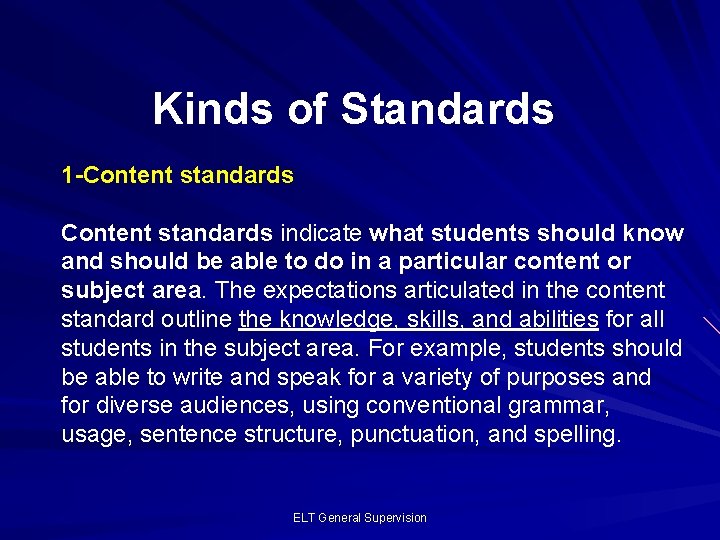
Kinds of Standards 1 -Content standards indicate what students should know and should be able to do in a particular content or subject area. The expectations articulated in the content standard outline the knowledge, skills, and abilities for all students in the subject area. For example, students should be able to write and speak for a variety of purposes and for diverse audiences, using conventional grammar, usage, sentence structure, punctuation, and spelling. ELT General Supervision
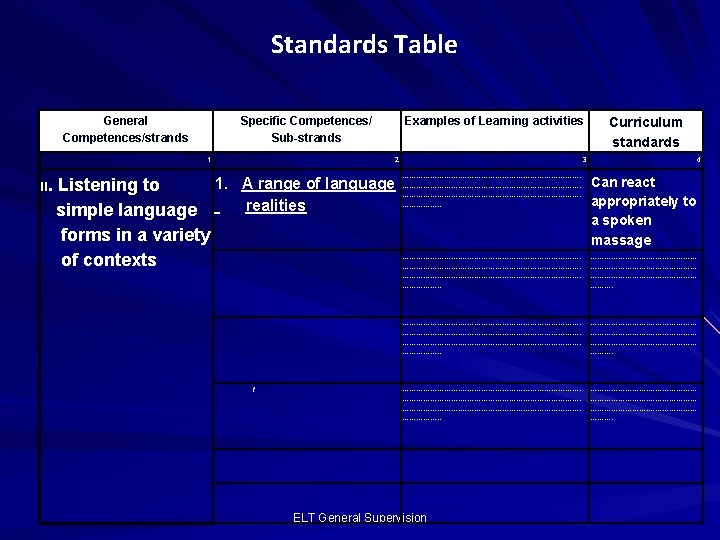
Standards Table General Competences/strands Specific Competences/ Sub-strands 1 Examples of Learning activities 2 Curriculum standards 3 4 --------------------------------------1. A range of language --------------------------------------- Can react --------------------------------------appropriately to -------- realities simple language II. Listening to a spoken massage forms in a variety of contexts 1. ----------------------------------------------------------------------------------------------------------------------------------------------------------------------------------------------------------------------------------------------------- --------------------------------------------------------------------------------------------------------------------------- ELT General Supervision
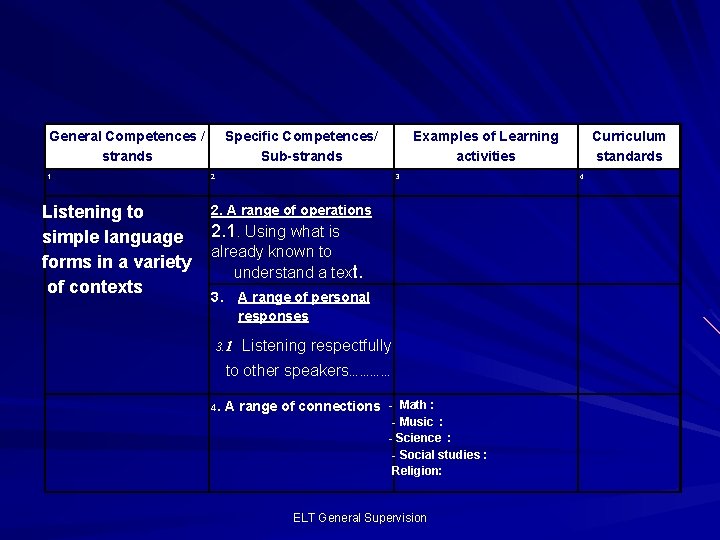
General Competences / strands 1 Specific Competences/ Sub-strands Examples of Learning activities 2 3 2. A range of operations Listening to simple language 2. 1. Using what is already known to forms in a variety understand a text. of contexts 3. A range of personal responses 3. 1 Listening respectfully to other speakers………… 4. A range of connections - Math : - Music : - Science : - Social studies : Religion: ELT General Supervision Curriculum standards 4
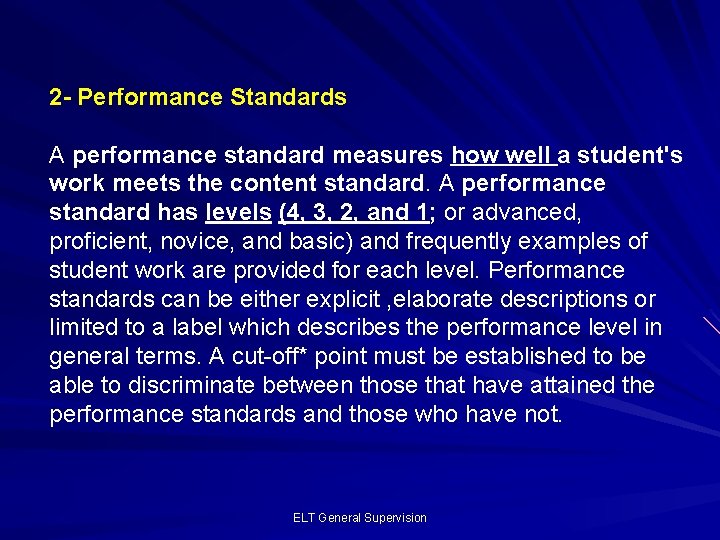
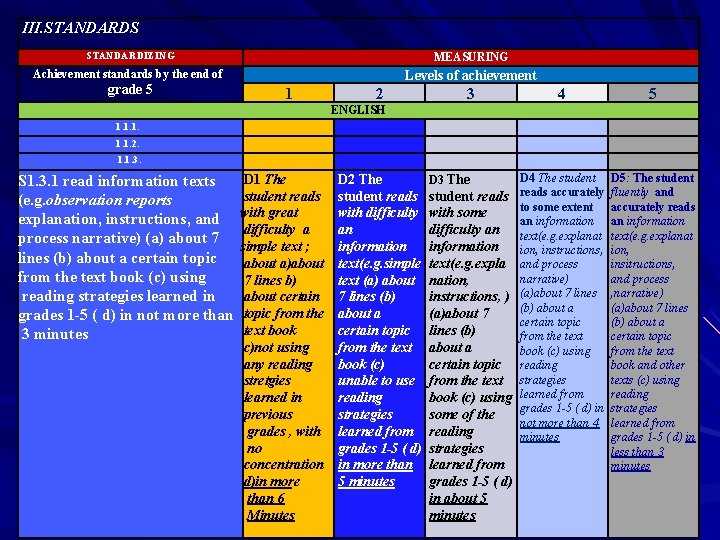
2 - Performance Standards A performance standard measures how well a student's work meets the content standard. A performance standard has levels (4, 3, 2, and 1; or advanced, proficient, novice, and basic) and frequently examples of student work are provided for each level. Performance standards can be either explicit , elaborate descriptions or limited to a label which describes the performance level in general terms. A cut-off* point must be established to be able to discriminate between those that have attained the performance standards and those who have not. ELT General Supervision
III. STANDARDS STANDARDIZING MEASURING Achievement standards by the end of Levels of achievement grade 5 1 2 3 4 5 D 4 The student reads accurately to some extent an information text(e. g. explanat ion, instructions, and process narrative) (a)about 7 lines (b) about a certain topic from the text book (c) using reading strategies learned from grades 1 -5 ( d) in not more than 4 minutes D 5: The student fluently and accurately reads an information text(e. g. explanat ion, insitructions, and process , narrative) (a)about 7 lines (b) about a certain topic from the text book and other texts (c) using reading strategies learned from grades 1 -5 ( d) in less than 3 minutes ENGLISH 1. 1. 1. 2. 1. 1. 3. S 1. 3. 1 read information texts (e. g. observation reports explanation, instructions, and process narrative) (a) about 7 lines (b) about a certain topic from the text book (c) using reading strategies learned in grades 1 -5 ( d) in not more than 3 minutes D 1 The D 2 The D 3 The student reads with great with difficulty with some difficulty a an difficulty an simple text ; information about a)about text(e. g. simple text(e. g. expla 7 lines b) text (a) about nation, about certain 7 lines (b) instructions, ) topic from the about a (a)about 7 text book certain topic lines (b) c)not using from the text about a any reading book (c) certain topic stretgies unable to use from the text learned in reading book (c) using previous strategies some of the grades , with learned from reading no grades 1 -5 ( d) strategies concentration in more than learned from d)in more 5 minutes grades 1 -5 ( d) than 6 in about 5 Minutes. ELT General Supervision minutes
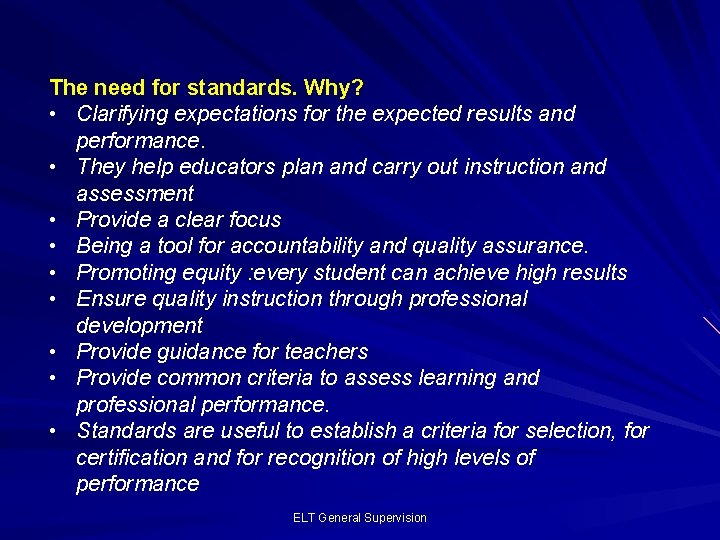
The need for standards. Why? • Clarifying expectations for the expected results and performance. • They help educators plan and carry out instruction and assessment • Provide a clear focus • Being a tool for accountability and quality assurance. • Promoting equity : every student can achieve high results • Ensure quality instruction through professional development • Provide guidance for teachers • Provide common criteria to assess learning and professional performance. • Standards are useful to establish a criteria for selection, for certification and for recognition of high levels of performance ELT General Supervision
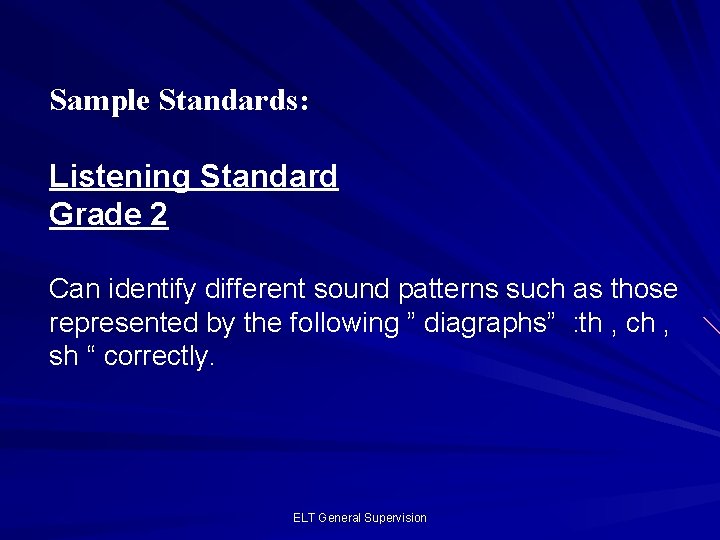
Sample Standards: Listening Standard Grade 2 Can identify different sound patterns such as those represented by the following ” diagraphs” : th , ch , sh “ correctly. ELT General Supervision
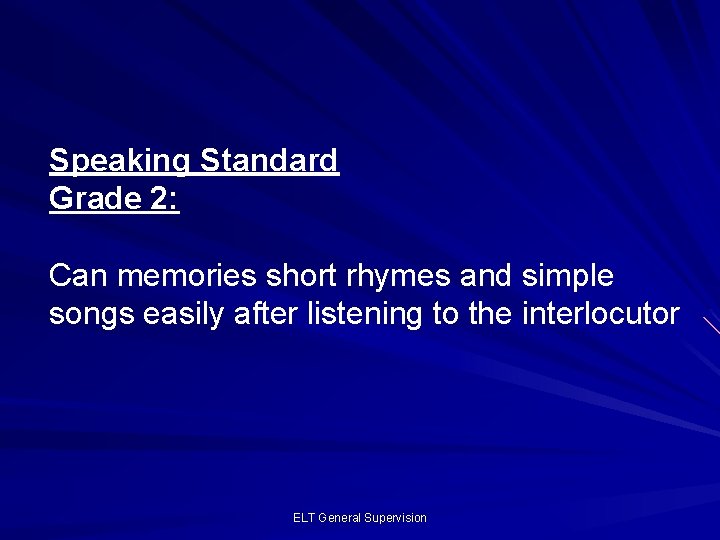
Speaking Standard Grade 2: Can memories short rhymes and simple songs easily after listening to the interlocutor ELT General Supervision
Reading Standard Grade 2 Can blend consonants and vowels to be able to decode CVC words ELT General Supervision
Writing Standard Grade 2: Can write all the letters of the alphabet and two digit numbers ( 20 -50 ) ELT General Supervision
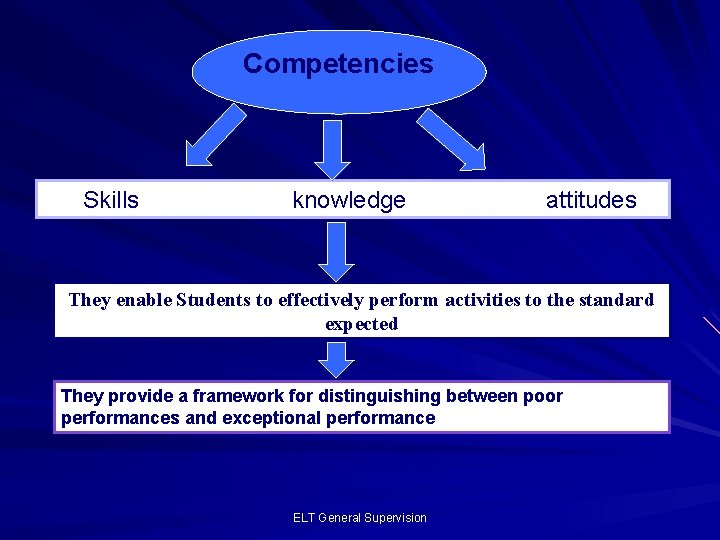
2. Competencies What are competencies? “ a state of being adequately or sufficiently qualified to perform a task that is reasonably well defined”. The International Board of Standards for Training , Performance and Instruction (ibstpi) defines a competency as “an integrated set of skills , knowledge , and attitudes that enables one effectively perform the activities of a given occupation, “ in our case TEACHING”, or function to the standard expected”. It is defined as “ A measurable pattern of knowledge , skills , abilities , behaviours , values and other characteristics that individual needs to perform successfully”. ELT General Supervision
They refer to skills or knowledge that lead to superior performance. These are formed through an individual / institutions knowledge , skills and abilities and provide a framework for distinguishing between poor performances through to exceptional performance. Competencies specify the “HOW” of performing job tasks , or what the person needs to do the job successfully. Competencies represent a wholeperson approach to assessing learners ELT General Supervision
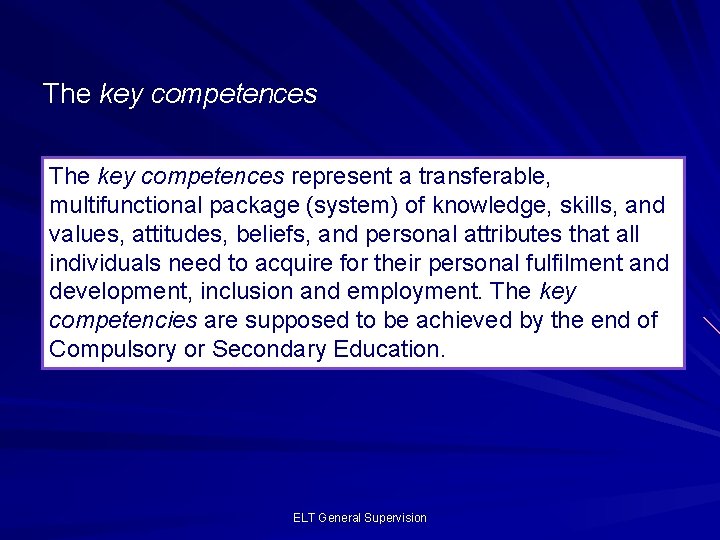
The key competences represent a transferable, multifunctional package (system) of knowledge, skills, and values, attitudes, beliefs, and personal attributes that all individuals need to acquire for their personal fulfilment and development, inclusion and employment. The key competencies are supposed to be achieved by the end of Compulsory or Secondary Education. ELT General Supervision
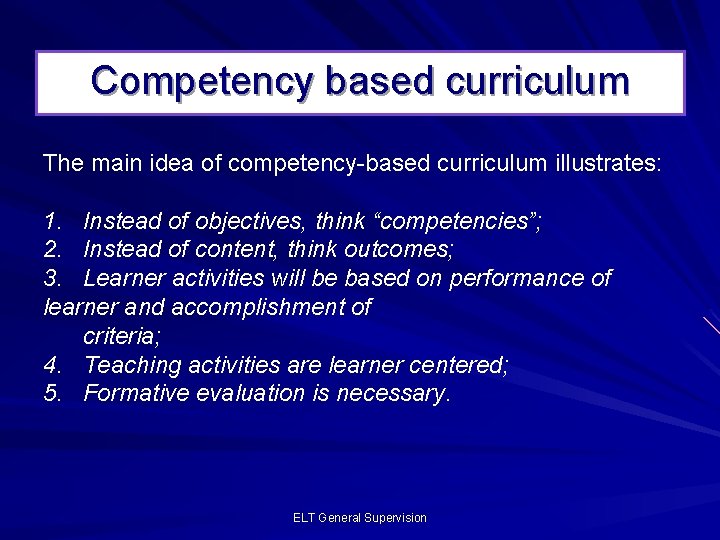
Competency based curriculum The main idea of competency-based curriculum illustrates: 1. Instead of objectives, think “competencies”; 2. Instead of content, think outcomes; 3. Learner activities will be based on performance of learner and accomplishment of criteria; 4. Teaching activities are learner centered; 5. Formative evaluation is necessary. ELT General Supervision
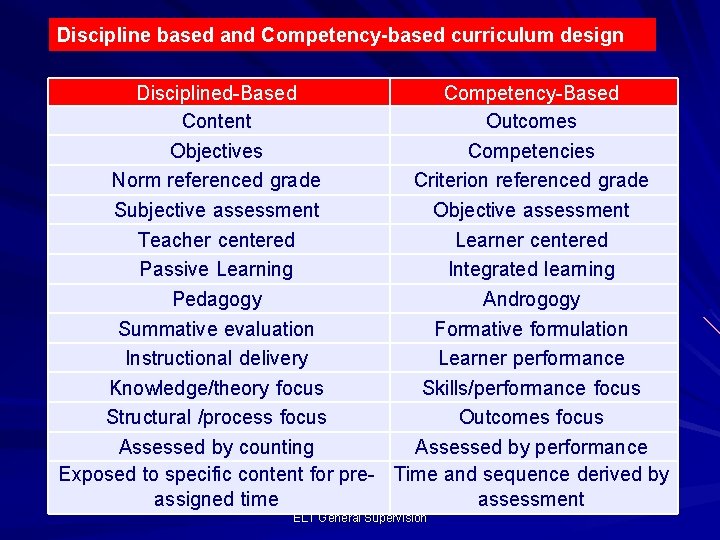
Discipline based and Competency-based curriculum design Disciplined-Based Competency-Based Content Outcomes Objectives Competencies Norm referenced grade Criterion referenced grade Subjective assessment Objective assessment Teacher centered Learner centered Passive Learning Integrated learning Pedagogy Androgogy Summative evaluation Formative formulation Instructional delivery Learner performance Knowledge/theory focus Skills/performance focus Structural /process focus Outcomes focus Assessed by counting Assessed by performance Exposed to specific content for pre- Time and sequence derived by assigned time assessment ELT General Supervision
Competencies Skills knowledge attitudes They enable Students to effectively perform activities to the standard expected They provide a framework for distinguishing between poor performances and exceptional performance ELT General Supervision
Competencies versus Learning Objectives Learning objectives describe what the learner should be able to achieve at the end of a learning period. Learning objectives should be specific, measurable statements and written in behavioral terms. In short, objectives say what we want the learners to know and competencies say how we can be certain they know it. Competencies are identified behaviours, knowledge, skills, and abilities that directly and positively impact the success of " employees and organizations". Competencies can be objectively measured, enhanced, and improved through coaching and learning opportunities. ELT General Supervision
3. Performance Indicators They are used by an organization to evaluate its success or the success of a particular activity in which it is engaged. Example of Performance Indicators: Increase in rate of learners' success not less than 75% in the three stages of education. 50% reduction in number of repeaters Participation of 90% of gifted and talented learners in the approved annual competitions ELT General Supervision
4. Outcomes An outcome is a desired state of well-being - a set of conditions, experiences or behaviours – that is the goal for change or improvement. They are anticipated or achieved results of programmes or the accomplishment of institutional objectives, as demonstrated by a wide range of indicators (such as student knowledge, cognitive skills, and attitudes) ELT General Supervision
4. Outcomes e. g. v Students will comprehend and communicate orally, using English vocabulary for personal, social, and academic purposes. v Students will acquire English vocabulary and apply knowledge of correct syntax to comprehend written text. v Students will write in English for a variety of purposes with clear focus, coherent organization, and sufficient detail. ELT General Supervision