
Ministry of Community and Territorial Development THE STATE



- Slides: 33
Ministry of Community and Territorial Development THE STATE RESEARCH INSTITUTE OF BUILDING CONSTRUCTIONS (NIISK, www. niisk. com) Experimental evaluation of ETICS reliability factors GENNADIY FARENYUK, Director, Doctor of Technical Sciences, Prof. UEAtc: Workshop ETICS Liverpool– 31. 10. 2019 International EPS Forum 2019 Kyiv – 07. 11. 2019
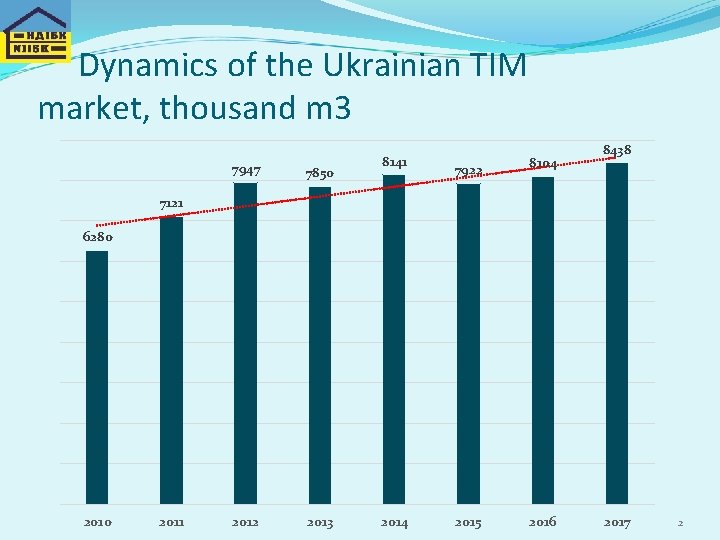
Dynamics of the Ukrainian TIM market, thousand m 3 7947 7850 2012 2013 8141 7922 8104 8438 7121 6280 2011 2014 2015 2016 2017 2
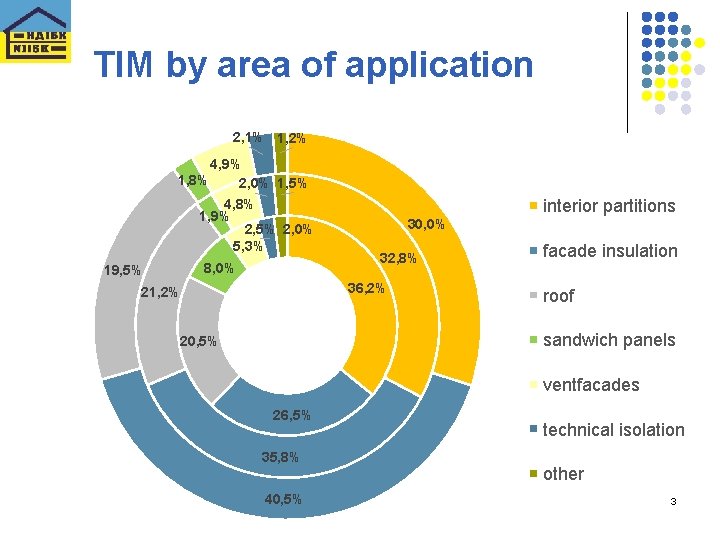
TIM by area of application 2, 1% 1, 2% 4, 9% 1, 8% 2, 0% 1, 5% 4, 8% 1, 9% 2, 5% 2, 0% 5, 3% 8, 0% 19, 5% interior partitions 30, 0% 32, 8% 36, 2% 21, 2% facade insulation roof sandwich panels 20, 5% ventfacades 26, 5% 35, 8% 40, 5% technical isolation other 3
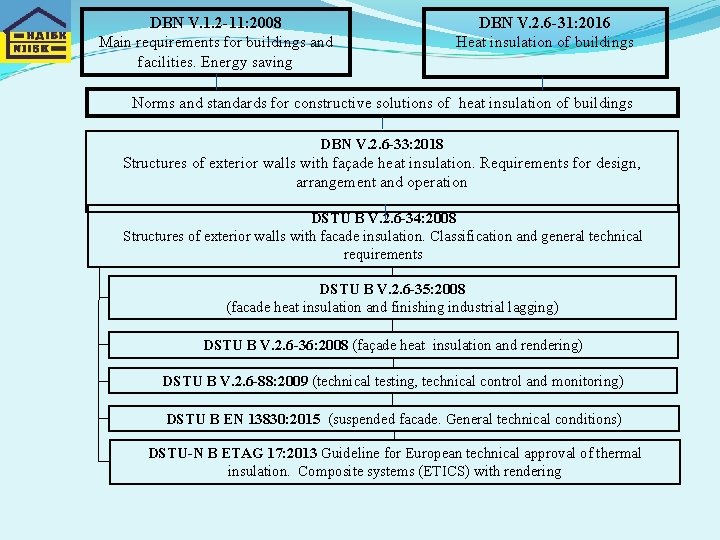
DBN V. 1. 2 -11: 2008 Main requirements for buildings and facilities. Energy saving DBN V. 2. 6 -31: 2016 Heat insulation of buildings Norms and standards for constructive solutions of heat insulation of buildings DBN V. 2. 6 -33: 2018 Structures of exterior walls with façade heat insulation. Requirements for design, arrangement and operation DSTU B V. 2. 6 -34: 2008 Structures of exterior walls with facade insulation. Classification and general technical requirements DSTU B V. 2. 6 -35: 2008 (facade heat insulation and finishing industrial lagging) DSTU B V. 2. 6 -36: 2008 (façade heat insulation and rendering) DSTU B V. 2. 6 -88: 2009 (technical testing, technical control and monitoring) DSTU B EN 13830: 2015 (suspended facade. General technical conditions) DSTU-N B ETAG 17: 2013 Guideline for European technical approval of thermal insulation. Composite systems (ETICS) with rendering
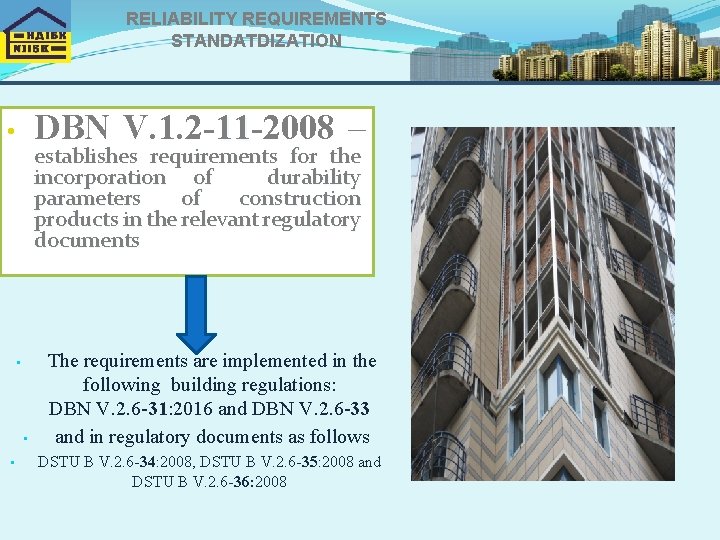
RELIABILITY REQUIREMENTS STANDATDIZATION DBN V. 1. 2 -11 -2008 – 11 • establishes requirements for the incorporation of durability parameters of construction products in the relevant regulatory documents • • • The requirements are implemented in the following building regulations: DBN V. 2. 6 -31: 2016 and DBN V. 2. 6 -33 and in regulatory documents as follows DSTU B V. 2. 6 -34: 2008, DSTU B V. 2. 6 -35: 2008 and DSTU B V. 2. 6 -36: 2008
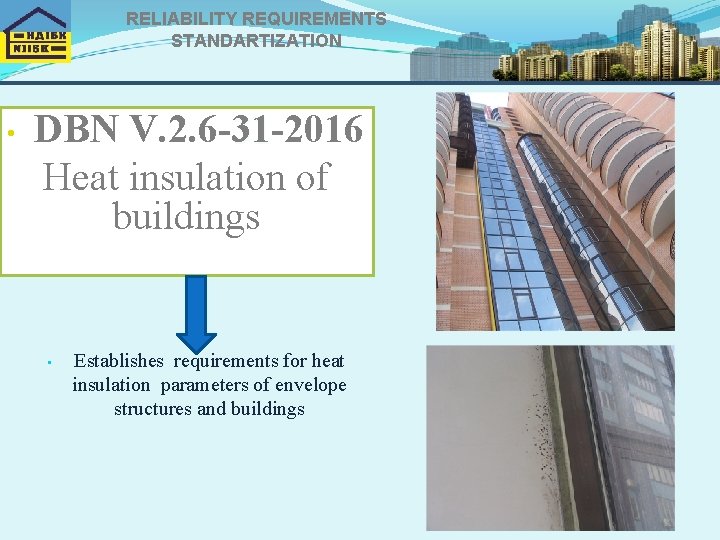
RELIABILITY REQUIREMENTS STANDARTIZATION • DBN V. 2. 6 -31 -2016 31 Heat insulation of buildings • Establishes requirements for heat insulation parameters of envelope structures and buildings
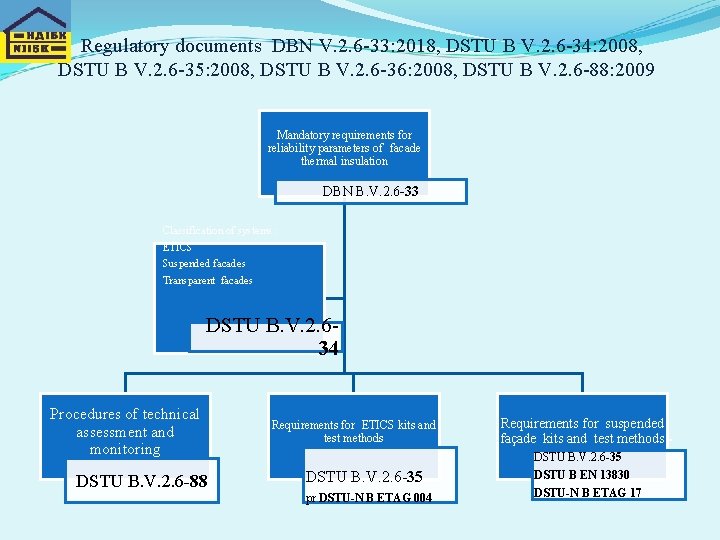
Regulatory documents DBN V. 2. 6 -33: 2018, DSTU B V. 2. 6 -34: 2008, DSTU B V. 2. 6 -35: 2008, DSTU B V. 2. 6 -36: 2008, DSTU B V. 2. 6 -88: 2009 Mandatory requirements for reliability parameters of faсade thermal insulation DBN B. V. 2. 6 -33 Classification of systems : ETICS Suspended faсades Transparent facades DSTU B. V. 2. 634 Procedures of technical assessment and monitoring DSTU B. V. 2. 6 -88 Requirements for ETICS kits and test methods Requirements for suspended façade kits and test methods DSTU B. V. 2. 6 -35 pr DSTU-N B ETAG 004 DSTU B EN 13830 DSTU-N B ETAG 17
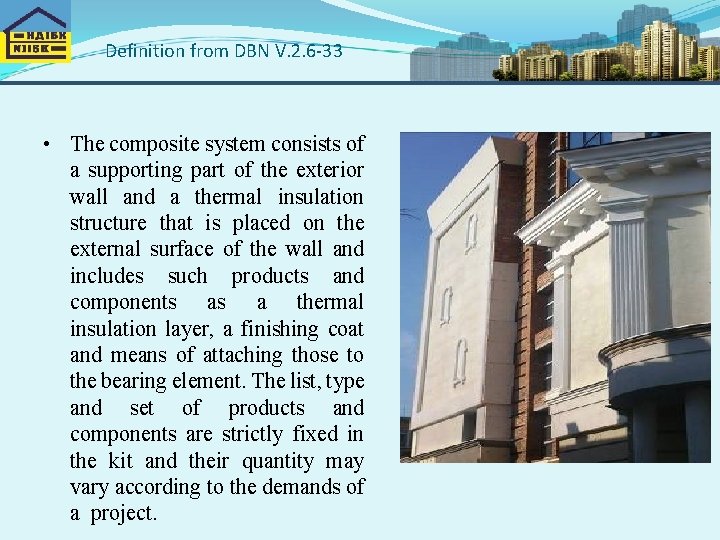
Definition from DBN V. 2. 6 -33 • The composite system consists of a supporting part of the exterior wall and a thermal insulation structure that is placed on the external surface of the wall and includes such products and components as a thermal insulation layer, a finishing coat and means of attaching those to the bearing element. The list, type and set of products and components are strictly fixed in the kit and their quantity may vary according to the demands of a project.
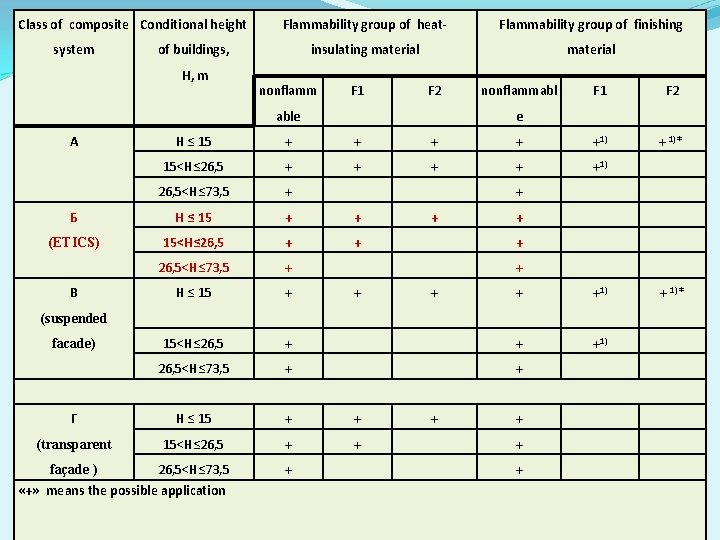
Class of composite Conditional height system Flammability group of heat- Flammability group of finishing insulating material of buildings, Н, m nonflamm F 1 F 2 able А nonflammabl F 1 F 2 + 1)* e Н ≤ 15 + + +1) 15<Н≤ 26, 5 + + +1) 26, 5<Н≤ 73, 5 + Б Н ≤ 15 + + (ETICS) 15<Н≤ 26, 5 + + 26, 5<Н≤ 73, 5 + Н ≤ 15 + 15<Н≤ 26, 5 В + + + + +1) 26, 5<Н≤ 73, 5 + + Г Н ≤ 15 + + (transparent 15<Н≤ 26, 5 + + (suspended facade) 26, 5<Н≤ 73, 5 façade ) «+» means the possible application + + + 1)*
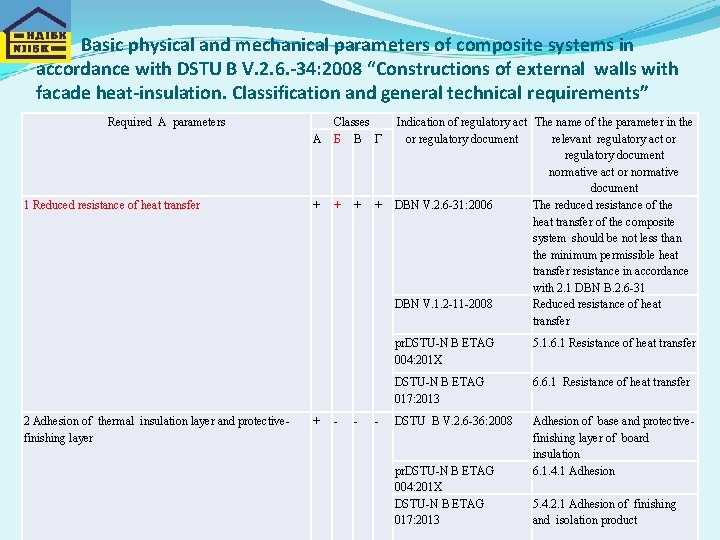
Basic physical and mechanical parameters of composite systems in accordance with DSTU B V. 2. 6. -34: 2008 “Constructions of external walls with facade heat-insulation. Classification and general technical requirements” Required A parameters 1 Reduced resistance of heat transfer 2 Adhesion of thermal insulation layer and protectivefinishing layer Classes А Б В Г + + + - + - Indication of regulatory act The name of the parameter in the or regulatory document relevant regulatory act or regulatory document normative act or normative document DBN V. 2. 6 -31: 2006 The reduced resistance of the heat transfer of the composite system should be not less than the minimum permissible heat transfer resistance in accordance with 2. 1 DBN В. 2. 6 -31 DBN V. 1. 2 -11 -2008 Reduced resistance of heat transfer pr. DSTU-N B ETAG 004: 201 Х 5. 1. 6. 1 Resistance of heat transfer DSTU-N B ETAG 017: 2013 6. 6. 1 Resistance of heat transfer DSTU B V. 2. 6 -36: 2008 Adhesion of base and protectivefinishing layer of board insulation 6. 1. 4. 1 Adhesion pr. DSTU-N B ETAG 004: 201 Х DSTU-N B ETAG 017: 2013 5. 4. 2. 1 Adhesion of finishing and isolation product
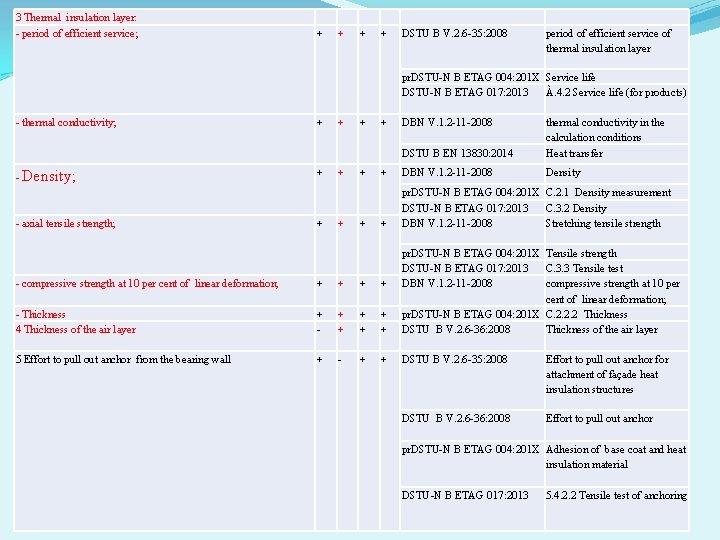
3 Thermal insulation layer: - period of efficient service; + + DSTU B V. 2. 6 -35: 2008 period of efficient service of thermal insulation layer pr. DSTU-N B ETAG 004: 201 Х Service life DSTU-N B ETAG 017: 2013 À. 4. 2 Service life (for products) - thermal conductivity; - Density; - axial tensile strength; + + + + + DBN V. 1. 2 -11 -2008 DSTU B EN 13830: 2014 thermal conductivity in the calculation conditions Heat transfer + DBN V. 1. 2 -11 -2008 Density + pr. DSTU-N B ETAG 004: 201 Х C. 2. 1 Density measurement DSTU-N B ETAG 017: 2013 С. 3. 2 Density DBN V. 1. 2 -11 -2008 Stretching tensile strength - compressive strength at 10 per cent of linear deformation; + + - Thickness 4 Thickness of the air layer + - + + + pr. DSTU-N B ETAG 004: 201 Х Tensile strength DSTU-N B ETAG 017: 2013 С. 3. 3 Tensile test DBN V. 1. 2 -11 -2008 compressive strength at 10 per cent of linear deformation; pr. DSTU-N B ETAG 004: 201 Х C. 2. 2. 2 Thickness DSTU B V. 2. 6 -36: 2008 Thickness of the air layer 5 Effort to pull out anchor from the bearing wall + - + + DSTU B V. 2. 6 -35: 2008 Effort to pull out anchor for attachment of façade heat insulation structures DSTU B V. 2. 6 -36: 2008 Effort to pull out anchor pr. DSTU-N B ETAG 004: 201 Х Adhesion of base coat and heat insulation material DSTU-N B ETAG 017: 2013 5. 4. 2. 2 Tensile test of anchoring
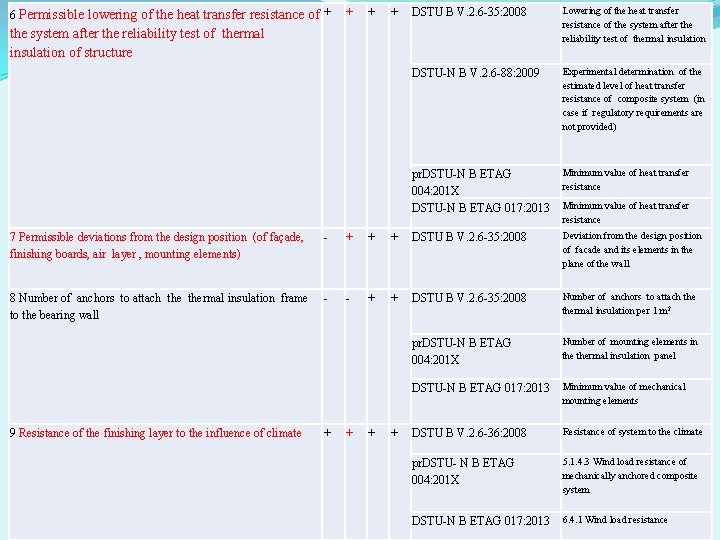
6 Permissible lowering of the heat transfer resistance of + + DSTU B V. 2. 6 -35: 2008 Lowering of the heat transfer resistance of the system after the reliability test of thermal insulation DSTU-N B V. 2. 6 -88: 2009 Experimental determination of the estimated level of heat transfer resistance of composite system (in case if regulatory requirements are not provided) pr. DSTU-N B ETAG 004: 201 Х DSTU-N B ETAG 017: 2013 Minimum value of heat transfer resistance the system after the reliability test of thermal insulation of structure Minimum value of heat transfer resistance 7 Permissible deviations from the design position (of façade, finishing boards, air layer , mounting elements) - + + + DSTU B V. 2. 6 -35: 2008 Deviation from the design position of facade and its elements in the plane of the wall 8 Number of anchors to attach thermal insulation frame to the bearing wall - - + + DSTU B V. 2. 6 -35: 2008 Number of anchors to attach thermal insulation per 1 m 2 pr. DSTU-N B ETAG 004: 201 Х Number of mounting elements in thermal insulation panel DSTU-N B ETAG 017: 2013 Minimum value of mechanical mounting elements DSTU B V. 2. 6 -36: 2008 Resistance of system to the climate pr. DSTU- N B ETAG 004: 201 Х 5. 1. 4. 3 Wind load resistance of mechanically anchored composite system DSTU-N B ETAG 017: 2013 6. 4. 1 Wind load resistance 9 Resistance of the finishing layer to the influence of climate + +
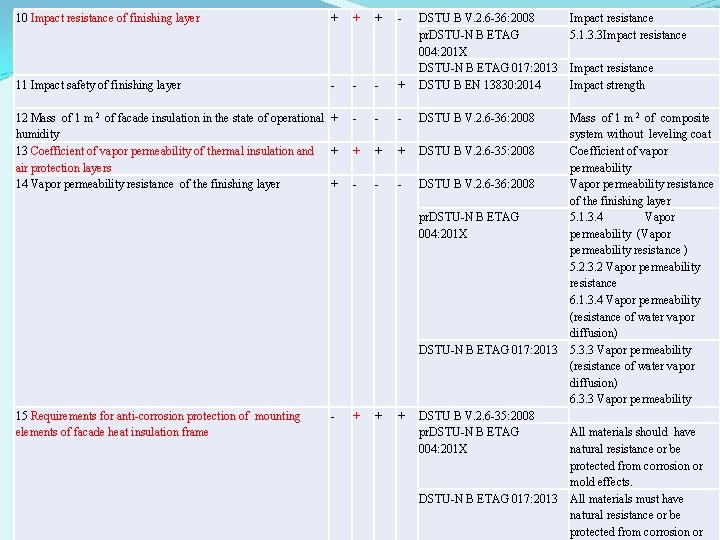
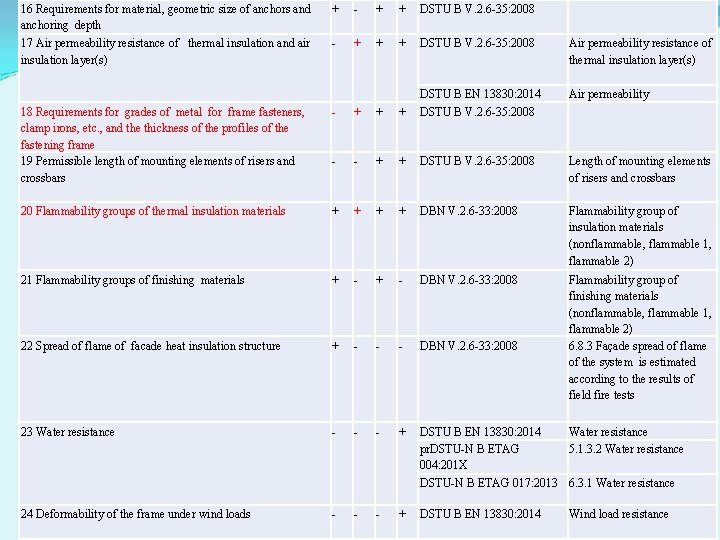
10 Impact resistance of finishing layer - - - + DSTU B V. 2. 6 -36: 2008 pr. DSTU-N B ETAG 004: 201 Х DSTU-N B ETAG 017: 2013 DSTU B EN 13830: 2014 12 Mass of 1 m 2 of facade insulation in the state of operational + humidity 13 Coefficient of vapor permeability of thermal insulation and + air protection layers 14 Vapor permeability resistance of the finishing layer + - - - DSTU B V. 2. 6 -36: 2008 + + + DSTU B V. 2. 6 -35: 2008 - - - DSTU B V. 2. 6 -36: 2008 11 Impact safety of finishing layer + + + - pr. DSTU-N B ETAG 004: 201 Х DSTU-N B ETAG 017: 2013 15 Requirements for anti-corrosion protection of mounting elements of facade heat insulation frame - + + + DSTU B V. 2. 6 -35: 2008 pr. DSTU-N B ETAG 004: 201 Х DSTU-N B ETAG 017: 2013 Impact resistance 5. 1. 3. 3 Impact resistance Mass of 1 m 2 of composite system without leveling coat Coefficient of vapor permeability Vapor permeability resistance of the finishing layer 5. 1. 3. 4 Vapor permeability (Vapor permeability resistance ) 5. 2. 3. 2 Vapor permeability resistance 6. 1. 3. 4 Vapor permeability (resistance of water vapor diffusion) 5. 3. 3 Vapor permeability (resistance of water vapor diffusion) 6. 3. 3 Vapor permeability Impact resistance Impact strength All materials should have natural resistance or be protected from corrosion or mold effects. All materials must have natural resistance or be protected from corrosion or
16 Requirements for material, geometric size of anchors and anchoring depth 17 Air permeability resistance of thermal insulation and air insulation layer(s) + - + + DSTU B V. 2. 6 -35: 2008 - + + + DSTU B V. 2. 6 -35: 2008 Air permeability resistance of thermal insulation layer(s) Air permeability 18 Requirements for grades of metal for frame fasteners, clamp irons, etc. , and the thickness of the profiles of the fastening frame 19 Permissible length of mounting elements of risers and crossbars - + + + DSTU B EN 13830: 2014 DSTU B V. 2. 6 -35: 2008 - - + + DSTU B V. 2. 6 -35: 2008 Length of mounting elements of risers and crossbars 20 Flammability groups of thermal insulation materials + + DBN V. 2. 6 -33: 2008 Flammability group of insulation materials (nonflammable, flammable 1, flammable 2) 21 Flammability groups of finishing materials + - DBN V. 2. 6 -33: 2008 22 Spread of flame of facade heat insulation structure + - - - DBN V. 2. 6 -33: 2008 Flammability group of finishing materials (nonflammable, flammable 1, flammable 2) 6. 8. 3 Façade spread of flame of the system is estimated according to the results of field fire tests 23 Water resistance - - - + DSTU B EN 13830: 2014 Water resistance pr. DSTU-N B ETAG 5. 1. 3. 2 Water resistance 004: 201 Х DSTU-N B ETAG 017: 2013 6. 3. 1 Water resistance 24 Deformability of the frame under wind loads - - - + DSTU B EN 13830: 2014 Wind load resistance
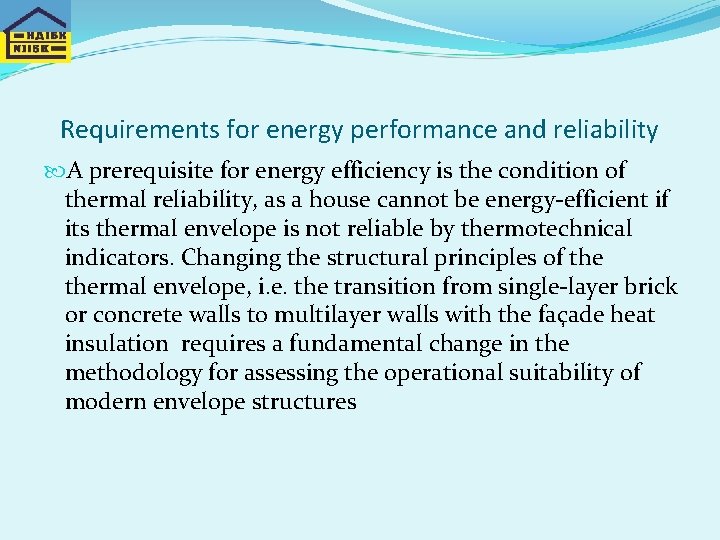
Requirements for energy performance and reliability A prerequisite for energy efficiency is the condition of thermal reliability, as a house cannot be energy-efficient if its thermal envelope is not reliable by thermotechnical indicators. Changing the structural principles of thermal envelope, i. e. the transition from single-layer brick or concrete walls to multilayer walls with the façade heat insulation requires a fundamental change in the methodology for assessing the operational suitability of modern envelope structures
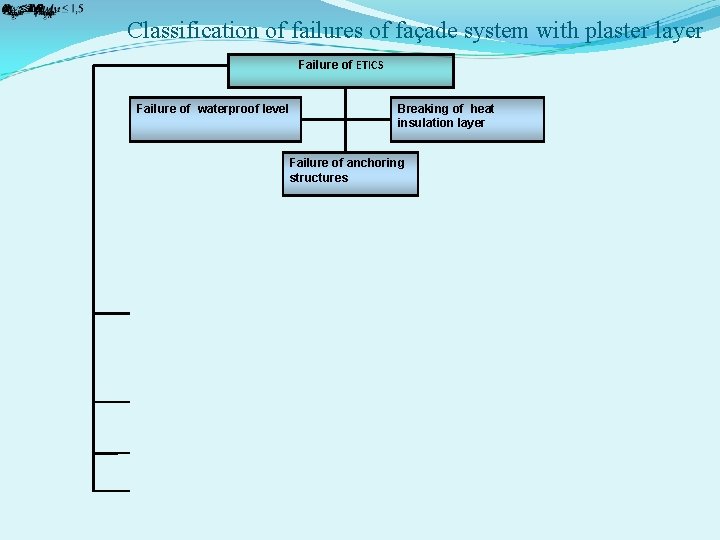
Classification of failures of façade system with plaster layer Failure of ETICS Failure of waterproof level Breaking of heat insulation layer Failure of anchoring structures
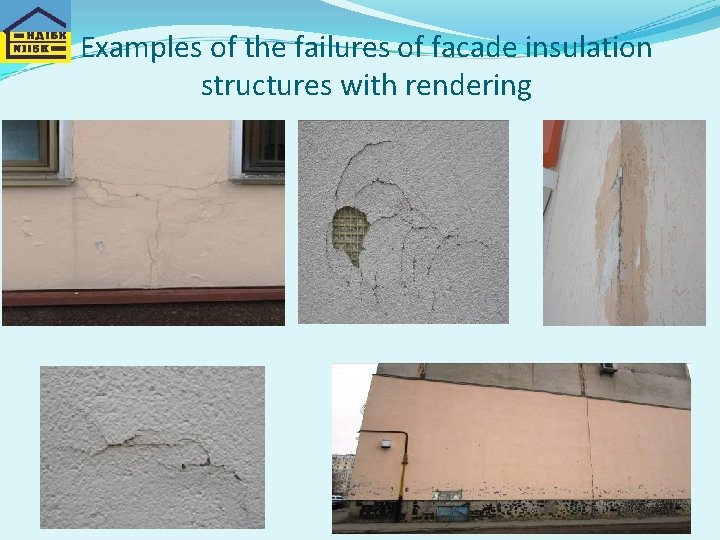
Examples of the failures of facade insulation structures with rendering
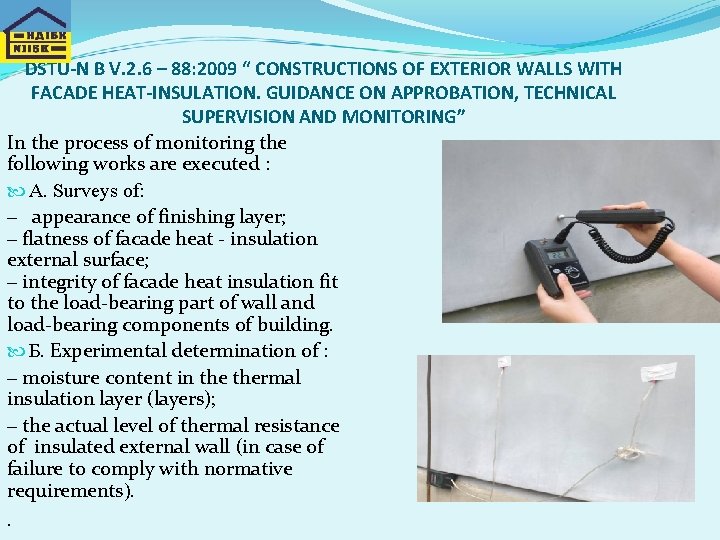
DSTU-N B V. 2. 6 – 88: 2009 “ CONSTRUCTIONS OF EXTERIOR WALLS WITH FACADE HEAT-INSULATION. GUIDANCE ON APPROBATION, TECHNICAL SUPERVISION AND MONITORING” In the process of monitoring the following works are executed : А. Surveys of: – appearance of finishing layer; – flatness of facade heat - insulation external surface; – integrity of facade heat insulation fit to the load-bearing part of wall and load-bearing components of building. Б. Experimental determination of : – moisture content in thermal insulation layer (layers); – the actual level of thermal resistance of insulated external wall (in case of failure to comply with normative requirements). .
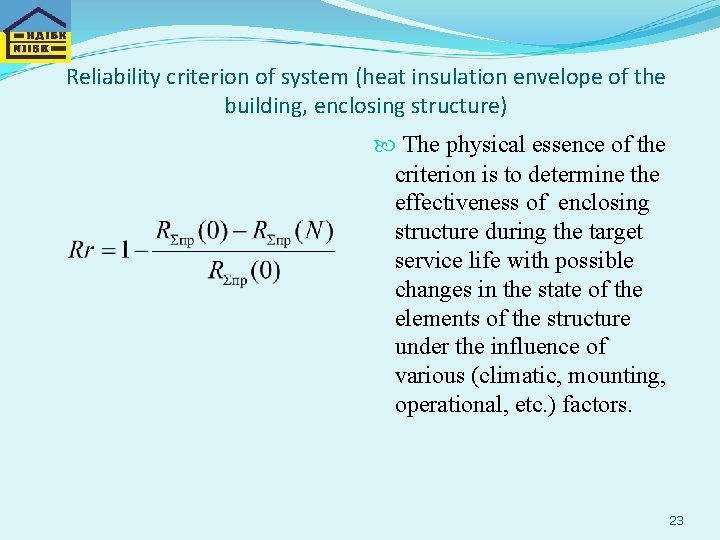
Reliability criterion of system (heat insulation envelope of the building, enclosing structure) The physical essence of the criterion is to determine the effectiveness of enclosing structure during the target service life with possible changes in the state of the elements of the structure under the influence of various (climatic, mounting, operational, etc. ) factors. 23
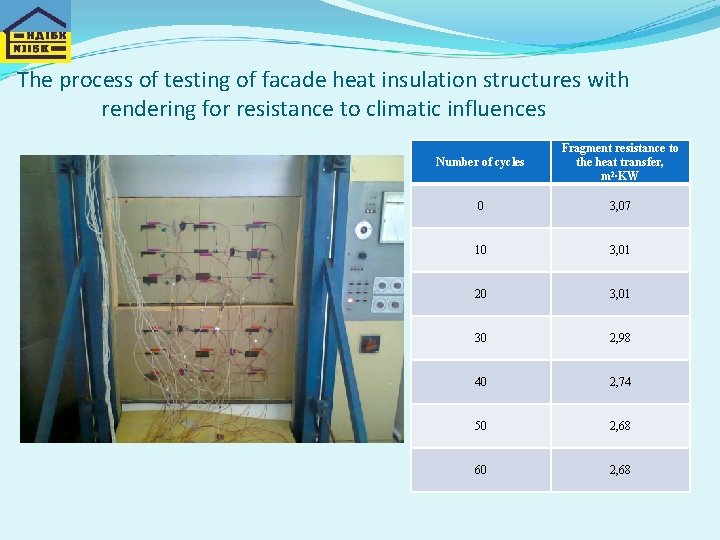
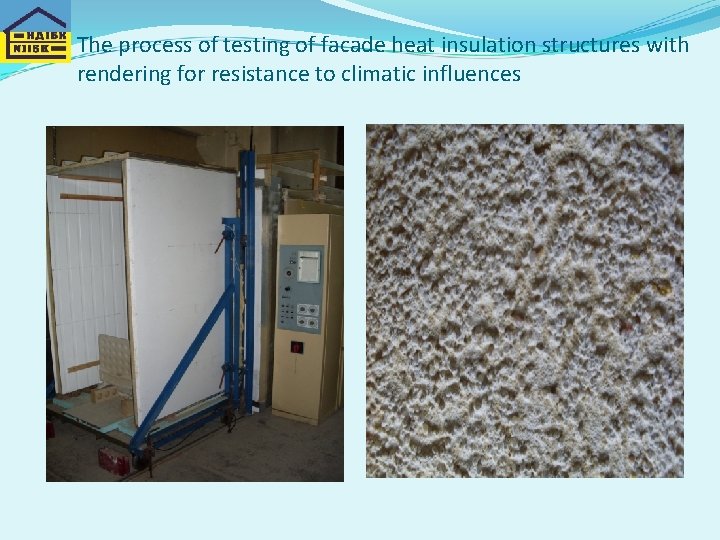
The process of testing of facade heat insulation structures with rendering for resistance to climatic influences Number of cycles Fragment resistance to the heat transfer, m 2∙KW 0 3, 07 10 3, 01 20 3, 01 30 2, 98 40 2, 74 50 2, 68 60 2, 68
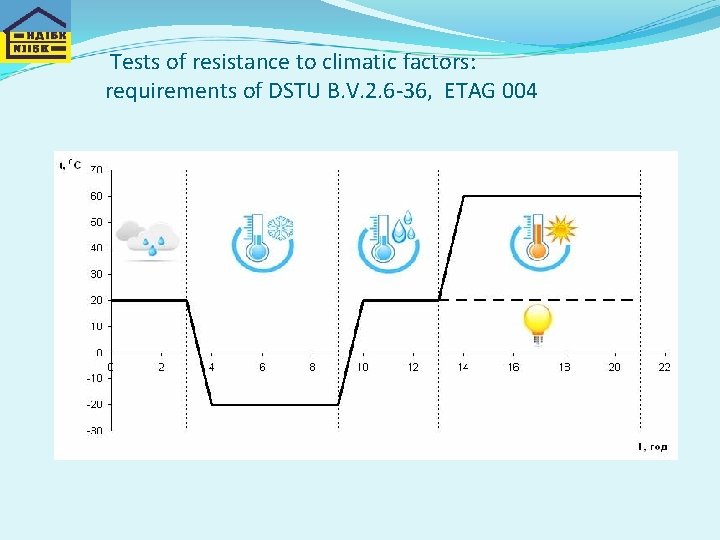
Tests of resistance to climatic factors: requirements of DSTU B. V. 2. 6 -36, ЕTAG 004
The process of testing of facade heat insulation structures with rendering for resistance to climatic influences
What is ETICS ? Is it a system or a kit?
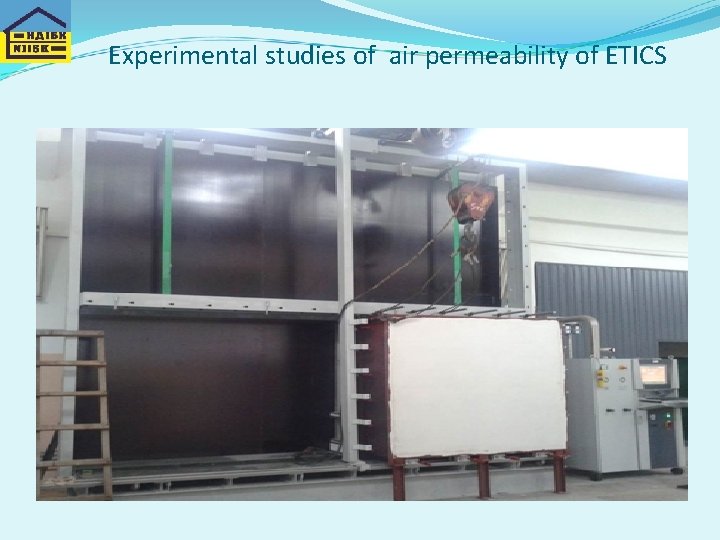
Experimental studies of air permeability of ETICS
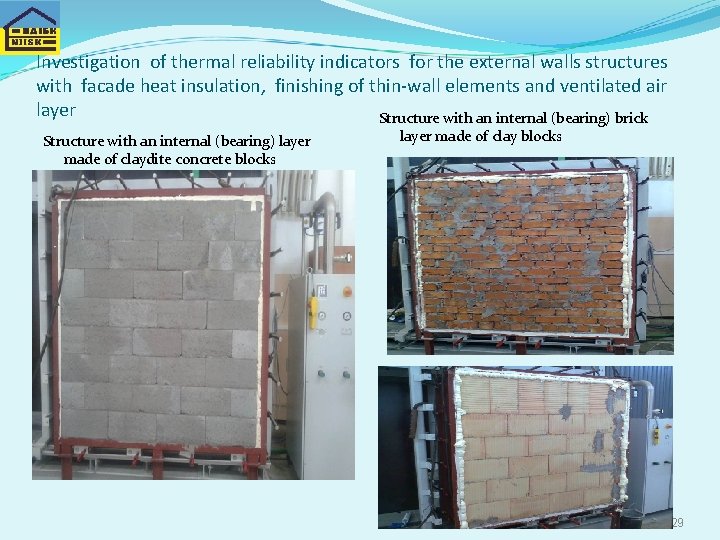
Investigation of thermal reliability indicators for the external walls structures with facade heat insulation, finishing of thin-wall elements and ventilated air layer Structure with an internal (bearing) brick Structure with an internal (bearing) layer made of claydite concrete blocks layer made of clay blocks 29
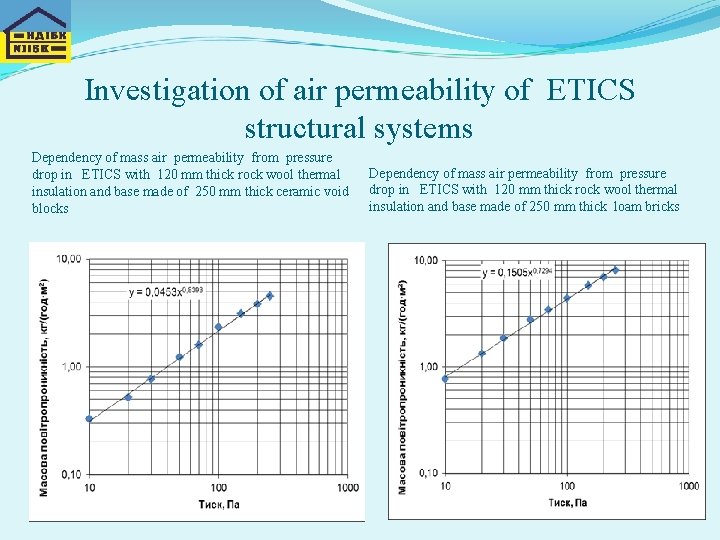
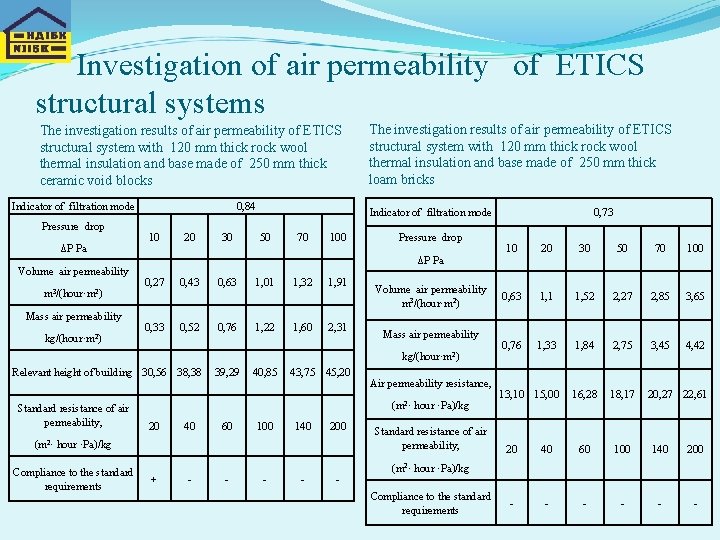
Investigation of air permeability of ETICS structural systems Dependency of mass air permeability from pressure drop in ETICS with 120 mm thick rock wool thermal insulation and base made of 250 mm thick ceramic void blocks Dependency of mass air permeability from pressure drop in ETICS with 120 mm thick rock wool thermal insulation and base made of 250 mm thick loam bricks
Investigation of air permeability of ETICS structural systems The investigation results of air permeability of ETICS structural system with 120 mm thick rock wool thermal insulation and base made of 250 mm thick ceramic void blocks Indicator of filtration mode Pressure drop ΔР Pa Volume air permeability m 3/(hour·m 2) Mass air permeability kg/(hour·m 2) 0, 84 10 20 30 The investigation results of air permeability of ETICS structural system with 120 mm thick rock wool thermal insulation and base made of 250 mm thick loam bricks Indicator of filtration mode 50 70 100 Pressure drop ΔР Pа 0, 27 0, 33 0, 43 0, 52 0, 63 0, 76 1, 01 1, 22 1, 32 1, 60 1, 91 2, 31 Volume air permeability m 3/(hour·m 2) Mass air permeability kg/(hour·m 2) Relevant height of building 30, 56 38, 38 Standard resistance of air permeability, 39, 29 40, 85 43, 75 45, 20 (m 2· hour ·Pа)/kg 20 40 60 100 140 200 (m 2· hour ·Pа)/kg Compliance to the standard requirements Air permeability resistance, + - - - Standard resistance of air permeability, 0, 73 10 20 30 50 70 100 0, 63 1, 1 1, 52 2, 27 2, 85 3, 65 0, 76 1, 33 1, 84 2, 75 3, 45 4, 42 13, 10 15, 00 16, 28 18, 17 20, 27 22, 61 20 40 60 100 140 200 - - - (m 2· hour ·Pа)/kg Compliance to the standard requirements
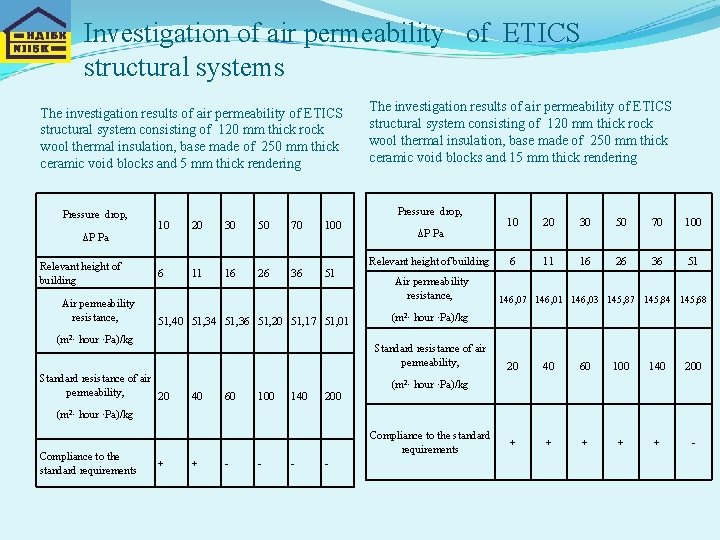
Investigation of air permeability of ETICS structural systems The investigation results of air permeability of ETICS structural system consisting of 120 mm thick rock wool thermal insulation, base made of 250 mm thick ceramic void blocks and 5 mm thick rendering Pressure drop, ΔР Pa Relevant height of building Air permeability resistance, Pressure drop, 10 20 30 50 70 100 6 11 16 26 36 51 ΔР Pa Relevant height of building 51, 40 51, 34 51, 36 51, 20 51, 17 51, 01 (m 2· hour ·Pа)/kg Air permeability resistance, 10 20 30 50 70 100 6 11 16 26 36 51 146, 07 146, 01 146, 03 145, 87 145, 84 145, 68 (m 2· hour ·Pа)/kg Standard resistance of air permeability, 20 (m 2· The investigation results of air permeability of ETICS structural system consisting of 120 mm thick rock wool thermal insulation, base made of 250 mm thick ceramic void blocks and 15 mm thick rendering 20 40 60 100 140 200 + + + - (m 2· hour ·Pа)/kg 40 60 100 140 200 hour ·Pа)/kg Compliance to the standard requirements + + - -
Thank you for your attention!