
Mining Massive Datasets Intro Map Reduce Data contains



- Slides: 48
Mining Massive Datasets Intro & Map. Reduce
Data contains value and knowledge 6/6/2021 3
Data Mining �But to extract the knowledge data needs to be § Stored (systems) § Managed (databases) § And ANALYZED this class Data Mining ≈ Big Data ≈ Predictive Analytics ≈ Data Science 6/6/2021 4
What This Course Is About �Data mining = extraction of actionable information from (usually) very large datasets, is the subject of extreme hype, fear, and interest �It’s not all about machine learning �But some of it is 6/6/2021 6
Data Mining Methods �Descriptive methods § Find human-interpretable patterns that describe the data § Example: Clustering �Predictive methods § Use some variables to predict unknown or future values of other variables § Example: Recommender systems 6/6/2021 7
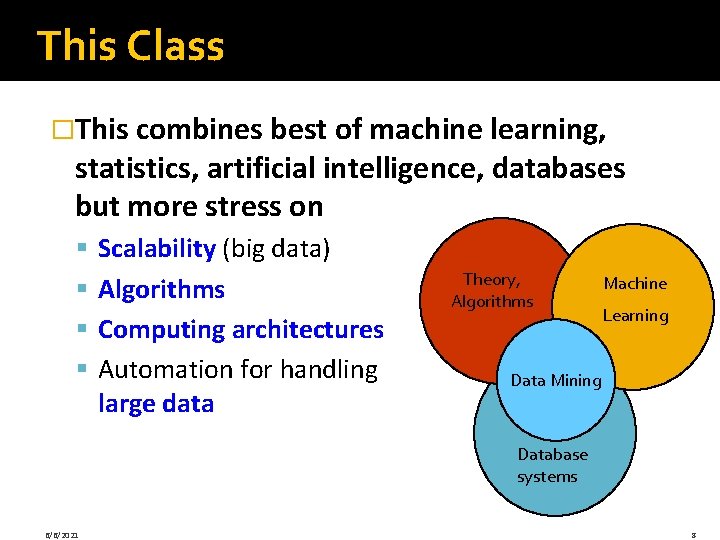
This Class �This combines best of machine learning, statistics, artificial intelligence, databases but more stress on § § Scalability (big data) Algorithms Computing architectures Automation for handling large data Theory, Algorithms Machine Learning Data Mining Database systems 6/6/2021 8
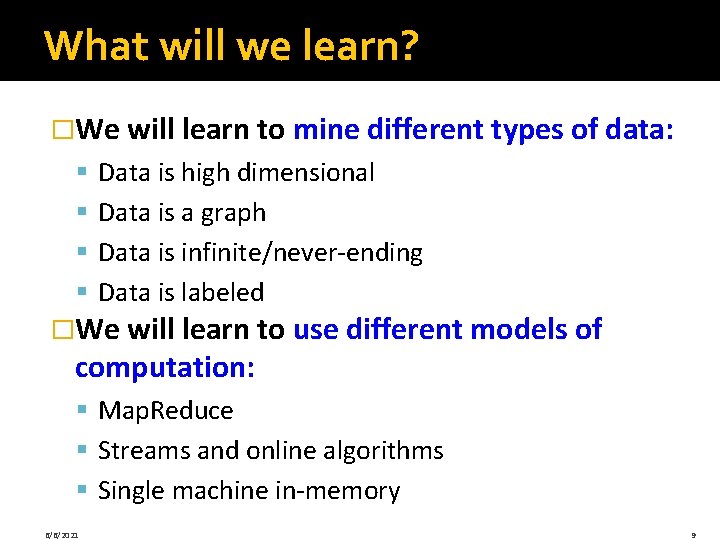
What will we learn? �We will learn to mine different types of data: § § Data is high dimensional Data is a graph Data is infinite/never-ending Data is labeled �We will learn to use different models of computation: § Map. Reduce § Streams and online algorithms § Single machine in-memory 6/6/2021 9
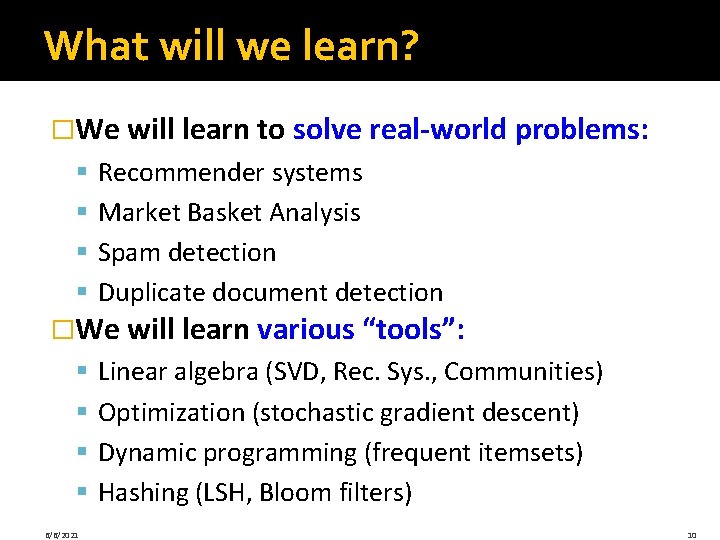
What will we learn? �We will learn to solve real-world problems: § § Recommender systems Market Basket Analysis Spam detection Duplicate document detection �We will learn various “tools”: § § 6/6/2021 Linear algebra (SVD, Rec. Sys. , Communities) Optimization (stochastic gradient descent) Dynamic programming (frequent itemsets) Hashing (LSH, Bloom filters) 10
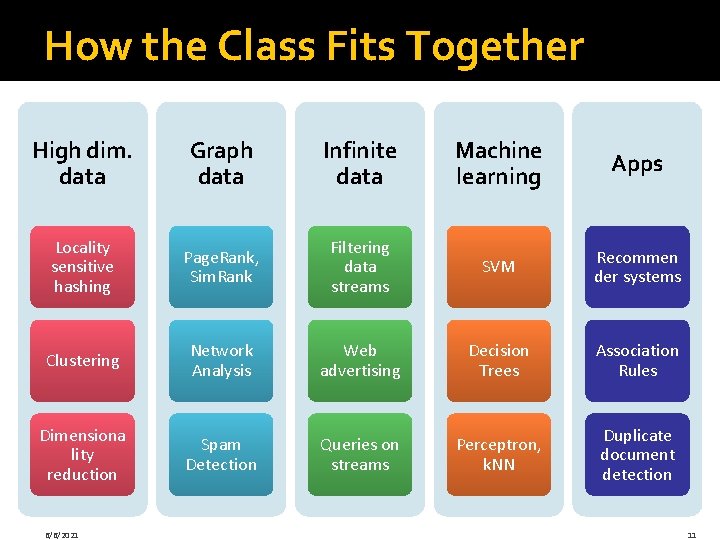
How the Class Fits Together High dim. data Graph data Infinite data Machine learning Apps Locality sensitive hashing Page. Rank, Sim. Rank Filtering data streams SVM Recommen der systems Clustering Network Analysis Web advertising Decision Trees Association Rules Dimensiona lity reduction Spam Detection Queries on streams Perceptron, k. NN Duplicate document detection 6/6/2021 11
I data♥ How do you want that data? 6/6/2021 12
Course Logistics
Prerequisites �Programming: Python or Java or Scala �Basic Algorithms �Probability �Linear algebra �Multivariable calculus �Database systems 6/6/2021 14
Honor Code �Grades: § 30% Mid Exam § 40% Final Exam § 30% Homeworks 6/6/2021 15
Distributed Computing for Data Mining
6/6/2021 17
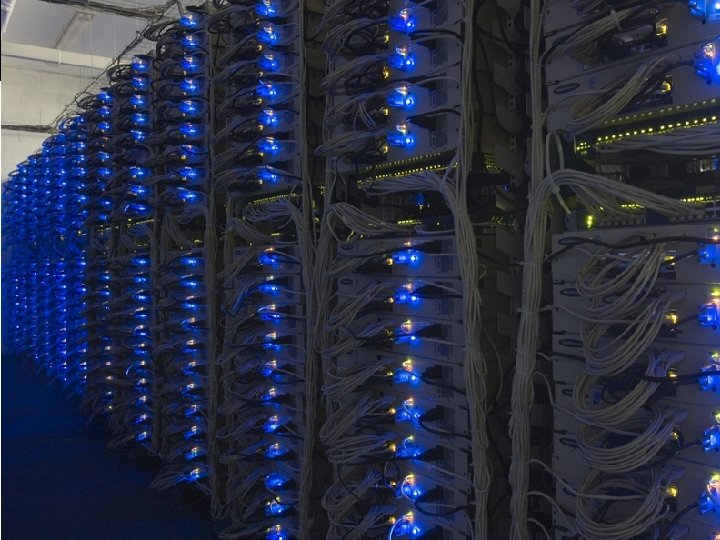
Large-scale Computing �Large-scale computing for data mining problems on commodity hardware �Challenges: § How do you distribute computation? § How can we make it easy to write distributed programs? § Machines fail: § One server may stay up 3 years (1, 000 days) § If you have 1, 000 servers, expect to loose 1/day § With 1 M machines 1, 000 machines fail every day! 6/6/2021 18
An Idea and a Solution �Issue: Copying data over a network takes time �Idea: § Bring computation to data § Store files multiple times for reliability �Spark/Hadoop address these problems § Storage Infrastructure – File system § Google: GFS. Hadoop: HDFS § Programming model § Map. Reduce § Spark 6/6/2021 19
Storage Infrastructure �Problem: § If nodes fail, how to store data persistently? �Answer: § Distributed File System § Provides global file namespace �Typical usage pattern: § Huge files (100 s of GB to TB) § Data is rarely updated in place § Reads and appends are common 6/6/2021 20
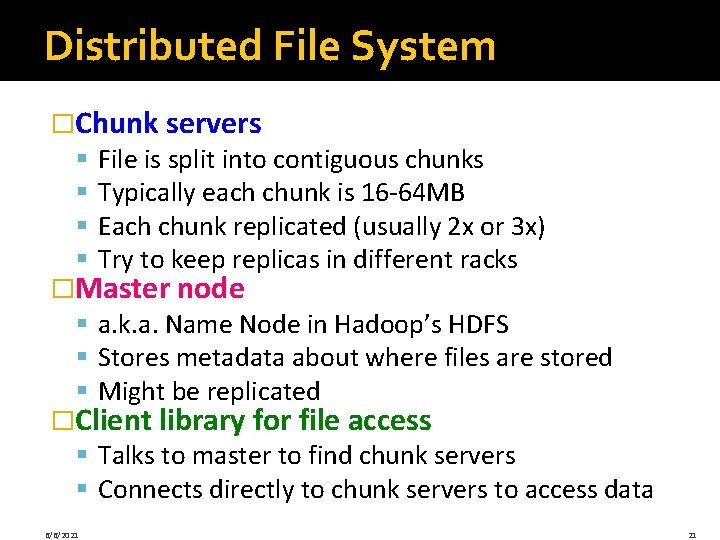
Distributed File System �Chunk servers § § File is split into contiguous chunks Typically each chunk is 16 -64 MB Each chunk replicated (usually 2 x or 3 x) Try to keep replicas in different racks �Master node § a. k. a. Name Node in Hadoop’s HDFS § Stores metadata about where files are stored § Might be replicated �Client library for file access § Talks to master to find chunk servers § Connects directly to chunk servers to access data 6/6/2021 21
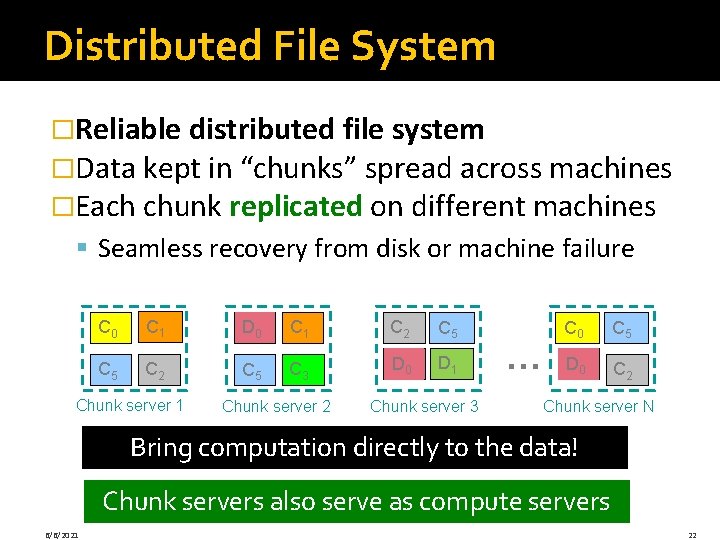
Distributed File System �Reliable distributed file system �Data kept in “chunks” spread across machines �Each chunk replicated on different machines § Seamless recovery from disk or machine failure C 0 C 1 D 0 C 1 C 2 C 5 C 3 D 0 D 1 Chunk server 2 Chunk server 3 … C 0 C 5 D 0 C 2 Chunk server N Bring computation directly to the data! Chunk servers also serve as compute servers 6/6/2021 22
Programming Model �Map. Reduce is a style of programming designed for: 1. Easy parallel programming 2. Invisible management of hardware and software failures 3. Easy management of very-large-scale data �It has several implementations, including Hadoop, Spark (used in this class), Flink, and the original Google implementation just called “Map. Reduce” 6/6/2021 23
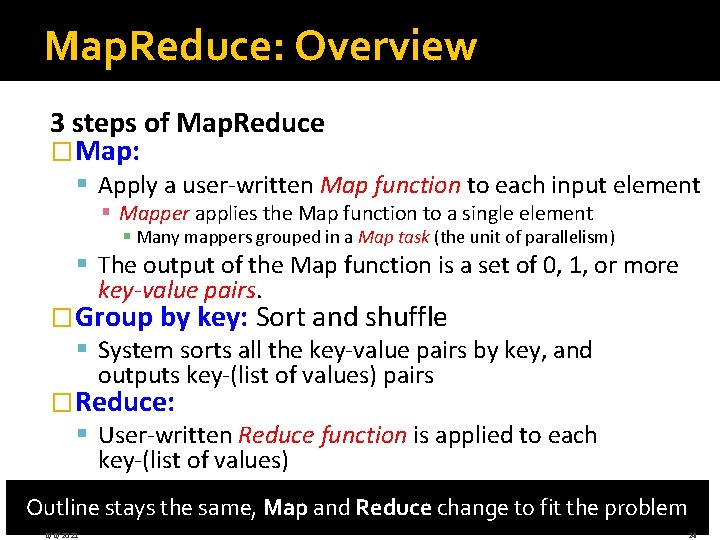
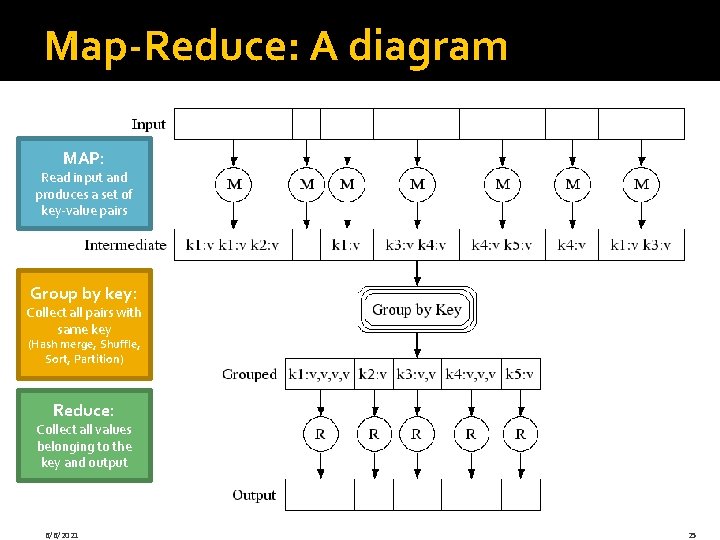
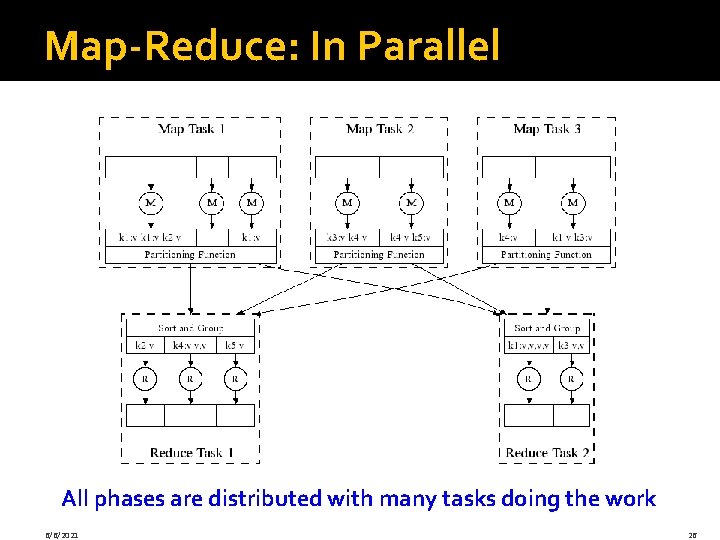
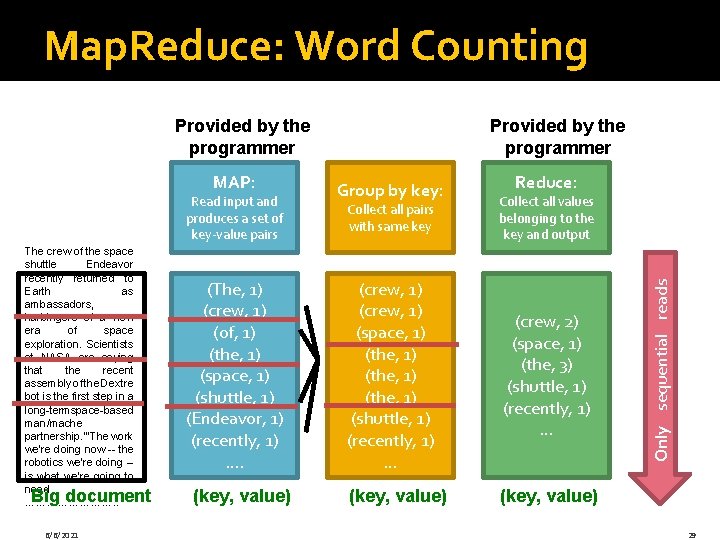
Map. Reduce: Overview 3 steps of Map. Reduce �Map: § Apply a user-written Map function to each input element § Mapper applies the Map function to a single element § Many mappers grouped in a Map task (the unit of parallelism) § The output of the Map function is a set of 0, 1, or more key-value pairs. �Group by key: Sort and shuffle § System sorts all the key-value pairs by key, and outputs key-(list of values) pairs �Reduce: § User-written Reduce function is applied to each key-(list of values) Outline stays the same, Map and Reduce change to fit the problem 6/6/2021 24
Map-Reduce: A diagram MAP: Read input and produces a set of key-value pairs Group by key: Collect all pairs with same key (Hash merge, Shuffle, Sort, Partition) Reduce: Collect all values belonging to the key and output 6/6/2021 25
Map-Reduce: In Parallel All phases are distributed with many tasks doing the work 6/6/2021 26
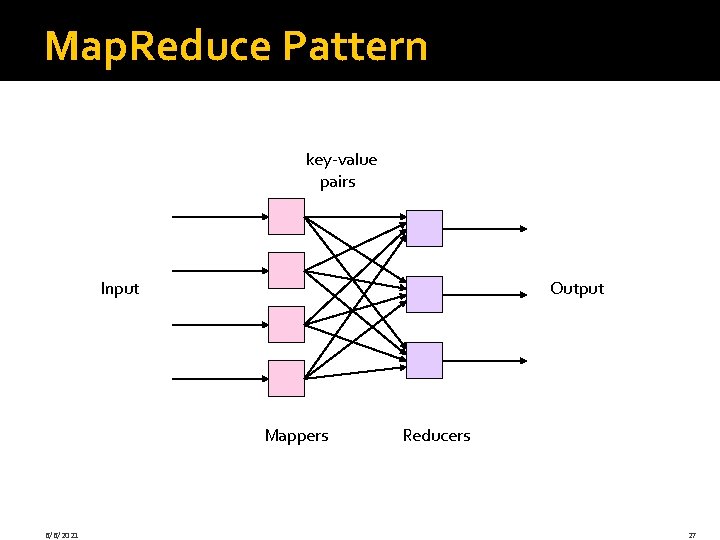
Map. Reduce Pattern key-value pairs Input Output Mappers 6/6/2021 Reducers 27
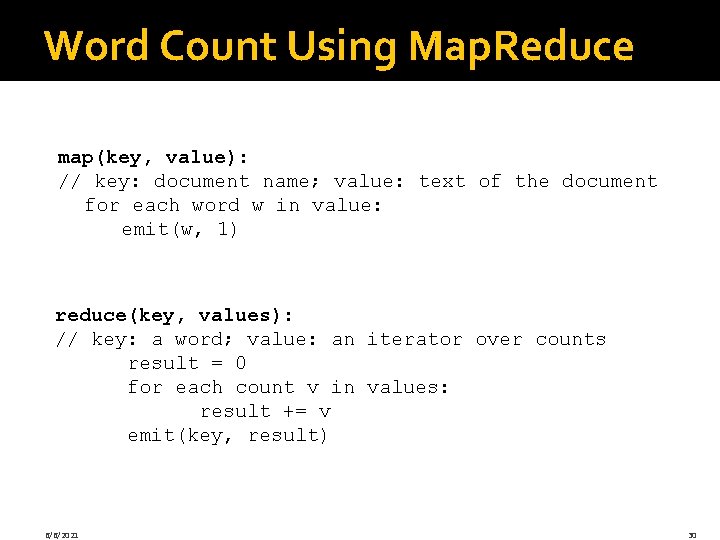
Example: Word Counting Example Map. Reduce task: �We have a huge text document �Count the number of times each distinct word appears in the file �Many applications of this: § Analyze web server logs to find popular URLs § Statistical machine translation: § Need to count number of times every 5 -word sequence occurs in a large corpus of documents 6/6/2021 28
Map. Reduce: Word Counting MAP: Read input and produces a set of key-value pairs The crew of the space shuttle Endeavor recently returned to Earth as ambassadors, harbingers of a new era of space exploration. Scientists at NASA are saying that the recent assembly of the Dextre bot is the first step in a long-termspace-based man/mache partnership. '"The work we're doing now -- the robotics we're doing -is what we're going to need …………. . Big document 6/6/2021 (The, 1) (crew, 1) (of, 1) (the, 1) (space, 1) (shuttle, 1) (Endeavor, 1) (recently, 1) …. (key, value) Provided by the programmer Group by key: Reduce: Collect all pairs with same key Collect all values belonging to the key and output (crew, 1) (space, 1) (the, 1) (shuttle, 1) (recently, 1) … (crew, 2) (space, 1) (the, 3) (shuttle, 1) (recently, 1) … (key, value) Only sequential reads Sequentially read the data Provided by the programmer 29
Word Count Using Map. Reduce map(key, value): // key: document name; value: text of the document for each word w in value: emit(w, 1) reduce(key, values): // key: a word; value: an iterator over counts result = 0 for each count v in values: result += v emit(key, result) 6/6/2021 30
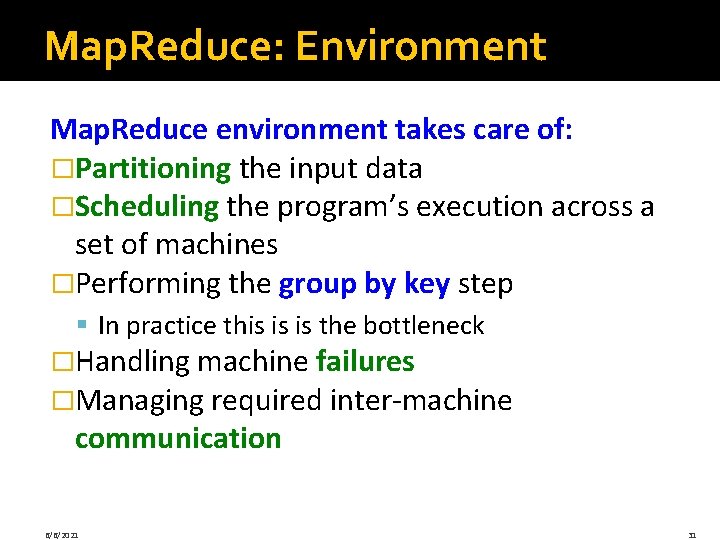
Map. Reduce: Environment Map. Reduce environment takes care of: �Partitioning the input data �Scheduling the program’s execution across a set of machines �Performing the group by key step § In practice this is is the bottleneck �Handling machine failures �Managing required inter-machine communication 6/6/2021 31
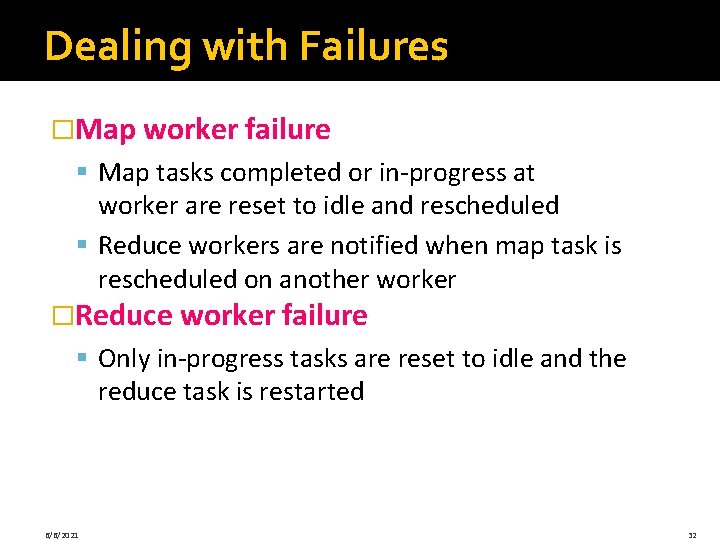
Dealing with Failures �Map worker failure § Map tasks completed or in-progress at worker are reset to idle and rescheduled § Reduce workers are notified when map task is rescheduled on another worker �Reduce worker failure § Only in-progress tasks are reset to idle and the reduce task is restarted 6/6/2021 32
Spark
Problems with Map. Reduce �Two major limitations of Map. Reduce: § Difficultly of programming directly in MR § Many problems aren’t easily described as map-reduce § Performance bottlenecks, or batch not fitting the use cases § Persistence to disk typically slower than in-memory work �In short, MR doesn’t compose well for large applications § Many times one needs to chain multiple mapreduce steps 6/6/2021 34
Data-Flow Systems �Map. Reduce uses two “ranks” of tasks: One for Map the second for Reduce § Data flows from the first rank to the second �Data-Flow Systems generalize this in two ways: 1. Allow any number of tasks/ranks 2. Allow functions other than Map and Reduce § As long as data flow is in one direction only, we can have the blocking property and allow recovery of tasks rather than whole jobs 6/6/2021 35
Spark: Most Popular Data-Flow System �Expressive computing system, not limited to the map-reduce model �Additions to Map. Reduce model: § Fast data sharing § Avoids saving intermediate results to disk § Caches data for repetitive queries (e. g. for machine learning) § General execution graphs (DAGs) § Richer functions than just map and reduce �Compatible with Hadoop 6/6/2021 36
Spark: RDD Key concept Resilient Distributed Dataset (RDD) § Partitioned collection of records § Generalizes (key-value) pairs �Spread across the cluster, Read-only �Caching dataset in memory § Different storage levels available § Fallback to disk possible �RDDs can be created from Hadoop, or by transforming other RDDs (you can stack RDDs) �RDDs are best suited for applications that apply the same operation to all elements of a dataset 6/6/2021 37
Spark RDD Operations �Transformations build RDDs through deterministic operations on other RDDs: § Transformations include map, filter, join, union, intersection, distinct § Lazy evaluation: Nothing computed until an action requires it �Actions to return value or export data § Actions include count, collect, reduce, save § Actions can be applied to RDDs; actions force calculations and return values 6/6/2021 38
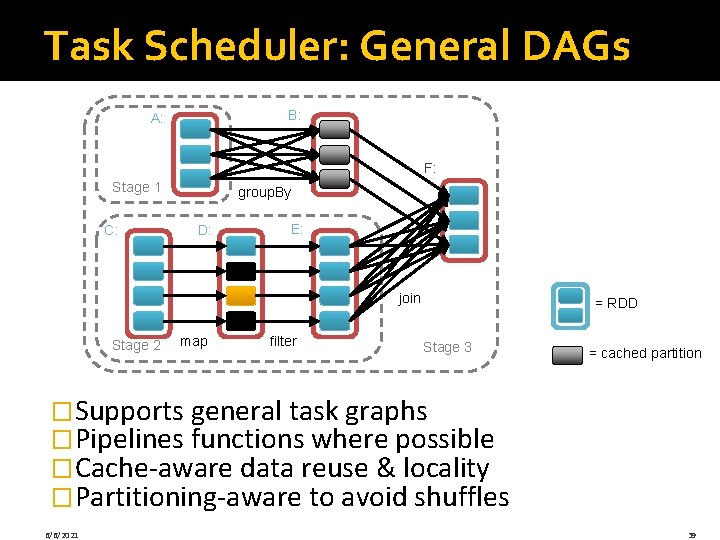
Task Scheduler: General DAGs B: A: F: Stage 1 C: group. By D: E: join Stage 2 map filter = RDD Stage 3 = cached partition �Supports general task graphs �Pipelines functions where possible �Cache-aware data reuse & locality �Partitioning-aware to avoid shuffles 6/6/2021 39
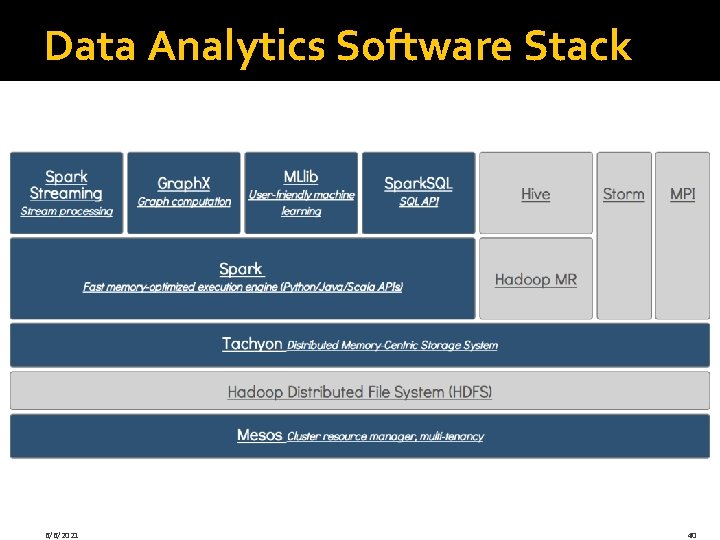
Data Analytics Software Stack 6/6/2021 40
Problems Suited for Map. Reduce
Example: Host size �Suppose we have a large web corpus �Look at the metadata file § Lines of the form: (URL, size, date, …) �For each host, find the total number of bytes § That is, the sum of the page sizes for all URLs from that particular host �Other examples: § Link analysis and graph processing § Machine Learning algorithms 6/6/2021 42
Example: Language Model �Statistical machine translation: § Need to count number of times every 5 -word sequence occurs in a large corpus of documents �Very easy with Map. Reduce: § Map: § Extract (5 -word sequence, count) from document § Reduce: § Combine the counts 6/6/2021 43
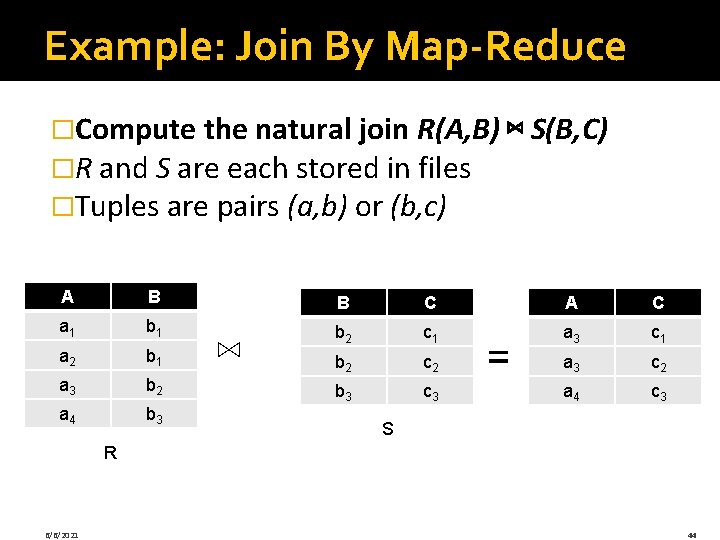
Example: Join By Map-Reduce �Compute the natural join R(A, B) ⋈ S(B, C) �R and S are each stored in files �Tuples are pairs (a, b) or (b, c) A B B C A C a 1 b 1 a 2 b 1 b 2 c 1 a 3 b 2 c 2 a 3 c 2 a 4 b 3 c 3 a 4 c 3 ⋈ = S R 6/6/2021 44
Map-Reduce Join �Use a hash function h from B-values to 1. . . k �A Map process turns: § Each input tuple R(a, b) into key-value pair (b, (a, R)) § Each input tuple S(b, c) into (b, (c, S)) �Each Reduce process matches all the pairs (b, (a, R)) with all (b, (c, S)) and outputs (a, b, c). 6/6/2021 45
Problems NOT suitable for Map. Reduce �Map. Reduce is great for: § Problems that require sequential data access § Large batch jobs (not interactive, real-time) �Map. Reduce is inefficient for problems where random (or irregular) access to data required: § Graphs § Interdependent data § Machine learning § Comparisons of many pairs of items 6/6/2021 46
Cost Measures for Algorithms In Map. Reduce we quantify the cost of an algorithm using 1. Communication cost = total I/O of all processes 2. Elapsed communication cost = max of I/O along any path 3. (Elapsed) computation cost analogous, but count only running time of processes � Note that here the big-O notation is not the most useful (adding more machines is always an option) 6/6/2021 47
Example: Cost Measures �For a map-reduce algorithm: § Communication cost = input file size + 2 (sum of the sizes of all files passed from Map processes to Reduce processes) + the sum of the output sizes of the Reduce processes. § Elapsed communication cost is the sum of the largest input + output for any map process, plus the same for any reduce process 6/6/2021 48
What Cost Measures Mean �Either the I/O (communication) or processing (computation) cost dominates § Ignore one or the other �Total cost tells what you pay in rent from your friendly neighborhood cloud �Elapsed cost is wall-clock time using parallelism 6/6/2021 49
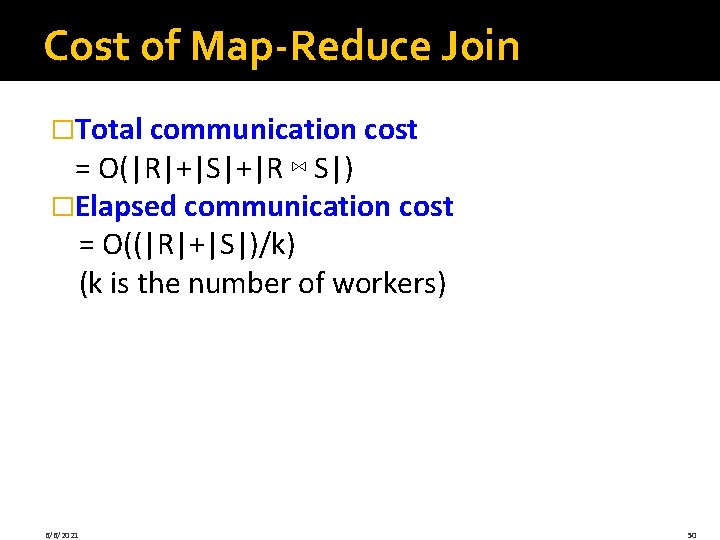
Cost of Map-Reduce Join �Total communication cost = O(|R|+|S|+|R ⋈ S|) �Elapsed communication cost = O((|R|+|S|)/k) (k is the number of workers) 6/6/2021 50