
Mining Frequent Itemsets over Uncertain Databases Yongxin Tong
Mining Frequent Itemsets over Uncertain Databases Yongxin Tong 1, Lei Chen 1, Yurong Cheng 2, Philip S. Yu 3 1 The Hong Kong University of Science and Technology, Hong Kong, China 2 Northeastern University, China 3 University of Illinois at Chicago, USA VLDB 2012
Outline q Motivations – An Example of Mining Uncertain Frequent Itemsets (FIs) – Deterministic FI Vs. Uncertain FI – Evaluation Goals q q Problem Definitions Evaluations of Algorithms – Expected Support-based Frequent Algorithms – Exact Probabilistic Frequent Algorithms – Approximate Probabilistic Frequent Algorithms q 2 Conclusions
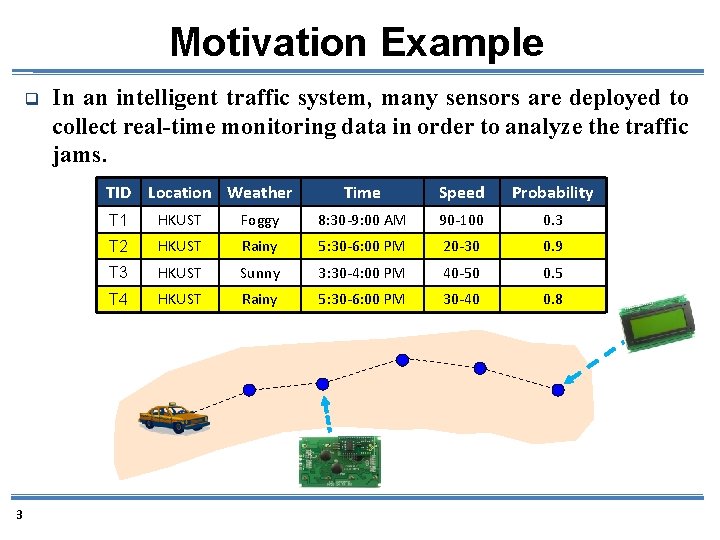
Motivation Example q In an intelligent traffic system, many sensors are deployed to collect real-time monitoring data in order to analyze the traffic jams. TID Location Weather 3 Time Speed Probability T 1 HKUST Foggy 8: 30 -9: 00 AM 90 -100 0. 3 T 2 HKUST Rainy 5: 30 -6: 00 PM 20 -30 0. 9 T 3 HKUST Sunny 3: 30 -4: 00 PM 40 -50 0. 5 T 4 HKUST Rainy 5: 30 -6: 00 PM 30 -40 0. 8
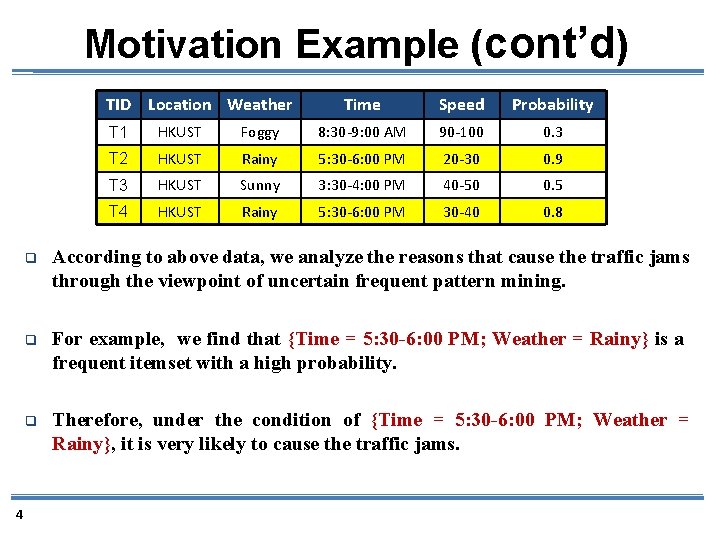
Motivation Example (cont’d) TID Location Weather 4 Time Speed Probability T 1 HKUST Foggy 8: 30 -9: 00 AM 90 -100 0. 3 T 2 HKUST Rainy 5: 30 -6: 00 PM 20 -30 0. 9 T 3 HKUST Sunny 3: 30 -4: 00 PM 40 -50 0. 5 T 4 HKUST Rainy 5: 30 -6: 00 PM 30 -40 0. 8 q According to above data, we analyze the reasons that cause the traffic jams through the viewpoint of uncertain frequent pattern mining. q For example, we find that {Time = 5: 30 -6: 00 PM; Weather = Rainy} is a frequent itemset with a high probability. q Therefore, under the condition of {Time = 5: 30 -6: 00 PM; Weather = Rainy}, it is very likely to cause the traffic jams.
Outline q Motivations – An Example of Mining Uncertain Frequent Itemsets (FIs) – Deterministic FI Vs. Uncertain FI – Evaluation Goals q q Problem Definitions Evaluations of Algorithms – Expected Support-based Frequent Algorithms – Exact Probabilistic Frequent Algorithms – Approximate Probabilistic Frequent Algorithms q 5 Conclusions
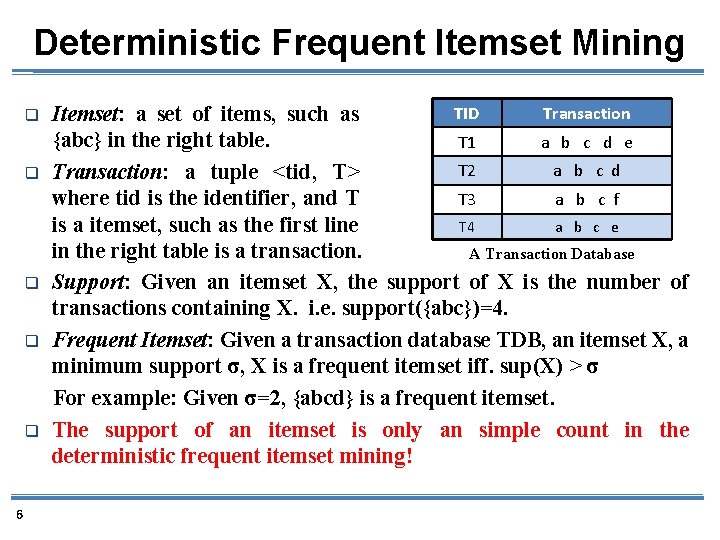
Deterministic Frequent Itemset Mining q q q 6 TID Transaction Itemset: a set of items, such as {abc} in the right table. T 1 a b c d e T 2 a b c d Transaction: a tuple <tid, T> T 3 a b c f where tid is the identifier, and T is a itemset, such as the first line T 4 a b c e in the right table is a transaction. A Transaction Database Support: Given an itemset X, the support of X is the number of transactions containing X. i. e. support({abc})=4. Frequent Itemset: Given a transaction database TDB, an itemset X, a minimum support σ, X is a frequent itemset iff. sup(X) > σ For example: Given σ=2, {abcd} is a frequent itemset. The support of an itemset is only an simple count in the deterministic frequent itemset mining!
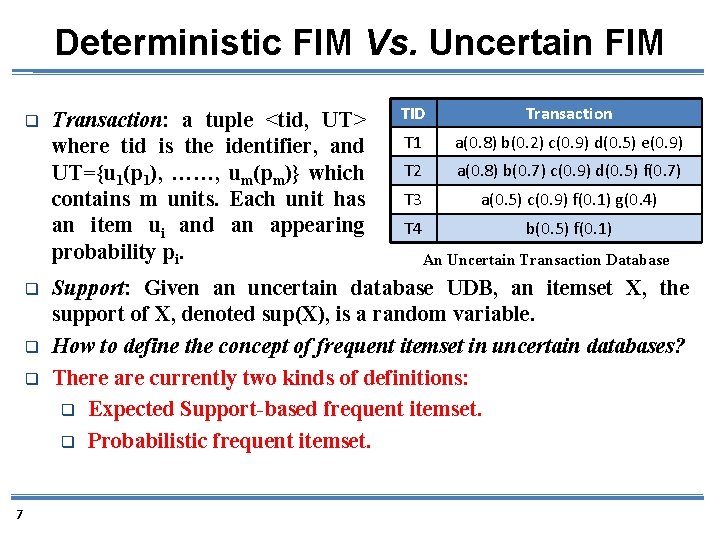
Deterministic FIM Vs. Uncertain FIM q q 7 Transaction: a tuple <tid, UT> where tid is the identifier, and UT={u 1(p 1), ……, um(pm)} which contains m units. Each unit has an item ui and an appearing probability pi. TID Transaction T 1 a(0. 8) b(0. 2) c(0. 9) d(0. 5) e(0. 9) T 2 a(0. 8) b(0. 7) c(0. 9) d(0. 5) f(0. 7) T 3 a(0. 5) c(0. 9) f(0. 1) g(0. 4) T 4 b(0. 5) f(0. 1) An Uncertain Transaction Database Support: Given an uncertain database UDB, an itemset X, the support of X, denoted sup(X), is a random variable. How to define the concept of frequent itemset in uncertain databases? There are currently two kinds of definitions: q Expected Support-based frequent itemset. q Probabilistic frequent itemset.
Outline q Motivations – An Example of Mining Uncertain Frequent Itemsets (FIs) – Deterministic FI Vs. Uncertain FI – Evaluation Goals q q Problem Definitions Evaluations of Algorithms – Expected Support-based Frequent Algorithms – Exact Probabilistic Frequent Algorithms – Approximate Probabilistic Frequent Algorithms q 8 Conclusions
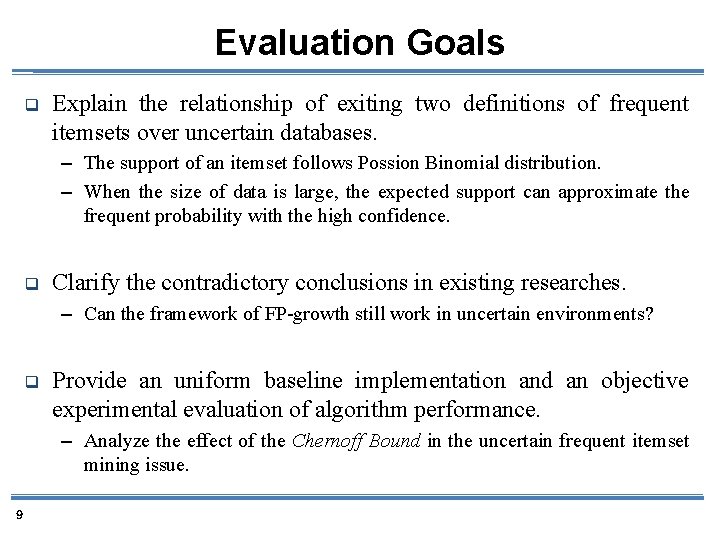
Evaluation Goals q Explain the relationship of exiting two definitions of frequent itemsets over uncertain databases. – The support of an itemset follows Possion Binomial distribution. – When the size of data is large, the expected support can approximate the frequent probability with the high confidence. q Clarify the contradictory conclusions in existing researches. – Can the framework of FP-growth still work in uncertain environments? q Provide an uniform baseline implementation and an objective experimental evaluation of algorithm performance. – Analyze the effect of the Chernoff Bound in the uncertain frequent itemset mining issue. 9
Outline q Motivations – An Example of Mining Uncertain Frequent Itemsets (FIs) – Deterministic FI Vs. Uncertain FI – Evaluation Goals q q Problem Definitions Evaluations of Algorithms – Expected Support-based Frequent Algorithms – Exact Probabilistic Frequent Algorithms – Approximate Probabilistic Frequent Algorithms q 10 Conclusion
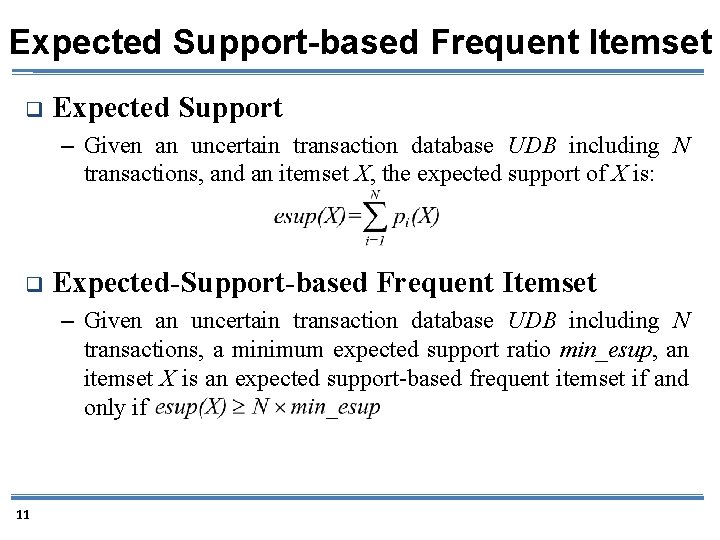
Expected Support-based Frequent Itemset q Expected Support – Given an uncertain transaction database UDB including N transactions, and an itemset X, the expected support of X is: q Expected-Support-based Frequent Itemset – Given an uncertain transaction database UDB including N transactions, a minimum expected support ratio min_esup, an itemset X is an expected support-based frequent itemset if and only if 11
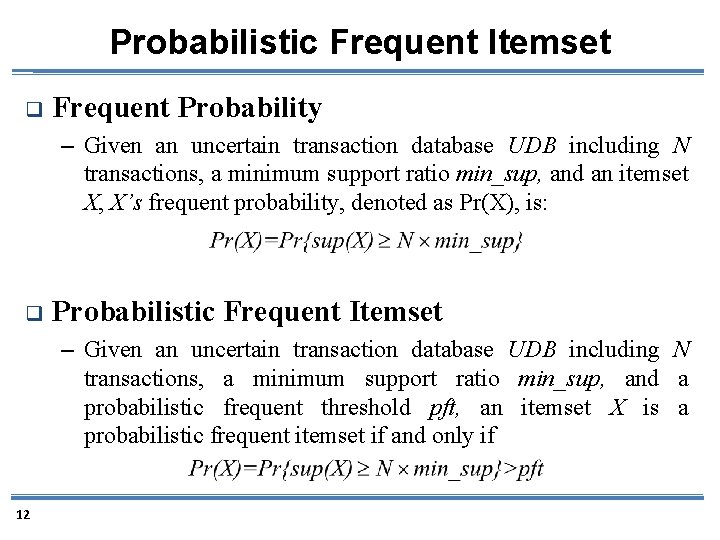
Probabilistic Frequent Itemset q Frequent Probability – Given an uncertain transaction database UDB including N transactions, a minimum support ratio min_sup, and an itemset X, X’s frequent probability, denoted as Pr(X), is: q Probabilistic Frequent Itemset – Given an uncertain transaction database UDB including N transactions, a minimum support ratio min_sup, and a probabilistic frequent threshold pft, an itemset X is a probabilistic frequent itemset if and only if 12
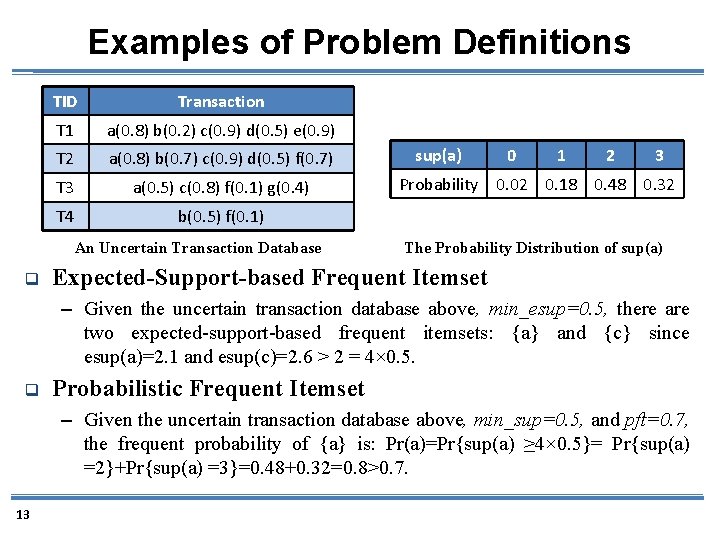
Examples of Problem Definitions TID Transaction T 1 a(0. 8) b(0. 2) c(0. 9) d(0. 5) e(0. 9) T 2 a(0. 8) b(0. 7) c(0. 9) d(0. 5) f(0. 7) T 3 a(0. 5) c(0. 8) f(0. 1) g(0. 4) T 4 b(0. 5) f(0. 1) An Uncertain Transaction Database q sup(a) 0 1 2 3 Probability 0. 02 0. 18 0. 48 0. 32 The Probability Distribution of sup(a) Expected-Support-based Frequent Itemset – Given the uncertain transaction database above, min_esup=0. 5, there are two expected-support-based frequent itemsets: {a} and {c} since esup(a)=2. 1 and esup(c)=2. 6 > 2 = 4× 0. 5. q Probabilistic Frequent Itemset – Given the uncertain transaction database above, min_sup=0. 5, and pft=0. 7, the frequent probability of {a} is: Pr(a)=Pr{sup(a) ≥ 4× 0. 5}= Pr{sup(a) =2}+Pr{sup(a) =3}=0. 48+0. 32=0. 8>0. 7. 13
Outline q Motivations – An Example of Mining Uncertain Frequent Itemsets (FIs) – Deterministic FI Vs. Uncertain FI – Evaluation Goals q q Problem Definitions Evaluations of Algorithms – Expected Support-based Frequent Algorithms – Exact Probabilistic Frequent Algorithms – Approximate Probabilistic Frequent Algorithms q 14 Conclusions
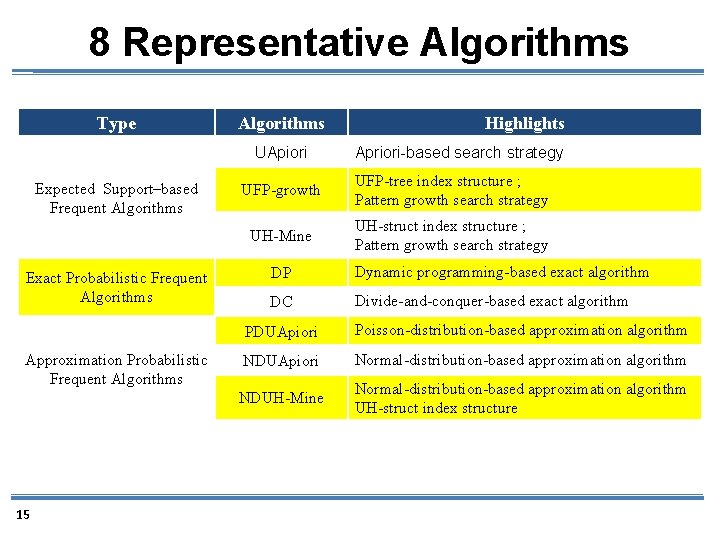
8 Representative Algorithms Type Algorithms UApiori Expected Support–based Frequent Algorithms Exact Probabilistic Frequent Algorithms Approximation Probabilistic Frequent Algorithms 15 Highlights Apriori-based search strategy UFP-growth UFP-tree index structure ; Pattern growth search strategy UH-Mine UH-struct index structure ; Pattern growth search strategy DP Dynamic programming-based exact algorithm DC Divide-and-conquer-based exact algorithm PDUApiori Poisson-distribution-based approximation algorithm NDUApiori Normal-distribution-based approximation algorithm NDUH-Mine Normal-distribution-based approximation algorithm UH-struct index structure
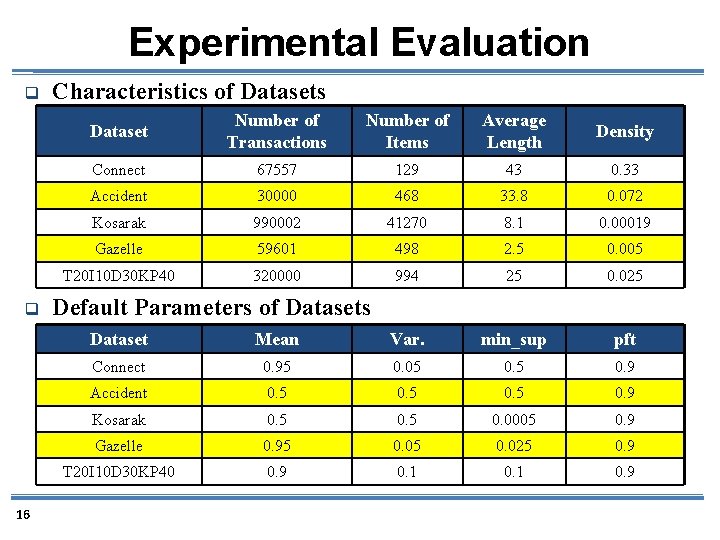
Experimental Evaluation q q 16 Characteristics of Datasets Dataset Number of Transactions Number of Items Average Length Density Connect 67557 129 43 0. 33 Accident 30000 468 33. 8 0. 072 Kosarak 990002 41270 8. 1 0. 00019 Gazelle 59601 498 2. 5 0. 005 T 20 I 10 D 30 KP 40 320000 994 25 0. 025 Default Parameters of Datasets Dataset Mean Var. min_sup pft Connect 0. 95 0. 05 0. 9 Accident 0. 5 0. 9 Kosarak 0. 5 0. 0005 0. 9 Gazelle 0. 95 0. 025 0. 9 T 20 I 10 D 30 KP 40 0. 9 0. 1 0. 9
Outline q Motivations – An Example of Mining Uncertain Frequent Itemsets (FIs) – Deterministic FI Vs. Uncertain FI – Existing Problems and Evaluation Goals q q Problem Definitions Evaluations of Algorithms – Expected Support-based Frequent Algorithms – Exact Probabilistic Frequent Algorithms – Approximate Probabilistic Frequent Algorithms q 17 Conclusion
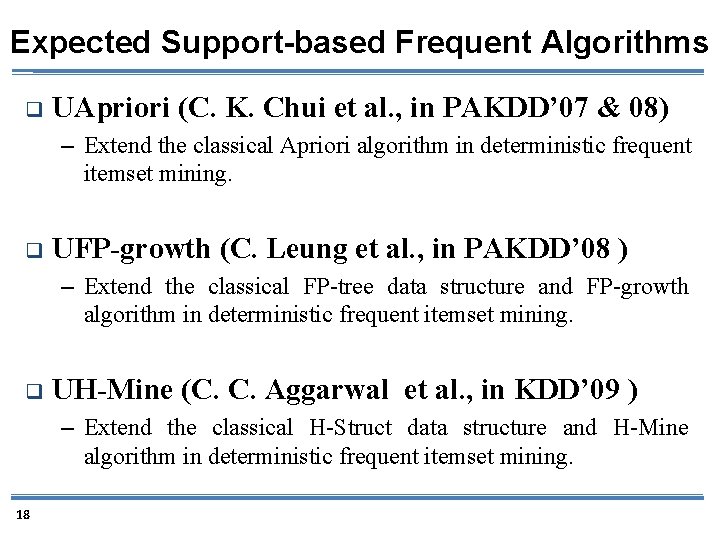
Expected Support-based Frequent Algorithms q UApriori (C. K. Chui et al. , in PAKDD’ 07 & 08) – Extend the classical Apriori algorithm in deterministic frequent itemset mining. q UFP-growth (C. Leung et al. , in PAKDD’ 08 ) – Extend the classical FP-tree data structure and FP-growth algorithm in deterministic frequent itemset mining. q UH-Mine (C. C. Aggarwal et al. , in KDD’ 09 ) – Extend the classical H-Struct data structure and H-Mine algorithm in deterministic frequent itemset mining. 18
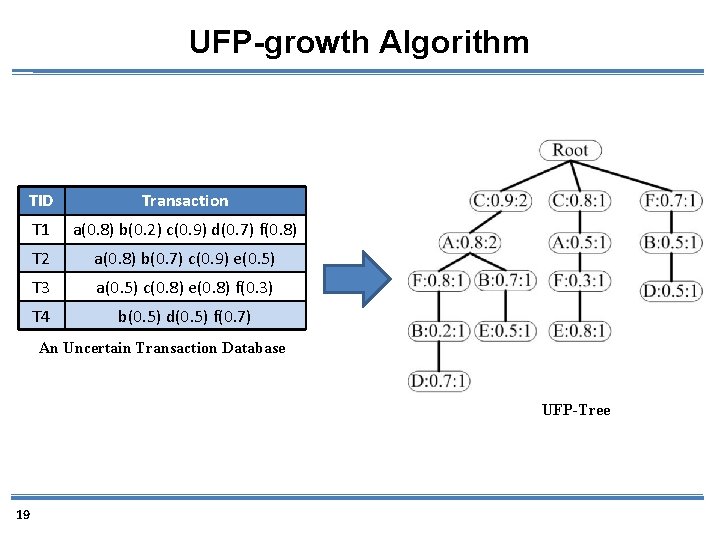
UFP-growth Algorithm TID Transaction T 1 a(0. 8) b(0. 2) c(0. 9) d(0. 7) f(0. 8) T 2 a(0. 8) b(0. 7) c(0. 9) e(0. 5) T 3 a(0. 5) c(0. 8) e(0. 8) f(0. 3) T 4 b(0. 5) d(0. 5) f(0. 7) An Uncertain Transaction Database UFP-Tree 19
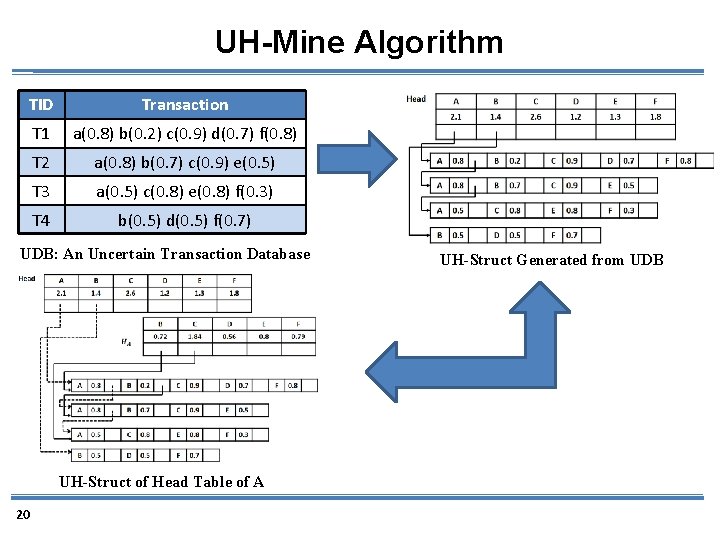
UH-Mine Algorithm TID Transaction T 1 a(0. 8) b(0. 2) c(0. 9) d(0. 7) f(0. 8) T 2 a(0. 8) b(0. 7) c(0. 9) e(0. 5) T 3 a(0. 5) c(0. 8) e(0. 8) f(0. 3) T 4 b(0. 5) d(0. 5) f(0. 7) UDB: An Uncertain Transaction Database UH-Struct of Head Table of A 20 UH-Struct Generated from UDB
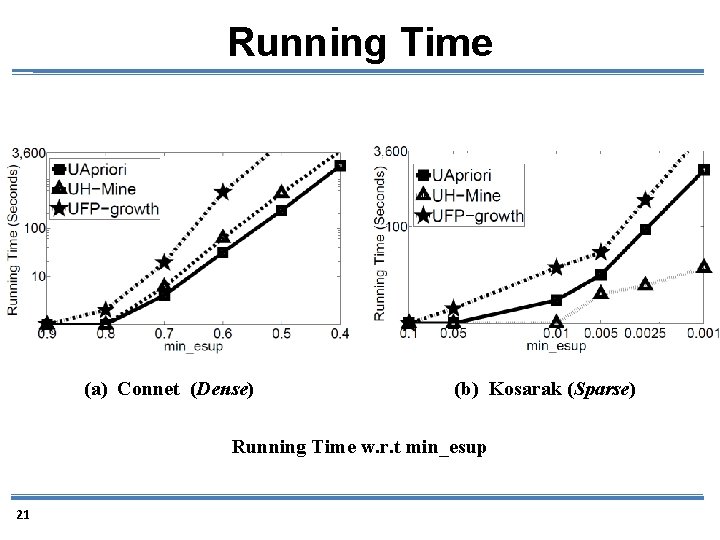
Running Time (a) Connet (Dense) (b) Kosarak (Sparse) Running Time w. r. t min_esup 21
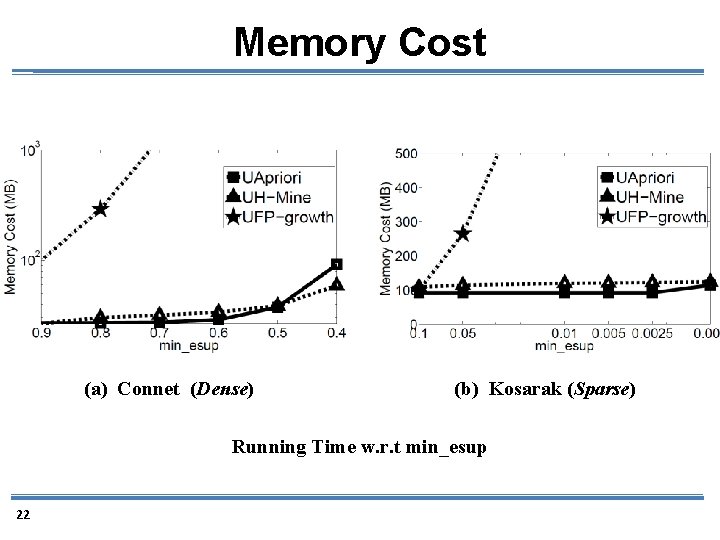
Memory Cost (a) Connet (Dense) (b) Kosarak (Sparse) Running Time w. r. t min_esup 22
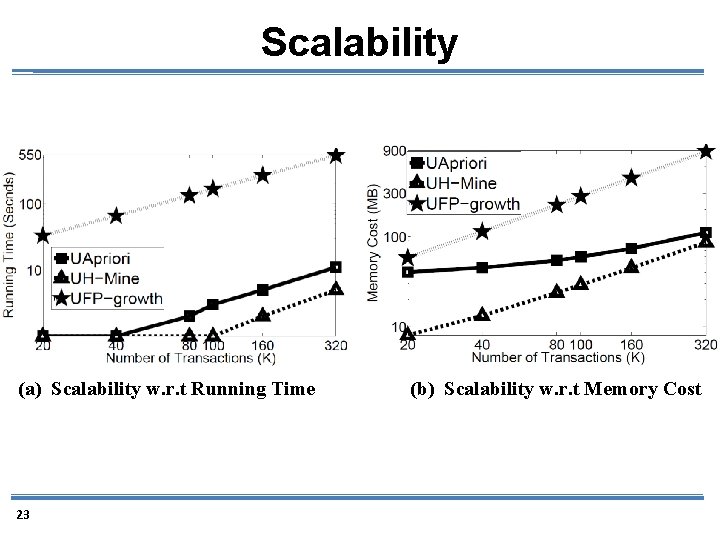
Scalability (a) Scalability w. r. t Running Time 23 (b) Scalability w. r. t Memory Cost
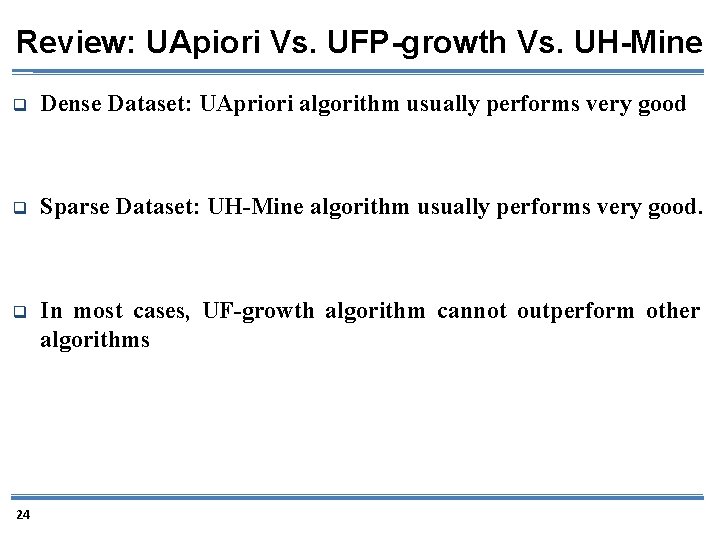
Review: UApiori Vs. UFP-growth Vs. UH-Mine q Dense Dataset: UApriori algorithm usually performs very good q Sparse Dataset: UH-Mine algorithm usually performs very good. q In most cases, UF-growth algorithm cannot outperform other algorithms 24
Outline q Motivations – An Example of Mining Uncertain Frequent Itemsets (FIs) – Deterministic FI Vs. Uncertain FI – Evaluation Goals q q Problem Definitions Evaluations of Algorithms – Expected Support-based Frequent Algorithms – Exact Probabilistic Frequent Algorithms – Approximate Probabilistic Frequent Algorithms q 25 Conclusions
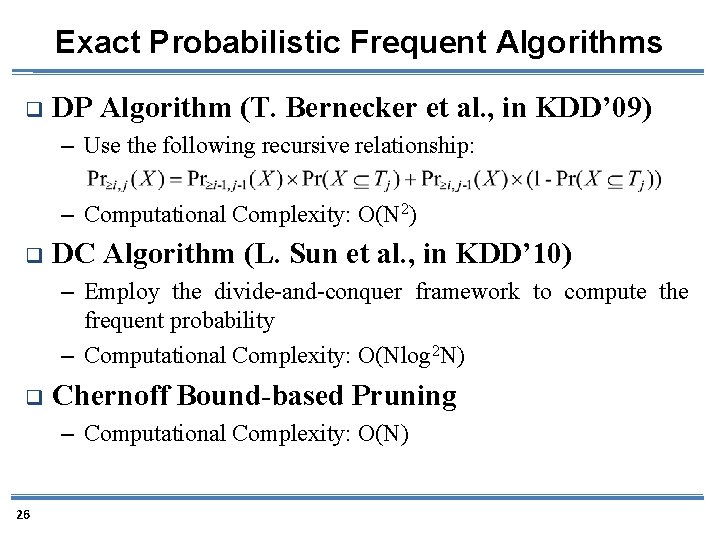
Exact Probabilistic Frequent Algorithms q DP Algorithm (T. Bernecker et al. , in KDD’ 09) – Use the following recursive relationship: – Computational Complexity: O(N 2) q DC Algorithm (L. Sun et al. , in KDD’ 10) – Employ the divide-and-conquer framework to compute the frequent probability – Computational Complexity: O(Nlog 2 N) q Chernoff Bound-based Pruning – Computational Complexity: O(N) 26
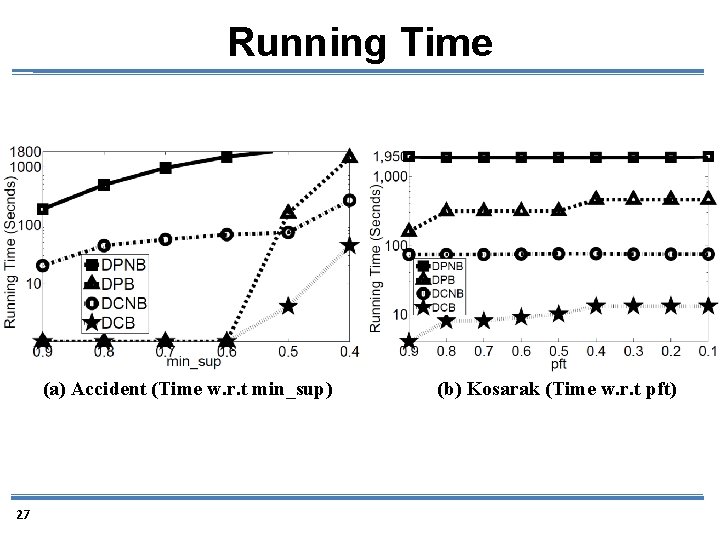
Running Time (a) Accident (Time w. r. t min_sup) 27 (b) Kosarak (Time w. r. t pft)
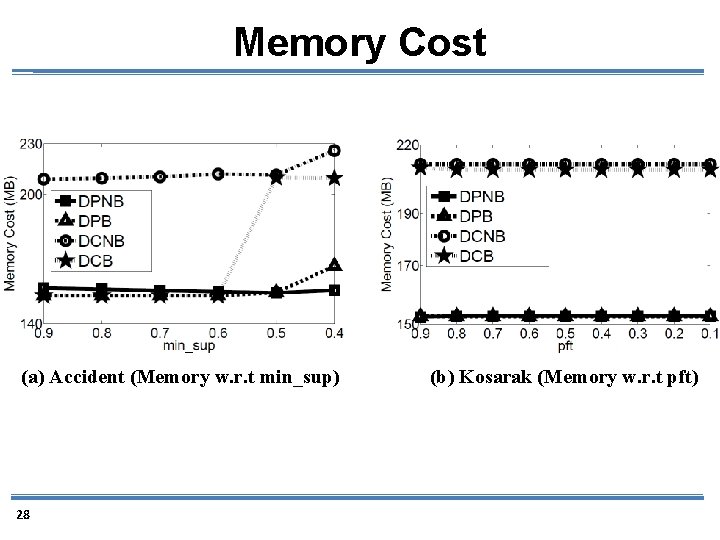
Memory Cost (a) Accident (Memory w. r. t min_sup) 28 (b) Kosarak (Memory w. r. t pft)
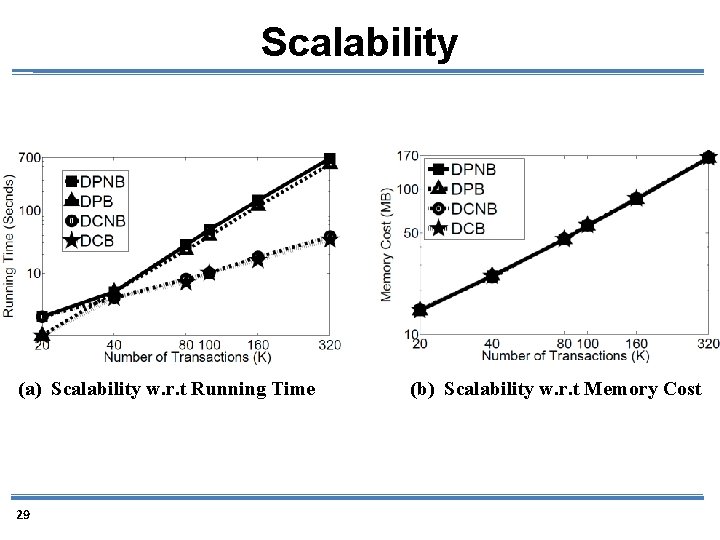
Scalability (a) Scalability w. r. t Running Time 29 (b) Scalability w. r. t Memory Cost
Review: DC Vs. DP q DC algorithm is usually faster than DP, especially for large data. – Time Complexity of DC: O(Nlog 2 N) – Time Complexity of DP: O(N 2) q DC algorithm spends more memory in trade of efficiency q Chernoff-bound-based pruning usually enhances the efficiency significantly. – Filter out most infrequent itemsets – Time Complexity of Chernoff Bound: O(N) 30
Outline q Motivations – An Example of Mining Uncertain Frequent Itemsets (FIs) – Deterministic FI Vs. Uncertain FI – Evaluation Goals q q Problem Definitions Evaluations of Algorithms – Expected Support-based Frequent Algorithms – Exact Probabilistic Frequent Algorithms – Approximate Probabilistic Frequent Algorithms q 31 Conclusions
Approximate Probabilistic Frequent Algorithms q PDUApriori (L. Wang et al. , in CIKM’ 10) – Poisson Distribution approximate Poisson Binomial Distribution – Use the algorithm framework of UApriori q NDUApriori (T. Calders et al. , in ICDM’ 10) – Normal Distribution approximate Poisson Binomial Distribution – Use the algorithm framework of UApriori q NDUH-Mine (Our Proposed Algorithm) – Normal Distribution approximate Poisson Binomial Distribution – Use the algorithm framework of UH-Mine 32
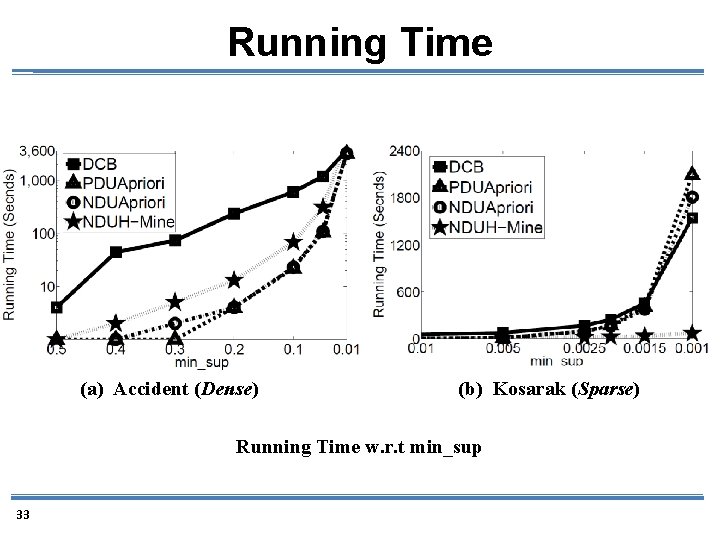
Running Time (a) Accident (Dense) (b) Kosarak (Sparse) Running Time w. r. t min_sup 33
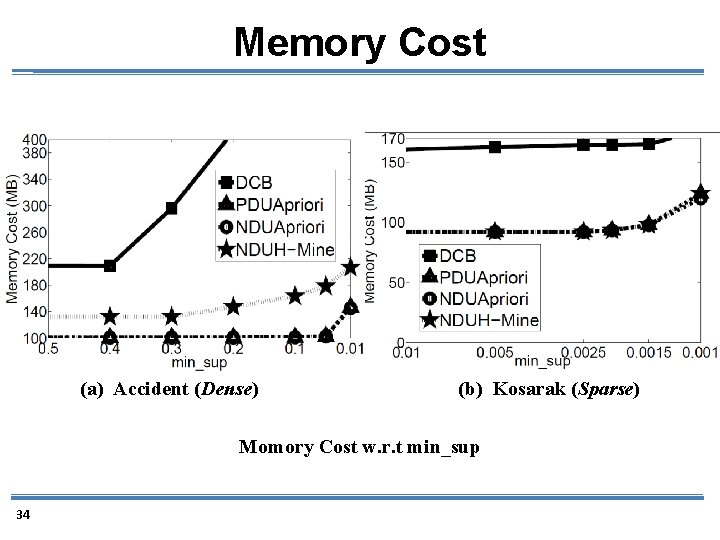
Memory Cost (a) Accident (Dense) (b) Kosarak (Sparse) Momory Cost w. r. t min_sup 34
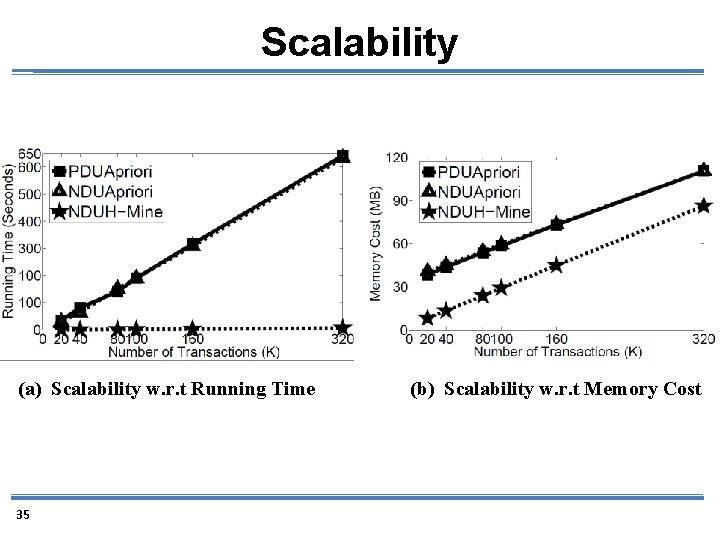
Scalability (a) Scalability w. r. t Running Time 35 (b) Scalability w. r. t Memory Cost
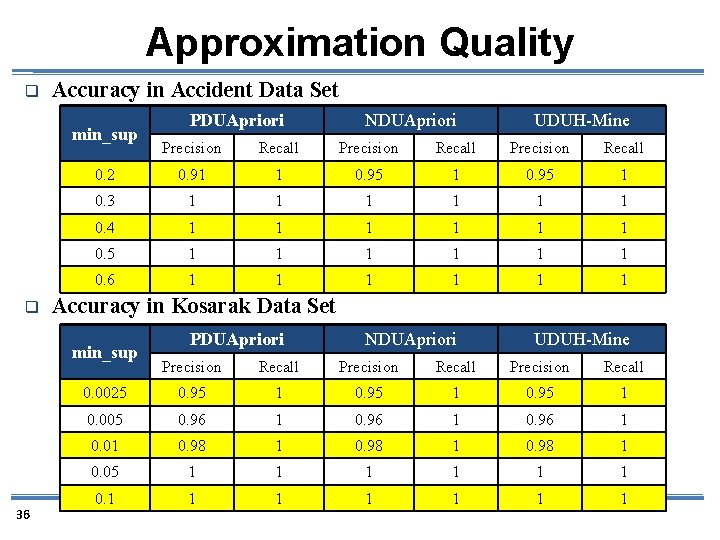
Approximation Quality q Accuracy in Accident Data Set min_sup q NDUApriori UDUH-Mine Precision Recall 0. 2 0. 91 1 0. 95 1 0. 3 1 1 1 0. 4 1 1 1 0. 5 1 1 1 0. 6 1 1 1 Accuracy in Kosarak Data Set min_sup 36 PDUApriori NDUApriori UDUH-Mine Precision Recall 0. 0025 0. 95 1 0. 005 0. 96 1 0. 01 0. 98 1 0. 05 1 1 1 0. 1 1 1 1
Review: PDUApriori Vs. NDUH-Mine q When datasets are large, three algorithms can provide very accurate approximations. q Dense Dataset: PDUApriori and NDUApriori algorithms perform very good q Sparse Dataset: NDUH-Mine algorithm usually performs very good q Normal distribution-based algorithms outperform the Possion distribution-based algorithms – Normal Distribution: Mean & Variance – Possion Distribution: Mean 37
Outline q Motivations – An Example of Mining Uncertain Frequent Itemsets (FIs) – Deterministic FI Vs. Uncertain FI – Evaluation Goals q q Problem Definitions Evaluations of Algorithms – Expected Support-based Frequent Algorithms – Exact Probabilistic Frequent Algorithms – Approximate Probabilistic Frequent Algorithms q 38 Conclusions
Conclusions q Expected Support-based Frequent Itemset Mining Algorithms – Dense Dataset: UApriori algorithm usually performs very good – Sparse Dataset: UH-Mine algorithm usually performs very good – In most cases, UF-growth algorithm cannot outperform other algorithms q Exact Probabilistic Frequent Itemset Mining Algorithms – Efficiency: DC algorithm is usually faster than DP – Memory Cost: DC algorithm spends more memory in trade of efficiency – Chernoff-bound-based pruning usually enhances the efficiency significantly q Approximate Probabilistic Frequent Itemset Mining Algorithms – Approximation Quality: In datasets with large size, the algorithms generate very accurate approximations. – Dense Dataset: PDUApriori and NDUApriori algorithms perform very good – Sparse Dataset: NDUH-Mine algorithm usually performs very good – Normal distribution-based algorithms outperform the Possion-based algorithms 39
Thank you Our executable program, data generator, and all data sets can be found: http: //www. cse. ust. hk/~yxtong/vldb. rar 40
- Slides: 40