
Mining for Answers The Case of Profitable and
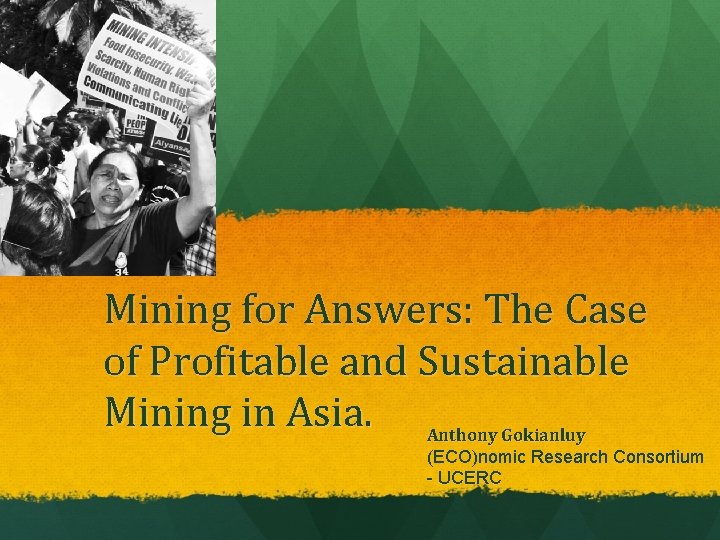
Mining for Answers: The Case of Profitable and Sustainable Mining in Asia. Anthony Gokianluy (ECO)nomic Research Consortium UCERC
Overview – A Philippine Case Study Supply Increase in the supply of raw materials due to an abundance of natural resources in Southeast Asia Attract investors to the region due to the potential of mining activities Benefits to Host Nation How much does mining really contribute to the economy? Should the government still encourage investments?
Overview – A Philippine Case Study Social Costs Profiteering by multinational mining companies Destruction of indigenous livelihoods and displacement Unsustainable mining practices Government Accountability Poor communication between stakeholders Corruption Inconsistent mining regulations
BIG QUESTION Should the country still encourage mass mining investments? (if so, under what circumstances? )
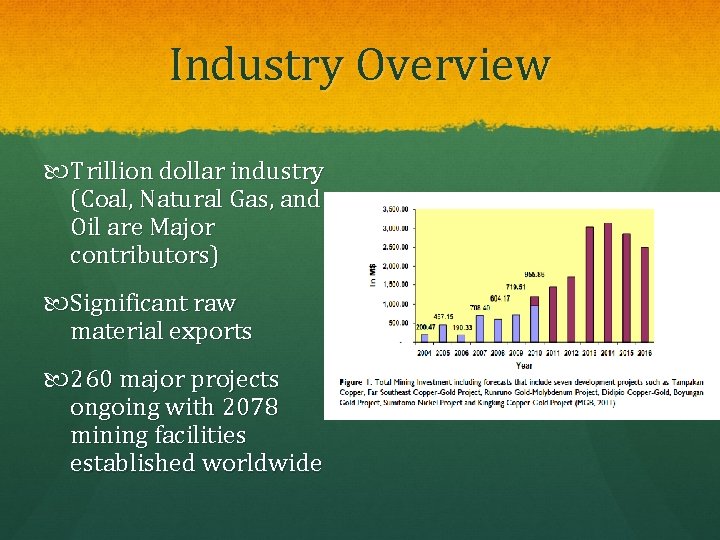
Industry Overview Trillion dollar industry (Coal, Natural Gas, and Oil are Major contributors) Significant raw material exports 260 major projects ongoing with 2078 mining facilities established worldwide
Philippine and Asia Mining Asia is a major producer of base metals, ferrous metals, and coal Most major producers are state controlled Investment in the fast growing mining sector (especially through Foreign Direct Investments) is being encouraged by many governments
The Arroyo & Aquino Governments Inconsistent pro mining economic policies and laws Lack of cost benefit analysis and consideration of local population interests Thirty two priority large scale mining projects already pipelined It was assumed by the administration that a revitalized mining industry would bring in significant investments, employment and revenues. These promises have included: US$ 5 7 billion dollars in foreign exchange generation PHP 5 7 billion pesos in excise tax collection 239, 000 indirect and direct employment US$ 4 6 billion dollars worth of investments.
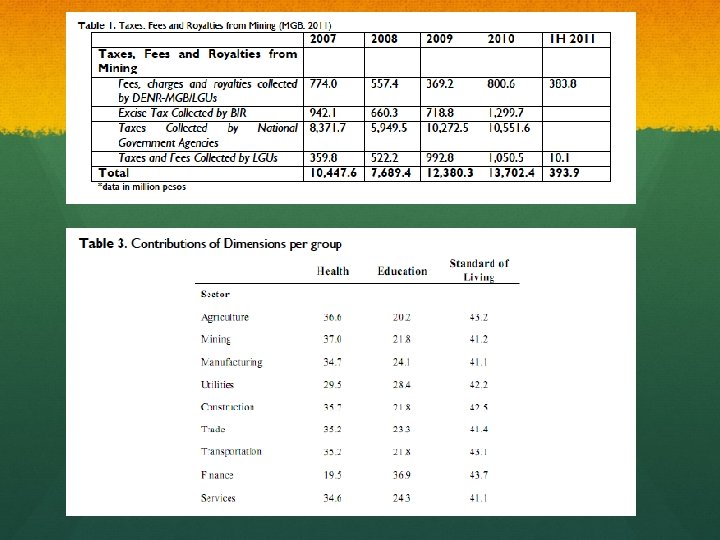
Financial Overview Mining Contributions and the Philippine Economy: The contribution of mining to GDP has only amounted to 1. 0% Exports of mining products have only averaged 4. 5% in the last four years (MGB, 2011) The manufacturing and service sector are the main drivers of economic growth comprising over 50% of GDP (ADB, 2011); the agricultural sector also contributed a significant 12% in 2010 (BAS, 2011) – Comparative Advantage Contributions in revenues and taxes to the government Only an estimated 19. 60% to 29. 74% of mining revenue accrues to government tax collection 7. 5% effective tax rate in the industry from 1997 2000; effective tax rate for the US can amount to 40% in comparison The government loses an average of 32% of revenues annually because of incentive laws
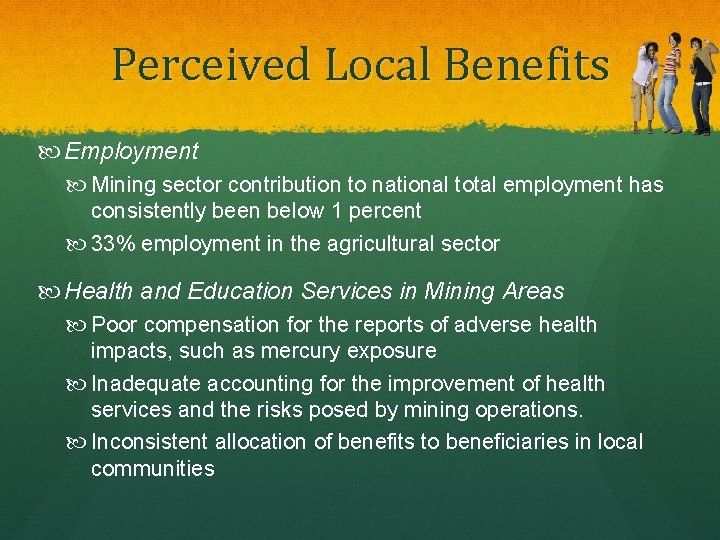
Perceived Local Benefits Employment Mining sector contribution to national total employment has consistently been below 1 percent 33% employment in the agricultural sector Health and Education Services in Mining Areas Poor compensation for the reports of adverse health impacts, such as mercury exposure Inadequate accounting for the improvement of health services and the risks posed by mining operations. Inconsistent allocation of benefits to beneficiaries in local communities
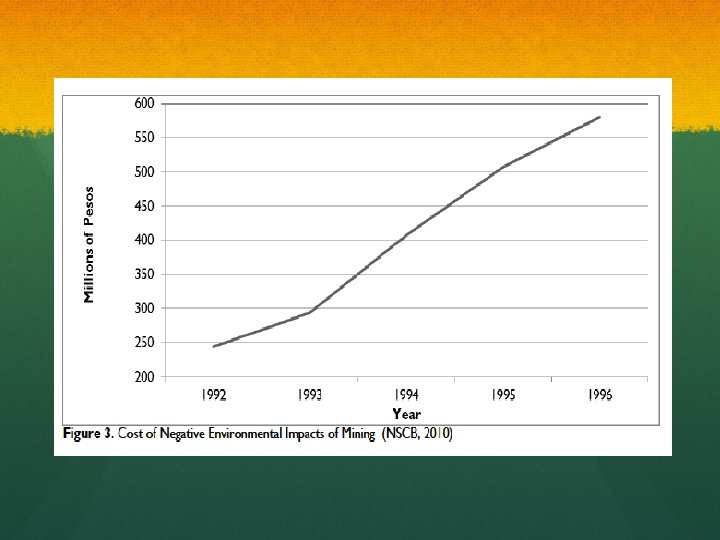
Social Costs Changes in a person’s lifestyle and well being Personal and property rights Mining in socially vulnerable areas and in areas where conflict is ongoing Mass displacement from ancestral lands and destruction livelihood Environmental and tourism risks associated with mining close to coastal ecosystems
Case Studies Bautista (2009) (Sakoan, 2003; Drasch et al. , 2001; Appleton, et al. , 1999; 2006) (Miranda, et al. , 2003; AER, 2009)
Bautista, 2009 0. 11% to 0. 26% of mining revenues go to community development; however, this meager percentage is not enough to cover for all the risks and communal disruptions associated with mining Limitations with Source: Possibility of being associated with an anti-mining organization (personal bias)
Sakoan, 2003; Drasch et al. , 2001; Appleton, et al. , 1999; 2006 Agrees with Bautista, and expands on his perspective and idea: Mining developers must compensate for the adverse health impacts and higher risk of natural disasters associated with mining for both large and small scale projects
Miranda, et al. , 2003; AER, 2009 Miranda et al. sees that proper decision making of mining managers may better help the local communities Decision makers must account for the changes in the mining environment and respond to its consequences Mining companies should look to invest in the local communities
THESIS, A Cost-Benefit Analysis Greater cooperation between the government and the private sector; strong policy enforcement Financial assurances to local communities, working with essential government bodies and NGOs such as the Contingent Liability and Rehabilitation Fund, Mine Rehabilitation Fund Develop a better system to collect available monitoring data on mining operations Develop a definitive document or legal framework to specifically detail the conditions and expectations for responsible and sustainable mining * Damage assessment and compensation, regulatory analyses, and natural resource accounting, among others, are essential to maintain good relationships amongst all parties
ANSWER Investments are inherently good for a country; the issue of mining natural resources in the Philippines must be tackled using a cost benefit analysis on the main stakeholders (the local people, the government, and the corporations) and a consideration of the situation of all parties. Economic feasibility, technology, and size deposit are some key factors that shape this debate although unique local and regional social conditions have to be taken into account. The extent of disturbance resulting from mining operations may need to be limited or controlled to minimize its adverse consequences.
FURTHER SOLUTIONS The Philippines and countries in a similar situation can refer to these steps to further improve their mining policies: Information sharing through regional conferences Analyzing the case of copper gold producer Oxiana and its community initiatives in Laos (anti poverty drives and transferable skills training in the vicinity of their mine)
Bibliography Ateneo School of Government. 2012. Policy Brief: Is There a Future for Mining in the Philippines? The Graduate School of Leadership and Public Service. Makati: Ateneo School of Government. Alyansa Tigil Muna. 2011. ATM Position Paper on the Continued Adoption of the Aquino Government of the Revitalization of the Philippine Mining Industry. Alyansa Tigil Mina National Secretariat. Quezon City: Alyansa Tigil Muna. Action for Economic Reforms. 2009. An Economic Critique of the Mining Revitalization Plan. Unpublished Draft Report. Quezon City, Philippines. Appleton, J. D. , JM Weeks, JPS Calvez, and C. Beinhoff. 2006. Impacts of Mercury Contaminated Mining Waste on Soil Quality, Crops, Bivalves, and Fish in the Naboc River Area, Mindanao, Philippines. Appleton, J. D. , T. M. Williams, N. Breward, A. Apostol, J. Miguel and C. Miranda. 1999. Mercury Contamination Associated with Artisanal Gold Mining on the Island of Mindanao, the Philippines. The Science of the Total Environment 228: 95 109. Balisacan, Arcenio. 2011. Multidimensional Poverty in the Philippines: New Measures, Evidence, and Policy Implications. Bautista, Germelino. 2009. Economics of Philippine Mining: Rents, Price Cycles, Externalities, and Uncompensated Damages. Ateneo School of Government Publication. Ateneo de Manila University, Quezon City, Philippines. Bravante, M. & Holden, W. 2009. Going through the motions: the environmental impact assessment of nonferrous metals mining in the Philippines. The Pacific Review. 22(4): 523 547. Bureau of Agricultural Statistics. Download. http: //countrystat. bas. gov. ph/ 2011. Agricultural Statistics. Internet

Bibliography Cordillera Peoples’ Alliance. 2007. Case Study on the Effects of Mining and Dams on the Environment and Indigenous Peoples in Benguet, Cordillera, Philippines. . United Nations Report. Drasch, G. , S. Bose O’Reilly, C. Beinhoff, G. Roider and S. Maydl. 2001. The Mt. Diwata Study on the Philippines 1999: Assessing Mercury Intoxication of the Population by Small scale Gold Mining. The Science of the Total Environment 267: 151 168. Guadalquiver, N K. "BPO firms, labor sign code of good practices. " Business World 16 June 2012. Web. 17 July 2012. http: //www. bworldonline. com/content. php? section=Economy&title=BPO firms, labor sign code of good practices&id=52759. Habito, Cielito. 2010. An Agenda for High and Inclusive Growth in the Philippines. Asian Development Bank, Mandaluyong, Philippines. Matthews, H. Scott. , Lave, Lester B. 2000. Applications of environmental valuation for determining externality cost. Environmental Science and Technology. 34: 1390 1395. Mines and Geosciences Bureau. 2011. Mining Industry Statistics (release date 23 September 2011). Internet Download. http: //www. mgb. gov. ph/ National Statistical Coordination Board (NSCB) and United Nations Development Progamme (UNDP). 2000. Environmental Degradation due to Selected Economic Activities. Last accessed: 25 November 2011. http: //www. nscb. gov. ph/peenra/Publications/Degradation/eco-act. pdf National Statistical Coordination Board (NSCB). 2010. The Philippine Statistical Yearbook (PSY). National Statistical Coordination Board. Makati, Philippines. Rosales, Rina and Herminia Francisco. 2000. Estimating Non use Values of the Samar Island Forest Reserve. Samar Island Biodiversity Study (SAMBIO), REECS, Inc. Quezon City. Sakoane, Malebabo. 2003. Occupational and Other Diseases in the Small Scale Mining Sector. In The Socio Economic Impacts of Artisanal and Small Scale Mining in Developing Countries. Hilson, Gavin (editor); Swets and Zeitlinger B. V. , Lisse, The Netherlands. http: //www. mbendi. com/indy/ming/p 0005. htm

Thank You Any Questions?
- Slides: 22