
Mining Data Streams Part 1 CS 345 a


- Slides: 34
Mining Data Streams (Part 1) CS 345 a: Data Mining Jure Leskovec and Anand Rajaraman Stanford University
Data Streams In many data mining situations, we know the entire data set in advance Sometimes the input rate is controlled externally § Google queries § Twitter or Facebook status updates 2
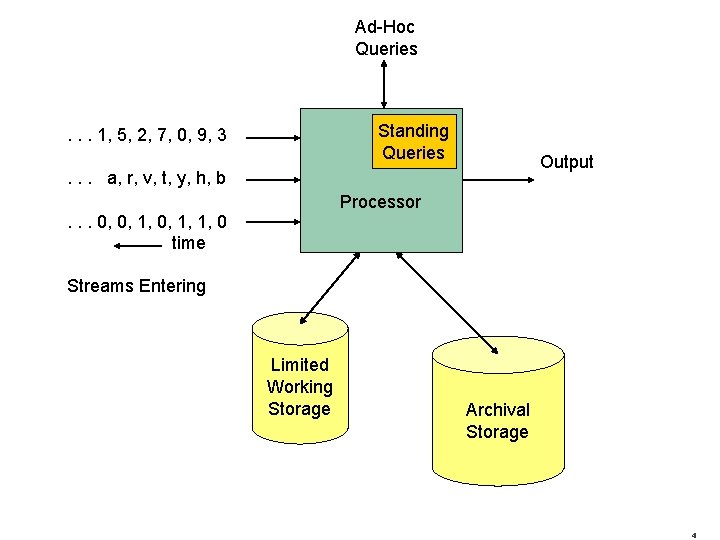
The Stream Model Input tuples enter at a rapid rate, at one or more input ports. The system cannot store the entire stream accessibly. How do you make critical calculations about the stream using a limited amount of (secondary) memory? 3
Ad-Hoc Queries Standing Queries . . . 1, 5, 2, 7, 0, 9, 3 Output . . . a, r, v, t, y, h, b Processor . . . 0, 0, 1, 1, 0 time Streams Entering Limited Working Storage Archival Storage 4
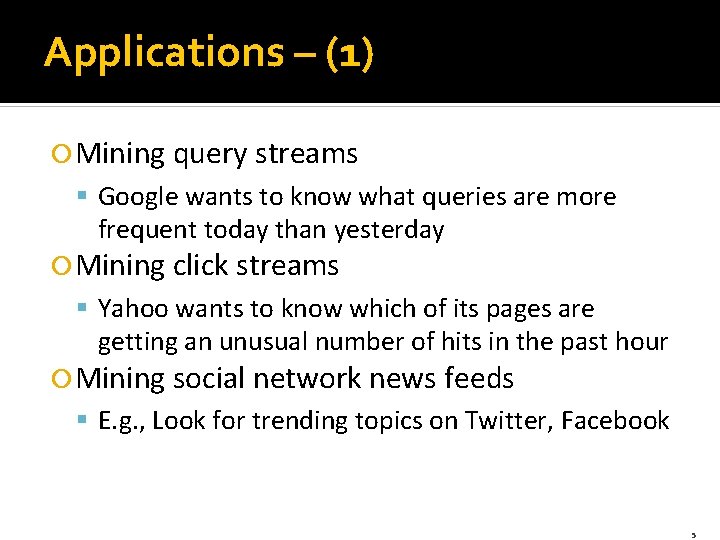
Applications – (1) Mining query streams § Google wants to know what queries are more frequent today than yesterday Mining click streams § Yahoo wants to know which of its pages are getting an unusual number of hits in the past hour Mining social network news feeds § E. g. , Look for trending topics on Twitter, Facebook 5
Applications – (2) Sensor Networks § Many sensors feeding into a central controller Telephone call records § Data feeds into customer bills as well as settlements between telephone companies IP packets monitored at a switch § Gather information for optimal routing § Detect denial-of-service attacks 6
Data Stream Problems Sampling data from a stream Filtering a data stream Queries over sliding windows Counting distinct elements Estimating moments Finding frequent elements Frequent itemsets 3/9/2021 Jure Leskovec & Anand Rajaraman, Stanford CS 345 a: Data Mining 7
Sampling from a Data Stream Since we can’t store the entire stream, one obvious approach is to store a sample Two different problems: § Sample a fixed proportion of elements in the stream (say 1 in 10) § Maintain a random sample of fixed size over a potentially infinite stream 3/9/2021 Jure Leskovec & Anand Rajaraman, Stanford CS 345 a: Data Mining 8
Sampling a fixed proportion Scenario: search engine query stream § Tuples: (user, query, time) § Answer questions such as: how often did a user run the same query on two different days? § Have space to store 1/10 th of query stream Naïve solution § Generate a random integer in [0. . 9] for each query § Store query if the integer is 0, otherwise discard 3/9/2021 Jure Leskovec & Anand Rajaraman, Stanford CS 345 a: Data Mining 9
Problem with naïve approach Consider the question: What fraction of queries by an average user are duplicates? Suppose each user issues s queries once and d queries twice (total of s+2 d queries) § Correct answer: d/(s+2 d) § Sample will contain s/10 of the singleton queries and 2 d/10 of the duplicate queries at least once § But only d/100 pairs of duplicates § So the sample-based answer is: d/(10 s+20 d) 3/9/2021 Jure Leskovec & Anand Rajaraman, Stanford CS 345 a: Data Mining 10
Solution Pick 1/10 th of users and take all their searches in the sample Use a hash function that hashes the user name or user id uniformly into 10 buckets 3/9/2021 Jure Leskovec & Anand Rajaraman, Stanford CS 345 a: Data Mining 11
Generalized Solution Stream of tuples with keys § Key is some subset of each tuple’s components § E. g. , tuple is (user, search, time); key is user § Choice of key depends on application To get a sample of size a/b § Hash each tuple’s key uniformly into b buckets § Pick the tuple if its hash value is at most a 3/9/2021 Jure Leskovec & Anand Rajaraman, Stanford CS 345 a: Data Mining 12
Maintaining a fixed-size sample Suppose we need to maintain a sample of size exactly s § E. g. , main memory size constraint Don’t know length of stream in advance § In fact, stream could be infinite Suppose at time t we have seen n items § Ensure each item is in sample with equal probability s/n 3/9/2021 Jure Leskovec & Anand Rajaraman, Stanford CS 345 a: Data Mining 13
Solution Store all the first s elements of the stream Suppose we have seen n-1 elements, and now the nth element arrives (n > s) § With probability s/n, pick the nth element, else discard it § If we pick the nth element, then it replaces one of the s elements in the sample, picked at random Claim: this algorithm maintains a sample with the desired property 3/9/2021 Jure Leskovec & Anand Rajaraman, Stanford CS 345 a: Data Mining 14
Proof: By Induction Assume that after n elements, the sample contains each element seen so far with probability s/n When we see element n+1, it gets picked with probability s/(n+1) For elements already in the sample, probability of remaining in the sample is: 3/9/2021 Jure Leskovec & Anand Rajaraman, Stanford CS 345 a: Data Mining 15
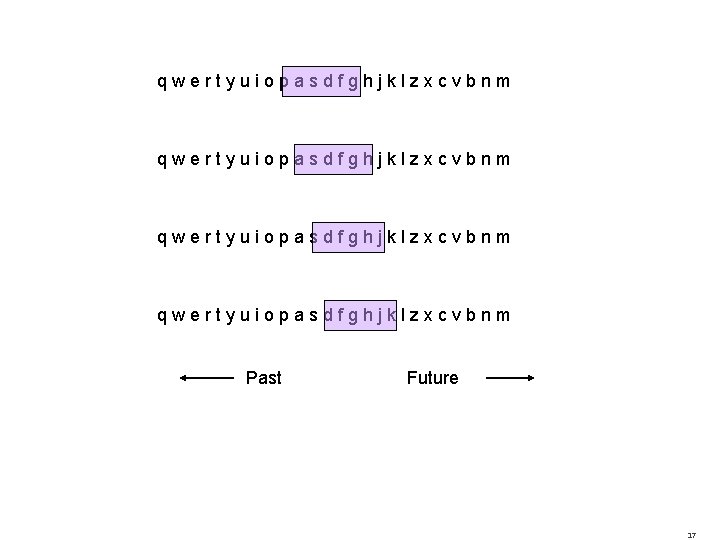
Sliding Windows A useful model of stream processing is that queries are about a window of length N – the N most recent elements received. Interesting case: N is so large it cannot be stored in memory, or even on disk. § Or, there are so many streams that windows for all cannot be stored. 16
qwertyuiopasdfghjklzxcvbnm Past Future 17
Counting Bits – (1) Problem: given a stream of 0’s and 1’s, be prepared to answer queries of the form “how many 1’s in the last k bits? ” where k ≤ N. Obvious solution: store the most recent N bits. § When new bit comes in, discard the N +1 st bit. 18
Counting Bits – (2) You can’t get an exact answer without storing the entire window. Real Problem: what if we cannot afford to store N bits? § E. g. , we’re processing 1 billion streams and = 1 billion N But we’re happy with an approximate answer. 19
DGIM* Method Store O(log 2 N ) bits per stream. Gives approximate answer, never off by more than 50%. § Error factor can be reduced to any fraction > 0, with more complicated algorithm and proportionally more stored bits. *Datar, Gionis, Indyk, and Motwani 20
Something That Doesn’t (Quite) Work Summarize exponentially increasing regions of the stream, looking backward. Drop small regions if they begin at the same point as a larger region. 21
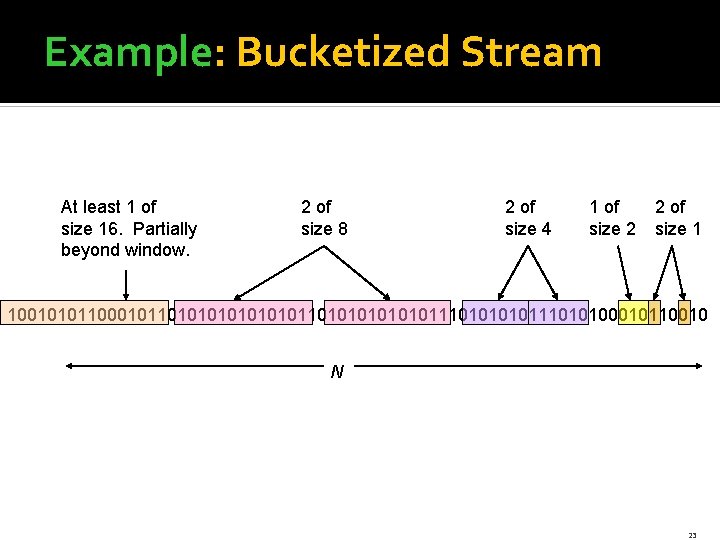
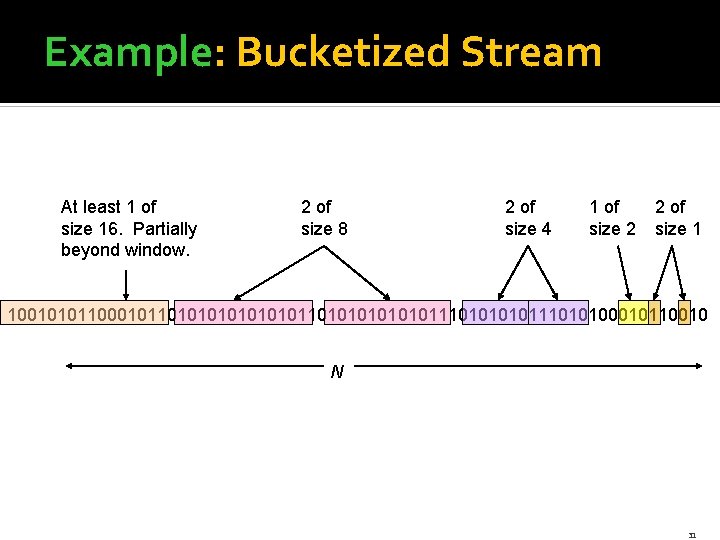
Key Idea Summarize blocks of stream with specific numbers of 1’s. Block sizes (number of 1’s) increase exponentially as we go back in time 22
Example: Bucketized Stream At least 1 of size 16. Partially beyond window. 2 of size 8 2 of size 4 1 of size 2 2 of size 1 100101011000101101010101010111010111010100010110010 N 23
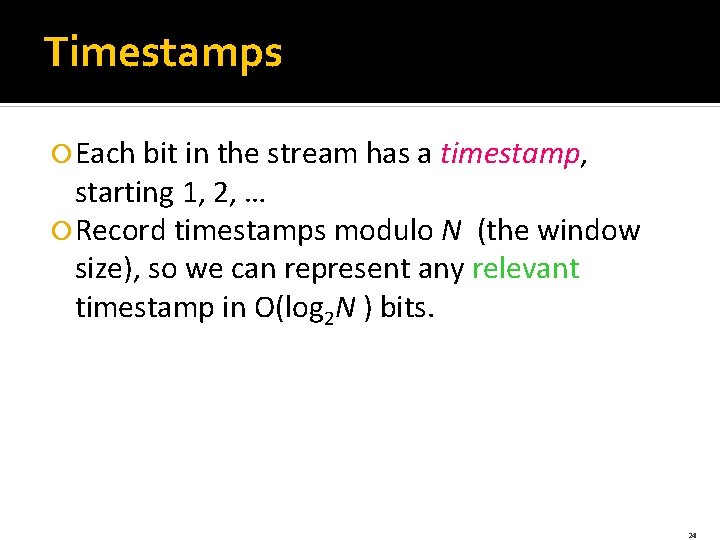
Timestamps Each bit in the stream has a timestamp, starting 1, 2, … Record timestamps modulo N (the window size), so we can represent any relevant timestamp in O(log 2 N ) bits. 24
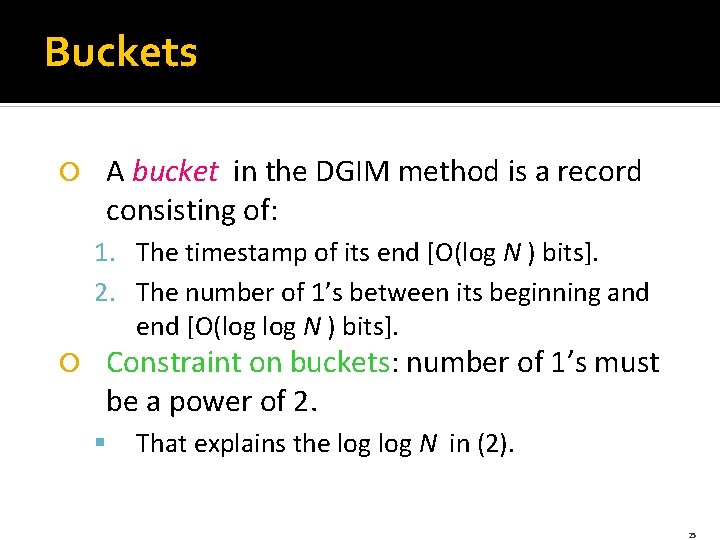
Buckets A bucket in the DGIM method is a record consisting of: 1. The timestamp of its end [O(log N ) bits]. 2. The number of 1’s between its beginning and end [O(log N ) bits]. Constraint on buckets: number of 1’s must be a power of 2. § That explains the log N in (2). 25
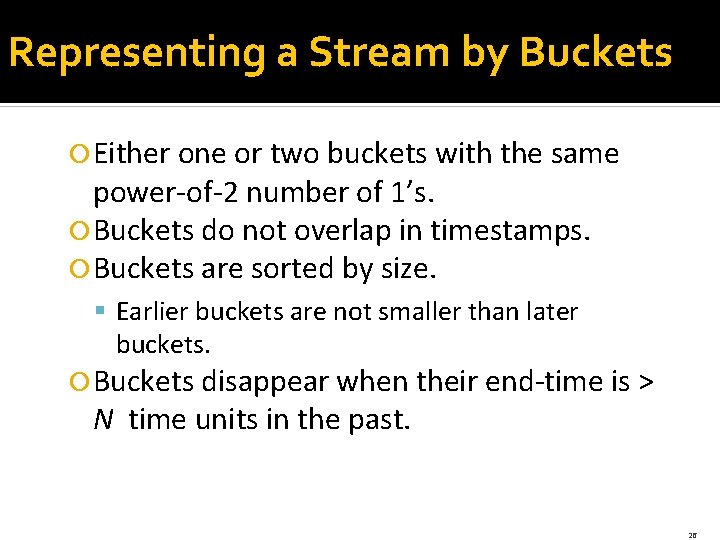
Representing a Stream by Buckets Either one or two buckets with the same power-of-2 number of 1’s. Buckets do not overlap in timestamps. Buckets are sorted by size. § Earlier buckets are not smaller than later buckets. Buckets disappear when their end-time is > N time units in the past. 26
Updating Buckets – (1) When a new bit comes in, drop the last (oldest) bucket if its end-time is prior to N time units before the current time. If the current bit is 0, no other changes are needed. 27
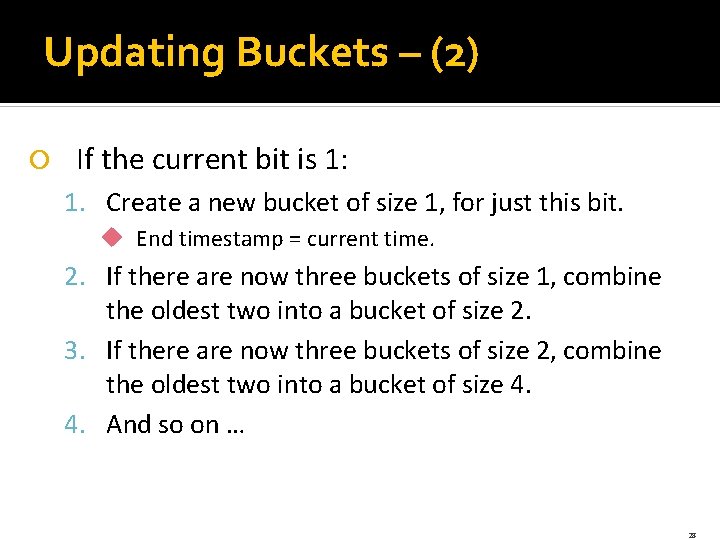
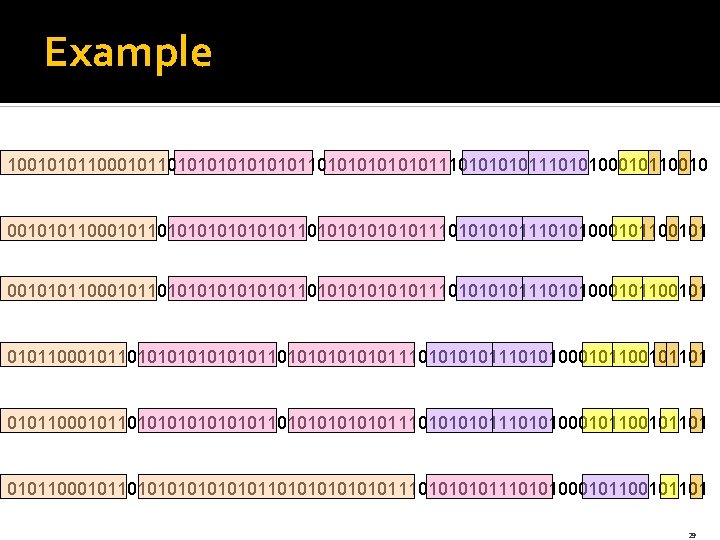
Updating Buckets – (2) If the current bit is 1: 1. Create a new bucket of size 1, for just this bit. u End timestamp = current time. 2. If there are now three buckets of size 1, combine the oldest two into a bucket of size 2. 3. If there are now three buckets of size 2, combine the oldest two into a bucket of size 4. 4. And so on … 28
Example 100101011000101101010101010111010111010100010110010101100010110101010101010110101010101011101010101110101000101100101100010110101010101010110101010101011101010101110101000101100101101 010110001011010101010101110101110101000101101 29
Querying To estimate the number of 1’s in the most recent N bits: 1. Sum the sizes of all buckets but the last. 2. Add half the size of the last bucket. Remember: we don’t know how many 1’s of the last bucket are still within the window. 30
Example: Bucketized Stream At least 1 of size 16. Partially beyond window. 2 of size 8 2 of size 4 1 of size 2 2 of size 1 100101011000101101010101010111010111010100010110010 N 31
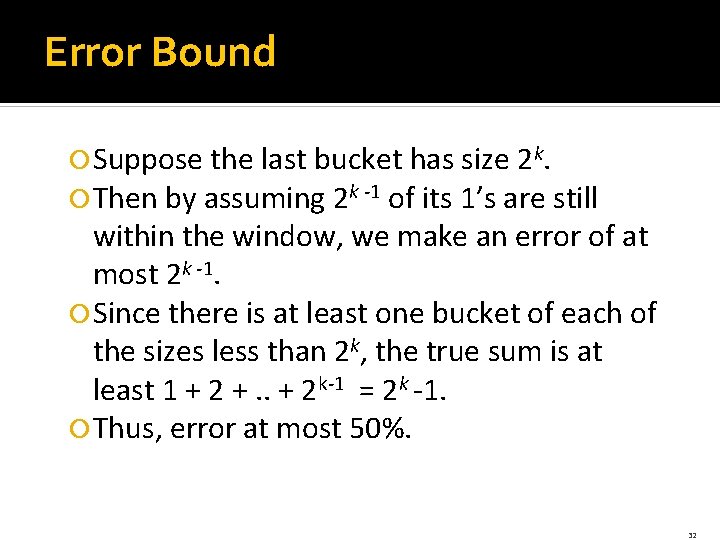
Error Bound Suppose the last bucket has size 2 k. Then by assuming 2 k -1 of its 1’s are still within the window, we make an error of at most 2 k -1. Since there is at least one bucket of each of the sizes less than 2 k, the true sum is at least 1 + 2 +. . + 2 k-1 = 2 k -1. Thus, error at most 50%. 32
Extensions Can we use the same trick to answer queries “How many 1’s in the last k ? ” where k < N ? Can we handle the case where the stream is not bits, but integers, and we want the sum of the last k ? 33
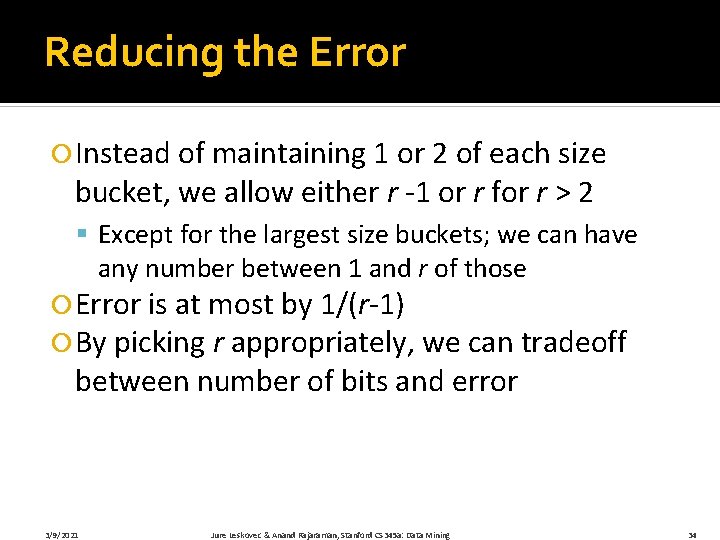
Reducing the Error Instead of maintaining 1 or 2 of each size bucket, we allow either r -1 or r for r > 2 § Except for the largest size buckets; we can have any number between 1 and r of those Error is at most by 1/(r-1) By picking r appropriately, we can tradeoff between number of bits and error 3/9/2021 Jure Leskovec & Anand Rajaraman, Stanford CS 345 a: Data Mining 34