
Mining and Railroads GUIDED READING ACTIVITY Texas The

- Slides: 21
Mining and Railroads GUIDED READING ACTIVITY
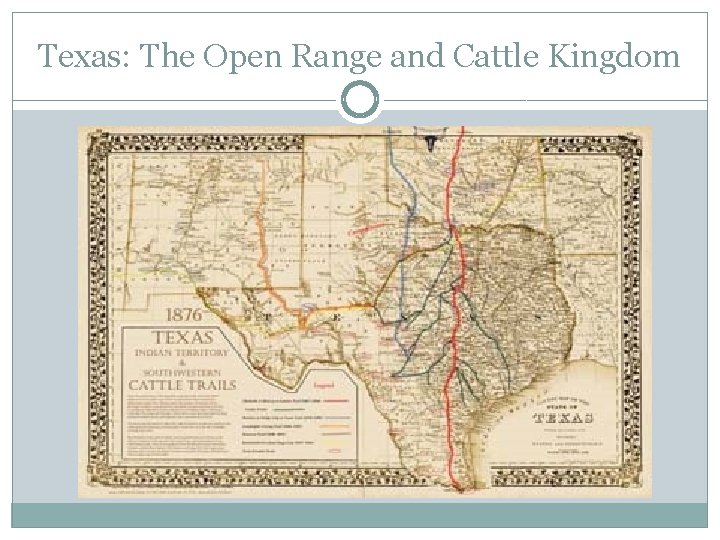
Texas: The Open Range and Cattle Kingdom
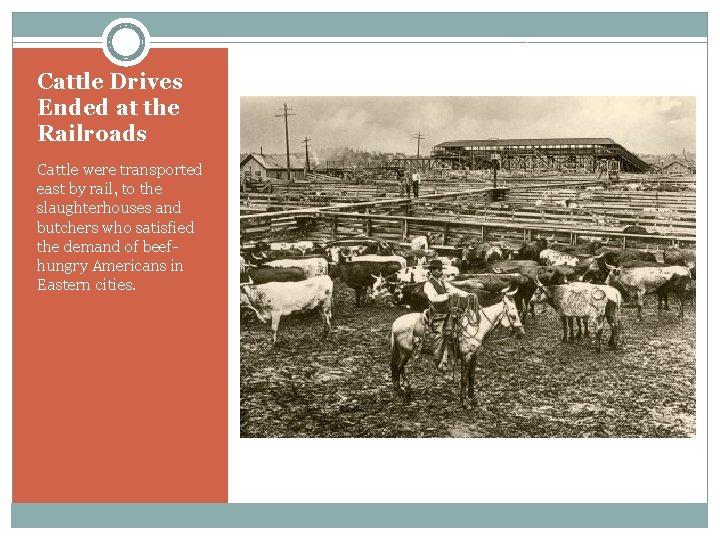
Cattle Drives Ended at the Railroads Cattle were transported east by rail, to the slaughterhouses and butchers who satisfied the demand of beefhungry Americans in Eastern cities.
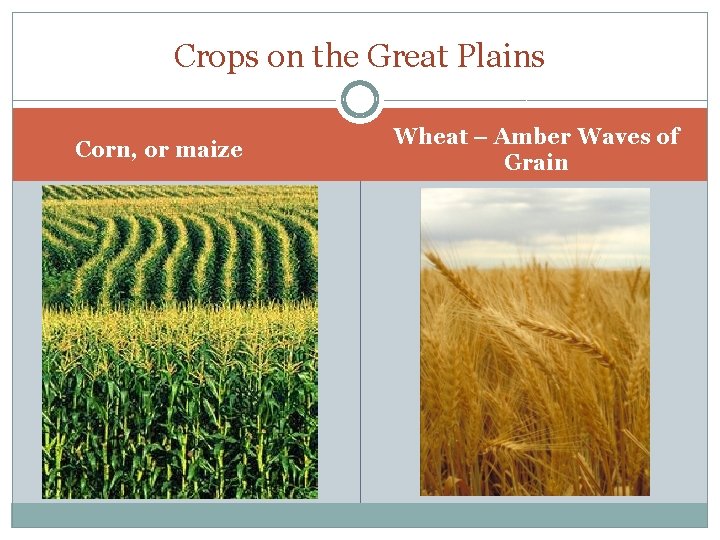
Crops on the Great Plains Corn, or maize Wheat – Amber Waves of Grain
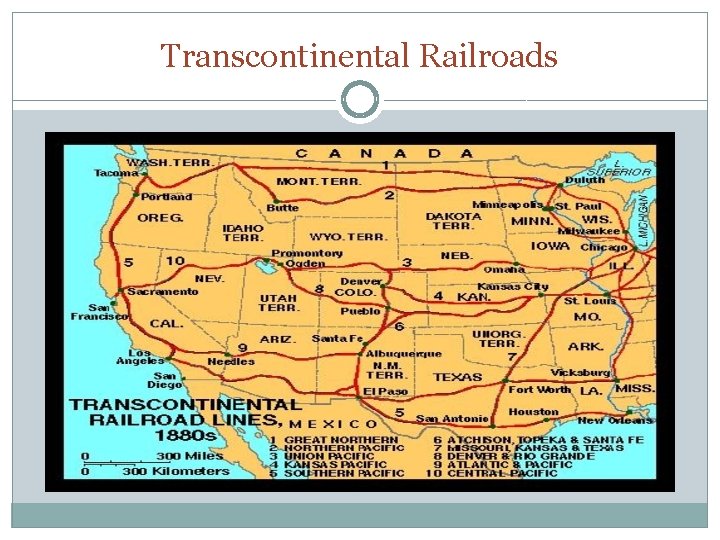
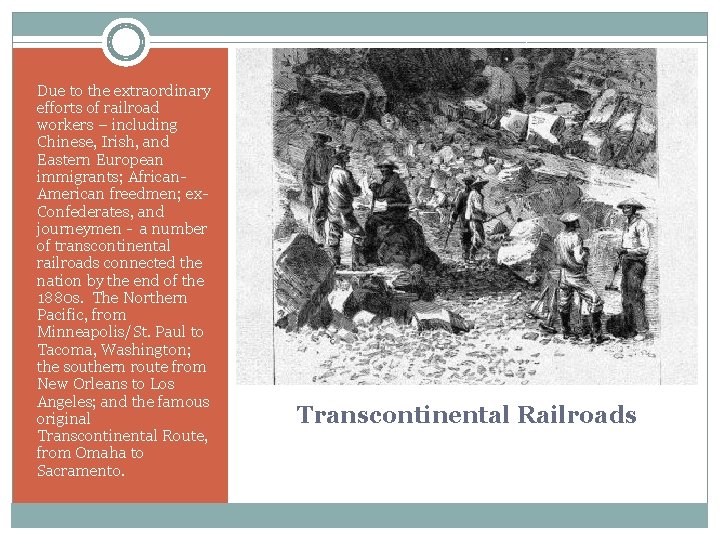
Transcontinental Railroads
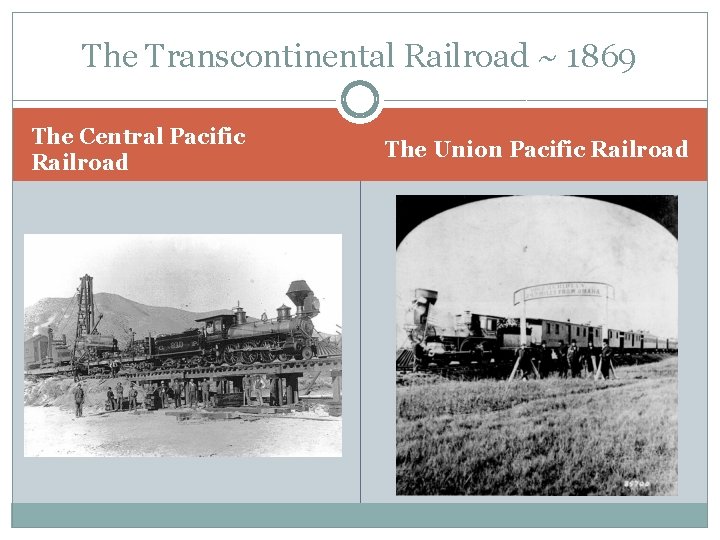
Due to the extraordinary efforts of railroad workers – including Chinese, Irish, and Eastern European immigrants; African. American freedmen; ex. Confederates, and journeymen - a number of transcontinental railroads connected the nation by the end of the 1880 s. The Northern Pacific, from Minneapolis/St. Paul to Tacoma, Washington; the southern route from New Orleans to Los Angeles; and the famous original Transcontinental Route, from Omaha to Sacramento. Transcontinental Railroads
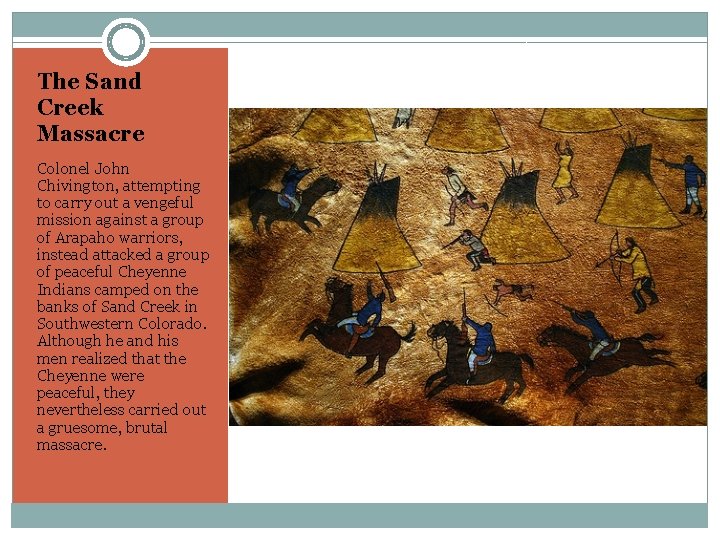
The Sand Creek Massacre Colonel John Chivington, attempting to carry out a vengeful mission against a group of Arapaho warriors, instead attacked a group of peaceful Cheyenne Indians camped on the banks of Sand Creek in Southwestern Colorado. Although he and his men realized that the Cheyenne were peaceful, they nevertheless carried out a gruesome, brutal massacre.
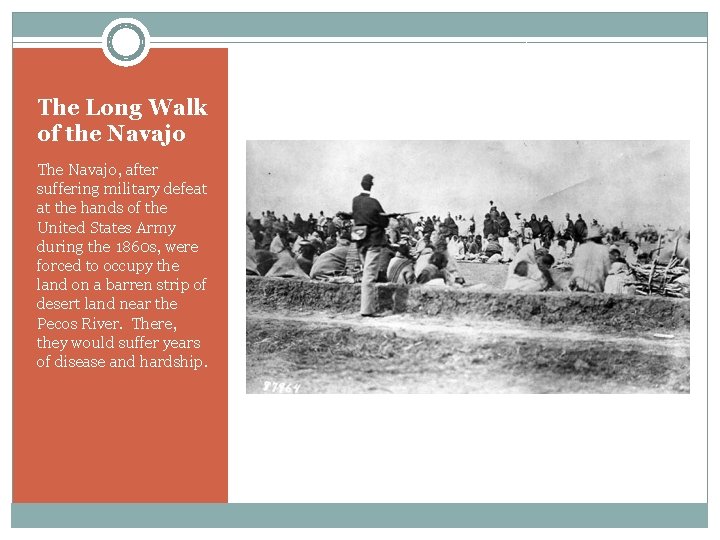
The Long Walk of the Navajo The Navajo, after suffering military defeat at the hands of the United States Army during the 1860 s, were forced to occupy the land on a barren strip of desert land near the Pecos River. There, they would suffer years of disease and hardship.
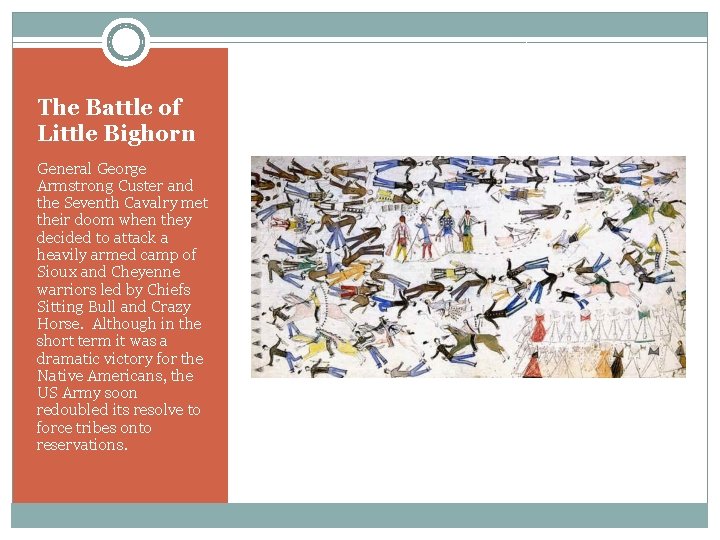
The Battle of Little Bighorn General George Armstrong Custer and the Seventh Cavalry met their doom when they decided to attack a heavily armed camp of Sioux and Cheyenne warriors led by Chiefs Sitting Bull and Crazy Horse. Although in the short term it was a dramatic victory for the Native Americans, the US Army soon redoubled its resolve to force tribes onto reservations.
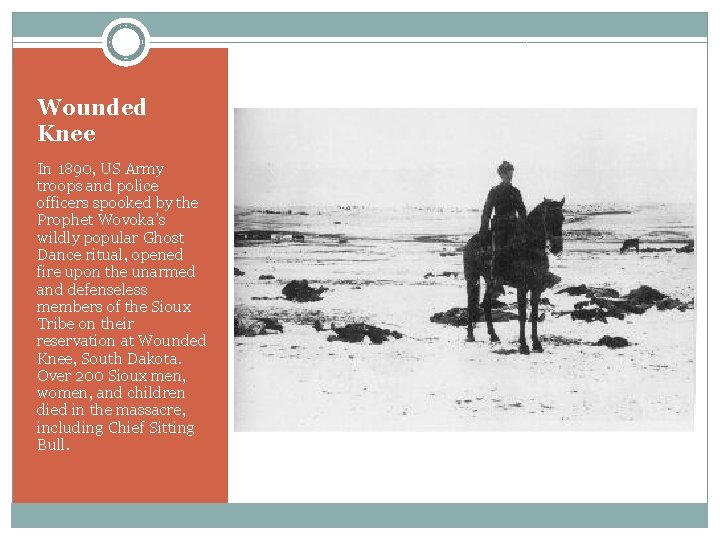
Wounded Knee In 1890, US Army troops and police officers spooked by the Prophet Wovoka’s wildly popular Ghost Dance ritual, opened fire upon the unarmed and defenseless members of the Sioux Tribe on their reservation at Wounded Knee, South Dakota. Over 200 Sioux men, women, and children died in the massacre, including Chief Sitting Bull.
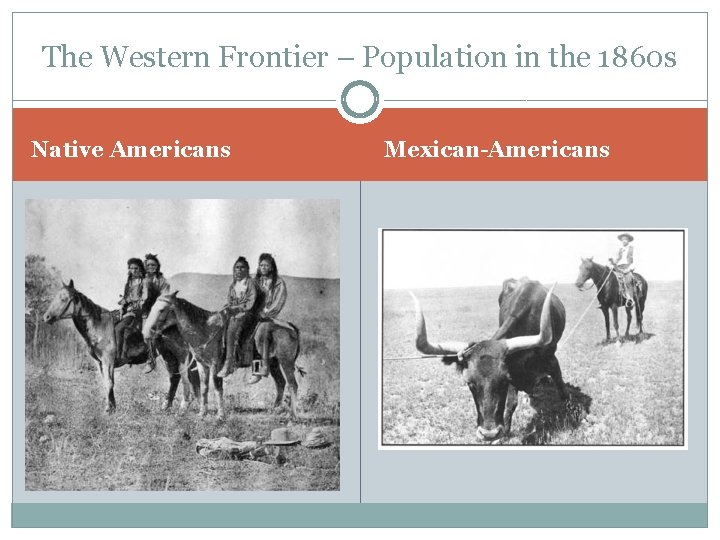
The Western Frontier – Population in the 1860 s Native Americans Mexican-Americans
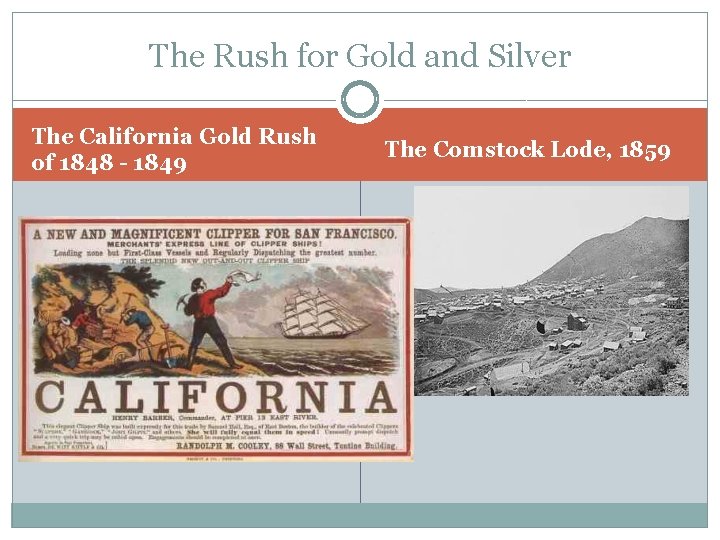
The Rush for Gold and Silver The California Gold Rush of 1848 - 1849 The Comstock Lode, 1859
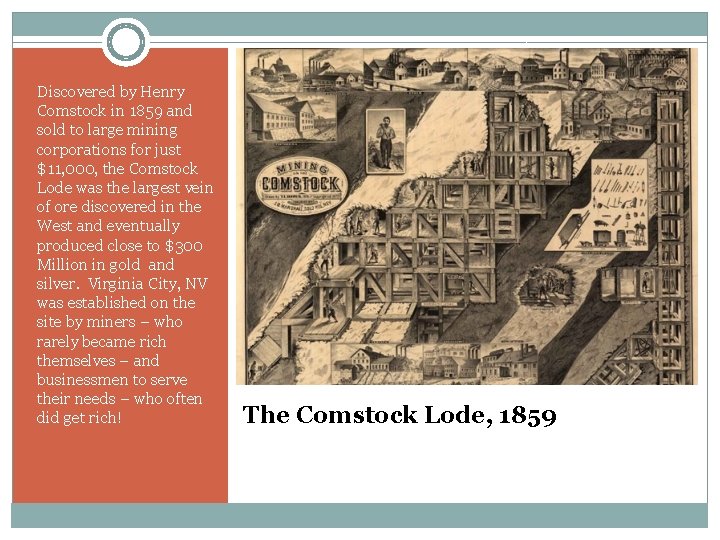
Discovered by Henry Comstock in 1859 and sold to large mining corporations for just $11, 000, the Comstock Lode was the largest vein of ore discovered in the West and eventually produced close to $300 Million in gold and silver. Virginia City, NV was established on the site by miners – who rarely became rich themselves – and businessmen to serve their needs – who often did get rich! The Comstock Lode, 1859
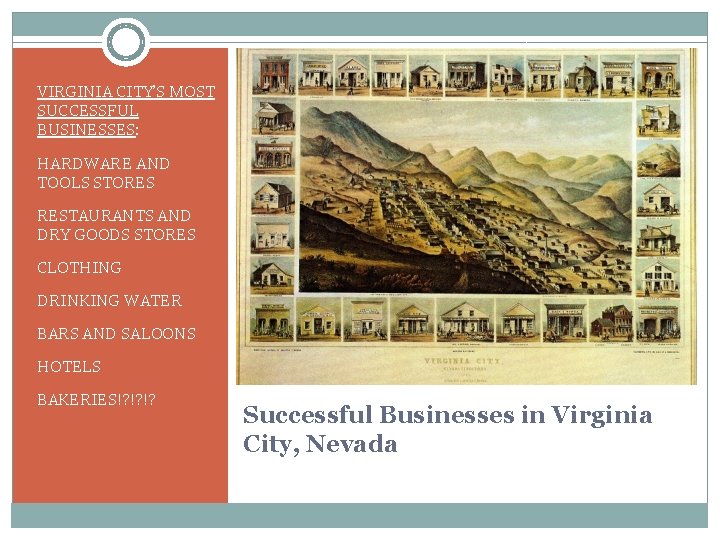
VIRGINIA CITY’S MOST SUCCESSFUL BUSINESSES: HARDWARE AND TOOLS STORES RESTAURANTS AND DRY GOODS STORES CLOTHING DRINKING WATER BARS AND SALOONS HOTELS BAKERIES!? !? !? Successful Businesses in Virginia City, Nevada
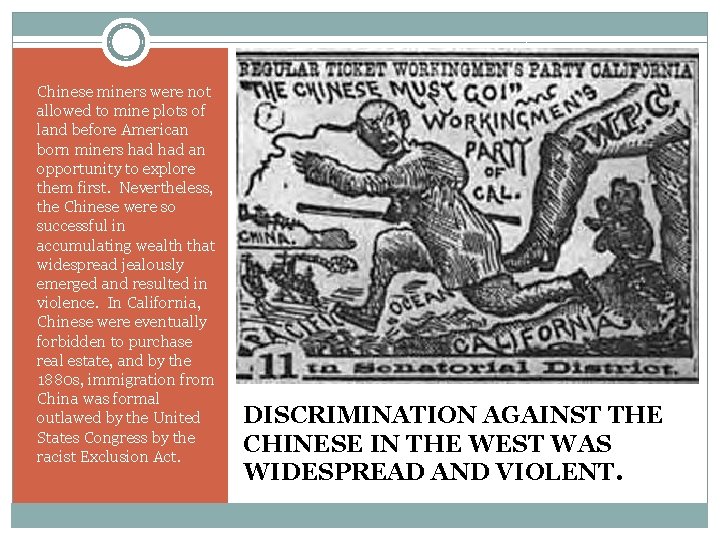
Chinese miners were not allowed to mine plots of land before American born miners had an opportunity to explore them first. Nevertheless, the Chinese were so successful in accumulating wealth that widespread jealously emerged and resulted in violence. In California, Chinese were eventually forbidden to purchase real estate, and by the 1880 s, immigration from China was formal outlawed by the United States Congress by the racist Exclusion Act. DISCRIMINATION AGAINST THE CHINESE IN THE WEST WAS WIDESPREAD AND VIOLENT.
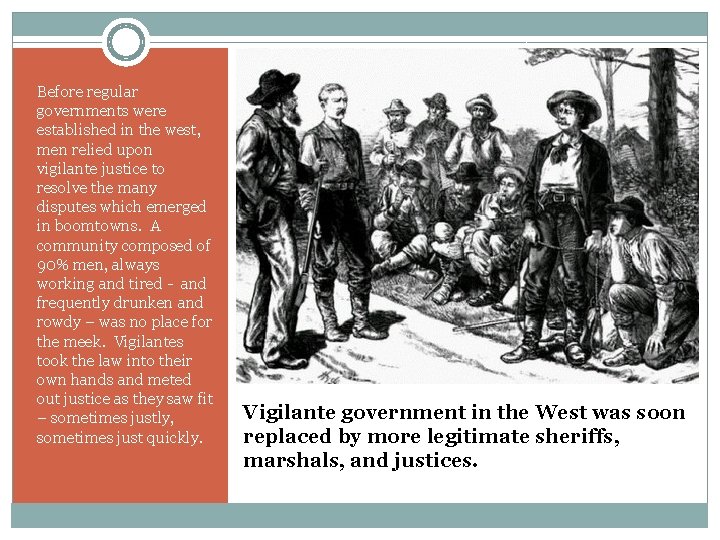
Before regular governments were established in the west, men relied upon vigilante justice to resolve the many disputes which emerged in boomtowns. A community composed of 90% men, always working and tired - and frequently drunken and rowdy – was no place for the meek. Vigilantes took the law into their own hands and meted out justice as they saw fit – sometimes justly, sometimes just quickly. Vigilante government in the West was soon replaced by more legitimate sheriffs, marshals, and justices.
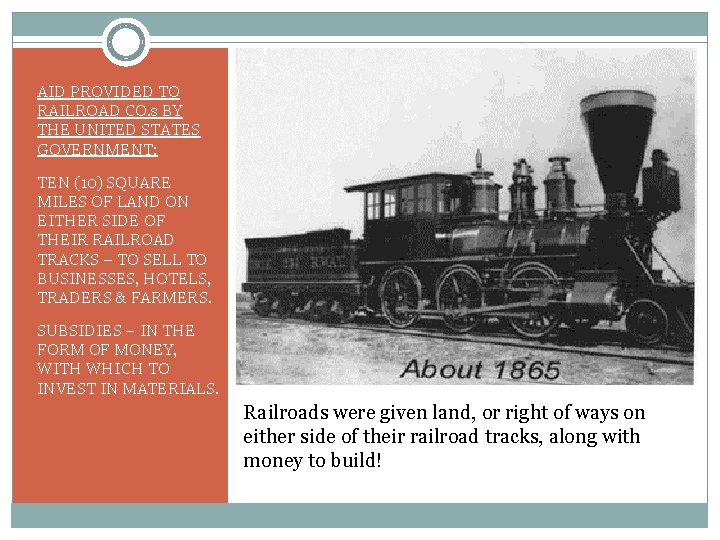
AID PROVIDED TO RAILROAD CO. s BY THE UNITED STATES GOVERNMENT: TEN (10) SQUARE MILES OF LAND ON EITHER SIDE OF THEIR RAILROAD TRACKS – TO SELL TO BUSINESSES, HOTELS, TRADERS & FARMERS. SUBSIDIES – IN THE FORM OF MONEY, WITH WHICH TO INVEST IN MATERIALS. Railroads were given land, or right of ways on either side of their railroad tracks, along with money to build!
The Transcontinental Railroad ~ 1869 The Central Pacific Railroad The Union Pacific Railroad
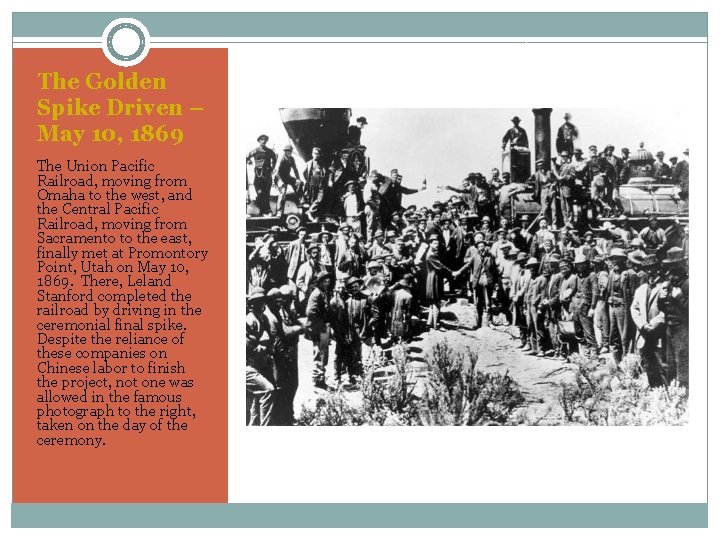
The Golden Spike Driven – May 10, 1869 The Union Pacific Railroad, moving from Omaha to the west, and the Central Pacific Railroad, moving from Sacramento to the east, finally met at Promontory Point, Utah on May 10, 1869. There, Leland Stanford completed the railroad by driving in the ceremonial final spike. Despite the reliance of these companies on Chinese labor to finish the project, not one was allowed in the famous photograph to the right, taken on the day of the ceremony.
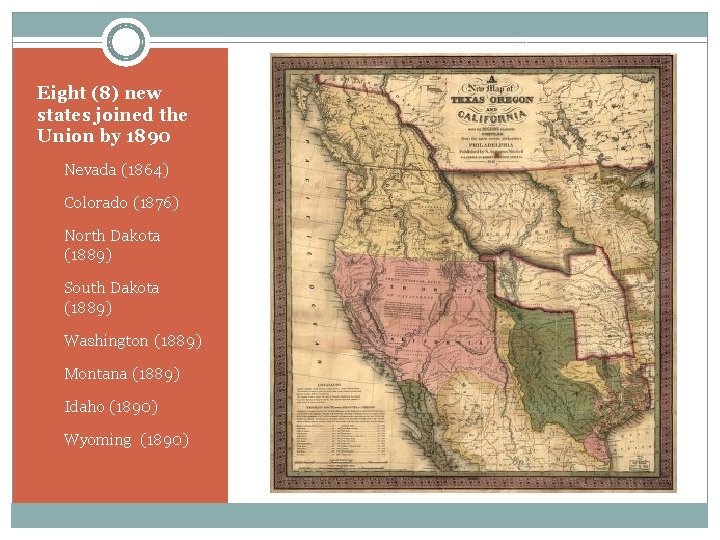
Eight (8) new states joined the Union by 1890 1. Nevada (1864) 2. Colorado (1876) 3. North Dakota (1889) 4. South Dakota (1889) 5. Washington (1889) 6. Montana (1889) 7. Idaho (1890) 8. Wyoming (1890)
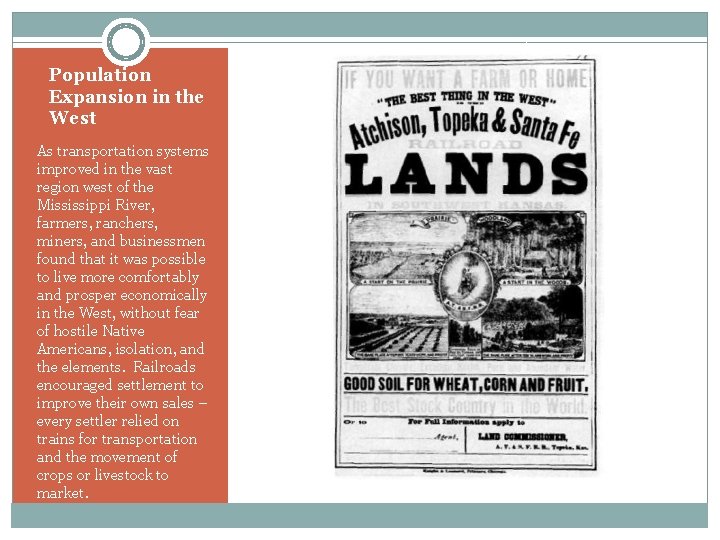
Population Expansion in the West As transportation systems improved in the vast region west of the Mississippi River, farmers, ranchers, miners, and businessmen found that it was possible to live more comfortably and prosper economically in the West, without fear of hostile Native Americans, isolation, and the elements. Railroads encouraged settlement to improve their own sales – every settler relied on trains for transportation and the movement of crops or livestock to market.