
Minimum Spanning Trees Majority Spanning Trees and Cotrees

- Slides: 19
Minimum Spanning Trees, Majority Spanning Trees and Cotrees Presented By: Dr. M. Kaykobad October 04, 2005
Contents n Introduction ¨ ¨ ¨ n Majority Spanning Tree ¨ ¨ n n n Fundamental Cutset Definition of Majority Spanning Tree Majority Co-Tree ¨ ¨ n Spanning Tree Minimum Spanning Tree (MST) MST Algorithm Fundamental Cycle Definition of Majority Co. Tree Theorems Applications Conclusion
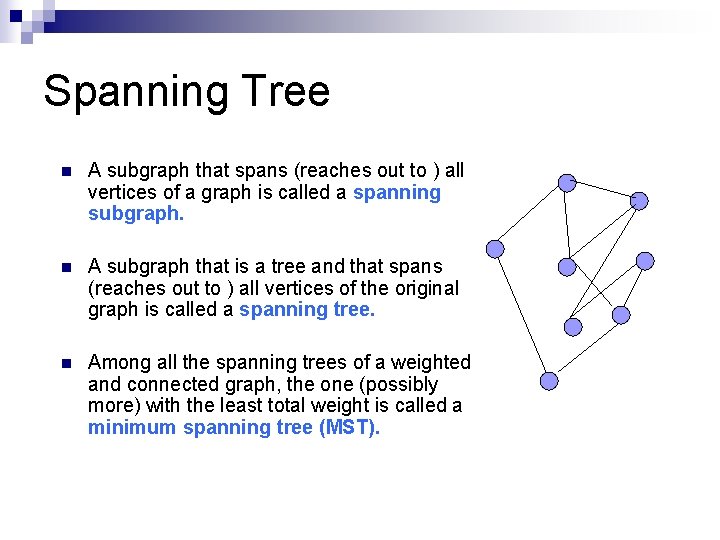
Spanning Tree n A subgraph that spans (reaches out to ) all vertices of a graph is called a spanning subgraph. n A subgraph that is a tree and that spans (reaches out to ) all vertices of the original graph is called a spanning tree. n Among all the spanning trees of a weighted and connected graph, the one (possibly more) with the least total weight is called a minimum spanning tree (MST).
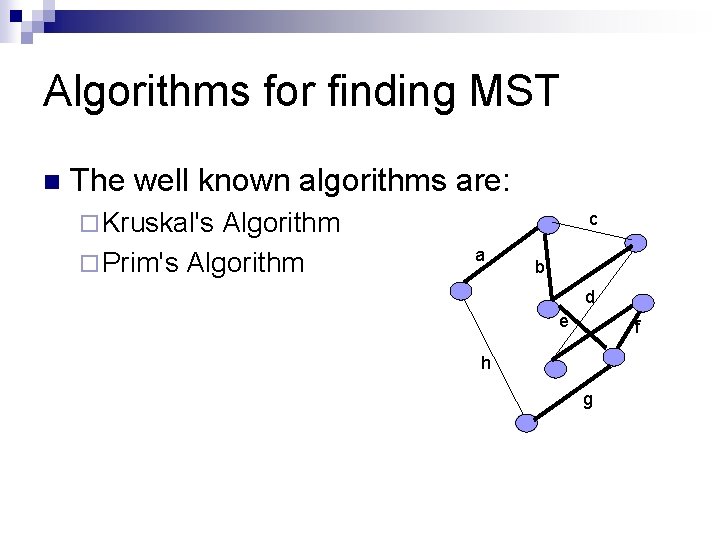
Algorithms for finding MST n The well known algorithms are: ¨ Kruskal's Algorithm ¨ Prim's Algorithm c a b d e f h g
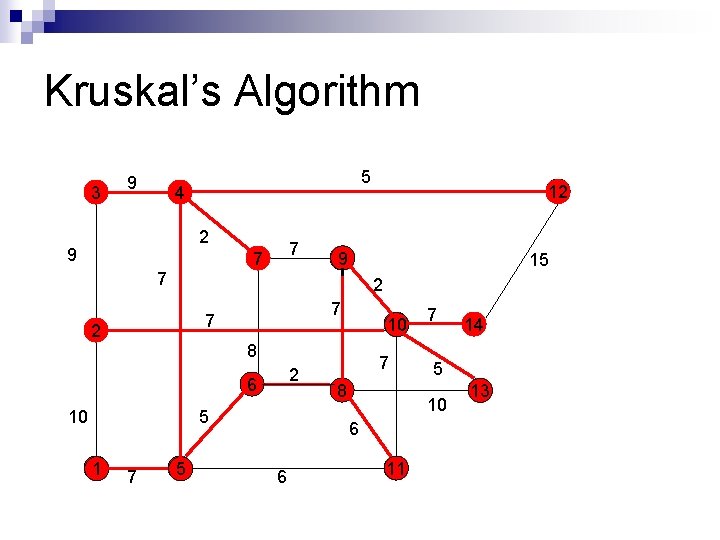
Kruskal’s Algorithm 3 9 5 4 2 9 7 7 9 15 7 2 7 7 2 10 8 2 6 10 5 1 7 12 5 7 8 11 14 5 10 6 6 7 13
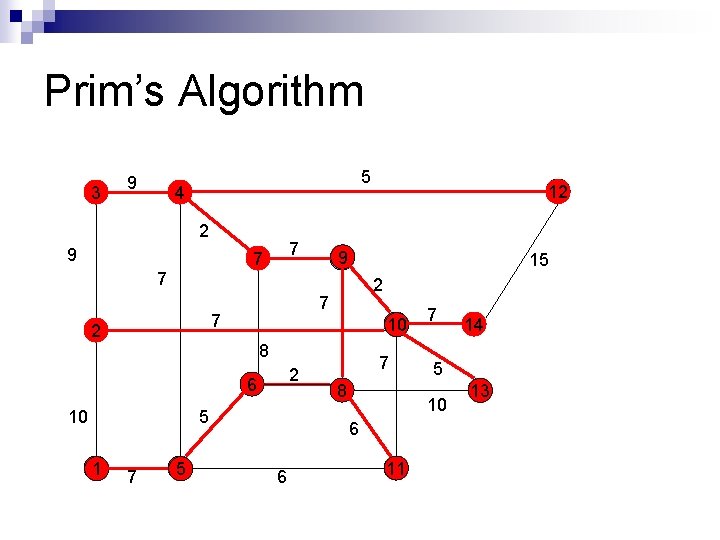
Prim’s Algorithm 3 9 5 4 2 9 7 7 9 15 7 2 2 7 7 10 8 2 6 10 5 1 7 5 12 7 8 11 14 5 10 6 6 7 13
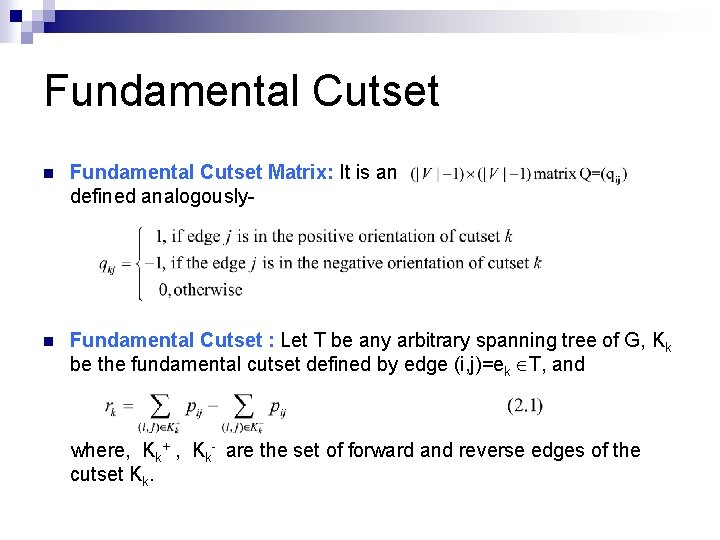
Fundamental Cutset n Fundamental Cutset Matrix: It is an defined analogously- n Fundamental Cutset : Let T be any arbitrary spanning tree of G, Kk be the fundamental cutset defined by edge (i, j)=ek T, and where, Kk+ , Kk- are the set of forward and reverse edges of the cutset Kk.
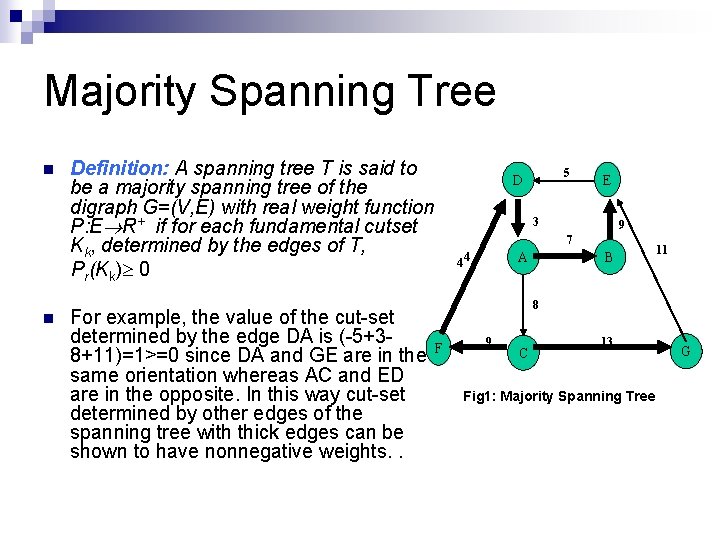
Majority Spanning Tree n n Definition: A spanning tree T is said to be a majority spanning tree of the digraph G=(V, E) with real weight function P: E R+ if for each fundamental cutset Kk, determined by the edges of T, Pr(Kk) 0 For example, the value of the cut-set determined by the edge DA is (-5+38+11)=1>=0 since DA and GE are in the same orientation whereas AC and ED are in the opposite. In this way cut-set determined by other edges of the spanning tree with thick edges can be shown to have nonnegative weights. . 5 D E 3 9 7 4 A 4 B 11 8 F 9 C 13 Fig 1: Majority Spanning Tree G
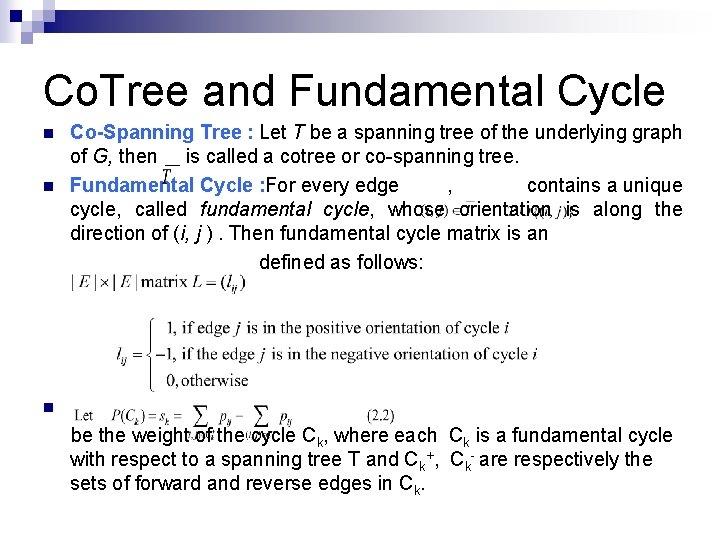
Co. Tree and Fundamental Cycle n n Co-Spanning Tree : Let T be a spanning tree of the underlying graph of G, then is called a cotree or co-spanning tree. Fundamental Cycle : For every edge , contains a unique cycle, called fundamental cycle, whose orientation is along the direction of (i, j ). Then fundamental cycle matrix is an defined as follows: n be the weight of the cycle Ck, where each Ck is a fundamental cycle with respect to a spanning tree T and Ck+, Ck- are respectively the sets of forward and reverse edges in Ck.
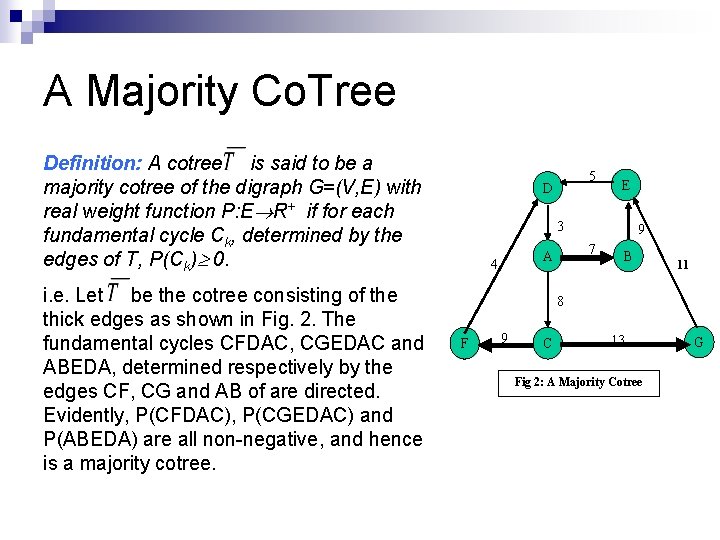
A Majority Co. Tree Definition: A cotree is said to be a majority cotree of the digraph G=(V, E) with real weight function P: E R+ if for each fundamental cycle Ck, determined by the edges of T, P(Ck) 0. i. e. Let be the cotree consisting of the thick edges as shown in Fig. 2. The fundamental cycles CFDAC, CGEDAC and ABEDA, determined respectively by the edges CF, CG and AB of are directed. Evidently, P(CFDAC), P(CGEDAC) and P(ABEDA) are all non-negative, and hence is a majority cotree. 5 D E 3 7 A 4 9 B 11 8 F 9 C 13 Fig 2: A Majority Cotree G
Theorems n Theorem 2. 1: Every digraph G=(V, A) with nonnegative weight function P: E R+ has a majority spanning tree. n Theorem 2. 2: Every digraph G=(V, E) with nonnegative weight function P: E R+ has a majority cotree. n Theorem 2. 3: For every digraph G=(V, E) with nonnegative weight function P: E R+ there is a majority spanning tree T such that T is a majority cotree.
Possible Applications n Minimum Connection Time Problem : ¨ In a transportation system it is not always possible to provide for all passengers a direct connection from origin to destination. Some passengers may have to use several connecting trips to reach their destination. ¨ The connection time is the time a passenger has to wait between connecting trips. ¨ The problem that addresses how to construct a timetable for the transportation system that minimizes the total weighted connection time will be referred to as Minimum Connection Time (MCT) Problem
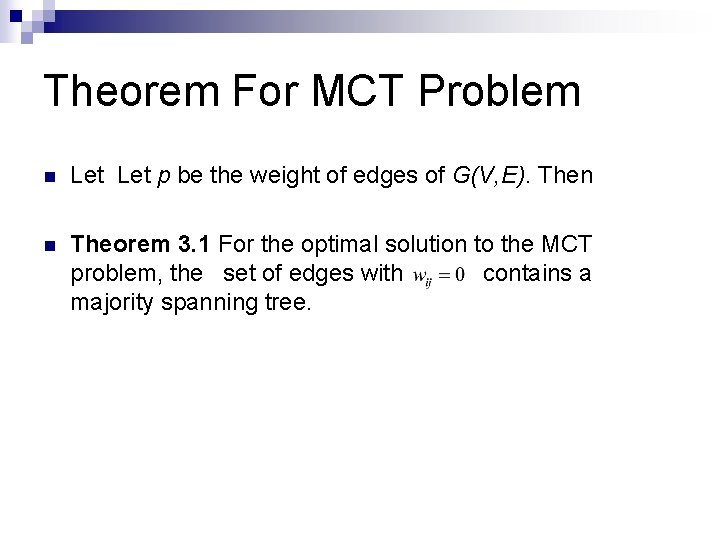
Theorem For MCT Problem n Let p be the weight of edges of G(V, E). Then n Theorem 3. 1 For the optimal solution to the MCT problem, the set of edges with contains a majority spanning tree.
Possible Applications (cont. ) n Ranking Problem: ¨ Consider the problem of ranking players of a round-robin tournament by minimizing number of upsets, that is number of matches in which lowly ranked players have defeated highly ranked players. ¨ The results of such a tournament can be expressed in a digraph known as tournament digraph. ¨ In a tournament digraph players correspond to vertices and each edge corresponds to the result of a match in which case edge starts at the vertex corresponding to the winning player, and the defeated player corresponds to the head of the edge.
Theorem For Ranking Problem n Let R be a ranking of players, ¨ VR=V and ¨ ER={(i, j)| rank of player corresponding to vertex j is immediately below that of player corresponding to vertex i}. ¨ It is obvious that GR=(VR, ER) is a spanning tree of G, more accurately GR=(VR, ER) is a Hamiltonian semipath. n Theorem 4: Let R be any optimal ranking of a tournament represented by G=(V, E). Then GR=(VR, ER) is an MST of G.
Theorem For Ranking Problem (cont. ) n Let, ¨ Gij® be the subgraph of G induced by the set of vertices corresponding to players ranked from i to j, and ¨ Gij. R be the subgraph of Gij® having the same set of vertices, and only those edges that correspond to the results of matches between consecutively ranked players. Then n Theorem 5: For any optimal ranking R and 1 i j n, Gij. R must be an MST of Gij®.
Conclusion n The novelty of these theorems is the discovery of a new class of spanning trees, termed as majority spanning trees, in directed graphs with non-negative weights on edges.
References n n Kaykobad, M. , "Minimum connection time and some related complexity problems", Ph. D. Thesis, The Flinders University of South Australia, 1986. Kaykobad, M. , Ahmed, Q. N. U. , Khalid, A. T. M. S. and Bakhtiar, Rezwan Al, A new algorithm for ranking players of a round robin tournament, Computers Ops. Res. 22, 221 -226 (1995).
Thank You