
Minimizing Radiation Dose in the Cath Lab PRIMER
Minimizing Radiation Dose in the Cath Lab PRIMER for ENDOVASCULAR INTEVENTIONS Session: Things to Know CRT 2016 2/21/2016 4: 10 -4: 20 PM Charles E. Chambers, MD, MSCAI, FACC Prior Fellow of the National Council of Radiation Protection (NCRP) Professor of Medicine and Radiology Pennsylvania State University College of Medicine Director, Cardiac Catheterization Laboratories Hershey, PA

Conflict of Interest n None for this talk Halong Bay, Vietnam
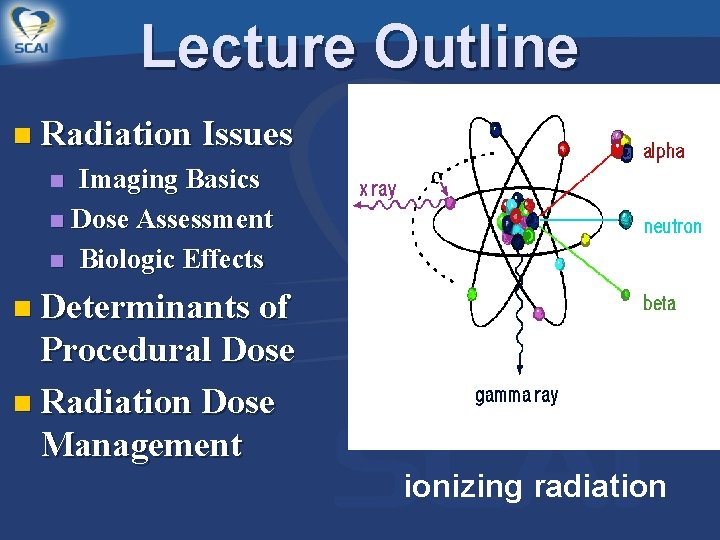
Lecture Outline n Radiation Issues Imaging Basics n Dose Assessment n Biologic Effects n n Determinants of Procedural Dose n Radiation Dose Management ionizing radiation
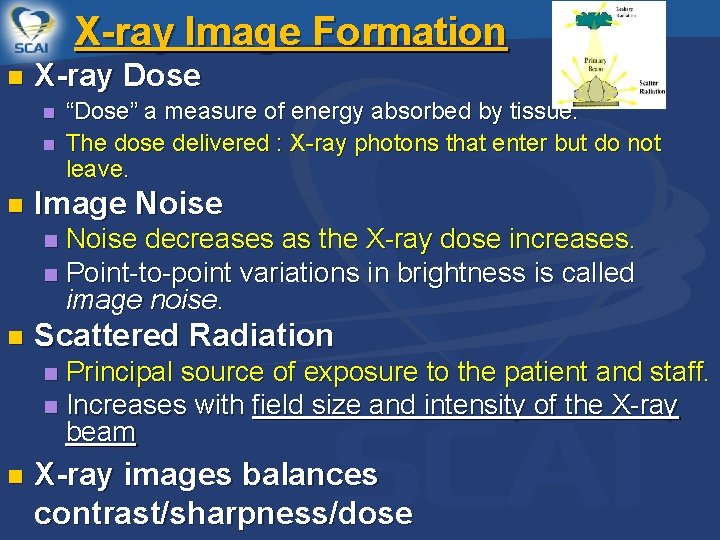
X-ray Image Formation n X-ray Dose n n n “Dose” a measure of energy absorbed by tissue. The dose delivered : X-ray photons that enter but do not leave. Image Noise decreases as the X-ray dose increases. n Point-to-point variations in brightness is called image noise. n n Scattered Radiation Principal source of exposure to the patient and staff. n Increases with field size and intensity of the X-ray beam n n X-ray images balances contrast/sharpness/dose
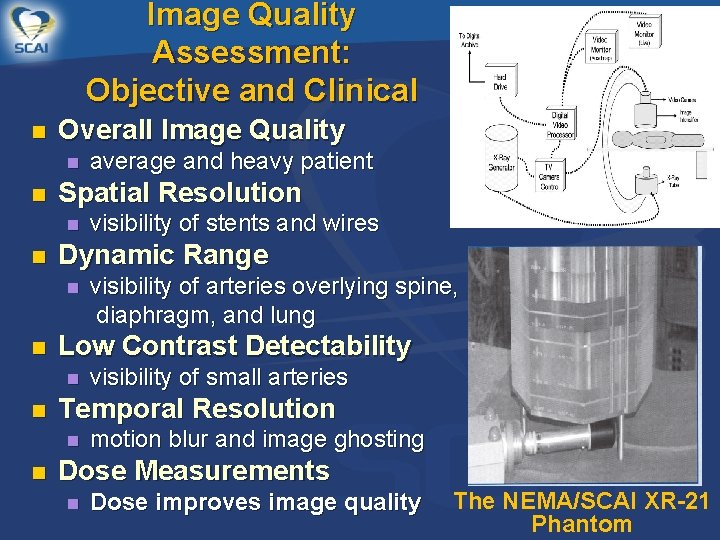
Image Quality Assessment: Objective and Clinical n Overall Image Quality n n Spatial Resolution n n visibility of small arteries Temporal Resolution n n visibility of arteries overlying spine, diaphragm, and lung Low Contrast Detectability n n visibility of stents and wires Dynamic Range n n average and heavy patient motion blur and image ghosting Dose Measurements n Dose improves image quality The NEMA/SCAI XR-21 Phantom
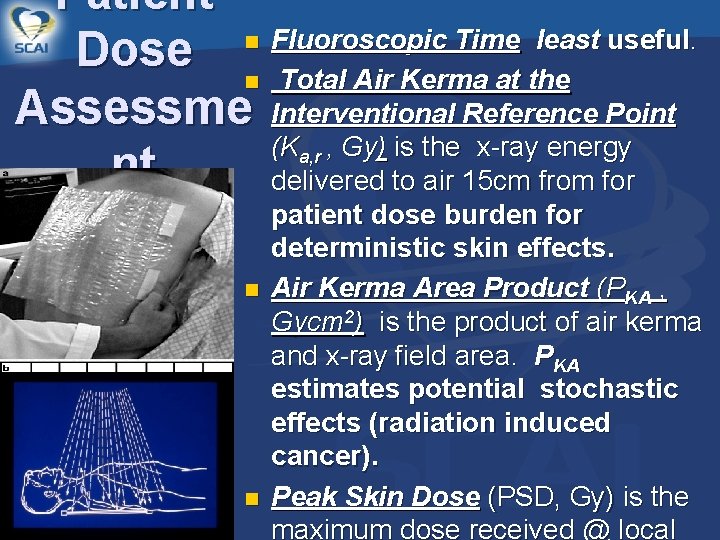
Patient n Fluoroscopic Time least useful. Dose n Total Air Kerma at the Assessme Interventional Reference Point (K , Gy) is the x-ray energy nt delivered to air 15 cm from for a, r n n patient dose burden for deterministic skin effects. Air Kerma Area Product (PKA , Gycm 2) is the product of air kerma and x-ray field area. PKA estimates potential stochastic effects (radiation induced cancer). Peak Skin Dose (PSD, Gy) is the maximum dose received @ local
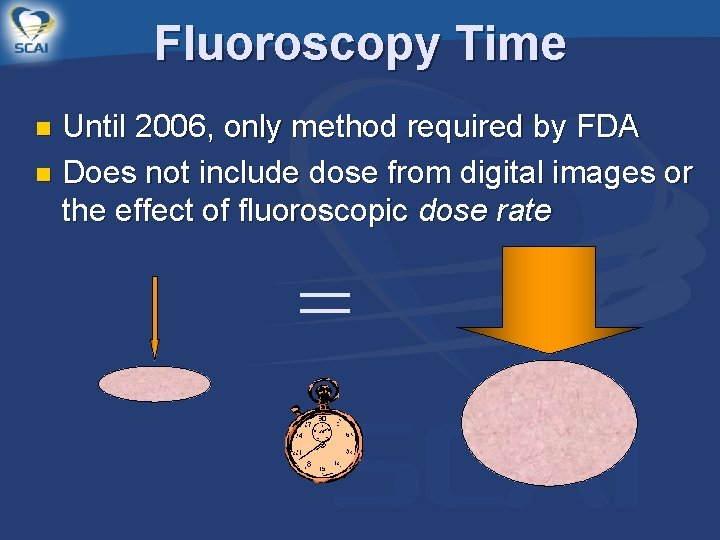
Fluoroscopy Time Until 2006, only method required by FDA n Does not include dose from digital images or the effect of fluoroscopic dose rate n =
KERMA Kinetic Energy Released in MAtter n A measure of energy delivered (dose) n Air Kerma = kerma measured in air (low scatter environment) n

Total Air Kerma at the Interventional Reference Point a/k/a Reference Air Kerma, Cumulative Dose n Measured at the IRP, may be inside, outside, or on surface of patient n Iso-center is the point in space through which the central ray of the radiation beam intersects with the rotation axis of the gantry. n Patient Isocenter 15 cm Interventional Reference Point (fixed to the system gantry Focal Spot
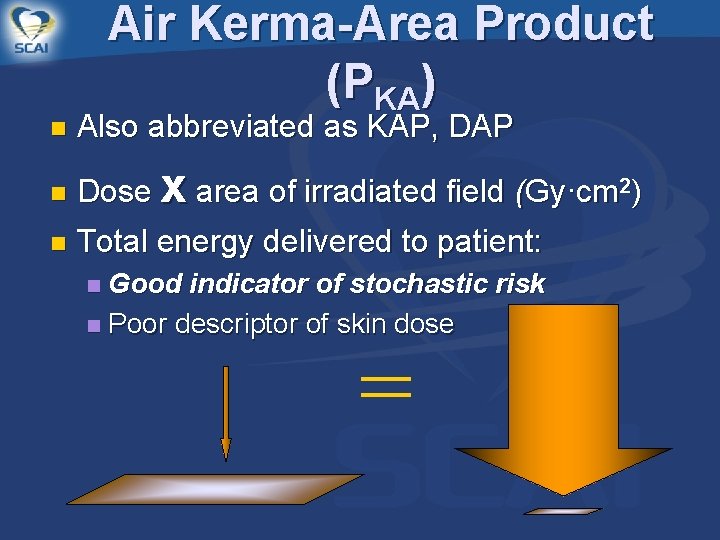
Air Kerma-Area Product (PKA) n Also abbreviated as KAP, DAP n Dose x area of irradiated field (Gy·cm 2) n Total energy delivered to patient: Good indicator of stochastic risk n Poor descriptor of skin dose n =
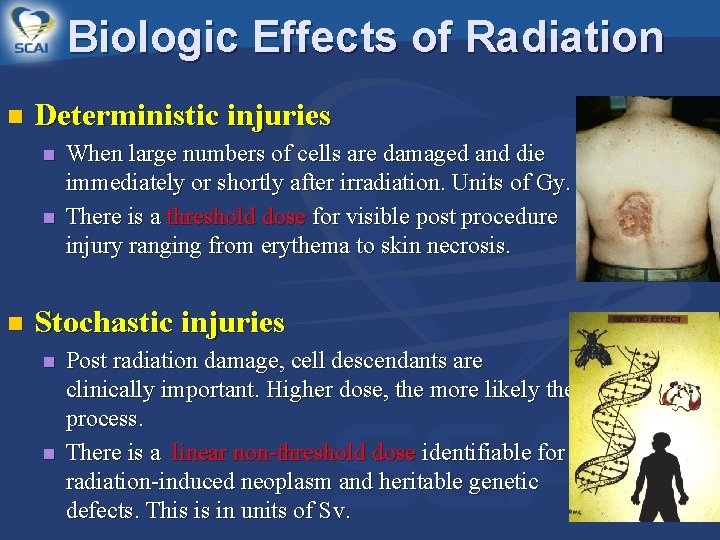
Biologic Effects of Radiation n Deterministic injuries n n n When large numbers of cells are damaged and die immediately or shortly after irradiation. Units of Gy. There is a threshold dose for visible post procedure injury ranging from erythema to skin necrosis. Stochastic injuries n n Post radiation damage, cell descendants are clinically important. Higher dose, the more likely the process. There is a linear non-threshold dose identifiable for radiation-induced neoplasm and heritable genetic defects. This is in units of Sv.
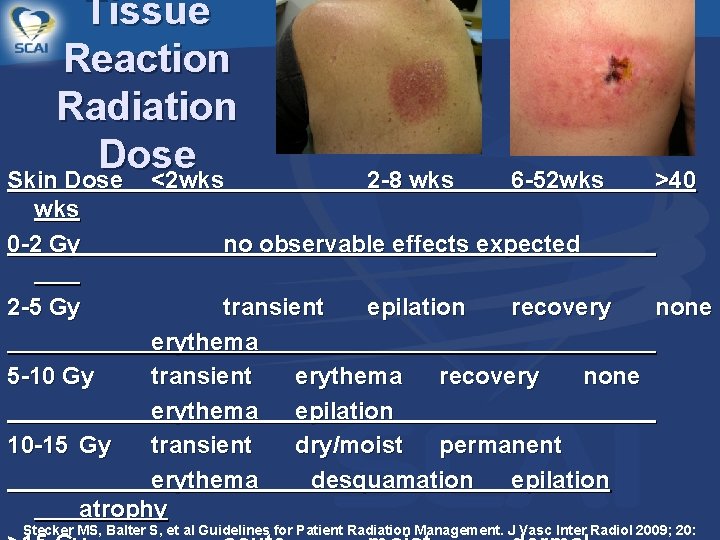
Tissue Reaction Radiation Dose Skin Dose <2 wks 0 -2 Gy 2 -8 wks 6 -52 wks >40 no observable effects expected 2 -5 Gy transient epilation recovery none erythema 5 -10 Gy transient erythema recovery none erythema epilation 10 -15 Gy transient dry/moist permanent erythema desquamation epilation atrophy Stecker MS, Balter S, et al Guidelines for Patient Radiation Management. J Vasc Inter Radiol 2009; 20:
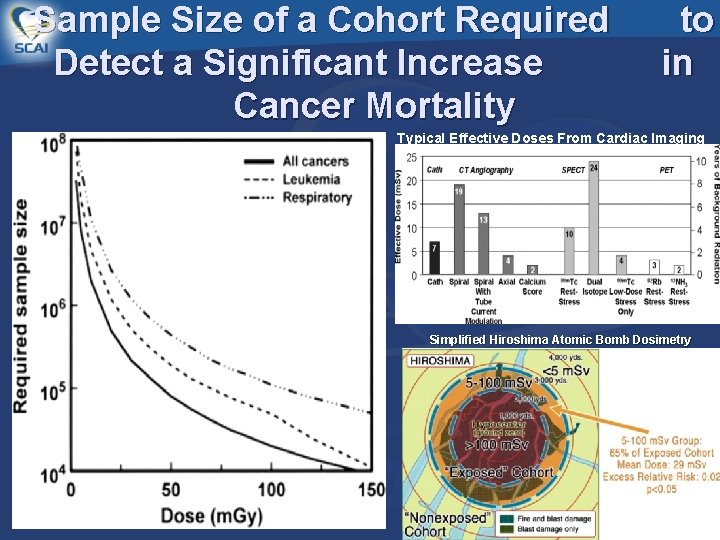
Sample Size of a Cohort Required Detect a Significant Increase Cancer Mortality to in Typical Effective Doses From Cardiac Imaging Simplified Hiroshima Atomic Bomb Dosimetry
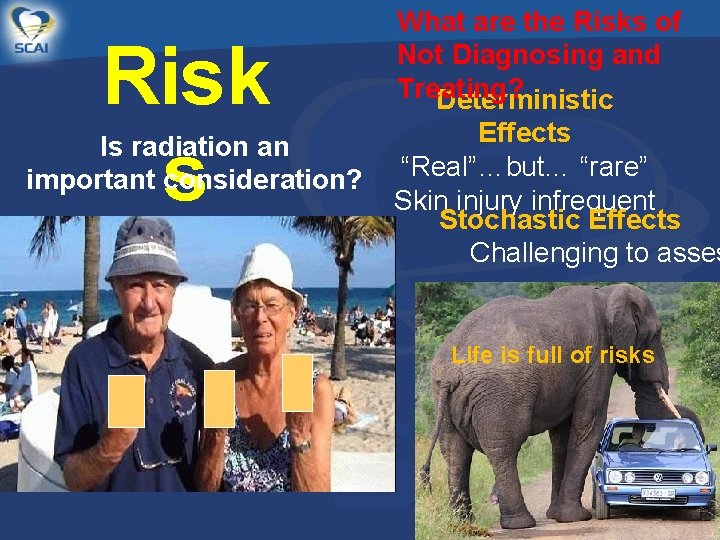
Risk s Is radiation an important consideration? What are the Risks of Not Diagnosing and Treating? Deterministic Effects “Real”…but… “rare” Skin injury infrequent Stochastic Effects Challenging to asses Life is full of risks
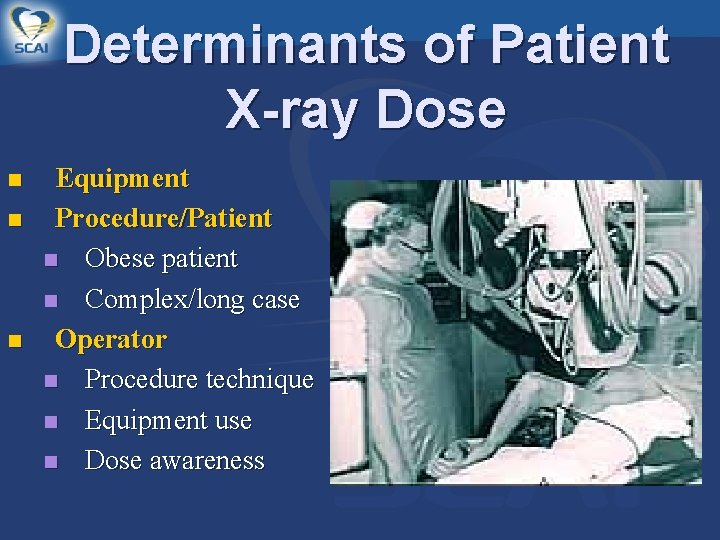
Determinants of Patient X-ray Dose n n n Equipment Procedure/Patient n Obese patient n Complex/long case Operator n Procedure technique n Equipment use n Dose awareness
Imaging Equipment n n n Purchase X-ray units with sophisticated dose-reduction and monitoring features. Maintain X-ray equipment in good repair and calibration. Utilize the Medical Physicist to assess dose & image quality.
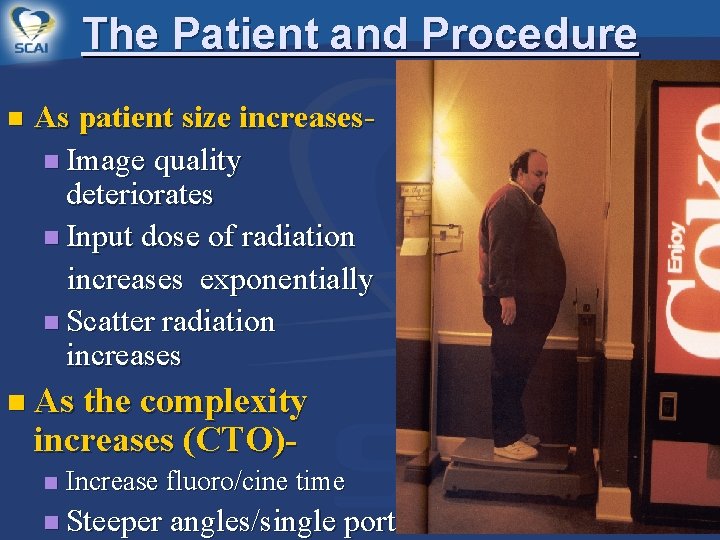
The Patient and Procedure n As patient size increasesn Image quality deteriorates n Input dose of radiation increases exponentially n Scatter radiation increases n As the complexity increases (CTO)n Increase fluoro/cine time n Steeper angles/single port
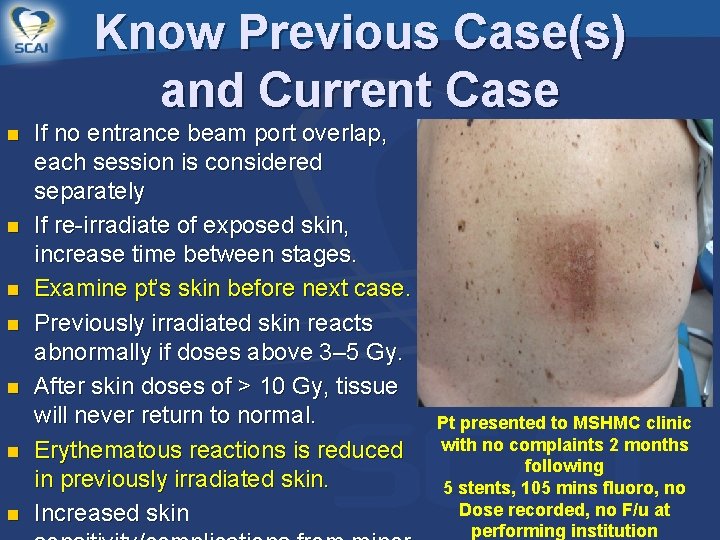
Know Previous Case(s) and Current Case n n n n If no entrance beam port overlap, each session is considered separately If re-irradiate of exposed skin, increase time between stages. Examine pt’s skin before next case. Previously irradiated skin reacts abnormally if doses above 3– 5 Gy. After skin doses of > 10 Gy, tissue will never return to normal. Erythematous reactions is reduced in previously irradiated skin. Increased skin Pt presented to MSHMC clinic with no complaints 2 months following 5 stents, 105 mins fluoro, no Dose recorded, no F/u at performing institution
The Operator It is the Physicians' Responsibility Provide “Best Patient Care” Justification: Avoid any unnecessary study utilizing ionizing radiation, basic principle radiation protection. Training n n A knowledgeable physician, well trained and who knows the patient , is essential to obtain the best patient outcomes. n Initial training or verification of prior training for all staff Annual updates Hands on training for newly hired operators and current operators on newly purchased equipment.
Radiation Dose Management Pre-Procedure Issues n Assessment of Risk n n n the obese patient complex PCI/CTO repeat procedures within 30 -60 days other radiation-related procedures Informed Consent Components n n n procedures are performed using x-ray ionizing radiation x-rays are delivered to help guide the equipment as well as to acquire images for long term storage your physicians will deliver the dose required for the procedure although risk is present, this rarely results in significant injury in complex cases, local tissue damage to the skin or even underlying layers may occur that may require additional follow up and treatment
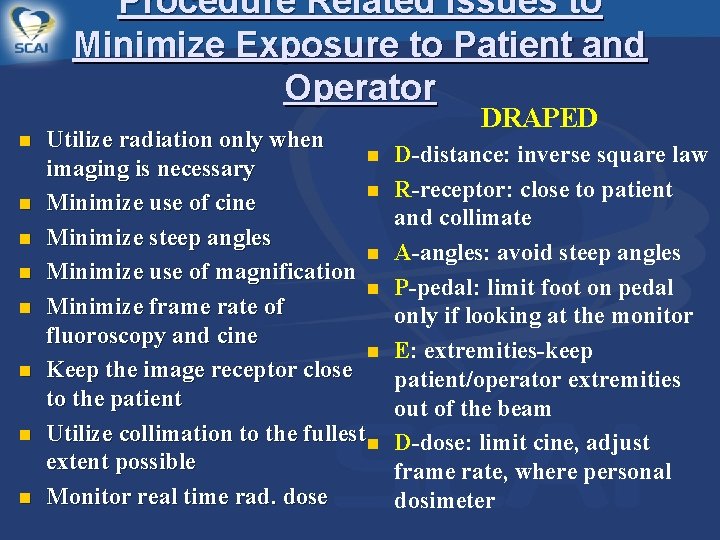
Procedure Related Issues to Minimize Exposure to Patient and Operator n n n n Utilize radiation only when n imaging is necessary n Minimize use of cine Minimize steep angles n Minimize use of magnification n Minimize frame rate of fluoroscopy and cine n Keep the image receptor close to the patient Utilize collimation to the fullest n extent possible Monitor real time rad. dose DRAPED D-distance: inverse square law R-receptor: close to patient and collimate A-angles: avoid steep angles P-pedal: limit foot on pedal only if looking at the monitor E: extremities-keep patient/operator extremities out of the beam D-dose: limit cine, adjust frame rate, where personal dosimeter
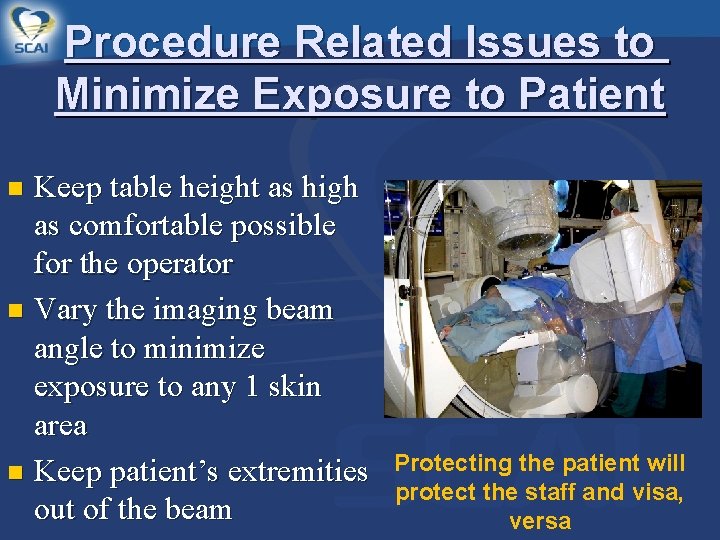
Procedure Related Issues to Minimize Exposure to Patient Keep table height as high as comfortable possible for the operator n Vary the imaging beam angle to minimize exposure to any 1 skin area n Keep patient’s extremities out of the beam n Protecting the patient will protect the staff and visa, versa
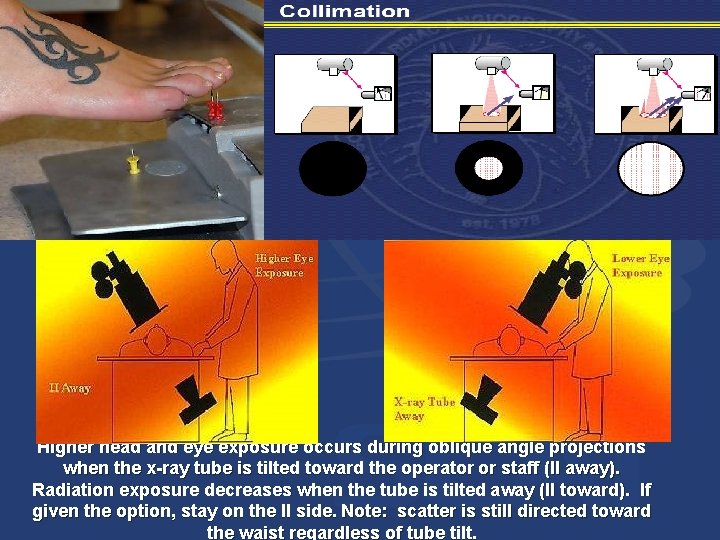
Higher head and eye exposure occurs during oblique angle projections when the x-ray tube is tilted toward the operator or staff (II away). Radiation exposure decreases when the tube is tilted away (II toward). If given the option, stay on the II side. Note: scatter is still directed toward the waist regardless of tube tilt.
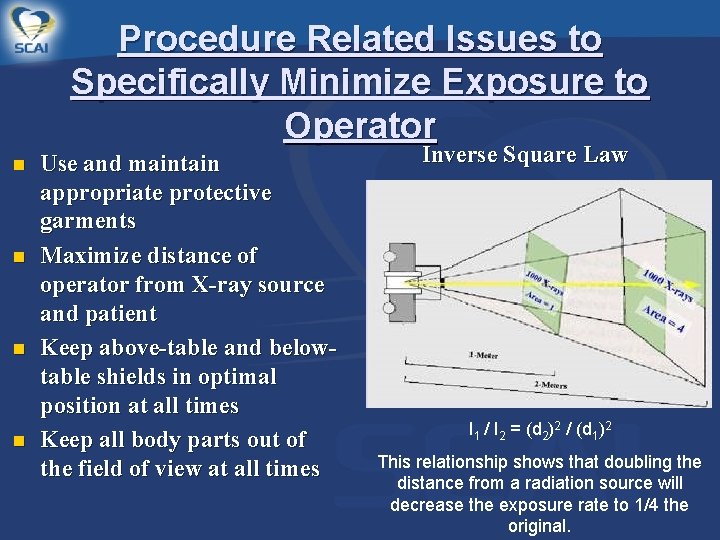
Procedure Related Issues to Specifically Minimize Exposure to Operator n n Use and maintain appropriate protective garments Maximize distance of operator from X-ray source and patient Keep above-table and belowtable shields in optimal position at all times Keep all body parts out of the field of view at all times Inverse Square Law I 1 / I 2 = (d 2)2 / (d 1)2 This relationship shows that doubling the distance from a radiation source will decrease the exposure rate to 1/4 the original.
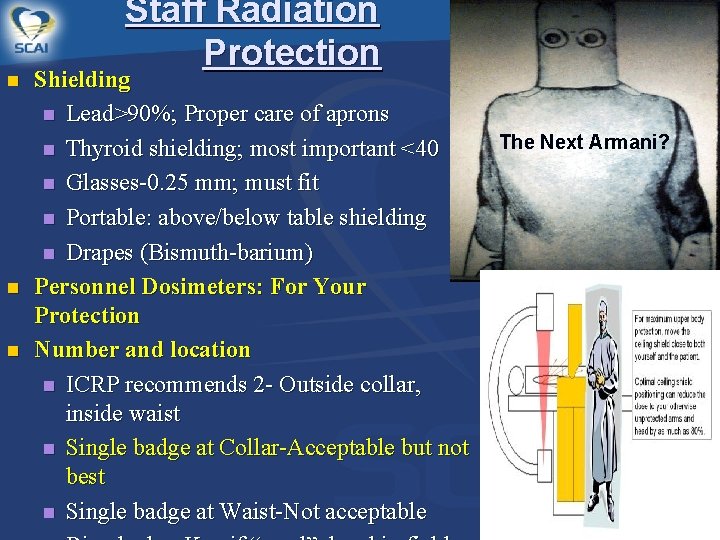
n n n Staff Radiation Protection Shielding n Lead>90%; Proper care of aprons n Thyroid shielding; most important <40 n Glasses-0. 25 mm; must fit n Portable: above/below table shielding n Drapes (Bismuth-barium) Personnel Dosimeters: For Your Protection Number and location n ICRP recommends 2 - Outside collar, inside waist n Single badge at Collar-Acceptable but not best n Single badge at Waist-Not acceptable The Next Armani?
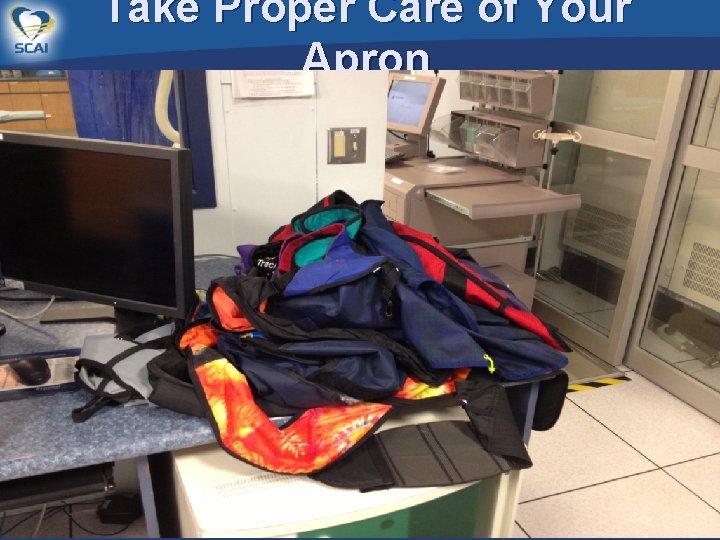
Take Proper Care of Your Apron
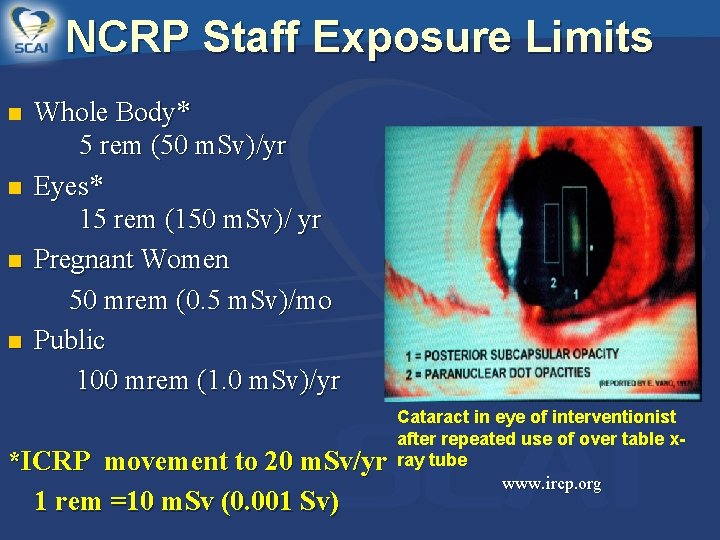
NCRP Staff Exposure Limits n n Whole Body* 5 rem (50 m. Sv)/yr Eyes* 15 rem (150 m. Sv)/ yr Pregnant Women 50 mrem (0. 5 m. Sv)/mo Public 100 mrem (1. 0 m. Sv)/yr *ICRP movement to 20 m. Sv/yr 1 rem =10 m. Sv (0. 001 Sv) Cataract in eye of interventionist after repeated use of over table xray tube www. ircp. org
Post Procedure Issues n n n Cardiac Catheterization Reports should include Fluoroscopic Time, and Total Air Kerma at the Interventional Reference Point (IRP) Cumulative Air Kerma (Ka, r, , Gy) , and/or Air Kerma Area Product (PKA , Gycm 2). FT is the least useful, PKA X 100 in Gy/cm 2 of the Ka, r in Gy. Chart Documentation following procedure for Ka, r doses >5 Gy. Follow up at 30 day is required for Ka, r of 5 -10 Gy. (Call/Visit) For Ka, r > 10 Gy, a qualified physicist perform a analysis.
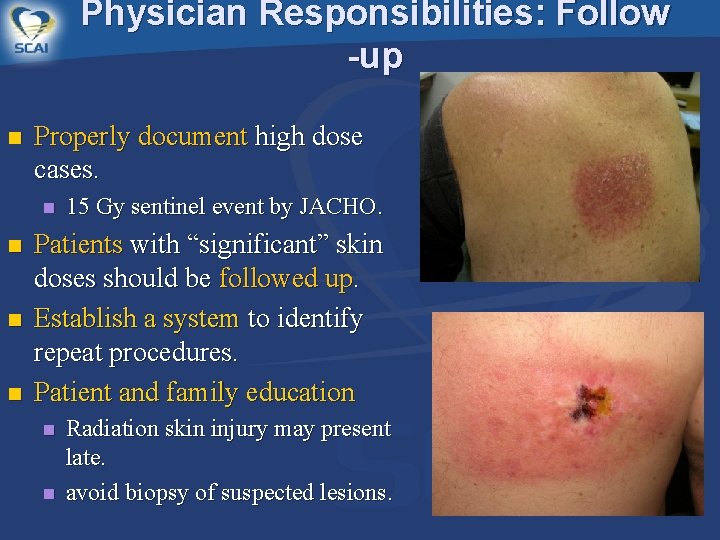
Physician Responsibilities: Follow -up n Properly document high dose cases. n n 15 Gy sentinel event by JACHO. Patients with “significant” skin doses should be followed up. Establish a system to identify repeat procedures. Patient and family education n n Radiation skin injury may present late. avoid biopsy of suspected lesions.
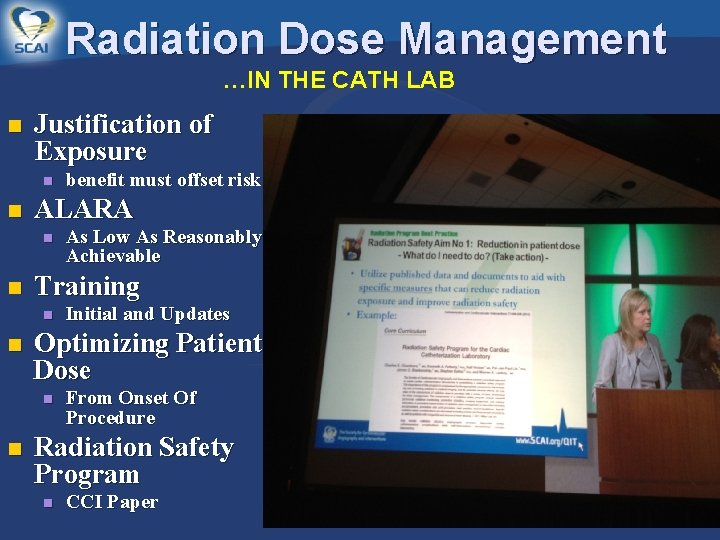
Radiation Dose Management …IN THE CATH LAB n Justification of Exposure n n ALARA n n Initial and Updates Optimizing Patient Dose n n As Low As Reasonably Achievable Training n n benefit must offset risk From Onset Of Procedure Radiation Safety Program n CCI Paper
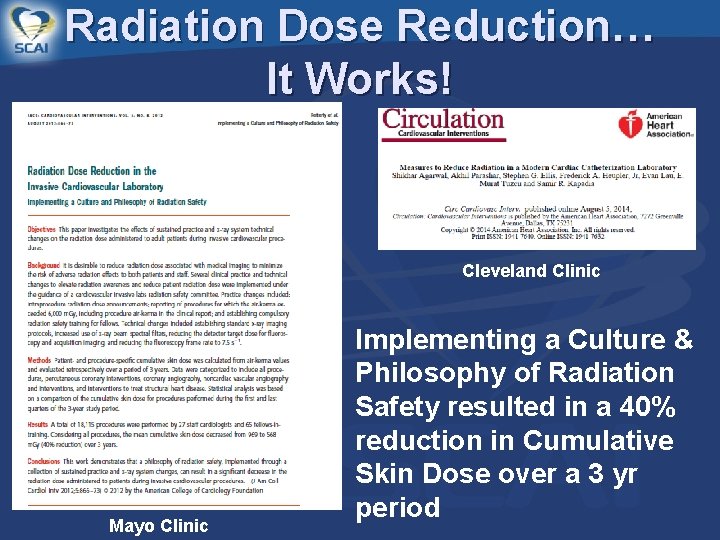
Radiation Dose Reduction… It Works! Cleveland Clinic Mayo Clinic Implementing a Culture & Philosophy of Radiation Safety resulted in a 40% reduction in Cumulative Skin Dose over a 3 yr period
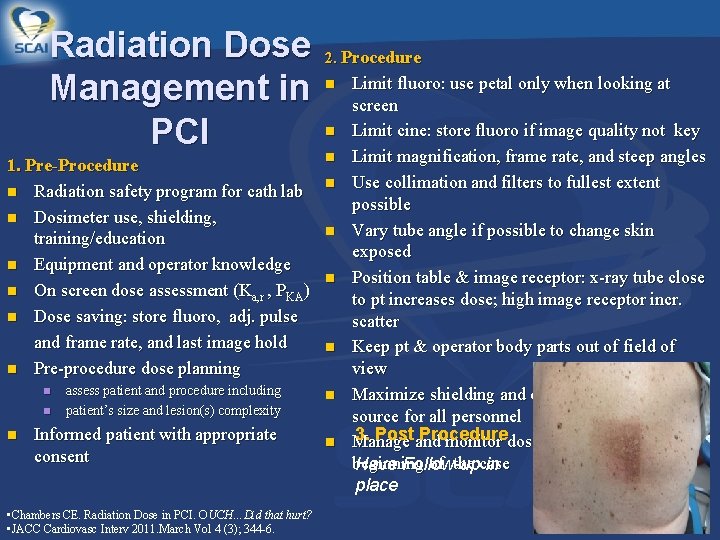
Radiation Dose Management in PCI 1. Pre-Procedure n Radiation safety program for cath lab n Dosimeter use, shielding, training/education n Equipment and operator knowledge n On screen dose assessment (Ka, r , PKA) n Dose saving: store fluoro, adj. pulse and frame rate, and last image hold n Pre-procedure dose planning n n n n assess patient and procedure including patient’s size and lesion(s) complexity n Informed patient with appropriate consent n n 2. Procedure • Chambers CE. Radiation Dose in PCI. OUCH…Did that hurt? • JACC Cardiovasc Interv 2011. March Vol 4 (3); 344 -6. Limit fluoro: use petal only when looking at screen Limit cine: store fluoro if image quality not key Limit magnification, frame rate, and steep angles Use collimation and filters to fullest extent possible Vary tube angle if possible to change skin exposed Position table & image receptor: x-ray tube close to pt increases dose; high image receptor incr. scatter Keep pt & operator body parts out of field of view Maximize shielding and distance from x-ray source for all personnel 3. Postand Procedure Manage monitor dose in real time from the beginning of the case Have Follow-up in place
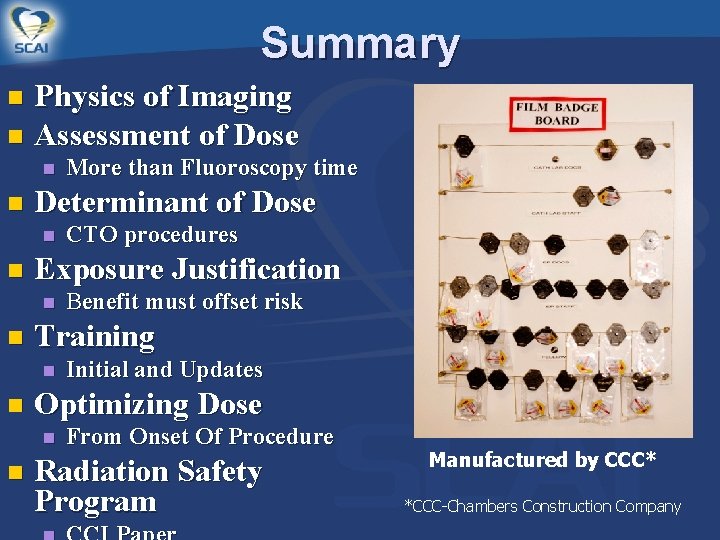
Summary Physics of Imaging n Assessment of Dose n n n Determinant of Dose n n Initial and Updates Optimizing Dose n n Benefit must offset risk Training n n CTO procedures Exposure Justification n n More than Fluoroscopy time From Onset Of Procedure Radiation Safety Program Manufactured by CCC* *CCC-Chambers Construction Company
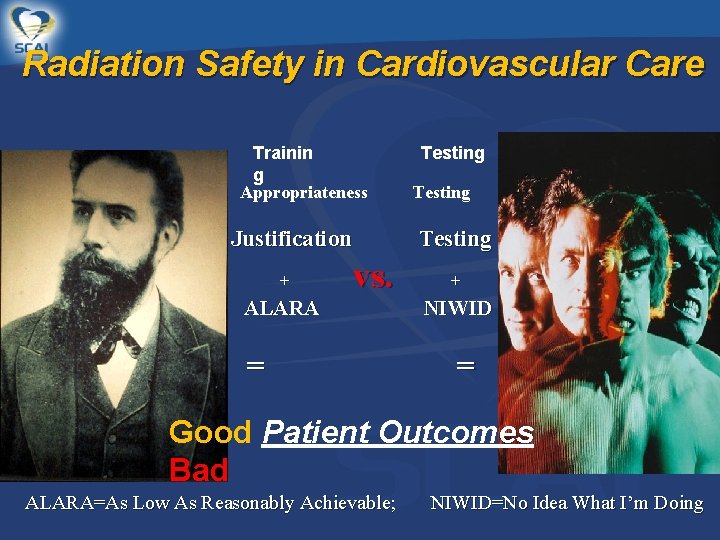
Radiation Safety in Cardiovascular Care Trainin g Appropriateness Justification + Testing vs. ALARA = Testing + NIWID = Good Patient Outcomes Bad ALARA=As Low As Reasonably Achievable; NIWID=No Idea What I’m Doing
- Slides: 34