
Minimally Invasive Instrumentation System MIIS HPM FieldTesting Application
- Slides: 18
Minimally Invasive Instrumentation System MIIS HPM Field-Testing Application August 2011 Dr. P. Parhami, SARA pparhami@sara. com January 2011 1
Purpose of Our Visit • Introduction to a new class of instrumentation system under development which can provide verification of HPM effects and M&S in operational environments – Minimally invasive – Massively parallel – ~10 X lower cost per parallel channel June 2011 2
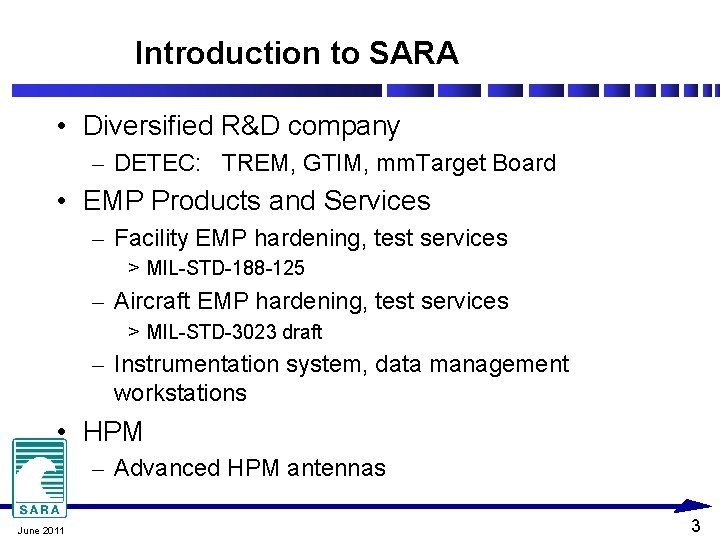
Introduction to SARA • Diversified R&D company – DETEC: TREM, GTIM, mm. Target Board • EMP Products and Services – Facility EMP hardening, test services > MIL-STD-188 -125 – Aircraft EMP hardening, test services > MIL-STD-3023 draft – Instrumentation system, data management workstations • HPM – Advanced HPM antennas June 2011 3
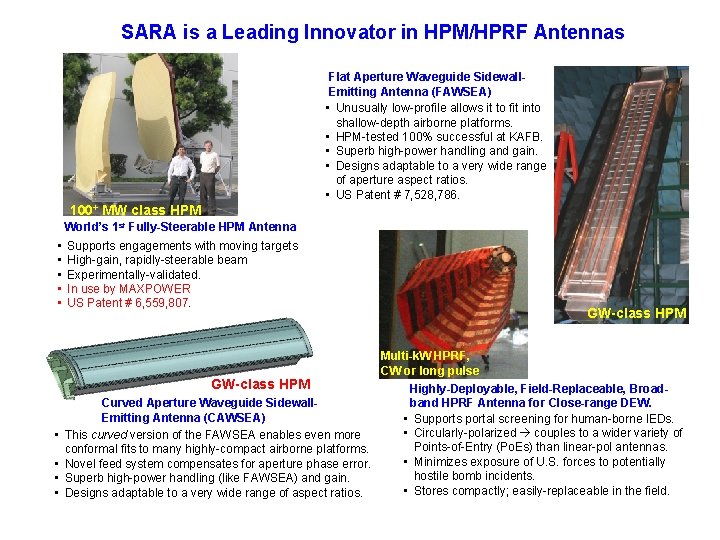
SARA is a Leading Innovator in HPM/HPRF Antennas Flat Aperture Waveguide Sidewall. Emitting Antenna (FAWSEA) • Unusually low-profile allows it to fit into shallow-depth airborne platforms. • HPM-tested 100% successful at KAFB. • Superb high-power handling and gain. • Designs adaptable to a very wide range of aperture aspect ratios. • US Patent # 7, 528, 786. 100+ MW class HPM World’s 1 st Fully-Steerable HPM Antenna • • • Supports engagements with moving targets High-gain, rapidly-steerable beam Experimentally-validated. In use by MAXPOWER US Patent # 6, 559, 807. GW-class HPM Multi-k. W HPRF, CW or long pulse GW-class HPM Highly-Deployable, Field-Replaceable, Broadband HPRF Antenna for Close-range DEW. Curved Aperture Waveguide Sidewall. Emitting Antenna (CAWSEA) • Supports portal screening for human-borne IEDs. • Circularly-polarized couples to a wider variety of • This curved version of the FAWSEA enables even more Points-of-Entry (Po. Es) than linear-pol antennas. conformal fits to many highly-compact airborne platforms. • Minimizes exposure of U. S. forces to potentially • Novel feed system compensates for aperture phase error. hostile bomb incidents. • Superb high-power handling (like FAWSEA) and gain. • Stores compactly; easily-replaceable in the field. • Designs adaptable to a very wide range of aspect ratios.
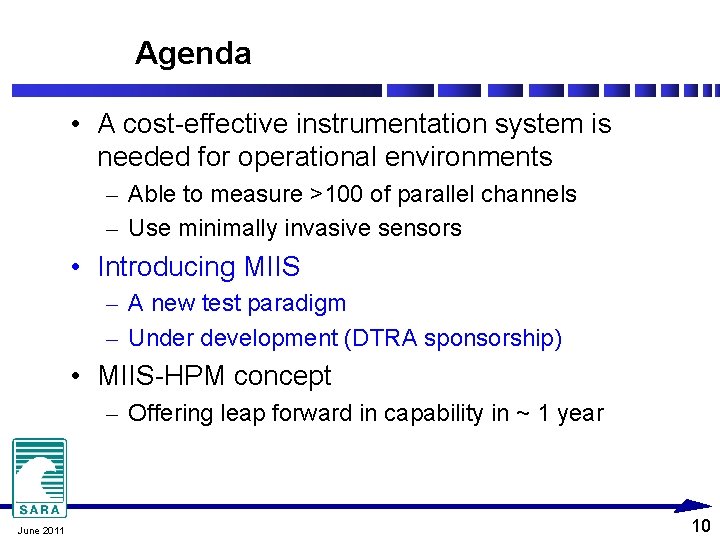
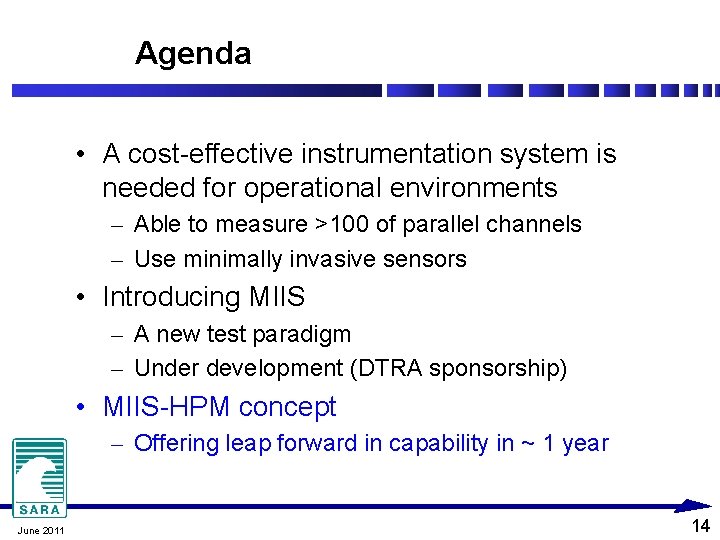
Agenda • A cost-effective instrumentation system is needed for operational environments – Able to measure >100 of parallel channels – Uses minimally invasive sensors • Introducing MIIS – A new test paradigm – Under development (DTRA sponsorship) • MIIS-HPM concept – Offering leap forward in capability in ~ 1 year June 2011 5
Need Better Understanding of HPM Coupling and Propagation • Need to accurately estimate HPM energy at target locations in operational environment – Minimally invasive (minimal perturbation) – Correlation to laboratory effects testing – Validate M&S codes • Candidate operational applications: – IED defeat: Impact of lossy and inhomogeneous ground on HPM beam pattern – Counter Electronics: HPM coupling to complex unhardened structures – Car stopping: HPM coupling to vehicle cables June 2011 6
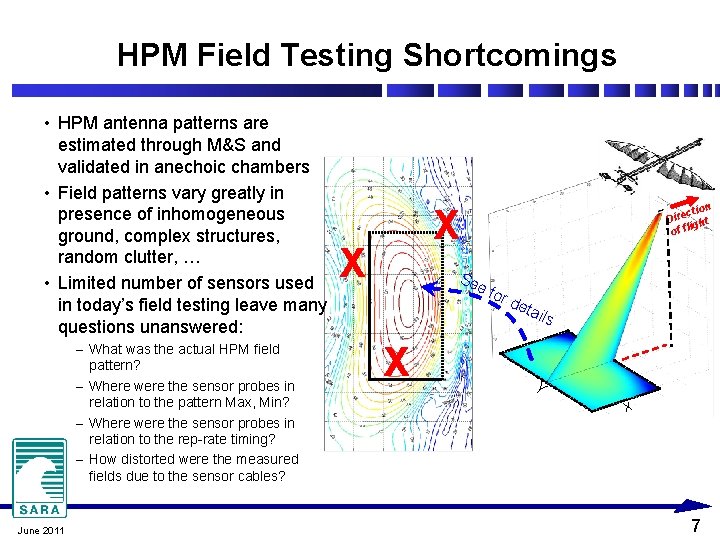
HPM Field Testing Shortcomings • HPM antenna patterns are estimated through M&S and validated in anechoic chambers • Field patterns vary greatly in presence of inhomogeneous ground, complex structures, random clutter, … • Limited number of sensors used in today’s field testing leave many questions unanswered: – What was the actual HPM field pattern? – Where were the sensor probes in relation to the pattern Max, Min? – Where were the sensor probes in relation to the rep-rate timing? – How distorted were the measured fields due to the sensor cables? June 2011 n ctio Dire ght li of f X X Se e fo X r de tail s Y X 7
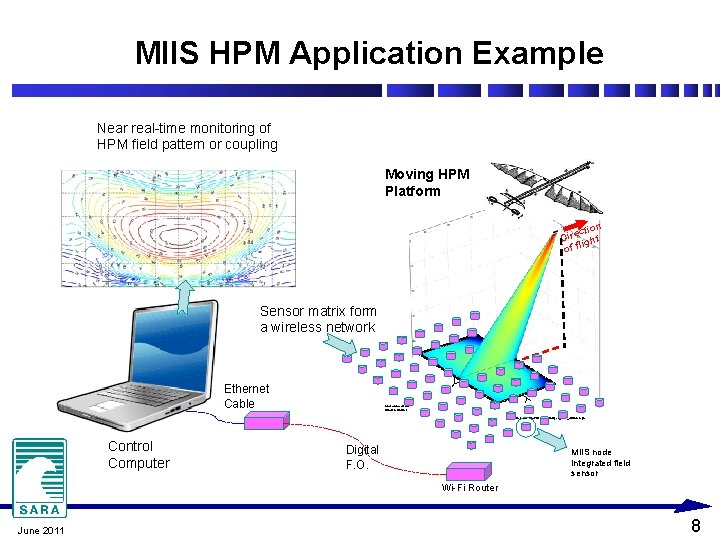
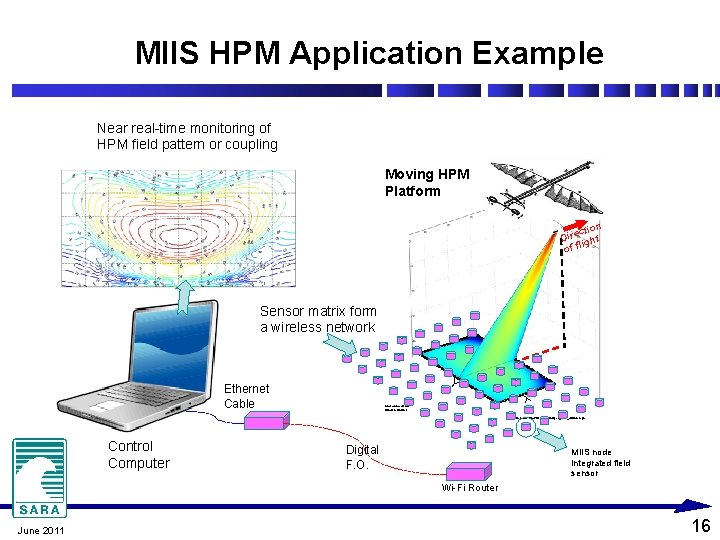
MIIS HPM Application Example Near real-time monitoring of HPM field pattern or coupling Moving HPM Platform n ctio Dire ght li of f Sensor matrix form a wireless network Y Ethernet Cable X Via balanced E&H Stratton-Chu A. I. From file: CAWSEA_groundspot_150 ft_altitude. mph Control Computer Digital F. O. MIIS node integrated field sensor Wi-Fi Router June 2011 8
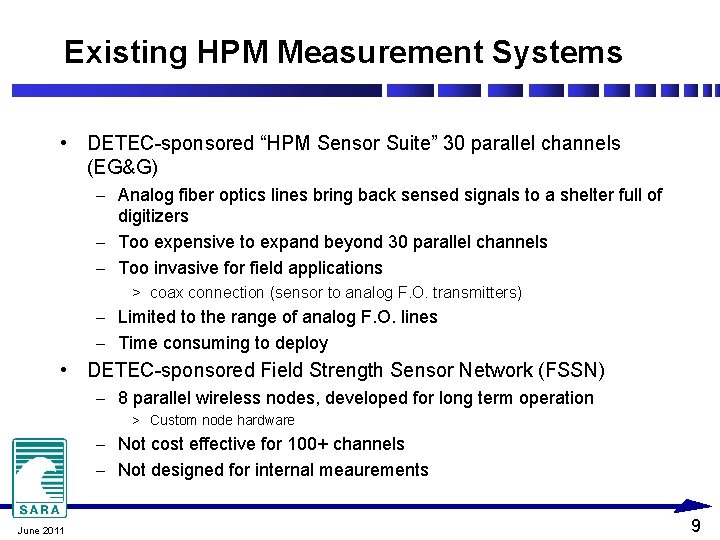
Existing HPM Measurement Systems • DETEC-sponsored “HPM Sensor Suite” 30 parallel channels (EG&G) – Analog fiber optics lines bring back sensed signals to a shelter full of digitizers – Too expensive to expand beyond 30 parallel channels – Too invasive for field applications > coax connection (sensor to analog F. O. transmitters) – Limited to the range of analog F. O. lines – Time consuming to deploy • DETEC-sponsored Field Strength Sensor Network (FSSN) – 8 parallel wireless nodes, developed for long term operation > Custom node hardware – Not cost effective for 100+ channels – Not designed for internal meaurements June 2011 9
Agenda • A cost-effective instrumentation system is needed for operational environments – Able to measure >100 of parallel channels – Use minimally invasive sensors • Introducing MIIS – A new test paradigm – Under development (DTRA sponsorship) • MIIS-HPM concept – Offering leap forward in capability in ~ 1 year June 2011 10
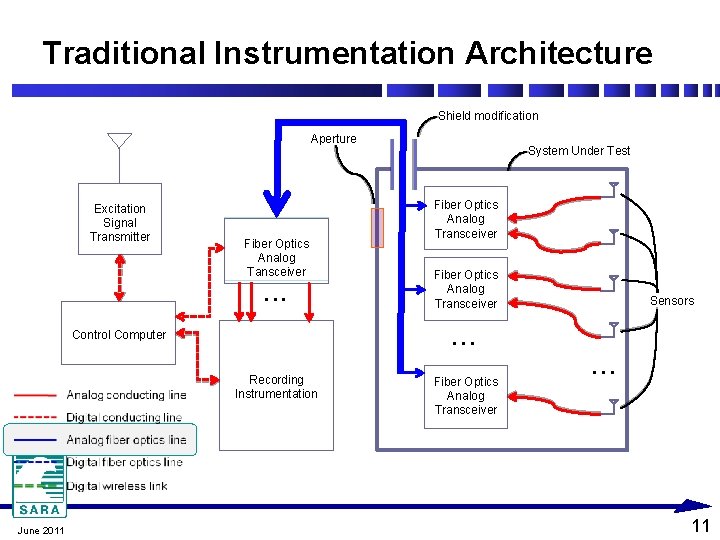
Traditional Instrumentation Architecture Shield modification Aperture Excitation Signal Transmitter Fiber Optics Analog Tansceiver • • • Control Computer Fiber Optics Analog Transceiver Sensors • • • Recording Instrumentation June 2011 System Under Test Fiber Optics Analog Transceiver • • • 11
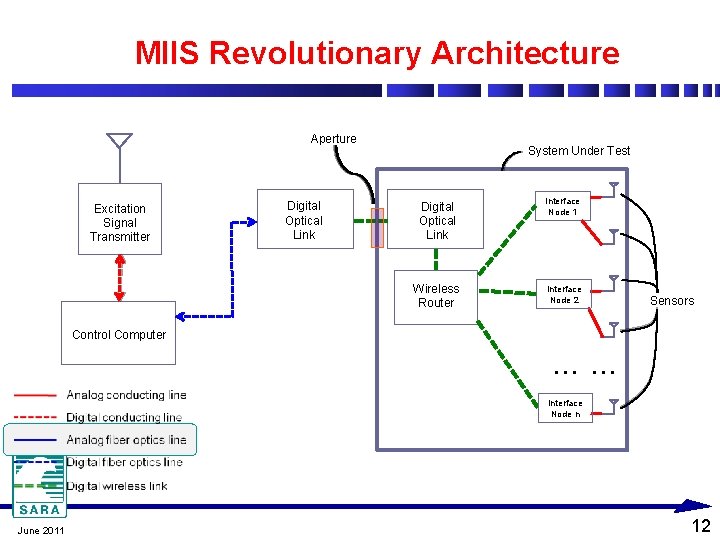
MIIS Revolutionary Architecture Aperture Excitation Signal Transmitter Digital Optical Link System Under Test Digital Optical Link Interface Node 1 Wireless Router Interface Node 2 Sensors Control Computer • • • Interface Node n June 2011 12
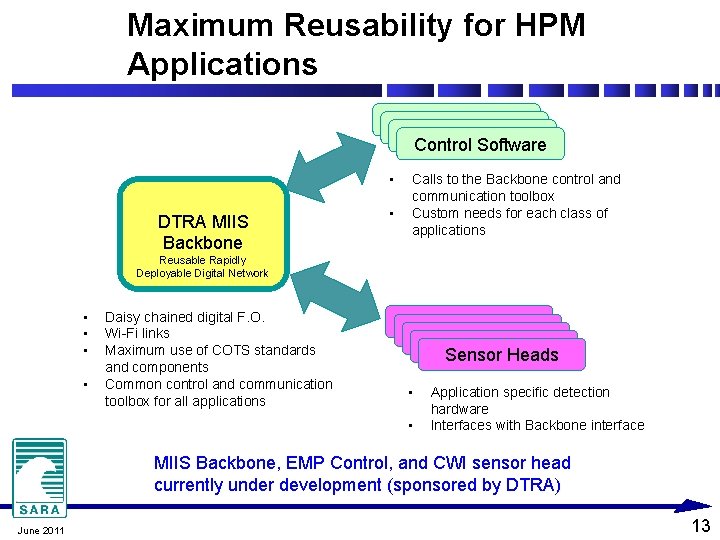
Maximum Reusability for HPM Applications Control Software • DTRA MIIS Backbone • Calls to the Backbone control and communication toolbox Custom needs for each class of applications Reusable Rapidly Deployable Digital Network • • Daisy chained digital F. O. Wi-Fi links Maximum use of COTS standards and components Common control and communication toolbox for all applications Sensor Heads Sensor Heads • • Application specific detection hardware Interfaces with Backbone interface MIIS Backbone, EMP Control, and CWI sensor head currently under development (sponsored by DTRA) June 2011 13
Agenda • A cost-effective instrumentation system is needed for operational environments – Able to measure >100 of parallel channels – Use minimally invasive sensors • Introducing MIIS – A new test paradigm – Under development (DTRA sponsorship) • MIIS-HPM concept – Offering leap forward in capability in ~ 1 year June 2011 14
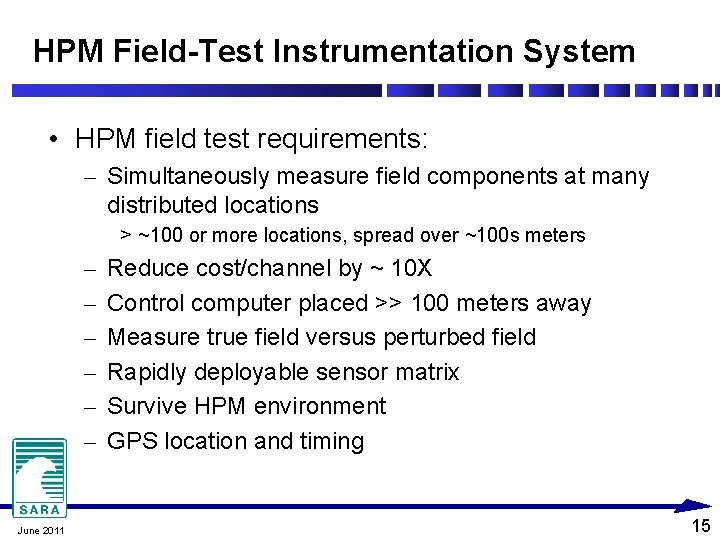
HPM Field-Test Instrumentation System • HPM field test requirements: – Simultaneously measure field components at many distributed locations > ~100 or more locations, spread over ~100 s meters – – – June 2011 Reduce cost/channel by ~ 10 X Control computer placed >> 100 meters away Measure true field versus perturbed field Rapidly deployable sensor matrix Survive HPM environment GPS location and timing 15
MIIS HPM Application Example Near real-time monitoring of HPM field pattern or coupling Moving HPM Platform n ctio Dire ght li of f Sensor matrix form a wireless network Y Ethernet Cable X Via balanced E&H Stratton-Chu A. I. From file: CAWSEA_groundspot_150 ft_altitude. mph Control Computer Digital F. O. MIIS node integrated field sensor Wi-Fi Router June 2011 16
HPM Sensor Interface Node Concept SARA IR&D • Sensor node control processor: – – – Low Power Microprocessor Multi-channel A/D 16+ GB or more static memory Wireless and digital F. O. Comm Interface with third party current probes Size of a deck a cards! • Sensor node with integrated 3 -axis field sensor: – Narrowband HPM envelop – Wideband HPM waveform June 2011 17
Summary/Feedback • HPM Laboratory Effects data and M&S results need to be validated in operational environments – Radiating over lossy & inhomogeneous ground – Coupling to complex structures • MIIS an important piece of the puzzle! – – – June 2011 Economical (10 X savings/channel) Massively parallel Minimally invasive, minimally intrusive Digital backbone and EMP application under development HPM sensor prototypes under development (SARA IR&D) > Uses the identical digital backbone 18