
MINILESSON PROOFREADING FOR SPELLING To check your spelling
- Slides: 5
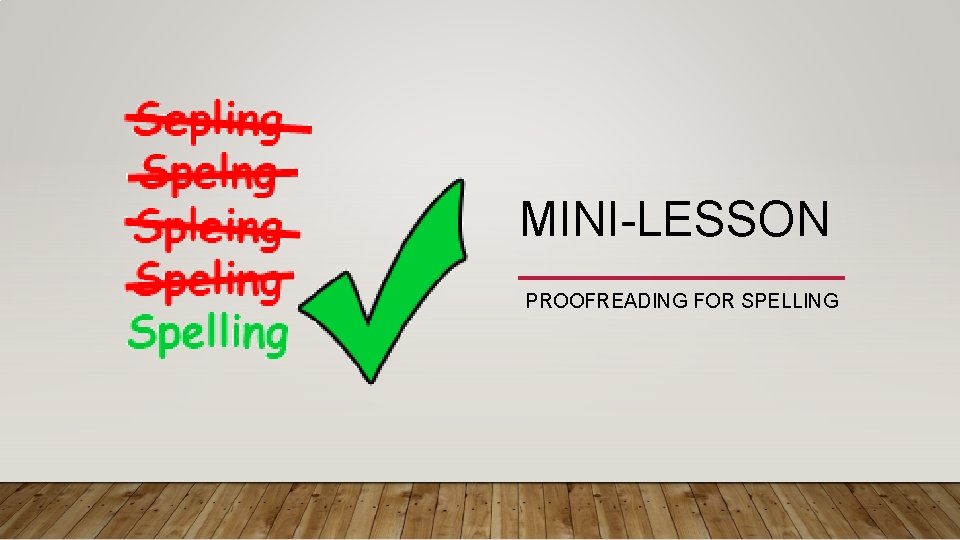
MINI-LESSON PROOFREADING FOR SPELLING
• To check your spelling you must slow down, focus on a single word at a time, and ask of each word, "Am I absolutely certain that this is the correct spelling? "
TECHNIQUES TO CHECK SPELLING • Circle each and every word you’re not absolutely, 100 percent certain of. Then go back and look up the spellings of the circled words. The dictionary or spellchecker should only come into play once you’ve identified every potential misspelling. • Scan each line of text backward, from right to left. Don’t allow your eyes to chunk text and attend to meaning. Instead, focus on one word and its spelling at a time. • Slow down on common homonyms (your and you’re; to, too, and two; its and it’s; their, there, and they’re) and other homonym-type confusions (college and collage, effect and affect, chose and choose, lead and led, than and then, etc. ).
MORE TECHNIQUES • Slow down on words you’ve confused in the past or continue to struggle with. Give these words particular attention: necessary, recommend, separate, a lot, all right, definitely, judgment, truly, restaurant, eighth, twelfth, etc. • Slow down on words with tricky prefixes and suffixes: • unnecessary, disappoint, disappear, granddaughter, occurred, writing, written, traveled, beginning, and finally • absolutely, ninety, forty, lonely, and believable
MORE TECHNIQUES • Slow down on plural nouns. Ask yourself: Is that word with an s at the end of it a possessive noun, requiring an apostrophe-s (for example, “I borrowed my brother’s CD”)? • Use the available sources to help you check for correct spellings. These include a college dictionary, a good speller in the class, a master list of frequently misspelled words, the computer spellchecker, and your personal spelling list. • After you’ve finished proofreading and editing for spelling, ask a good speller to recheck your text for misspellings if it’s handwritten, or use the computer spellchecker if the piece is word-processed.