
MiniClinical Evaluation Exercise MiniCEX Dr Jatin G Bhatt
Mini-Clinical Evaluation Exercise (Mini-CEX) Dr. Jatin G. Bhatt Professor & Head Dept. of Surgery PDUMC Rajkot 1
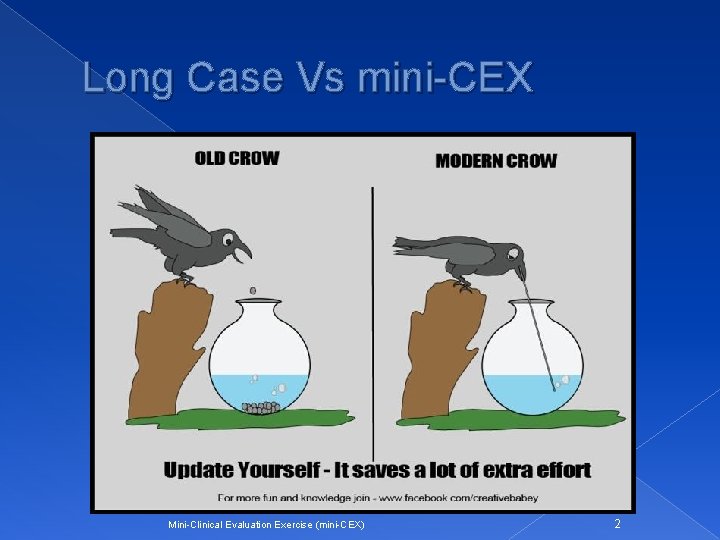
Long Case Vs mini-CEX Mini-Clinical Evaluation Exercise (mini-CEX) 2

Objectives Participants will be able to � Analyze reliability and validity of long case in assessing clinical skills � Describe how mini-CEX works � Define nine domains of scoring in mini-CEX � Incorporate mini-CEX in formative assessment in their settings Mini-Clinical Evaluation Exercise (mini-CEX) 3
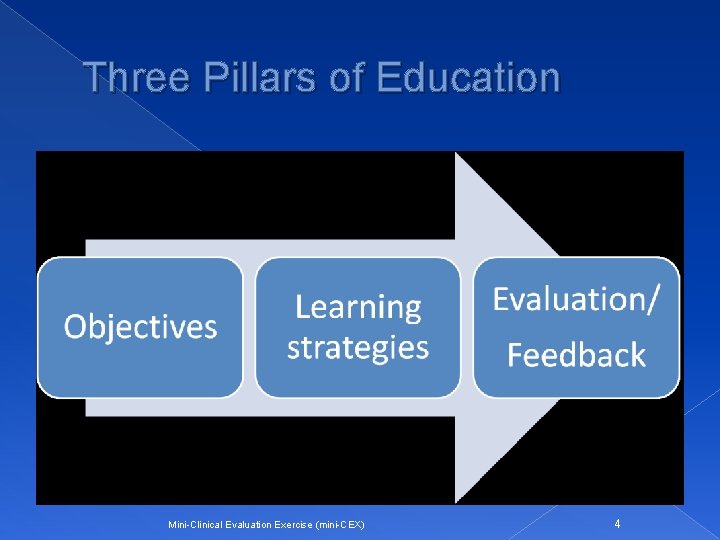
Three Pillars of Education Mini-Clinical Evaluation Exercise (mini-CEX) 4
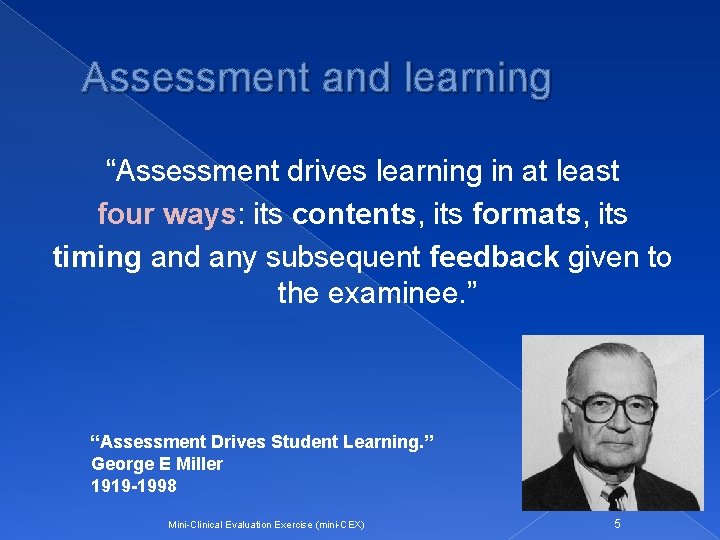
Assessment and learning “Assessment drives learning in at least four ways: its contents, its formats, its timing and any subsequent feedback given to the examinee. ” “Assessment Drives Student Learning. ” George E Miller 1919 -1998 Mini-Clinical Evaluation Exercise (mini-CEX) 5
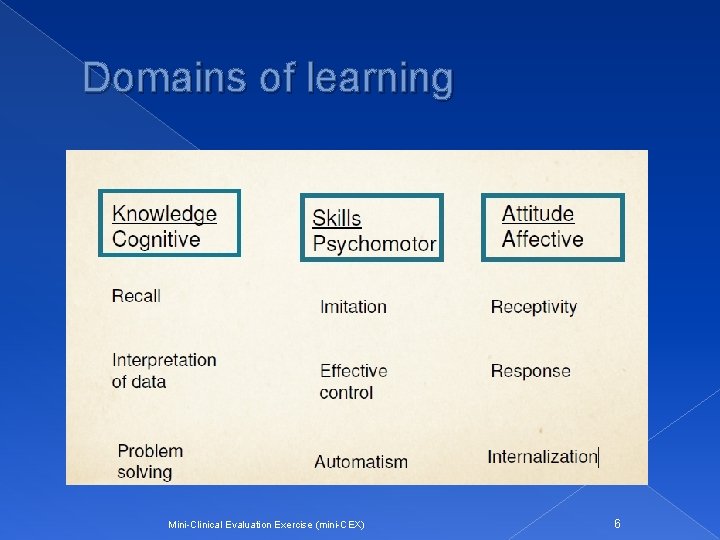
Domains of learning Mini-Clinical Evaluation Exercise (mini-CEX) 6
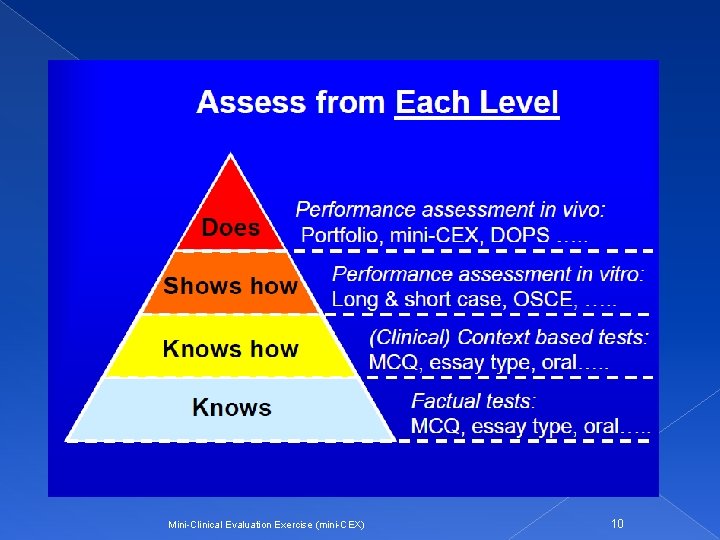
Clinical Assessment � Knowledge and performance are not separable. � Students need knowledge to perform. � We can’t do it if you don’t know how to do it. � For assessment of clinical competency, we need both knowledge (cognition) and performance measures. � Knowledge measurement should not replace the performance measurement and performance measurement should not replace knowledge measurement. Mini-Clinical Evaluation Exercise (mini-CEX) 7
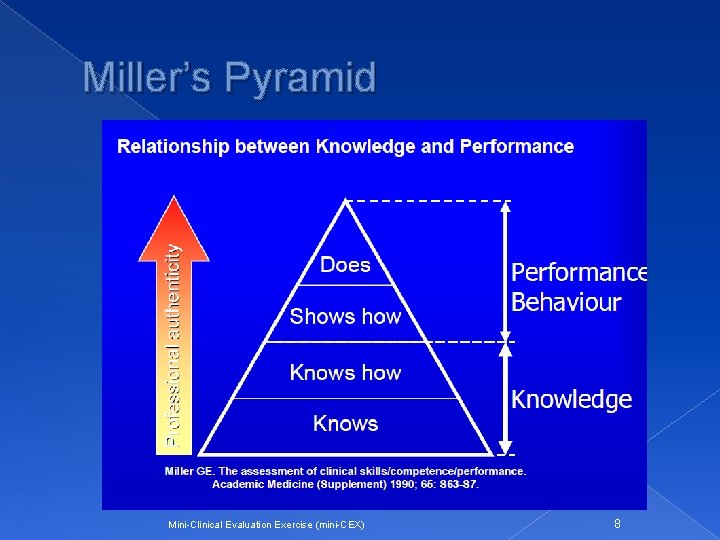
Miller’s Pyramid Mini-Clinical Evaluation Exercise (mini-CEX) 8
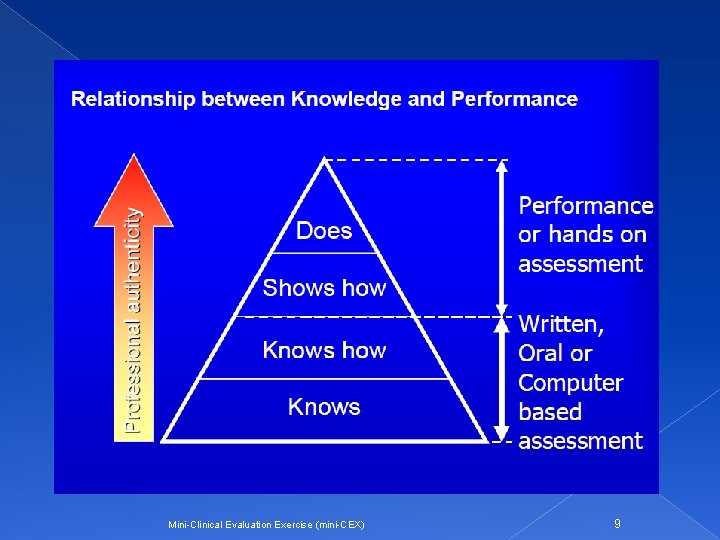
Mini-Clinical Evaluation Exercise (mini-CEX) 9
Mini-Clinical Evaluation Exercise (mini-CEX) 10
Mini-Clinical Evaluation Exercise (mini-CEX) 11

Mini-Clinical Evaluation Exercise (mini-CEX) 12
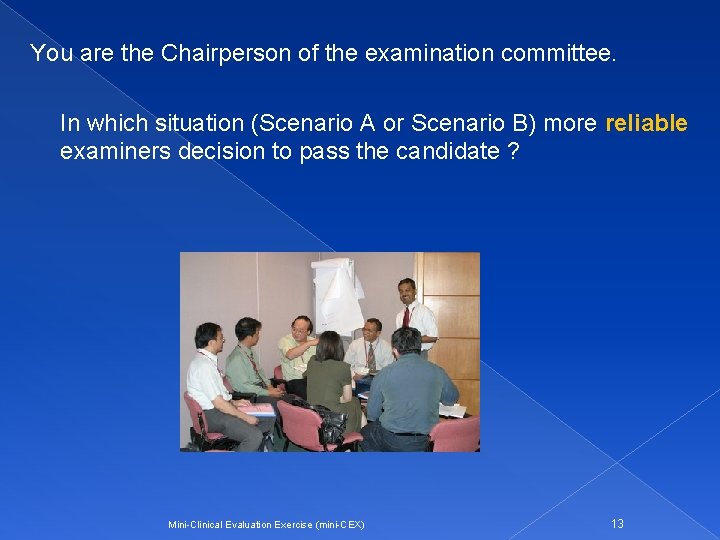
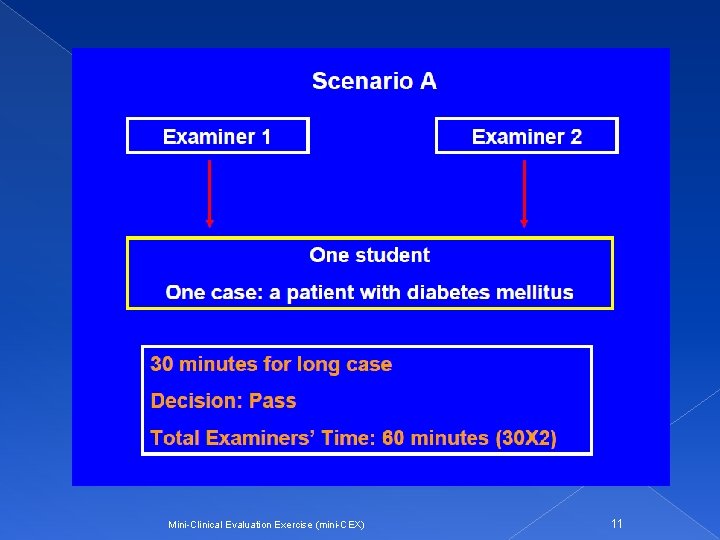
You are the Chairperson of the examination committee. In which situation (Scenario A or Scenario B) more reliable examiners decision to pass the candidate ? Mini-Clinical Evaluation Exercise (mini-CEX) 13
Long Case Vs mini-CXE � In depth assessment of clinical competence in setting uninfluenced by time constraints � Limitations � Unstructured � Subjective � Limited observations of clinical skills � Narrow sampling of contents � Each student gets different case � Case specific Mini-Clinical Evaluation Exercise (mini-CEX) 14
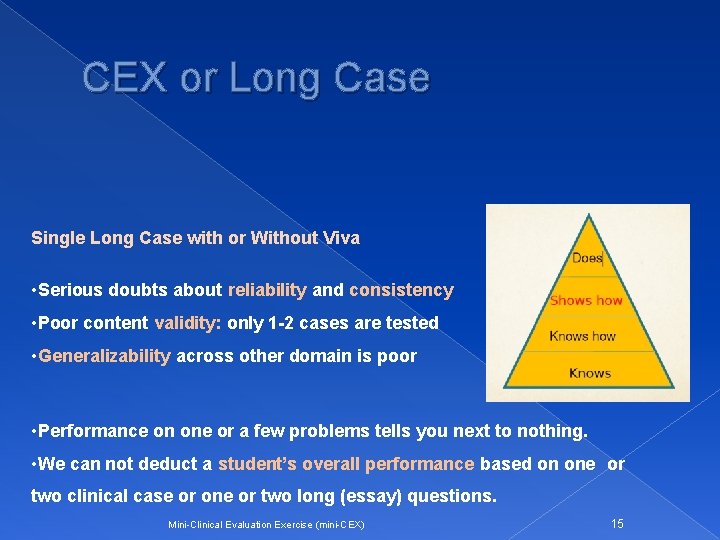
CEX or Long Case Single Long Case with or Without Viva • Serious doubts about reliability and consistency • Poor content validity: only 1 -2 cases are tested • Generalizability across other domain is poor • Performance on one or a few problems tells you next to nothing. • We can not deduct a student’s overall performance based on one or two clinical case or one or two long (essay) questions. Mini-Clinical Evaluation Exercise (mini-CEX) 15
Long Case Vs mini-CXE The only solution is multiple samples � Questions � Cases � Problems � Examiners, etc � Any single/limited item based test will be faulty regardless of efforts that are put into development. Mini-Clinical Evaluation Exercise (mini-CEX) 16
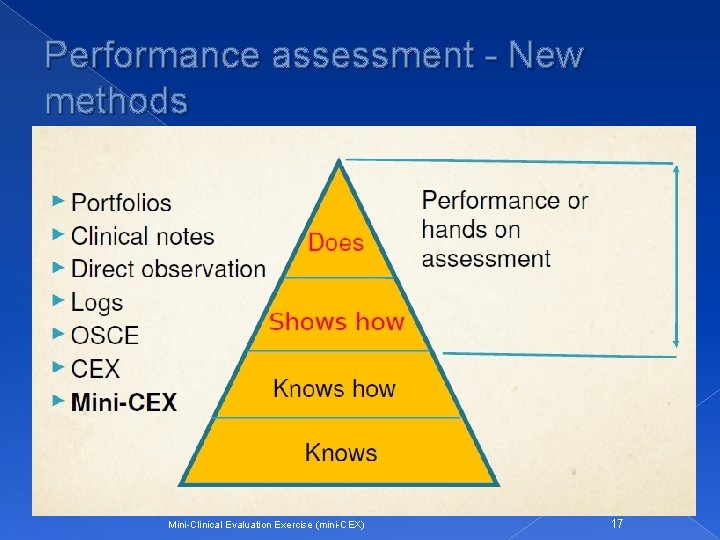
Performance assessment - New methods � � � � Portfolios Clinical notes Direct observation Logs OSCE CEX Mini-Clinical Evaluation Exercise (mini-CEX) 17

Mini-CXE As trainees approach entry to practice their education and assessment needs to be based on real patients. Mini-Clinical Evaluation Exercise (mini-CEX) 18
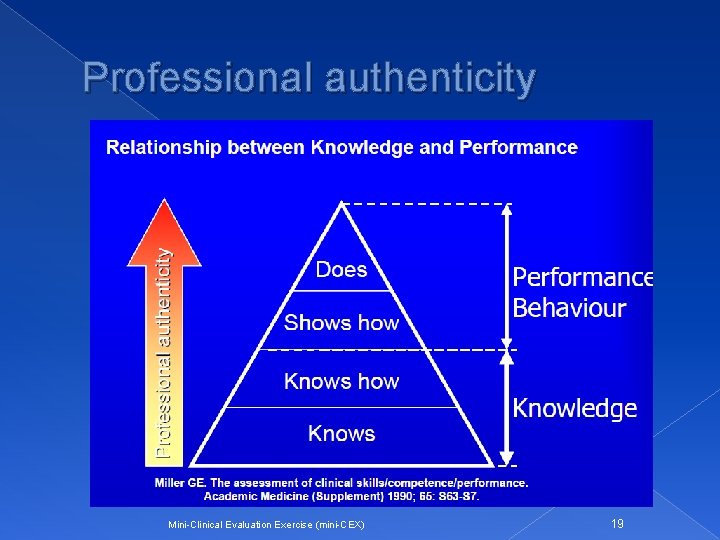
Professional authenticity Mini-Clinical Evaluation Exercise (mini-CEX) 19
New: Performance Based assessment � � � Mini CEX Direct Observation of Procedural skills (DOPS) Procedure Based Assessment (PBA) Case-based Discussion (CBD) Multiple source feedback Mini-Clinical Evaluation Exercise (mini-CEX) 20
mini-CEX: Description Examiner /Assessor observes a trainee with a patient in any setting: OPD, IPD, A & E � Trainee performs a focused task � Examiner/Assessor rates along several dimensions on a form � Feedback � Takes 15 -20 minutes, feedback 5 -7 min � Multiple encounters expected � Intended to be short and routine � Mini-Clinical Evaluation Exercise (mini-CEX) 21
mini-CXE � Primary purpose is to provide structured teaching and feedback � Focuses on formative assessment of clinical skills � Responds to assessment problems of traditional CEX � Responds to educational problems of workplace � Requires observation and feedback Mini-Clinical Evaluation Exercise (mini-CEX) 22
Role Play A second year resident undergoing mini CEX session in OPD setting. A Case of Multi-nodular Thyroid Swelling Mini-Clinical Evaluation Exercise (mini-CEX) 23

mini-CEX form: 1. Medical Interviewing Skills/History Taking: � Facilitates patient’s telling of story � Effectively uses questions/directions � to obtain accurate, adequate information needed � responds appropriately to affect, non-verbal clues Mini-Clinical Evaluation Exercise (mini-CEX) 24

mini-CEX form: 2. Physical Examination Skills: � Follows efficient, logical sequence � balances screening/diagnostic steps for problem � informs patient � sensitive to patient’s comfort, modesty Mini-Clinical Evaluation Exercise (mini-CEX) 25

mini-CEX form: 3. Humanistic Qualities/Professionalism: � Shows respect � compassion � empathy � establishes trust � attends to patient’s needs of comfort, modesty, confidentiality, information. Mini-Clinical Evaluation Exercise (mini-CEX) 26
mini-CEX form 4. Clinical Judgment: � Selectively orders/performs appropriate diagnostic studies � considers risks benefits Mini-Clinical Evaluation Exercise (mini-CEX) 27

mini-CEX Form 5. Counselling Skills: � Explains rationale for test/treatment � obtains patient’s consent � educates/counsels regarding management Mini-Clinical Evaluation Exercise (mini-CEX) 28

mini-CEX Form 6. Organization/Efficiency: � Prioritizes � is timely � Succinct (expressed in few words) Mini-Clinical Evaluation Exercise (mini-CEX) 29

mini-CEX Form 7. Overall Clinical Competence: � Demonstrates judgment � Synthesis � Caring � Effectiveness � efficiency Mini-Clinical Evaluation Exercise (mini-CEX) 30

Evaluation Form Mini-Clinical Evaluation Exercise (mini-CEX) 31
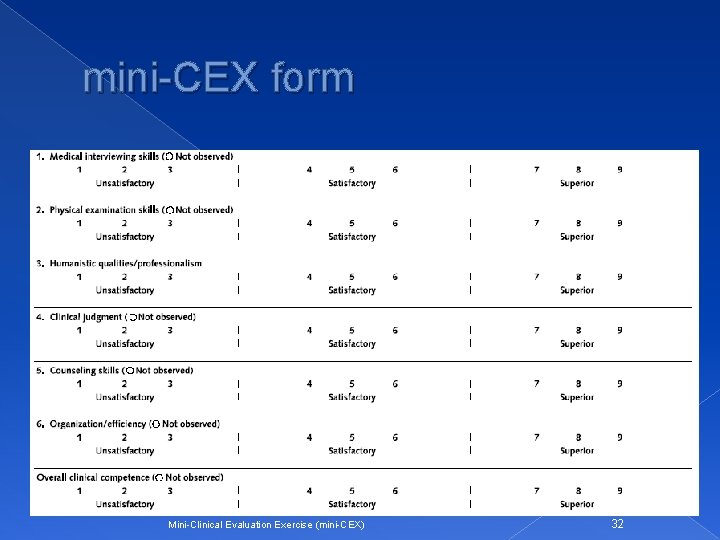
mini-CEX form Mini-Clinical Evaluation Exercise (mini-CEX) 32

mini-CEX form Mini-Clinical Evaluation Exercise (mini-CEX) 33

Mini-CEX � Assess to focus and prioritize diagnosis and management of real clinical practice. � More reliable � Assess in a broader range � More opportunity for observation and feedback. Mini-Clinical Evaluation Exercise (mini-CEX) 34
General Tips � Assessment should be designed prospectively and methodically with the purpose in mind. � Multiple assessment instruments targeting all levels in Miller’s pyramid are necessary to capture reasonable breadth of competency. � Compromise is inevitable, but it should be based on sound judgment. � Students need to be tested with multiple cases and scenarios to achieve an acceptable degree of reliability. Mini-Clinical Evaluation Exercise (mini-CEX) 35
Tips…. . Consider characteristics of the method: � Relative validity � Relative Reliability � Relative Educational Impact � Relative Practicality � View assessment of competency as a whole rather than only function of knowledge or performance. Mini-Clinical Evaluation Exercise (mini-CEX) 36
Four Cardinal Principles in Assessment in Medical Education � Principle One: A sound knowledge base that is contextual is essential in clinical setting � Principle Two: Knowledge and performance are not separable. We need to assess both � Principle Three: There is no generic problem solving skills. We need to assess students across multiple domains � Principle Four: Mastery of knowledge is not an “all or none” phenomenon Mini-Clinical Evaluation Exercise (mini-CEX) 37

Mini-Clinical Evaluation Exercise (mini-CEX) 38
Thanks The work of a teacher. . . exhausting, complex, idiosyncratic, never twice the same. . . is at its heart, an intellectual and ethical enterprise. Teaching begins in challenge and is never far from mystery. William Ayres Mini-Clinical Evaluation Exercise (mini-CEX) 39
- Slides: 39