
Miniature Wall Climbing Robot Autonomous microrobots equipped with
Miniature Wall Climbing Robot
• Autonomous microrobots, equipped with smart sensors, actuators and energy scavenging devices • are expected to use new walking, rolling, climbing, jumping and flying technique • In areas such as biomedical, aerospace, environmental and military systems, walking or climbing autonomous robots are needed.
• It is necessary to design a small mechanical system to move on flat and vertical surfaces, to collect data and make decisions in different situations • Recently, a smart robot foot based on suction cups and monitoring devices was reported, which has been used in wall-climbing robots.

• capable of climbing smooth walls. • However, the stainless steel body parts of these wall climbers were relatively heavy and, consequently, a tether was used in most cases of testing. • Micro And Nano Technology Laboratory, Department of Electrical and Computer Engineering, Michigan State University
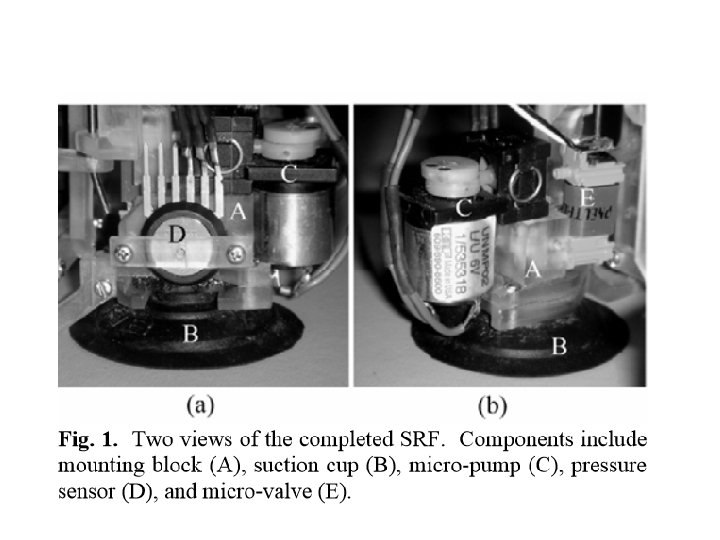
• Uses lighter body materials and different walking/climbing mechanisms • Substantially improved smart robotic feet (SRF) • This new robot is faster, lighter and smaller than earlier robots. • The new SRF is equipped with a 40 mm diameter suction cup, a vacuum pump, a pressure sensor and a micro-valve.

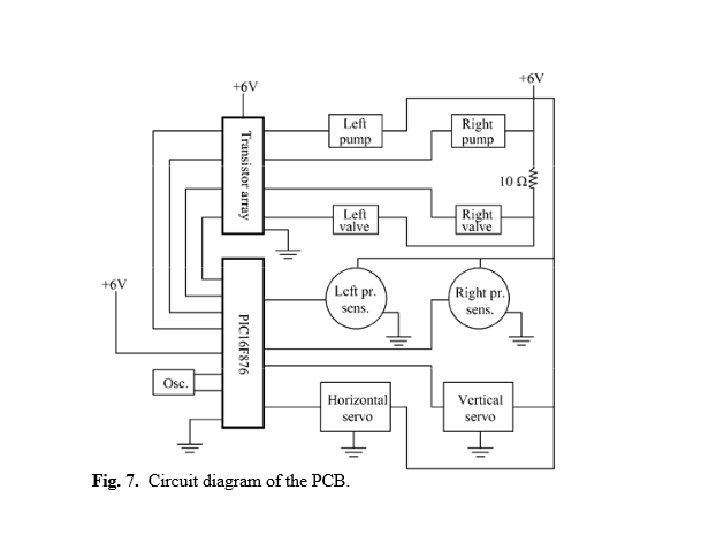
• The entire system operates by control of a single programmable microcontroller, • can be powered by a 6 -volt thin cell lithium battery pack mounted onboard, making the robot totally autonomous. • The robot has the potential to serve as a base on which to mount data acquisition devices, surveillance equipment, or objectmanipulation tools
• A suction cup with a 40 mm diameter base is secured in a clamp assembly attached to the underside of the mounting block, creating an airtight seal. • A diaphragm-type micro-pump measuring only 27. 1 mm × 16. 9 mm × 28 mm is attached to the top of the mounting block, and provides suction in the cup
• The robotic frame is primarily made from machined polycarbonate plastic. • Polycarbonate exhibits exceptional strength, thermal and electrical properties, and is light weight. • The frame’s components are joined with various lengths of stainless steel machine screws, and their kinematics enables various walking motions of the robot. • Two Hitec HS-311 servo motors drive the robot’s movements • These are light weight and provide high torque, and precise angular positioning capability
• One servo (Servo 1) controls the motion of the legs in a vertical plane • Other servo (Servo 2) controls their motion in a horizontal plane. • This was found to be the most convenient setup because it enabled both the height and length of each step to be independently controlled. • When standing upright, the robot is 108 mm high, 106 mm wide, and 101 mm long
• In addition to walking forward, this robot is designed to transit between two perpendicular surfaces • e. g. from a floor to a vertical wall - by employing a special kinematic mechanism located on each leg assembly
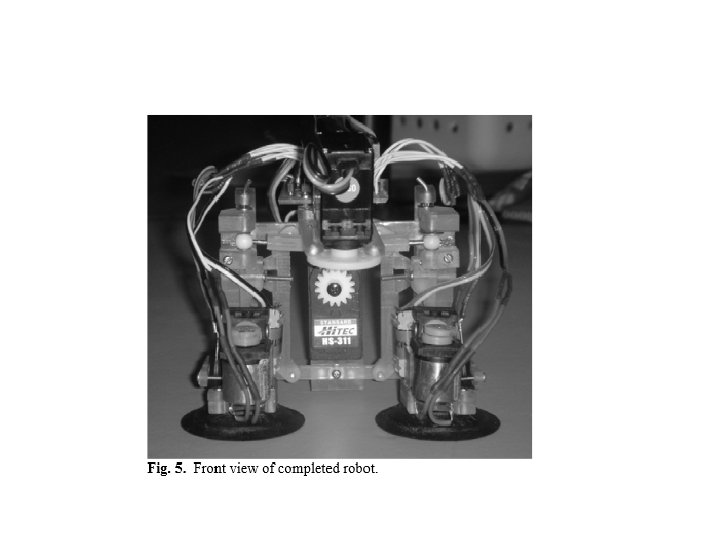
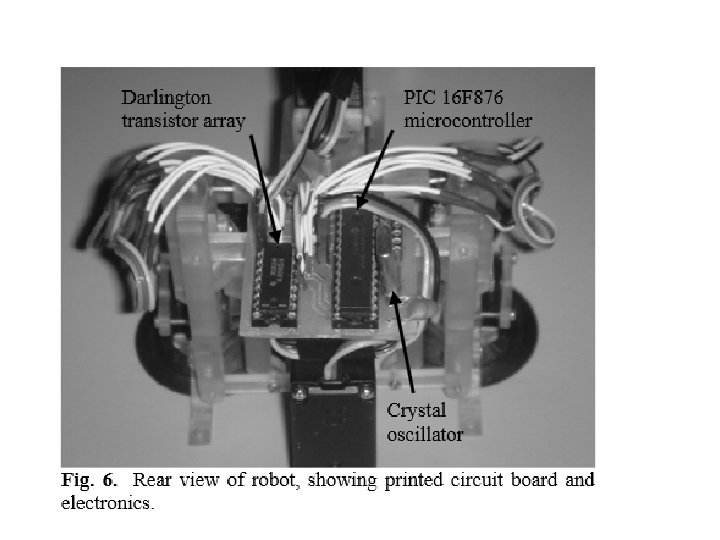
• The robot (Fig. 5) was designed such that both servo motors and both SRFs can be controlled by a single, central circuit board. • This configuration was chosen to minimize the number of electronic components, reduce the total weight of the control system, and to make the overall design more compact. • The controller and associated electronic components are mounted on a printed circuit board attached to the Top Link behind Servo 2, as shown in Fig. 6.
• A recurrent problem when running the robot was the deformation of the polycarbonate frame as it moved. • Due to the complexity of the frame design, space tolerances in the multiple joints connecting the members tended to magnify the deformations. • Ideally, the robot should be able to walk without the aid of braces mounted behind the suction cups. • In the finished robot, however, these braces were found to be necessary, and they improved the robot’s walking capability on horizontal and inclined surfaces.
• When ascending a near-vertical wall, the moment caused by the weight of the body created deformations in the frame that prevented the cups from squarely contacting the wall and creating suction. • Another significant issue noted was the deformations of the suction cups themselves when supporting the robot’s weight. • One possible remedy for this is to add small braces around the perimeter of the suction cups similar to the guard added to the back of each SRF. • This would help hold the standing leg perpendicular to the surface, as well as guide the lowering foot squarely by preventing the cup’s edge from catching the surface prematurely.
• In the future, a touch, light, or other suitable sensor will be added to the front of the robot to detect the presence of a perpendicular wall. • Eventually, a CMOS camera may be mounted on the body to monitor the robot’s surroundings, including surface features, texture, or obstacles.
- Slides: 18