
Mini Introduction to Normal Form with 5 D
- Slides: 3
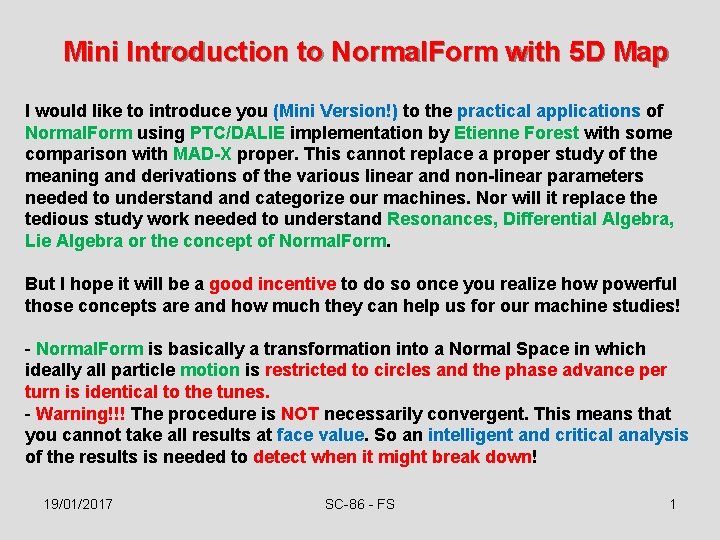
Mini Introduction to Normal. Form with 5 D Map I would like to introduce you (Mini Version!) to the practical applications of Normal. Form using PTC/DALIE implementation by Etienne Forest with some comparison with MAD-X proper. This cannot replace a proper study of the meaning and derivations of the various linear and non-linear parameters needed to understand categorize our machines. Nor will it replace the tedious study work needed to understand Resonances, Differential Algebra, Lie Algebra or the concept of Normal. Form. But I hope it will be a good incentive to do so once you realize how powerful those concepts are and how much they can help us for our machine studies! - Normal. Form is basically a transformation into a Normal Space in which ideally all particle motion is restricted to circles and the phase advance per turn is identical to the tunes. - Warning!!! The procedure is NOT necessarily convergent. This means that you cannot take all results at face value. So an intelligent and critical analysis of the results is needed to detect when it might break down! 19/01/2017 SC-86 - FS 1
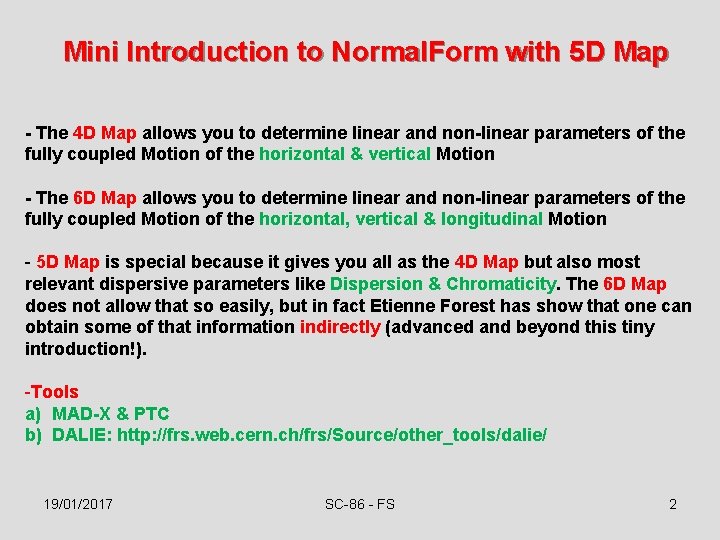
Mini Introduction to Normal. Form with 5 D Map - The 4 D Map allows you to determine linear and non-linear parameters of the fully coupled Motion of the horizontal & vertical Motion - The 6 D Map allows you to determine linear and non-linear parameters of the fully coupled Motion of the horizontal, vertical & longitudinal Motion - 5 D Map is special because it gives you all as the 4 D Map but also most relevant dispersive parameters like Dispersion & Chromaticity. The 6 D Map does not allow that so easily, but in fact Etienne Forest has show that one can obtain some of that information indirectly (advanced and beyond this tiny introduction!). -Tools a) MAD-X & PTC b) DALIE: http: //frs. web. cern. ch/frs/Source/other_tools/dalie/ 19/01/2017 SC-86 - FS 2
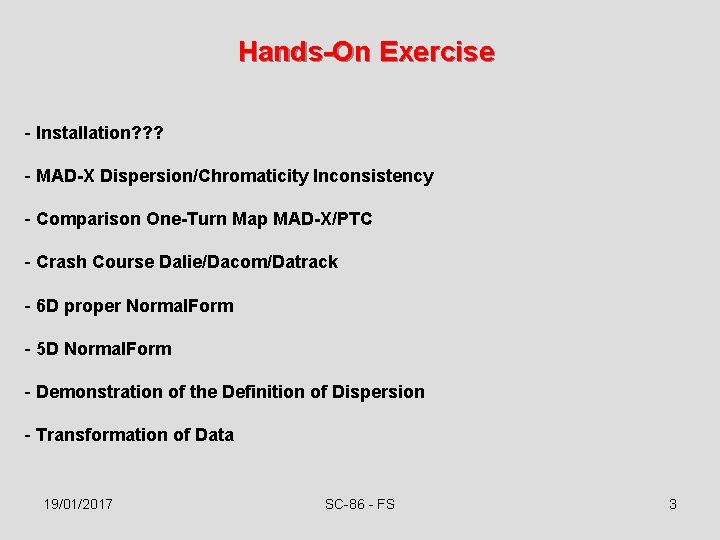
Hands-On Exercise - Installation? ? ? - MAD-X Dispersion/Chromaticity Inconsistency - Comparison One-Turn Map MAD-X/PTC - Crash Course Dalie/Dacom/Datrack - 6 D proper Normal. Form - 5 D Normal. Form - Demonstration of the Definition of Dispersion - Transformation of Data 19/01/2017 SC-86 - FS 3